The Disappearers Summary, Characters and Themes
The Disappearers by Marlon James is a powerful work of literary fiction examining sexuality, violence, identity, and survival in Jamaica during a period of widespread hostility toward homosexuality. Beginning in Kingston in 1988, the novel follows a group of young men whose participation in a theater production exposes them to devastating violence.
Across seventeen years, their lives develop in radically different directions as they confront trauma, disappearance, revenge, and the possibility of personal freedom. Through shifting perspectives, intimate recollections, and disturbing revelations, James examines how prejudice shapes individual lives and how people struggle to recover their identities after experiencing cruelty and social rejection.
Summary
In May 1988, eighteen-year-old Edmond “Eddy” Porteous lives in Kingston, Jamaica, where he struggles to understand his sexuality while navigating a society that treats homosexuality with hostility and suspicion. Recording his experiences in a diary, Eddy reveals his feelings of isolation, his difficult memories of school, and his uncertainty about what adulthood might offer him.
Hoping to escape the emotional limitations of his earlier life, Eddy auditions for a theatrical production of John Herbert’s Fortune and Men’s Eyes, directed by Havelock Titus. The play explores imprisonment, sexual violence, masculinity, and the persecution of homosexual men, subjects that gradually acquire personal significance for everyone participating in the production.
During rehearsals, Eddy meets Jordan Brown, Matt Chin, Orrin Turner, Rainford Ellis, Omar Joseph, and stage manager Clive Lim. Although their personalities and backgrounds differ considerably, the men begin developing relationships through their shared participation in a project that challenges the values surrounding them.
Eddy becomes especially attracted to Matt Chin, whose presence awakens romantic desires that Eddy finds difficult to acknowledge openly. Jordan Brown, meanwhile, possesses a confrontational personality that simultaneously attracts and frustrates Eddy, creating a complicated relationship marked by curiosity, tension, and occasional emotional conflict.
Away from the theater, Eddy maintains an uneasy friendship with Dionne and a sexual relationship with Kofi, while memories of bullying continue to influence his understanding of himself. His personal circumstances become increasingly unstable as his parents’ marriage deteriorates following revelations of his father’s infidelity.
The conflict within Eddy’s household eventually erupts into violence, reinforcing his awareness that conventional family structures do not necessarily provide safety or emotional security. At the same time, growing public anxiety about AIDS contributes to an atmosphere in which gay men are increasingly treated as dangerous outsiders.
As rehearsals continue, members of the theater group reveal experiences of discrimination, abuse, and emotional suffering. Their conversations encourage Eddy to recognize that the shame and isolation he has experienced are not exclusively personal problems but consequences of broader social attitudes.
The production gradually becomes a place where the men can express ideas and emotions that remain dangerous elsewhere. Nevertheless, the sense of protection offered by the rehearsal house proves fragile when hostility from the outside world reaches the group.
One evening, Eddy arrives to discover police officers surrounding the building where rehearsals have taken place. Crime-scene tape and a bloodstained sheet indicate that a terrible act of violence has occurred, abruptly destroying the possibility of the ordinary future he had begun imagining.
The narrative then moves into the perspectives of the men responsible for the attack, a group calling themselves the Blackjacks. Their participation exposes the different sources of hatred operating within Jamaican society, including religious extremism, institutional authority, masculine insecurity, and fear surrounding homosexuality.
The Blackjacks target the rehearsal house after observing a gathering composed entirely of men. Interpreting the gathering as evidence of sexual immorality, they convince themselves that violent punishment represents a necessary defense of their community.
Their actions reveal how prejudice can transform ordinary social anxieties into organized cruelty. Religious justifications, rumors about AIDS, and cultural expectations concerning masculinity become excuses for assaults that grow increasingly brutal.
The attackers enter the building carrying weapons and begin beating, humiliating, and terrorizing the men inside. Some participants demonstrate an enthusiastic willingness to inflict suffering, while others become disturbed as the violence exceeds what they originally anticipated.
The contradictions within the attacking group become especially disturbing when certain men reveal private sexual desires that conflict with their public condemnation of homosexuality. Their violence emerges partly from an inability to accept aspects of themselves that they have been taught to fear or despise.
Omar Joseph attempts to flee but is pursued and repeatedly stabbed, ultimately losing his life. Rainford Ellis suffers another devastating assault when the popular reggae performer Streggeh Don deliberately destroys his eyes, leaving him permanently blinded.
A police officer involved in the attack attempts to represent the violence as a legitimate intervention. His participation demonstrates that the men cannot rely on the institutions supposedly responsible for protecting them, because those institutions are themselves implicated in the persecution.
As the assault ends, Rainford struggles to communicate his identity and plead for assistance despite his catastrophic injuries. His desperate attempts to be recognized emphasize the humanity that the attackers have systematically refused to acknowledge.
By April 1994, six years have passed, but the consequences of the massacre continue to dominate the survivors’ lives. Jordan Brown works in his family’s funeral business, surrounded by reminders of mortality while struggling with unresolved anger, loneliness, and a deeply troubled relationship with his father.
The emotional damage caused by the attack has become inseparable from Jordan’s everyday existence. Instead of finding closure, he increasingly interprets his life through memories of humiliation, helplessness, and the suffering inflicted upon his companions.
Through Jordan’s recollections and interviews conducted by journalist Peta-Gaye Burke, the circumstances following the attack gradually emerge. Omar is dead, Rainford has lost his sight, and two members of the theater group, Matt Chin and Orrin Turner, have vanished without providing clear explanations.
Jordan and Eddy spend months investigating their friends’ disappearances, visiting addresses, questioning acquaintances, and attempting to reconstruct their movements. Their search repeatedly confronts the secrecy imposed upon gay men, whose personal lives often remain deliberately concealed for protection.
Eddy discovers evidence that Matt maintained different identities and residences, suggesting a far more complicated existence than his companions previously understood. An unfinished manuscript offers additional indications of a hidden personal history, although it fails to establish where Matt has gone.
The absence of reliable information gradually undermines Eddy and Jordan’s investigation. Their growing frustration damages their friendship, while the uncertainty surrounding Matt and Orrin becomes another lasting consequence of the violence that destroyed their community.
Jordan’s attention eventually shifts toward Gareth Coombes, whom he recognizes as one of the men involved in the attack. Discovering that Gareth secretly pursues sexual relationships with men, Jordan identifies an opportunity to punish someone whose public behavior contradicts his private desires.
Jordan deliberately establishes a sexual relationship with Gareth while concealing his true intentions. With assistance from Paul Royale, he records their encounters and arranges for compromising photographs to appear in a newspaper.
The resulting exposure publicly humiliates Gareth and contributes to his eventual suicide. Although Jordan initially approaches the scheme as a means of obtaining justice, its consequences force him to confront the troubling similarities between his own methods and the cruelty he condemns.
Rather than achieving emotional peace, Jordan becomes increasingly isolated and consumed by thoughts of retaliation. The boundaries between punishment, justice, and personal obsession grow less distinct as he continues allowing the massacre to govern his decisions.
By 1999, the narrative turns toward Havelock Titus, whose letters to his longtime friend Mark reconstruct his personal history and continuing struggle with the events of 1988. His reflections reveal a man who has experienced considerable freedom and opportunity but remains burdened by exploitation, discrimination, and guilt.
Havelock recalls leaving Jamaica for England, where he encounters both possibilities for sexual independence and new forms of social exclusion. Racism, class prejudice, and unequal relationships complicate his attempts to establish a meaningful existence beyond the restrictions of his homeland.
During his time at Oxford, Havelock becomes involved with Everton Caulfield, an aristocrat whose possessive attachment gradually develops into a dangerous relationship. Their association exposes the unequal distribution of power between them, particularly when emotional dependency becomes a means of control.
Havelock eventually retaliates against Everton, contributing to his public disgrace and confinement in a psychiatric institution. Looking back, Havelock recognizes that his own efforts to survive have sometimes involved morally complicated decisions and relationships shaped by economic vulnerability.
The memories of his earlier life repeatedly return him to the theater production and its catastrophic ending. He continues to experience guilt over Omar’s death, Rainford’s blinding, Matt and Orrin’s disappearances, and his own failure to remain beside the injured survivors.
Living with HIV, Havelock attempts to maintain a quieter existence while managing the physical and emotional consequences of his past. Eddy occasionally visits him, hoping to offer support, but Havelock frequently resists attempts to draw him into closer relationships.
Meanwhile, Jordan’s campaign against people associated with homophobic violence becomes increasingly dangerous. He begins targeting individuals whom he considers responsible for the suffering of gay men, convinced that retaliation can correct injustices that society refuses to acknowledge.
Havelock recognizes the destructive nature of Jordan’s growing obsession and attempts to confront him about its consequences. Their disagreement exposes a fundamental difference in how the survivors respond to trauma: Havelock struggles with guilt and withdrawal, while Jordan seeks control through punishment.
By August 2005, Jordan is thirty-six years old and remains psychologically imprisoned by the events of 1988. His pursuit of revenge has developed into a systematic campaign against men associated with homophobic violence, leaving him increasingly detached from ordinary human relationships.
Jordan captures Streggeh Don, the reggae performer responsible for Rainford’s blinding, and confines him inside an isolated building. Addressing his captive, Jordan recounts previous acts of retaliation and demands acknowledgment of the harm caused by his public influence and personal brutality.
When Havelock discovers the building, however, he realizes that Streggeh Don has already been dead for several weeks. Jordan has continued speaking to the decomposing body as though the man were alive, exposing the extent of his deteriorating psychological condition.
Jordan’s hallucinations and repeated references to Gareth Coombes indicate that his past victims continue to occupy his imagination. The revenge he believed would restore his dignity has instead intensified his inability to distinguish memory, guilt, and present reality.
The narrative subsequently introduces Rupert Holmes, gradually revealing that he is actually Matt Chin, one of the actors who disappeared after the massacre. His life since 1988 has been characterized by changing identities, religious repression, emotional isolation, and repeated efforts to escape the shame surrounding his sexuality.
Through concealed relationships, sexual experimentation, and attempts at personal reinvention, Matt struggles to establish an identity that does not depend upon fear. His experiences demonstrate how disappearance can become both a survival strategy and a source of enduring loneliness.
After another violent encounter in Miami, Matt begins rejecting the beliefs that have governed his understanding of himself. Instead of continuing to treat his sexuality as something requiring concealment or punishment, he gradually accepts the possibility of living with greater honesty.
Matt eventually returns to Kingston and visits Eddy Porteous, who has become a successful lawyer. Eddy initially fails to recognize the man standing before him, revealing how completely Matt has altered his outward identity during their seventeen years apart.
References to the old theatrical production gradually awaken Eddy’s memories, reconnecting their present encounter with the friendship they shared as young men. The recognition becomes complete when Matt identifies himself as Smitty, confirming that one of the long-missing survivors has finally returned.
The novel closes without resolving every disappearance or repairing every consequence of the massacre. Nevertheless, Matt’s return offers a possibility that Jordan’s revenge has failed to provide: the opportunity to acknowledge the past without allowing it to determine the entire future.
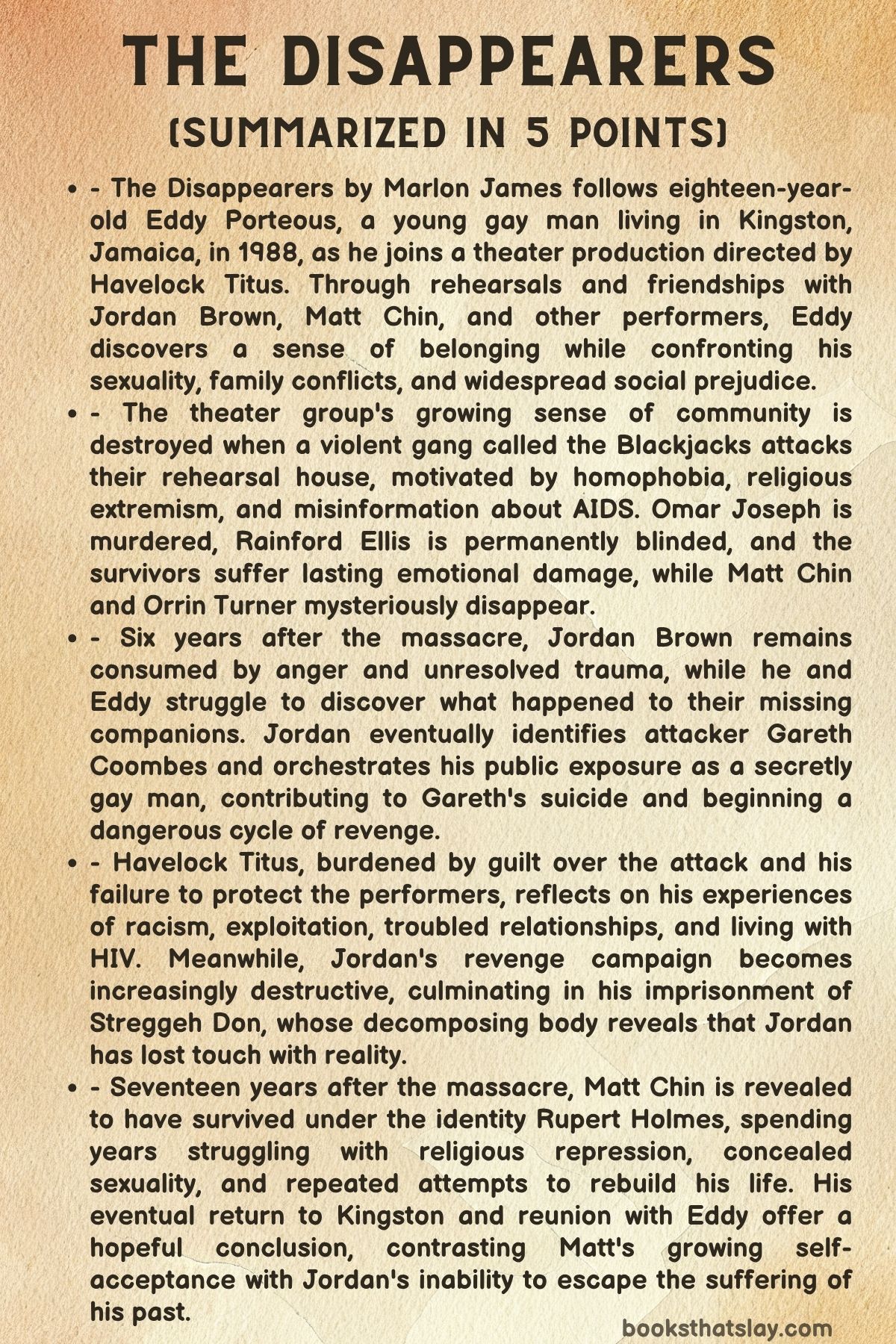
Characters
Edmond “Eddy” Porteous
Edmond Porteous serves as the reader’s primary introduction to the world of The Disappearers, presenting the experiences of a young gay man attempting to understand his identity within an intensely hostile environment. At eighteen, Eddy possesses an emotional sensitivity that makes him particularly aware of rejection, humiliation, and the complicated expectations imposed by family and society.
His diary reveals his vulnerability and his tendency to examine relationships through personal longing and insecurity. Memories of bullying have damaged his confidence, making him uncertain whether his desires can coexist with a stable and respectable future.
Eddy’s participation in the theatrical production becomes a crucial stage in his development because it introduces him to other men who understand aspects of his experiences. His attraction to Matt Chin and his complicated friendship with Jordan Brown encourage him to confront feelings he has previously struggled to articulate.
The violence against the theater group fundamentally changes Eddy’s understanding of personal safety and community. His subsequent search for Matt and Orrin demonstrates loyalty and determination, although the investigation also exposes the limits of his ability to protect or recover the people he cares about.
By 2005, Eddy has become a successful lawyer, suggesting that he has developed a measure of professional stability despite his traumatic youth. His reunion with Matt reveals that the past remains emotionally significant, even when outward circumstances have changed considerably.
Jordan Brown
Jordan Brown emerges as one of the most psychologically complex figures in The Disappearers, illustrating how unresolved trauma can transform an injured person into someone capable of inflicting serious harm. His personality initially appears provocative and confrontational, but these qualities gradually reveal deeper experiences of anger, vulnerability, and emotional insecurity.
His difficult relationship with his father contributes to an understanding of masculinity shaped by conflict and power. Working in the family funeral business also places him in constant proximity to death, an environment that reinforces his preoccupation with mortality and the losses caused by the massacre.
Jordan’s loyalty to the theater group is inseparable from his inability to accept what happened to its members. His prolonged search for Matt and Orrin demonstrates genuine concern, but the investigation gradually becomes another source of frustration and emotional isolation.
His relationship with Gareth Coombes marks a decisive change in his behavior. By exploiting Gareth’s concealed sexuality and arranging his public exposure, Jordan adopts the mechanisms of humiliation that once threatened his own existence.
Gareth’s suicide introduces a moral contradiction Jordan cannot easily resolve. Although his actions are motivated by an understandable desire for accountability, he begins treating the suffering of others as proof that justice has been achieved.
By the final section, Jordan’s psychological condition has deteriorated to the point that he converses with the corpse of Streggeh Don. His character demonstrates the terrible consequences of allowing revenge to replace human connection, emotional recovery, and a meaningful relationship with the present.
Matt Chin / Rupert Holmes / Smitty
Matt Chin represents the possibility of transformation and personal survival in The Disappearers, although his development is marked by secrecy, isolation, and repeated attempts to escape his identity. Initially introduced as a member of the theater group, Matt attracts Eddy’s romantic attention while maintaining aspects of his personal life that remain unknown to his companions.
His disappearance after the massacre creates one of the novel’s central mysteries. The discovery of multiple identities, residences, and an unfinished manuscript suggests that Matt has constructed separate versions of himself to negotiate the dangers surrounding his sexuality.
The revelation that he has been living as Rupert Holmes places his earlier disappearance within a larger struggle between survival and self-erasure. Changing names and circumstances allows him to escape certain threats, but these transformations do not automatically free him from shame.
Religious repression plays a significant role in his psychological development. The moral judgments he has absorbed continue influencing his relationships, often preventing him from experiencing desire without anxiety or self-condemnation.
His experiences in Miami, including another encounter with violence, eventually encourage him to reconsider the assumptions governing his existence. Rather than continuing to seek safety exclusively through concealment, he begins accepting his sexuality as a legitimate part of his identity.
Matt’s return to Kingston demonstrates that personal renewal does not require denying everything that came before. When he identifies himself as Smitty, he reconnects his altered present identity with the young man Eddy once knew, suggesting that survival can include both change and remembrance.
Havelock Titus
Havelock Titus occupies a central position in The Disappearers as the director whose theatrical project temporarily provides a space for young men excluded from much of Jamaican society. His artistic commitments suggest an awareness of the relationship between public expression, political resistance, and personal freedom.
His history in England complicates any interpretation of him as simply a mentor or moral authority. Experiences of racism, class discrimination, sexual exploitation, and unequal relationships have shaped his understanding of power and personal compromise.
His relationship with Everton Caulfield demonstrates the dangers of intimacy when social position and emotional dependency become instruments of control. Havelock’s eventual retaliation also reveals his willingness to respond to mistreatment through actions that carry serious consequences.
The massacre becomes a lasting source of guilt because Havelock believes he failed to protect those who trusted his leadership. His memories of Omar, Rainford, and the missing actors repeatedly challenge his attempts to separate himself from the violence.
Living with HIV intensifies his confrontation with vulnerability and mortality. His reluctance to accept Eddy’s support suggests a man who has learned to protect himself through emotional distance, even when companionship might offer comfort.
Havelock’s response to Jordan’s revenge campaign illustrates his recognition of the destructive potential of retaliatory violence. Although he cannot erase his own failures, he understands that continued cruelty cannot restore the lives and relationships destroyed in 1988.
Rainford Ellis
Rainford Ellis embodies the physical and psychological consequences of homophobic violence in The Disappearers, particularly through the permanent injuries he suffers during the attack. Initially a participant in the theatrical production, Rainford becomes one of the clearest examples of how public hatred can transform a person’s entire future.
His blinding by Streggeh Don is especially disturbing because it involves a public cultural figure using violence to enforce ideas about acceptable masculinity and sexuality. The assault exposes the relationship between influential expressions of prejudice and the physical punishment directed against marginalized people.
Rainford’s desperate attempts to identify himself after the attack demonstrate his determination to remain recognized as a human being. Even when subjected to extraordinary cruelty, he continues asserting an identity that his attackers attempt to strip away.
His injuries also become central to Jordan’s later pursuit of revenge. Although Rainford does not control the direction of Jordan’s campaign, his suffering becomes one of the memories used to justify further violence.
Rainford’s character demonstrates that survival does not necessarily mean returning to the conditions that existed before a traumatic event. His permanent blindness stands as evidence of an injustice whose consequences cannot be erased through punishment alone.
Omar Joseph
Omar Joseph is one of the most tragic figures in the novel because his participation in the theater group ends in murder. Like the other performers, he enters the production as someone seeking artistic expression and a connection with people who understand the dangers surrounding their identities.
His attempt to escape the attacking Blackjacks demonstrates an instinctive determination to survive. Nevertheless, he is pursued and repeatedly stabbed, making his death a particularly direct expression of the attackers’ willingness to destroy those they consider unacceptable.
Omar’s death becomes a permanent emotional burden for the survivors. Havelock repeatedly returns to it through feelings of guilt, while Jordan incorporates the loss into his broader belief that society has refused to provide justice.
The significance of Omar’s character continues beyond his physical presence in the narrative. His absence represents both an individual life destroyed and the future possibilities that violence prevents from becoming reality.
Orrin Turner
Orrin Turner is a member of the theater group whose disappearance after the 1988 attack becomes one of the enduring mysteries surrounding the survivors. His participation initially places him within the same developing community as Eddy, Jordan, Matt, and the other performers.
Unlike Matt, whose later identity is eventually revealed, Orrin remains missing within the account of events presented by the novel. This unresolved absence creates a different kind of suffering because those who knew him cannot determine whether he survived or what circumstances led to his disappearance.
Eddy and Jordan’s attempts to locate Orrin demonstrate the importance of recovering people whose lives have been obscured by fear and social hostility. Their unsuccessful investigation also emphasizes the difficulties of tracing individuals who may have concealed personal relationships or identities for protection.
Orrin represents the uncertainty that remains after collective violence, particularly when survivors lack the information necessary to understand what happened to everyone involved.
Gareth Coombes
Gareth Coombes demonstrates the contradictions produced by a society that publicly condemns homosexuality while forcing individuals to conceal their own sexual desires. His participation in the attack establishes him as someone willing to enforce social prejudice through violence.
Jordan’s discovery that Gareth secretly maintains sexual relationships with men exposes the division between his public actions and private behavior. Rather than confronting this contradiction openly, Gareth has participated in the persecution of people whose experiences resemble aspects of his own.
His relationship with Jordan becomes a means through which the past violence returns in another form. Jordan deliberately cultivates intimacy while planning to expose Gareth, turning private vulnerability into an instrument of punishment.
The publication of compromising photographs results in severe public humiliation and contributes to Gareth’s suicide. His death does not excuse his involvement in earlier brutality, but it complicates the assumption that destroying a perpetrator necessarily produces justice.
Gareth’s character reveals how shame can operate simultaneously as a motivation for violence and a weapon used against those who commit it.
Streggeh Don
Streggeh Don is a popular reggae performer whose participation in the assault demonstrates the dangerous relationship between cultural influence and organized prejudice. His destruction of Rainford’s eyes makes him responsible for one of the attack’s most devastating acts.
His public identity matters because his influence extends beyond his immediate physical actions. The harmful attitudes promoted through his music contribute to a cultural environment in which violence against gay men can be presented as socially acceptable.
Years later, Streggeh becomes a central target of Jordan’s campaign of revenge. His captivity represents Jordan’s attempt to force a powerful aggressor into the helpless position once occupied by the theater group’s victims.
The revelation that Streggeh has been dead for weeks transforms his presence into evidence of Jordan’s psychological collapse. His corpse becomes a disturbing symbol of revenge continuing after its supposed objective has already been achieved.
Clive Lim
Clive Lim serves as the stage manager of the theatrical production, placing him within the organizational structure that brings the performers together. Although his personal history receives less attention, his role establishes him as an important participant in the community developing around the play.
As stage manager, Clive represents the practical cooperation required for an artistic project to function. His presence helps establish that the theater is not merely a gathering of individuals but a collective undertaking built through shared responsibility.
The attack against the rehearsal house demonstrates how such a community can become vulnerable simply because its members are associated with a stigmatized form of expression. Clive’s connection to the production places him within the broader group whose ordinary creative activity becomes the target of hostility.
Dionne
Dionne occupies an important place in Eddy’s personal life as a friend whose relationship with him reflects the complications of adolescence, sexuality, and social expectations. Their friendship exists alongside Eddy’s growing recognition of his attraction to men.
Her presence helps establish the difference between the outward relationships Eddy maintains and the private emotional experiences he struggles to express. This tension contributes to the uncertainty surrounding his identity during the opening stages of the novel.
Dionne also provides a connection between Eddy’s developing involvement in the theater and the everyday social world from which he comes. Through their complicated friendship, the story demonstrates that the discovery of sexual identity affects existing relationships as well as the formation of new ones.
Kofi
Kofi is significant because of his sexual relationship with Eddy, which reveals an important dimension of the young protagonist’s private life. Their involvement demonstrates that Eddy’s sexuality is not merely an abstract question but something he is already experiencing through intimate encounters.
Nevertheless, physical intimacy does not automatically resolve Eddy’s uncertainty about identity or relationships. His experiences with Kofi exist within a society where exposure could carry serious personal consequences.
Kofi’s place in the story helps distinguish sexual experience from emotional security. Eddy’s continuing attraction to Matt and his uncertainty about his relationships suggest that desire, affection, and the need for acceptance are related but not identical experiences.
Peta-Gaye Burke
Peta-Gaye Burke functions as a journalist whose interviews help reconstruct the consequences of the 1988 massacre. Her work allows different experiences and memories to emerge, broadening the narrative beyond the perspective of any single survivor.
Her professional interest in the events emphasizes the importance of testimony in circumstances where violence has been obscured by prejudice and institutional hostility. By gathering accounts of the attack and its aftermath, she contributes to the preservation of experiences that might otherwise remain hidden.
Peta-Gaye also introduces questions about the relationship between personal suffering and public knowledge. Her character demonstrates that documenting violence is one way of resisting the silence surrounding marginalized communities.
Paul Royale
Paul Royale becomes involved in Jordan’s revenge against Gareth Coombes, assisting with the recording and exposure of Gareth’s sexual encounters. His participation gives Jordan the practical assistance necessary to transform a private relationship into a public scandal.
Although Jordan remains the principal force behind the scheme, Paul’s involvement shows that retaliation can extend beyond one individual’s anger. Other people may become participants in actions whose consequences are far more destructive than initially anticipated.
Paul’s character therefore contributes to the novel’s examination of shared responsibility. His assistance helps enable an act of humiliation that ultimately contributes to Gareth’s death, demonstrating how private vengeance can acquire wider consequences.
Everton Caulfield
Everton Caulfield is an aristocratic figure from Havelock’s past in England whose relationship with him exposes the influence of wealth and class upon intimate relationships. Their association initially exists within a world offering Havelock greater sexual freedom than he experienced in Jamaica.
However, Everton’s obsessive attachment gradually becomes threatening, revealing that apparent openness does not necessarily eliminate exploitation. Differences in social position contribute to an unequal relationship in which emotional dependence becomes associated with power.
Havelock’s eventual retaliation produces severe consequences for Everton, including public disgrace and confinement in a psychiatric institution. This outcome introduces another instance in which humiliation and punishment become difficult to separate from the pursuit of personal freedom.
Everton’s role also complicates Havelock’s moral development. The relationship reveals how someone who has experienced injustice may nonetheless participate in harmful patterns when attempting to recover control.
Mark
Mark is Havelock’s longtime friend and the recipient of the letters through which much of the older man’s history becomes known. Although Mark’s independent actions receive limited attention, his relationship with Havelock provides a foundation for personal confession and recollection.
The letters allow Havelock to examine memories that remain difficult to confront directly. Addressing a trusted individual creates an opportunity to consider the relationships, compromises, and decisions that have shaped his life.
Mark’s significance therefore lies partly in his role as a person capable of receiving experiences that Havelock has struggled to communicate elsewhere. Their correspondence highlights the importance of friendship and testimony in preserving personal history.
Jordan’s Father
Jordan’s father represents one of the difficult personal relationships that contribute to his son’s emotional instability. Their abusive relationship forms part of the environment in which Jordan develops his understanding of power, conflict, and masculine authority.
The connection between them helps explain why Jordan experiences relationships through anger and defensiveness. His behavior cannot be attributed exclusively to his family circumstances, but those circumstances intensify the psychological damage caused by the massacre.
Jordan’s father also represents the persistence of domination within supposedly protective family structures. His presence demonstrates that an individual’s struggle for dignity can be complicated by hostility both inside and outside the home.
Eddy’s Parents
Eddy’s parents contribute to the atmosphere of instability surrounding his adolescence. Their deteriorating marriage, particularly the exposure of his father’s infidelity, reveals the contradictions within conventional expectations concerning family life and sexual morality.
The violence that follows the marital conflict challenges the assumption that socially approved relationships are necessarily more stable or morally secure than those condemned by the wider community.
For Eddy, the breakdown of his parents’ marriage becomes another reason to question the adult world around him. Their conflict contrasts with his search for meaningful relationships within the theater group, emphasizing that emotional safety depends upon trust and mutual respect rather than social approval alone.
The Blackjacks
The Blackjacks operate as a collective force of violence, representing different forms of prejudice embedded within Jamaican society. Their membership includes religious extremists, police officers, and men whose hostility is intensified by fear, misinformation, or conflicts concerning their own sexuality.
Their actions demonstrate how individuals with different motivations can unite around a common target. Religious certainty, masculine insecurity, and public anxiety about AIDS provide justifications that allow the attackers to regard brutality as a legitimate social response.
The differences among the attackers are equally significant. Some embrace violence enthusiastically, while others become uncomfortable as the assaults escalate, revealing varying degrees of conviction and moral awareness.
Their collective responsibility remains central despite these differences. Through the Blackjacks, the novel demonstrates that persecution does not depend entirely upon a few exceptionally cruel individuals but can emerge when widespread prejudices receive social encouragement and institutional support.
Themes
Homophobia, Social Prejudice, and Institutional Violence
Hostility toward homosexuality shapes nearly every aspect of the characters’ lives, influencing their relationships, personal identities, and opportunities for safety. In The Disappearers, prejudice operates not simply through individual insults or acts of discrimination but through a wider social environment that encourages exclusion and legitimizes violence.
The attack against the theater group demonstrates the consequences of treating sexual difference as a threat to established moral and cultural values. The Blackjacks justify their brutality through religious arguments, masculine expectations, and misinformation about AIDS, transforming prejudice into what they perceive as a public responsibility.
The involvement of a police officer makes this violence particularly disturbing because it exposes the failure of institutions responsible for protecting citizens. When representatives of authority participate in persecution, marginalized individuals lose confidence that reporting crimes or seeking legal assistance will provide meaningful protection.
The novel also examines the contradictions within homophobic attitudes through attackers who privately experience desires similar to those they publicly condemn. Their behavior suggests that prejudice can be strengthened by internal shame, especially when individuals attempt to establish their social acceptability by punishing others.
Streggeh Don’s involvement extends this criticism into popular culture, demonstrating how influential public figures can reinforce hostile beliefs through their artistic and social platforms. His attack on Rainford becomes an extreme example of the relationship between prejudicial expression and physical harm.
The broader tragedy emerges from a society that repeatedly refuses to recognize the full humanity of those who differ from its accepted sexual norms. Through the survivors’ experiences, the story presents homophobia as a destructive system whose consequences extend far beyond the initial acts of violence.
Trauma, Memory, and the Destructive Nature of Revenge
The massacre of 1988 does not end when the attackers leave the rehearsal house, because its psychological consequences continue shaping the survivors for nearly two decades. Trauma becomes a persistent presence that influences how the characters remember their past, interpret other people’s behavior, and imagine their futures.
Jordan Brown demonstrates the most destructive response to this unresolved suffering. His memories of the attack gradually become the foundation of his identity, preventing him from developing meaningful relationships that exist independently of the injustice he experienced.
His campaign of revenge initially appears connected to an understandable desire for accountability. However, his treatment of Gareth Coombes reveals how easily the pursuit of justice can become another form of humiliation and cruelty.
Gareth’s suicide exposes the moral uncertainty surrounding Jordan’s actions, while the later discovery of Streggeh Don’s corpse reveals the extent of his psychological deterioration. Jordan has become so consumed by punishment that he continues addressing an enemy who is no longer alive, demonstrating his inability to recognize when violence has ended.
Havelock’s response provides a contrasting expression of trauma. Instead of directing his suffering outward through revenge, he struggles with guilt, withdrawal, and the belief that he abandoned people who depended upon him.
Neither character can simply erase the past, but their experiences reveal different dangers associated with failing to process suffering. The novel suggests that recovery requires more than identifying those responsible for injustice; it also requires finding a way to live without allowing that injustice to determine every subsequent action.
Identity, Shame, and the Search for Personal Freedom
Identity develops under constant pressure when people must conceal essential aspects of themselves to avoid punishment or rejection. Eddy’s early experiences demonstrate this conflict through his uncertainty about sexuality, his fear of public exposure, and his desire to discover relationships in which he can express himself honestly.
The theatrical production temporarily offers a different environment, allowing individuals with related experiences to develop connections through artistic collaboration. Its significance extends beyond performance because it creates opportunities for the participants to acknowledge feelings and experiences that remain dangerous elsewhere.
Matt Chin’s journey presents an especially complex examination of identity because his disappearance involves the adoption of different names and personal circumstances. His transformations allow him to escape particular dangers, but they also reveal the psychological costs of repeatedly separating his public existence from his private desires.
Religious repression and internalized shame continue influencing Matt even after he leaves the people and places associated with his earlier life. His experiences demonstrate that physical escape does not automatically eliminate beliefs absorbed through years of condemnation.
Eddy’s eventual professional success provides another perspective on personal development. His transformation into a lawyer suggests that a person can establish a stable outward identity while continuing to carry memories of earlier insecurity and loss.
Matt’s return ultimately offers the clearest possibility of reconciliation between past and present. By identifying himself as Smitty, he acknowledges the person he once was without surrendering the changes that have allowed him to survive, suggesting that personal freedom involves accepting identity rather than endlessly attempting to replace it.
Disappearance, Survival, and the Possibility of Renewal
Disappearance functions as both a literal event and a broader representation of the ways individuals become separated from their communities, identities, and personal histories. In The Disappearers, the unexplained absences of Matt Chin and Orrin Turner create uncertainty that continues troubling the survivors long after the massacre.
Their disappearances illustrate how social hostility can force people to withdraw from relationships and established identities. When openly acknowledging one’s sexuality carries serious risks, concealment can become a necessary strategy, even when it requires abandoning friendships and familiar surroundings.
The uncertainty surrounding Orrin demonstrates the suffering experienced by those who remain behind. Without reliable information, Eddy and Jordan cannot determine whether their missing companion has escaped, suffered further violence, or constructed another life elsewhere.
Matt’s eventual reappearance transforms the significance of disappearance by revealing that absence does not always mean death or permanent defeat. His experiences show that survival may require profound personal changes, although those changes can produce loneliness and a fractured sense of belonging.
Jordan provides a contrasting example because he remains physically present while gradually disappearing into his memories and obsession. His psychological deterioration suggests that a person can lose meaningful contact with the world without ever leaving it.
The conclusion establishes an important distinction between survival and genuine renewal. Jordan’s pursuit of vengeance prevents him from developing a future independent of past suffering, while Matt’s return suggests that reconstruction remains possible even after years of fear, secrecy, and isolation.
The reunion between Matt and Eddy does not repair every tragedy or resolve every unanswered question. Nevertheless, it affirms the possibility of human connection after prolonged separation, allowing the novel to end with a sense of cautious hope grounded in recognition, acceptance, and the continuing struggle for personal freedom.