The House of Gardenias Summary, Characters and Themes
The House of Gardenias by Isabel Cañas is a gothic fantasy novel that combines supernatural horror, political rebellion, colonial injustice, and a young woman’s struggle for independence.
Set in a fictional country torn between aristocratic rule and revolutionary resistance, the book follows Minerva Treviño, an impoverished servant who seeks safety in a wealthy household but becomes involved in a dangerous supernatural conspiracy. At the center of the story stands an ancient mansion haunted by spirits whose suffering originates in the violence of colonization. Through Minerva’s experiences, the novel explores power, loyalty, revenge, exploitation, and the difficult choices people make when survival conflicts with justice.
Summary
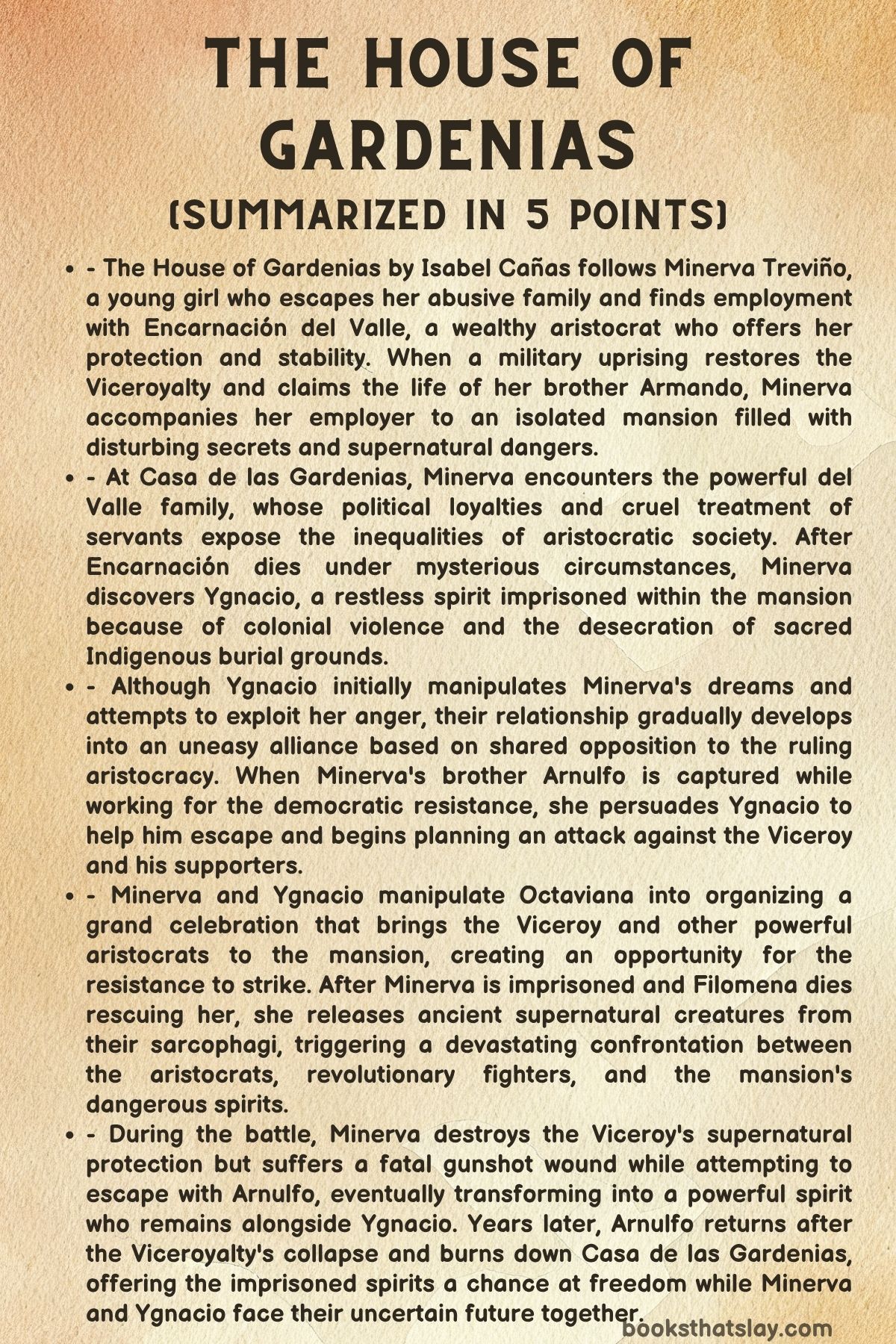
Minerva Treviño grows up in poverty under the control of her abusive father and cruel stepmother. After her older brothers, Armando and Arnulfo, abandon the family home, she becomes increasingly desperate to escape the violence that has defined her childhood.
Her opportunity arrives when she discovers an advertisement seeking a lady’s maid at Casa Azafrán, the residence of an elderly aristocrat named Encarnación del Valle. Although Minerva has no experience and lacks suitable clothing, she steals her stepmother’s finest dress and leaves home, determined to secure employment.
At Casa Azafrán, Minerva meets Encarnación, a proud woman whose family once enjoyed considerable influence under the Viceroyalty. The elderly aristocrat initially doubts Minerva’s suitability but eventually hires her after witnessing her persistence and willingness to work.
For Minerva, the employment provides comforts she has never experienced, including regular meals, clean clothing, running water, and a private bedroom. More importantly, Encarnación offers protection from the father whose cruelty has shaped her understanding of the world.
Their relationship becomes particularly meaningful when Minerva’s father unexpectedly confronts her in public and demands that she return home. Encarnación intervenes, using her authority to have him removed and assuring Minerva that she is safe.
Despite this kindness, their relationship contains significant contradictions because Encarnación supports the aristocratic regime and expresses prejudices against people of mixed ancestry. Minerva recognizes these beliefs as troubling, especially because her brothers sympathize with the democratic movement opposing the Viceroyalty.
Encarnación also teaches Minerva a strategic board game called Mice and Hounds, encouraging her to think carefully about defense, aggression, and the advantages available to apparently weaker opponents. These lessons gradually shape Minerva’s ability to recognize opportunities and challenge people who possess greater authority.
Meanwhile, political unrest develops into a military uprising against President Epifano Valbuena IV, whose democratic government faces opposition from aristocrats seeking to restore the Viceroy. The president refuses to surrender, and soldiers attack the Capital while his supporters attempt to preserve his final message of resistance.
Armando, Minerva’s eldest brother, serves as one of the president’s messengers and is killed during the uprising. Arnulfo subsequently finds Minerva and informs her of Armando’s death, warning that her association with the democratic movement could place her in danger.
Although Arnulfo urges her to escape into the mountains with the surviving resistance fighters, Minerva refuses to abandon her newly established security. Her decision becomes emotionally complicated when Encarnación celebrates the restoration of aristocratic authority, unaware that the political victory has devastated Minerva’s family.
As violence continues, Minerva accompanies Encarnación to Casa de las Gardenias, an isolated mansion belonging to the del Valle family. There, they join Octaviana, her husband Cirilo, their son Leoncio, and the pregnant Eugenia, alongside a large household of servants.
The mansion immediately unsettles Minerva because of its dark corridors, strange echoes, abandoned rooms, and disturbing atmosphere. She also notices a shadowy human figure reflected in a mirror, although nobody is physically present when she turns around.
While performing her duties, Minerva encounters the rigid social hierarchy maintained by the aristocratic household. Servants such as Filomena look down on those occupying lower positions, while members of the del Valle family discuss political executions and military operations with little concern for their victims.
Minerva gradually discovers that the mysterious sounds accompanying her movements originate from something more disturbing than ordinary echoes. After finding a concealed staircase leading to the fourth floor, she discovers three ancient stone sarcophagi whose positions suggest that they have recently moved.
The supernatural danger becomes undeniable when Encarnación suddenly begins choking after drinking tea. Minerva desperately attempts to save her, but a monstrous darkness materializes and extracts a brilliant golden energy from the dying woman’s body, appearing as hundreds of luminous butterflies.
The entity responsible is Ygnacio, a ghost imprisoned within the mansion for generations. By consuming Encarnación’s life force, known as chispa, he regains temporary physical form and experiences sensations that death has denied him for many years.
Encarnación’s death leaves Minerva devastated and without the protection that previously distinguished her from the other servants. Octaviana refuses to acknowledge Minerva’s description of the supernatural attack and forces her to choose between leaving the dangerous estate and accepting employment as an ordinary maid.
Minerva remains because the surrounding countryside is engulfed in civil war. Her reduced position exposes her to greater humiliation, but it also provides opportunities to investigate the mansion and discover what truly happened to Encarnación.
Ygnacio becomes increasingly interested in Minerva because she possesses both a strong will and considerable resentment toward the del Valle family. He begins entering her dreams, manipulating her fears and attempting to turn her anger against Leoncio, who has started behaving inappropriately toward her.
However, Minerva proves far more difficult to control than Ygnacio expects. After observing his unusual behavior and recognizing his connection to the mansion’s supernatural disturbances, she confronts him in the garden with a butcher’s knife.
During their confrontation, Ygnacio reveals that he died generations earlier after being forced to work on the construction of the mansion. His community had suffered under colonial soldiers, who destroyed homes, separated families, seized sacred land, and forced Indigenous people into labor.
The mansion was built over an ancient burial site, and the colonizers desecrated the tombs in their search for riches. Ygnacio died in a construction accident and was buried without the traditional ceremonies necessary to release his spirit, leaving him imprisoned alongside other dangerous supernatural beings.
Although Ygnacio believes the del Valle family deserves punishment for generations of exploitation, Minerva refuses to accept historical injustice as an excuse for murdering Encarnación. Their disagreement establishes a tense relationship in which both characters recognize the other’s suffering without fully accepting their methods.
Minerva’s circumstances become increasingly dangerous when Arnulfo is captured while operating as a Valbuenista spy near the estate. Terrified that Octaviana will execute him, she seeks Ygnacio’s assistance and persuades him to create a supernatural distraction that allows her brother to escape.
This success strengthens their uneasy partnership. Minerva begins recognizing that Ygnacio’s powers might accomplish something greater than individual revenge, particularly if they can be used against the Viceroyalty’s political leadership.
Together, they formulate a plan to bring the regime’s influential supporters into Casa de las Gardenias. To accomplish this, Minerva secretly removes Octaviana’s protective bracelet, allowing Ygnacio to enter her dreams and encourage her to organize an elaborate celebration honoring the Viceroy.
The operation is dangerous because Octaviana knows that supernatural entities inhabit the mansion and has deliberately protected herself against them. Nevertheless, Minerva succeeds in removing the bracelet, while Ygnacio manipulates Octaviana’s dreams until she decides to invite the Viceroy and his supporters.
As preparations begin, Minerva learns that Filomena has connections to the resistance. The young attendant’s apparent arrogance conceals personal suffering, including the disappearance of Lucia, someone whose fate has made Filomena deeply hostile toward the restored regime.
Minerva also begins developing a more personal understanding of Ygnacio. Their conversations about death, family, and the afterlife reveal his longing to reunite with his father and sisters, while Minerva wonders whether Encarnación’s spirit might still exist somewhere beyond the physical world.
She proposes destroying the mansion after the Viceroyalty has fallen, believing that its destruction might release the supernatural beings imprisoned within it. Ygnacio fears the uncertainty of such an attempt but gradually becomes willing to consider freedom even if it means abandoning the only existence he knows.
When the Viceroy arrives, Minerva discovers that Arnulfo has infiltrated his household disguised as a servant. He explains that Valbuenista fighters have secretly entered the estate and intend to attack during the celebration, creating an unexpected opportunity to coordinate their operation with Minerva’s supernatural plan.
Minerva insists that Arnulfo and his companions wear seven-knotted protective bracelets to shield themselves from the ancient creatures. However, before the attack can begin, Octaviana accuses Minerva of suspicious movements throughout the mansion and orders the guards to seize her.
The Viceroy initially intervenes because Encarnación had written favorably about Minerva, but Octaviana secretly orders the young servant imprisoned in the slaughterhouse. Ygnacio attempts to free her but discovers that his remaining chispa is insufficient to break the reinforced cage.
Filomena eventually arrives and creates an opportunity for Minerva to escape by distracting and attacking the guards. Although the two young women manage to flee the slaughterhouse, soldiers open fire, and Filomena is killed before reaching safety.
Devastated by another loss, Minerva abandons the possibility of simply escaping and resolves to complete the operation. She returns to the fourth floor, where she opens the three ancient sarcophagi and releases the hungry supernatural creatures against the assembled aristocrats.
Chaos spreads throughout the mansion as the creatures attack the guests and Valbuenista fighters engage the Viceroy’s soldiers. Minerva discovers that the Viceroy, Octaviana, and Cirilo remain protected by a magical circle constructed from seven-knotted rope and powered by brilliant orbs of chispa.
Determined to destroy their defense, she seizes a burning log and sets the protective rope alight. When Octaviana attacks her, Minerva strikes back with the burning wood, leaving the aristocrat engulfed in flames.
Minerva attempts to escape through the fighting but encounters Leoncio, who attacks her again. Arnulfo reaches his sister, yet she suffers a devastating gunshot wound as they struggle to leave the mansion.
As Arnulfo desperately carries her toward safety, Minerva feels herself separating from her physical body. She realizes that she has died when she sees her own motionless form and encounters Ygnacio, who explains that she may become trapped like him without a proper burial.
Rather than demanding that Arnulfo remain beside her, Minerva urges him to escape and preserve his life. Her new supernatural existence soon reveals unexpected power, allowing her to transform into a formidable presence with monstrous claws, fangs, and command over darkness.
In the aftermath, the Viceroy is dead, and his regime begins breaking apart amid rival factions and political instability. Minerva and Ygnacio remain within Casa de las Gardenias, where they drive away loyalists seeking refuge and eventually force the surviving del Valle family members to abandon the estate.
The spirits of Filomena and other victims of the battle also remain connected to the mansion. Although Minerva and Ygnacio are still imprisoned, they find companionship in their shared existence and continue watching the political changes unfolding beyond the estate.
Years later, Arnulfo returns as an influential leader of the victorious Valbuenistas after the Viceroyalty finally collapses. Accompanied by men carrying torches and tools, he prepares to destroy the mansion and fulfill the promise of ending its hold over the dead.
As flames consume Casa de las Gardenias, Ygnacio fears that the destruction might bring annihilation rather than freedom. Minerva takes his hand and repeats the protective blessing her mother taught her family, offering reassurance as the ancient prison disappears around them.
The novel ends without explaining precisely what awaits the spirits after the mansion’s destruction. Nevertheless, Minerva and Ygnacio face the unknown together, having transformed their experiences of captivity, suffering, and resistance into the possibility of a different existence.
Characters
Minerva Treviño
Minerva Treviño is the central protagonist of The House of Gardenias, a young servant whose journey from an abused child to a powerful supernatural figure forms the emotional and political foundation of the novel. Her character represents the struggle to secure independence in a society that systematically denies vulnerable people control over their circumstances.
At the beginning of the story, Minerva’s greatest ambition is simply to escape her abusive household and obtain food, shelter, and protection. Her decision to steal her stepmother’s dress and seek employment at Casa Azafrán demonstrates resourcefulness and determination despite her limited opportunities.
Minerva initially believes that safety depends on finding a powerful individual willing to protect her. Encarnación fulfills this role, but their relationship also teaches Minerva that personal kindness can coexist with deeply unjust political beliefs.
Her experiences at Casa de las Gardenias force her to reconsider the difference between genuine independence and security granted by someone else. Once Encarnación dies, Minerva discovers how quickly her position can deteriorate when protection depends on aristocratic favor.
Her intelligence becomes particularly evident through her developing understanding of strategy. The lessons she learns from Mice and Hounds influence her decisions as she confronts Ygnacio, rescues Arnulfo, manipulates Octaviana, and attacks the Viceroy’s supernatural defenses.
Minerva’s greatest strength is her refusal to accept the helplessness others expect from her. Even when she is frightened, exhausted, or grieving, she repeatedly finds ways to act rather than surrender control of her future.
However, her development is not without moral complications. Her willingness to release dangerous supernatural creatures demonstrates how the pursuit of justice can require decisions with uncertain consequences for innocent people.
Her relationship with Ygnacio also reveals her capacity to understand suffering without excusing cruelty. Although she recognizes the historical injustices that created his imprisonment, she challenges his willingness to exploit other victims.
Minerva’s transformation after death represents the culmination of her struggle for agency. She becomes powerful enough to defend herself and the people she loves, ultimately remaining in the mansion until its destruction offers the possibility of freedom.
Ygnacio
Ygnacio is one of the most morally complicated characters in The House of Gardenias, functioning simultaneously as a supernatural antagonist, a victim of colonial violence, and Minerva’s unlikely companion. His existence demonstrates how unresolved suffering can transform into a desire to inflict suffering on others.
Before his death, Ygnacio belonged to an Indigenous community whose traditions emphasized spiritual continuity, sacred burial practices, and the relationship between living people and the dead. Colonial soldiers destroyed his family life and forced him to labor on land that held profound spiritual importance to his community.
His death during the mansion’s construction leaves him trapped without the ceremonies necessary for spiritual release. As generations pass, his longing for freedom becomes increasingly entangled with resentment toward the descendants of those responsible for his suffering.
Ygnacio discovers that consuming chispa from dying people allows him to regain temporary physical existence. Although these experiences offer relief from his imprisonment, they require him to exploit other human beings.
His involvement in Encarnación’s death establishes the terrifying consequences of his hunger. He is not presented as someone whose tragic history automatically excuses his actions, because the suffering he endured does not eliminate his responsibility for the suffering he creates.
Initially, Ygnacio treats Minerva as another person whose anger and vulnerability can be manipulated. His attempts to influence her dreams demonstrate that he has adopted methods resembling the coercion once practiced against him.
Minerva challenges this behavior by refusing to become an instrument of his revenge. Their confrontations gradually force Ygnacio to acknowledge her independence and recognize that personal suffering does not justify controlling others.
As their relationship develops, he becomes increasingly concerned with Minerva’s survival rather than merely benefiting from her actions. His willingness to expend his diminishing strength to protect her marks a significant change in his priorities.
His fear of the mansion’s destruction reveals another important contradiction: he longs for freedom but fears abandoning the familiar boundaries of his imprisonment. By the conclusion, his connection with Minerva allows him to confront that uncertainty through companionship rather than isolation.
Encarnación del Valle
Encarnación del Valle occupies a distinctive moral position in The House of Gardenias because her personal generosity exists alongside loyalty to an oppressive political system. She becomes Minerva’s protector, mentor, and substitute parental figure, yet she also represents the aristocratic privileges that sustain the Viceroyalty.
When Minerva first approaches her for employment, Encarnación recognizes the girl’s determination and provides an opportunity that fundamentally changes her circumstances. She offers food, shelter, regular employment, and protection from the violence Minerva previously endured.
Her intervention when Minerva’s father attempts to reclaim control over his daughter demonstrates genuine concern. Unlike the adults in Minerva’s family, Encarnación treats her fear as something deserving protection rather than exploitation.
However, Encarnación remains deeply committed to the restoration of aristocratic authority. Her prejudice against people of mixed ancestry and her celebration of the military uprising reveal the limitations of her compassion.
The contrast becomes especially painful when Minerva learns that Armando has died defending the democratic government. Encarnación celebrates the same political victory that has destroyed someone Minerva loves.
Her lessons through Mice and Hounds become one of her most enduring influences. She encourages Minerva to understand strategy, recognize opportunities, and consider how seemingly powerless individuals can challenge stronger opponents.
Encarnación’s death transforms the direction of the story because it destroys Minerva’s sense of security and exposes the supernatural forces within the mansion. Her continued influence demonstrates that a character can leave a lasting positive impression while remaining morally compromised.
Arnulfo Treviño
Arnulfo Treviño is Minerva’s surviving older brother and an important representative of the revolutionary movement. His relationship with Minerva develops through abandonment, disagreement, mutual protection, and the painful demands of political commitment.
After leaving the family home, Arnulfo becomes involved with the Valbuenista resistance. Although his departure contributes to Minerva’s vulnerability, his later actions demonstrate that he remains deeply concerned about her safety.
When he returns after the military uprising, Arnulfo informs Minerva of Armando’s death and urges her to escape with him. Her refusal reveals the distance between their priorities, as Arnulfo considers political resistance essential while Minerva is unwilling to sacrifice the stability she has finally obtained.
His capture at Casa de las Gardenias provides an important turning point in their relationship. Minerva refuses to abandon him and persuades Ygnacio to intervene, showing that her love for her brother can overcome her distrust of supernatural forces.
Arnulfo’s decision to return disguised as a servant demonstrates bravery and considerable political commitment. He participates in a dangerous operation against the Viceroy while attempting to protect Minerva and coordinate with other resistance supporters.
His inability to rescue Minerva immediately after her imprisonment exposes the difficult conflict between family loyalty and revolutionary responsibility. Even when he loves his sister, his obligations to the larger movement limit his choices.
The moment when Arnulfo carries Minerva’s wounded body is particularly significant because it reverses their earlier separation. His desperation reveals how much his sister means to him, while her insistence that he escape demonstrates her own development.
By the conclusion, Arnulfo emerges as an influential leader among the victorious revolutionaries. His return to destroy the mansion fulfills Minerva’s earlier proposal and connects his political victory with the possible spiritual liberation of those imprisoned there.
Armando Treviño
Armando Treviño is Minerva’s eldest brother, whose influence continues long after his death. Although he appears primarily through Minerva’s memories and the account of the military uprising, he represents courage, familial love, and commitment to democratic resistance.
During Minerva’s childhood, Armando provides emotional support and teaches her protective traditions inherited from their mother. The seven-knotted bracelet becomes especially important because it represents both familial affection and a form of spiritual protection.
Armando’s decision to work for President Valbuena demonstrates his willingness to risk his life for political principles. His final mission involves carrying the president’s message to a printing press so the public can learn that resistance continues.
His death exposes the human cost of the aristocratic coup and intensifies Minerva’s complicated feelings about Encarnación. Although her employer protects her personally, Encarnación celebrates the regime responsible for killing her brother.
Armando’s lasting importance comes from the values and knowledge he passes to Minerva. His memory strengthens her resolve and helps preserve her connection to the family she lost.
Octaviana del Valle
Octaviana del Valle functions as one of the principal human antagonists in The House of Gardenias, embodying the cruelty, entitlement, and authoritarian attitudes of the aristocratic ruling class. As the mistress of the estate, she exercises enormous control over servants whose economic dependence leaves them vulnerable to her decisions.
Octaviana maintains a strict household hierarchy and expects absolute obedience from everyone beneath her social position. Her treatment of Minerva after Encarnación’s death reveals how little protection ordinary servants possess once an influential patron disappears.
Her refusal to acknowledge supernatural activity is especially revealing because she secretly wears a protective bracelet. Rather than warn the household about the dangers, she uses her knowledge to protect herself while forbidding others from discussing their experiences.
This behavior reflects her broader political outlook. She believes that powerful people deserve privileges unavailable to those who serve them, even when those privileges involve protection from deadly threats.
Octaviana’s treatment of captured resistance fighters demonstrates her willingness to use violence without meaningful legal restraint. Her punishment of the guards after Arnulfo’s escape similarly reveals an authoritarian approach to maintaining obedience.
Her confrontation with Minerva exposes the depth of her class prejudice. She considers a servant’s life expendable and orders Minerva imprisoned even after the Viceroy intervenes on the young woman’s behalf.
Ironically, Octaviana’s desire for aristocratic recognition makes her vulnerable to Ygnacio’s manipulation. Her dreams of hosting the Viceroy become the means through which Minerva brings the regime’s leaders into a supernatural trap.
Her eventual confrontation with Minerva represents the collapse of the authority she has taken for granted. When Minerva attacks her with burning wood, the servant she considered powerless becomes capable of directly challenging her.
Leoncio del Valle
Leoncio del Valle is Octaviana and Cirilo’s son, whose privileged upbringing has encouraged arrogance, cruelty, and disregard for other people’s boundaries. He represents the dangers created when social status protects individuals from accountability.
His rooms contain collections of insects, botanical specimens, and experimental materials, suggesting an obsessive interest in controlling and examining living things. These interests contribute to the unsettling atmosphere surrounding his character.
Leoncio’s treatment of Minerva reveals his willingness to exploit the power imbalance between aristocrats and servants. He touches her without permission and creates situations in which she must carefully manage his behavior to avoid danger.
His political attitudes are similarly disturbing. When reading about disappeared Valbuenista supporters, he responds with mockery rather than sympathy for their families.
Ygnacio initially hopes to manipulate Minerva into attacking Leoncio, recognizing that her anger toward him could be turned toward violence. Minerva’s refusal to become Ygnacio’s instrument complicates this plan.
During the final battle, Leoncio continues acting as an aggressor and shoots a young insurgent attempting to assist Minerva. His repeated violence establishes him as a serious threat rather than merely an unpleasant aristocrat.
Filomena
Filomena is one of the characters whose development most strongly challenges the reader’s initial impressions in The House of Gardenias. She begins as an arrogant household attendant who belittles Minerva but eventually emerges as a courageous resistance supporter willing to risk her life for political change.
Her superior position among the servants initially appears to make her an enthusiastic defender of aristocratic hierarchy. She mocks Minerva’s background and takes pleasure in reminding her of the disadvantages associated with her lower status.
However, her behavior conceals resentment toward the regime and personal suffering connected to Lucia’s disappearance. Her secret involvement with the Valbuenistas reveals that her apparent loyalty to the household is partly a means of survival.
Filomena’s connection with Arnulfo further establishes her commitment to resistance. She becomes part of a network of individuals who exploit their access to aristocratic households to undermine the government they outwardly serve.
Her decision to rescue Minerva from the slaughterhouse demonstrates remarkable bravery. Unlike characters who express opposition without accepting personal danger, Filomena directly confronts armed guards and kills one to secure Minerva’s freedom.
Her death during their escape is especially tragic because she has ambitions extending far beyond service in an aristocratic mansion. She hopes for education, political participation, and a future in which her social background does not determine her opportunities.
The fact that her ghost remains at the estate reinforces the destructive consequences of the conflict. Filomena’s unfinished ambitions become a reminder of the lives and possibilities lost to political violence.
Sara
Sara is a fellow servant who helps Minerva adjust after Encarnación’s death forces her into the general household staff. Her presence offers moments of companionship within an environment dominated by suspicion, strict expectations, and unequal treatment.
Unlike Filomena’s initial hostility, Sara approaches Minerva with practical kindness and helps her understand the responsibilities of ordinary maids. Their shared work creates a sense of solidarity that makes the mansion’s daily demands more manageable.
Sara also provides important information about the household’s strange experiences. Her conversations suggest that other servants have encountered unexplained phenomena, even though Octaviana forbids open discussion.
Her character represents the ordinary workers who must continue serving powerful families despite political uncertainty and supernatural danger. Through Sara, the novel shows how companionship can provide limited but meaningful protection against isolation.
Eugenia
Eugenia is a pregnant member of the del Valle household whose personal concerns complicate the family’s otherwise confident political discussions. She is particularly worried about Santiago, her husband, whose parliamentary associations have placed him in danger.
Her anxiety reveals that political violence can threaten even those connected to privileged families. Although she benefits from aristocratic security, she cannot completely separate her personal life from the consequences of civil war.
Eugenia does not display the same openly aggressive behavior as Octaviana or Leoncio, but she remains part of a household that normalizes repression. Her limited response to reports of disappeared political opponents illustrates how passive acceptance helps sustain an unjust system.
Her pregnancy also establishes a contrast between the family’s investment in its own future and its disregard for the futures of ordinary citizens. This tension makes her a useful representative of aristocratic self-interest without reducing her entirely to cruelty.
Cirilo
Cirilo is Octaviana’s husband and Leoncio’s father, occupying a position of authority within the del Valle family. His association with the aristocratic household places him among the privileged beneficiaries of the restored Viceroyalty.
Although he is less prominently developed than Octaviana, his actions reinforce the family’s commitment to preserving its political and social advantages. He participates in the household’s response to the civil war and maintains his position within the ruling establishment.
His presence inside the protective circle during the final confrontation is particularly revealing. Alongside Octaviana and the Viceroy, Cirilo benefits from supernatural defenses unavailable to the servants and soldiers exposed to violence outside.
Cirilo represents a form of complicity based on participation in an unjust order rather than constant displays of personal cruelty. His privilege depends on institutions whose suffering he has little incentive to challenge.
Cosme
Cosme is the senior household servant responsible for supervising aspects of daily life at Casa de las Gardenias. His position places him between the aristocratic family and the workers who must obey its demands.
He enforces household expectations, directs Minerva through the mansion, and helps maintain the discipline necessary to support such a large estate. His authority is considerable among servants but remains limited by the wishes of the del Valle family.
After Encarnación’s death, Cosme persuades Octaviana to allow Minerva additional time to decide whether she will remain employed. This intervention reveals a degree of consideration within his otherwise disciplined professional behavior.
However, Cosme also participates in a system that restricts servants’ independence. His character illustrates the compromises made by individuals who acquire limited authority within institutions controlled by more powerful people.
Antonio
Antonio is a household servant associated with one of the novel’s earliest supernatural tragedies. He delivers the refreshments shortly before Encarnación becomes violently ill and dies.
His involvement in this sequence makes him important to Minerva’s investigation, although delivering the tea does not establish that he knowingly poisoned Encarnación. His role introduces uncertainty about whether her death resulted from an individual conspiracy, supernatural manipulation, or some combination of events.
Later, Antonio becomes a victim of the supernatural attack unleashed during the celebration. His fate demonstrates that the creatures do not necessarily distinguish between aristocrats and the servants supporting their household.
Through Antonio, the story emphasizes the unpredictable consequences of releasing destructive forces into a building occupied by people with very different levels of responsibility.
The Viceroy
The Viceroy is the aging ruler whose restoration drives the central political conflict. He represents an inherited system of authority built upon colonial conquest, aristocratic privilege, and the extraction of wealth through chispa.
Although he does not dominate the narrative through frequent appearances, his political influence determines the circumstances affecting nearly every major character. The military coup carried out in his name destroys the democratic government and contributes to Armando’s death.
His treatment of Minerva during her confrontation with Octaviana reveals a limited capacity for personal consideration. Because Encarnación spoke favorably about the girl, he prevents her immediate punishment and orders the guards to release her.
However, this intervention does not challenge the broader hierarchy that makes Minerva vulnerable. His personal affection for Encarnación exists alongside his position at the center of an oppressive political system.
His death during the final assault becomes a decisive turning point for the Viceroyalty. Without a clear successor, the regime fractures into competing factions, demonstrating how heavily its political stability depends on a single inherited authority.
President Epifano Valbuena IV
President Epifano Valbuena IV represents the democratic government overthrown by the military uprising. His refusal to resign establishes him as a political counterpoint to the restored Viceroy.
As soldiers close in on the presidential palace, he orders his family evacuated and prepares a declaration reaffirming his commitment to democratic government. His decision to continue resisting despite overwhelming danger demonstrates the strength of his political convictions.
His final message becomes especially significant because Armando attempts to deliver it to a printing press. The president’s resistance therefore becomes directly connected to Minerva’s personal loss.
Although the president dies early in the story, his political movement survives through the Valbuenistas. His character demonstrates how an individual’s death can transform political opposition into a prolonged struggle.
Minerva’s Father
Minerva’s father is a central source of trauma in her childhood and represents the abusive authority she initially struggles to escape. His violence establishes the emotional conditions that make her desperate for employment and protection.
He treats Minerva as someone subject to his control rather than an individual entitled to make decisions about her own life. His behavior damages her confidence and teaches her to associate authority with physical danger.
When he confronts her after she begins working for Encarnación, Minerva must challenge the fear he has cultivated throughout her childhood. Her declaration that her father is dead represents a symbolic rejection of his authority.
His character also establishes an important parallel between domestic violence and political oppression. Both depend on the belief that powerful individuals are entitled to control people who cannot easily defend themselves.
Minerva’s Stepmother
Minerva’s stepmother reinforces the cruelty of her family environment and contributes to her sense that escape is necessary for survival. Her treatment of Minerva offers little affection or protection, leaving the girl isolated after her brothers depart.
The stepmother’s clothing becomes important when Minerva decides to apply for employment at Casa Azafrán. By stealing her finest dress, Minerva temporarily claims an appearance associated with dignity and respectability.
Her stepmother’s attempt to stop her departure demonstrates the household’s resistance to Minerva’s independence. Minerva’s refusal to return marks an early victory over the circumstances that have kept her powerless.
Although her role is relatively brief, she helps establish the desperate conditions from which Minerva’s courage emerges.
Lucia
Lucia is an absent but emotionally significant figure whose disappearance influences Filomena’s involvement in the resistance. Her fate reflects the suffering of people who vanish under authoritarian rule without their families receiving reliable information about what happened.
Through Lucia, the novel gives personal meaning to reports of disappeared Valbuenista supporters. The political practice of making opponents vanish is shown not simply as a method of repression but as a continuing source of uncertainty and grief.
Filomena’s commitment to political resistance is partly shaped by this personal loss. Lucia therefore influences the plot indirectly by motivating one of the people who eventually helps Minerva survive.
Santiago
Santiago is Eugenia’s husband, whose previous involvement in Parliament places him in a politically dangerous position. Although he remains largely outside the central action, his circumstances reveal the instability created by the military coup.
Eugenia’s concern for him introduces anxiety into the aristocratic household, reminding readers that changing regimes can threaten individuals associated with former political institutions. His uncertain position also demonstrates that belonging to a privileged family does not guarantee safety during a civil war.
Santiago serves primarily as a reminder of how political upheaval affects relationships and family decisions even when the individuals involved are absent from the immediate setting.
Comandante
Comandante is the Viceroy’s dog, accompanying his household during the visit to Casa de las Gardenias. Although the animal plays a minor role, his presence helps establish the elaborate demands placed upon servants during the political celebration.
The responsibility of attending to the visitors’ dogs also creates opportunities for movement and private conversation. Arnulfo uses an errand involving Comandante to arrange a meeting with Minerva without openly revealing their relationship.
Comandante therefore contributes indirectly to the coordination of the resistance operation. His role demonstrates how apparently ordinary household responsibilities can become useful opportunities for characters acting secretly.
Themes
Colonial Exploitation and the Persistence of Historical Injustice
The history of Casa de las Gardenias reveals how colonial violence continues influencing society long after the original conquest has ended. The mansion stands on land taken from an Indigenous community and contains sacred burial sites desecrated during the search for valuable resources.
In The House of Gardenias, this violent foundation is not merely historical background. It directly determines the supernatural conditions that shape the lives of Minerva, Ygnacio, and the del Valle family.
Ygnacio’s imprisonment begins when colonial soldiers destroy his community, force him into construction labor, and leave him improperly buried after his death. His inability to find peace symbolizes the lasting consequences of violence that remains unacknowledged and unresolved.
The discovery of chispa also exposes the economic foundations of colonial power. The resource supports technological advancement and aristocratic wealth, but its benefits are distributed unequally.
The wealthy enjoy conveniences and luxuries while impoverished families such as Minerva’s struggle to survive. This contrast demonstrates how economic progress can coexist with exploitation when resources remain controlled by a privileged minority.
The del Valle family’s political influence further illustrates the persistence of colonial structures. Even after a democratic government emerges, powerful aristocrats organize a military uprising to recover their former authority.
The supernatural occupation of the mansion reflects this unresolved history. Spirits remain trapped beneath a building that celebrates the wealth accumulated through their suffering, making the estate a physical representation of inherited injustice.
The eventual destruction of the mansion suggests that meaningful change may require dismantling institutions built upon exploitation. Yet the uncertain fate of the spirits also acknowledges that removing a structure cannot automatically erase generations of suffering.
Power, Class Hierarchy, and the Struggle for Independence
Minerva’s experiences reveal that social power operates through economic dependence, political authority, and personal relationships. Her childhood demonstrates the dangers of being controlled by an abusive parent, while her employment exposes similar imbalances within aristocratic households.
At Casa Azafrán, Encarnación’s generosity provides genuine relief from poverty and violence. However, Minerva’s security remains dependent on the continued goodwill of someone possessing greater wealth and influence.
Encarnación’s death reveals the instability of this arrangement. Without her employer’s protection, Minerva immediately loses her privileged position and becomes subject to Octaviana’s authority.
The distinctions among household servants reinforce the system of inequality. Filomena initially considers herself superior to ordinary maids, even though her position remains subordinate to the aristocratic family.
Such divisions demonstrate how hierarchical institutions encourage people with limited power to compete against one another. This competition makes collective resistance more difficult because individuals become invested in defending the small advantages they possess.
Minerva gradually recognizes that independence requires more than obtaining favor from powerful people. Her growing understanding of strategy allows her to influence events instead of merely responding to decisions made by others.
In The House of Gardenias, the lessons associated with Mice and Hounds become a central expression of this development. Minerva learns that apparent weakness does not eliminate the possibility of victory when someone understands an opponent’s assumptions and vulnerabilities.
Her eventual collaboration with the resistance represents a decisive movement from personal survival toward collective political action. Instead of seeking protection exclusively for herself, she participates in an effort to change the institutions that produce widespread insecurity.
Her transformation after death extends this struggle beyond the limitations of her human existence. The young servant who once depended upon aristocratic permission becomes a formidable supernatural presence capable of controlling the mansion itself.
Revenge, Justice, and Moral Responsibility
Ygnacio’s desire for revenge originates in terrible injustice, but his actions repeatedly challenge the assumption that suffering automatically grants someone moral authority. The colonial violence inflicted upon his community explains his anger without making every expression of that anger defensible.
His consumption of Encarnación’s chispa reveals this distinction clearly. Although her wealth and social status connect her to the system responsible for his suffering, her death also devastates Minerva, another vulnerable person.
Ygnacio initially shows little concern for these consequences because he regards the del Valle family as collectively responsible for historical crimes. His reasoning risks reducing individuals to representatives of institutions rather than recognizing their separate choices and relationships.
Minerva challenges him by insisting that accepting Encarnación’s kindness does not make her responsible for the aristocracy’s history. She also refuses to accept his manipulation of her dreams as justified simply because his intended targets are cruel.
Their disagreements highlight the difference between resisting injustice and reproducing abusive methods. Ygnacio’s willingness to control Minerva resembles the coercion he suffered under colonial rule, even though his political sympathies oppose that system.
Minerva’s own decisions become morally complicated when she plans to release the ancient creatures. Although her objective is to weaken an oppressive government, she knows that supernatural violence may extend beyond the people directly responsible for political repression.
Filomena’s death intensifies Minerva’s determination and creates a similar temptation to treat retaliation as justice. The narrative does not eliminate this danger simply because Minerva’s cause is sympathetic.
Instead, both Minerva and Ygnacio must confront the consequences of pursuing political and personal revenge. Their developing relationship suggests that recognizing another person’s humanity can challenge destructive attitudes formed through fear, resentment, and prolonged suffering.
Death, Memory, Love, and the Possibility of Freedom
Death repeatedly transforms the relationships that shape Minerva’s life. Armando’s death creates an enduring absence within her family, while Encarnación’s death destroys the security she had struggled to establish.
These losses influence Minerva’s understanding of love because affection becomes inseparable from the possibility of separation. Her determination to protect Arnulfo reflects her fear of losing the last brother who remains alive.
Ygnacio’s experiences offer a supernatural examination of the same concerns. His imprisonment prevents him from rejoining the ordinary cycle of death and spiritual renewal described by his father’s traditions.
His memories of his family preserve his emotional connection to the living world while intensifying his suffering. The desire to see his father and sisters again becomes one of the few hopes capable of challenging his obsession with revenge.
The novel also associates death with incomplete obligations and interrupted ambitions. Filomena loses her life before achieving the education and political freedom she desires, while countless victims of the civil war disappear without receiving recognition or proper burial.
The protective seven-knotted bracelet connects these experiences with inherited traditions of care. Originally associated with Minerva’s mother’s blessing, it becomes a means of protection against supernatural forces and a reminder that family affection can survive physical separation.
Minerva’s transformation complicates conventional distinctions between life and death. Although her human existence ends, her ability to love, remember, make decisions, and protect others continues in another form.
Her relationship with Ygnacio becomes especially meaningful because both understand the loneliness of being trapped between existence and the unknown. Their companionship provides emotional freedom even before their supernatural imprisonment ends.
The destruction of Casa de las Gardenias brings these ideas together. Arnulfo’s return fulfills a promise rooted in familial love, while Minerva’s reassurance allows Ygnacio to confront his greatest fear.
The ending deliberately leaves the afterlife uncertain, suggesting that freedom does not always mean knowing what comes next. Sometimes it means having the courage to release the past and face an unfamiliar future with someone who understands the suffering that came before.