Taipei Story Summary, Characters and Themes
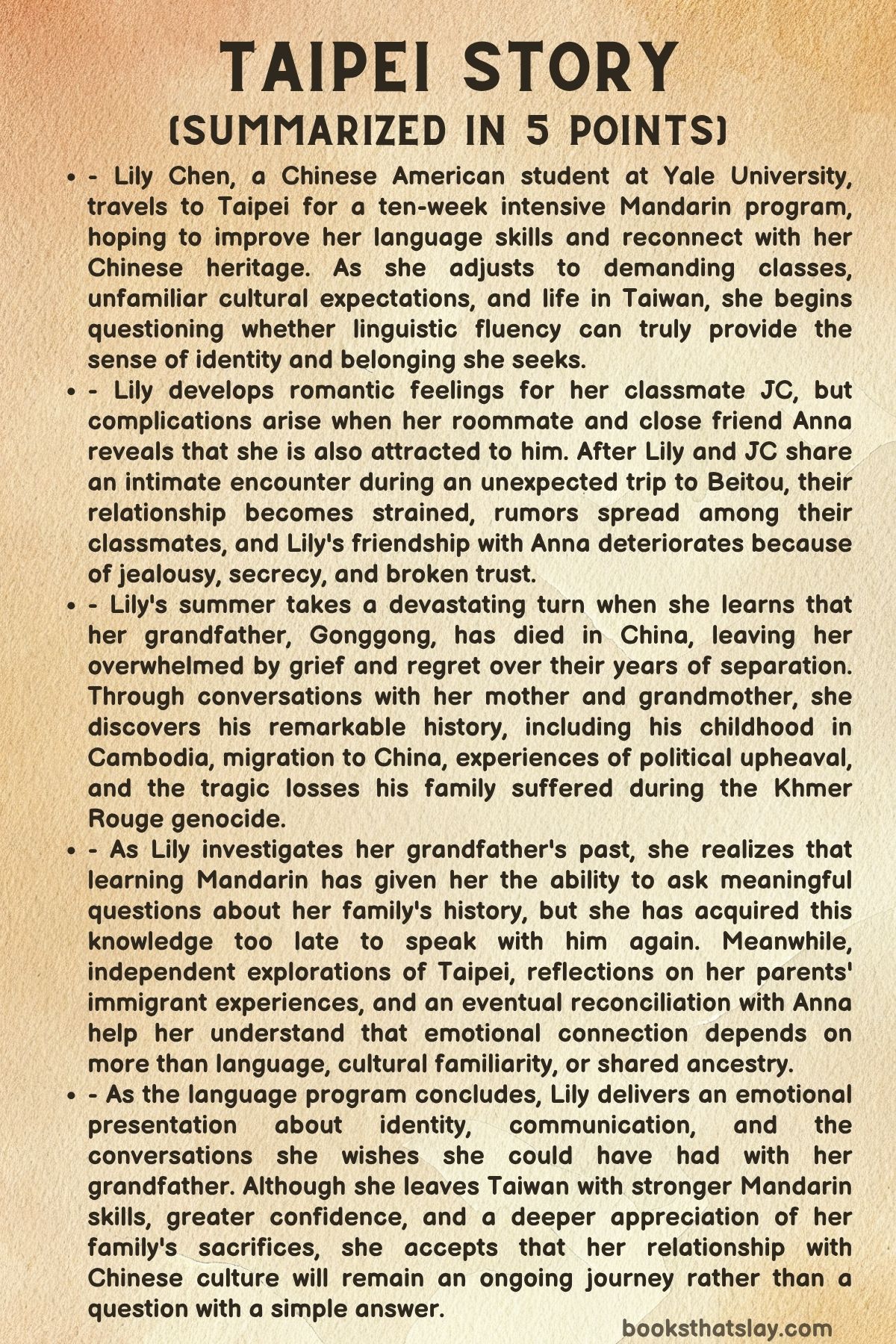
Taipei Story by R. F. Kuang is a literary novel about language, cultural identity, family history, and the emotional distances created by migration. The story follows Lily Chen, a Chinese American university student who travels to Taiwan to improve her Mandarin and reconnect with her heritage.
What begins as an academic summer becomes a complicated journey through friendship, romantic disappointment, grief, and historical discovery. As Lily struggles to understand both her ancestral language and her family’s past, she realizes that fluency cannot resolve every uncertainty about belonging. The novel examines how people inherit histories they barely know and how language can both connect and separate generations.
Summary
Lily Chen, a Chinese American student at Yale University, travels to Taipei for a ten-week intensive Mandarin program at National Taiwan University. Born in Guangzhou but raised in the United States, Lily has gradually lost much of the Chinese vocabulary she once possessed, leaving her uncertain about her relationship with her cultural heritage.
She hopes that studying in Taiwan will strengthen her Mandarin and help her develop a clearer understanding of her identity. However, she soon discovers that returning to a language associated with her childhood is more complicated than she anticipated.
At the airport, Lily reunites with her Yale classmate Anna, with whom she has arranged to share an apartment. Their enthusiasm diminishes when they discover that their accommodation is considerably smaller than advertised, forcing them to adjust to uncomfortable living arrangements.
During orientation, Lily meets several other students, including Skipper Leys, who is interested in Chinese-Taiwanese military relations, and John Cahan-Song, commonly known as JC. Coming from a multilingual family with a prominent social media presence, JC attracts Lily’s attention almost immediately.
The program’s demanding schedule requires students to communicate exclusively in Mandarin. Lily quickly becomes frustrated by the gap between her cultural familiarity with Chinese and her limited ability to express complicated ideas.
Her instructors, particularly Teacher Sun, insist on grammatical accuracy, sophisticated vocabulary, and appropriate expressions. Although Lily possesses an intuitive understanding of certain aspects of the language, this familiarity does not always translate into academic success.
Outside the classroom, Lily explores Taipei’s night markets, restaurants, museums, and historical attractions. These experiences expose her to the complexities of Taiwanese society, including debates about national identity and the relationship between Taiwan and mainland China.
Lily also grows increasingly attracted to JC, whose companionship offers a welcome escape from academic pressure. Their lunches and conversations become an important part of her daily routine.
Complications emerge when Anna admits that she also has romantic feelings for JC and asks Lily to determine whether he might be interested in her. Lily becomes uncomfortable because she has developed similar feelings and does not know how to acknowledge them without damaging their friendship.
Their strained relationship worsens when Lily discovers Anna reading her private messages with JC. Although Anna apologizes, the incident damages Lily’s trust and exposes deeper tensions between the roommates.
The situation reaches a turning point when Lily, Anna, and JC arrange a weekend trip to the hot springs in Beitou. JC accidentally books their accommodation for the wrong date, prompting him and Lily to travel together after they fail to contact Anna.
Lily interprets the unexpected trip as an opportunity for romance. They explore the area, visit local attractions, and eventually share an intimate encounter at their hotel.
However, the experience proves awkward and disappointing rather than emotionally fulfilling. Lily finds herself unable to communicate her desires clearly, making the encounter another example of how difficult communication can be even when people appear to understand one another.
Upon returning to Taipei, Lily feels guilty about excluding Anna. Their friendship deteriorates further when Anna discovers what happened, while rumors about Lily and JC spread among their classmates.
Lily becomes particularly upset when she learns that JC has discussed private details of their encounter with Skipper. When confronted, JC dismisses her concerns, revealing a troubling difference between their expectations concerning intimacy and privacy.
Feeling betrayed by both JC and Anna, Lily becomes increasingly isolated. At a student gathering, she encounters an older student named Andrew, but his condescending remarks about Chinese American identity and unwanted attention leave her feeling even more misunderstood.
Her personal difficulties are suddenly overshadowed by devastating news from home. Lily’s mother informs her that her maternal grandfather, Gonggong, has died after falling at his residence.
The announcement unsettles Lily because she has not seen her grandfather for years. Although they were once close, geographical separation and the gradual loss of their shared language have weakened their relationship.
Anna’s return to the apartment creates another confrontation, during which she demands that Lily move out. Their argument escalates before Lily reveals her grandfather’s death, but the disclosure cannot immediately repair the friendship.
Lily learns that her mother will travel from America to China for the funeral and has a connecting flight through Taipei. She arranges to meet her during the layover, hoping to find some comfort in their shared loss.
Their airport reunion is emotionally difficult. Lily notices signs of aging in her mother’s appearance and becomes frightened by the realization that she could eventually lose her too.
They eat breakfast, browse shops, and attempt to discuss their grief. However, their conversations remain uncomfortable, especially when Lily unintentionally upsets her mother by repeating a Confucian saying about the responsibility of remaining close to one’s parents.
Eventually, they sit together on a quiet observation balcony overlooking the runway. Their shared silence offers a temporary form of understanding that words cannot provide.
Afterward, Lily attempts to control her grief through philosophical reasoning and emotional detachment. She convinces herself that because her grandfather was already absent from her everyday life, his death should not significantly alter her existence.
Yet her feelings repeatedly contradict this explanation. She struggles to concentrate in class and finds that ordinary discussions of literature, history, and mortality now carry unexpected emotional significance.
A conversation with Meijuan, whose father died during the pandemic, helps Lily recognize that grief cannot be fully anticipated or controlled. She begins contacting her mother and grandmother more frequently, asking questions about family experiences that previously seemed unimportant.
These conversations reveal that Gonggong, whose name was Zhong Derui, was born into an overseas Chinese family in Cambodia. As a teenager, he was sent to China to participate in the country’s political and national development.
His early experiences were shaped by revolutionary ideals, military service, and the enormous historical upheavals of twentieth-century China. Meanwhile, the relatives he left behind in Cambodia suffered terrible losses during the Khmer Rouge genocide.
Lily learns that several family members disappeared or died, leaving gaps in the family’s history that may never be filled. Her grandfather’s surviving sister eventually reached a refugee camp in Thailand and informed him that their parents and other relatives were dead.
These discoveries transform Lily’s understanding of her family. What she previously regarded as an ordinary immigrant background becomes connected to war, displacement, political violence, and the difficult decisions made by earlier generations.
She also remembers moments of her grandfather’s kindness, particularly his compassionate response during a frightening family crisis involving her older sister Jasmine. Such memories intensify Lily’s regret over the years they spent apart.
Lily becomes determined to reconstruct Gonggong’s life, but she discovers that historical records and family recollections cannot answer every question. Her mother’s reluctance to revisit painful subjects creates further obstacles.
One evening, Lily attends a piano performance and experiences an unexpected sense of relief. The music offers an emotional connection that does not require translation, allowing her to experience grief without struggling to describe it.
Determined not to waste the remainder of her time abroad, Lily begins exploring Taipei independently. She visits cafés, attends concerts, watches films, and participates in excursions to places such as Pinglin’s tea plantations and Yehliu Geopark.
During these experiences, she observes other travelers confronting linguistic and cultural misunderstandings. Gradually, she recognizes that speaking a language correctly does not automatically guarantee acceptance, cultural knowledge, or emotional understanding.
Her academic work increasingly reflects these realizations. Preparing a final presentation about the relationship between language, personality, and identity, Lily considers how her parents have spent much of their adult lives communicating in English rather than their native language.
She begins to appreciate the emotional and intellectual effort required to establish a life in a second language. At the same time, she recognizes how difficult it has been for her to recover the language that once connected her to her grandfather.
When a typhoon approaches Taipei, Anna unexpectedly returns to their apartment. The storm creates an opportunity for the two women to discuss their conflict more openly.
Lily apologizes for her behavior, and Anna reveals that JC is now dating Margrit. This news exposes the futility of their earlier rivalry, allowing both women to reconsider the importance they assigned to his attention.
They spend the storm eating instant noodles and watching Taiwanese television. Their companionship gradually restores the friendship that had deteriorated during the summer.
Lily eventually delivers her final presentation, explaining how her Mandarin studies have changed her understanding of language and family. She acknowledges the painful irony that she has acquired the vocabulary to ask her grandfather meaningful questions only after his death.
Teacher Sun asks what Lily would say if she could speak with Gonggong one final time. This question leads Lily to imagine conversations about his Cambodian childhood, journey to China, political beliefs, experiences of war, and separation from his relatives.
The narrative then reconstructs Zhong Derui’s life more fully. As a young man, he believes in the possibility of national progress, but decades of political upheaval complicate his earlier convictions.
Despite devastating family losses, he witnesses China’s economic transformation and takes pride in the opportunities available to his descendants. His youngest daughter eventually moves to America, marries, and raises three children.
Zhong Derui visits the family in Massachusetts but struggles with the isolation of suburban American life. Although he loves his grandchildren, their lives increasingly belong to a world that differs from his own.
His experiences reveal the contradictions of migration: the same opportunities that offer younger generations security and prosperity also create emotional and geographical distance from their ancestors.
As the language program approaches its conclusion, Lily becomes anxious about leaving Taiwan. She has developed greater confidence in Mandarin, but she fears that her progress will disappear once she returns to an English-speaking environment.
Her farewell to Teacher Sun is surprisingly ordinary, reminding her that relationships can hold different meanings for the people involved. She also attends a farewell banquet with Anna and their classmates, reflecting on the friendships and experiences that have shaped her summer.
Small achievements demonstrate the extent of Lily’s development. She finally finds an onigiri shop she had searched for earlier and orders naturally, without mentally rehearsing every sentence.
During her final examination, she recognizes a reading passage that she could not understand before arriving in Taiwan. This time, she comprehends the story and realizes how much her linguistic abilities have improved.
After Anna leaves for a family visit to mainland China, Lily packs her belongings and departs for the airport. A shop assistant compliments her Chinese, providing a modest but meaningful acknowledgment of her progress.
Lily also encounters Chinese American students she remembers from her original flight. Listening to their experiences, she understands that although the summer has transformed her relationship with Chinese, it has not eliminated the uncertainties surrounding cultural identity.
Taipei Story ends with Lily accepting that fluency, family history, and belonging are not destinations she can reach through one summer of study. Her language learning remains unfinished, but she now understands that its value lies not only in communicating with others but also in recognizing the experiences, relationships, and histories that make communication meaningful.
Characters
Lily Chen
Lily Chen is the central character of Taipei Story, and her experiences provide the foundation for the novel’s examination of language, identity, grief, and cultural inheritance. As a Chinese American student studying Mandarin in Taiwan, she occupies an uncomfortable position between familiarity with Chinese culture and uncertainty about whether she genuinely belongs within it.
Her decision to study abroad reflects a desire to reconnect with her heritage and recover something she feels she has lost while growing up in America. However, her expectations reveal an initially simplified understanding of cultural identity, as she assumes that improved language skills might produce a more authentic version of herself.
Lily’s insecurity becomes especially evident in her interactions with teachers and classmates. She is intelligent and academically motivated, but her inability to communicate complex thoughts in Mandarin makes her feel less capable than she is in English.
Her relationship with JC exposes another aspect of her personality: her longing for validation and emotional intimacy. She becomes so invested in his attention that she struggles to consider the consequences for Anna and fails to recognize how little she understands JC’s intentions.
Nevertheless, Lily is capable of acknowledging her mistakes. Her eventual apology to Anna demonstrates a developing willingness to accept responsibility rather than allowing embarrassment and resentment to determine her behavior.
Her grandfather’s death produces the most significant transformation in her character. Lily initially tries to rationalize her grief, but she gradually realizes that her emotional attachment to Gonggong cannot be measured by the frequency of their recent interactions.
Through her investigation of family history, she develops a deeper appreciation for her ancestors’ sacrifices and the limitations of her own knowledge. By the novel’s conclusion, Lily no longer regards cultural belonging as something that can be achieved through perfect pronunciation or grammatical accuracy.
Instead, she accepts identity as an ongoing relationship with language, memory, family, and personal experience. Her growth lies in becoming more comfortable with uncertainty and recognizing that meaningful connections do not require complete understanding.
Anna
Anna is Lily’s classmate, roommate, and one of the most significant supporting characters in Taipei Story. Her relationship with Lily demonstrates how friendship can become complicated when personal insecurities, romantic interests, and uncomfortable living arrangements collide.
At the beginning, Anna appears to be a dependable companion who shares Lily’s enthusiasm about spending the summer abroad. Their partnership provides familiarity in an unfamiliar environment, particularly as both women confront the difficulties of intensive language study.
However, the limitations of their apartment and their different expectations gradually expose tensions. Anna’s attraction to JC creates additional difficulties when she asks Lily to investigate his feelings without realizing the extent of Lily’s own interest.
Her decision to read Lily’s private messages represents a serious violation of trust. It reveals her insecurity and desire for reassurance, although it does not justify her invasion of Lily’s privacy.
Anna’s anger after learning about Lily and JC’s trip is understandable within the context of their friendship, but her reaction also demonstrates how romantic disappointment can distort personal priorities. Her demand that Lily leave the apartment illustrates the extent to which resentment has overwhelmed their original companionship.
The eventual reconciliation during the typhoon is important because Anna proves capable of moving beyond the conflict. By admitting that JC has started dating Margrit, she helps expose the temporary nature of their rivalry.
Anna represents the possibility of repairing relationships through honest conversation, humility, and a willingness to recognize that friendship deserves greater attention than romantic competition.
John Cahan-Song (JC)
John Cahan-Song, commonly called JC, is the principal romantic interest in Taipei Story and an important influence on Lily’s emotional development. His multilingual background and socially prominent family initially make him appear confident, worldly, and comfortable with the cultural complexities that Lily finds intimidating.
His attention provides Lily with excitement and reassurance during the demanding language program. Because she is already uncertain about her identity and social relationships, his companionship becomes particularly meaningful to her.
However, JC’s behavior reveals a significant difference between social confidence and emotional maturity. His willingness to pursue intimacy without adequately considering Lily’s expectations makes their encounter uncomfortable and disappointing.
His decision to share private details with Skipper demonstrates a troubling disregard for Lily’s boundaries. When Lily confronts him, he dismisses her concerns rather than attempting to understand why his disclosure feels like a betrayal.
JC’s response suggests that he interprets sexual openness as a reason to reject embarrassment, while Lily understands privacy as an essential part of intimacy. Their disagreement illustrates how two people can interpret the same experience in fundamentally different ways.
His eventual relationship with Margrit further reveals the instability of the emotional significance Lily and Anna attached to him. While both women sacrificed elements of their friendship over his attention, JC moves into another relationship.
He functions as an example of how attraction can encourage people to project expectations onto someone whose values and intentions they have not fully understood.
Zhong Derui (Gonggong)
Zhong Derui, Lily’s maternal grandfather, is one of the most historically significant figures in Taipei Story. Although his death occurs relatively early in the narrative, his life becomes increasingly central as Lily investigates the experiences that shaped her family.
Born into an overseas Chinese family in Cambodia, Zhong Derui is sent to China during adolescence to contribute to the country’s future. His upbringing reflects a period when political ideals, national loyalty, and the belief in modernization strongly influenced personal decisions.
His early enthusiasm is complicated by the wars and political upheavals he encounters during his life. The losses suffered by his relatives during the Khmer Rouge genocide demonstrate how historical violence can permanently alter the structure of a family.
His correspondence with his surviving sister reveals a man who understands that national attachment cannot always provide safety or belonging. When she asks whether she should return to China, he encourages her to pursue opportunities elsewhere.
Zhong Derui’s experiences also demonstrate the contradictions of migration and progress. He takes pride in his daughters’ achievements and the opportunities available to his grandchildren, yet these successes create distances that increasingly separate him from their everyday lives.
His uncomfortable experience in suburban Massachusetts suggests that affection alone cannot eliminate linguistic and cultural isolation. Although he loves his American grandchildren, he gradually recognizes that they inhabit a world increasingly unfamiliar to him.
The memories of his compassion, particularly during Jasmine’s family crisis, reveal his emotional generosity. His importance extends beyond his historical experiences because he embodies the personal relationships that Lily wishes she had understood more deeply while he was alive.
Lily’s Mother
Lily’s mother is an important figure in the novel’s exploration of migration, family responsibility, and communication across generations. Having moved from China to the United States, she has established a life that offers her children opportunities very different from those available during her own upbringing.
Her relationship with Lily contains affection but also emotional distance. Their different linguistic environments and cultural experiences mean that they do not always possess the same ways of expressing complicated feelings.
The death of her father reveals her vulnerability. When Lily meets her at Taipei’s airport, the visible signs of aging in her appearance force Lily to recognize her mother’s mortality.
Their conversation becomes uncomfortable when Lily repeats a Confucian teaching about remaining near one’s parents. This moment highlights the difficulties of discussing familial obligations when migration has made geographical separation an unavoidable part of life.
Her reluctance to discuss certain aspects of the family’s traumatic past also suggests that silence may serve as a means of emotional protection. What Lily sees as missing historical information may represent experiences her mother finds too painful to revisit.
She symbolizes the difficult position occupied by immigrants who must build new lives while remaining emotionally connected to the people and places they have left behind.
Teacher Sun
Teacher Sun is Lily’s demanding Mandarin instructor and an important influence on her intellectual development in Taipei Story. Through rigorous instruction and high expectations, she challenges Lily to move beyond intuitive familiarity with Chinese and develop greater linguistic accuracy.
Her teaching style initially contributes to Lily’s frustration because it exposes the limitations of her vocabulary and grammar. Nevertheless, these difficulties become necessary parts of Lily’s eventual progress.
Teacher Sun also offers perspectives on Chinese language and cultural identity that complicate Lily’s assumptions about Taiwan. Her attachment to Chinese heritage demonstrates that political and cultural belonging cannot always be reduced to geographical boundaries.
Her most significant contribution occurs during Lily’s final presentation. By asking what Lily would say to her grandfather if she could speak with him again, she transforms a language exercise into an opportunity for personal reflection.
The question encourages Lily to recognize the emotional significance of the conversations she can no longer have. Teacher Sun therefore becomes an indirect catalyst for Lily’s confrontation with grief and family history.
Their farewell is comparatively ordinary, however, revealing a difference in how they understand their relationship. Lily views her teacher as a transformative presence, while Teacher Sun remains within the familiar boundaries of her professional role.
Skipper Leys
Skipper Leys is another participant in the Mandarin program whose interests center on military relations between China and Taiwan. His presence introduces the political complexities surrounding the island and provides a contrast to Lily’s more personal reasons for studying Chinese.
Skipper approaches the region through geopolitical questions, while Lily initially approaches it through language and ancestry. Their differing interests suggest that the same place can hold radically different meanings for different visitors.
He also becomes involved in Lily’s private difficulties when JC shares information about their sexual encounter with him. Although the available account does not establish Skipper’s reaction in detail, his involvement demonstrates how private relationships can become subjects of public discussion within a relatively small student community.
Skipper helps reveal the uncomfortable social environment in which Lily must negotiate privacy, reputation, and interpersonal trust.
Margrit
Margrit is a supporting character whose importance emerges through her association with Anna and her later relationship with JC. She becomes involved in the roommates’ conflict when Anna returns to the apartment with her and demands that Lily move out.
Her presence during this confrontation emphasizes Lily’s growing social isolation. Anna appears to have found companionship outside their friendship, while Lily remains increasingly disconnected from the people around her.
Margrit’s eventual romantic relationship with JC also changes how Lily and Anna interpret their rivalry. Their earlier conflict appears less meaningful once they realize that neither has established the lasting relationship with him that she had imagined.
Although her individual motivations receive limited attention, Margrit serves an important structural purpose by demonstrating that romantic attachments can change quickly while the damage done to friendships may persist.
Meijuan
Meijuan is a fellow student whose experience of bereavement provides Lily with an important perspective on grief. Having lost her father during the pandemic, Meijuan understands the suddenness and emotional disorientation that can accompany the death of a family member.
Her conversation with Lily offers a contrast to Lily’s efforts to rationalize her grandfather’s death. Through Meijuan’s experience, Lily encounters the reality that grief cannot be predicted according to intellectual expectations or personal preparation.
Meijuan also demonstrates that suffering is not unique to Lily, even when grief creates feelings of profound isolation. Her presence encourages Lily to recognize bereavement as a human experience that can produce unexpected connections between people.
Although she is not a major participant in the central conflicts, Meijuan contributes significantly to the emotional development of Lily’s understanding of loss.
Jasmine
Jasmine is Lily’s older sister, whose importance emerges primarily through Lily’s memories of their family life. A frightening crisis involving Jasmine becomes especially meaningful because of the compassionate way their grandfather responded.
The circumstances of the incident are not fully detailed in the provided account, but its emotional significance is clear. Lily remembers Gonggong as someone capable of offering understanding and kindness when the family confronted difficulty.
Jasmine’s experiences therefore help preserve an image of her grandfather that extends beyond the historical facts Lily begins collecting. Through this memory, his character becomes associated with personal generosity rather than simply with migration and political upheaval.
Jasmine also represents the broader family relationships that connect Lily to her childhood and remind her of experiences that can never be entirely recovered through language study.
Andrew
Andrew is an older student whom Lily encounters at a gathering during a particularly difficult period of her summer. After experiencing romantic disappointment and conflict with Anna, Lily is emotionally vulnerable and searching for companionship.
At first, Andrew appears to offer an opportunity for conversation and social connection. However, his patronizing remarks about Chinese American identity quickly undermine this possibility.
His attitude suggests that he believes himself qualified to judge Lily’s relationship with her cultural heritage. This creates another situation in which Lily feels that other people are attempting to define an identity she is still struggling to understand.
His increasingly uncomfortable attention further damages the interaction, leaving Lily disappointed and isolated. Andrew represents the tendency of some individuals to mistake cultural confidence or intellectual superiority for genuine understanding.
Lily’s Grandmother
Lily’s grandmother becomes important after Gonggong’s death because she possesses memories and family knowledge that Lily has neglected to seek. Their conversations create opportunities for Lily to investigate her grandfather’s background and the experiences of earlier generations.
As an elder family member, she represents a living connection to a past that has become increasingly unfamiliar to Lily. Her recollections help demonstrate that family history is preserved not only through official records but also through personal conversations.
Her presence reinforces the urgency of Lily’s growing interest in her ancestry. The loss of Gonggong has shown Lily that opportunities to ask questions are limited, making her grandmother’s surviving knowledge especially valuable.
Although the account provides little detail about her individual personality, her contribution to the novel emphasizes the importance of intergenerational communication.
Rayer
Rayer is Lily’s former teaching assistant, whom she encounters during her time in Taiwan. His difficulty delivering a literary presentation in Chinese becomes an important observation for Lily as she reflects on the meaning of fluency.
Because Rayer possesses an academic background yet still struggles to communicate effectively in a demanding linguistic environment, his experience challenges Lily’s assumptions about competence.
He demonstrates that intellectual ability in one language does not guarantee equal confidence or precision in another. His difficulties also suggest that fluency depends on context, specialized vocabulary, and familiarity with particular forms of expression.
Although his role is brief, Rayer contributes to Lily’s growing recognition that language learning is an ongoing process rather than a simple distinction between knowing and not knowing a language.
Themes
Language, Identity, and Cultural Belonging
Language determines much more than the ability to exchange information in Taipei Story. For Lily, Mandarin represents a connection to childhood, ancestry, and a cultural identity she fears she has partially lost through growing up in the United States.
Her decision to study in Taiwan reflects an expectation that linguistic improvement will make her feel more authentically Chinese. However, her experiences gradually demonstrate that cultural belonging cannot be established solely through vocabulary, grammar, or pronunciation.
Although she was born in China, Lily often struggles to communicate thoughts that would be effortless in English. Her frustration reveals how language can shape an individual’s confidence and create unexpected feelings of inadequacy.
Her encounters with Taiwanese students and teachers further complicate her assumptions. Differences in political identity, personal history, and cultural understanding show that speaking Chinese does not necessarily imply a shared national or social perspective.
The theme becomes especially significant when Lily considers her parents’ experiences as immigrants. Their ability to build lives in America required them to function in a language that may never have offered the same emotional familiarity as their native tongue.
This realization broadens Lily’s understanding of the relationship between language and personal identity. She begins to recognize that linguistic difficulty does not diminish a person’s intelligence, cultural legitimacy, or emotional depth.
By the end, her improved Mandarin provides satisfaction without resolving every uncertainty about belonging. Her development suggests that identity is not a fixed achievement but a continuing process shaped by experience, relationships, and the willingness to accept cultural complexity.
Grief, Memory, and Unspoken Conversations
The death of Lily’s grandfather changes her understanding of both the past and the present. Before receiving the news, she regards her family relationships as relatively stable despite the geographical distances that separate her from older relatives.
Gonggong’s death forces her to confront the permanence of separation. She can no longer assume that conversations postponed because of distance, inconvenience, or linguistic discomfort will eventually become possible.
Initially, Lily attempts to regulate her grief through rational explanations. Since her grandfather had been absent from her everyday life for years, she reasons that his death should not greatly affect her routine.
Her emotional response demonstrates the limitations of this approach. Memories, affection, and family attachments continue to shape people even when relationships are maintained across considerable distances.
As Lily begins asking questions about Gonggong’s life, grief develops into a desire to preserve history. She wants to understand his childhood, political experiences, migration, and the suffering endured by his relatives.
However, her investigation repeatedly encounters gaps that cannot be filled. Certain records are missing, surviving relatives remain reluctant to revisit painful experiences, and her grandfather is no longer available to explain his decisions.
In Taipei Story, these unanswered questions become one of the clearest expressions of loss. Lily has finally developed the language needed to ask meaningful questions, but she cannot recover the person who would have answered them.
The novel presents grief as more than sorrow over someone’s absence. It also involves mourning the conversations, discoveries, and possible relationships that death has permanently prevented.
Migration, Generational Distance, and Historical Trauma
Zhong Derui’s life demonstrates how migration can simultaneously create opportunity and produce lasting emotional separation. Sent from Cambodia to China during adolescence, he enters a world shaped by political uncertainty and ambitious visions of national transformation.
His journey reflects the belief that personal sacrifices might contribute to a more prosperous future. Yet the historical upheavals he experiences expose the unpredictability of political commitments and the vulnerability of families separated across national borders.
The destruction suffered by his relatives during the Khmer Rouge genocide reveals the devastating human consequences of political violence. Their experiences become part of the family’s inheritance even though later generations possess only fragmentary knowledge of what occurred.
Zhong Derui’s advice to his surviving sister also complicates conventional ideas about homeland and loyalty. Despite his own connection to China, he recognizes that safety and opportunity may require her to establish a life elsewhere.
The same contradiction appears when his daughter immigrates to America. Her children receive educational and professional opportunities that earlier generations could scarcely imagine, but those achievements create new forms of cultural distance.
During visits to Massachusetts, Zhong Derui finds himself isolated within an environment that his grandchildren regard as ordinary. Their growing unfamiliarity with his language and history makes communication increasingly difficult.
Through these experiences, the novel questions the assumption that economic advancement necessarily produces uncomplicated happiness. Material security and educational success can coexist with loneliness, displacement, and the gradual disappearance of shared family memories.
Historical trauma also persists through silence. Lily’s effort to understand her family reveals that descendants may inherit the consequences of events they were never taught to recognize.
Communication, Intimacy, and the Limits of Understanding
Lily’s relationships repeatedly demonstrate that communication involves more than finding the correct words. Although she spends the summer improving her Mandarin, some of her most painful misunderstandings occur with people who share her English-speaking background.
Her relationship with JC provides an important example. Their growing attraction creates expectations that remain largely unspoken, leaving Lily uncertain about the meaning of their encounters.
Their intimate experience becomes disappointing partly because Lily struggles to articulate her desires and discomfort. JC’s subsequent disclosure of private information reveals an even deeper difference in how they understand trust and emotional responsibility.
The conflict with Anna develops through similar failures of communication. Both women conceal or mishandle their feelings about JC, allowing insecurity to replace the openness that their friendship requires.
Anna’s invasion of Lily’s privacy and Lily’s decision to travel with JC without her contribute to a cycle of resentment. Their difficulties show how dishonesty, avoidance, and assumptions can damage relationships even when everyone possesses the vocabulary needed to communicate clearly.
Their eventual reconciliation occurs when they speak more openly about their behavior and recognize the limited importance of their romantic rivalry. The typhoon confines them to a shared space, but it is their willingness to acknowledge mistakes that makes renewed friendship possible.
Lily’s relationship with her mother presents a quieter version of the same difficulty. During their airport reunion, attempts to discuss grief become uncomfortable, while sitting together in silence provides a form of comfort that conversation cannot achieve.
The piano performance offers another example of meaningful expression beyond spoken language. Through music, Lily encounters emotions that resist straightforward explanation but remain deeply understandable.
Ultimately, the novel suggests that genuine connection requires empathy, trust, emotional awareness, and respect for experiences that may never be completely expressed. Perfect fluency cannot guarantee understanding, just as imperfect language does not prevent people from sharing meaningful relationships.