We Already Dug the Grave Summary, Characters and Themes
We Already Dug the Grave by Emma C. Wells is a Southern Gothic psychological thriller that combines family secrets, supernatural abilities, murder, and the complicated relationship between two sisters. The story follows Milly Waters, a woman haunted by childhood trauma and a violent secret that forced her to abandon her family.
When threatening messages and a mysterious murder suggest that her past has returned, she must confront the sister she once sacrificed everything to protect. Through its dark family history and unexpected revelations, the novel examines the destructive consequences of unconditional loyalty, the cycle of domestic violence, and the unsettling possibility that the greatest danger can come from someone we love.
Summary
Milly Waters is eight years old when her life changes forever. Growing up with her younger sister Frances, she has become accustomed to the violence of their father, Chris, whose unpredictable cruelty keeps the entire household living in fear.
Their mother, Lilibet, desperately wants to escape her abusive marriage. One morning, she prepares special blueberry pancakes for her daughters before sending them to school, where they later learn that something terrible has happened to their parents.
Lilibet has killed Chris and is subsequently imprisoned, leaving the two girls in the care of their unusual relatives in Puddle Creek, Tennessee. Even before the killing, Milly experienced disturbing premonitions, which she eventually learns are manifestations of a supernatural ability inherited through the Robbins family.
Known as the Sight, this gift allows certain family members to perceive possible futures through tea leaves. However, it operates according to strict rules, including a prohibition against examining the future of the person one loves most, since doing so supposedly brings suffering upon that relationship.
Years later, Milly lives an entirely different life in Persimmon Key, Alabama. Working as a waitress at the Huddle Hut diner, she survives on a modest income and has spent nearly a decade avoiding her family, especially Frances, who has married into a powerful political dynasty.
Her carefully maintained anonymity begins unraveling when a college student named Andrea Conway is discovered murdered near a creek in Moss Grove, where Frances lives. Andrea’s boyfriend, Blake Willis, remains missing, and the circumstances of the crime awaken memories Milly has tried desperately to suppress.
The situation becomes more disturbing when Milly receives a message bearing the name Shane Fortenberry. Shane was a teacher from her adolescence whom Milly believes she killed, making the apparent communication from him both impossible and terrifying.
Meanwhile, Milly discovers that Frances has been making an old childhood distress signal in photographs posted online. Although the sisters have been estranged for years, the gesture convinces Milly that Frances is secretly asking for help.
Milly attempts to use the Sight to understand what is happening, but her abilities have become unreliable since she left Tennessee. When the supernatural connection finally responds, she experiences fragmented visions involving violence, threatening laughter, and death.
The narrative gradually reveals the events that destroyed the sisters’ relationship. During their adolescence, Milly and Frances lived with Aunt Ruth and Aunt Hattie-May, whose strange household offered genuine affection but also concealed a disturbing history of dealing violently with abusive men.
Milly had hoped that she and Frances would eventually leave Puddle Creek and escape their family’s reputation. Frances, exceptionally intelligent and socially isolated, received a scholarship to a prestigious school, but her increasing resistance to leaving created tension between them.
Their relationship deteriorated further when Milly discovered that fifteen-year-old Frances was romantically involved with Shane Fortenberry, a thirty-year-old teacher. Shane had manipulated Frances’s loneliness and insecurities, convincing her that he genuinely loved and understood her.
Milly recognized his behavior as exploitation and demanded that Frances end the relationship. Frances reluctantly agreed but continued meeting Shane secretly, regarding Milly’s interference as another attempt to control her life.
During this period, Milly also developed romantic feelings for her childhood best friend, Casey Montgomery. Their growing affection offered her a rare opportunity to imagine a future defined by companionship rather than violence and responsibility.
Everything changed during a homecoming bonfire when Frances secretly drove Milly’s truck into the woods to meet Shane. Milly followed and confronted the teacher, photographing him with Frances to obtain evidence of his misconduct.
Shane became furious and attacked Frances, grabbing her throat and choking her. When Frances made their secret distress signal, Milly reacted instinctively, striking Shane with a shovel and continuing until she became overwhelmed by the violence.
Believing she had killed him, Milly experienced immediate terror and guilt. Frances, however, remained surprisingly composed and suggested disposing of the body, although Milly eventually insisted on seeking assistance from their aunts.
Ruth, Hattie-May, and Ruth’s partner Bunny organized the concealment of Shane’s apparent death with disturbing efficiency. They instructed the girls to return to the bonfire and establish an alibi while the adults handled the evidence.
That night, Casey visited Milly and listened as she confessed what had happened. Rather than condemning her, he reassured her that defending Frances did not make her evil and gave her a silver ring that had belonged to his mother.
The two fell asleep together, but when Milly awakened the following morning, Casey was dead. Remembering an involuntary supernatural vision during their earlier romantic encounter, Milly became convinced that she had accidentally invoked the family curse by glimpsing the future of someone she loved.
Overwhelmed by guilt, she secretly buried Casey near a creek behind the Robbins property. Terrified that she would be blamed for another death, she traveled to the prison where Lilibet was incarcerated and sought her mother’s guidance.
Lilibet instructed her to disappear and begin a new life without contacting anyone from her past. Milly obeyed, abandoning Puddle Creek and leaving Frances behind, despite having promised never to abandon her.
In the present, Milly discovers that Blake Willis is Shane Fortenberry’s stepson. This connection strengthens her suspicion that Andrea’s murder, Blake’s disappearance, and the threatening messages are related to the secret surrounding Shane’s death.
Determined to protect Frances, she visits her sister’s luxurious home in Moss Grove. Frances responds with hostility, insisting that she is happy and accusing Milly of abandoning her, but Milly notices bruises that resemble injuries caused by physical abuse.
After being ordered to leave, Milly returns to Persimmon Key, where additional threatening calls arrive from someone pretending to be a police detective. The caller knows disturbing details about Milly’s past and eventually identifies himself as Shane.
Unexpectedly, Frances arrives at Milly’s apartment, frightened and desperate for assistance. She admits that her husband, Burt Anderson, is controlling and violently abusive, and that she believes he murdered Andrea Conway.
Frances explains that she once told Burt about Shane’s death, believing he would understand her family’s history. Instead, he became obsessed with the killing, the Robbins women’s violent reputation, and the possibility of using their secrets against them.
She produces identification cards belonging to Andrea and Blake, claiming to have found them among Burt’s possessions. Convinced that her husband may kill her, she asks Milly to examine her future using the Sight.
The reading suggests that either Frances or Burt will die. Frances immediately argues that they must kill Burt before he kills her, but Milly resists repeating the violence that destroyed her adolescence.
Instead, Milly proposes gathering evidence against Burt and using the authorities to expose him. The sisters return to his house, where they obtain an engraved wristwatch intended to connect him to the murder investigation.
While searching his office, Milly discovers Casey’s old motorcycle helmet, an object that should have remained in Tennessee. Its presence raises questions about how much Burt knows and whether he has discovered Casey’s burial place.
Frances then reveals that she witnessed Milly burying Casey years earlier but never confronted her. She explains that Burt once visited the Robbins property and apparently searched through the family’s belongings, although she cannot fully explain what happened to Casey’s remains.
The sisters travel to the creek where Andrea’s body was discovered, intending to plant evidence that will implicate Burt. Afterward, they return to Puddle Creek, hoping their relatives can help them escape his control.
Milly’s reunion with Ruth, Hattie-May, and Bunny is emotionally complicated but ultimately affectionate. The family begins discussing how to protect Frances, while Milly learns that Lilibet has recently been released from prison and is living in an Alabama halfway house.
As Burt sends increasingly threatening messages, the family concludes that legal intervention may not be enough. Hattie-May proposes using poison, and the women develop a plan to lure Burt to an isolated motel and disguise his death as an overdose.
Before the plan proceeds, Milly searches the woods for Casey’s grave. She finds the location where she buried him but discovers that his remains have disappeared, leaving her uncertain whether Burt or another person has disturbed the burial.
The mystery deepens when Hattie-May shows her a rare mourning willow, an unusual plant associated with decomposing human remains. Although the older woman speaks cryptically about protecting family secrets, Milly cannot determine what she knows.
Meanwhile, Frances becomes emotionally unstable, prompting Milly to insist that she remain at the Robbins house with Hattie-May. Milly, Ruth, and Bunny proceed to the motel without her, hoping to improvise their plan against Burt.
Instead of Burt, Lilibet unexpectedly arrives. She explains that Burt personally collected her from the halfway house and brought her to the motel under the pretense of arranging a family reunion.
The women realize that Burt has anticipated their trap and is heading toward Puddle Creek, where Frances and Hattie-May are waiting. They race home, but Burt arrives first, injuring Hattie-May and threatening Frances.
During the confrontation, Burt reveals that Frances has been manipulating Milly and may be responsible for the murders and disappearances attributed to him. He claims she participated in choosing victims and arranging events to implicate him.
Milly initially rejects these allegations, recognizing Burt as a dangerous abuser. Nevertheless, she begins noticing inconsistencies in Frances’s behavior, including her resistance to the motel plan and her repeated insistence that Burt be brought to Puddle Creek.
When Burt produces a gun, Ruth attacks him, allowing Milly to seize the weapon. Frances urges Milly to shoot her husband, but Milly hesitates, terrified of becoming responsible for another deliberate killing.
Lilibet intervenes and asks Milly to surrender the gun. After confirming that Burt has repeatedly abused Frances, she shoots him multiple times, killing him and ending the immediate threat.
Understanding that Burt’s influential family will demand an investigation, Lilibet decides to accept responsibility for the murder. She hopes that doing so will protect her daughters and prevent investigators from uncovering the family’s other secrets.
Before surrendering to the authorities, Lilibet asks Milly to read her future. The Sight predicts confinement and suffering, suggesting that her decision will cost her the freedom she has only recently regained.
Lilibet also reveals the truth about Chris’s death. She originally intended to poison his coffee with foxglove, but when he refused to drink it, she resorted to shooting him, establishing a troubling parallel between the two killings that have defined her daughters’ lives.
Milly and Frances eventually leave Puddle Creek while Lilibet remains behind. During their journey, Milly discovers Andrea’s and Blake’s identification cards, Burt’s watch, and two disposable telephones hidden in Frances’s belongings.
The evidence that was supposedly planted near the creek has never left Frances’s possession. When Milly calls the number used by the fake detective, one of the disposable phones rings, proving that Frances orchestrated the threatening messages herself.
Milly begins questioning everything she believed about her younger sister, including the circumstances of Casey’s death and other suspicious disappearances. She recognizes that Frances has deliberately exploited her protective instincts to regain control over her life.
The truth about Shane’s death further confirms Frances’s capacity for calculated violence. After Milly struck him and temporarily lost awareness, Frances attacked him repeatedly with the shovel, then returned alone and deliberately suffocated him while he was still alive.
Frances allowed Milly to believe she had killed Shane, permitting her older sister to carry the guilt for years. The revelation transforms the apparent history of an innocent girl being protected into a darker account of manipulation and concealed cruelty.
Another final revelation explains Casey’s missing remains. Hattie-May discovered his body shortly after Milly disappeared, removed the silver ring, and secretly relocated his remains to nourish the mourning willow, believing that concealing the discovery would protect Milly.
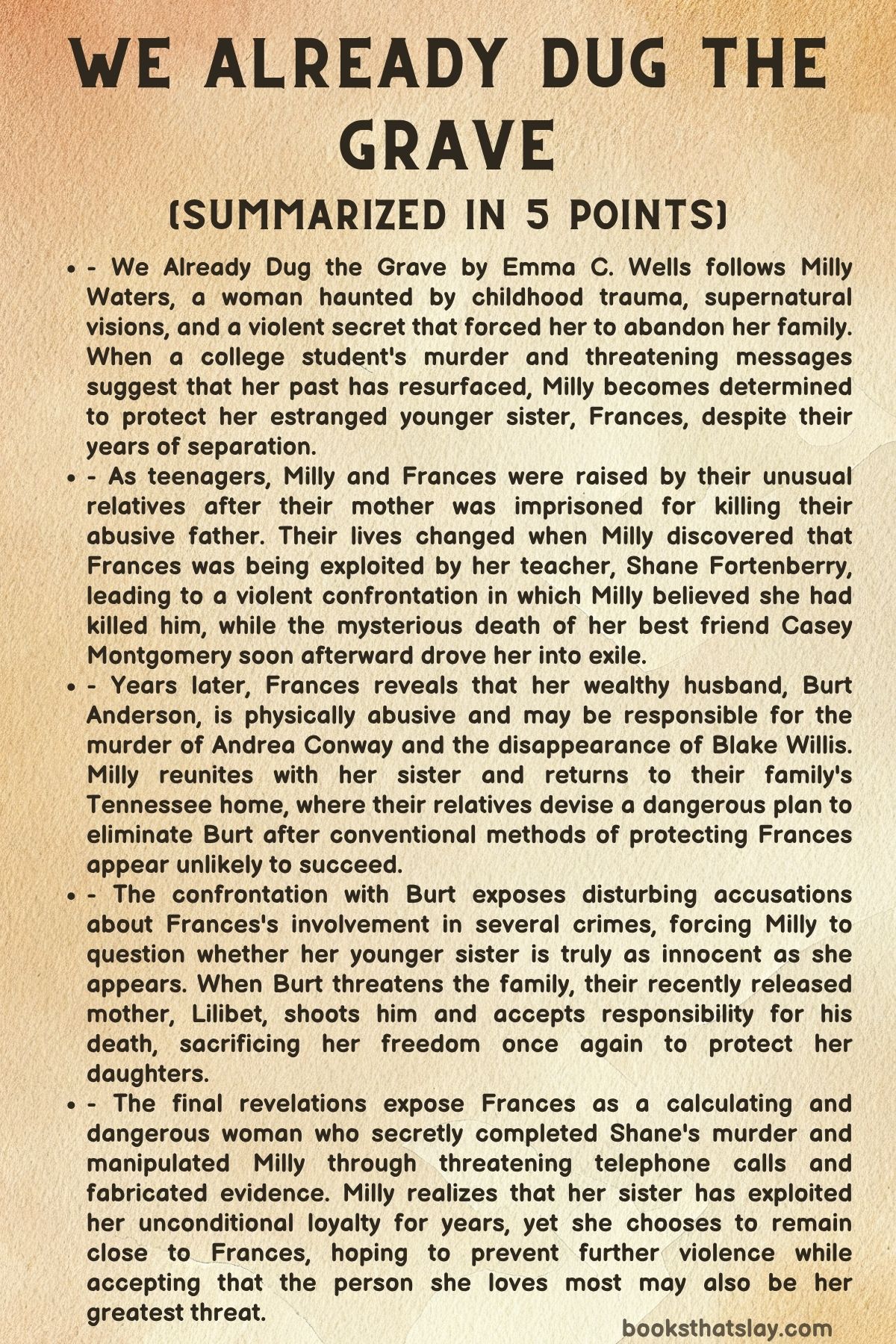
The story ends with Milly recognizing that her love for Frances has become both her greatest attachment and her greatest danger. Rather than abandoning her again, she decides to remain close enough to watch her, hoping to prevent further violence even as she understands that the sister she has spent her life protecting may be the person from whom others need protection.
Characters
Milly Waters
Milly Waters is the central protagonist of We Already Dug the Grave, a woman whose entire identity has been shaped by childhood trauma, overwhelming guilt, and her determination to protect her younger sister. Having witnessed her father’s abuse and experienced the consequences of her mother’s imprisonment, she grows up believing that love requires constant vigilance and personal sacrifice.
Her protective instincts become especially powerful after Frances enters an exploitative relationship with Shane Fortenberry. Although Milly understands the danger her sister faces, her attempts to intervene create resentment and ultimately lead to the violent confrontation that changes both their lives.
Milly possesses the Sight, a supernatural ability that allows her to glimpse possible futures through tea leaves. However, instead of providing her with certainty, the gift frequently intensifies her anxiety and makes her question whether she is responsible for the tragedies surrounding her.
Casey’s mysterious death represents the greatest emotional burden of her adolescence. Convinced that she accidentally caused his death through the family curse, she buries him secretly and abandons everyone she loves, choosing isolation as punishment for what she believes she has done.
As an adult, Milly lives modestly in Persimmon Key, deliberately avoiding emotional connections that might expose her past. Her return to Frances’s life forces her to confront the difference between protecting someone and allowing that person to manipulate her.
Her most significant transformation occurs when she discovers that Frances deliberately orchestrated the threats and concealed her involvement in Shane’s death. Milly finally recognizes that her sister’s apparent vulnerability has concealed intelligence, calculation, and a willingness to exploit others.
Rather than abandoning Frances, Milly decides to remain close enough to monitor her behavior. This decision demonstrates her enduring compassion but also leaves her future uncertain, suggesting that her sense of responsibility may continue to imprison her emotionally.
Frances Waters
Frances Waters is the most psychologically unsettling character in We Already Dug the Grave, initially appearing as a vulnerable younger sister whose life has been repeatedly threatened by predatory and abusive men. Her intelligence, emotional sensitivity, and difficult childhood make her seemingly dependent on Milly’s protection.
As a teenager, Frances struggles with loneliness and social rejection despite her extraordinary academic abilities. Shane Fortenberry exploits these insecurities by convincing her that their inappropriate relationship represents genuine love rather than manipulation.
Her resentment toward Milly emerges from the belief that her older sister constantly interferes with her independence. However, the gradual revelations suggest that Frances also understands how to exploit Milly’s guilt and protective instincts to obtain what she wants.
The events surrounding Shane’s death expose a deeply disturbing aspect of Frances’s personality. After Milly incapacitates him, Frances attacks him herself and eventually suffocates him, allowing her sister to believe she bears responsibility for the entire killing.
Her marriage to Burt Anderson introduces another complicated dimension to her character. Although Burt genuinely abuses and threatens her, Frances appears capable of participating in violence herself, making their relationship considerably more complicated than her initial account suggests.
Frances’s manipulation becomes undeniable when Milly discovers that she orchestrated the threatening telephone calls. By impersonating someone connected to Shane’s disappearance, Frances deliberately awakens Milly’s deepest fears and draws her back into their shared history.
The suspicion surrounding Casey’s death and other unexplained incidents further complicates Frances’s moral identity. The novel does not conclusively establish her responsibility for every disappearance, but it encourages readers to reconsider events previously interpreted through Milly’s unquestioning loyalty.
Frances ultimately represents the frightening possibility that a person can be genuinely victimized while also possessing a capacity for deliberate cruelty. Her declaration that Milly is her true soulmate transforms sisterly affection into something possessive, suggesting that she intends to maintain their relationship regardless of what Milly wants.
Lilibet Waters
Lilibet Waters is the mother of Milly and Frances, whose desperate attempts to escape domestic abuse establish the violent pattern that shapes the Robbins family’s history. In We Already Dug the Grave, she represents maternal devotion complicated by secrecy, desperation, and the belief that killing an abuser can be necessary for survival.
During her daughters’ childhood, Lilibet endures repeated violence from her husband, Chris. After unsuccessfully attempting to poison him, she shoots him, accepting the consequences of an action she believes will finally protect her children.
Her imprisonment separates her from Milly and Frances during their formative years, leaving the girls to grow up without their mother. Although her absence causes considerable suffering, her decision also reflects the limited choices she believes are available.
When Milly visits her after Casey’s death, Lilibet recognizes her daughter’s distress without demanding a confession. She advises Milly to disappear and establish a new identity, believing that separation from the family’s violent history may offer her a chance at safety.
Lilibet’s eventual reunion with her daughters reveals that her protective instincts remain unchanged. When Burt threatens Frances, she takes the gun from Milly and kills him, deliberately assuming the responsibility her daughter cannot bear.
Her willingness to return to prison demonstrates extraordinary sacrifice, but it also raises questions about whether her methods perpetuate the same suffering she hopes to end. Lilibet embodies the contradiction between selfless maternal love and the destructive consequences of answering violence with more violence.
Aunt Hattie-May
Aunt Hattie-May is one of the Robbins family’s oldest and most mysterious members, combining supernatural knowledge, medicinal expertise, and a morally flexible understanding of justice. We Already Dug the Grave uses her character to connect the family’s supernatural inheritance with its long history of concealed violence.
She helps Milly understand that her unusual premonitions are manifestations of the Sight rather than signs of mental instability. Her reassurance gives Milly a sense of belonging after the traumatic loss of her parents.
However, Hattie-May also possesses extensive knowledge of poisonous plants and methods of eliminating abusive men. Her willingness to discuss these matters practically suggests that she views violence against dangerous men as a form of protection rather than an extraordinary moral transgression.
Her relationship with the natural world is particularly significant through her fascination with the mourning willow. The unusual tree, sustained by decomposing remains, reflects her belief that death can nourish new life and that disturbing events can be absorbed into the natural order.
Her final revelation explains Casey’s missing body and the silver ring recovered from his grave. After discovering his remains, she secretly moves them to protect Milly, continuing the family’s tradition of concealing potentially devastating truths.
Hattie-May is motivated by genuine affection, yet her interventions repeatedly prevent others from confronting the consequences of their actions. She represents an older generation whose love is inseparable from concealment, control, and the belief that family members must be protected regardless of the truth.
Aunt Ruth
Aunt Ruth is a practical, fiercely protective member of the Robbins family who helps raise Milly and Frances after Lilibet’s imprisonment. Her stern personality and unconventional behavior initially intimidate Milly, but she gradually becomes one of the most reliable sources of affection and stability in the girl’s life.
Ruth understands the importance of the family’s frightening reputation and deliberately reinforces it through unusual decorations and intimidating appearances. The animal bones displayed around the property are less supernatural defenses than psychological barriers intended to discourage unwanted interference.
Her relationship with Bunny provides an example of love based on mutual respect and commitment. For Milly, this partnership offers a healthier model of intimacy than the abusive marriage she witnessed during childhood.
Despite her protective nature, Ruth participates in concealing Shane’s death and later helps organize the plan against Burt. Her willingness to break the law for her family demonstrates loyalty but also reinforces the moral ambiguity that defines the Robbins household.
Ruth’s importance becomes especially evident when she welcomes Milly home after years of separation. Her affection remains unchanged despite Milly’s disappearance, suggesting that family relationships can survive estrangement even when painful secrets remain unresolved.
Bunny
Bunny is Aunt Ruth’s partner and the owner of a local strip club, bringing humor, confidence, and practical resourcefulness into the Robbins household. Her flamboyant personality contrasts with the family’s darker history, although she proves equally willing to defend those she loves.
Her relationship with Ruth is especially meaningful because it challenges Milly’s childhood assumption that intimate relationships inevitably involve fear or domination. Their partnership demonstrates that loyalty can exist alongside individuality and mutual affection.
Bunny’s familiarity with Shane as a customer at her club helps expose the hypocrisy beneath his respectable public image. She also contributes practical knowledge and supplies when the family plans to eliminate Burt.
Although often associated with moments of comic relief, Bunny becomes an important participant in the family’s most dangerous decisions. Her character demonstrates how chosen family can become as powerful as blood relationships, both in offering emotional support and in participating in questionable acts of protection.
Casey Montgomery
Casey Montgomery is Milly’s childhood best friend and emerging romantic partner, representing the possibility of an ordinary, loving future beyond the violence surrounding her family. His kindness and emotional maturity distinguish him from the abusive men who dominate much of the novel.
As their friendship develops into romance, Casey provides Milly with a rare opportunity to experience affection without fear. Their growing closeness allows her to imagine a life in which she is valued for herself rather than solely for her responsibility toward Frances.
After learning about Shane’s death, Casey responds with compassion instead of judgment. He shares his own experience of using lethal force during a home invasion and reassures Milly that protecting someone from danger does not automatically make a person evil.
His gift of his mother’s silver ring becomes a powerful symbol of acceptance and emotional connection. The ring later acquires additional significance through its appearance among Frances’s possessions and its connection to Hattie-May’s concealment of his remains.
Casey’s mysterious death gives We Already Dug the Grave one of its most devastating emotional turning points. Although Milly believes the family curse caused his death, the unresolved circumstances leave open the possibility that human interference played a role.
Through Casey, the novel explores how guilt can destroy someone even when responsibility has never been conclusively established. His loss deprives Milly of a potentially happy future and becomes the central reason for her self-imposed exile.
Shane Fortenberry
Shane Fortenberry is a high school teacher whose respected public reputation conceals predatory behavior and manipulation. By pursuing a romantic relationship with fifteen-year-old Frances, he abuses his authority and exploits her loneliness and desire for acceptance.
He convinces Frances that he understands her exceptional intelligence and emotional struggles better than anyone else. This carefully cultivated intimacy makes it difficult for her to recognize the fundamentally exploitative nature of their relationship.
When Milly confronts him with photographic evidence, Shane initially attempts to bargain his way out of the situation. His subsequent attack on Frances destroys any illusion that his behavior is motivated by genuine love.
His death becomes the defining secret of the sisters’ adolescence, but the eventual revelation that Frances deliberately suffocated him changes its significance. Shane is both a predatory abuser and the victim of a killing whose full responsibility Milly never understood.
Burt Anderson
Burt Anderson is Frances’s wealthy, politically connected husband, whose attractive public image conceals cruelty, possessiveness, and physical abuse. His position within an influential family makes him especially dangerous because he can use money, reputation, and connections to intimidate those who challenge him.
Burt initially presents himself as a loving partner who admires Frances’s intelligence and personal history. Over time, his behavior becomes increasingly controlling, including sexual aggression, physical assaults, and threats designed to maintain his authority.
His fascination with Shane’s death and the Robbins family’s secrets reveals an attraction to violence that extends beyond ordinary jealousy. He appears to enjoy manipulating Milly’s fears and using the sisters’ traumatic history as a source of power.
However, his final accusations complicate his characterization by suggesting that Frances may be a willing participant in some of the violence attributed to him. Although his account cannot be accepted without question, later discoveries support the possibility that he understands Frances’s dangerous capabilities better than Milly does.
Burt ultimately represents the dangerous combination of domestic abuse and social privilege. His death ends the immediate threat he poses, but the revelations surrounding his marriage expose a deeper problem that cannot be resolved simply by eliminating him.
Chris Waters
Chris Waters is Milly and Frances’s abusive father, whose violence establishes the emotional foundation of the entire story. His unpredictable temper forces his wife and daughters to organize their lives around avoiding his anger.
Although he dies near the beginning of the narrative, the psychological consequences of his behavior continue influencing the family for decades. Milly’s fierce protectiveness, Frances’s vulnerability to manipulation, and Lilibet’s willingness to kill all develop in the shadow of his abuse.
Chris’s death also establishes the troubling precedent of violent resistance that subsequent generations repeat. Through him, the novel shows how an abusive person’s influence can persist long after their physical presence has disappeared.
Carla
Carla is Milly’s roommate in Persimmon Key, providing a connection to the ordinary life Milly has constructed away from her family. Her kindness becomes particularly visible when she finds Milly emotionally and physically overwhelmed after receiving threatening messages.
Believing that Milly is ill, Carla brings medicine, water, and crackers without demanding explanations. Her practical compassion contrasts with the secrecy and manipulation dominating Milly’s family relationships.
Although she does not understand the true source of Milly’s distress, Carla represents the possibility of uncomplicated human kindness. Her presence also emphasizes how successfully Milly has concealed her past from the people around her.
Larry
Larry is Milly’s employer at the Huddle Hut diner, where she works while maintaining her anonymous existence in Persimmon Key. He represents the routine responsibilities and financial limitations that define her adult life.
His role becomes important when he passes along the mysterious telephone message bearing Shane Fortenberry’s name. Although Larry has no apparent involvement in the threats, this ordinary workplace interaction becomes the event that begins dismantling Milly’s carefully maintained separation from her past.
Billy
Billy is a regular customer at the Huddle Hut who discusses the disappearance of two university students and the discovery of Andrea Conway’s body. His casual conversation introduces the murder investigation that eventually draws Milly back into her family’s dangerous history.
Billy serves as a reminder that disturbing events can enter someone’s life through seemingly harmless everyday interactions. He has no apparent understanding of the personal significance the news holds for Milly.
Andrea Conway
Andrea Conway is the murdered college student whose body is discovered near a creek in Moss Grove. Although she does not appear as an active participant in the main narrative, her death provides the immediate mystery that reconnects Milly with Frances.
Andrea initially appears to be a victim of a crime potentially connected to Blake Willis, but the investigation becomes more complicated as Burt and Frances emerge as possible participants. The revelations surrounding Frances raise serious doubts about the explanations Milly initially accepts.
Andrea also symbolizes the human cost of the violence surrounding the central family. Her death demonstrates that the sisters’ secrets and conflicts may endanger people who have no connection to their original trauma.
Blake Willis
Blake Willis is Andrea Conway’s missing boyfriend and the stepson of Shane Fortenberry. His disappearance becomes significant when Milly recognizes his connection to the teacher whose death she has spent years concealing.
As a child, Blake occasionally accompanied Shane to school activities, leaving Milly with memories that eventually help her identify him. His relationship with Shane provides an apparently meaningful connection between the contemporary murder investigation and the sisters’ adolescence.
Blake’s fate remains uncertain in the supplied account, but his disappearance contributes to the growing suspicion that someone is deliberately manipulating events around Milly. His character primarily functions as a link between two generations of concealed violence.
Allison Willis Fortenberry
Allison Willis Fortenberry is Blake’s mother and Shane Fortenberry’s wife. Although she remains largely outside the central action, her identity establishes the connection that transforms Andrea’s murder investigation into a personal threat for Milly.
Her family relationship also emphasizes the existence of another household affected by Shane’s dishonesty and disappearance. Through Allison, the story suggests that the consequences of his behavior extend beyond the Robbins family.
Mrs. Earline Baker
Mrs. Earline Baker is a woman who visits Milly for a tea-leaf reading during her adolescence. The bruise on her face suggests that she is being abused by her husband, Archie.
Her interaction with Hattie-May becomes significant when Milly overhears a conversation suggesting that her aunt may be offering a lethal solution to Earline’s problems. The subsequent death of Archie strengthens Milly’s suspicion that the Robbins women have been secretly eliminating abusive men for years.
Earline’s character demonstrates why the family’s violent practices may appear justified to women with few safe alternatives. Her circumstances also reflect Lilibet’s experience, connecting individual cases of abuse to the broader family history.
Archie Baker
Archie Baker is Mrs. Earline Baker’s abusive husband, whose death is announced shortly after his wife visits the Robbins household. Although the precise circumstances remain uncertain, Milly suspects that Hattie-May may have helped bring about his death.
Archie represents the abusive men whose behavior leads the Robbins women to develop their own methods of protection. His apparent disappearance from Earline’s life reinforces Milly’s fear that killing dangerous men has become an accepted family practice.
Nathan Clark
Nathan Clark is a boy who humiliates Frances during her adolescence by kissing her as part of a dare. His cruelty contributes to her feelings of rejection and makes Shane’s attention appear especially meaningful.
Although Nathan has a limited role, his actions help explain Frances’s emotional vulnerability at the time Shane begins manipulating her. He represents the casual cruelty of teenage social relationships and the lasting damage that humiliation can cause.
Walsh Anderson
Walsh Anderson is a former Alabama governor and an influential member of Burt’s family. His public recognition and political standing emphasize the wealth and institutional power surrounding the Anderson household.
The ceremony honoring Walsh becomes important because Milly notices Frances making their childhood distress signal during the televised event. His position also helps explain why Frances fears that ordinary legal action may be insufficient to protect her from Burt.
Themes
The Dangerous Boundaries Between Love, Loyalty, and Possession
In We Already Dug the Grave, love frequently becomes difficult to distinguish from responsibility, control, and possession. Milly’s relationship with Frances demonstrates how an apparently noble desire to protect another person can gradually become a source of emotional captivity.
From childhood, Milly assumes responsibility for Frances’s safety because their father’s abuse and their mother’s imprisonment force her into a protective role. This responsibility becomes so deeply connected to her identity that she struggles to imagine a meaningful existence outside her sister’s needs.
Her intervention in Frances’s relationship with Shane initially demonstrates legitimate concern. However, Frances interprets Milly’s behavior as controlling, creating tension between an older sister’s responsibility to intervene and a younger sister’s desire for independence.
The eventual revelation of Frances’s manipulation fundamentally changes this relationship. Frances understands that Milly’s love can be used to influence her decisions, and she deliberately exploits her guilt to force renewed contact.
Her declaration that the sisters are soulmates becomes especially disturbing because it suggests that she considers their connection permanent and exclusive. Rather than respecting Milly’s independence, Frances appears determined to maintain access to her protective loyalty.
The novel also examines this conflict through Lilibet and Hattie-May, whose affection leads them to commit or conceal acts of violence. Their actions are motivated by protection, but they also deprive younger family members of opportunities to confront difficult truths.
Milly’s final decision to remain near Frances captures the theme’s central ambiguity. She hopes to prevent future harm, yet her choice suggests that love may continue binding her to a relationship that threatens her emotional freedom.
The story ultimately questions whether devotion remains healthy when it requires constant sacrifice, secrecy, and the surrender of personal independence.
The Cycle of Domestic Violence and Its Lasting Consequences
Violence against women shapes the experiences of several generations of the Robbins family. Chris Waters’s abuse of Lilibet establishes a pattern in which fear becomes an ordinary feature of domestic life, influencing how his daughters understand safety, intimacy, and power.
Lilibet eventually kills Chris because she believes that ordinary escape is impossible. Although her action ends the immediate abuse, the resulting imprisonment separates her from her children and creates additional trauma that influences their development.
Milly grows up intensely fearful of violent men and determined to prevent Frances from experiencing similar suffering. Her reaction to Shane’s attack emerges from this history, making her violence understandable even as its consequences prove devastating.
Frances’s marriage to Burt repeats many characteristics of her parents’ relationship. His initial charm gives way to threats, domination, and physical cruelty, demonstrating how an abusive relationship can develop gradually beneath an attractive public appearance.
The novel also highlights the importance of social authority in protecting perpetrators. Shane’s respected position as a teacher makes him difficult to challenge, while Burt’s political connections create obstacles to obtaining justice.
Against this background, the Robbins women establish their own methods of dealing with abusive men. Poisoning, concealment, and direct violence become alternative forms of justice within a community where they doubt that official institutions will protect them.
However, these responses create their own destructive inheritance. Each killing produces new secrets, emotional burdens, and practical dangers that younger family members must eventually confront.
The contrast between Milly and Frances also demonstrates that exposure to violence does not produce identical responses. Milly becomes burdened by guilt and fearful of harming others, while Frances develops a disturbing fascination with power and violence.
By showing these contrasting outcomes, the novel examines how trauma can influence behavior without making every subsequent action inevitable or morally excusable.
Fate, Supernatural Abilities, and the Power of Personal Choice
The Sight creates an ongoing conflict between supernatural destiny and individual responsibility. Throughout We Already Dug the Grave, Milly struggles to determine whether the tragedies surrounding her result from unavoidable predictions or from decisions made by the people she loves.
Her childhood premonition of her father’s death establishes that the supernatural ability can reveal meaningful information about approaching events. However, the vision does not provide enough context for her to understand what will happen or prevent it.
The family’s rules suggest that knowledge of the future can itself become dangerous. In particular, the prohibition against examining the fate of one’s most beloved person creates an atmosphere in which affection, fear, and supernatural punishment become closely connected.
Milly’s belief that she caused Casey’s death demonstrates the psychological consequences of this uncertainty. Because she experienced an involuntary vision while kissing him, she assumes responsibility for his unexplained death without possessing clear evidence of causation.
This conviction destroys her relationship with her family and leads to years of isolation. Her suffering therefore arises not only from what happened to Casey but also from the interpretation she imposes upon the event.
As the novel progresses, Frances questions whether the family’s supposed curses may actually conceal deliberate human actions. The revelation that she intentionally killed Shane supports this possibility, exposing how supernatural explanations can obscure personal responsibility.
The Sight’s repeated references to Frances acquire a different meaning once Milly understands her sister’s behavior. What initially appears to be a warning about someone needing protection becomes a warning about someone capable of causing harm.
The novel does not completely reject the supernatural, since Milly’s abilities repeatedly reveal information she could not otherwise know. Instead, it questions whether knowing something about the future makes that outcome inevitable.
Ultimately, the story suggests that supernatural knowledge cannot eliminate the importance of judgment, responsibility, and conscious choice.
Family Secrets, Guilt, and the Destructive Nature of Hidden Truths
Secrecy operates as one of the Robbins family’s primary methods of survival. Across generations, relatives conceal violence, manipulate evidence, and suppress uncomfortable information because they believe that protecting family members is more important than revealing the truth.
Milly’s experience following Shane’s death demonstrates how this tradition can create lasting psychological damage. Although she acts to protect Frances, the adults respond by concealing the incident rather than allowing her to understand its full circumstances.
Because Milly never learns that Frances deliberately completed Shane’s killing, she carries guilt for an act whose true details remain hidden from her. This false understanding shapes her identity and contributes to her eventual disappearance.
Casey’s death creates an even more destructive secret. Believing that she caused his death through a supernatural curse, Milly buries him without seeking help and subsequently abandons the people who might have supported her.
Hattie-May later discovers Casey’s remains and secretly relocates them, believing she is protecting Milly. Her decision prevents the discovery from becoming public but also removes the possibility of establishing an explanation for Casey’s death.
Frances’s manipulation demonstrates an even more sinister use of secrecy. Unlike relatives who conceal information to prevent punishment, she deliberately manufactures false information to influence Milly’s behavior and maintain control over their relationship.
The threatening telephone calls, hidden evidence, and misleading accusations surrounding Burt all reveal how easily Milly can be manipulated when she lacks reliable knowledge. Her willingness to trust Frances makes her especially vulnerable to these distortions.
The mourning willow provides a powerful symbol of the family’s relationship with concealed truths. Its growth depends on buried remains, suggesting that the family continues to sustain itself through the hidden consequences of earlier violence.
The final revelations expose the limitations of a family culture built around silence and unconditional protection. Although secrets may prevent immediate suffering, they also preserve dangerous misunderstandings and allow harmful behavior to continue.
By ending with Milly aware of Frances’s capacity for deception but still determined to remain near her, the novel presents an unsettling conclusion in which knowledge brings responsibility rather than freedom.