The Sweetest Fiend Summary, Characters and Themes
The Sweetest Fiend by Raven Kennedy is a dark fantasy romance that reimagines the legend of the Pied Piper in a world devastated by supernatural Plagues, ancient magic, and deep-rooted prejudice.
The novel follows Esti Calyx, a young fiend who struggles to protect her family while facing discrimination because of her dangerous ancestry. Her life changes dramatically when she encounters Varrik, a powerful Core fae whose extraordinary music can control living creatures. As their complicated relationship develops, the story explores forbidden love, personal freedom, sacrifice, identity, and the consequences of trusting someone whose loyalties remain uncertain. It’s the first book of the Played by the Piper series.
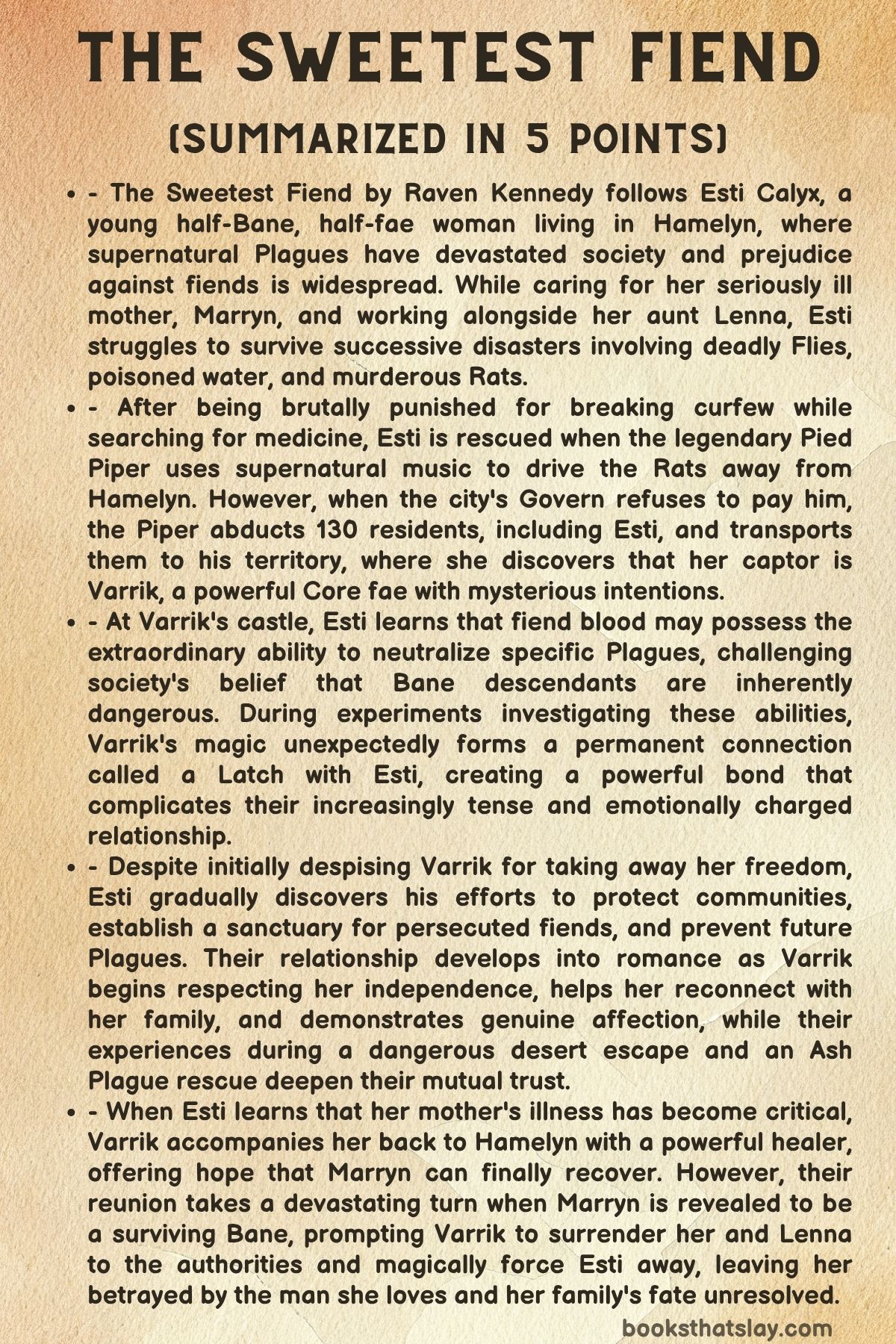
Summary
Thirty years before the central events of The Sweetest Fiend, a catastrophic rupture tears through the world of Brekon, transforming its magical foundations and destroying countless lives. The disaster occurs when the earth can no longer contain the excessive magical energy placed inside it by the Fates, releasing devastating power and nine terrifying creatures known as Banes.
Among the survivors is Varrik, a young soldier who witnesses the destruction of his military compound and the death of his younger brother, Trigg. Although molten lava engulfs him, Varrik survives by absorbing extraordinary magical energy, becoming one of the powerful beings subsequently known as Core fae.
The Banes are eventually defeated, but their destruction leaves nine supernatural Plagues that repeatedly devastate Brekon. Their descendants, called fiends, inherit characteristics of their Bane ancestors and become targets of widespread fear and hatred.
Years later, Esti Calyx lives in Hamelyn with her chronically ill mother, Marryn, and her devoted aunt, Lenna. Esti is a fiend whose glittering horns and unusual appearance make her vulnerable to discrimination, forcing her to conceal her identity whenever she ventures outside.
She works at a paper mill alongside Lenna, helping support their struggling household while searching for treatments for Marryn’s mysterious convulsions. Despite the hostility surrounding her, Esti remains compassionate and possesses an unusual magical ability to perceive constellations that reveal aspects of people’s personalities.
Hamelyn has already endured months of devastation from the Plague of Flies when an unnatural storm brings poisonous black rain. The new Poison Plague contaminates the city’s water, leaving frightened citizens desperate for survival.
Lord Havlon, the city’s Govern, responds by placing the remaining clean water under government control and demanding payment from residents. His decision increases tensions, particularly among impoverished families who cannot afford the supplies necessary to survive.
Esti and Lenna manage to purchase water, but their journey home is interrupted by men who threaten to steal it. Esti’s former boyfriend, Theo, intervenes, forcing her to confront memories of a relationship that ended painfully when he chose another woman, Gisela.
Although Theo offers protection, his presence reminds Esti of the friendships and acceptance she lost after their separation. She gradually recognizes that her former relationship was shaped by his discomfort with her fiend identity and her own fear of never being loved again.
Meanwhile, Marryn’s convulsions become increasingly severe, and Esti desperately searches Hamelyn for medicine. Her attempt to obtain treatment extends beyond curfew, leading to her arrest by a patrolman who openly despises fiends.
The officer chains Esti to a public punishment post and brutally whips her, leaving her seriously injured and unable to escape. Before anyone can rescue her, the Plague of Rats arrives, sending enormous swarms of murderous creatures through the city.
Esti survives by climbing to the top of the punishment post while the Rats overwhelm the streets below. After spending a terrifying night suspended above the creatures, she hears mysterious music that begins controlling their movements.
The musician is the legendary Pied Piper, a Core fae whose supernatural melodies can command living beings. He drives the Rats away and rescues Hamelyn, but his intervention soon reveals a disturbing price.
When Havlon refuses to pay the Piper thirty thousand coins for his services, the musician claims people as an alternative payment. Using his magic, he compels 130 residents, including Esti, Theo, and Kaetir, to leave Hamelyn against their will.
The captives are transported across Dolven Bay and forced to travel under the supervision of the Piper and his powerful companions. Esti remains determined to escape because she fears that Marryn will die without her assistance.
During the journey, Esti discovers that the Piper’s real name is Varrik, although she initially knows him only as her frightening captor. His behavior appears contradictory, alternating between harsh commands, possessive attention, and unexpected concern for her injuries.
When Esti attempts to flee, Varrik effortlessly recaptures her through his magical music. Her frustration grows because she understands that even her physical movements can be controlled without her permission.
The prisoners eventually travel through a magical leyline and reach Penbroge Castle, Varrik’s residence and the center of his territory. Although the castle is beautiful and its inhabitants appear well cared for, Esti remains convinced that she has entered another form of imprisonment.
Her untreated whipping wounds become infected, placing her life in immediate danger. After discovering that a healer is subjecting her to intolerable suffering, Varrik intervenes, removes her from the treatment room, and personally ensures that she receives appropriate care.
As Esti recovers, she gradually learns more about Varrik’s companions, including Lacera, whose magic temporarily suppresses pain, and Ciona, who can identify unusual properties of blood. Ciona becomes particularly interested in Esti after discovering that her blood possesses characteristics she cannot immediately explain.
Esti also discovers that the abducted fiends are being housed separately from ordinary fae. Although they receive food, clothing, and comfortable accommodations, their uncertain future continues to trouble her.
After confronting Varrik repeatedly about the captives, Esti learns that he has been collecting fiends from different settlements throughout Brekon. His explanations suggest that his actions serve a purpose beyond the collection of debts, but he initially refuses to reveal his complete plan.
The mystery begins unraveling when the fiends are transported to Midoraye Burg, where Ciona has established a controlled environment for studying different Plagues. She reveals evidence that the blood of fiends may neutralize the Plagues associated with their particular Bane ancestry.
The discovery challenges the widespread belief that fiends are inherently dangerous or responsible for Brekon’s suffering. Instead, the very people society has persecuted may possess the power necessary to save civilization.
Testing confirms that Kaetir’s blood can combat the Flies, while Rimona’s blood extinguishes supernatural Fire. Other fiends demonstrate similar abilities, although Esti’s blood does not react to the Plagues against which it is tested.
During the experiments, Varrik unexpectedly tastes blood from Esti’s injured arm, triggering a powerful magical connection. He explains that his Core magic has formed a Latch with her, establishing an enduring bond between their life forces.
Because Core fae contain more magic than their bodies can naturally sustain, Latches help stabilize their powers and prevent dangerous physical deterioration. However, no Core fae has previously formed such a connection with a fiend, making Esti and Varrik’s situation unprecedented.
Esti is furious because the bond develops without her consent and may permanently alter her life. Although Varrik promises that it will strengthen her body and slow her aging, she fears becoming even more dependent on someone who already controls her freedom.
Her desperation eventually leads to another escape attempt, this time by disguising herself as a servant and entering a leyline. Instead of returning to Hamelyn, she emerges in a dangerous desert inhabited by enormous serpentine creatures.
Varrik follows and saves her from one of the monsters, but another creature attacks and poisons him. Esti kills the beast and struggles to carry Varrik to safety, discovering through her fear of losing him that her feelings have changed.
Believing that Varrik is dying, Esti finally admits that she no longer hates him, and they share their first passionate kiss. Varrik later reveals that the venom will not kill him, and their experience leads to an important conversation in which he apologizes for his earlier treatment of her.
After returning to Penbroge, Varrik becomes more willing to respect Esti’s wishes and explain his intentions. When she finally tells him about Marryn’s illness, he arranges for a letter to be sent to her family in Hamelyn.
Their relationship develops further during a romantic dinner and subsequent visits to Wystinn Burg, a settlement established for the displaced captives. Esti discovers that the community offers housing, employment, relative safety, and opportunities for fiends and ordinary fae to live together without the same social divisions.
She also learns that Varrik hopes the settlement will allow more Core fae to find compatible Latches. His seriously ill friend Birute demonstrates the terrible consequences of possessing unstable Core magic without such a connection.
Although Esti increasingly appreciates Varrik’s intentions, she continues objecting to his methods of taking people without their consent. She also persuades him to release Theo from confinement, demonstrating that her commitment to fairness extends even to someone who previously hurt her.
Meanwhile, Ciona suspects that Esti may descend from the Bane associated with the mysterious Darkness Plague. Before the possibility can be investigated, an Ash Plague strikes Beddig Burg, forcing Varrik and his companions to organize an emergency rescue.
Esti accompanies them and witnesses the terrible consequences of the supernatural disaster. Varrik exhausts himself using his music to guide hundreds of trapped citizens toward safety, while Esti assists frightened survivors and helps comfort a young child.
Although many residents escape, others die, reinforcing the extraordinary dangers facing Brekon. Esti begins fully understanding why Varrik considers his work essential and recognizes the compassion beneath his intimidating personality.
Their growing affection eventually becomes a romantic and physical relationship built on increasing openness. Varrik demonstrates that his music can exist without magical compulsion, while Esti begins feeling genuinely beautiful and accepted because he appreciates the features she once struggled to conceal.
Their happiness is interrupted when a letter arrives from Hamelyn. Lenna confirms that she and Marryn survived the Rat Plague, but reveals that Marryn’s convulsions have become dangerously frequent and her health continues declining.
Varrik immediately promises to help and arranges a journey to Hamelyn with Conrad, a Core fae whose healing abilities may save Marryn. Esti travels home filled with relief, hope, and gratitude toward the man she now believes she can trust.
After reaching Hamelyn, Esti reunites with Lenna and Marryn, but their happiness is interrupted when Lord Havlon arrives with armed patrolmen. Furious about Varrik’s unauthorized return, Havlon threatens Esti’s family and confronts the rival Govern.
During the confrontation, the weakened Marryn begins collapsing, prompting Varrik to catch her. Their physical contact produces an extraordinary magical reaction, causing pale antlers to emerge from Marryn’s head and revealing that she is actually a surviving Bane.
The revelation transforms the situation immediately because the Banes were believed to have been destroyed decades earlier. Havlon orders the arrest of Marryn, Esti, and Lenna, while Esti desperately begs Varrik to protect the family he promised to save.
Instead, Varrik unexpectedly uses his music to compel Marryn and Lenna toward the authorities. When Esti attempts to seize his pipe and stop him, she discovers that he can control people through whistling as well.
Varrik allows the patrolmen to take her mother and aunt into custody while preventing Esti from following them. His actions destroy the trust they have developed and return Esti to the helplessness she experienced when he originally abducted her.
The novel ends with Varrik forcing Esti to leave Hamelyn despite her desperate protests. As she is carried away, Esti remembers the constellation she once read in his stars, which identified him as a defender, a thief, and a liar, leaving their relationship shattered by betrayal and her family’s fate unresolved.
Characters
Esti Calyx
Esti Calyx is the central protagonist of The Sweetest Fiend, a young woman whose compassion, determination, and strong moral convictions distinguish her in a society that judges people according to their ancestry. As a half-Bane, half-fae individual, she has spent much of her life concealing her glittering horns and enduring discrimination from people who consider fiends inherently dangerous.
Despite the constant hostility, Esti maintains a remarkable capacity for kindness. She helps strangers, supports her family through exhausting work at the paper mill, and consistently places the needs of vulnerable people above her own comfort.
Her devotion to Marryn is especially important because it motivates nearly every major decision she makes. She risks punishment to obtain medicine, repeatedly attempts to escape Varrik’s captivity, and refuses to abandon the hope of returning home.
Esti’s emotional insecurities are revealed through her former relationship with Theo. His discomfort with her appearance and social position caused her to question her worth, making her initially uncertain whether anyone could love her without expecting her to change.
Her relationship with Varrik gradually challenges those insecurities, particularly because he openly admires the physical characteristics she has been taught to hide. Nevertheless, her attraction never completely eliminates her objections to his controlling behavior.
Esti also possesses an unusual ability to see constellations that reveal aspects of people’s personalities. This power reflects her sensitivity toward human nature while emphasizing that she possesses qualities beyond those traditionally associated with fiends.
Her experiences force her to confront difficult questions about personal freedom, forgiveness, and the difference between someone’s intentions and actions. The ending places her greatest moral convictions under pressure when Varrik betrays her trust and prevents her from protecting her family.
Varrik / The Pied Piper
Varrik is the powerful and morally complicated male protagonist of The Sweetest Fiend, whose extraordinary musical abilities make him one of the most influential Core fae in Brekon. Known throughout the world as the Pied Piper, he can control living creatures through supernatural melodies, giving him tremendous authority over both enemies and ordinary citizens.
His personality is shaped by the devastating rupture that transformed him into a Core fae and killed his younger brother, Trigg. The loss leaves him with deep emotional wounds, bitterness toward the Fates, and a tendency to conceal vulnerability beneath aggression and authority.
As Govern of Penbroge, Varrik accepts responsibility for protecting communities from the supernatural Plagues. His efforts to gather fiends, investigate their blood, and establish Wystinn demonstrate that he possesses a genuine commitment to saving lives.
However, his methods create serious ethical problems because he frequently treats his extraordinary power as justification for controlling others. His abduction of Hamelyn’s residents and repeated use of music against Esti reveal his willingness to violate individual freedom when he believes his objectives require it.
His developing attraction to Esti exposes a more tender side of his personality. He cares for her injuries, helps restore contact with her family, and gradually attempts to respect her independence.
The formation of their Latch creates an additional complication because their connection is both magical and emotional. Varrik insists that their romance remains a matter of choice, yet his behavior repeatedly demonstrates how difficult he finds surrendering control.
His betrayal at the conclusion becomes particularly devastating because it follows his apparent emotional growth. By surrendering Marryn and Lenna to the authorities and compelling Esti to leave, he demonstrates that his deepest loyalties and motivations remain unresolved.
Marryn Calyx
Marryn Calyx is Esti’s mother and one of the most emotionally significant characters in The Sweetest Fiend. Her devotion to her daughter offers a powerful contrast to the widespread hostility that fiends experience throughout Brekon.
Although she suffers from a mysterious illness that causes increasingly dangerous convulsions, Marryn remains a source of emotional strength. She consistently rejects society’s hateful assumptions about Esti and encourages her daughter to recognize her own worth.
Their relationship is characterized by sacrifice, affection, and mutual concern. Esti spends much of her life attempting to protect Marryn, while her mother offers reassurance even when her physical condition becomes almost unbearable.
Marryn’s illness establishes much of the novel’s emotional urgency because Esti fears that every delay in returning home could cost her mother’s life. Her apparent helplessness also makes the final revelation especially surprising.
When contact with Varrik reveals that Marryn is actually a surviving Bane, her character becomes central to the larger mystery surrounding the world’s history. Her transformation raises questions about the supposed destruction of the Banes, the origins of the Plagues, and the true nature of Esti’s ancestry.
The revelation complicates the reader’s understanding of good and evil because Marryn’s loving behavior contradicts everything society believes about the Banes. Her arrest leaves her future uncertain and creates the central emotional conflict of the ending.
Aunt Lenna
Aunt Lenna is Esti’s practical, outspoken, and fiercely protective aunt, whose loyalty gives the Calyx household much of its stability in The Sweetest Fiend. Working beside Esti at the paper mill, she helps support the family financially while sharing responsibility for Marryn’s increasingly demanding care.
Lenna possesses a direct manner and rarely hesitates to challenge people who mistreat her niece. Her confrontation with Theo demonstrates her refusal to accept his inconsistent concern for Esti after their painful separation.
Although Lenna is not especially demonstrative with affection, her actions consistently reveal how deeply she cares. She comforts Esti during moments of insecurity, helps obtain desperately needed supplies, and remains devoted to Marryn during the Plagues.
Her courage becomes especially apparent when she sends a letter demanding Esti’s release from the Pied Piper. By offering to repay the supposed debt, she demonstrates that she will challenge even a powerful Core fae to protect her family.
Lenna also represents the importance of ordinary individuals who survive through persistence rather than supernatural abilities. Her eventual arrest alongside Marryn exposes the vulnerability of people caught between competing magical authorities.
Theo / Theodwin
Theo is Esti’s former romantic partner, whose relationship with her reveals the damaging consequences of social prejudice and emotional insecurity. Initially, he offers Esti the companionship and acceptance she rarely receives elsewhere, introducing her to a circle of friends that makes her feel included.
However, his affection is limited by his desire for social approval and his discomfort with aspects of her fiend identity. His criticisms of her appearance, clothing, and circumstances gradually undermine her confidence.
Theo eventually ends their relationship because he wants a future with Gisela. Although he does not begin the new relationship before ending the previous one, Esti experiences the separation as a profound rejection.
His influence extends beyond their romance when Esti learns that he discouraged their mutual friends from maintaining contact with her. This revelation demonstrates how much control he exercised over her social life.
Nevertheless, Theo is not presented as entirely cruel or indifferent. He helps protect Esti from threatening men and expresses genuine concern for her safety during their captivity.
His imprisonment at Wystinn provides an opportunity for Esti to demonstrate moral independence. By persuading Varrik to release Theo, she shows that she no longer needs either man’s approval to decide what is right.
Kaetir
Kaetir is a fiend who belongs to Esti’s former circle of acquaintances and becomes an important companion during their captivity. Unlike Theo, his interactions with Esti gradually develop into a more supportive friendship.
His experiences reveal how fiends often grow up without the security of loving families. Having lived in an abandonment house, he understands the consequences of being rejected because of Bane ancestry.
Kaetir also provides Esti with information about the other captives and their living conditions. His willingness to communicate openly helps her navigate the uncertainty surrounding Varrik’s plans.
During Ciona’s experiments, Kaetir discovers that his blood can neutralize the Plague of Flies. This discovery gives his ancestry a potentially lifesaving purpose and challenges the belief that fiends represent a danger to society.
His eventual happiness in Wystinn demonstrates the possibility of creating communities where people are valued for their abilities and character rather than condemned for their origins.
Ciona
Ciona is an intelligent and resourceful Core fae whose investigations become essential to understanding the supernatural Plagues. Her unusual magical ability allows her to analyze the properties of blood through scent, making her particularly valuable in studying the relationship between the Banes and their descendants.
Unlike many inhabitants of Brekon, Ciona approaches fiends primarily with curiosity rather than hostility. She recognizes that their ancestry may contain answers to problems that conventional magical power has failed to solve.
Her experiments reveal that particular fiend bloodlines can neutralize specific Plagues. The discovery challenges established beliefs about the nature of fiends and suggests that the world’s most persecuted population may hold the key to its survival.
Ciona is also aware that scientific discovery can create opportunities for exploitation. Her insistence on secrecy reflects her understanding that revealing the value of fiend blood could expose vulnerable individuals to trafficking and violence.
Her suspicion that Esti may descend from the Darkness Bane introduces another mystery. Through her work, Ciona represents knowledge as a possible means of overcoming prejudice, although her research also raises questions about consent and the treatment of experimental subjects.
Lacera
Lacera is a Core fae whose supernatural needles allow her to manipulate pain and provide temporary relief from physical suffering. She becomes particularly important after Esti suffers severe injuries from the patrolman’s whipping.
Her interventions allow Esti to endure the journey to Penbroge and function despite her damaged back. However, Lacera’s abilities do not immediately cure the underlying injuries, exposing the limitations of her particular form of magic.
She generally behaves with greater patience toward Esti than some of Varrik’s other companions. Their conversations also provide information about the catastrophic rupture and the experiences of those transformed into Core fae.
Lacera frequently serves as a practical intermediary between Esti and Varrik. Her involvement in medical care, blood examinations, and important deliveries makes her a dependable supporting presence throughout the story.
Conrad
Conrad is a powerful Core fae and neighboring Govern whose healing abilities make him an invaluable ally. His playful personality and relaxed approach to conversation contrast with Varrik’s stern and frequently intimidating behavior.
He enjoys provoking Varrik through jokes and affectionate insults, revealing the depth of their friendship. Their interactions allow Esti to see that Varrik can experience companionship and humor outside his responsibilities as a ruler.
Conrad’s magical healing proves particularly important when he treats Esti’s damaged back. His intervention finally resolves the physical injuries that have caused her suffering since her punishment in Hamelyn.
He also offers hope when Esti reveals the severity of Marryn’s illness. By agreeing to accompany the group to Hamelyn, he becomes associated with the possibility of restoring the family’s stability.
His account of surviving the original rupture adds another dimension to his character. Already suffering from a mysterious illness before the catastrophe, Conrad experienced the transformation into a Core fae as both an escape from death and a traumatic ordeal.
Frid
Frid is one of Varrik’s trusted Core fae companions, distinguished by extraordinary physical strength. His imposing abilities make him essential to maintaining security during the transportation of captives and the management of dangerous situations.
Although his strength can intimidate prisoners, Frid also uses it to protect others. During the Ash Plague at Beddig, he forces open blocked entrances and assists in the evacuation of endangered residents.
His interactions with Esti frequently reveal a practical and skeptical personality. When she rescues a stray cat, his commentary provides humor without undermining the seriousness of her compassion.
Frid represents the importance of loyalty and dependable action within Varrik’s inner circle. His presence reinforces the idea that extraordinary abilities can serve both coercive authority and genuine public protection.
Garren
Garren is a powerful Core fae associated with water manipulation and one of Varrik’s most reliable companions. His abilities contribute to the elimination of the Poison Plague in Hamelyn, demonstrating the practical importance of Core magic in protecting settlements.
He is introduced as a quiet, suspicious figure who catches Esti attempting to escape from the campsite. His alertness makes him an effective guard, particularly when prisoners attempt to exploit moments of reduced supervision.
Garren’s reserved behavior distinguishes him from the more outspoken members of Varrik’s circle. He generally relies on vigilance and action rather than lengthy explanations.
His participation in rescue operations also reveals that his responsibilities extend beyond enforcing Varrik’s authority. Like the other Core fae, he occupies a morally complicated position as both a protector and an agent of coercion.
Lord Havlon
Lord Havlon is the Govern of Hamelyn and an important representation of political authority corrupted by self-interest. Although he possesses Core magic capable of extinguishing supernatural Fire, his abilities prove inadequate against the succession of Plagues threatening his citizens.
His response to the Poison Plague exposes his questionable leadership. Rather than ensuring that clean water reaches the most vulnerable residents, he places the remaining supplies under official control and demands payment.
Havlon’s decision contributes to growing desperation and unrest throughout the city. His refusal to pay the Pied Piper after accepting his assistance leads directly to the forced removal of 130 residents.
His hostility toward Varrik reflects both political rivalry and resentment over the consequences of their earlier agreement. He prioritizes his authority even when confronting circumstances that demand cooperation.
At the conclusion, Havlon responds to Marryn’s revealed identity by ordering the arrest of her entire family. His behavior demonstrates how established institutions can exploit public fear to justify harsh treatment of people considered dangerous.
Rimona
Rimona is a fiend who becomes one of Esti’s companions after the prisoners are brought together in Varrik’s territory. Having previously lived in the same abandonment house as Kaetir, she understands the isolation experienced by people rejected because of their Bane ancestry.
Her developing friendship with Esti creates a sense of companionship during an uncertain period. Through Rimona, Esti gains a broader understanding of the experiences of fiends who did not have supportive families.
During the blood experiments, Rimona discovers that her blood can extinguish supernatural Fire. The discovery gives her a new understanding of her ancestry and its potential importance.
Her eventual happiness in Wystinn demonstrates the positive effects of acceptance, opportunity, and community.
Nell
Nell is an outspoken fiend whose hostility reflects years of discrimination and resentment toward ordinary fae. She is particularly suspicious of Varrik’s intentions and refuses to interpret comfortable accommodations as proof of genuine benevolence.
Her confrontations with Esti reveal divisions among the captives. Nell resents what she perceives as preferential treatment and suspects that Esti’s relationship with Varrik gives her advantages unavailable to others.
When Ciona explains the possible importance of fiend blood, Nell questions why fiends should risk themselves to save the society responsible for their persecution. Her reaction raises a legitimate moral question about the responsibilities of people who have been systematically mistreated.
Although Nell can be antagonistic, her anger represents the accumulated consequences of injustice rather than simple malice. She reminds readers that rebuilding trust requires more than offering protection or material comfort.
Odelina
Odelina is a fiend whose response to Ciona’s experiments contrasts with Nell’s anger and suspicion. She recognizes the possibility that their blood may save countless lives and believes that participating in the research offers a meaningful opportunity.
Her outlook demonstrates that people who experience similar discrimination do not necessarily respond in identical ways. While some feel justified in withholding assistance from their persecutors, Odelina emphasizes the value of preventing further suffering.
She contributes to the broader moral discussion surrounding the experiments by representing hope, cooperation, and the possibility of positive change.
Birute
Birute is a seriously ill Core fae whose deteriorating condition illustrates the dangers associated with possessing unstable magical power. After expending enormous energy to stop a Hail Plague, his body becomes severely weakened.
Because he has not found a compatible Latch, his magic continues threatening his survival. His circumstances demonstrate that even extraordinarily powerful individuals remain vulnerable to forces they cannot completely control.
Despite his suffering, Birute maintains a sarcastic sense of humor and exchanges friendly insults with Varrik. Their interactions suggest a longstanding relationship grounded in shared experiences and mutual understanding.
Birute’s condition also gives greater urgency to Varrik’s efforts to gather potential Latches. Through him, the novel shows that protecting Brekon requires preserving the lives of those capable of combating its supernatural threats.
Trigg
Trigg is Varrik’s younger brother, whose death during the original rupture has an enduring influence on the story. The brothers are training together when the catastrophe destroys their military compound, separating them amid the chaos.
Varrik desperately searches for Trigg after surviving the lava, eventually identifying his remains through a boot marked with blue paint. This small detail emphasizes the ordinary affection and shared memories that existed between the brothers.
Although Trigg dies before the central events, his absence shapes Varrik’s emotional life. The grief associated with losing him contributes to Varrik’s bitterness toward the Fates and his reluctance to reveal personal vulnerabilities.
Trigg’s memory also connects Varrik’s love of music to his childhood, since their mother taught both brothers to play.
Gisela
Gisela is Theo’s current romantic partner and an important figure in Esti’s emotional history. Her relationship with Theo represents the future he chose after ending his romance with Esti.
Although Esti initially associates Gisela with rejection and abandonment, Gisela herself behaves with unexpected kindness. Her considerate treatment prevents Esti from viewing her simply as a romantic rival.
Gisela’s character highlights the difference between the pain created by a relationship and the individual who becomes involved afterward. Her presence helps reveal Esti’s unresolved insecurities without portraying every person connected to Theo as malicious.
Wend
Wend is a servant at Penbroge Castle whose attitude toward Esti reflects the prejudice against fiends that exists even within Varrik’s comparatively progressive territory. She responds to Esti’s horns with religious condemnation and unmistakable disapproval.
Her behavior demonstrates that social hostility cannot be eliminated merely through changes in political leadership. Even in a comfortable environment, Esti continues encountering people who judge her ancestry rather than her actions.
Wend’s judgmental presence also contrasts with Varrik’s growing appreciation of Esti’s appearance. She represents the persistence of inherited prejudice in everyday interactions.
Frena
Frena is one of the servants assigned to assist Esti during her recovery at Penbroge Castle. Unlike Wend, she generally treats Esti with kindness and consideration, helping her bathe, dress, and adjust to unfamiliar surroundings.
Her presence provides Esti with moments of ordinary courtesy during a period defined by uncertainty and confinement. Frena also becomes unintentionally involved in Esti’s escape when the protagonist manipulates a clothing exchange to disguise herself as a servant.
Although her role is relatively limited, she demonstrates that compassion and prejudice can exist side by side within the same household.
Ryn
Ryn is another servant responsible for assisting Esti at Penbroge Castle. She helps provide the practical comforts and personal attention that Esti has rarely experienced while living in poverty.
Her comparatively considerate behavior distinguishes her from Wend and contributes to the castle’s atmosphere of unexpected hospitality. Although she does not receive extensive individual development, her role helps establish the contrast between Esti’s previous life and her circumstances at Penbroge.
Rance
Rance is a member of Theo’s social circle who appears during Esti’s confrontation with the men attempting to steal her water. His presence helps discourage the aggressors from attacking Esti and Lenna.
He also belongs to the network of acquaintances associated with Esti’s earlier relationship. Although the account provides limited information about his personality, his inclusion reinforces the social world Esti loses following her breakup with Theo.
Yordon
Yordon is another acquaintance associated with Theo and the group that intervenes when Esti and Lenna are threatened. His participation contributes to the collective show of support that causes the aggressors to withdraw.
Like Rance, Yordon represents the wider friendship circle from which Esti becomes increasingly separated. His role is comparatively small, and the available events do not establish an extensive independent character arc.
Hektor
Hektor is a fellow soldier who dies during the catastrophic rupture that transforms Varrik into a Core fae. His body is consumed by lava as the military compound collapses.
Although his appearance is brief, his death demonstrates the enormous scale of the disaster and the helplessness experienced by those trapped within it. He represents the countless ordinary individuals whose lives are destroyed by forces beyond their understanding or control.
Henry
Henry is the messenger entrusted with carrying Esti’s letter from Penbroge to her family in Hamelyn. His assignment provides the first practical opportunity for Esti to communicate with Marryn and Lenna after her abduction.
Although he remains a minor supporting character, his successful delivery helps resolve Esti’s uncertainty about her family’s survival. His role becomes especially significant when Lenna’s reply reveals Marryn’s worsening illness and prompts the journey back to Hamelyn.
The Woodsman
The Woodsman is a member of the traveling party accompanying Varrik and Esti on their return to Hamelyn. His participation places him among the trusted associates involved in the journey to rescue Marryn.
He contributes to the group setting in which the Core fae discuss their experiences of the original rupture. The provided events establish his presence and association with the expedition but offer limited independent characterization.
The Patrolman
The unnamed patrolman who arrests and whips Esti is an important antagonist during the novel’s early events. His actions demonstrate how institutional authority can become an instrument of discrimination when prejudice is treated as justification for cruelty.
Rather than acknowledging Esti’s desperate attempt to obtain medicine for her mother, he focuses on her fiend identity and punishes her with extreme violence. His brutality leaves her seriously injured and exposed to the Rat Plague.
The injuries he inflicts continue affecting Esti long after she leaves Hamelyn, shaping her experiences during captivity and recovery. He embodies the immediate physical consequences of the hatred directed toward Bane descendants.
Themes
Prejudice, Identity, and the Struggle for Acceptance
The discrimination experienced by fiends establishes one of the central conflicts in The Sweetest Fiend. Brekon’s inhabitants associate Bane ancestry with destruction and evil, leading them to treat descendants of the Banes as dangerous regardless of their individual personalities or actions.
Esti’s experiences reveal how deeply these assumptions affect everyday life. She conceals her horns, endures public insults, loses social connections, and suffers physical violence simply because of circumstances surrounding her birth.
Her identity becomes a source of insecurity because the people around her repeatedly suggest that she is less deserving of affection and dignity than ordinary fae. Even her relationship with Theo reinforces these harmful beliefs when his discomfort with her appearance and social position makes her feel inadequate.
The experiences of Kaetir and Rimona demonstrate that Esti’s suffering is part of a larger social problem. Many fiends grow up in abandonment houses because their families reject them, creating generations of people deprived of security and belonging.
The revelation that fiend blood can neutralize supernatural Plagues challenges the foundations of this discrimination. Individuals previously condemned as threats to society may actually possess abilities essential to humanity’s survival.
However, the novel also raises questions about whether people should need to prove their usefulness before receiving respect. A fiend’s right to safety and dignity should not depend on possessing blood capable of stopping a catastrophe.
Varrik’s admiration for Esti’s horns and unusual appearance becomes personally meaningful because it challenges the shame she has internalized. His acceptance encourages her to recognize qualities in herself that she previously considered reasons for rejection.
Marryn’s final transformation into a surviving Bane complicates the theme further. Her history of kindness and sacrifice challenges the assumption that ancestry determines moral character, leaving the reader to reconsider established distinctions between monsters and ordinary people.
Power, Consent, and the Limits of Protection
Supernatural power creates an enduring conflict between the ability to protect others and the temptation to control them. Varrik’s musical magic represents this contradiction because the same ability that saves entire settlements can also deprive individuals of their freedom.
His intervention during the Rat Plague demonstrates the extraordinary benefits of his power. Without his music, countless residents of Hamelyn would likely have died, making his presence essential to the city’s survival.
However, his subsequent decision to abduct 130 inhabitants exposes the darker consequences of possessing nearly unlimited authority. Varrik considers the captives legitimate compensation, but they experience the arrangement as imprisonment because they never agreed to become payment.
The establishment of Wystinn further complicates the ethical situation. Varrik provides housing, employment, food, safety, and opportunities unavailable to many fiends in their previous communities.
His intentions appear constructive, particularly when the research reveals that fiend blood may stop the Plagues. Nevertheless, the benefits of his actions do not erase the fact that the individuals involved were initially denied the right to choose.
Esti consistently challenges this reasoning because she believes protecting people should not require treating them as possessions. Her resistance establishes an important distinction between benevolent leadership and coercive authority.
The Latch intensifies the conflict by creating a magical connection that Esti cannot freely reverse. Although Varrik claims the bond will benefit her, its permanence raises questions about bodily autonomy and relationships shaped by supernatural forces.
The ending makes these concerns impossible to dismiss. When Varrik once again uses music to control Esti, his earlier promises of respect are undermined by his willingness to override her wishes when their interests conflict.
The novel therefore presents power as something whose morality depends not only on its intended purpose but also on the freedom and dignity afforded to those affected by it.
Love, Trust, and Betrayal
Romantic attachment in The Sweetest Fiend develops alongside questions about whether genuine love can exist when one person possesses overwhelming power over another. Esti’s relationships with Theo and Varrik reveal different forms of emotional vulnerability, insecurity, and dependence.
Theo initially offers Esti companionship and social acceptance, creating the impression that she has finally found someone willing to appreciate her. Over time, however, his discomfort with her appearance and concern for social expectations undermine the security she feels.
His decision to end their relationship leaves Esti questioning whether her ancestry makes her inherently difficult to love. The loss of mutual friendships strengthens her belief that acceptance can disappear whenever someone else withdraws their approval.
Varrik initially represents an even greater threat to Esti’s independence because he controls her through magical music. Their developing attraction therefore carries an unavoidable tension between genuine emotional connection and the coercive circumstances of their first encounters.
As Varrik begins caring for Esti, sharing personal experiences, and acknowledging his mistakes, she gradually allows herself to trust him. His admiration for her horns and glittering appearance offers the unconditional acceptance she never experienced with Theo.
Their relationship appears to progress when Varrik provides Esti with her own room, helps her contact her family, and explains that their Latch does not require romance. These actions suggest that he is learning to recognize her autonomy.
Their experience in the desert also becomes significant because each risks personal safety to protect the other. Esti’s willingness to save Varrik despite their earlier hostility suggests that affection can emerge through mutual vulnerability rather than supernatural obligation.
However, the ending challenges the belief that emotional intimacy necessarily produces lasting trust. Varrik’s decision to surrender Marryn and Lenna to the authorities reveals that he remains capable of prioritizing undisclosed obligations over Esti’s wishes.
His betrayal is especially painful because Esti has already experienced rejection from someone she loved. The story suggests that trust requires consistent respect for another person’s freedom, particularly when love and personal duty come into conflict.
Family, Sacrifice, and the Cost of Survival
Family relationships provide the emotional foundation for much of Esti’s story. Her devotion to Marryn and Lenna motivates her determination to survive, escape captivity, and return to Hamelyn despite overwhelming obstacles.
The Calyx household possesses limited material resources, yet its members consistently prioritize one another’s well-being. Esti works long hours to support the family, Lenna helps maintain their financial stability, and Marryn offers emotional reassurance despite her illness.
Their affection contrasts with the abandonment experienced by many other fiends. Esti’s upbringing demonstrates how powerful acceptance can become when someone grows up in a society that continually rejects their identity.
The desperate search for Marryn’s medicine reveals how family loyalty can inspire extraordinary courage. Esti knowingly risks punishment because remaining passive would mean allowing her mother to suffer without attempting to help.
Her sacrifice becomes especially significant when the patrolman brutalizes her for breaking curfew. The punishment transforms an act of devotion into a traumatic experience, exposing the cruelty of a society that values regulations and prejudice above compassion.
Varrik’s history introduces another form of familial loss through the death of Trigg. His inability to save his brother during the rupture continues influencing his personality and reinforces his determination to prevent further devastation.
The Core fae’s efforts to combat the Plagues also demonstrate the physical costs of protecting others. Birute’s deteriorating condition and Varrik’s exhaustion during the Ash rescue reveal that supernatural power does not eliminate vulnerability or suffering.
Esti gradually recognizes that saving lives sometimes requires extraordinary personal sacrifice. Nevertheless, her experiences also demonstrate that sacrifice becomes morally complicated when individuals are forced to bear costs they never willingly accepted.
The final confrontation brings these questions together when Marryn’s identity is exposed and Esti is separated from her family once again. Her determination to protect her loved ones remains unchanged, but the person she trusted to help her becomes the immediate obstacle to their safety.
The unresolved ending emphasizes that survival involves more than escaping death. It also requires preserving the relationships, independence, and sense of belonging that make life meaningful.