John of John Summary, Characters and Themes
John of John by Douglas Stuart is a literary novel about family, faith, sexuality, obligation, and the difficult meaning of home.
Set largely on the remote island of Falabay, it follows John-Calum “Cal” Macleod as financial failure forces him back into the life he once escaped. His return exposes tensions that have been hidden for years: his father’s rigid religion, his own concealed sexuality, an old friendship damaged by abandonment, and a secret relationship that has shaped his family without his knowledge. The story asks whether love can survive when shame, tradition, duty, and fear have been allowed to determine how people live.
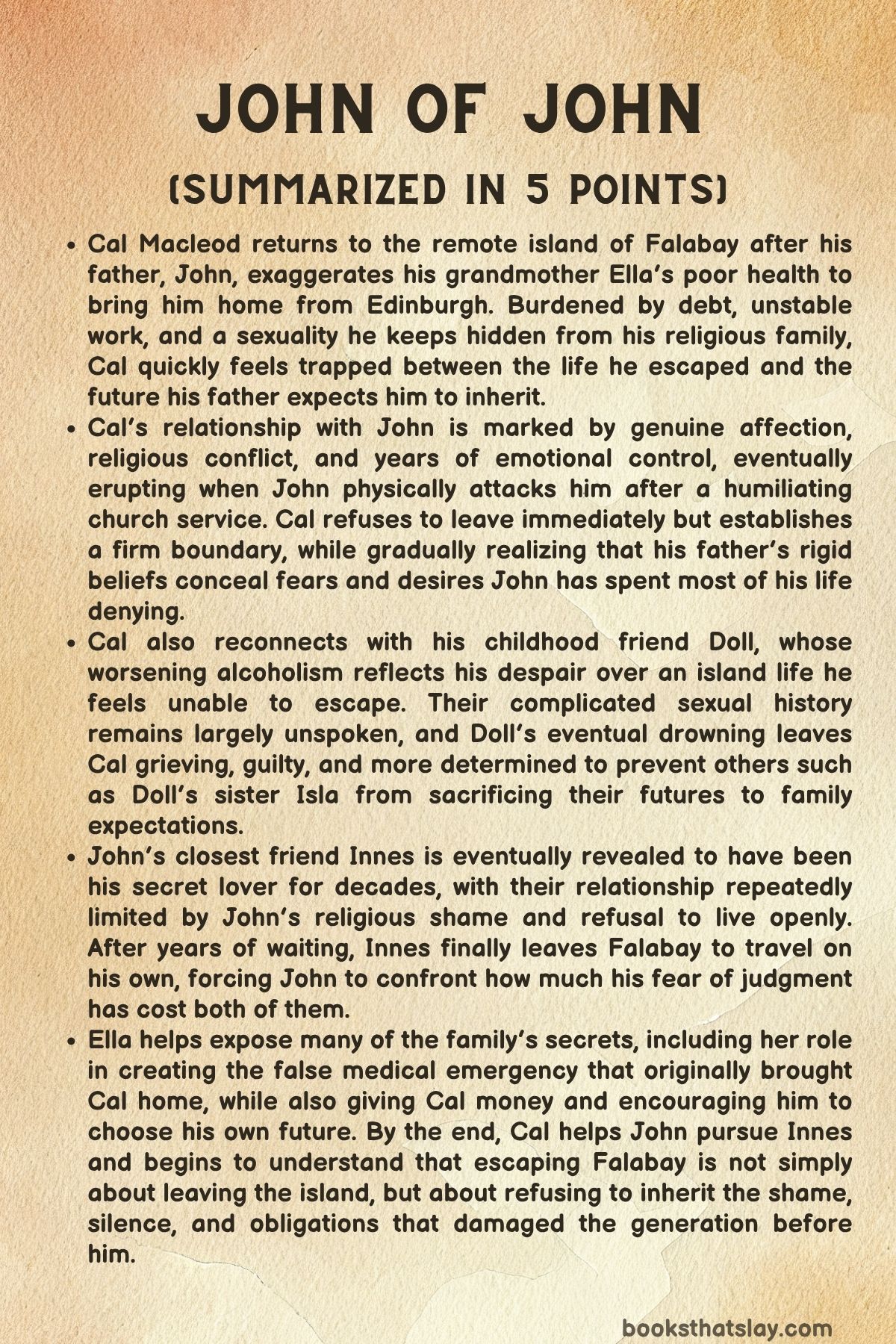
Summary
John-Calum “Cal” Macleod has finished a textile degree in Edinburgh, but his apparent independence is largely an illusion. He has no stable home, survives by staying with friends, takes poorly paid cleaning work, hides his relationships with men, and carefully prevents his deeply religious father, John, from learning how badly his mainland life has gone.
Their regular telephone conversations reveal both affection and avoidance. John uses Gaelic, scripture, prayer, and psalm singing to maintain their bond while avoiding difficult questions, until he finally tells Cal that his grandmother Ella is seriously unwell and suggests that her failing circulation may indicate a dangerous decline.
Cal reluctantly returns to Falabay, the island where he grew up. During the journey he uses alcohol and drugs to quiet his anxiety and deliberately hides anything that might reveal his sexuality or adult life, understanding that returning home means performing an acceptable version of himself.
His reunion with John is loving but immediately tense. John criticizes his appearance, drinking, clothes, and bleached hair, while Cal uses humor to protect himself from his father’s judgment.
Cal soon discovers that Ella is nowhere near as ill as John implied. Her feet are swollen, but they do not match the alarming description John provided, and Cal begins to realize that his father probably exaggerated her condition simply to bring him back.
Life at the croft quickly becomes restrictive. Cal attempts to reconnect with his childhood friend Doll MacDonald, only to discover that Doll deeply resents him for leaving Falabay and rarely returning during his college years.
Their friendship contains an even more complicated history. As adolescents, Cal and Doll had secret sexual encounters, but while Cal attached emotional meaning to them, Doll treated them as something private that could never change their public relationship.
John discovers Cal’s debts and proposes a practical solution: father and son can secretly operate the same loom in different shifts and increase their earnings. Cal agrees reluctantly, and their shared understanding of color and cloth briefly reminds him that genuine closeness still exists beneath their arguments.
Yet the work also terrifies him. Cal recognizes how easily a temporary arrangement could become permanent, leaving him trapped in the same crofting and textile life his father considers an inheritance rather than a limitation.
Ella sees his situation more clearly. When she discovers the beautiful dresses Cal created during his studies, she recognizes both his talent and the scale of the ambitions he has been forced to hide.
Cal also remembers Sammy, a man in Edinburgh who had offered him affection, financial help, and a place to live. Instead of accepting intimacy, Cal disappeared from the relationship, recognizing that the shame and emotional habits created by his upbringing have made it difficult for him to believe that love can be safe.
Conflict with John worsens around religion and appearance. Before church, John demands that Cal cut his hair and dress conventionally, but Cal refuses because controlling his appearance has become one of the few ways he can assert ownership over himself.
At church, Cal accidentally creates a public spectacle when his Walkman comes apart. John experiences the incident as a humiliation before a congregation in which he has spent years presenting himself as a disciplined Christian patriarch.
Their argument afterwards becomes violent. John repeatedly strikes Cal in the face, revealing how quickly his commitment to religious authority and masculine obedience can turn into physical control when he feels his son escaping him.
The assault is not entirely new. Memories reveal that John physically punished Cal during childhood whenever he believed the boy was weak, frightened, or insufficiently masculine.
Cal initially considers leaving immediately. Instead, he stays but tells John that another act of violence will end their relationship permanently and that he will never return to care for him in old age.
Meanwhile, Cal begins working at Flash’s inn and reconnects with Isla MacDonald, Doll’s sister. Isla has earned a university place, and Cal enthusiastically encourages her to use mainland life as an opportunity to discover an identity beyond Falabay.
Isla reveals that Doll’s alcoholism has become dangerous. Cal later discovers the enormous number of bottles Doll has hidden in an abandoned croft and realizes that his old friend has spent years developing a private despair while everyone else treated his drinking as another island problem to be managed.
Cal also secretly begins corresponding with Billy Tudhope after answering a personal advertisement. Billy initially represents the possibility of romantic connection outside Falabay, but he later rejects Cal after seeing his photograph, worsening Cal’s fear that he belongs neither on the mainland nor at home.
Cal eventually visits his mother, Grace, who left John years earlier and now lives with John’s older brother, Uilleam. Uilleam is experiencing severe cognitive decline, and the noisy family household is dramatically different from the restrained atmosphere of the croft.
Grace reveals that Ella intends to transfer legal control of the croft to her, potentially leaving John dependent upon land belonging to the family he feels betrayed by. Cal becomes frightened for his father despite everything between them and asks Grace to guarantee that John will never lose his home.
The visit also forces Cal to reconsider his anger toward Grace. He remembers how, during childhood, she once attempted to leave Falabay with him but deliberately sent him back for a forgotten book and disappeared while he was gone.
That abandonment shaped Cal profoundly. It helps explain why he clings to John even while resisting him and why emotional closeness so often makes him expect rejection.
John, however, is carrying a secret of his own. His closest friend Innes has loved him for years, and their intimacy has survived beneath religious shame, secrecy, and John’s refusal to imagine a public life with another man.
John has also had secret encounters with Anndra, a married crofter. When Innes discovers this indirectly through Cal, the revelation is devastating because John has denied Innes an open relationship while continuing to seek other men privately.
Innes finally confronts John and asks him to choose a different future. He even begins constructing a textile shed where John could work if he moved into the MacInnes household, but John remains frightened of openly changing his life.
Innes eventually tells him that he cannot continue surviving on fragments of affection. He identifies the central contradiction of John’s existence: John condemns the very sexuality that defines one of the deepest relationships of his life.
Cal and Innes later travel together to the mainland. Their conversations become unusually intimate, and Cal misreads Innes’s kindness and emotional openness as romantic interest.
Cal kisses him, but Innes does not return the gesture. Innes cares about Cal, yet his emotional attachment remains centered on John, and the awkward encounter leaves both men ashamed and unsettled.
A more serious boundary violation occurs later when Cal enters Innes’s bedroom to apologize and initiates sexual contact after Innes tells him to stop. Cal finally withdraws when he sees Innes crying, and Innes orders him to leave and never return.
At the same time, Falabay turns its judgment toward Isla after she becomes pregnant. Gossip incorrectly identifies Cal as the father, and church elders attempt to solve the scandal by suggesting that he marry her.
Cal refuses to sacrifice both their futures for appearances. Isla is eventually revealed to have conceived the child with a visitor, and her situation exposes the community’s tendency to protect respectability even when doing so requires young people to surrender their choices.
Ella increasingly challenges the same system. She reveals that she has understood Gaelic for years despite John using the language to exclude her, gives Cal money she secretly saved, and tells him to leave the island and build a better life.
When she directly asks whether he is homosexual, however, Cal still cannot admit the truth. His instinctive denial shows how deeply fear remains embedded in him even with someone who loves him without John’s conditions.
Doll’s deterioration ends tragically when he is found dead near the abandoned van. Medical evidence indicates that he drowned while his body was already badly damaged by alcohol, although no one can determine with certainty whether his death was intentional.
At the funeral Cal insists on carrying Doll’s coffin despite the physical difficulty. His grief is intensified when Isla reveals that she saw him and Doll having sex years earlier and promises to protect the secret from their mother.
Isla later uses Ella’s financial help to prepare for university rather than remain trapped by family duty. Her determination becomes especially important because Doll’s life demonstrates what can happen when a person sees no believable route beyond the future chosen for them.
Before leaving the croft, Ella reveals that John’s original deception was larger than Cal imagined. She deliberately used dark makeup to make her feet appear dangerously purple, helping John invent the emergency that brought Cal home.
She also confirms that she has transferred the croft to Grace and hopes it might eventually go to Isla rather than Cal. Ella understands that Cal does not want the life John expects him to inherit and does not want another young person destroyed by obligations presented as destiny.
John responds to the loss of control by using Ella’s secret financial behavior against her. Believing he has secured his own position, he kisses Innes and celebrates what he imagines as freedom, although his version of freedom still asks Innes to remain hidden.
Innes finally refuses that arrangement. When Cal and John later visit the MacInnes property, they discover that Innes has transferred his tenancy, obtained a passport, and left Falabay to travel through the places he once knew only through radio conversations.
John breaks down completely. Watching him, Cal finally understands that Innes is not merely his father’s friend but the person John has loved for much of his life.
Cal decides that John must pursue him. After learning that Innes is in Portree, he arranges transportation, invents a socially acceptable reason for John’s journey, and sends a message asking Innes to wait without surrendering his own plans.
Cal tells Innes that John loves him and that “the other John” loves him too. Left alone afterwards, Cal begins reconsidering the father he thought he understood, recognizing that beneath John’s cruelty, faith, fear, and control existed another life that secrecy never allowed him to see fully.
Characters
John-Calum “Cal” Macleod
At the center of John of John, Cal is caught between the identity he has built away from Falabay and the version of himself his father expects to return home. His financial instability makes that conflict even sharper because he cannot simply reject the island when he lacks the money, employment, and confidence required to support himself elsewhere.
Cal wants freedom, but he is not emotionally free. Grace’s abandonment during childhood and John’s mixture of love, religious judgment, and physical intimidation have taught him that affection can disappear suddenly or become conditional.
His sexuality therefore becomes connected not simply to desire but to shame, secrecy, and fear of intimacy. His treatment of Sammy shows that even when another man offers stability and affection, Cal can sabotage the relationship rather than risk being truly known.
His relationship with Doll contains another painful imbalance. Cal attaches tenderness and emotional meaning to their adolescent encounters, while Doll repeatedly insists upon secrecy and refuses to allow those moments to redefine their public friendship.
Cal’s behavior toward Innes reveals his most serious moral failure. His loneliness and attraction do not excuse his failure to respect Innes’s refusal immediately, and the incident forces the book to show that Cal can reproduce forms of violation even while understanding himself primarily as someone controlled by others.
Yet Cal also changes considerably. He sets a firm boundary after John attacks him, supports Isla’s right to leave, recognizes Doll’s despair too late but honestly, and ultimately helps his father pursue the love John has spent decades denying.
John Macleod
John of John presents John as both a damaging father and a deeply damaged man. His strict religious identity gives him a structure through which he can understand work, masculinity, family authority, and personal worth, but it also supplies the language through which he condemns desires he cannot eliminate.
His love for Cal is genuine, yet it is consistently contaminated by possession. He wants his son near him, wants him to inherit the crofting and textile life, wants him to appear respectable, and interprets Cal’s independence as rejection rather than growth.
That possessiveness helps explain his deception about Ella’s illness. Instead of admitting that he is aging, frightened, economically vulnerable, and unable to manage everything alone, John invents a respectable family emergency that allows Cal to return without forcing either man to admit how much they need each other.
His violence represents the ugliest expression of his fear. By striking Cal and recalling earlier physical punishments, the novel shows how John uses masculine authority whenever affection, religion, or persuasion fail to produce obedience.
John’s relationship with Innes exposes the central contradiction of his character. He is capable of profound love for another man while participating in a religious system that treats such love as sinful, forcing him to divide his private desires from the identity he publicly defends.
His eventual collapse after Innes leaves is therefore essential. Only when secrecy stops guaranteeing Innes’s presence does John face the possibility that preserving appearances may cost him the person who has remained loyal to him for decades.
Innes MacInnes
Within John of John, Innes represents the emotional cost of waiting for someone who refuses to choose openly. He has spent years accepting a relationship that must remain indirect, private, and deniable because John cannot reconcile his desires with his religious identity.
Innes is initially easy for Cal to underestimate. He appears to be simply John’s loyal friend, yet his conversations gradually reveal an intelligent, lonely man who has sacrificed travel, companionship, and other possibilities while remaining on Falabay.
His proposal to travel with John is significant because he does not initially demand dramatic public disclosure. He wants modest ordinary experiences together: unfamiliar streets, meals, galleries, conversation, and the freedom to exist near one another without constant fear of recognition.
The new work shed is an even larger expression of hope. Innes imagines constructing a practical future for John, yet the building eventually becomes evidence of everything John was too frightened to accept.
Innes also provides Cal with a different model of queer adulthood. He has visited gay spaces, sought anonymous connection through radio, and understands that companionship can exist beyond Falabay, although his own life has remained restricted by devotion to John.
His departure is his strongest act of self-respect. Rather than spend the rest of his life accepting whatever John is willing to offer, he gets a passport and leaves, forcing John to decide whether love means anything if it never produces action.
Ella
In John of John, Ella provides humor, resistance, practical intelligence, and an alternative form of family loyalty. Unlike John, she does not assume that loving someone gives her the right to determine the course of that person’s life.
Her relationship with Cal is especially important because she encouraged his irreverence when he was young and offered companionship after Grace disappeared. She understands that people sometimes survive by revealing different parts of themselves in different situations, an idea directly relevant to Cal’s concealed sexuality.
Ella is also more complicated than a purely supportive grandmother. She refuses to finance Cal’s immediate escape when he first asks because she does not want to become a weapon in the struggle between father and son.
At the same time, she quietly manipulates events when she thinks intervention is necessary. She helps create the false medical emergency, subsidizes possible employment for Cal, saves money by reducing church donations, and eventually gives him funds for a future beyond Falabay.
Her revelation that she has understood Gaelic all along changes the power dynamic with John. For years he assumed language gave him a private territory from which he could exclude her, only to discover that she had understood much more than he imagined.
Ella’s decision to leave for Grace’s household demonstrates that she also refuses to let usefulness determine her entire identity. By transferring the croft and leaving, she reclaims control over the final stage of her life while trying to prevent Cal from inheriting an obligation he does not want.
Doll MacDonald
Doll begins as the embodiment of Cal’s unresolved past, but his story gradually reveals a despair independent of Cal. He resents his friend for escaping Falabay because Cal’s departure reminds him of the possibilities he himself never managed to pursue.
His hostility is mixed with attachment. The adolescent sexual relationship between the two matters deeply to Cal, while Doll reduces it to something secret and practical, suggesting that acknowledging emotional meaning would threaten the masculine identity he has learned to perform.
Alcohol becomes Doll’s primary method of managing frustration. He hates aspects of the fishing life, lacks financial independence, sees few routes toward change, and increasingly hides bottles and drinks despite the fear of his family.
The community’s response often increases his isolation. Public religious correction, family control, and confinement in the byre may be intended to contain his drinking, but they also confirm his sense that everyone is managing him rather than understanding him.
His death becomes one of the story’s most consequential events. Whether his drowning was intentional remains uncertain, which prevents his life from being reduced to a simple explanation.
Doll ultimately represents the danger of having no believable future. His tragedy influences Cal’s determination to support Isla’s departure and strengthens Ella’s conviction that young people should not automatically inherit lives that have already made them miserable.
Isla MacDonald
Isla is intelligent, ambitious, and more determined than the community initially allows her to appear. Her university place offers her a route beyond Falabay, and Cal immediately recognizes the importance of encouraging her to discover herself somewhere that her family history does not define every possibility.
Her pregnancy creates a severe test of that independence. The elders and families respond by attempting to restore social order, even proposing that Cal marry her despite knowing that a marriage built on deception would determine both their futures.
Isla’s experience exposes the unequal demands placed upon young women. Once she becomes pregnant, her education risks becoming less important than family reputation, childcare, and the emotional needs of relatives.
Doll’s death intensifies those pressures. Sarah’s deterioration gives John another reason to argue that Isla should remain home, yet Cal recognizes that forcing her to sacrifice university could reproduce the same pattern that contributed to Doll’s hopelessness.
Isla also knows more about Cal than he realizes. Her disclosure that she saw him and Doll together years earlier gives her power over one of his deepest secrets, but she chooses compassion rather than judgment.
Her decision to leave for university therefore carries broader significance. She accepts responsibility for her child without accepting the idea that motherhood must erase her intellectual ambitions or her right to imagine a different life.
Grace
Grace is initially defined through Cal and John’s sense of abandonment, but the story gradually complicates that judgment. She left John and eventually formed a household with his older brother Uilleam, a choice that created wounds John has never stopped revisiting.
Her abandonment of young Cal is particularly damaging. By tricking him into leaving her briefly and then departing without him, she creates one of the foundational injuries of his childhood.
Yet Grace’s history with John reveals that her marriage also placed her inside a relationship shaped by secrets she could not resolve. Her discovery of John’s intimacy with Innes forced her to confront the fact that part of her husband’s emotional life belonged elsewhere.
She therefore exists as both someone who hurt Cal and someone who escaped a marriage that could not provide what she needed. Her later concern about Cal’s injuries and her willingness to discuss John’s behavior show that distance has not eliminated her maternal attachment.
Grace’s household ultimately becomes a place of return for Ella as well. Her role demonstrates that leaving can be an act of betrayal and an act of survival at the same time, depending on whose pain is being considered.
Uilleam
Uilleam is John’s older brother and Grace’s later partner, making his presence a continuing source of humiliation for John. For John, Grace’s life with his own brother turns marital separation into something inseparable from sibling resentment and wounded pride.
By the time Cal visits, however, Uilleam is experiencing serious cognitive deterioration. He becomes confused about the identities of family members and increasingly exists at a distance even from the crowded household around him.
His illness changes the emotional meaning of Grace’s new life. What John may imagine from afar as proof that Grace successfully escaped him is actually a household facing its own severe difficulties and impending losses.
Uilleam therefore helps weaken the simplistic contrast between miserable Falabay and happy escape. Every possible life carries forms of responsibility and suffering, even when leaving one situation remains necessary.
Sarah MacDonald
Sarah is a frightened mother trying unsuccessfully to save Doll from alcoholism. Her anger toward him repeatedly exists alongside affection and fear, especially as she realizes that his drinking may eventually kill him.
Her decision to interfere with Doll’s beloved car shows the desperate logic of her parenting. Rather than confronting every danger directly, she quietly makes the vehicle unreliable because she fears he will drive while drunk and die.
After Doll’s death, her behavior shows how completely grief can destabilize the survivors. Her later attempts to drown herself transform the MacDonald household into another place where Isla is expected to surrender her future to meet the needs of those who remain.
Sarah also challenges tradition during Doll’s burial when women are initially excluded from the graveside. Her resistance reflects a recurring pattern in the novel: extreme grief can expose how arbitrary inherited rules appear when they prevent people from doing what love demands.
Sorley MacInnes
Sorley is Innes’s brother, and their sixteen-year refusal to communicate directly gives their household an eccentric but revealing emotional atmosphere. Their silence demonstrates that Falabay families often maintain relationships through indirect routines rather than honest conversation.
He also represents another version of restricted island masculinity. Anna-Marie’s frustrated interest in him suggests that Sorley has difficulty responding directly even when emotional opportunities are placed in front of him.
Cal’s teasing suggestion that he might pursue Anna-Marie exposes Sorley’s jealousy. The moment is humorous, but it also mirrors the larger novel’s concern with people who struggle to say clearly what they want.
When Innes eventually leaves, Sorley receives the tenancy. His position therefore changes from the brother who remained inside an old silence to the person who inherits responsibility for a property Innes has finally chosen to escape.
Anna-Marie
Anna-Marie is the local nurse and one of the practical figures who sees more than people openly admit. When she gives Cal a lift, she notices the medication he has taken, suggesting both professional awareness and concern.
Her frustration with Sorley creates a smaller parallel to the novel’s larger romantic relationships. She wants clearer acknowledgment from a man who remains emotionally difficult to read.
Anna-Marie also treats Cal after his injury following the confrontation with Innes. Her presence at moments of physical vulnerability gives her a quiet role as someone who responds to consequences after other characters have failed to communicate or respect boundaries.
Flash
Flash runs the inn where Cal seeks employment and later begins working. His limited ability to hire Cal reflects the island’s broader economic difficulty: even people who might willingly offer opportunities often lack the resources to do so.
Flash is also less judgmental than many members of the religious community. When he sees evidence that Cal has been assaulted, he advises him that adulthood requires establishing limits and defending himself if John attacks him again.
His recollections later help undermine the rumor that Cal fathered Isla’s baby. Flash therefore serves as a practical witness within a society where gossip often becomes more powerful than fact.
Dòmhnall
Dòmhnall is closely associated with the community’s expectations around family reputation. His response to Isla’s pregnancy shows how quickly concern for social respectability can become anger directed toward people expected to repair a situation through conventional marriage.
His violent reaction when Cal refuses to marry Isla demonstrates that he treats marriage partly as a mechanism for containing scandal. Cal’s refusal therefore threatens not only a proposed solution but the authority of the assumptions behind it.
Later, however, Dòmhnall also becomes practically useful when Cal arranges for him to transport John across the water in pursuit of Innes. Like many secondary figures, he cannot be reduced to a single moral function because communal rigidity coexists with ordinary cooperation.
Reverend Rose
Reverend Rose gives formal religious expression to the fears governing Falabay. His preaching stresses sin, fear, revelation, and spiritual accountability, reinforcing an atmosphere in which private identity is constantly measured against public belief.
The church service that humiliates Cal demonstrates how this environment works socially as well as spiritually. Cal’s appearance becomes evidence to be interpreted, while John experiences his son’s difference as a judgment upon his own ability to govern his household.
Rose therefore represents more than an individual preacher. He helps sustain the structure within which John has learned to convert personal fear into moral certainty.
Billy Tudhope
Billy offers Cal a brief possibility of romance beyond Falabay. Their correspondence allows Cal to imagine connection with someone who shares interests in music and understands something of life beyond his father’s expectations.
Cal becomes unusually hopeful, preparing an altered photograph and a handmade gift. His excitement shows how intensely he wants to be chosen by someone who knows him independently of his family.
Billy’s rejection is therefore painful far beyond the short correspondence itself. It confirms Cal’s existing fear that escape from the island does not automatically produce belonging or love.
Sammy
Sammy belongs to Cal’s mainland past and represents an opportunity Cal was emotionally unable to accept. He offered financial assistance, intimacy, and a home, all of which could have relieved the practical instability Cal later hides from John.
Cal responds by fleeing and even giving Sammy a false address. His behavior demonstrates that the emotional damage of Falabay follows him beyond the island, making geographical escape much easier than psychological change.
Sammy therefore helps clarify why Cal’s loneliness cannot be blamed entirely on the absence of suitable partners. Cal must also learn to stop interpreting vulnerability as danger before he can sustain the intimacy he claims to want.
Anndra
Anndra is a married crofter with whom John has secret sexual encounters. His importance comes less from his individual development than from what those encounters reveal about John’s treatment of Innes.
John is willing to seek physical contact elsewhere while refusing the man who has offered him emotional commitment and a shared future. When Innes realizes the truth, he understands that John’s secrecy cannot be defended simply as religious restraint.
Anndra therefore becomes evidence of the difference between desire and commitment. John permits himself hidden episodes because they require less emotional courage than openly choosing the person he actually loves.
Cheeks
Cheeks provides one of Cal’s first realistic opportunities for an independent future after his return. He tells Cal about employment connected to a new fish farm and later helps him secure the position.
That practical opportunity matters because Cal’s choices are often limited by money rather than imagination alone. A stable job gives him the possibility of leaving the croft without returning to the precarious instability he experienced in Edinburgh.
Cheeks is less compassionate regarding Doll. His warning that Doll should be excluded because his drunken behavior embarrasses other people shows how addiction often turns a suffering person into a social inconvenience long before others recognize the seriousness of the crisis.
Shiv Malone
Shiv Malone runs the bed-and-breakfast where Cal and Doll stay during their trip to Lewis. Her attraction to Doll contributes to a sequence that briefly gives Cal the physical closeness he has wanted from his friend before taking it away again.
When Cal is left outside in freezing rain, Shiv eventually discovers him and brings him inside. Her intervention prevents the situation from becoming even more dangerous.
Her presence also sharpens the difference between sexual access and emotional intimacy in Doll’s behavior. Doll can pursue Shiv openly while the tenderness Cal experiences with him must immediately return to secrecy.
Beady
Beady appears when Cal seeks treatment for the injuries John inflicted. Cal claims that he fell, but she clearly suspects that the explanation does not account for what she sees.
Her quiet awareness matters because it reflects the island’s culture of partial knowledge. People often understand more than they officially acknowledge, yet awareness does not necessarily lead to intervention.
By stitching Cal’s wound without forcing a confession, Beady occupies the uneasy space between care and silence that surrounds many of Falabay’s hidden problems.
Airchie Calder
Airchie represents the casual cruelty Cal encounters after returning home. His suggestion that Grace might have left because she could not bear looking at her son turns Cal’s deepest childhood wound into entertainment.
Cal’s refusal to quietly accept the remark shows an important change in him. He is becoming less willing to let age, community standing, or tradition give other people unrestricted permission to humiliate him.
Airchie’s brief appearance therefore reinforces the social pressures of Falabay. Harm does not always arrive through major confrontations; sometimes it appears through ordinary comments that everyone has learned to excuse.
Themes
Inherited Duty and the Right to Choose
In John of John, duty is repeatedly presented as something that can resemble love while still restricting the person expected to accept it. John believes the croft, livestock, textile work, religion, and family history form an inheritance Cal should value because they connect him to generations who lived before him.
Cal experiences the same inheritance differently. He understands the practical skills of the croft and is talented enough to earn his father’s approval, but every sign of competence frightens him because usefulness can quickly become an argument for why he should never leave.
Doll provides the darkest version of this conflict. He remains embedded in family work he dislikes, sees few realistic routes toward independence, and increasingly relies on alcohol while the community interprets his deterioration through discipline rather than possibility.
Isla faces a related pressure after becoming pregnant and after Doll dies. Her family’s needs could easily become the reason she abandons university, turning one crisis into a permanent surrender of her future.
Ella eventually rejects that logic. By transferring the croft away from Cal and supporting Isla’s education, she recognizes that inheritance has value only when the person receiving it actually wants the life attached to it.
Queer Secrecy, Shame, and the Cost of Concealment
Cal and John belong to different generations, yet both learn to separate desire from the identities they present publicly. Cal hides relationships, edits his appearance before returning home, lies when Ella asks whether he is gay, and struggles to believe that romantic intimacy can exist without danger.
John’s secrecy is more destructive because he has lived within it for decades. His religious beliefs allow him to classify his own desire as something shameful even while his relationship with Innes becomes one of the strongest emotional attachments of his life.
The consequences extend far beyond the two men. Grace’s marriage collapses partly because John cannot give himself fully to it, Innes spends years waiting for a future that never arrives, and Cal grows up beneath a paternal model of masculinity shaped by self-rejection.
Doll and Cal’s adolescent encounters reveal another form of concealment. Doll permits physical intimacy but insists that it remain detached from public identity, leaving Cal with the message that desire can exist only if its emotional meaning is denied.
The story ultimately distinguishes privacy from enforced invisibility. Innes’s departure is powerful because he refuses to continue calling secrecy a relationship when secrecy has become the condition preventing that relationship from developing.
Faith, Masculinity, and Emotional Violence
The religious world of John of John gives John language for discipline, salvation, sin, authority, and masculine responsibility. His faith contains genuine beauty, especially in the psalms and traditions that still move Cal emotionally, but it also becomes inseparable from John’s fear of failing before his congregation.
John’s treatment of Cal shows how religious certainty can merge with patriarchal control. He criticizes Cal’s hair and clothing, attempts to direct his future toward marriage, demands conformity at church, and eventually attacks him physically when Cal refuses to submit.
His violence is especially revealing because earlier memories show that it is not an isolated loss of control. John has repeatedly treated fear or softness in his son as defects that physical force can correct.
The same environment encourages concealment rather than self-knowledge in John himself. He condemns homosexual desire through the religious framework he publicly protects while privately seeking men and maintaining a decades-long attachment to Innes.
The novel does not reduce faith itself to cruelty. Instead, it asks what happens when belief becomes a defense against truth and when a person’s public righteousness depends upon suppressing realities that cannot actually be removed.
Home, Belonging, and the Possibility of Leaving
Falabay is simultaneously refuge, prison, inheritance, memory, and community. Cal resents the island because its single roads, gossip, and shared histories make anonymity almost impossible, whereas the mainland initially promises corners, strangers, and the ability to exist without constant observation.
Yet leaving does not automatically produce belonging. Edinburgh gives Cal freedom from his father but also homelessness, debt, unstable employment, failed intimacy, and a profound reluctance to admit that he needs help.
Other characters expose different versions of the same tension. Grace leaves and builds another family, Ella spends years complaining but ultimately recognizes that she chose Falabay as home, and Doll remains until the possibilities beyond it seem increasingly unreachable.
Innes eventually changes the meaning of departure. Instead of leaving because another person has guaranteed him a better life, he obtains a passport and travels toward places he has only encountered through distant radio voices.
His decision also changes John. For decades John assumes that home means remaining where duty, religion, land, and reputation have placed him, but Innes’s absence forces him to consider whether home might instead be connected to the person with whom he has refused to build a life.
Cal ends in a similarly uncertain position. He has a possible job and greater independence, but his final task is not simply escaping Falabay; it is deciding which parts of home deserve to be carried forward and which must finally be left behind.