One Aladdin Two Lamps Summary and Analysis
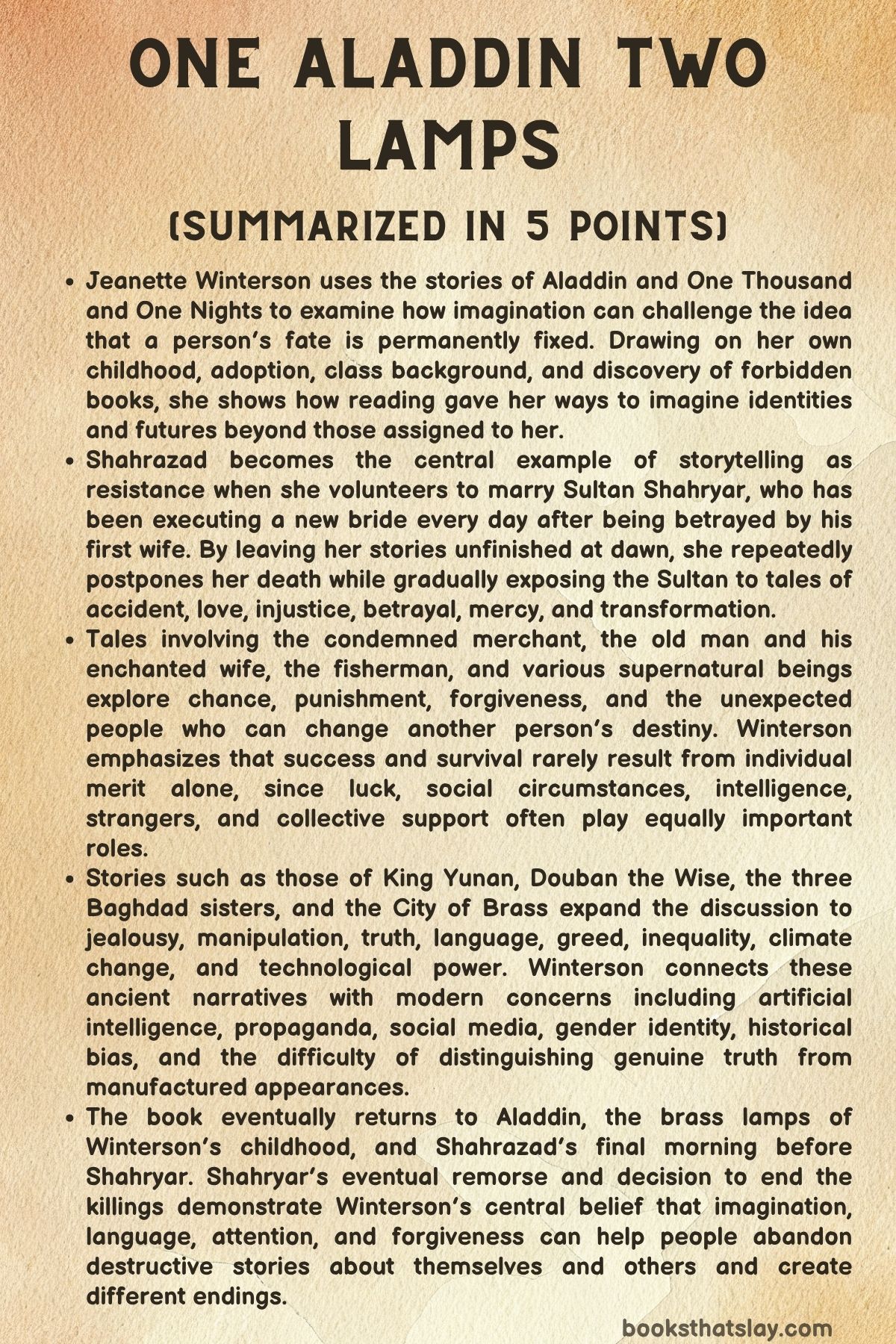
One Aladdin Two Lamps by Jeanette Winterson is a hybrid of memoir, literary criticism, cultural history, and imaginative reflection built around the enduring stories of One Thousand and One Nights. Starting with Aladdin and Shahrazad, Winterson asks how storytelling can challenge ideas that seem fixed: class, gender, identity, luck, power, history, and destiny.
She combines memories of her own childhood with retellings of ancient tales and discussions of science, politics, language, artificial intelligence, climate, and inequality. The book ultimately argues that stories are not escapes from reality but tools that help people imagine different futures, question inherited beliefs, and recognize their capacity for change.
Summary
Jeanette Winterson begins with a childhood trip to an Aladdin pantomime attended with children from her father’s factory. At first, Aladdin seems like a straightforward fantasy about escaping poverty through magic, but Winterson later discovers that the traditions behind Aladdin and One Thousand and One Nights are far stranger, more mobile, and less predictable than the simplified versions she knew as a child.
As a teenager living within a restrictive working-class and religious environment, she discovers a complete version of the Nights in her local library. Shahrazad immediately becomes central to her imagination because the young woman confronts Sultan Shahryar, a ruler who has responded to betrayal by marrying and murdering a new virgin every day.
Shahrazad volunteers to become his next wife and survives through storytelling. Each night she begins a tale but stops before dawn at a moment of uncertainty, forcing Shahryar to postpone her execution if he wants to hear what happens next.
For Winterson, this creates a powerful model of resistance to supposedly inevitable endings. Storytelling stretches a few hours into entire worlds and allows another possibility to appear where death had previously seemed certain.
One of Shahrazad’s early stories follows an ordinary merchant who accidentally kills an invisible supernatural being when he throws away a date stone. An Ifrit appears and demands the merchant’s life in repayment, refusing to accept accidental death as a reason for mercy.
The merchant persuades the Ifrit to allow him one year to return home, settle his obligations, and say goodbye to his family. His predicament becomes a way for Winterson to consider how people inherit circumstances involving poverty, class, race, gender, education, family, and social expectations before they have any opportunity to shape those conditions themselves.
Winterson connects this question to scientific and historical narratives that have often been used to make inequality appear natural. She discusses Darwin, Francis Galton, eugenics, overlooked achievements outside the traditional Western historical centre, and figures such as Ada Lovelace and George Boole before turning to epigenetics, where genes interact with environment and experience rather than operating as an absolute script.
Her own history of adoption becomes part of the same argument. Feelings of abandonment, rescue, and insecurity shaped her, but literature gave her a language through which she could understand identity as unfinished rather than as something permanently assigned by childhood circumstances.
When the merchant returns to the oasis after a year, he fully expects to die. An old man accompanied by a gazelle unexpectedly appears, and when the Ifrit arrives to execute the merchant, the old man interrupts the killing by proposing a bargain: if his story is extraordinary enough, the Ifrit must surrender one third of the merchant’s blood.
The intervention demonstrates a pattern that becomes central to Winterson’s interpretation of the Nights. Outcomes depend not only on heroic qualities but also on accidental meetings, strangers, acts of curiosity, kindness, courage, and simple luck.
The old man reveals that the gazelle is his first wife. Jealous after he fathered a son with another woman, she used magic to turn the second wife into a cow and the child into a calf, beginning a chain of transformations that leads Winterson to questions of revenge, gendered power, bodily identity, sexuality, and the difference between transformations imposed by others and changes freely chosen by the self.
The herdsman’s daughter discovers the truth because she can recognize the young man beneath the calf’s appearance. She restores him, punishes the guilty first wife by turning her into a gazelle rather than killing her, and becomes another example of a woman whose knowledge allows her to see beyond surfaces.
Another traveller arrives with two Saluki dogs that were once his brothers. Their jealousy led them to attempt to murder both him and his wife, but the wife revealed herself as an Ifrita, rescued her husband, and transformed the brothers into dogs; despite their betrayal, their brother continues to care for them, making forgiveness another form of transformation.
A different story follows a poor fisherman who limits himself to four casts of his net each day. After three useless catches, his final attempt brings up a sealed brass jar containing an Ifrit who has spent eighteen hundred years imprisoned and now intends to kill whoever releases him.
The fisherman survives through intelligence rather than strength. He challenges the enormous Ifrit to prove that he could possibly have fitted inside the jar, then seals him inside once vanity causes the creature to return to it.
The fisherman’s predicament allows Winterson to consider displaced anger. Just as the Ifrit wants to kill an innocent rescuer because of suffering caused by others, Shahryar murders innocent women because one woman betrayed him; Winterson extends the comparison toward misogyny, prejudice, religious hostility, and the tendency to create enemies rather than confront pain honestly.
The trapped Ifrit eventually asks for another chance, and the fisherman risks freeing him. Instead of taking revenge, the supernatural being leads him to a mysterious pool containing coloured fish, which eventually guides a Sultan toward the enchanted Prince of the Black Isles and the restoration of a ruined kingdom.
Winterson stresses that the fisherman’s later prosperity does not prove that he was uniquely worthy of wealth. Chance placed the jar in his net, intelligence helped him survive, and later encounters opened opportunities unavailable to him before, making success a combination of circumstances and choices rather than simple evidence of merit.
Another embedded tale concerns King Yunan, who is dying from leprosy until the healer Douban the Wise cures him. The king initially rewards Douban generously, but a jealous Vizier convinces Yunan that anyone capable of curing him must also possess the power to kill him.
Fear destroys the king’s gratitude, and he orders Douban’s execution. Before dying, Douban gives Yunan a mysterious book whose poisoned pages eventually kill the king, creating a warning about jealousy, manipulation, insecurity, and the destructive consequences of repaying goodness with injustice.
Winterson then turns more directly toward truth and narration. Every person tells stories about family, love, failure, success, politics, and national history, but even factual events are shaped by decisions about emphasis, omission, explanation, and perspective.
Rather than concluding that truth does not exist, she argues for greater attention to who is speaking and why. Fiction trains readers to notice unreliable narration, while Winterson’s childhood experience of having her identity defined by her adoptive mother demonstrates the danger of allowing another person’s version of events to become the only available reality.
Shahrazad later tells of a porter who enters the Baghdad home of three independent sisters. The evening expands into a gathering involving one-eyed dervishes and a disguised Caliph, but the guests violate the sisters’ rule against asking questions when they demand an explanation for the eldest sister’s strange treatment of two chained dogs.
The men’s lives can again be saved through storytelling. Winterson uses the episode to examine the power of language, including speech, poetry, riddles, religious language, oral tradition, and literature, emphasizing that words allow human voices to survive physical absence and even death.
The eldest sister eventually explains that the dogs were once her sisters, who tried to kill her despite repeatedly benefiting from her generosity. A jinnia who owes the eldest sister a debt of gratitude transforms the guilty women into dogs, but their victim refuses to permit their destruction, creating a difficult balance between justice, punishment, mercy, and the slow process of moral change.
The lesson is indirectly aimed at Shahryar. The sisters have actually committed crimes and are still offered the possibility of eventual restoration, whereas his murdered brides were innocent; Shahrazad is therefore teaching him that punishment without individual guilt is not justice and that even wrongdoing need not permanently eliminate the possibility of change.
Winterson eventually returns to the betrayal that created Shahryar’s murderous worldview. Shahryar and his brother Shah Zaman discover that their wives have been unfaithful, and a later encounter with a woman kidnapped and imprisoned by a Jinn confirms only what they already want to believe about women.
The imprisoned woman has developed her own pattern of sexual revenge in response to captivity, but the brothers fail to recognize that her behaviour is linked to violence committed against her. Shahryar turns individual betrayal into a universal judgment against women, and more than a thousand innocent girls die because he refuses to examine his own reasoning.
Shahrazad counters this closed worldview not through direct argument but through accumulated experiences. Night after night, she introduces Shahryar to merchants, fishermen, rulers, women, supernatural beings, lovers, fools, victims, betrayers, strangers, and people capable of forgiveness until his imagination becomes large enough to recognize lives beyond his own pain.
The City of Brass extends the book’s concerns into questions of mortality, technology, greed, and environmental collapse. Musa, Samad, Talib, and their expedition repeatedly encounter warnings that wealth and power cannot prevent death, eventually reaching a magnificent city whose people died after drought and famine made treasure worthless.
Talib nevertheless attempts to steal from the dead princess and is killed after ignoring a clear warning. Winterson connects the ruined city with climate change, speculative wealth, inequality, artificial intelligence, robotics, and the danger of confusing technological achievement with wisdom.
Meanwhile, Shahrazad’s own life has changed during the years of storytelling. She has become a mother, and her children represent a future that could never have existed when Shahryar believed every new marriage must end in death.
Winterson finally returns to the brass lamps of her own childhood and to Aladdin. The tale’s uncertain origins, numerous translations, theatrical adaptations, magical ring, powerful lamp, ambitious hero, resourceful mother, and Princess Badr all become part of her final reflection on luck, power, work, class, identity, and the possibility that technology might function like a modern genie if its benefits were widely shared.
On Shahrazad’s final morning, she brings her children before Shahryar and asks for mercy. He responds with regret and tears, ending the murders not because his past has disappeared but because years of stories have changed the person interpreting that past.
The final transformation is therefore neither magical wealth nor supernatural rescue. It is the ability to abandon a destructive narrative, accept responsibility, forgive, and imagine an ending that once appeared impossible.
Key People and Figures
Jeanette Winterson
Jeanette Winterson is both author and central reflective presence in One Aladdin Two Lamps, linking ancient storytelling with her own experience of childhood, adoption, religion, class, sexuality, education, and artistic discovery. Her life provides practical evidence for her argument that inherited circumstances can shape a person powerfully without determining every later possibility.
Winterson presents reading as one of the forces that expanded the boundaries imposed around her. Her character as it appears in the book is defined by intellectual curiosity and resistance to predetermined identities, but she also acknowledges emotional patterns created by abandonment and family experience rather than presenting self-reinvention as easy or complete.
Shahrazad
Shahrazad is the book’s greatest example of imagination used as active resistance. She knowingly enters a lethal situation and survives not through physical force but by understanding that Shahryar’s certainty can be interrupted if curiosity, suspense, sympathy, and emotional identification gradually replace repetition.
Within One Aladdin Two Lamps, her significance extends beyond personal survival because she is trying to alter the mind of a ruler whose private wound has become public violence. Her stories patiently expose him to accident, mercy, injustice, foolish rulers, wronged women, forgiving victims, ordinary people, and unexpected reversals until he becomes capable of recognizing a world that does not revolve solely around his betrayal.
Sultan Shahryar
Shahryar begins as a ruler who converts personal betrayal into a universal judgment against women. His enormous political power makes his emotional failure catastrophic because his refusal to distinguish one guilty person from countless innocent women results in systematic murder.
His most important characteristic, however, is that he is not presented as permanently incapable of change. Shahrazad gradually reawakens his capacity for attention and sympathy, and his eventual regret shows that the book distinguishes accountability from the idea that a human being must remain forever identical to the worst version of himself.
Shah Zaman
Shah Zaman shares his brother’s experience of marital betrayal and contributes to the confirmation of Shahryar’s growing hostility toward women. During their encounter with the Jinn’s captive woman, both men interpret what they see according to assumptions they already possess rather than considering the violence and imprisonment that have shaped her behaviour.
His role is important because he demonstrates how destructive beliefs strengthen when people validate one another without questioning the basis of those beliefs. Rather than challenging Shahryar’s conclusion, he helps create an environment in which private resentment can appear reasonable.
The Merchant
The merchant is deliberately ordinary, which gives his predicament unusual force. He has not set out to harm anyone, yet one casual action produces an unimaginable consequence when the discarded date stone accidentally kills an invisible being.
His willingness to return after one year also reveals integrity in circumstances where escape would seem understandable. He represents people trapped by conditions they did not intentionally create, making his eventual rescue dependent on keeping possibilities open long enough for another person to enter his story.
The Merchant’s Ifrit
The Ifrit initially embodies rigid justice stripped of context or mercy. For him, a life has been taken and therefore another life must be surrendered, even though the merchant could not see the victim and had no intention of causing harm.
His willingness to listen is nevertheless significant. Curiosity creates a weakness in his certainty, allowing stories to interrupt execution and demonstrating that even an apparently inflexible authority can be affected once an alternative narrative is allowed to enter the situation.
The Old Man
The old man with the gazelle becomes the merchant’s unexpected defender. He has no personal obligation to the condemned stranger, yet he refuses to treat another person’s approaching death as irrelevant to him.
His intervention expresses the communal ethic Winterson finds throughout the Nights. Rather than being an isolated hero, he becomes one person entering another person’s crisis at the decisive moment, proving that involvement can change an outcome that previously appeared settled.
The Gazelle
The gazelle is actually the old man’s first wife, transformed after her own destructive use of magic. Her jealousy over her husband’s second wife and son leads her to turn the woman into a cow and the child into a calf, demonstrating how power gained by someone who has suffered restriction can itself become abusive.
Her transformation into a gazelle creates a punishment that mirrors the bodily violations she imposed on others. At the same time, she is allowed to live, making her fate part of the book’s continuing distinction between punishment intended to teach and vengeance intended only to destroy.
The Younger Wife and Her Son
The younger wife and her son become victims of the first wife’s jealousy despite having committed no comparable wrong. Their transformation into a cow and calf makes them examples of innocent people forced into identities and conditions by someone else’s resentment.
The son’s eventual restoration is especially important because his true identity survives beneath the form imposed on him. His experience supports Winterson’s wider interest in whether outward classifications reveal the whole person or merely describe the form others currently see.
The Herdsman’s Daughter
The herdsman’s daughter possesses the knowledge necessary to recognize that the calf is actually an enchanted young man. Her ability to see truth beneath appearance places her alongside Shahrazad as a woman whose intelligence changes circumstances that male authority has failed to understand.
She is also notable for refusing the demand that the guilty wife should simply be killed. Her solution punishes wrongdoing without eliminating the possibility of later restoration, making her a figure of judgment tempered by restraint.
The Traveller with the Saluki Dogs
The traveller accompanied by two dogs has suffered severe betrayal from his own brothers. Their attempt to murder him could justify permanent hatred, yet his continued care for them shows that he refuses to reduce his future entirely to what they did to him.
His role strengthens the connection between love and transformation. Forgiveness does not mean denying betrayal, but it allows the injured person to resist becoming psychologically controlled by the injury.
The Traveller’s Ifrita Wife
The traveller’s wife appears initially as a human partner but reveals herself as an Ifrita when her husband is endangered. Her supernatural identity allows her to save him and punish his murderous brothers by changing them into dogs.
She embodies protective power as well as potentially severe justice. Her presence also destabilizes ordinary categories of identity because the person her husband loves belongs simultaneously to familiar domestic life and a supernatural world beyond human appearance.
The Brothers Turned into Dogs
The brothers are driven by envy of their sibling’s prosperity and successful marriage. Their jealousy becomes so extreme that they attempt to murder both their brother and his wife, turning resentment into direct violence.
Their transformation into dogs strips them of the human status they failed to honour through their behaviour. Yet their brother’s continued care prevents punishment from becoming total abandonment, preserving the possibility that damaged relationships may still contain responsibility and compassion.
The Fisherman
The fisherman is one of the clearest examples of practical intelligence in One Aladdin Two Lamps. Poor and apparently powerless, he survives an encounter with a vastly stronger supernatural being because he observes the Ifrit’s vanity and creates a situation in which cleverness matters more than physical force.
His later prosperity is equally important because he never treats good fortune as proof of moral superiority. Winterson uses him to challenge simplistic ideas about success by showing that effort, discipline, chance, timing, intelligence, and unexpected encounters can all contribute to a changed life.
The Ifrit in the Brass Jar
The imprisoned Ifrit has allowed centuries of suffering to turn into hatred of an unknown future rescuer. Instead of distinguishing the person who frees him from those responsible for his imprisonment, he decides that an innocent stranger must absorb his accumulated rage.
His behaviour mirrors Shahryar’s central moral failure. Both respond to injury by transferring punishment onto people who did not cause that injury, but the Ifrit’s eventual change after hearing a story proves that destructive patterns can be interrupted before revenge is completed.
Douban the Wise
Douban is defined by knowledge used for healing. He cures King Yunan when other physicians have failed, requests no extravagant reward in advance, and becomes dangerous only in the king’s imagination after the Vizier transforms gratitude into suspicion.
His final poisoned book turns intellectual knowledge into a weapon after peaceful service has been repaid with execution. Douban therefore becomes both victim and avenger, showing how injustice can convert beneficence into retaliation when trust is deliberately destroyed.
King Yunan
King Yunan begins as a grateful ruler but proves dangerously vulnerable to fear. His tragedy lies less in ignorance than in his willingness to believe speculation over direct evidence of Douban’s loyalty.
The king demonstrates how authority becomes destructive when insecurity controls judgment. Because he possesses the power to kill, an unverified suspicion becomes irreversible action, and his later death by the poisoned book makes him a victim of the distrust he allowed another person to create.
The Jealous Vizier
The Vizier cannot tolerate Douban’s influence and therefore searches for the emotional weakness through which the healer can be destroyed. He discovers that King Yunan fears threats to his life and carefully transforms that fear into suspicion.
His character represents manipulation driven by envy rather than evidence. He demonstrates how destructive advisers often succeed not by proving their claims but by identifying an existing insecurity and repeatedly giving it a persuasive narrative.
The Sultan Who Investigates the Coloured Fish
The Sultan responds to the supernatural coloured fish with curiosity rather than fear. Instead of dismissing the mystery or merely exploiting it, he follows the evidence toward the hidden pool and eventually discovers the devastated kingdom connected to the Prince of the Black Isles.
His actions provide a contrast to rulers such as Yunan and Shahryar. Authority here becomes useful because the ruler is willing to investigate, act, and restore rather than allow insecurity or private resentment to dictate his decisions.
The Prince of the Black Isles
The Prince of the Black Isles is physically trapped between human and stone after being cursed by his sorceress wife. His divided body turns emotional and political paralysis into literal physical form.
His condition also reflects the destruction of his kingdom, whose inhabitants and social order have been transformed by the same abusive power. His eventual restoration shows how individual liberation and communal recovery can occur together when the source of domination is removed.
The Sorceress Wife
The prince’s wife uses magical power to punish both her husband and his kingdom. Unlike female characters whose supernatural abilities compensate for social restrictions or defend others against violence, she demonstrates that possession of power does not automatically produce justice.
Her role keeps Winterson’s treatment of gender from becoming morally simplistic. Women may suffer under unequal systems, but suffering does not make every later use of power virtuous, and cruelty remains cruelty regardless of who possesses the ability to inflict it.
The Porter
The porter enters the Baghdad household of the three sisters as an outsider invited temporarily into a private world. His presence introduces humour, curiosity, sensuality, poetry, and social movement into a setting governed by an explicit rule against asking intrusive questions.
Like the other male guests, he becomes caught between the human desire to understand and the ethical obligation to respect boundaries. His situation contributes to the story’s examination of what people are entitled to know about another person’s pain.
The Eldest Sister
The eldest sister is simultaneously victim, survivor, successful businesswoman, merciful sibling, and participant in an unsettling punishment. Her sisters betray her despite repeatedly receiving her generosity, yet after a jinnia offers to destroy them, she asks that their lives be spared.
Her daily beating of the transformed dogs complicates any easy portrait of forgiveness. She has rejected annihilation but still participates in punishment, making her story a difficult investigation of whether consequences can coexist with mercy and whether genuine change sometimes requires time.
The Two Sisters Turned into Dogs
The younger sisters repeatedly benefit from their elder sister’s generosity but respond to her success with resentment. Their attempt to murder her represents betrayal committed not by strangers but by people connected through family, dependence, and past kindness.
Their fate is severe but not final. Because restoration remains possible, they become examples of wrongdoing treated as something that demands consequences without necessarily defining a person for all time.
The Jinnia
The jinnia rewards the eldest sister for instinctively saving her while she is disguised as a snake. Her gratitude is fierce enough that she initially offers to destroy the treacherous sisters completely.
She represents a stricter understanding of justice than the woman she rescues. The compromise they reach creates one of the story’s central moral tensions: mercy may preserve the wrongdoer, but mercy without consequences may fail to produce understanding or change.
The Captive Woman
The beautiful woman imprisoned by the Jinn has been abducted, raped, and confined, and she responds by secretly collecting lovers whenever her captor sleeps. Her sexual behaviour is therefore presented within a history of coercion rather than as isolated evidence of female deceit.
Shahryar and Shah Zaman fail to perceive this context because they are searching for confirmation of what they already believe. She becomes a crucial example of how the same behaviour can be interpreted completely differently depending on whether the observer notices the conditions that produced it.
The Captor Jinn
The Jinn who keeps the woman imprisoned imagines that physical control can guarantee sexual possession and loyalty. His elaborate methods of confinement reveal both domination and insecurity because the more tightly he tries to control another person, the more clearly he demonstrates his inability to command her inner life.
His relationship with the captive woman reinforces the distinction between possession and genuine relationship. A person can control another body through force without acquiring love, consent, fidelity, or emotional allegiance.
Talib
Talib is one of the clearest warnings in the City of Brass episode because repeated evidence of mortality fails to weaken his desire for treasure. Even after entering a dead city whose riches proved useless during famine, he still attempts to take possessions from the dead princess.
His death results not from insufficient information but from refusing to apply what he has learned. Talib therefore represents a form of greed more dangerous than ignorance: the decision to continue pursuing wealth after the limitations and costs of that pursuit have become unmistakable.
Musa
Musa leads the expedition through landscapes filled with evidence that kingdoms, wealth, technology, and individual lives eventually disappear. His journey gradually becomes less a hunt for extraordinary objects than an education in mortality.
As a governor and leader, he provides a political dimension to the City of Brass. The discoveries confronting his party suggest that rulers must think beyond acquisition because no civilization can preserve itself through wealth alone when food, environment, social stability, and wisdom collapse.
Samad
Samad serves as the learned guide of the expedition, helping the travellers interpret unfamiliar places and supernatural dangers. His knowledge gives the journey an intellectual structure that contrasts with Talib’s increasingly reckless hunger for material gain.
He represents accumulated knowledge and cultural memory. The journey repeatedly demonstrates that surviving unfamiliar circumstances requires more than courage; interpretation, reading, historical understanding, and respect for warnings can matter just as much.
Aladdin
Aladdin returns near the end as both a familiar popular figure and a character whose story has been repeatedly altered through translation, performance, and adaptation. His movement from poverty toward extraordinary wealth can easily be mistaken for a simple lesson about deserving success, but Winterson emphasizes how heavily his fortunes depend on magical objects, accident, assistance, and temporary access to power.
By the close of One Aladdin Two Lamps, Aladdin represents the seductive fantasy that transformed circumstances prove transformed human worth. Winterson resists that conclusion by emphasizing that whoever possesses the lamp possesses its power, making fortune unstable rather than proof that one individual is naturally superior.
Aladdin’s Mother
Aladdin’s mother is important partly because many simplified adaptations reduce or remove her contribution. Winterson restores her as an active participant in a story too often remembered primarily through the young male hero and the magical genie.
Her presence also strengthens the book’s interest in overlooked contributors. Success that later appears to belong to one exceptional individual often depends on family, helpers, historical conditions, accidents, and forms of labour that conventional heroic narratives leave outside the spotlight.
Princess Badr
Princess Badr is similarly restored from adaptations that diminish female agency. Winterson’s interest in her reflects a broader effort to question what is lost when complicated older stories are simplified for later audiences.
Her significance therefore extends beyond romance. Recovering her role demonstrates that retelling is never neutral because every new version decides which characters deserve action, intelligence, desire, and narrative importance.
Themes
Fate, Circumstance, and the Possibility of Change
Characters throughout One Aladdin Two Lamps repeatedly confront situations that appear to have already determined their endings. The merchant has accidentally killed an invisible being, the fisherman releases an Ifrit determined to murder him, the Prince of the Black Isles has been physically transformed, and Shahrazad enters a marriage that has ended in death for every woman before her.
Winterson uses these situations to challenge the assumption that beginnings dictate conclusions. Her reflections on class, adoption, gender, historical inequality, genetics, and epigenetics all support the same idea: circumstances are real and can exert enormous pressure, but they should not automatically be mistaken for permanent destiny.
Change in the book is rarely presented as simple individual willpower. The merchant needs a stranger to intervene, the fisherman needs intelligence and chance, Winterson needs books and changing social opportunities, and Shahryar needs years of stories told by someone willing to risk herself.
The result is a nuanced understanding of freedom. People do not choose the conditions into which they are born or every event that happens to them, but new encounters, knowledge, imagination, social change, courage, and luck can introduce alternatives into situations that once seemed closed.
Storytelling, Language, and Imagination
Stories repeatedly interrupt death. Shahrazad survives because dawn arrives before a tale is complete, the condemned merchant survives longer because another man begins a story, and the guests in the Baghdad house receive opportunities to save themselves by explaining who they are and how they arrived there.
This gives language a practical force within the tales. Words create delay, but the delay matters because time allows curiosity, sympathy, understanding, and alternative decisions to develop.
Winterson also treats reading as a private form of freedom. Books gave her access to thoughts and possibilities unavailable within her restrictive childhood home, allowing an inner life to develop beyond the identities other people attempted to impose on her.
Imagination therefore does not mean refusing reality. It means becoming capable of seeing more than one possible interpretation or future, which is precisely what Shahryar initially cannot do.
His transformation occurs because Shahrazad gradually enlarges the emotional world available to him. By listening to hundreds of lives, he learns that betrayal, love, greed, mercy, foolishness, intelligence, suffering, and generosity belong to human beings in many forms rather than to one gender or one fixed category.
Power, Justice, Revenge, and Mercy
Many of the embedded tales begin with an injury and then ask what kind of response the injury justifies. The merchant’s Ifrit demands a life for a life without considering intention, Shahryar murders innocent women because of his wife’s betrayal, the jinnia wants to destroy the sisters who attempted murder, and transformed wrongdoers must live under punishment imposed by those with supernatural authority.
Winterson repeatedly distinguishes justice from displaced revenge. The greatest moral failures occur when suffering becomes permission to punish someone who did not cause it, as happens when the jar Ifrit turns centuries of imprisonment against the fisherman and when Shahryar transfers one woman’s betrayal onto generations of innocent brides.
Mercy, however, is not portrayed as pretending that wrongdoing never happened. The eldest sister saves her betrayers from death but does not immediately free them from consequences, while the traveller continues caring for the brothers who tried to murder him.
These stories suggest that forgiveness and accountability can exist together. The difficult task is to prevent punishment from becoming another form of cruelty while also acknowledging that betrayal, violence, and abuse leave consequences that cannot be erased by a single declaration of forgiveness.
Shahryar’s eventual change gives this tension its largest political form. He must stop killing, recognize the horror of what he has done, and accept that pain never gave him the moral right to destroy innocent lives.
Truth, Perspective, and Seeing Beyond Appearances
Much of One Aladdin Two Lamps asks readers to question the stories through which reality is interpreted. Winterson argues that even factual accounts require choices about what to include, what to omit, where to begin, whose voice deserves authority, and which events are treated as causes rather than background.
Several tales dramatize the consequences of failing to look beyond appearances. The herdsman’s daughter recognizes a young man inside a calf, King Yunan mistakes a loyal healer for an assassin because the Vizier supplies a persuasive interpretation, and Shahryar sees the captive woman’s behaviour as proof of female treachery while ignoring the kidnapping, rape, and imprisonment that shaped her actions.
Winterson connects this problem with propaganda, unreliable narrators, personal branding, manipulated images, and contemporary digital culture. The ability to ask who created a story, what that person wants, and what has been left outside the frame becomes increasingly important when technology makes false appearances easier to manufacture.
Literature develops this form of attention because it asks readers to inhabit perspectives without automatically accepting them as objective truth. Seeing beyond the surface does not eliminate uncertainty, but it makes manipulation harder and creates space for interpretations that inherited habits, prejudice, fear, or authority might otherwise prevent.