The Devil’s Daughter Summary, Characters and Themes
The Devil’s Daughter by Danielle Steel is a contemporary novel about two sisters whose sharply different values send them toward very different lives. Billie Banks is intelligent, disciplined, and accustomed to earning everything for herself, while her younger sister Mickie is glamorous, manipulative, and attracted to wealth and status.
Their difficult family history follows them into adulthood, but the central conflict develops when Mickie becomes involved with Alexander Addison, a supposedly brilliant Beverly Hills doctor whose entire identity rests on fraud. Against this dangerous relationship, Billie gradually builds a healthier life through work, love, personal integrity, and the difficult decision to stop seeking affection from people who repeatedly hurt her.
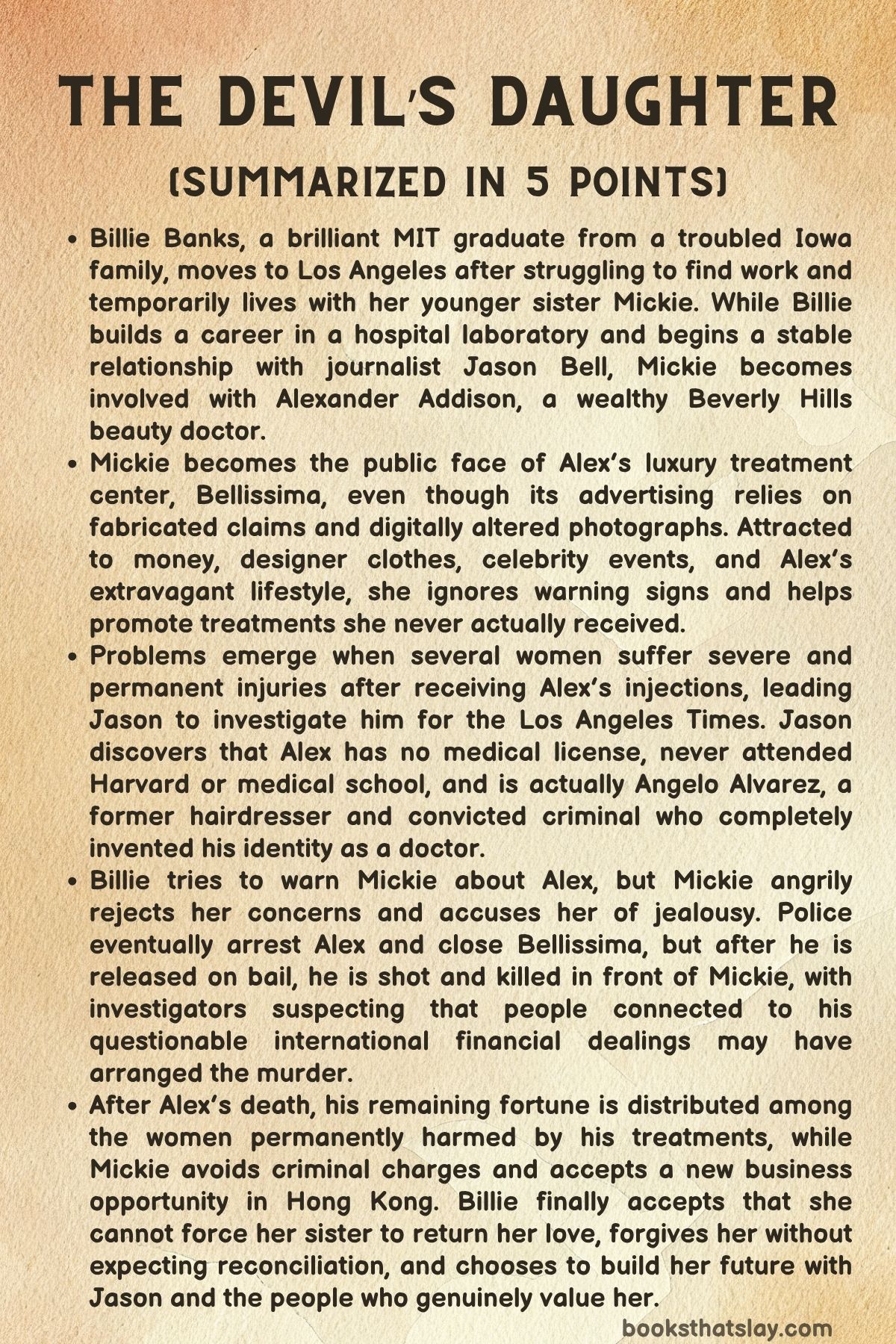
Summary
Wilhelmina “Billie” Banks graduates magna cum laude from MIT with a biology degree and a chemistry minor, an achievement made more meaningful by the memory of her late mother, Virginia. Billie grew up on a dairy farm in Collins, Iowa, where her father Jim consistently favored her younger sister Michaela “Mickie” Banks, whose beauty and charm often allowed her to escape responsibility while Billie took the blame.
Virginia’s death from breast cancer made the family even more fractured, and Billie eventually escaped to MIT on a full scholarship. Her closest childhood friend, Tom Carter, later entered military intelligence, while Mickie left Iowa for Los Angeles in pursuit of modeling and acting opportunities.
After graduation, Billie struggles to find scientific work in Boston because most laboratory positions have already been filled. With her savings disappearing, she faces the humiliating possibility of returning to Iowa until Mickie unexpectedly offers her a place to stay in Los Angeles and temporary work at Harry’s, the restaurant where she waits tables.
Billie reluctantly accepts and moves into Mickie’s shabby West Hollywood apartment. She immediately begins contacting medical employment agencies while working evenings at Harry’s, determined that her education will eventually lead to something better.
Their lives soon begin moving in opposite directions. Billie obtains a temporary pathology laboratory position at Cedars-Sinai, while Mickie auditions for an advertising campaign connected with Dr. Alexander Addison IV, a handsome and wealthy-looking Beverly Hills practitioner launching a nonsurgical beauty center called Bellissima.
Billie becomes suspicious when she learns that the advertising photographs are deliberately deceptive. Photographer Zack Campbell digitally alters Mickie’s appearance to make her look decades older in the “before” images, while her natural nineteen-year-old face is presented as the “after” result of procedures she never received.
Mickie is initially aware that the advertising is dishonest, but her concerns disappear once she becomes fascinated by Alex’s money, confidence, and glamorous lifestyle. Alex invites her to dinner, hires her as Bellissima’s public ambassador, and instructs her to pretend she is thirty-three so potential patients will believe his procedures have preserved her youthful appearance.
Their relationship quickly becomes sexual as well as professional. Mickie begins attending expensive parties, wearing designer clothing supplied through Alex, and publicly promoting treatments whose effects she cannot honestly verify.
Billie’s new relationship develops in a completely different way. She meets Jason Bell, a thirty-three-year-old crime reporter for the Los Angeles Times who lives near Mickie’s apartment, and the two discover that they share similar educational backgrounds, ambitions, and attitudes toward life.
On their first dates, Billie tells Jason about Virginia’s death, Jim’s emotional neglect, and Mickie’s long history of lying and manipulation. Jason comes from a close and educated family, and Billie is struck by how different his emotional world is from the one in which she grew up.
As their relationship develops, Jason visits Billie at work, takes her to a Dodgers game, and gradually becomes an important source of emotional security. After spending a late evening together, they become lovers, and Billie soon begins spending most nights with him.
Meanwhile, Bellissima becomes increasingly successful. Alex treats wealthy women with secret formulas, experimental injections, mesotherapy, and other procedures while refusing to disclose exactly what substances he uses.
One of his strongest supporters is Marilyn Hodges, whose influential husband has helped finance Bellissima. Alex lies even to Marilyn, telling her that Mickie’s youthful appearance proves the effectiveness of treatments that Mickie has never actually received.
Jason eventually meets Mickie and immediately notices how dismissively she treats Billie. He warns Billie that he finds something disturbing in Mickie’s personality, but Billie has spent so many years forgiving her sister that she continues making excuses for her.
Mickie’s position becomes increasingly lucrative as she accompanies Alex to celebrity gatherings and luxury destinations. When investors from Korea agree to provide ten million dollars for another Bellissima center, Alex gives Mickie one hundred thousand dollars to postpone the Stanford education she falsely claimed she was pursuing.
Billie and Jason, by contrast, create an increasingly stable domestic life together. When Jason invites Billie to spend Christmas with his family in New York and Connecticut, she contacts Jim to see whether he wants her to come home, but his continued indifference finally persuades her to accept Jason’s invitation.
Christmas with Jason’s parents, his sister Emily, and Emily’s partner Thad gives Billie an unfamiliar experience of warmth and inclusion. Although she initially feels like an outsider, she gradually realizes that this family welcomes her without requiring her to earn their affection.
At Bellissima, however, serious problems are beginning to surface. Alex receives a letter from a former patient who was permanently disfigured and nearly died after being injected with liquid silicone and other substances, followed by another complaint from a similarly injured woman.
Alex realizes that some of his products may have been counterfeit or extremely dangerous. Instead of reporting the problem, stopping treatment, or seeking legitimate legal and medical advice, he conceals the evidence and locks away advertising material containing the fraudulent photographs of Mickie.
He and Mickie then leave for an extravagant Caribbean holiday aboard a yacht after traveling on a leased private jet. Alex has been spending millions of dollars obtained from Korean investors and even briefly considers marrying Mickie because a wife could provide him with protection from damaging testimony.
After New Year’s, Jason receives an assignment to investigate several women who claim that a prominent plastic surgeon has severely injured them with illegal or dangerous injections. He is shocked to discover that the doctor is Alex and immediately tells Billie, offering to withdraw because Mickie is directly connected to the man under investigation.
Billie refuses to ask Jason to protect her sister at the expense of injured women. Jason begins checking Alex’s professional background and soon discovers that the Medical Board of California has no record of his license, Florida records provide no proof of his earlier practice, and Harvard has no evidence that he ever attended the university or its medical school.
As additional victims emerge, Jason realizes that Alex’s deception extends far beyond unsafe treatments. Billie becomes increasingly afraid for Mickie and, despite promising not to reveal Jason’s confidential information, arranges a private meeting with her sister and warns her that Alex may not be what he claims.
Mickie reacts furiously and accuses Billie of jealousy. She refuses to question Alex’s background, attacks Jason’s motives, and orders Billie to stay out of her life.
Jason and his editor eventually bring the information to the police. Lieutenant Dan Kelly and the LAPD fraud unit discover that Alexander Addison IV is actually Angelo Alvarez, a man who never finished high school and never attended medical school.
After a troubled youth involving foster care and juvenile detention, Angelo worked as a hairdresser and in spas, sold drugs, served time in jail, changed his name, and gradually manufactured the identity of an elite physician. His diplomas, professional history, and prestigious education were all inventions supporting years of illegal medical practice and financial deception.
While Billie is absorbing the scale of Alex’s crimes, she receives devastating news that Tom Carter has been killed during a military operation in Syria. Tom was one of the few people who truly understood and loved Billie during her childhood, so his death forces her to confront another major loss.
Jason’s investigation leads to the professional advancement he has long sought, and he is promised promotion to senior political reporter. Police then arrest Alex while he is treating patients, close Bellissima, freeze his assets, and confiscate his supplies.
Alex pleads not guilty and receives bail with financial assistance from Marilyn Hodges. Mickie stays with him briefly but quickly recognizes that his money, business, and social position have collapsed, while also becoming concerned that she herself could face legal consequences.
Before Mickie goes to the police with attorney Patricia Scott, she leaves a hotel with Alex and witnesses his murder. A gunman approaches and shoots Alex dead before escaping, abruptly ending the criminal case against him while opening a new investigation into whoever wanted him silenced.
During questioning, Mickie presents herself as a young woman whom Alex manipulated financially and sexually. She claims she genuinely believed he was a doctor, denies knowledge of his illegal medical activities, and gives investigators information about the Korean investment money that Alex had misused.
Police suspect that people connected with his overseas financial dealings may have arranged his death, but the murder remains unsolved. The getaway vehicle is stolen, the killers cannot be identified, and investigators eventually reach a dead end.
Because Alex dies without heirs, his remaining property and fortune are divided among the five women permanently injured by his treatments. Each receives approximately three million dollars, although no financial settlement can restore the health or appearance they lost.
Mickie shows little lasting emotional attachment to Alex and soon redirects her attention toward a new opportunity. She contacts the Hong Kong investors he had been courting, tells them the truth about her age, and presents herself as an ambitious young woman with experience in luxury marketing, fashion, and high-end clientele.
They offer her a junior executive position in Hong Kong with a strong salary, housing, and the possibility of advancing into buying. Mickie accepts immediately, seeing the job as a new beginning rather than examining deeply how her choices helped sustain Alex’s deception.
Before leaving Los Angeles, Mickie tells Billie that she neither wants nor needs a family. Billie nevertheless goes to the airport hoping for some form of farewell, but Mickie initially remains beyond security and avoids speaking to her.
At the last moment, Mickie turns and acknowledges Billie from a distance before boarding. Billie finally understands that loving her sister does not require continuing to wait for Mickie to become capable of returning that love.
Billie forgives Mickie without pretending that their relationship can become what she once wanted. Leaving the airport with Jason, she feels released from the emotional burden she has carried since childhood and recognizes that family can also be formed through people who offer loyalty, respect, safety, and genuine affection.
Characters
Wilhelmina “Billie” Banks
Billie is the emotional and moral center of The Devil’s Daughter, and much of her development comes from learning that intelligence and determination alone cannot repair relationships built on neglect. She begins the novel as an exceptionally capable young woman whose academic success at MIT proves that she can overcome the limitations of her childhood, yet her emotional life remains strongly affected by her father’s favoritism and her sister’s repeated cruelty.
Her strongest qualities are discipline, integrity, patience, and an unusually persistent capacity for forgiveness. Even after years of being blamed and mistreated by Mickie, Billie moves to Los Angeles, tries to rebuild their relationship, and repeatedly gives her sister opportunities to behave differently.
Billie’s scientific background also influences the way she responds to Alex. She is naturally suspicious of fabricated medical claims, digitally manipulated advertising, and treatments presented without credible evidence, so she senses the ethical problems surrounding Bellissima before the full extent of the fraud becomes known.
Her relationship with Jason demonstrates how much Billie changes once she experiences dependable affection. She gradually discovers that intimacy does not need to involve competition, manipulation, or the constant fear of rejection, and Jason’s family gives her a model of emotional security that her own family never provided.
The final airport scene completes Billie’s personal development because she stops confusing forgiveness with endless emotional pursuit. She does not become bitter toward Mickie, but she accepts that she cannot force her sister to love her, which allows her to choose a future built around people who willingly choose her in return.
Michaela “Mickie” Banks
Mickie is one of the most morally difficult characters in The Devil’s Daughter because she combines immaturity, ambition, charm, dishonesty, and emotional detachment. From childhood onward, she learns that beauty and manipulation can protect her from consequences, particularly because Jim repeatedly favors her over Billie.
Her involvement with Alex reveals how naturally she adapts herself to whatever situation promises status or money. She lies about attending Stanford, lies about her age, promotes treatments she never received, accepts fraudulent advertising, and participates in Bellissima’s public deception despite having enough information to recognize that its claims are false.
Mickie is not presented as the architect of Alex’s medical crimes, however. She does not formulate his injections or create his false identity, and when the police investigation begins she can plausibly claim ignorance of many specific medical activities.
Her deeper moral failure lies in deliberate indifference. She repeatedly encounters signs of dishonesty but chooses not to ask questions whenever the truth might threaten her luxurious lifestyle.
Mickie’s reaction to Billie’s warning is especially revealing because she interprets concern as jealousy. Her self-image depends so strongly on feeling admired, successful, and superior that questioning Alex would also require questioning her own judgment and the identity she has constructed around him.
Even after Alex’s death, Mickie rapidly turns toward Hong Kong and another career opportunity. Her final acknowledgment of Billie at the airport suggests some remaining awareness of their bond, but she is still unwilling to offer the closeness Billie has long wanted, making her less a transformed character than a person who continues moving forward according to her own emotionally detached priorities.
Alexander Addison IV / Angelo Alvarez
Alexander Addison, born Angelo Alvarez, is the central antagonist of The Devil’s Daughter and represents deliberate self-invention carried far beyond ordinary ambition. Everything about the identity he presents to wealthy patients—his name, education, professional credentials, medical authority, and social standing—is constructed to create trust he has not earned.
His deception works because he understands what wealthy clients want to believe. He surrounds Bellissima with luxury, secrecy, glamorous marketing, exclusive access, and the appearance of scientific innovation, allowing spectacle to substitute for medical legitimacy.
Alex also understands the commercial value of Mickie’s youth and beauty. By transforming her into supposed proof of his antiaging treatments, he converts a nineteen-year-old woman’s natural appearance into fabricated evidence designed to influence vulnerable clients.
His worst actions arise from the fact that he does not merely impersonate a doctor for social status. He performs invasive procedures, administers dangerous substances, hides the composition of his formulas, and continues treating people even after women report catastrophic injuries.
Fear briefly emerges when complaints arrive, but it never develops into remorse. His primary concerns are protecting himself, preserving his money, controlling evidence, and preventing Mickie from becoming dangerous to him as a possible witness.
Alex’s murder prevents him from facing the legal consequences of his conduct. His death also reinforces the instability of the world he created: the wealth, prestige, and international connections that once protected him eventually surround him with people and financial arrangements dangerous enough to make his own life disposable.
Jason Bell
Jason provides the strongest ethical counterweight to Alex in The Devil’s Daughter. As a Los Angeles Times crime reporter, he is professionally committed to verifying facts, questioning appearances, and following evidence, while his relationship with Billie shows the same preference for honesty and emotional directness in his private life.
He recognizes troubling qualities in Mickie soon after meeting her, particularly the contempt hidden beneath the way she speaks to Billie. Unlike Billie, whose judgment is complicated by childhood loyalty, Jason has enough emotional distance to see the unhealthy relationship clearly.
His handling of the Alex investigation also demonstrates professional integrity. As soon as he discovers that his assignment involves Mickie’s partner, he tells Billie and offers to remove himself rather than conceal a potential conflict.
Billie’s decision to support the investigation strengthens their relationship because both choose the victims and the truth over family convenience. Jason then patiently verifies Alex’s licensing and educational history before involving law enforcement, showing that his work depends on evidence rather than suspicion alone.
Jason’s importance extends beyond the investigation. Through his stable personality and welcoming family, he helps Billie understand that love can be dependable rather than conditional, making him both her romantic partner and an important part of her emotional reconstruction.
Jim Banks
Jim is Billie and Mickie’s father, and his favoritism contributes significantly to the damaged relationship between his daughters. He undervalues Billie’s intelligence and achievements while consistently preferring Mickie, reinforcing the lesson that beauty and charm receive more attention than discipline or academic ability.
His emotional coldness becomes especially clear around Billie’s MIT graduation and later when she considers returning home for Christmas. His lack of interest continues even after Billie has become an accomplished adult, suggesting that his behavior is not simply the result of temporary family tension.
Jim’s significance lies less in what he actively does during the main events than in the emotional consequences of his parenting. Billie’s repeated attempts to win affection from unavailable people can be understood partly as an extension of the pattern established in childhood, while Mickie’s entitlement is strengthened by years of preferential treatment.
Virginia Banks
Virginia, Billie and Mickie’s late mother, appears primarily through Billie’s memories, yet her emotional influence remains substantial. Billie believes Virginia would have valued her MIT achievement, which distinguishes her mother from Jim and gives Billie a lasting sense that at least one parent understood what she was capable of accomplishing.
Her death from breast cancer also marks a turning point in the Banks family. Without Virginia, already difficult relationships worsen, leaving Billie more isolated and increasing the importance of her eventual departure for MIT.
Virginia therefore functions as both a source of grief and a remembered source of affirmation. Her absence helps explain why Billie remains so hungry for family connection even after becoming independent.
Tom Carter
Tom Carter is Billie’s closest childhood friend and one of the few people associated with Iowa who represents genuine loyalty rather than rejection. His presence in her memories shows that Billie’s childhood was not completely without affection, even though her immediate family often failed her.
As an adult, Tom serves in military intelligence and undertakes dangerous counterterrorism work overseas. His death during an operation in Syria becomes one of Billie’s most painful losses because it removes someone who understood the circumstances from which she came.
Tom’s death also arrives when Billie is already facing the collapse of Mickie’s world and the exposure of Alex. The event reminds her that meaningful relationships can be lost without warning, strengthening the contrast between people like Tom, whose affection was real, and people whose approval she has spent years unsuccessfully trying to obtain.
Marilyn Hodges
Marilyn Hodges illustrates how effectively Alex manipulates wealthy and trusting clients. Her powerful husband helps finance Bellissima, and Marilyn becomes so devoted to Alex that she accepts experimental injections and believes his explanations without demanding proof.
She is especially important because her trust continues even after Alex’s arrest. By funding his bail, she demonstrates how charisma and perceived authority can survive even when serious evidence of wrongdoing has emerged.
Marilyn is not portrayed as unintelligent so much as deeply persuaded by the identity Alex has constructed. Her character shows why professional credentials and medical claims matter: when patients assume that someone is qualified, their trust can make them vulnerable to people who deliberately exploit it.
Zack Campbell
Zack Campbell is the photographer responsible for producing the altered images used in Bellissima’s advertising campaign. He digitally ages Mickie so that her genuine youthful appearance can later be presented as the supposed result of Alex’s treatments.
His role is relatively limited, but it is important to the mechanics of the fraud. Bellissima’s success depends not only on Alex’s verbal lies but also on visual evidence manufactured to appear convincing.
Zack therefore represents the commercial machinery that can help transform deception into something polished and believable. Even though he is not described as participating in Alex’s dangerous medical procedures, his work helps create the false image on which Bellissima’s public credibility depends.
Ben Hewitt
Ben Hewitt is Billie’s MIT classmate and appears at a moment when her family’s absence is especially painful. When neither Jim nor Mickie attends Billie’s graduation, Ben invites her to celebrate with his family.
The gesture is simple but significant because it gives Billie an early example of generosity from people who owe her nothing. His family’s warmth foreshadows the much deeper sense of belonging she later experiences with Jason and his relatives.
Ben therefore contributes to the novel’s broader contrast between biological family and chosen emotional support. He reminds Billie that kindness can come from outside the relationships she has spent years trying to repair.
Lieutenant Dan Kelly
Lieutenant Dan Kelly leads the LAPD fraud investigation after Jason and his editor decide that Alex’s activities require police involvement. His work converts journalistic suspicion into a criminal inquiry supported by verifiable records.
Kelly’s investigation uncovers the full history behind Alexander Addison’s invented identity. By tracing him back to Angelo Alvarez and establishing his lack of education, licensing, and legitimate medical training, Kelly reveals how extensive the fraud has become.
His character represents institutional accountability entering a world that Alex has controlled through secrecy and appearance. Once investigators begin checking facts rather than accepting his self-created reputation, the professional identity Alex spent years constructing collapses rapidly.
Patricia Scott
Patricia Scott is the attorney who accompanies Mickie when she prepares to speak with police after Alex’s arrest. Her appearance is brief, but her presence marks an important shift in Mickie’s position from glamorous companion to a person potentially exposed to legal scrutiny.
By obtaining legal representation, Mickie demonstrates that she understands how serious the situation has become. Patricia’s role also reinforces the difference between Alex’s collapsing world of fabrication and the formal legal process now surrounding everyone connected to him.
Emily Bell
Emily is Jason’s sister and forms part of the welcoming family environment Billie encounters during Christmas in New York and Connecticut. Her importance comes primarily from the contrast between the Bell family’s warmth and Billie’s experience with Jim and Mickie.
Emily helps create a family setting in which Billie does not have to compete for affection or prove that she deserves inclusion. That experience gradually changes Billie’s understanding of belonging and shows her that healthy family relationships can exist outside the household in which she was raised.
Thad
Thad is Emily’s partner and another member of the family circle that welcomes Billie during Christmas. Although the source material gives him little independent development, his inclusion contributes to the sense of ease and acceptance that Billie experiences around Jason’s relatives.
His presence helps make the holiday significant because Billie is not treated as an outsider attached temporarily to Jason. Instead, she is absorbed naturally into a larger social unit whose interactions contrast sharply with the emotional distance of the Banks family.
Jason’s Parents
Jason’s parents are not individually named, but they play an important emotional role in Billie’s development. Their welcoming treatment of her gives Billie one of her clearest experiences of a stable household in which affection is freely expressed rather than distributed according to favoritism.
At first, their closeness makes Billie conscious of everything she lacked growing up. Over time, however, that discomfort changes into reassurance because she begins to understand that she can participate in this kind of family life rather than merely observe it from outside.
Tom Carter’s Mother
Tom’s mother appears when she contacts Billie with the news that Tom has been killed in Syria. Although her role is brief, she becomes the person who delivers one of the most devastating pieces of information Billie receives in the story.
Her call connects Billie directly to the world of her childhood and to the person who had offered her friendship during difficult years. Through this moment, the story gives Tom’s death personal immediacy rather than allowing it to remain a distant consequence of his military career.
Themes
Deception, Appearance, and the Manufacture of Credibility
Appearance repeatedly functions as a substitute for truth in The Devil’s Daughter, especially through Alex’s transformation of himself into a respected physician. His expensive surroundings, confident manner, supposed Harvard education, fabricated diplomas, luxury lifestyle, and elite clientele create a convincing external identity even though none of these things prove that he possesses legitimate medical training.
Bellissima extends the same strategy into advertising. Mickie’s photograph is digitally altered so that a nineteen-year-old woman can be presented as an older patient whose youth has supposedly been restored by treatment, converting an obvious lie into persuasive visual evidence.
Mickie knowingly participates because the deception benefits her materially and socially. The lie about her age, her invented Stanford education, and her willingness to promote treatments she never received demonstrate how easily false identities multiply once people discover that others are willing to accept attractive appearances without checking facts.
Jason represents the opposite method of understanding reality. His investigation depends on licenses, university records, professional histories, victim testimony, and police verification, and Alex’s entire identity begins collapsing as soon as someone replaces admiration with basic fact-checking.
The injured patients show the human cost of confusing prestige with competence. Their suffering turns the theme from a question of social dishonesty into a warning about situations in which false credibility gives someone authority over another person’s body, health, money, or future.
Family, Rejection, and Chosen Belonging
Family shapes Billie long before the main conflict begins because she grows up learning that love within her household is unequal. Jim’s preference for Mickie teaches Billie that achievement does not guarantee affection, while Mickie’s manipulation repeatedly places Billie in the position of being blamed, overlooked, or expected to forgive.
Virginia’s death removes the parent Billie remembers as someone capable of appreciating her. The loss leaves her emotionally exposed and helps explain why she continues trying to preserve a relationship with Mickie even after years of disappointment.
This tension gives The Devil’s Daughter much of its emotional structure. Billie’s problem is not simply that Mickie mistreats her; it is that Billie continues hoping that enough patience, understanding, and forgiveness will eventually turn their biological bond into the loving sisterhood she wants.
Jason and his family offer a different definition of belonging. Billie enters their Christmas celebration expecting to feel like an outsider, but their warmth teaches her that family can be created through consistent behavior, mutual respect, and genuine welcome rather than blood alone.
The airport ending completes this idea. Billie does not stop loving Mickie, but she stops allowing that love to keep her emotionally trapped, accepting that forgiveness can coexist with distance and that releasing an unhealthy relationship may be necessary before healthier relationships can fully become home.
Ambition, Greed, and Moral Compromise
Ambition takes sharply different forms through Billie, Mickie, Alex, and Jason. Billie’s ambition is based on education and work, while Jason seeks professional advancement through reporting; both are willing to proceed gradually because accomplishment matters to them only when it is legitimately earned.
Mickie’s ambition is much more closely tied to luxury, recognition, and access. She is willing to lie about her education, age, and experience because these falsehoods move her toward the lifestyle she wants without requiring the slower process of building real qualifications.
Alex represents the most extreme version of ambition separated from ethics. He does not merely exaggerate his background but constructs an entire professional identity, obtains money from wealthy investors, practices medicine illegally, and uses patients as sources of profit despite lacking the training necessary to protect them.
Money continually encourages further compromise. The Korean investment allows Alex to spend lavishly on a private jet and yacht, and the possibility of even larger Hong Kong investments persuades him to imagine expanding the fraud rather than abandoning it after injured patients begin threatening legal action.
The novel ultimately distinguishes ambition from greed by asking what a person is willing to sacrifice for success. Billie and Jason continue advancing without surrendering their principles, while Mickie repeatedly compromises honesty and Alex sacrifices nearly every moral boundary until the elaborate world created by his greed finally collapses.
Truth, Accountability, and the Consequences of Choice
The conflict surrounding Bellissima demonstrates how truth can be delayed but not permanently controlled. Alex manages for years to create an image of success because patients, investors, and social acquaintances accept his claims, yet every lie also creates records, victims, financial connections, and contradictions that can eventually be examined.
Jason’s reporting begins the process of accountability because he chooses to pursue evidence even though doing so may damage Billie’s relationship with Mickie. Billie makes an equally important decision when she tells him not to abandon the investigation merely to protect her family from embarrassment or consequences.
That choice places moral responsibility above personal loyalty. Billie recognizes that the women injured by Alex deserve truth and justice, even if revealing that truth exposes her sister’s connection to the fraud.
Formal accountability arrives through Dan Kelly and the police, but Alex’s murder prevents the legal system from reaching a complete conclusion. His death does not erase the damage, and the financial compensation awarded to five injured women can only partially address what his actions permanently took from them.
Personal accountability remains more complicated, particularly for Mickie. She escapes criminal responsibility and immediately pursues a new career, while Billie’s final act in The Devil’s Daughter is a quieter form of accountability directed toward herself: she accepts the reality of her sister rather than continuing to build hope around the person she wishes Mickie could become.
The ending therefore connects truth with freedom as much as punishment. Billie becomes freer when she stops denying what years of experience have already taught her, showing that accepting painful reality can be the beginning of a healthier life rather than simply the end of an old relationship.