The Final Problem Summary, Characters and Themes
The Final Problem by Arturo Pérez-Reverte is a literary mystery centered on Ormond Basil, an aging British actor whose screen portrayal of Sherlock Holmes has followed him long after his film career faded. Stranded by a storm on a remote Greek island in 1960, Basil becomes involved in a series of seemingly impossible murders that imitate the conventions of classic detective fiction.
The novel combines locked-room puzzles, literary references, wartime secrets, identity deception, revenge, and Basil’s conflicted relationship with the fictional detective he once embodied. At its center is a contest between appearances and reality, forcing Basil to discover whether acting like Holmes can lead him to a truth that ordinary investigation cannot.
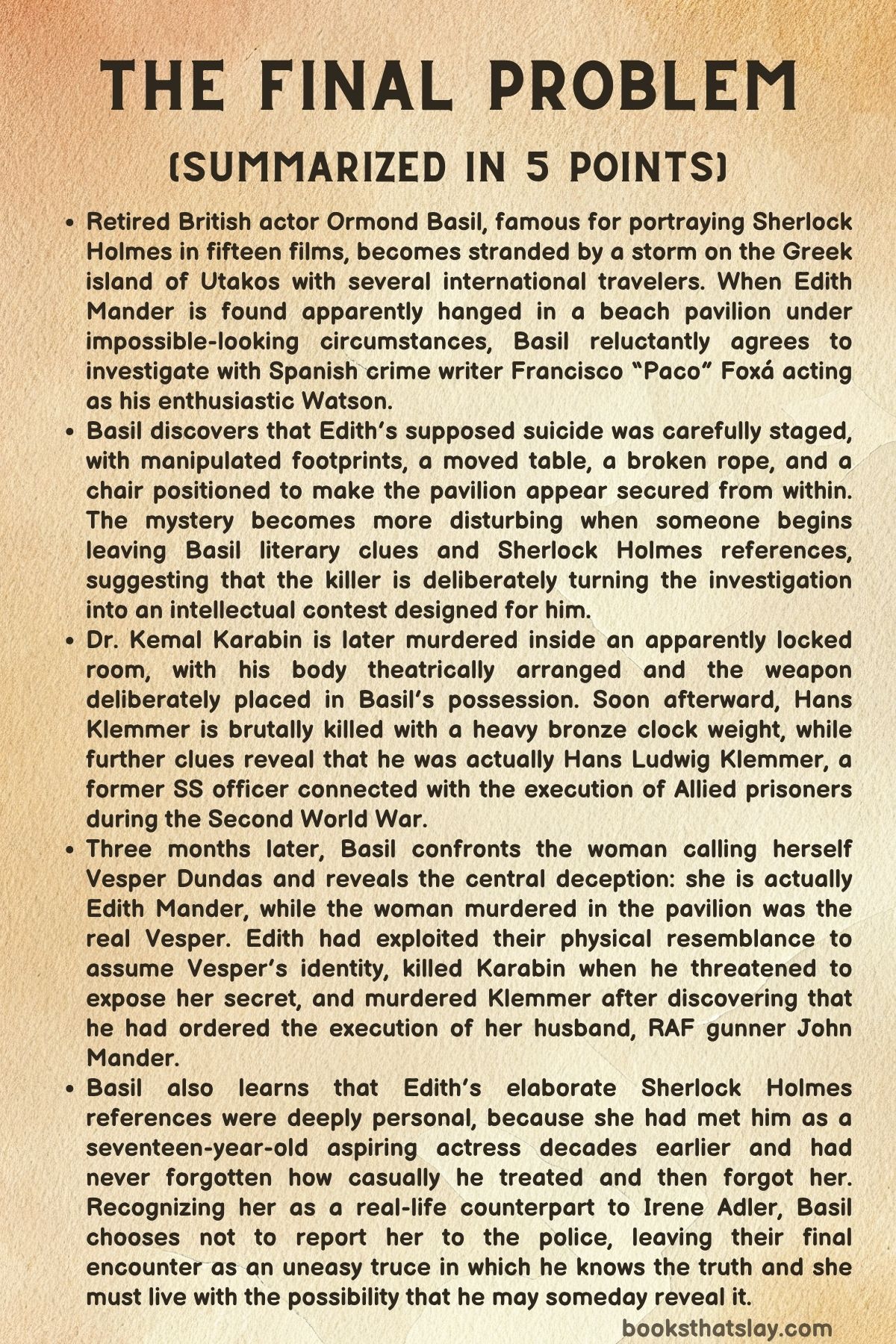
Summary
In June 1960, retired British actor Ormond Basil travels to Genoa, where chance brings him into contact with Italian film producer Pietro Malerba and the celebrated soprano Najat Farjallah. Basil was once widely known under the stage name Hopalong Basil, but his enduring fame comes from having played Sherlock Holmes in fifteen films, a role so successful that it overshadowed almost everything else he accomplished as an actor.
Malerba invites Basil aboard his yacht, partly because he is considering a possible television project. The journey eventually brings them to Utakos, a tiny Greek island near Corfu, where a violent storm leaves Basil and several other international travelers effectively trapped at the Hotel Auslander.
Among the people Basil meets there is Francisco “Paco” Foxá, a Spanish writer of crime stories and Westerns who has admired Basil’s Holmes films for years. Foxá immediately treats Basil almost as though the actor possesses the deductive abilities of the character he portrayed, although Basil repeatedly insists that Sherlock Holmes was fictional and that an actor should not be confused with his role.
The situation changes when Vesper Dundas reports that Edith Mander, the woman traveling with her, has disappeared. Edith is soon found hanging in a pavilion on the beach, and the initial appearance suggests suicide, yet the physical circumstances raise troubling questions.
There is a bruise on Edith’s head, the rope has broken, and a chair appears to have blocked the pavilion door from inside. Even more puzzling, footprints cross the sand toward the pavilion, but there is no second set showing anyone returning from it.
Vesper explains that Edith had been her companion and secretary during several months of travel. Edith had served during the Second World War, lost her RAF husband, possessed useful skills in typing and accounting, and later experienced an unhappy relationship, but nothing in her recent conduct indicated that she intended to kill herself.
The other guests begin looking toward Basil for answers because of his association with Sherlock Holmes. Basil initially resists, arguing that fictional deductions are possible because writers carefully select and arrange facts, while real life is chaotic and may not provide neat solutions.
Foxá persuades him to treat the situation as an intellectual exercise, effectively volunteering himself for the Watson role. Basil finally agrees to examine the circumstances more closely, and the supposed suicide begins to look increasingly like a carefully constructed murder.
Dr. Kemal Karabin provides crucial medical information. Edith was still alive when she was hanged, while the blow to her temple could have been inflicted beforehand, raising the possibility that she had first been knocked unconscious and then suspended by the neck.
When pieces of the rope unexpectedly disappear, Basil and Foxá return to the pavilion and examine it more thoroughly. Basil notices Edith’s costly jewelry, her carefully maintained appearance, the positioning of the furniture, disturbed dust, magazines on the table, and an unusually clean threshold.
He begins to reconstruct a possible murder. Someone could have struck Edith with a heavy teak stool, moved a table beneath the beam, placed a rope around her neck, hanged her while she was alive, and then rearranged the room in order to make the event resemble suicide.
The footprints may also have been manipulated. A murderer could have followed Edith’s existing tracks when leaving, reducing the visible evidence of another person’s movements, while the broken rope and apparently blocked door added to the illusion that nobody else could have been present.
Basil briefly suspects that the position of the injury proves the killer was left-handed. Foxá demonstrates that a right-handed attacker could have produced the same wound, reminding Basil that attractive deductions are not necessarily correct simply because they sound like something Holmes might say.
As Basil questions the hotel manager Gérard and the island’s owner, Raquel Auslander, he gains additional information about the guests without finding an obvious culprit. Raquel, a survivor of Auschwitz, also becomes part of Basil’s reflections on memory, appearances, survival, and the difference between fiction and lived reality.
At the same time, Basil notices that he is gradually assuming some of Holmes’s familiar habits. The investigation restores a sense of intellectual purpose that he had lost, although he remains uneasy about how easily the boundaries between himself and his famous character are beginning to blur.
A new development makes it clear that someone is deliberately addressing him. An ornate dagger-like letter opener and a cryptic handwritten message referring to Ajax and footprints are slipped beneath his bedroom door.
Foxá recognizes the reference to Sophocles, in which Odysseus follows Ajax with the alertness of a Laconian hunting dog. Whoever is controlling events is therefore educated, knowledgeable about literature, and apparently interested in transforming the murders into a personal challenge aimed directly at Basil.
Soon afterward, Dr. Karabin fails to appear at breakfast. When his locked room is finally entered, he is found dead at his table with a narrow wound in the back of his neck.
The circumstances appear impossible because the door was secured and the terrace shutters were closed. Karabin’s wig has also been placed backward, while his stiffened arm points toward an old Greek magazine containing photographs of Basil as Sherlock Holmes.
The theatrical arrangement strongly suggests that someone is designing the scene rather than merely concealing a murder. The letter opener previously delivered to Basil appears to be the murder weapon, meaning the killer has deliberately planted incriminating evidence in the detective figure’s possession.
Other details complicate matters further. Four spent matches lie in Karabin’s room, but there are only three cigarette ends, suggesting that a fourth cigarette may have been removed to prevent identification of another person who had been there.
Basil reasons that the murderer could have escaped through the terrace and later returned after rigor mortis developed. The killer could then have positioned Karabin’s arm, completed the staged clues, and created the illusion of a completely sealed room.
Possible motives begin to surface. Karabin had serious financial difficulties connected with his medical clinic in Izmir, leaving open the possibility that he was involved in blackmail, corruption, or another dangerous arrangement.
Then all of the guests’ passports disappear from Raquel’s desk. The theft suggests that identity itself is important to the case, because someone may want to conceal, verify, or compare names, birthplaces, histories, or travel records.
Another message appears, this time using a quotation from Thomas De Quincey’s writing about murder considered as a fine art. The message is typed on Edith’s Olivetti, reinforcing the impression that the murderer is combining literary games with actual violence.
Basil eventually solves the mechanism behind the apparently blocked pavilion door. Edith’s black shawl could have been placed beneath a chair so that, after the murderer closed the door from outside, the protruding fabric could be pulled until the chair slid against the door.
The shawl could then be pulled completely free. Its later discovery among seaweed supports Basil’s theory and also explains why the threshold appeared unusually clean.
Attention then turns toward Hans Klemmer, a German guest whose body bears a mark resembling the remains of a wartime SS blood-group tattoo. Basil suspects that Klemmer has concealed part of his identity and past, but Klemmer angrily denies involvement with either Edith or the other guests.
Spiros, a young hotel employee, also admits that he lied about Edith. She had invited him toward the beach on the night she died, and the two smoked, talked, and kissed before he left her alive.
His earlier dishonesty appears to have come from embarrassment rather than guilt. Although this eliminates one deception, it leaves the larger mystery unresolved.
A third murder follows. Klemmer is discovered in the reading room with his skull crushed by repeated blows, yet the weapon initially seems to be missing.
Basil notices that a large clock in the hotel is ten minutes slow even though Raquel had properly wound it. Inspecting the clock, he discovers blood on one of its heavy bronze weights.
The killer had removed the weight, used it to murder Klemmer, cleaned it on Klemmer’s cardigan, and then replaced it in the clock. Because the mechanism had stopped while the weight was absent, the ten-minute discrepancy preserves evidence of the period during which the murder weapon was being used.
A coded note near the corpse sends Basil toward a facsimile edition of the Strand Magazine and pages associated with the Sherlock Holmes story The Speckled Band. The murderer is once again signing the crime through references to classic detective fiction.
Basil also discovers a torn page from a 1949 issue of Paris Match that identifies Klemmer as Hans Ludwig Klemmer, a former SS officer who had been tried and acquitted in connection with the execution of Allied prisoners at Gorbitz. The disappearance of the passports now appears connected to the need to establish his true identity.
Several people seem capable of having motives. Raquel’s survival of Auschwitz could provide a reason for hostility toward a former SS officer, while details surrounding Foxá also make him temporarily suspicious.
Foxá knows detective literature intimately, has unexplained knowledge of Karabin’s room, and can potentially be associated with some of the planted evidence. Yet he offers explanations for the suspicious details and continues to deny having anything to do with the killings.
Eventually police are able to reach Utakos, but the investigation does not publicly identify the murderer. Three months later, however, Basil visits the woman calling herself Vesper Dundas at her villa on Lake Garda and reveals that he has solved the case.
The central deception concerns identity. The woman Basil is visiting is not Vesper Dundas at all but Edith Mander, while the woman murdered in the beach pavilion was the real Vesper.
Basil explains the small inconsistencies that exposed the substitution. The dead woman had eaten a raspberry dessert despite medical records showing that Edith suffered from a serious fruit allergy.
The corpse also had long, immaculate fingernails that did not resemble the hands of someone accustomed to professional typing. The surviving “Vesper,” by contrast, shows the physical habits expected of an experienced typist, while a wartime photograph finally confirms that she is Edith.
Edith and Vesper had resembled each other closely enough that they sometimes exchanged identities for amusement. Edith turned that private game into a permanent escape from her own life by killing the wealthy Vesper and assuming her name, possessions, and social position.
The murder in the pavilion was therefore intended to establish that Edith Mander had died. Stealing the passports helped protect the substitution and prevent inconvenient comparisons that might expose the deception.
Karabin became dangerous because he noticed something wrong about the corpse. He may also have attempted to profit from what he discovered, making him a threat Edith believed she had to silence.
Klemmer’s murder had an entirely different emotional motive. During the war, Klemmer had been responsible for ordering the execution of Allied prisoners after the Dresden bombing, and among those prisoners was Edith’s husband, RAF gunner John Mander.
After confirming Klemmer’s identity, Edith killed him as an act of revenge. Her crimes therefore combine calculation, self-reinvention, self-protection, and unresolved anger originating in wartime loss.
The elaborate Sherlock Holmes references have an even more personal explanation. Edith is deeply familiar with Conan Doyle’s stories, but her fascination with Basil goes back decades.
When she was a seventeen-year-old aspiring actress in 1934, she spent a night with Basil after he suggested that he might help her career. Basil soon forgot her, leaving her with a humiliation that remained significant to her long afterward.
Later Edith met John Mander at a cinema where one of Basil’s Holmes films was being shown. After John’s death, her memories of her husband, Basil, Sherlock Holmes, and Conan Doyle became linked in a private emotional history.
Utakos therefore offered Edith more than an opportunity to commit murder. It allowed her to construct an elaborate intellectual challenge for the man who had once hurt her and then forgotten her, forcing Basil to become in reality the detective whose fictional image had shaped both their lives.
Basil recognizes that Edith resembles a real-life Irene Adler, the exceptional woman capable of testing Holmes intellectually rather than merely serving as another criminal to be defeated. The case becomes a confrontation between two people who understand that fiction has influenced the roles they now perform in real life.
Despite solving the murders, Basil decides not to report Edith to the police. He does not forgive or justify what she has done, but neither does he choose conventional justice.
Instead, he leaves her with the uncertainty that he could expose her at any future moment. Their final encounter becomes an uneasy truce between the actor who has again become “Sherlock Holmes” and the woman he privately recognizes as his “Irene Adler,” bringing the mystery to an ending in which knowledge and psychological power replace arrest and punishment.
Characters
Ormond Basil
Ormond Basil is the central figure of the novel, an elderly British actor whose professional success has become inseparable from the fictional detective he portrayed. His fifteen Sherlock Holmes films gave him lasting fame, but they also imprisoned him within a public identity that overshadowed the remainder of his career and made strangers assume that the qualities of Holmes somehow belonged to Basil himself.
At the beginning, Basil strongly resists this confusion between actor and character. He repeatedly insists that Holmes never existed and that fictional detection works because authors control the evidence, yet the murders on Utakos gradually force him to use the habits of observation, skepticism, reconstruction, and logical testing that he once performed only from a script.
His development in The Final Problem depends on the tension between performance and genuine ability. Basil discovers that although he is not Sherlock Holmes, decades of portraying the detective have shaped the way he notices objects, challenges assumptions, and understands the dramatic construction of evidence.
The investigation also restores something personally important to him. Age and retirement have left him living partly inside the shadow of his past, but the crimes give him a renewed sense of alertness and purpose, making the danger psychologically invigorating even when he recognizes how strange it is to be acting like the character who dominated his professional life.
Basil is not presented as infallible. His incorrect speculation about the murderer being left-handed demonstrates how easily clever reasoning can become self-deception, and Foxá’s correction reminds him that a convincing deduction still requires testing against alternative explanations.
His final confrontation with Edith reveals his greatest moral ambiguity. Having solved the crimes, he refuses to give her to the authorities, choosing psychological judgment over legal justice and leaving her uncertain whether he may eventually expose her.
That decision prevents Basil from becoming a simple imitation of Holmes. He has acquired the detective’s ability to discover truth, but he retains the actor’s awareness that human beings cannot always be reduced to clues, crimes, and solutions.
Edith Mander
Edith Mander is the hidden center of the entire mystery and the character whose real identity transforms the meaning of nearly every earlier event. For much of the story she is believed to be the woman found dead in the pavilion, but Basil eventually establishes that she is alive and has been presenting herself as Vesper Dundas.
Her deception is extraordinarily ambitious. Because she and Vesper resemble each other, their earlier habit of exchanging identities becomes the foundation for a plan in which Edith murders Vesper and permanently assumes her wealthier companion’s existence.
Edith is intelligent, patient, literate, and highly attentive to detail. She understands both practical crime and the conventions of detective fiction, allowing her to create physical puzzles while simultaneously surrounding the murders with quotations, references, false trails, and deliberately theatrical clues.
Within The Final Problem, her crimes cannot be reduced to one motive. Vesper’s murder is connected to self-reinvention and material transformation, Karabin’s murder is committed to protect the deception, and Klemmer’s death is an act of long-delayed revenge for the execution of her husband.
Her wartime history explains much of the emotional force behind her actions without making those actions morally simple. The death of John Mander leaves her carrying unresolved grief and anger, while the later discovery of Klemmer gives her an opportunity to punish a man who escaped conventional justice.
Edith’s connection to Basil makes the entire construction even more personal. As a seventeen-year-old aspiring actress, she trusted Basil after he suggested he could help her career, spent a night with him, and was then forgotten, turning what may have been an insignificant episode to Basil into something that remained embedded in her memory.
Her later fascination with Holmes and Conan Doyle transforms Basil into both an adversary and a symbol from her past. By designing crimes filled with Holmesian references, she effectively compels him to notice her in a way he failed to do decades earlier.
Basil’s comparison of Edith with Irene Adler captures her unusual role. She is neither merely a victim nor merely an opponent; she is the person capable of designing an intellectual contest complicated enough to force Basil into the role that made him famous.
Francisco “Paco” Foxá
Francisco “Paco” Foxá is a Spanish writer of popular crime fiction and Westerns whose enthusiasm for Basil immediately shapes their relationship. As a longtime admirer of Basil’s Sherlock Holmes performances, he approaches the retired actor with a mixture of affection, humor, literary curiosity, and almost childlike excitement at the possibility of witnessing a real investigation.
Foxá becomes the practical Watson figure of the novel, although he is considerably more than a passive assistant. He discusses evidence with Basil, questions deductions, provides literary knowledge, and helps prevent Basil from becoming too impressed with his own theories.
His correction of Basil’s assumption about a left-handed murderer is particularly revealing. Foxá demonstrates that the same injury could have been inflicted by a right-handed attacker, exposing how easily deduction can become a performance when the investigator begins preferring an elegant explanation to a fully tested one.
Because Foxá is a crime writer, however, his usefulness also makes him suspicious. His knowledge of detective conventions, familiarity with the language of constructed mysteries, access to information surrounding Karabin, and possible connection to several details give Basil reason to consider whether the enthusiastic Watson might secretly be playing another role.
The suspicion illustrates one of the structural pleasures of The Final Problem: the person best equipped to understand the literary qualities of the murders is also someone whose expertise makes him capable of staging them. Foxá ultimately emerges as an ally rather than the mastermind, but the uncertainty surrounding him demonstrates how effectively Edith uses knowledge and coincidence to direct suspicion.
Foxá also helps Basil recover his confidence. By treating him as someone capable of real detection rather than merely as a retired performer, he encourages Basil to test whether the skills associated with Holmes have become part of his own intellectual personality.
Vesper Dundas
The real Vesper Dundas is initially known only through the identity that Edith steals from her, making her one of the story’s most unusual victims. Much of what the other guests believe they know about Vesper is actually learned through Edith’s performance after the substitution, meaning the real woman remains partially hidden even after the crime is solved.
She is wealthy enough that assuming her identity offers Edith a radically different future. Her resemblance to Edith had previously allowed the two women to exchange identities playfully, but this harmless private joke ultimately supplies Edith with the mechanism for a calculated murder.
Vesper’s death also demonstrates the danger of social identity being treated as something confirmed by clothing, possessions, documents, and expectations. Because people see what they expect to see, Edith can exploit superficial similarities while relying on others to complete the deception for her.
The most revealing evidence comes not from dramatic clues but from small bodily facts. Vesper’s raspberry dessert, immaculate nails, and lack of a professional typist’s physical habits eventually contradict the identity assigned to her corpse.
Her role is therefore crucial even though she cannot participate in the later events. The investigation succeeds when Basil stops focusing only on how the woman died and asks a more fundamental question: who actually died?
Dr. Kemal Karabin
Dr. Kemal Karabin is both a source of essential medical evidence and the second victim of the murderer. His examination of the first corpse establishes that the woman was alive when hanged and that the blow to her temple may have preceded the hanging, helping Basil move decisively away from the theory of suicide.
Karabin’s own circumstances make him morally uncertain. Financial difficulties connected with his medical clinic suggest that he may have been vulnerable to blackmail, bribery, or opportunism, although the available evidence never turns him into a simple villain.
His death is staged as an elaborate locked-room puzzle. The wound in his neck, backward wig, rigid arm, Sherlock Holmes magazine, missing cigarette end, and planted letter opener create a scene designed to confuse the investigation while also speaking directly to Basil.
Karabin ultimately appears to have recognized that something about the supposed Edith Mander did not fit. Whether he intended simply to confront Edith or tried to profit from his knowledge, his discovery made him dangerous to her continued impersonation.
His murder illustrates how quickly one crime creates pressure for another. Edith’s original plan depends upon everyone accepting the false identity of Vesper’s corpse, so a witness capable of exposing that mistake becomes a threat she cannot tolerate.
Hans Ludwig Klemmer
Hans Klemmer first appears as another international guest, but traces of his wartime past gradually transform him into a figure connected to historical violence. A mark resembling the remains of an SS blood-group tattoo alerts Basil to the possibility that Klemmer has concealed part of his identity.
The later discovery of a Paris Match article confirms that he is Hans Ludwig Klemmer, a former SS officer tried and acquitted in connection with the execution of Allied prisoners at Gorbitz. Among the men whose deaths are linked to his orders was Edith’s husband, John Mander.
Klemmer’s murder therefore differs sharply from Vesper’s and Karabin’s deaths. He is not killed to gain a new identity or silence someone who knows too much; he is killed because Edith sees him as a man who escaped punishment for an atrocity that permanently altered her life.
His presence complicates the moral structure of the book because his status as a victim does not erase his earlier actions. Edith has still committed murder, but Klemmer’s past ensures that the reader must confront the difference between legal acquittal, historical responsibility, and private revenge.
The brutality of his death also reveals the personal anger behind it. Unlike the elaborate hanging or carefully staged murder of Karabin, Klemmer is struck repeatedly with the heavy clock weight, suggesting that this killing carries an emotional intensity connected to decades of suppressed loss.
Raquel Auslander
Raquel Auslander is the formidable owner associated with the hotel and island, and her personality gives her an authority that makes Basil take her seriously from the beginning. Her conversations with him move beyond the immediate mechanics of the murders and introduce questions about reality, appearance, memory, and the stories people tell themselves in order to survive.
Her history as an Auschwitz survivor gives these discussions special weight. For Raquel, the difference between fiction and reality is not merely a philosophical game, because she has experienced historical horrors that resist the tidy logic of detective stories.
Her wartime past also temporarily makes her a plausible suspect in Klemmer’s murder. Once Basil learns that Klemmer was an SS officer, Raquel seems to possess an imaginable motive, demonstrating how personal history can be transformed into circumstantial suspicion.
Yet the suspicion also exposes the danger of reasoning from trauma alone. The fact that Raquel survived Nazi persecution does not mean she must become the person who kills a former SS officer, and the actual motive belongs to Edith through the death of John Mander.
Raquel functions as one of the book’s important reminders that life does not follow the moral symmetry expected from fiction. Her presence strengthens Basil’s awareness that real suffering exists outside the elegant machinery of the mystery he is trying to solve.
Spiros
Spiros is a young hotel employee whose connection with Edith initially makes him suspicious because he conceals the fact that they spent time alone together shortly before the death. His refusal to admit the encounter creates exactly the kind of gap in testimony that can make an innocent person appear guilty.
He eventually acknowledges that Edith invited him toward the beach, where they talked, smoked, and kissed. He insists that she was alive when he left, and his explanation indicates that embarrassment and fear of scandal caused his dishonesty rather than involvement in murder.
His role illustrates an important investigative problem: people may lie for reasons completely unrelated to the crime being investigated. A false statement is evidence of concealment, but it does not automatically reveal what is being concealed.
Spiros therefore becomes another example of Basil learning to distinguish suspicious behavior from actual guilt. The discovery of his secret eliminates one uncertainty while demonstrating why real investigations are more complicated than the neatly controlled evidence of detective fiction.
Gérard
Gérard, the hotel manager, serves as an important practical source of information because his position gives him knowledge of routines, movements, and events inside the hotel. Basil questions him while reconstructing the circumstances surrounding the guests, staff, and victims.
Gérard is not a major suspect or intellectual participant, but his role matters because the investigation depends on ordinary observations as much as dramatic clues. He provides the kind of contextual information that allows Basil to compare what should have happened with what actually happened.
He also becomes a messenger of danger when he informs Basil and Foxá that another guest has been killed. Through Gérard, the isolated hotel increasingly becomes a contained crime scene in which routine hospitality has been replaced by fear and uncertainty.
Pietro Malerba
Pietro Malerba is the Italian producer whose meeting with Basil helps place the retired actor on the path toward Utakos. His invitation aboard the yacht and discussion of a possible television project initially suggest that Basil’s journey may lead back toward professional performance.
Instead, the trip leads him into a real mystery in which the role that defined his career becomes relevant in an unexpected way. Malerba therefore functions primarily as a catalyst, bringing Basil into the geographical and social circumstances where the murders will occur.
His connection to entertainment also subtly reinforces the novel’s concern with performance. Basil begins the journey as an actor discussing possible future work, only to discover that his most famous performance has already prepared both himself and the murderer for an entirely different kind of stage.
Najat Farjallah
Najat Farjallah is a celebrated soprano whom Basil meets around the beginning of his journey. Although she does not become central to the murder investigation, her presence contributes to the international and cultured social world surrounding the travelers.
As a professional performer, she also belongs to the artistic environment from which Basil comes. Her presence helps establish Basil initially as an aging figure of entertainment and celebrity before the murders transform him into the unofficial investigator everyone expects him to become.
John Mander
John Mander never appears alive during the principal action, but his death during the Second World War becomes one of the deepest causes behind Edith’s behavior. He was an RAF gunner and Edith’s husband, and his execution after the Dresden raid connects her private grief directly to Klemmer’s concealed past.
His importance grows dramatically once Basil uncovers Klemmer’s identity. Klemmer is not simply a former Nazi whom Edith happens to encounter; he is connected to the specific killing that deprived her of her husband and altered the course of her life.
John also occupies a symbolic position between Basil and Edith. Edith met him at a cinema showing one of Basil’s Sherlock Holmes films, meaning that Basil’s fictional identity becomes connected in her memory with both the beginning of her relationship with John and the later trauma of losing him.
Through John, The Final Problem connects the elegant machinery of a detective puzzle with the consequences of historical violence. The murder on Utakos may imitate fiction, but the grief motivating Edith’s revenge originates in something that no fictional solution can undo.
Themes
Identity, Performance, and the Distance Between Appearance and Reality
Identity is repeatedly shown as something that can be performed, assumed, mistaken, and reconstructed from external signs. Basil himself embodies this problem because the public continues to see Sherlock Holmes when looking at him, even though he insists that he is only an actor who once delivered lines written by other people.
Edith carries this idea much further by literally becoming Vesper Dundas. Because the two women resemble each other and have previously exchanged identities for amusement, Edith discovers that personality can be socially accepted through clothing, behavior, confidence, documents, and the willingness of observers to believe what appears plausible.
The solution depends on Basil looking beneath that performance. The raspberry dessert, the condition of the dead woman’s nails, the surviving woman’s typing habits, and the wartime photograph all demonstrate that identity survives in details that imitation cannot perfectly erase.
The Final Problem also asks whether Basil’s transformation into Holmes is itself another form of impersonation. He begins by rejecting the idea that playing a detective makes him one, yet the investigation shows that years of performance have left genuine habits of thought behind.
Edith similarly transforms literary identification into lived behavior when she takes on the role of a criminal mastermind and positions herself against Basil as though they were Holmes and Irene Adler. Both characters therefore reveal how repeated stories and performed identities can begin influencing real conduct.
The novel ultimately refuses to draw a simple boundary between authentic selfhood and role-playing. Basil is not Holmes, Edith is not Vesper, and neither becomes exactly what they pretend to be, yet their assumed identities still produce real consequences, demonstrating that performance can alter reality even when the underlying identity remains different.
Fiction, Detection, and the Human Desire for Order
Basil repeatedly emphasizes that fictional detectives possess an unfair advantage because authors arrange evidence so that a solution exists. In real life, information is incomplete, witnesses conceal irrelevant secrets, coincidences occur, and apparently meaningful details may lead nowhere.
The murders challenge this distinction because Edith deliberately constructs reality according to the grammar of detective fiction. Locked rooms, impossible footprints, coded quotations, manipulated furniture, planted weapons, references to Holmes stories, and artificial crime scenes make the island resemble a mystery designed by an author.
Basil therefore faces an unusual problem: he must investigate real deaths while recognizing that the murderer wants him to think like a reader. Some clues are genuine, others are decorative, and still others exist only to guide suspicion in a particular direction.
His mistakes are important because they prevent deduction from appearing magical. The left-handed murderer theory sounds persuasive until Foxá demonstrates an alternative, showing that intelligence requires the willingness to revise an attractive explanation.
The final solution also arrives through ordinary physical inconsistencies rather than the grandest literary clues. Food allergies, fingernails, typing habits, photographs, passports, and personal history prove more decisive than the murderer’s dramatic references.
Through this contrast, The Final Problem examines why people are attracted to detective stories in the first place. They promise that confusion can be organized, contradictions can be explained, and hidden truth can eventually be made visible.
Yet the ending deliberately denies complete narrative order. Basil discovers the truth but does not deliver the murderer to the police, meaning that intellectual resolution and moral resolution separate from each other.
Memory, Trauma, and the Persistence of the Past
The murders on Utakos are rooted in events that occurred long before the people involved arrived on the island. Edith’s wartime loss, Klemmer’s SS history, Raquel’s survival of Auschwitz, and Basil’s forgotten encounter with Edith all demonstrate that past experiences continue shaping present actions even when other people believe those experiences have disappeared.
For Basil, the past initially takes the form of professional memory. Sherlock Holmes belongs to his earlier career, yet strangers continue treating that role as the defining fact of his identity, forcing him to confront a version of himself he thought he had left behind.
Edith’s relationship with memory is far more destructive. Basil’s behavior toward her when she was seventeen remained significant to her even though he forgot the encounter, establishing a painful imbalance in which the same event could be trivial for one person and formative for another.
The death of John Mander creates an even deeper wound. When Edith discovers that Klemmer is connected to the execution of her husband, historical injustice becomes a private motive for murder decades later.
Raquel offers another perspective because her Auschwitz experience gives memory a moral seriousness beyond the artificial pleasures of detection. Her presence reminds Basil that history contains suffering that cannot be neatly reconstructed like a puzzle and then emotionally resolved once the facts are known.
The story therefore treats memory as active rather than passive. People do not simply remember the past; they continue living through its consequences, altering their decisions, identities, loyalties, resentments, and understanding of justice according to events that remain psychologically present.
Justice, Revenge, and Moral Ambiguity
The three murders cannot be judged through a single moral explanation because Edith kills for different reasons. Vesper is murdered so that Edith can assume her identity, Karabin is killed because he threatens to expose the deception, and Klemmer is killed as revenge for his responsibility in John Mander’s death.
These distinctions matter because they complicate any attempt to view Edith solely as either a calculating criminal or an injured woman seeking justice. Her murder of Vesper is self-serving and carefully planned, while the killing of Klemmer emerges from historical grievance against a man who had escaped legal punishment.
Klemmer’s acquittal intensifies the question of whether legality and justice are always identical. The law failed to punish him for actions that destroyed other lives, but Edith’s private execution of him creates another form of violence rather than restoring what was lost.
Basil’s final decision creates the book’s most difficult moral question. He possesses the evidence needed to expose Edith but deliberately withholds it, placing himself in a position of judgment that properly belongs to legal authorities.
His choice can be interpreted as sympathy, fascination, arrogance, mercy, or recognition that the truth is more complicated than a conventional detective ending would allow. By refusing to hand Edith over immediately, he also condemns her to live with uncertainty, because she can never know whether he may eventually change his mind.
The ending therefore separates solving a crime from resolving its morality. Basil can explain what happened and why, but explanation does not automatically produce a satisfying punishment, forgiveness, or restoration.
Justice remains incomplete because the dead cannot be returned, wartime crimes cannot be undone, Vesper and Karabin cannot receive compensation, and Edith’s suffering cannot excuse the lives she has taken. The final truce leaves both Basil and Edith facing a truth that is intellectually clear but morally unsettled.