This Land Is Your Land Summary and Analysis
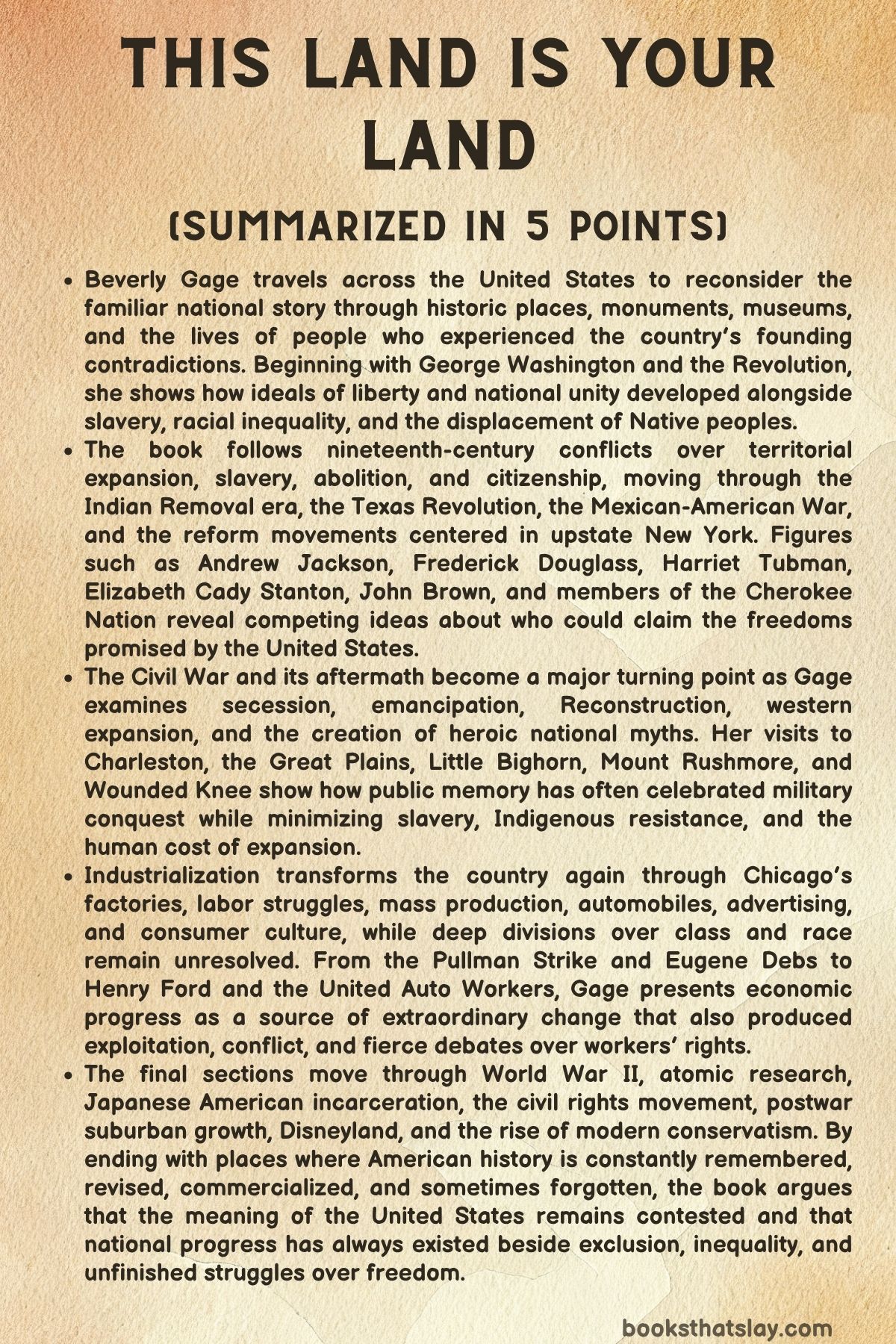
This Land Is Your Land: A Road Trip Through U.S. History by Beverly Gage is a historical journey across the United States that examines how Americans have created, contested, and remembered their national story.
Rather than presenting the country’s past as a straightforward progression toward freedom and prosperity, Gage visits historic sites and follows influential individuals whose lives reveal contradictions within American ideals. The book moves from the Revolution and slavery through territorial expansion, industrialization, civil rights, technological transformation, and modern political culture. Throughout, Gage asks who has been included in the promise of American liberty, who has been excluded, and how public memory shapes present-day understandings of the nation.
Summary
This Land Is Your Land begins with George Washington’s journeys through the newly established United States after his election in 1789. Washington believed that traveling through the country could help him understand a population that still tended to identify more strongly with individual states and regions than with the new nation, and Beverly Gage uses his example as the starting point for her own journey through American history.
Returning to the Philadelphia region where she grew up, Gage reconsiders familiar Revolutionary landmarks such as Brandywine Battlefield, Valley Forge, Independence Hall, the Liberty Bell, and the Museum of the American Revolution. These places reveal how the founding has repeatedly been converted into a heroic national narrative even though the Revolution involved military failure, deprivation, uncertainty, and radically different consequences for white colonists, enslaved people, and Native communities.
The contradiction between liberty and slavery becomes even clearer in Virginia through the story of Ona Judge, an enslaved woman in George and Martha Washington’s household. After experiencing life in northern cities with substantial free Black communities, Judge escaped in 1796 rather than allow herself to be permanently returned to Virginia, resisting Washington’s efforts to recapture her and eventually establishing an independent life in New Hampshire.
Gage continues through Mount Vernon, Monticello, Montpelier, and Colonial Williamsburg, examining how the Founders’ homes have gradually confronted the realities of slavery. Thomas Jefferson’s relationship with Sally Hemings, James Madison’s ownership of Paul Jennings, and Gabriel’s planned rebellion near Richmond all expose the profound distance between revolutionary language about natural rights and the realities imposed on enslaved Americans.
The book next turns toward Andrew Jackson and the transformation of the early republic into an expanding continental power. Jackson cultivated an image as a frontier military hero and representative of ordinary white citizens, but his rise depended heavily on warfare against Native peoples and culminated politically in the Indian Removal Act of 1830.
Gage places Cherokee history beside Jackson’s public legend. Sequoyah’s writing system, the Cherokee constitution, and the newspaper established at New Echota demonstrate the Cherokee Nation’s efforts to preserve political sovereignty, yet neither cultural adaptation nor legal resistance prevented forced removal, and thousands were expelled from their southeastern homeland along routes remembered as the Trail of Tears.
Territorial expansion continues through the story of David Crockett and the Texas Revolution. Crockett traveled west after political defeat in Tennessee and died defending the Alamo, but Gage situates the familiar heroic story within the larger conflict between Anglo settlers and Mexico, emphasizing that Mexico had abolished slavery while many American settlers in Texas were committed to preserving it.
The deaths of Crockett, William Travis, James Bowie, and the other defenders became central to a patriotic mythology surrounding the Alamo. Sam Houston’s victory at San Jacinto secured Texan independence, while the later annexation of Texas contributed to the Mexican-American War and the vast territorial transfers created by the Treaty of Guadalupe Hidalgo, an expansion Ulysses S. Grant later condemned as unjust.
In upstate New York, Frederick Douglass becomes the central figure in a broader landscape of reform. From Rochester, where he published The North Star, Douglass challenged Americans to explain how a nation devoted to the Declaration of Independence could tolerate slavery, while the Erie Canal and rapid economic development helped create communities receptive to abolitionism, religious experimentation, women’s rights, and other reform movements.
Gage connects Douglass with Elizabeth Cady Stanton, Lucretia Mott, Harriet Tubman, Susan B. Anthony, William Seward, Gerrit Smith, and John Brown. Their overlapping campaigns show the possibilities of reform coalitions but also the tensions surrounding race, gender, suffrage, violence, and political strategy, with Brown’s failed raid on Harpers Ferry foreshadowing the national collapse into civil war.
Charleston then becomes the setting for secession and the struggle over Confederate memory. The Democratic Party’s fracture in 1860 helped Abraham Lincoln win the presidency, after which South Carolina seceded and presented itself as defending liberty even though preservation of slavery stood at the center of the sectional conflict.
Gage examines Fort Sumter, Confederate monuments, plantation tourism, the racist massacre at Emanuel African Methodist Episcopal Church, and the later removal of prominent Confederate symbols. Against the older public celebration of John C. Calhoun and other defenders of slavery, she places Robert Smalls, who escaped bondage by commandeering a Confederate vessel, served the Union, entered politics during Reconstruction, and has increasingly become part of South Carolina’s official public memory.
The journey westward centers on George Armstrong Custer and the Battle of the Little Bighorn. His widow Libbie spent decades cultivating his reputation as a heroic frontier soldier, yet Gage contrasts this legend with Lakota resistance and the federal government’s violation of treaty promises concerning the Black Hills after Custer’s expedition encouraged a rush of white settlement into Native land.
Sitting Bull and Crazy Horse represent Native determination to maintain independence, while Mount Rushmore and the Crazy Horse Memorial demonstrate how competing interpretations of western history have been built directly into the landscape. The period closes not with an uncomplicated story of frontier triumph but with the destruction of the bison, the collapse of Native autonomy, suppression of the Ghost Dance, and the massacre of Lakota people at Wounded Knee in 1890.
Industrial Chicago introduces another form of American transformation. The 1893 World’s Columbian Exposition celebrated technological achievement and consumer capitalism, but the rapidly growing industrial city was also marked by dangerous labor, poverty, immigrant overcrowding, radical politics, and intense conflict between workers and employers.
Jane Addams responded to urban inequality through settlement work, Upton Sinclair later exposed industrial abuses, and George Pullman attempted to combine industrial efficiency with employer control over workers’ lives. The Pullman Strike demonstrated the weakness of this paternalistic model, while Eugene V. Debs emerged from the conflict as a leading socialist and symbol of a powerful American tradition of organized resistance to concentrated industrial wealth.
Atlanta offers another version of modernity. The 1895 Cotton States and International Exposition advertised a prosperous “New South,” but racial segregation remained fundamental to the region, and Booker T. Washington’s call for Black economic advancement within temporary social separation was challenged by thinkers such as W. E. B. Du Bois.
Gage sets the commercial success of Coca-Cola beside the cultural power of the Lost Cause. Stone Mountain, the renewed Ku Klux Klan, Uncle Remus, and Gone with the Wind helped romanticize the Confederate past, while Atlanta’s Sweet Auburn neighborhood and its growing Black professional class created institutions that would later support the civil rights movement.
Detroit and Dearborn provide the setting for Henry Ford’s industrial revolution. The Model T, moving assembly line, River Rouge complex, and five-dollar workday transformed production and consumer life, but Ford’s system also subjected workers to repetitive labor, intrusive social supervision, fierce anti-union policies, and the influence of Ford’s antisemitic ideas.
Walter Reuther and the United Auto Workers challenged Ford’s authority, and the violent Battle of the Overpass revealed the coercive force behind the company’s paternalistic image. Ford’s creation of Greenfield Village further demonstrated the contradictions of a man who helped produce modern mass society while yearning for an idealized version of rural America.
The Southwest becomes a landscape of science, war, secrecy, and displacement. Through Peggy Pond Church’s connection to Los Alamos, Gage follows the transformation of a rural school site into the secret laboratory where J. Robert Oppenheimer and other scientists developed the atomic bomb, while local Hispanic families displaced by the project frequently received unequal compensation.
The incarceration of approximately 120,000 Japanese Americans during World War II provides another stark contradiction between national claims about freedom and government action. The chapter then follows nuclear testing, missile development, German V-2 research, military installations, and even atomic tourism, showing how the desert Southwest became closely associated with both technological optimism and the possibility of catastrophic destruction.
The civil rights movement brings Gage back to the persistent conflict between American democratic promises and racial inequality. Martin Luther King Jr.’s path from education in the North to Montgomery places him at the center of the bus boycott that followed Rosa Parks’s refusal to surrender her seat in December 1955.
From Montgomery, Gage travels toward Selma and into Mississippi, confronting Bloody Sunday, the march for voting rights, the murder of Viola Liuzzo, the Freedom Riders, the activism associated with T. R. M. Howard, and the killing of Emmett Till. Fannie Lou Hamer’s challenge about whether America truly lived up to its own ideals becomes a way of emphasizing that civil rights victories were substantial but did not end poverty, discrimination, political exclusion, or disputes over historical memory.
The final stage of the journey focuses on postwar Southern California and Walt Disney’s vision of the United States. Disneyland transformed Main Street, the frontier, technological progress, and popular figures such as Davy Crockett into an accessible national story shaped by optimism, entertainment, and selective remembrance.
At the same time, Southern California became a major center of suburban growth, defense spending, and modern conservatism, producing political figures such as Richard Nixon and Ronald Reagan. Gage ends by observing a far more diverse contemporary Orange County and visiting a replica of Independence Hall at Knott’s Berry Farm, where an employee’s uncertainty about the landmark captures the book’s final idea: national memory is never permanent, because each generation decides what to preserve, celebrate, challenge, or forget.
Key People
Beverly Gage
Beverly Gage serves as the book’s narrator, traveler, historian, and organizing consciousness. In This Land Is Your Land, she does not present herself as a detached observer standing outside American history; instead, she begins with places familiar from her own upbringing and repeatedly considers how museums, monuments, landscapes, and inherited stories influenced the way she once understood the country.
Her importance lies in her willingness to place celebrated national narratives beside less comfortable histories. She moves between admiration for American experimentation and awareness of slavery, Indigenous dispossession, racial violence, labor exploitation, wartime incarceration, and political exclusion, allowing contradiction rather than simple celebration or condemnation to guide her journey.
George Washington
George Washington functions simultaneously as a founding national hero and as an example of the contradictions embedded in the early republic. His post-election travels reveal his concern that Americans lacked a strong common national identity, while his military experiences at Brandywine and Valley Forge show how later mythology could transform defeat, suffering, and endurance into a unified founding story.
At the same time, This Land Is Your Land refuses to separate Washington’s public commitment to American liberty from his private dependence on slavery. His efforts to prevent enslaved servants from gaining freedom in Pennsylvania and his attempts to recover Ona Judge after her escape expose the limits of the freedom he symbolized.
Martha Washington
Martha Washington appears most significantly through her relationship with Ona Judge, who served her while enslaved. Judge’s expectation that she might eventually be transferred as property to another member of the Washington family makes Martha part of the domestic system through which slavery reproduced itself beyond plantations and formal politics.
Her role is therefore important precisely because she represents the ordinary functioning of elite slaveholding society. The contrast between the dignity associated with the presidential household and the absence of personal autonomy experienced by the people it enslaved challenges idealized images of the Founders’ private lives.
Ona Judge
Ona Judge emerges as one of the clearest embodiments of personal resistance in the book. Exposure to the free Black population of northern cities gave her a practical understanding that another life was possible, and when she learned that her future would remain controlled by the Washington family, she chose escape despite the dangers involved.
Her significance extends beyond the fact that she successfully fled slavery. Judge transforms the abstract language of liberty into an individual claim to self-ownership, and Washington’s efforts to recover her reveal how easily revolutionary ideals could be abandoned when an enslaved person demanded those ideals for herself.
Thomas Jefferson
Thomas Jefferson represents the intellectual grandeur and moral contradiction of the founding generation. As a principal voice of natural rights and equality, he helped define the language by which Americans would understand freedom, yet his plantation at Monticello depended on enslaved labor.
His relationship with Sally Hemings intensifies this contradiction because it existed within a system in which Jefferson possessed extraordinary legal and economic power over her life. Gage’s treatment of Jefferson therefore requires readers to see political philosophy and personal behavior together rather than allowing his universal claims about liberty to remain detached from the human beings he held in bondage.
Sally Hemings
Sally Hemings stands at the center of the book’s examination of slavery as an intimate system of power rather than merely an economic institution. Her association with Jefferson reveals the profound imbalance that existed when an enslaved woman’s life, movement, family relationships, and legal status were controlled by a powerful slaveholder.
Her presence also challenges older museum and plantation narratives that focused almost entirely on famous white owners. By including Hemings in the historical interpretation of Monticello, the book demonstrates how public memory changes when the experiences of enslaved people are treated as essential rather than peripheral.
James Madison
James Madison appears as another Founder whose commitment to republican government existed beside slave ownership. His home at Montpelier becomes a site where the ideals associated with constitutional government must be considered alongside the lives of the enslaved people whose labor supported the household and estate.
His relationship with Paul Jennings gives this contradiction a personal dimension. Madison helped build institutions intended to protect political liberty, yet Jennings had to secure freedom through a separate struggle, demonstrating that the constitutional order created by the Founders initially distributed liberty extremely unevenly.
Paul Jennings
Paul Jennings provides an important perspective from within James Madison’s household. Enslaved by Madison before eventually obtaining freedom, Jennings later became an abolitionist, showing that formerly enslaved individuals could move from being subjects of elite political households to active critics of the system those households sustained.
His life undermines any assumption that enslaved servants were merely background figures in the Founders’ world. Jennings possessed his own political judgment and historical memory, and his later abolitionist commitment turns his personal experience into part of the wider struggle against slavery.
Gabriel
Gabriel represents the revolutionary implications of the language created by the American founding. His planned rebellion near Richmond in 1800 showed what could happen when enslaved people interpreted liberty not as a privilege reserved for white citizens but as a principle applicable to themselves.
The violent suppression of his conspiracy reveals the limits of white Virginia’s revolutionary rhetoric. Gabriel’s significance lies in forcing the political elite to confront the possibility that enslaved people might act upon the same ideas of resistance and freedom that white Americans had celebrated in their break from Britain.
Marquis de Lafayette
Lafayette serves as a living connection between the Revolutionary generation and the United States of the 1820s. His celebrated return in 1824 allowed Americans to honor the revolutionary past at the same moment that Andrew Jackson was emerging as the hero of a newer, more aggressively expansionist political culture.
The contrast between Lafayette and Jackson is important because it marks a shift in national heroism. Lafayette represented memory of an international struggle for republican independence, while Jackson’s popularity grew from frontier warfare, territorial conquest, and a populist image suited to a rapidly expanding republic.
Andrew Jackson
Andrew Jackson is presented as one of the strongest examples of the distance between heroic national mythology and the experiences of those harmed by American expansion. His reputation as a self-made military leader rested on campaigns against Native peoples, the Battle of New Orleans, and conflicts in Florida, all of which supported his image as a defender of white American interests.
His presidency converted that expansionist worldview into federal policy through the Indian Removal Act. Jackson’s treatment in the book therefore complicates older portrayals of him as a champion of democracy by asking whose democratic power increased and whose sovereignty was destroyed.
Sequoyah
Sequoyah represents Cherokee intellectual achievement and cultural adaptation under enormous political pressure. His creation of a Cherokee writing system provided the nation with a powerful means of communication and became part of a broader effort to preserve political identity while selectively adopting institutions used by the United States.
His significance challenges stereotypes that presented Native societies as incapable of complex political or cultural development. The Cherokee constitution and newspaper reinforce the point that removal was not a response to an absence of civilization but an act of dispossession directed against a functioning sovereign society.
David Crockett
David Crockett occupies an uneasy position between political independence and expansionist mythology. His opposition to Jackson’s removal policies suggests that frontier politics were not ideologically uniform, while his departure for Texas after electoral defeat ultimately placed him inside another struggle involving territory, sovereignty, and slavery.
His death at the Alamo transformed him into a national legend whose symbolic afterlife became much larger than his individual political career. The book uses Crockett to show how the memory of a person can be simplified into heroism even when the larger conflict surrounding that person remains morally and politically complicated.
Antonio López de Santa Anna
Antonio López de Santa Anna is important because his presence prevents the Texas Revolution from being interpreted solely through an American national framework. From the Mexican government’s perspective, Anglo settlers in Texas were not simply heroic revolutionaries but residents challenging the sovereignty of the country in which they had settled.
His role therefore provides a necessary counterweight to the familiar Alamo narrative. By including the Mexican perspective, the book reveals that terms such as liberty, rebellion, independence, and invasion can look very different depending on which political community is defining them.
William Travis
William Travis is remembered primarily as one of the most prominent defenders of the Alamo. His role belongs to the patriotic narrative that transformed the doomed defense into evidence of courage and sacrifice and connected Texan rebels symbolically to the American Revolution.
The book does not erase that courage, but it places Travis within a broader conflict involving Mexican sovereignty and the future of slavery in Texas. This context makes him part of a story that is more complicated than the heroic legend preserved in later monuments and popular culture.
James Bowie
James Bowie shares with Travis and Crockett the powerful symbolic status created by the Alamo. His death made him part of a group whose military defeat was rapidly transformed into a moral victory through the slogan “Remember the Alamo.”
His significance in the book comes less from detailed personal development than from what happened to his memory. Bowie illustrates how individuals can become national symbols whose cultural meaning eventually obscures the political conflicts and social institutions surrounding their lives.
Sam Houston
Sam Houston provides the military success that transformed the Alamo from a defeat into the foundation of an independence narrative. His victory at San Jacinto secured Texan independence and helped establish a new political order that would eventually be incorporated into the United States.
Houston consequently stands at the point where regional rebellion becomes national expansion. His achievements cannot be separated from the later annexation of Texas and the Mexican-American War, through which the United States acquired enormous western territories.
Ulysses S. Grant
Ulysses S. Grant appears as a critical retrospective voice on American expansion. Although he served in the Mexican-American War, he later judged the conflict to have been an unjust act of aggression, connecting territorial conquest to the sectional tensions that eventually produced the Civil War.
His judgment matters because it complicates any assumption that nineteenth-century expansion enjoyed uncontested legitimacy among those who participated in it. Grant gives the book an internal American critique of conquest from a figure who would later become one of the country’s most celebrated generals and presidents.
Frederick Douglass
Frederick Douglass is one of the book’s most powerful interpreters of American ideals because he treats the nation’s founding language as both an accusation and a possibility. From Rochester, he attacked slavery, published The North Star, and challenged Americans to explain how celebrations of independence could coexist with the continued enslavement of millions.
Within This Land Is Your Land, Douglass embodies the practice of demanding that the country live by principles it already claimed to honor. His famous Fourth of July argument does not simply reject national ideals; it exposes the hypocrisy produced when those ideals are selectively applied.
Gerrit Smith
Gerrit Smith represents the experimental side of northern abolitionism. His effort to establish Black landowning communities in the Adirondacks reflected the belief that economic independence and property ownership could strengthen Black citizenship in a society that connected political power to land.
His project also demonstrates the diversity of reform strategies pursued before the Civil War. Rather than relying only on speeches or electoral politics, Smith attempted to alter the material circumstances that limited Black freedom, showing how abolitionist reform could include economic as well as moral objectives.
Elizabeth Cady Stanton
Elizabeth Cady Stanton represents the extension of revolutionary political language into the struggle for women’s rights. At Seneca Falls, she helped transform the Declaration of Independence into the Declaration of Sentiments, making the founding vocabulary of equality serve as an argument against women’s political and legal subordination.
Her role also reveals tensions within nineteenth-century reform alliances. Campaigns for abolition, Black citizenship, and women’s suffrage often overlapped, but disagreements over voting rights, race, and political priorities repeatedly tested the solidarity of reformers.
Lucretia Mott
Lucretia Mott appears as an important link between abolitionism and early organized women’s rights activism. Her involvement at Seneca Falls demonstrates how reformers could move from opposition to slavery toward a broader criticism of legal and political hierarchies.
She helps illustrate the atmosphere of upstate New York, where religious change, abolitionism, women’s rights, and other experiments in social reform existed close together. Her presence reinforces the argument that American reform movements developed through personal connections and overlapping networks rather than in isolation.
Harriet Tubman
Harriet Tubman represents direct resistance to slavery and the practical pursuit of freedom. Her connection to the reform landscape of upstate New York places her among a group of activists whose commitments were not merely theoretical but involved significant personal risk and organized resistance to the slave system.
Tubman’s place among figures such as Douglass, Anthony, Seward, and Brown demonstrates how the antislavery struggle gathered people with very different backgrounds and methods. Her presence also keeps the question of freedom grounded in the lived experience of escape, danger, and self-emancipation.
Susan B. Anthony
Susan B. Anthony is part of the reform culture that connected abolitionism with the movement for women’s political equality. Her association with the New York network described in the book reflects the possibilities created when activists shared organizations, arguments, and personal relationships across different causes.
At the same time, her presence helps expose the difficulties within reform coalitions. The struggle over whether race or gender should take precedence in voting-rights campaigns demonstrated that people committed to equality could still clash sharply over strategy and political opportunity.
William Seward
William Seward represents the movement of antislavery sentiment into formal political power. His connections to the reform culture of New York place him near activists operating outside conventional government even as his own career demonstrates the importance of institutional politics in the struggle over slavery.
His role helps show that reform required several kinds of action at once. Moral protest, escape networks, journalism, armed resistance, electoral politics, and legislation all became part of the larger conflict that eventually destabilized the national political system.
John Brown
John Brown represents the point at which antislavery moral conviction becomes revolutionary violence. His failed raid on Harpers Ferry was militarily unsuccessful, but it intensified sectional fears and transformed Brown into both a martyr and a terrorist figure depending on the observer’s political position.
His burial in New York connects him symbolically with the region’s intense reform culture. Brown’s role forces the book to confront a difficult question: what forms of resistance become imaginable when ordinary political mechanisms repeatedly fail to end an institution regarded as profoundly unjust?
Stephen Douglas
Stephen Douglas appears at the moment when national party politics fracture over slavery. Southern delegates’ rejection of him during the Democratic convention in Charleston contributed to a divided presidential contest, weakening the party and helping Abraham Lincoln win the election of 1860.
His significance lies in the failure of political compromise. Douglas had built his career around managing sectional conflict through democratic procedures, yet by 1860 those mechanisms could no longer contain the struggle over slavery and the future of the Union.
Abraham Lincoln
Abraham Lincoln enters the book as the electoral catalyst for secession despite winning no Southern state. His victory demonstrated that a national political coalition could capture the presidency without Southern electoral support, intensifying fears among slaveholding states that their power within the Union was declining.
The resulting secession crisis makes Lincoln central even when he is not the chapter’s main personal focus. His election marks the point at which decades of conflict over slavery ceased to be manageable through ordinary political bargaining.
John C. Calhoun
John C. Calhoun represents the intellectual defense of slavery and the long survival of Confederate political memory. His description of slavery as a “positive good” made him a particularly explicit defender of the racial order upon which South Carolina’s antebellum power depended.
The later removal of his enormous monument in Charleston shows how the meaning of public honor can change. Calhoun’s importance therefore extends beyond his nineteenth-century politics into modern disputes over whether monuments simply preserve history or actively celebrate particular values.
Robert Smalls
Robert Smalls provides a striking counterstory to older South Carolina narratives centered on Confederate leaders. Enslaved at the beginning of the Civil War, he liberated himself and others by commandeering a Confederate vessel, later served the Union cause, and entered public life during Reconstruction.
His later recognition by South Carolina demonstrates how public memory can expand. Smalls represents Black courage, military contribution, citizenship, and political leadership, all of which challenge narratives in which Reconstruction appeared only as a period of Southern defeat and disorder.
Elizabeth “Libbie” Custer
Libbie Custer is important because she demonstrates how historical reputations are actively constructed. After her husband’s death at Little Bighorn, she spent decades protecting and promoting his image, helping transform a disastrous military defeat into a legend of frontier courage and sacrifice.
Her role makes memory itself an active force in history. Rather than treating George Custer’s heroic reputation as something that emerged naturally, the book shows how personal devotion, publishing, commemoration, and popular culture can determine how later generations understand the past.
George Armstrong Custer
George Armstrong Custer stands at the intersection of national expansion, military celebrity, and Native resistance. His expedition into the Black Hills helped publicize the discovery of gold in territory promised to the Sioux, contributing to the influx of settlers and escalation of federal pressure on Native peoples.
His death at Little Bighorn later became a symbol of heroic sacrifice, but the book repositions the battle within a struggle over treaty rights and Indigenous sovereignty. Custer therefore becomes a case study in how defeat can be converted into patriotic mythology when the defeated side controls much of the later national narrative.
Sitting Bull
Sitting Bull represents resistance to federal attempts to end Lakota independence. His refusal to accept demands for surrender arose from a determination to defend Native political autonomy and a way of life threatened by settlers, military campaigns, and the seizure of treaty-protected territory.
His presence transforms Little Bighorn from a story about Custer’s defeat into a story about Native agency. The battle becomes evidence that Indigenous peoples did not simply disappear before American expansion but actively resisted it with political and military determination.
Crazy Horse
Crazy Horse stands alongside Sitting Bull as an emblem of Lakota resistance. His opposition to federal authority was rooted in defense of territory and independence rather than in the aggressive expansion that older American accounts often attributed to Native peoples.
The enormous memorial bearing his name offers an alternative to Mount Rushmore’s celebration of national presidents. His continuing symbolic power demonstrates that the same landscape can sustain competing memories of conquest, resistance, nationhood, and belonging.
Theodore Roosevelt
Theodore Roosevelt represents the way frontier experience became part of modern American political identity. His time in North Dakota helped him develop a public image based on physical toughness, self-reliance, and what he later described as the strenuous life.
The ideal he represented was highly influential, but the surrounding history complicates it. The frontier that strengthened Roosevelt’s mythology was also a region marked by the destruction of bison herds, forced confinement of Native peoples, and the erosion of Indigenous sovereignty.
Jane Addams
Jane Addams represents the reformist response to the inequality created by rapid industrial urbanization. In Chicago, settlement-house work attempted to address the social consequences of crowded immigrant neighborhoods, poverty, dangerous employment, and inadequate public support.
Her work provides an alternative to both laissez-faire industrial capitalism and revolutionary labor politics. Addams demonstrates the Progressive belief that social investigation, community institutions, education, and organized civic action could reduce the human costs of industrial growth.
Upton Sinclair
Upton Sinclair appears as a writer who exposed the conditions hidden beneath Chicago’s image of industrial prosperity. His work directed public attention toward the brutal environments created by large-scale industry and therefore challenged celebratory stories of economic modernization.
His role illustrates the political possibilities of journalism and literature. By making industrial conditions visible to readers who did not experience them directly, Sinclair helped transform private suffering into a matter of public concern.
George Pullman
George Pullman embodies the paternalistic industrialist who believed corporate authority could organize not only production but also workers’ communities. His planned town promised order and harmony, yet the imbalance became clear when wages were reduced during economic depression while housing costs remained burdensome.
The resulting strike exposed the weakness of Pullman’s claim that employer control naturally served workers’ interests. His character demonstrates how apparent benevolence can become coercive when one side controls wages, housing, employment, and the terms of negotiation.
Eugene V. Debs
Eugene V. Debs emerges from the Pullman conflict as a major critic of industrial capitalism. Beginning as a railway labor leader, he became convinced that concentrated corporate power required a broader political response and eventually emerged as one of the best-known American socialists.
His importance challenges modern assumptions that socialism has always existed outside mainstream American political culture. The preservation of his home in Indiana reminds readers that radical labor politics once had substantial roots in the industrial Midwest.
Booker T. Washington
Booker T. Washington represents one influential strategy for Black advancement during the era of segregation. At Atlanta’s 1895 exposition, he argued for economic development and practical opportunity while accepting, at least temporarily, continued social separation between Black and white Americans.
His position reflected the severe constraints under which Black leaders operated in the post-Reconstruction South. Rather than treating his approach as simple submission, the book places it within a debate over what forms of progress were realistically possible under a violent and deeply entrenched racial system.
W. E. B. Du Bois
W. E. B. Du Bois appears as an important critic of the accommodationist approach associated with Booker T. Washington. His presence represents demands for fuller political, intellectual, and civil equality rather than postponing direct challenges to segregation.
The contrast between the two men reveals that Black political thought was never represented by a single strategy. Their disagreement demonstrates the difficult choices faced by activists deciding whether economic advancement, elite education, political agitation, or direct claims to equal citizenship offered the strongest path forward.
Henry Ford
Henry Ford is both a creator of modern mass society and a deeply contradictory figure. Through the Model T, assembly-line production, River Rouge, and the five-dollar workday, This Land Is Your Land presents him as a businessman whose innovations fundamentally altered transportation, work, consumption, tourism, and the physical organization of American life.
Yet Ford’s control over employees’ private lives, hostility toward unions, and public antisemitism complicate the benevolent image he cultivated. His nostalgia for an imagined rural past, embodied by Greenfield Village, also reveals the paradox of a man who did much to create modern America while emotionally resisting aspects of the world his own innovations produced.
Walter Reuther
Walter Reuther represents organized labor’s challenge to Ford’s enormous industrial power. Through the United Auto Workers, he sought collective bargaining rights in an industry where workers faced repetitive labor and management hostility toward union organization.
The Battle of the Overpass, during which company security men attacked union organizers, revealed the risks faced by labor activists. Reuther’s eventual success helped establish unions as influential participants in the industrial economy and challenged the assumption that employers alone should determine workplace conditions.
Peggy Pond Church
Peggy Pond Church provides a personal route into the transformation of New Mexico by the wartime federal government. Her childhood connection to the Los Alamos Ranch School links a local landscape of community and memory to the secret scientific complex that replaced it during World War II.
Through Church, the enormous geopolitical story of the atomic bomb becomes connected to a specific place and its displaced inhabitants. Her presence reminds readers that national projects often transform local environments long before their full significance becomes visible to the wider public.
J. Robert Oppenheimer
J. Robert Oppenheimer represents the extraordinary scientific ambition concentrated at Los Alamos during World War II. Under his leadership, scientists worked on the atomic bomb in a secret federal project that permanently altered warfare, international politics, and the meaning of technological power.
His role belongs to a broader landscape in which scientific achievement exists beside displacement, secrecy, militarization, and fear. The book therefore presents the atomic project not simply as a triumph of intellect but as part of a larger transformation whose consequences spread far beyond the laboratory.
Martin Luther King Jr.
Martin Luther King Jr. represents the moral and organizational force of the mid-twentieth-century civil rights movement. After studying outside the segregated South, he returned to take a ministry in Montgomery and became a national leader through the bus boycott that followed Rosa Parks’s arrest.
In This Land Is Your Land, King’s importance lies in his insistence that American democracy be judged against its professed ideals. His leadership connects local protest with a national struggle over voting rights, segregation, citizenship, and the meaning of freedom.
Rosa Parks
Rosa Parks is presented as the individual whose refusal to surrender her bus seat helped trigger the Montgomery Bus Boycott. Her action transformed an ordinary mechanism of segregation into a public confrontation over the legitimacy of racial hierarchy.
Her importance lies partly in the disciplined power of refusal. Rather than accepting segregation as an unavoidable condition of daily life, Parks made a personal decision that became the basis for collective action and helped propel King into national leadership.
Viola Liuzzo
Viola Liuzzo represents the danger faced by people who joined the voting-rights struggle across racial and regional lines. Her murder after the Selma campaign demonstrates that even successful civil rights mobilization existed within an environment where activists could be targeted with deadly violence.
Her story prevents the movement from being remembered only through famous speeches and legislative victories. Progress had a human cost, and individuals who supported democratic participation could face severe personal consequences for challenging white supremacy.
T. R. M. Howard
T. R. M. Howard represents the institutional foundations of Black political activism in Mississippi. As a physician and activist connected to Mound Bayou, he demonstrates how Black communities created local networks, professional leadership, and organizational resources even under the restrictive conditions of segregation.
His role also broadens civil rights history beyond the best-known national leaders. The movement depended on local figures who built organizations and communities capable of supporting resistance before national attention arrived.
Emmett Till
Emmett Till represents the devastating human consequences of racial violence and the continuing struggle over how that violence is remembered. The sites associated with his murder, including the location where his body was recovered, make his death part of the physical landscape through which Gage travels.
Repeated vandalism of memorials dedicated to Till shows that remembrance itself remains contested. His story therefore belongs not only to the history of racial terror but also to contemporary conflict over whether communities will publicly acknowledge that history.
Fannie Lou Hamer
Fannie Lou Hamer provides one of the book’s clearest challenges to celebratory accounts of American democracy. Her question about whether the country she experienced could truly be called America captures the distance between constitutional ideals and the violence, poverty, intimidation, and political exclusion endured by Black citizens in Mississippi.
Her significance also complicates narratives in which civil rights legislation marks a neat conclusion. Hamer’s experience emphasizes that formal legal victories did not immediately remove economic inequality or the personal costs suffered by those who challenged established power.
Walt Disney
Walt Disney represents the power of entertainment to create persuasive versions of national history. Disneyland turned small-town America, western expansion, technological optimism, and figures such as Davy Crockett into physical experiences that millions of visitors could encounter as enjoyable and seemingly familiar parts of the national past.
Disney’s importance therefore extends well beyond amusement. By deciding which parts of history became adventure, nostalgia, or progress, his cultural empire helped shape public memory just as museums and monuments did.
Richard Nixon
Richard Nixon represents one branch of the conservative political culture that developed in postwar Southern California. His presidential library becomes an example of how institutions devoted to political leaders must balance commemoration with difficult history, particularly in relation to Watergate.
His politics also reveal a less optimistic side of the postwar American story. Alongside suburban prosperity and technological confidence, resentment and political division became important forces in modern national life.
Ronald Reagan
Ronald Reagan represents a more confident language of national restoration. Emerging from the political culture of California, he argued that future progress depended on recovering an older belief in American greatness and renewing public confidence in the nation.
His political message parallels the optimism found in some aspects of Disney culture, even though the two operated in different fields. Both offered Americans a reassuring connection between an idealized past and a promising future, demonstrating the continuing political power of nostalgia.
Themes
Liberty and the Boundaries of American Citizenship
Freedom repeatedly functions as both the nation’s strongest ideal and the standard by which its failures become visible. This Land Is Your Land begins with a Revolution remembered as a struggle for liberty, yet that same political order preserved slavery and allowed figures such as George Washington, Thomas Jefferson, and James Madison to exercise ownership over other human beings.
Ona Judge’s escape makes the contradiction intensely personal because she claims for herself the freedom that the revolutionary generation celebrated politically. Gabriel’s planned rebellion raises the same issue in collective form: if resistance to oppression justified the American Revolution, enslaved people could logically invoke similar principles against those who enslaved them.
The contradiction persists long after emancipation. Frederick Douglass’s Fourth of July challenge, Black political struggles during Reconstruction, the civil rights movement, Rosa Parks’s refusal, the Selma campaign, and Fannie Lou Hamer’s questioning of American democracy all demonstrate that citizenship on paper did not automatically produce equal access to political rights or public dignity.
The incarceration of Japanese Americans during World War II extends the same problem beyond the history of Black freedom. The book repeatedly asks readers to judge the United States not simply by the ideals it proclaims but by whether institutions apply those ideals when doing so becomes politically difficult.
Expansion, Conquest, and Dispossession
The physical growth of the United States appears throughout the book as a process that created opportunity for some populations while destroying the independence or security of others. Andrew Jackson’s rise, the Indian Removal Act, and the forced expulsion of the Cherokee demonstrate how democratic expansion for white citizens could depend directly upon the removal of Native nations.
Texas extends this pattern. The Alamo became an enduring symbol of resistance and sacrifice, but the larger conflict involved Anglo settlers living within Mexican territory, disputes over slavery, and an expansionist process that eventually contributed to war with Mexico and the acquisition of vast western lands.
The Great Plains provide another version of the same conflict. Federal treaty promises regarding the Black Hills gave way when gold attracted settlers, while Custer’s expedition, military pressure, and federal demands threatened Lakota independence and eventually contributed to warfare, confinement, and the destruction of traditional economic life.
By placing Sitting Bull, Crazy Horse, Cherokee political institutions, Mexican sovereignty, and Wounded Knee alongside stories of American settlement, the book changes the meaning of “westward expansion.” What one national tradition remembers as exploration, development, and fulfillment can simultaneously be understood by others as invasion, dispossession, broken treaties, or loss of sovereignty.
Historical Memory, Myth, and the Control of the Past
History in This Land Is Your Land is never confined to archives because Americans encounter the past through monuments, museums, tourist attractions, presidential libraries, battlefields, plantation houses, amusement parks, and popular culture. Gage repeatedly studies not only what happened but also what later generations chose to make those events mean.
Libbie Custer’s lifelong promotion of her husband demonstrates how reputation can be deliberately constructed, while the Alamo shows how military defeat can become heroic national mythology. Confederate monuments, Stone Mountain, Lost Cause culture, Uncle Remus, and Gone with the Wind similarly reveal how cultural repetition can make one interpretation of history appear natural even when it excludes the experiences of enslaved people or those who opposed the Confederacy.
Changes in commemoration are equally important. The removal of Confederate symbols in Charleston, increased recognition of Robert Smalls, revised interpretations of slavery at presidential plantations, and memorials to Emmett Till show that public memory can be challenged and reconstructed.
Disneyland demonstrates that entertainment participates in the same process. Frontierland, Main Street, Davy Crockett programs, presidential libraries, and even a replica Independence Hall at Knott’s Berry Farm show that historical memory is continuously produced through choices about what deserves visibility, nostalgia, criticism, or neglect.
Progress, Technology, and the Unequal Costs of Modernity
Technological and economic progress repeatedly promises greater mobility, wealth, efficiency, and national power, yet the benefits are rarely distributed equally. Industrial Chicago symbolizes this tension: the World’s Columbian Exposition celebrated a modern capitalist future while workers endured dangerous conditions, overcrowding, insecurity, and severe conflict with employers.
George Pullman’s company town illustrates the danger of assuming that industrial efficiency automatically improves human welfare. His paternalistic system appeared orderly until wage cuts exposed how little power workers possessed, while Eugene Debs and organized labor insisted that economic modernization had to include political and workplace rights.
Henry Ford deepens the contradiction. The Model T and assembly line helped ordinary Americans participate in mass consumer culture and transformed transportation, but repetitive factory labor, surveillance of private life, anti-union violence, and Ford’s antisemitism complicate the idea that industrial innovation necessarily produces social improvement.
The atomic Southwest carries the theme into an even more dangerous realm. Los Alamos, nuclear weapons, missile research, and Cold War installations demonstrated extraordinary scientific capability, yet these developments also brought secrecy, local displacement, militarization, and the possibility of destruction on an unprecedented scale.
Disney’s Carousel of Progress finally captures the cultural faith that technology and consumption will continually improve everyday life. The book does not simply reject that confidence, but it repeatedly asks what progress costs, who receives its benefits, who bears its burdens, and which consequences disappear when technological achievement becomes the only measure of national success.