With Love from Harlem Summary, Characters and Themes
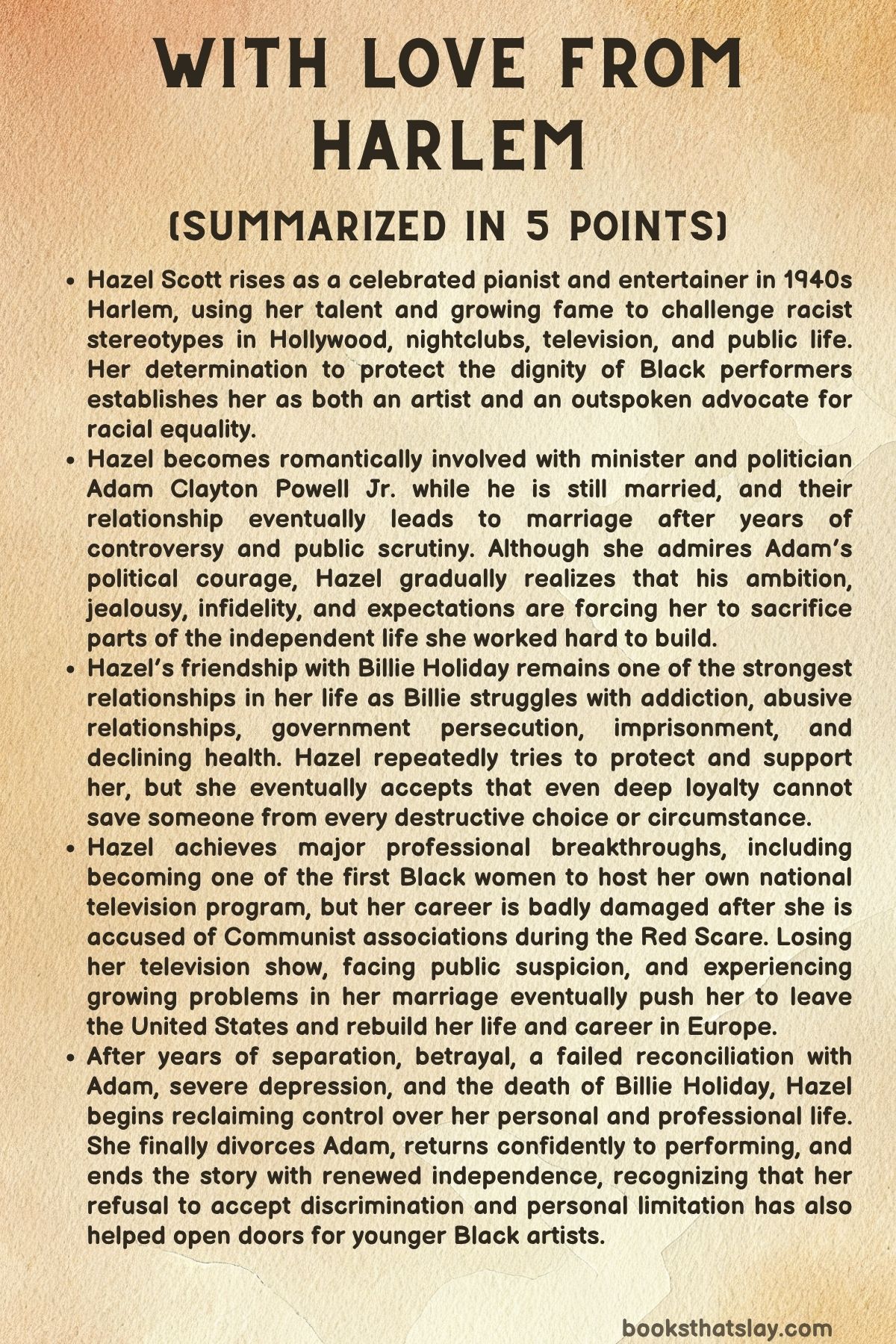
With Love from Harlem by ReShonda Tate is a historical novel centered on pianist and entertainer Hazel Scott, tracing her rise as an exceptional Black artist alongside her turbulent marriage to politician and minister Adam Clayton Powell Jr. Beginning in the Harlem cultural world of the 1940s, the book follows Hazel through artistic breakthroughs, racial discrimination, political controversy, motherhood, friendship, betrayal, depression, and eventual renewal.
At its center is a woman determined to retain ownership of her talent and identity even when marriage, racism, public judgment, and powerful institutions repeatedly demand compromises from her.
Summary
In 1943, twenty-two-year-old Hazel Scott is already a celebrated pianist at Cafe Society, astonishing audiences with a style that combines classical technique and jazz improvisation. Her professional confidence contrasts with the complicated personal world around her: her mother Alma remains her demanding teacher and closest guide, Billie Holiday is a beloved friend struggling with addiction, and Hazel’s dependable boyfriend Lee increasingly seems unable to share the scale of her ambitions.
Hazel’s life changes when she attracts the attention of Adam Clayton Powell Jr., a charismatic Harlem minister, councilman, newspaper publisher, and aspiring congressman. Adam is married to Isabel, and Hazel initially refuses to become involved with him, yet their shared interest in Black advancement, culture, politics, and Harlem creates an attraction that becomes difficult to control.
Hazel is simultaneously expanding her career beyond the nightclub stage. In Hollywood, she refuses to participate in degrading portrayals of Black women, halting production until actresses appearing beside her are allowed to look dignified rather than stereotypical, even though her protest threatens future film opportunities.
Her refusal to accept racial humiliation becomes a defining principle in both her public and private life. She believes artistic success means little if achieving it requires cooperation with a system that insults Black people, and she increasingly uses her celebrity to challenge discrimination rather than simply protect her own position.
Back in New York, Hazel grows closer to Adam while watching him emerge as a powerful political voice during unrest in Harlem. His ability to explain racial and economic injustice, organize residents, and transform anger into political purpose strengthens her admiration until her attraction to the politician and her belief in his causes become almost impossible to separate.
Billie repeatedly warns Hazel that an admired public man can still cause private pain. Hazel understands the danger, particularly because Adam remains married, but the emotional intimacy between them deepens until they begin an affair, forcing Hazel to end her relationship with Lee and accept responsibility for the damage her choices create.
The affair eventually becomes public when Isabel seeks legal separation and identifies another woman as the reason Adam has abandoned their marriage. Isabel directly confronts Hazel and warns that Adam’s charm, ego, ambition, and selfishness will eventually hurt Hazel just as they have hurt her, while Alma insists that Adam settle his existing marriage before expecting her daughter to build a future with him.
Adam nevertheless publicly acknowledges Hazel at Abyssinian Baptist Church and later wins election to Congress. Hazel becomes deeply involved in his campaigns and takes pride in watching a Black representative from Harlem claim political power inside institutions that still tolerate segregation and racial exclusion.
Their relationship develops into an engagement, but even before their wedding Hazel encounters a problem that will define their marriage. When she receives an important theatrical opportunity, Adam becomes upset that the work will interfere with their planned time together, while Hazel fears that one compromise will eventually lead her down the same path as Isabel, who surrendered her career for him.
They marry in August 1945, but marriage soon places Hazel inside Adam’s demanding political and religious world. Congregants judge her glamorous profession, Adam pressures her to leave nightclub work, and he publicly announces her departure from Cafe Society before she has fully accepted the decision herself.
At the same time, Hazel continues challenging discrimination. When Constitution Hall refuses to welcome her because she is Black, Adam uses his political position to fight the exclusion, while Hazel insists that she does not want special treatment as a congressman’s wife but the ordinary rights that should belong to every citizen.
Hazel becomes pregnant, bringing happiness to the marriage, but her joy is followed by the devastating death of Alma from pneumonia. Losing the woman who shaped nearly every part of her artistic development sends Hazel into deep grief, and Adam’s tendency to cope with pain by returning to public work creates emotional distance between them.
Their son, Adam Clayton Powell III, nicknamed Skipper, is born in 1946. Hazel embraces motherhood, but the demands of caring for him, assisting Adam, satisfying church expectations, and managing domestic responsibilities gradually separate her from the independent musician she once was.
Josephine Schuyler becomes an especially important warning. Having watched her own ambitions shrink beneath her marriage to George Schuyler, Josephine tells Hazel that she is beginning to make the same mistake by automatically postponing her music and arranging her life around her husband’s work.
Billie faces an even more dangerous battle. Federal authorities pursue her over narcotics while her performance of “Strange Fruit” makes her politically threatening, and Hazel becomes convinced that addiction has given powerful officials a convenient means of punishing a Black woman who refuses to remain silent about lynching.
Billie is arrested, pleads guilty after believing she may receive treatment, and is instead sent to prison. Hazel desperately wants Adam to intervene, but he refuses to risk his political career on Billie’s case, creating another serious fracture between husband and wife.
Soon afterward Adam suffers a heart attack, and Hazel temporarily abandons her own work to protect him from stress. His illness briefly restores tenderness between them, and Adam encourages Hazel to revive her career, but his inability to stay away from politics soon causes him to break promises about spending time with his family.
A trip to Trinidad becomes important because Hazel travels without Adam and reconnects with the country of her birth and the memories of Alma’s earlier life. Removed from Adam’s political environment, she begins questioning how much of herself has disappeared beneath the identities of wife, mother, minister’s spouse, and political partner.
Billie’s release from prison and triumphant Carnegie Hall comeback demonstrates the continuing power of her art, while Hazel also rebuilds her own musical life. Her marriage briefly improves as she and Adam support one another’s public careers, creating a period in which political work, music, travel, family, and intimacy seem capable of existing together.
Hazel then reaches one of the greatest milestones of her career when she receives her own television program. The Hazel Scott Show places a sophisticated Black woman at the center of national television rather than assigning her a servant, stereotype, or secondary role, giving Hazel a form of cultural influence that she regards as political in its own right.
That achievement is destroyed during the Red Scare. After Hazel is named in Red Channels as an alleged Communist sympathizer, she voluntarily appears before congressional investigators to defend herself, but sponsors withdraw and her television program is canceled despite her insistence that she has knowingly supported no Communist organization.
The controversy also damages her relationship with Barney Josephson, her longtime mentor, who believes her testimony has increased scrutiny on him and his family. Professional loss combines with financial arguments, Adam’s jealousy of Hazel’s fame, and Hazel’s growing suspicion that her husband is involved with other women.
Billie eventually brings Hazel evidence of Adam behaving intimately with another woman. Rather than confront him publicly without preparation, Hazel begins examining her finances, protecting property held in her own name, and considering how she could build a life independent of him.
By 1951 the marriage has effectively collapsed, and Hazel accepts an opportunity to work in Europe. Paris becomes a place where she can exist outside constant American racial restrictions and beyond the social identity of Adam Clayton Powell Jr.’s wife, although they remain legally married for years.
There she renews her friendship with Billie and meets the younger musician Quincy Jones. Quincy understands Hazel’s artistic ambitions and makes her feel appreciated as an independent woman, leading first to creative companionship and eventually to a romantic relationship.
The relationship collapses after Hazel learns that Quincy has made comments suggesting pride in having captured the attention of a famous, financially successful woman. Feeling betrayed again, she refuses to excuse dishonesty simply because she is lonely and ends the relationship rather than allow another man to reduce her value to what she can provide.
Adam later appears in Paris with Skipper and asks Hazel to reunite with him. Her son’s desire to have his parents together persuades Hazel to attempt reconciliation, but the same patterns quickly return: Adam resents being overshadowed by Hazel’s reputation, behaves suspiciously around other women, and reopens wounds that years apart never healed.
The failed reconciliation pushes Hazel into devastating despair, and she attempts to take her own life. After she survives, she learns that Adam tried to control how the incident would be publicly reported, and she later undergoes electroconvulsive treatment that leaves her feeling as though decisions about her own mind and body have again been taken from her.
Josephine and Skipper help Hazel reconnect with the determined woman she once was. Hazel ultimately refuses further treatment, dismisses the doctor managing her care, changes the locks, and decides that Adam will no longer determine when he enters or leaves her life.
While recovering, Hazel faces the approaching death of Billie Holiday. She visits Billie in the hospital, fights against the degrading treatment of her dying friend, and must finally accept that years of loyalty could not rescue Billie from the combined effects of addiction, illness, abusive relationships, and institutional persecution.
After Billie’s death, Hazel gradually returns to performing and finally completes her divorce from Adam. She no longer needs him to confess, apologize, or choose her, and legal separation becomes the final confirmation of an independence she had been seeking emotionally for years.
The ending brings Hazel back to one of the places that once embodied racial exclusion. The Daughters of the American Revolution apologizes for having denied her access to Constitution Hall and invites her to perform there, giving Hazel the opportunity to return not as a supplicant asking for acceptance but as an established artist whose achievements can no longer be denied.
Before taking the stage, she encounters Nina Simone, the young pianist she had encouraged years earlier at Cafe Society, now a successful artist herself. Hazel recognizes that her struggles have mattered beyond her individual career: by insisting on dignity and refusing prescribed limitations, she has helped make space for others, and she closes the story having reclaimed her music, identity, independence, and authority over her own life.
Characters
Hazel Scott
Hazel Scott is the central figure of With Love from Harlem, and nearly every major conflict in the book develops from her determination to remain both emotionally connected to others and personally independent. She begins as an extraordinarily self-assured young pianist who already knows that artistic success means nothing if she must accept degrading portrayals of Black people to achieve it.
Her courage is evident in Hollywood, in television, in her political statements, and in her refusal to accept discriminatory treatment at prestigious venues. Hazel does not treat artistry as separate from racial dignity; the way she performs, dresses, speaks, and occupies public space becomes part of her resistance to expectations that Black women should make themselves smaller.
Her greatest internal struggle emerges through marriage. Hazel enters her relationship with Adam already aware of what Isabel sacrificed for him, yet she slowly makes similar concessions by leaving Cafe Society, postponing work, assisting with political responsibilities, and allowing motherhood and marriage to displace her musical identity.
This contradiction makes Hazel complex rather than simply heroic. She can identify oppression immediately when it comes from studios, racist organizations, or government institutions, yet it takes years for her to recognize how emotional dependence can gradually erode freedom inside an intimate relationship.
Her loyalty is another defining quality, particularly in her friendship with Billie. Hazel repeatedly tries to rescue Billie from drugs, violent men, imprisonment, professional destruction, and degrading treatment, even as she eventually learns that love cannot substitute for another person’s decision to survive.
Hazel’s later depression represents the devastating cost of years spent fighting external and internal battles simultaneously. Her eventual refusal of further shock treatment, decision to lock Adam out, return to music, and acceptance of divorce complete her development from a woman fighting to preserve independence into one who finally understands that she alone must define it.
Adam Clayton Powell Jr.
Adam Clayton Powell Jr. is both one of the most admirable and one of the most damaging figures in With Love from Harlem. As a public leader, he possesses confidence, political intelligence, courage, and an ability to transform community anger into organized action, qualities that understandably attract Hazel long before their relationship becomes physical.
His achievements are substantial within the story. He challenges segregation, fights for Black employment and civil rights, uses publicity as a political weapon, and represents Harlem inside a federal institution that continues to tolerate racial inequality.
The difficulty is that Adam’s public commitment to freedom does not consistently extend to the women closest to him. Isabel has already sacrificed her acting career during their marriage, yet when Hazel becomes his wife, he gradually pressures her toward similar compromises despite once claiming that he regretted what Isabel gave up.
Adam is especially sensitive when Hazel’s fame eclipses his own. His discomfort at being treated merely as her escort or husband reveals an ego that can celebrate an accomplished wife when her success supports his image but becomes threatened when she commands attention independently of him.
His repeated infidelity deepens this contradiction. Adam expects loyalty and becomes jealous over men such as Lee while behaving in ways that make Hazel question whether he accepts the same standards for himself.
Even after Hazel’s suicide attempt, his instinct to manage the public explanation demonstrates how deeply reputation governs his thinking. His character therefore embodies a central contradiction of the story: a man capable of fighting courageously against national injustice can still reproduce control, selfishness, and inequality inside his own home.
Billie Holiday
Billie Holiday is Hazel’s closest friend and one of the most emotionally important figures in With Love from Harlem. Her brilliance as a singer exists beside addiction, destructive relationships, legal persecution, and a stubborn insistence on controlling her own life even when her choices repeatedly place her in danger.
Billie often sees Hazel’s romantic problems more clearly than Hazel does. From the beginning she recognizes the risks of Adam’s charm, later brings evidence of his infidelity, and teaches Hazel to think strategically about leaving rather than allowing anger to expose her publicly and financially.
At the same time, Billie cannot apply equivalent discipline to her own life. She remains surrounded by drugs and dangerous men, resists attempts to manage her behavior, and repeatedly returns to situations that Hazel desperately wants to remove her from.
Her performance of “Strange Fruit” gives her struggles a political dimension. Hazel comes to believe that authorities are not simply responding to narcotics violations but are also exploiting Billie’s addiction because her art challenges racial violence and refuses acceptable silence.
Billie’s prison sentence demonstrates how vulnerable she becomes once powerful institutions define her primarily by addiction rather than artistry. Yet her Carnegie Hall comeback proves that incarceration cannot erase the connection between her voice and her audience.
Her death forces Hazel to accept one of the hardest truths in the book: devotion has limits. Hazel can defend Billie, comfort her, challenge police, attend hearings, arrange support, and remain present when others disappear, but she cannot make Billie choose a different life or reverse the damage already done.
Alma Scott
Alma is the formative force behind Hazel’s discipline, ambition, and self-respect in With Love from Harlem. She is not simply a mother who celebrates her daughter’s talent; she is also a demanding teacher who believes excellence requires constant correction and who refuses to let success make Hazel careless.
Her warnings often anticipate later problems. Alma tells Hazel that she cannot save Billie from herself and warns that constantly sacrificing for others may damage Hazel’s own ambitions, advice that becomes increasingly important once Hazel’s life begins revolving around Adam, Skipper, and Billie’s crises.
Alma also sees Adam without being overwhelmed by his public charm. When his relationship with Hazel becomes scandalous, she insists that political importance does not excuse irresponsibility and demands that he resolve his existing marriage before expecting to build another one.
Her death leaves Hazel without the person who had anchored her identity since childhood. Hazel’s severe grief is partly a response to losing a parent and partly the collapse of a structure that had always provided discipline, criticism, history, and emotional certainty.
Even after her death, Alma continues influencing Hazel through memory, especially during the trip to Trinidad. Understanding more about Alma’s own ambitions and limitations allows Hazel to see her mother not only as a parental authority but as a woman whose life also required difficult compromises.
Josephine Schuyler
Josephine Schuyler serves as both friend and warning in With Love from Harlem. Her own marriage to George gradually reduces a politically engaged, independent woman to someone who doubts whether her work matters, allowing Hazel to witness what can happen when one spouse’s ambitions consume all the space in a relationship.
Her position is complicated by race as well as marriage. As a white woman married into Harlem’s Black intellectual world, she is repeatedly treated with suspicion, while George’s changing political views further isolate her from people with whom she once shared causes.
Josephine’s importance grows as Hazel becomes more absorbed in Adam’s life. She is the person willing to tell Hazel that making coffee, distributing campaign material, canceling personal plans, and abandoning performances are not isolated acts of generosity but evidence that Hazel is gradually disappearing inside her husband’s career.
She also becomes crucial after Hazel’s psychological collapse. Rather than defining Hazel by illness or weakness, Josephine reminds her of the artist and fighter she has always been and helps her take practical steps toward controlling her home and future.
Their friendship survives ideological disputes, marriages, bereavement, political scandals, and personal failures. Josephine represents the value of a friend who offers compassion without avoiding uncomfortable truths.
Barney Josephson
Barney Josephson is one of the strongest professional influences in Hazel’s life and often functions as a paternal figure. As the owner of Cafe Society, he provides Hazel with a space where her talent can develop in an integrated environment and consistently values the originality that makes her different.
Barney understands that Hazel’s refusal to conform is central to her success. When conservative church members judge her nightclub career, he recognizes that changing herself merely to satisfy critics would undermine the very identity that made her an important performer.
His relationship with Hazel is therefore especially painful when the Red Scare damages it. During her congressional testimony Hazel describes the practical way bookings were arranged, and Barney believes her answers contribute to increased scrutiny of him and his family.
Their estrangement shows how political fear destroys relationships beyond the people directly accused. Hazel never intends to betray him, yet intention cannot erase the consequences Barney experiences, making their rupture one of the clearest examples of public persecution creating private casualties.
Isabel Powell
Isabel is initially positioned as the obstacle between Hazel and Adam, but the story gradually makes her far more complicated than a jealous former wife. She gave up a promising acting career during her marriage, and her anger comes from having sacrificed personal ambitions only to watch Adam pursue another woman.
Her confrontation with Hazel is severe because she understands Adam from experience. Isabel warns that his charm, ambition, and selfishness will eventually hurt Hazel, and later developments give those warnings considerable weight.
She also forces Hazel to confront the moral reality of the affair. Adam repeatedly describes his first marriage as emotionally finished, but Isabel’s anger demonstrates that one person’s declaration that a relationship is over does not eliminate the injuries created by betrayal.
Isabel ultimately functions as an uncomfortable reflection of Hazel’s future. Hazel initially believes she will never surrender herself as Isabel did, only to discover after marriage how gradually compromise can become expectation.
Adam Clayton Powell III / Skipper
Skipper is more than Hazel and Adam’s son; he represents the emotional bond that makes complete separation difficult even after their marriage has stopped functioning. His birth gives both parents enormous joy and briefly creates the possibility that family life may stabilize their relationship.
For Hazel, motherhood becomes both enriching and restrictive. She deeply loves Skipper, yet caring for him contributes to the period in which her own career and identity recede, forcing her to confront whether being a devoted mother requires abandoning other parts of herself.
Skipper later becomes one of the strongest reasons Hazel considers reconciling with Adam. His happiness when his parents are together makes Hazel willing to reopen a relationship that she already knows has caused her considerable suffering.
His pain after Adam remarries and announces the possibility of another son inheriting the Powell name reveals how parental decisions affect children even when adults believe their marital conflict is finished. Hazel’s response shows her growth because she comforts Skipper without making him responsible for her anger toward his father.
Quincy Jones
Quincy Jones enters Hazel’s life during her years in Paris and represents possibility after the emotional confinement of her marriage. Younger, ambitious, musically gifted, and intensely interested in Hazel’s creativity, he initially offers the kind of companionship she has long wanted.
Their bond develops through artistic conversation as much as attraction. Quincy listens to Hazel’s musical ideas, offers creative suggestions, and treats her as an artist rather than primarily as a politician’s wife.
The age difference and imbalance in their professional positions nevertheless create tension. Hazel is already internationally established while Quincy is still building his career, raising questions about whether admiration, dependence, ambition, and romance can remain separate.
Those fears become real when Hazel learns that he has spoken about their relationship in ways that involve her fame and financial resources. His admission destroys her belief that he values her entirely apart from celebrity, and Hazel’s decision to leave him demonstrates a stronger boundary than she once maintained with Adam.
Lee
Lee represents stability, familiarity, and the life Hazel might have chosen before Adam. He is kind, dependable, and connected to her past, but the distance between his everyday ambitions and Hazel’s rapidly expanding artistic world eventually becomes impossible for her to ignore.
Hazel’s decision to leave him is painful precisely because Lee has not committed some dramatic wrong. She simply no longer loves him in the way required for a shared future and recognizes that continuing the relationship would turn his loyalty into something she exploits.
When they meet years later, Lee appears to have moved forward without bitterness. Adam’s jealousy toward him says more about Adam’s insecurity than about Lee’s intentions, making Lee a quiet contrast to the possessiveness and instability that later dominate Hazel’s marriage.
George Schuyler
George Schuyler functions primarily as a political and marital counterpoint to Adam. His arguments emphasizing individual advancement rather than collective racial action alienate many Harlem activists and create ideological conflict with people who believe structural discrimination demands organized resistance.
His relationship with Josephine reveals another side of him. As his politics and temperament increasingly dominate their household, Josephine’s confidence and public involvement diminish, making their marriage an example Hazel cannot easily dismiss.
George and Adam disagree politically, yet the consequences their ambitions have for their wives create an important similarity. Both men become so absorbed in public ideas and personal importance that the women beside them struggle to maintain identities independent of the marriage.
Isa Kloukowsky
Isa is Hazel’s agent and a practical voice regarding the realities of the entertainment industry. He understands that talent alone does not determine opportunity and repeatedly confronts the commercial consequences of Hazel’s political statements, racial barriers, and public controversies.
He secures important opportunities, including later work in Europe, and his professional relationship with Hazel survives periods when the American industry becomes hostile to her. Isa therefore represents the infrastructure behind an artistic career: negotiations, bookings, warnings, and opportunities that allow Hazel to continue working even when institutions close doors.
His caution sometimes contrasts with Hazel’s willingness to speak publicly about injustice. Where Hazel often thinks first about principle, Isa is inclined to think about the professional consequences, creating a useful tension between artistic conscience and career survival.
Reverend Adam Clayton Powell Sr.
Reverend Powell is an important figure in the religious and familial environment Hazel enters through Adam. His authority at Abyssinian Baptist Church places him at the center of a community whose expectations about respectability, marriage, religion, and women’s behavior often make Hazel uncomfortable.
He becomes involved in the confrontation between Isabel, Hazel, and Adam, exposing how the younger Powell’s personal decisions create problems extending beyond the couple themselves. His presence also reinforces the weight of family legacy that Adam later places on Skipper through naming and expectations.
The elder Powell’s world helps explain some of Adam’s attachment to status, church leadership, public responsibility, and inherited identity. Hazel’s difficulty adapting to that environment shows that marrying Adam means entering not merely a relationship but an institution with its own rules and judgments.
Hattie Dodson
Hattie is one of Adam’s trusted political associates and becomes an early source of uneasiness in Hazel’s marriage. Her presence in Adam’s Washington residence immediately raises questions about boundaries, especially because Adam treats an arrangement involving another woman as practical while reacting differently when Hazel asks him to imagine the reverse.
Hattie therefore matters less because of any fully established romantic role than because of what she reveals about unequal expectations. Hazel’s discomfort begins exposing the double standard that will later become much more serious as rumors and evidence of Adam’s affairs accumulate.
Her closeness to Adam also illustrates how political and personal life are nearly impossible to separate around him. Staff members, campaign workers, friends, admirers, and potential romantic interests occupy overlapping spaces, leaving Hazel uncertain about where professional intimacy ends.
Yvette Flores
Yvette Flores appears during a period when Hazel’s trust in Adam is already deteriorating. Her conspicuous closeness to him at public events contributes to Hazel’s suspicion that the rumors surrounding her husband’s relationships with other women are not merely attacks from political enemies.
By the time Hazel is finalizing her divorce, she believes Yvette may occupy both a professional and personal role in Adam’s life. The significant change is Hazel’s reaction: rather than fighting to prove anything, she realizes that she no longer cares enough to compete.
Yvette therefore helps mark the emotional end of the marriage. Earlier women provoke jealousy and confrontation, while later Hazel’s awareness of Yvette confirms that she has reached a stage where Adam’s romantic choices no longer determine her own sense of worth.
Nina Simone
Nina Simone appears briefly but meaningfully at both ends of Hazel’s story. As the teenage Eunice Kathleen Waymon, she approaches Hazel as an aspiring pianist and receives encouragement from an already established Black woman artist.
When they meet again years later at Constitution Hall, Nina has become an artist in her own right. The reunion allows Hazel to see that individual acts of encouragement and barrier-breaking can have effects beyond the person who first challenges a closed door.
Nina’s presence gives the ending a generational dimension. Hazel’s success is not valuable solely because she gains access for herself; it contributes to a cultural environment in which younger Black women can imagine occupying artistic spaces once denied to them.
James Baldwin
James Baldwin appears as part of the intellectual and artistic community surrounding Hazel. During the Harlem unrest he assists when Hazel is trying to get Billie to safety, placing him within the network of friends who respond practically when racial tension becomes dangerous.
He later remains part of Hazel’s expatriate and artistic world, including the Paris period when she is rebuilding a life outside her marriage. His warnings concerning Quincy reflect the kind of direct friendship Hazel increasingly needs: support that does not require pretending troubling signs are harmless.
James also reinforces the book’s presentation of Hazel as belonging to a broader generation of Black artists and thinkers rather than existing only within the worlds of entertainment or Adam’s politics. Her friendships continually connect music, literature, race, public responsibility, and personal freedom.
Themes
Personal Independence and the Cost of Love
Hazel’s struggle to remain herself while loving other people gives With Love from Harlem much of its emotional structure. Long before marrying Adam, she understands the danger of surrender because she knows Isabel sacrificed an acting career for him, yet awareness does not prevent Hazel from gradually repeating parts of Isabel’s experience.
The losses occur in small stages rather than through one decisive command. Hazel leaves Cafe Society, rearranges professional commitments, performs campaign work, takes on church expectations, becomes absorbed in motherhood, and repeatedly allows Adam’s political emergencies to outrank her own plans.
Marriage therefore tests the difference between compromise and disappearance. Healthy compromise requires both people to make room for each other’s ambitions, while Hazel increasingly discovers that compromises become destructive when the same person is repeatedly expected to adjust.
Josephine’s life makes the danger visible from another angle. She once possessed political commitments and an identity independent of George, but years of marriage gradually convince her that her work has little value, which is why she recognizes Hazel’s decline before Hazel can admit it herself.
Hazel’s eventual independence is not presented as rejection of love itself. She continues loving Skipper, Billie, Josephine, Alma’s memory, and even parts of what Adam once represented, but she finally understands that devotion cannot require the destruction of the person who gives it.
Changing the locks becomes a particularly powerful expression of this realization. Hazel is not merely preventing Adam from entering a house; she is claiming authority over the boundaries of a life he had long entered, exited, disrupted, and reclaimed according to his own needs.
Art as Identity, Resistance, and Public Power
Music is never simply Hazel’s occupation. It is the part of her identity that survives changing relationships, public scandals, motherhood, grief, political persecution, depression, and the repeated efforts of others to determine what kind of Black woman she should be.
Her Hollywood protest establishes the political meaning of representation early in the story. Hazel refuses to protect only her own wardrobe and insists that the Black women appearing beside her deserve dignity as well, accepting professional risk rather than helping a studio reproduce degrading stereotypes.
Television expands that idea. By controlling her own national program, Hazel understands that millions of viewers can see a sophisticated Black woman occupying the center of the screen without serving, entertaining, or supporting a white protagonist.
The Red Scare demonstrates how vulnerable artistic freedom becomes when political institutions can punish association and suspicion. Hazel believes rational testimony will establish her innocence, but the cancellation of her television show proves that institutions dependent on sponsors and public fear may punish someone even without evidence of wrongdoing.
Billie’s career provides a darker parallel. “Strange Fruit” transforms artistic performance into direct confrontation with racial violence, and Hazel sees how Billie’s addiction makes her vulnerable to authorities who can present political intimidation as ordinary law enforcement.
Hazel’s eventual return to Constitution Hall completes the theme without suggesting that exclusion has been forgotten. She performs there because years of resistance have forced an institution that once rejected her to recognize her stature, allowing music itself to become evidence that those who attempted to limit her failed.
Racism, Respectability, and the Politics of Representation
Racial discrimination in With Love from Harlem operates through entertainment, housing, government, religion, public accommodations, employment, and social expectations. Hazel can buy property and become a major recording artist while still being denied ordinary respect because professional success does not cancel the structures surrounding her.
The story repeatedly asks who gets to define respectable Black identity. Hollywood expects Black women to perform stereotypes, conservative church members regard Hazel’s nightclub career and glamorous clothing with suspicion, and political society judges her relationship with Adam while often tolerating behavior from powerful men that would destroy a woman’s reputation.
Hazel resists the assumption that racial progress requires becoming harmless to white or conservative expectations. She dresses elegantly, speaks openly, performs jazz and classical music, challenges producers, questions politicians, and refuses to behave as though acceptance is more valuable than self-respect.
Adam’s political work attacks racism through legislation, protest, confrontation, publicity, and institutional power. Hazel’s work attacks many of the same assumptions culturally, which is why their disagreement over whose activism matters reveals a significant limitation in Adam’s thinking.
He sometimes treats politics as more substantial than artistic representation. Hazel understands that seeing a Black woman control a television program or command a prestigious concert hall can alter public imagination in ways that legislation alone cannot accomplish.
The Constitution Hall ending brings these forms of struggle together. Hazel does not receive recognition because she has become less challenging; she receives it after remaining successful long enough for an exclusionary institution to confront the injustice of its earlier decision.
Friendship, Loyalty, and the Limits of Saving Others
Hazel’s relationship with Billie repeatedly tests the difference between supporting another person and assuming responsibility for that person’s survival. From the beginning, Hazel sees Billie’s brilliance alongside the addiction and dangerous relationships threatening to destroy her, and her instinct is consistently to intervene.
Alma recognizes the danger in this instinct before Hazel does. Her warning that Hazel cannot save Billie becomes relevant again and again as Hazel searches for her during unrest, confronts violent people around her, helps after arrests, attends court, appeals unsuccessfully to Adam, celebrates her release, and later fights against the degrading treatment Billie receives in the hospital.
Billie is not portrayed simply as someone waiting to be rescued. She is intelligent, funny, perceptive, proud, politically courageous, and often better at diagnosing Hazel’s problems than her own, making the friendship reciprocal rather than a relationship between protector and victim.
The tragedy lies in the fact that insight does not automatically create self-preservation. Billie can recognize Adam’s dangers, advise Hazel to protect her finances, and understand the forces working against her while remaining unable or unwilling to escape her own addictions and destructive relationships.
Josephine offers another model of friendship. She does not require Hazel to obey her advice but continues returning with observations, companionship, practical assistance, and reminders of who Hazel was before despair overwhelmed her.
By the end, Hazel has learned that loyalty means remaining present without believing presence grants control over another person’s fate. Billie’s death is therefore not evidence that Hazel failed as a friend; it is the painful confirmation that friendship can defend, comfort, witness, and sustain another person, but it cannot make every decision on that person’s behalf.