A Bad Bad Place Summary, Characters and Themes
A Bad Bad Place by Frances Crawford is a dark crime novel set in Possilpark, Glasgow, seen largely through the frightened eyes of twelve-year-old Janey Devine. The story begins when Janey discovers the murdered body of young Samantha Watson near an abandoned railway line, an event that breaks her sense of safety and leaves gaps in her memory.
As police, gangland figures, neighbours, and possible suspects press in around her, Janey struggles to understand what she saw and what she has tried to forget. The book is about trauma, class prejudice, fear, loyalty, and the painful search for truth in a community marked by violence.
Summary
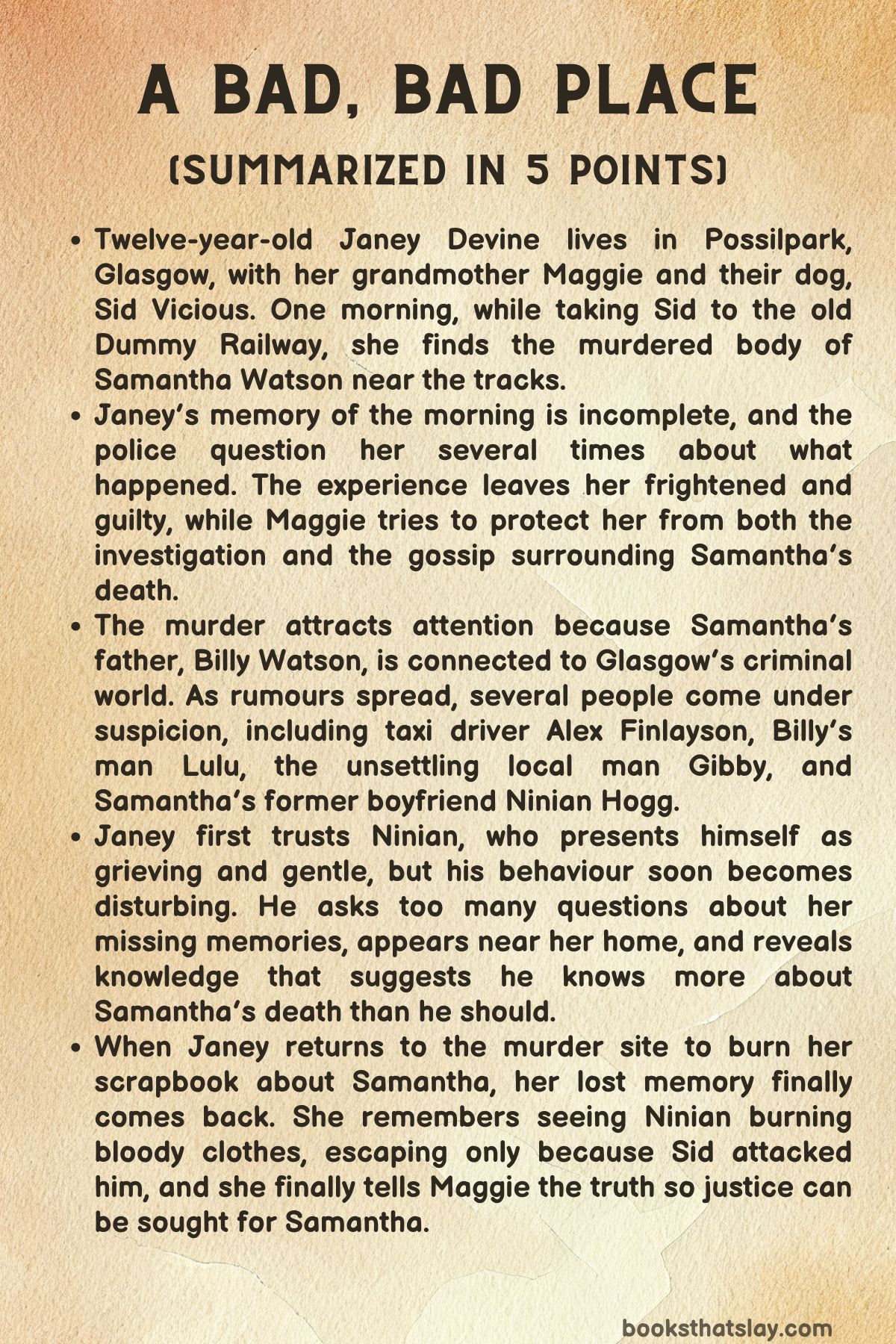
Twelve-year-old Janey Devine lives with her grandmother Maggie in Possilpark, Glasgow, a place often judged harshly by outsiders and treated as rough, poor, and dangerous. Janey’s life is not easy, but it has its own routines and comforts.
Maggie is strict but loving, and their dog, Sid Vicious, is Janey’s companion. One morning, Janey takes Sid to the old Dummy Railway, planning to set off a firework.
Instead of an ordinary childhood adventure, she finds the body of Samantha Watson, a twenty-two-year-old woman who has been murdered and left near the railway tracks.
The discovery shocks Janey so deeply that her mind cannot hold the whole event together. She remembers finding Samantha, touching her dress, and holding her hand, but there is a stretch of time she cannot explain.
Somehow, she later ends up on Balmore Road, where a taxi driver named Alex Finlayson nearly hits her. Alex stops, helps her, and contacts the police.
From that moment, Janey becomes central to a murder investigation she does not fully understand.
The police question Janey again and again, hoping she can remember more. Some officers are patient, but others treat her with suspicion or impatience.
Because Janey comes from Possilpark, they make assumptions about her and her family. Their attitude frightens and humiliates her.
She already feels guilty and confused, and the repeated interviews make her withdraw further into herself. Maggie tries to protect her, but even Maggie cannot reach every part of what Janey is suffering.
After Samantha’s death, Janey begins to change. She has nightmares and accidents, stops looking after Sid properly, and picks obsessively at a scab on her knee.
Her fear turns inward. She becomes quiet, nervous, and ashamed, as if she has done something wrong simply by surviving.
She also begins keeping a scrapbook about Samantha, cutting out newspaper stories and collecting rumours. The scrapbook becomes a way for her to hold on to the case, but it also keeps her trapped inside it.
As the murder becomes public news, gossip spreads quickly. Newspapers focus on Samantha’s father, Billy Watson, who is linked to Glasgow’s criminal world.
Stories suggest that Samantha may have been killed because of Billy’s connections with dangerous families, especially the Edgars. This version of events makes sense to many people because it fits what they expect from a gangland murder.
Samantha’s death is treated not only as a personal tragedy, but as part of a wider world of threats, debts, and revenge.
Billy Watson is devastated by his daughter’s murder. Though he is feared by many, his grief makes him more than a criminal figure.
He wants answers, and because Janey found Samantha, he has her brought to his house so he can hear what she saw. Maggie is furious when she finds out.
She confronts Billy, ready to defend Janey from him, but she is forced to face the depth of his loss. Over time, a wary bond begins to form between Maggie and Billy.
They come from different worlds in some ways, but both understand love, anger, and the need for justice.
While at Billy’s house, Janey sees Samantha’s room and begins to understand that Samantha had a private life hidden from her father and from the public stories being told about her. Janey notices photographs and a Rock Against Racism sticker, signs that Samantha had interests, beliefs, and relationships beyond the world people are trying to assign to her.
Samantha becomes more real to Janey, not just a victim in a newspaper or a body by the tracks.
Several men come under suspicion or begin to frighten Janey. Alex Finlayson, the taxi driver who helped her, worries that the police think he may be involved, especially after they take his shoes for forensic testing.
Lulu, one of Billy Watson’s men, is arrested when evidence seems to connect him to the crime. Lulu’s girlfriend Heather insists he is innocent and tries to pressure Janey into helping him.
Janey feels pulled between adults who want something from her, even though she is still a frightened child.
Another disturbing figure is Gibby, a local man who has been walking Sid. At first, he seems merely odd, but Janey becomes terrified when she realizes he knows something he should not know.
Before the police arrived at the scene, Janey had wiped an obscene word from Samantha’s face because she thought she was protecting her dignity. Gibby’s knowledge of that detail makes him seem dangerous.
Janey begins to wonder whether he could be the killer, or whether he is connected to the truth in some other way.
Janey also meets Ninian Hogg, known as Nino, Samantha’s former boyfriend. Nino works as a librarian and presents himself as gentle, educated, and wounded by Samantha’s death.
He talks to Janey about his relationship with Samantha and claims that Samantha’s new political friends changed her and turned her against him. At first, Janey trusts him.
Compared with gangsters, police officers, and threatening neighbours, Nino seems kind and safe.
But Nino’s behaviour slowly becomes unsettling. He asks too much about Janey’s missing memories.
He touches her in ways that make her uncomfortable. He appears near her home and seems far too interested in what she might remember.
Later, he builds a memorial cross at the exact place where Samantha’s body was found. That detail is troubling because the precise location was not public knowledge.
Nino’s grief begins to look less like sorrow and more like control.
Through the summer, Janey slowly begins to recover some of her old self. Maggie arranges help for her, and there is hope that the worst of her fear may be passing.
Yet the missing memory remains. Janey still cannot explain what happened between finding Samantha and appearing on Balmore Road.
Her mind has locked that part away because it is too terrible for her to face.
Eventually, Janey decides to burn her scrapbook at the Dummy Railway. She wants to say goodbye to Samantha and free herself from the clippings, rumours, and fear she has been carrying.
When she returns to the murder site and sees Nino’s memorial cross, the buried memory returns.
Janey remembers that after finding Samantha, she hid in a tunnel known as the Screke. From there, she saw the killer burning bloody clothes.
His face and hands were red with blood, and in her terror she thought he was the Devil. He saw her and tried to kill her.
Sid Vicious attacked him, biting his leg, and that gave Janey the chance to escape. The shock was so great that her mind buried the memory.
Now she understands that the killer was not Lulu, Alex, or Gibby. The killer was Ninian Hogg.
The truth changes everything. Nino had not been a harmless grieving boyfriend.
He had been watching Janey because she was the witness who could expose him. His questions, his strange appearances, and his memorial at the hidden location all point back to his guilt.
Janey finally understands why she has felt so afraid around him, even before she could name the reason.
Janey runs home and tells Maggie everything. She explains how she found Samantha, how she wiped the word from her face, how she hid, how Sid saved her, and how Nino had tricked her by pretending to care.
Maggie realizes that Janey’s memory loss was not weakness or childish confusion. It was survival.
Janey’s mind had protected her until she was ready to remember.
At the end, Maggie places two phone numbers before Janey: Detective Baxter’s and Billy Watson’s. One represents the law; the other represents a more dangerous form of justice.
Janey does not want to choose what happens next or decide anyone’s fate. She has already carried too much.
Maggie accepts this. She leaves Janey with Martin and Sid, puts both numbers in her handbag, and goes out to act on what Janey has told her.
A Bad Bad Place ends with the truth finally restored, but not with easy comfort. Samantha Watson’s killer has been named, Janey’s memory has returned, and Maggie is ready to seek justice.
Yet the story leaves a lasting sense of how violence damages not only the dead, but also the living who witness it, survive it, and must find a way to go on.
Characters
The characters in A Bad Bad Place are shaped by fear, grief, poverty, loyalty, guilt, and the search for justice. Each character plays a role in showing how one violent death affects not only the victim’s family, but also a child witness, a frightened community, and people connected to power, crime, and suspicion.
Janey Devine
Janey Devine is the emotional centre of the book. At twelve years old, she is still a child, but she is forced into a terrifying adult world when she discovers Samantha Watson’s murdered body near the Dummy Railway.
Her reaction to the body shows her innocence and compassion. She touches Samantha’s dress, holds her hand, and wipes the obscene word from Samantha’s face because she feels that Samantha deserves dignity, even in death.
This act is important because it shows that Janey is not simply a witness; she is someone with a deep instinct for kindness, even when she does not fully understand the danger around her.
Janey’s broken memory becomes one of the most important parts of her character. She remembers finding Samantha and later being helped by Alex Finlayson, but she cannot remember the missing stretch of time in between.
This memory gap is not a weakness. It shows how deeply traumatised she is.
Her mind protects her by burying the truth of what she saw in the Screke. As a result, Janey becomes frightened, withdrawn, and guilty.
Her nightmares, bed-wetting, scab-picking, and neglect of Sid Vicious all reveal a child who has been damaged by something too frightening to face directly.
Janey is also affected by class prejudice and social judgement. Because she comes from Possilpark, some people treat her as unreliable or less deserving of respect.
The police interviews upset her because certain officers are rough, dismissive, or suspicious. This makes Janey’s trauma worse because she is not only carrying the horror of Samantha’s death, but also the pressure of adults who want answers from her without truly understanding her fear.
Her scrapbook about Samantha shows her attempt to make sense of the murder. By collecting newspaper clippings and rumours, Janey tries to control a story that has taken control of her life.
The scrapbook becomes a symbol of her obsession, guilt, and need for answers. When she later decides to burn it, she is trying to say goodbye to Samantha and free herself from the fear that has trapped her.
Janey’s final recovery begins when Nino’s memorial cross triggers her memory. She remembers seeing the killer burning bloody clothes, remembers Sid protecting her, and finally understands that Nino was the murderer.
This moment shows Janey’s courage. She has been manipulated, frightened, and silenced, but she eventually finds the strength to speak.
By the end of the story, Janey is no longer only a traumatised witness. She becomes the person whose truth can bring justice for Samantha.
Maggie
Maggie, Janey’s grandmother, is one of the strongest protective figures in the book. She represents family loyalty, practical love, and emotional toughness.
Maggie’s life with Janey in Possilpark is not shown as easy, but she gives Janey stability and care. Her relationship with Janey is built on protection rather than sentimentality.
When Janey is questioned by the police and shaken by the murder, Maggie’s first instinct is to defend her from anyone who tries to hurt, pressure, or exploit her.
Maggie’s anger after Billy Watson has Janey taken to his house shows her fierce sense of responsibility. She understands that Janey is a child and should not be pulled into the grief or violence of adults.
However, Maggie is not a flat or one-dimensional character. When she confronts Billy and sees his pain, she begins to understand him as a grieving father rather than only as a dangerous man.
This creates a wary connection between them, showing Maggie’s ability to recognise suffering even in someone she does not fully trust.
Maggie also understands Janey more deeply than many of the adults around her. When Janey finally tells her everything, Maggie realises that Janey’s mind buried the memory in order to survive.
This response shows Maggie’s emotional intelligence. She does not blame Janey for forgetting, nor does she treat her as foolish.
Instead, she understands that trauma can protect and imprison a person at the same time.
At the end of the story, Maggie becomes the person who must carry the burden of action. By placing Detective Baxter’s number and Billy Watson’s number before Janey, she shows that justice may come through different routes: the law or Billy’s own dangerous world.
When Janey says she does not want to decide anyone’s fate, Maggie takes that responsibility away from her. This makes Maggie both loving and morally complex.
She protects Janey from the final decision while preparing to seek justice for Samantha.
Sid Vicious
Sid Vicious, Janey’s dog, is more than a pet in the story. He represents loyalty, protection, and the ordinary childhood life that Janey begins to lose after finding Samantha’s body.
At the beginning, Janey takes Sid to the Dummy Railway to set off a firework, which places him at the centre of the event that changes everything. His presence connects Janey’s innocence with the violence she is about to discover.
After the murder, Janey’s neglect of Sid becomes a sign of her trauma. She stops caring for him properly, which shows how deeply the experience has disrupted her normal emotions and routines.
Sid is therefore important not only because of what he does, but also because of what Janey’s changing relationship with him reveals. When she cannot care for him, it shows that she cannot fully care for herself either.
Sid’s most important role is revealed when Janey recovers her memory. In the tunnel, when Nino tries to kill her, Sid attacks him and bites his leg.
This act makes Sid a protector and a hidden hero of the story. He saves Janey when no adult is there to help her.
His loyalty contrasts sharply with the betrayal and danger represented by Nino. Sid is instinctive, faithful, and brave, and his actions make Janey’s survival possible.
Samantha Watson
Samantha Watson is the murder victim, but she is not only important because of her death. Her character exists through the traces she leaves behind: her bedroom, photographs, political interests, relationships, and the reactions of those who knew her.
Even though she is dead for most of the book, Samantha’s presence shapes the entire story. She becomes the centre of grief, fear, gossip, suspicion, and justice.
Samantha appears to have had a private life that was more complex than other people understood. The hidden photographs and Rock Against Racism sticker suggest that she had interests, beliefs, and connections that may not have fitted neatly into her father’s world.
Her political friends seem to have represented a different direction for her, one that Nino resented. This makes Samantha feel like a young woman trying to form an identity of her own.
Her relationship with Billy Watson adds another layer to her character. As the daughter of a man linked to criminal families, Samantha is seen by the public through the shadow of her father’s reputation.
Newspapers suggest that her murder may be connected to underworld conflicts, reducing her life to gossip and speculation. Yet the story pushes against that reduction.
Samantha is not merely someone’s daughter or a victim of criminal politics. She is a young woman whose dignity matters, which is why Janey’s act of wiping her face becomes so meaningful.
Samantha also becomes a moral presence in Janey’s life. Janey’s guilt, fear, scrapbook, and final decision to burn the clippings all show that Samantha has become deeply important to her.
Janey did not know Samantha well, but she feels responsible for her dignity and truth. Through Samantha, the book explores how the dead can continue to affect the living, especially when their story has been distorted by rumour, fear, and male violence.
Billy Watson
Billy Watson is one of the most morally complex adults in the story. He is connected to Glasgow’s criminal world, and this makes him frightening to others.
His reputation suggests power, danger, and possible violence. However, his role as Samantha’s father reveals a more human and vulnerable side.
He is devastated by his daughter’s death, and his grief drives many of his actions.
Billy’s decision to have Janey brought to his house is disturbing because it shows how used he is to power and control. He wants answers, and he uses fear and influence to get close to the child who may have seen something.
This action makes him dangerous, especially from Maggie’s point of view. Yet when Maggie confronts him, his grief becomes impossible to ignore.
He is not only a criminal figure; he is a father shattered by loss.
Billy’s relationship with Maggie is important because it creates an uneasy bond between two protective adults. They come from different kinds of power, but both care about the children in their lives.
Maggie protects Janey, while Billy wants justice for Samantha. Their connection remains wary because Billy’s world is not safe, but their shared grief and determination create a form of understanding.
By the end, Billy represents an alternative kind of justice. Maggie’s decision to carry both his number and Detective Baxter’s number shows that Billy stands outside the official law but may still be capable of acting against evil.
This makes him morally ambiguous. He is not presented as purely good, but his grief for Samantha is real, and his desire for justice gives him emotional weight.
Ninian “Nino” Hogg
Ninian Hogg, also called Nino, is the most deceptive and dangerous character in the book. At first, he presents himself as kind, heartbroken, and gentle.
As Samantha’s former boyfriend and a librarian, he appears to be different from the openly threatening figures around Janey. His calm and sympathetic manner allows Janey to trust him.
This makes his character especially disturbing because his danger is hidden behind politeness and apparent sadness.
Nino’s behaviour gradually reveals his possessiveness and manipulation. He tells Janey about his relationship with Samantha and blames her new political friends for turning her against him.
This shows that he sees Samantha’s independence as a betrayal. Rather than accepting her right to change, grow, or move away from him, he frames himself as the wounded victim.
This self-pity is part of his violence because it allows him to justify his resentment.
His interest in Janey’s missing memories is deeply sinister. He asks questions, touches her, appears near her home, and watches her because he knows she may remember the truth.
He is not trying to comfort her; he is trying to measure how much danger she poses to him. His memorial cross is one of the clearest signs of his guilt because he places it exactly where Samantha’s body was found, even though that location was not public knowledge.
His attempt to appear grieving becomes the very clue that exposes him.
Nino’s identity as the killer also changes the meaning of the story’s danger. The murderer is not the most obvious suspect, not the criminal associate, not the taxi driver, and not the strange local man.
He is someone who performs sensitivity while hiding brutality. This makes him a frightening portrait of male possessiveness and hidden violence.
His attack on Samantha and later attempt to kill Janey show that he destroys those who threaten his control.
Alex Finlayson
Alex Finlayson is the taxi driver who nearly hits Janey on Balmore Road and then calls the police. His role in the story is important because he appears at a confusing moment, when Janey has escaped from danger but cannot remember what happened.
To Janey, Alex is connected with rescue, because he finds her and brings adults into the situation. However, because of the uncertainty around the timeline, he also becomes someone the police may suspect.
Alex’s anxiety after the police take his shoes for forensic testing shows how quickly an ordinary person can become trapped in suspicion. He has not done anything wrong, but his closeness to the event makes him vulnerable.
His character shows the wider effect of Samantha’s murder: it spreads fear beyond the victim and the witness, touching anyone who came near the crime.
Alex also contrasts with more threatening male figures in the story. Unlike Nino, who hides danger beneath kindness, Alex’s fear is rooted in being falsely suspected.
His role reminds the reader that suspicion can be misleading, especially when people are judged because of circumstance rather than truth. He is a supporting character, but he helps create the atmosphere of uncertainty that surrounds the investigation.
Lulu
Lulu is one of Billy Watson’s men and becomes one of the major suspects after evidence points toward him. His connection to Billy’s world makes him an easy person for others to imagine as guilty.
Because the newspapers and public gossip already link Samantha’s death to criminal families, Lulu’s arrest seems to fit the story that outsiders want to believe. In this way, Lulu represents how reputation and association can shape suspicion.
Although Lulu is not shown as harmless, his suspected guilt is part of the book’s misdirection. He belongs to a dangerous environment, but that does not make him Samantha’s killer.
His character helps expose how people often look for violence in the most obvious places while missing the more hidden, intimate form of violence represented by Nino.
Lulu’s arrest also increases the pressure on Janey. Because she is the witness with missing memories, others begin to treat her as someone who may be able to save or condemn him.
This places an unfair burden on a child. Through Lulu, the story shows how adult conflicts and criminal reputations pull Janey further into danger.
Heather
Heather, Lulu’s girlfriend, is important because she insists that Lulu is innocent and pressures Janey to help. Her loyalty to Lulu drives her actions, but her pressure on Janey also shows how adults in the story repeatedly place their needs onto a traumatised child.
Heather may be acting out of love and fear, but she does not fully recognise what Janey is suffering.
Heather’s character shows another side of the murder’s consequences. For Samantha’s family, the crime brings grief.
For Janey, it brings trauma. For Heather, it brings the fear that someone she loves will be punished for something he did not do.
This makes her desperate, and that desperation causes her to behave unfairly toward Janey.
She also helps develop the theme of mistaken suspicion. Heather’s belief in Lulu’s innocence is eventually proven right, but the way she tries to involve Janey shows that being right does not always make a person kind or careful.
Her character is emotionally understandable, but her actions add to Janey’s burden.
Gibby
Gibby is a local man who walks Sid Vicious and becomes frightening to Janey when she realises he knows about the obscene word written on Samantha’s face. Because Janey wiped the word away before the police arrived, only the killer should know about it.
This makes Gibby seem deeply suspicious and dangerous for a time. His character adds tension because he appears to possess knowledge that connects him to the murder.
Gibby’s role is another example of how fear can distort judgement. Janey’s terror is understandable because the detail he knows is so specific and private.
However, he is ultimately not the killer. His character helps maintain the atmosphere of uncertainty in the story, where several people appear threatening, and Janey cannot easily know whom to trust.
Gibby also reflects the unease of the local community. He is close enough to Janey’s everyday life to be familiar, but after Samantha’s murder, even familiar people become frightening.
This is one of the lasting effects of violence in the book: it makes ordinary relationships feel unsafe.
Detective Baxter
Detective Baxter represents the official path toward justice. Although the police as a group do not always treat Janey well, Baxter’s number at the end becomes symbolically important.
It represents law, investigation, and the possibility that Samantha’s killer can be dealt with through proper authority rather than revenge.
Baxter’s role is limited compared with Janey, Maggie, or Nino, but his presence matters because the ending places him beside Billy Watson as one of two possible routes. Maggie’s decision to take both numbers suggests that justice is complicated in this world.
The official system may be necessary, but it has also failed to fully protect Janey from pressure and suspicion.
Through Baxter, the story raises questions about whether institutions can be trusted. The police need Janey’s truth, but some officers have already hurt her by the way they questioned and judged her.
Baxter therefore stands for the possibility of lawful justice, but not for a perfect system.
Martin
Martin is a smaller supporting character, but his role at the end is meaningful. Maggie leaves Janey with Martin and Sid while she goes out with the two phone numbers.
This shows that Martin is someone Maggie trusts enough to stay with Janey at a crucial moment. His presence helps create a small circle of safety around Janey after she finally reveals the truth.
Martin’s importance lies in stability. After so much fear, suspicion, and danger, Janey needs to be left with someone safe rather than pulled further into adult decisions.
Martin helps make that possible. He does not dominate the story, but he supports the protective structure that Maggie builds around Janey.
Themes
Trauma and the Mind’s Need to Protect Itself
Janey’s broken memory shows how trauma can force the mind to hide what it cannot safely face. After discovering Samantha’s body, Janey does not simply forget because she is careless or confused; her memory shuts away the most terrifying part of the experience because the truth is too violent for a child to carry.
Her nightmares, bed-wetting, fearfulness, silence, and physical habits reveal that the memory still lives inside her, even when she cannot explain it. She is haunted by something she does not fully understand.
This makes her behaviour deeply believable, because trauma often appears through fear, guilt, bodily reactions, and sudden emotional changes before it becomes clear in words. The missing stretch of time becomes a symbol of survival.
Janey’s mind protects her from the image of the killer, the threat to her life, and the knowledge that she was a witness. When the memory finally returns, it is painful, but it also gives her the power to speak.
Class Prejudice and Social Judgement
Possilpark is not only Janey’s home; it becomes the reason many adults judge her before they truly listen. Because she comes from Possil, some police officers treat her as unreliable, rough, or unimportant.
Their attitude shows how class prejudice can shape the search for truth. Janey is a frightened child who has found a murdered woman, yet she is often treated as a problem rather than a victim.
This deepens her fear and makes her silence worse. The wider public also turns the murder into gossip, linking Samantha’s death to criminal families and local rumours.
Instead of seeing the people involved as grieving, scared, or vulnerable, society reduces them to stereotypes: the criminal father, the poor child, the dangerous neighbourhood, the suspicious taxi driver. A Bad Bad Place presents class judgement as a form of damage.
It does not kill Samantha, but it slows compassion, distorts truth, and makes justice harder to reach.
Innocence Confronting Violence
Janey’s childhood is forced into contact with adult brutality when she finds Samantha’s body. Her actions at the scene show both innocence and moral courage.
She holds Samantha’s hand and wipes the obscene word from her face, not because she understands evidence or police procedure, but because she feels that Samantha deserves dignity. This moment reveals Janey’s instinctive goodness in a world that has suddenly become cruel.
The contrast between Janey’s age and the violence around her makes the story more disturbing. She is surrounded by murder, police questioning, criminal suspicion, threatening adults, and public gossip, yet she is still a child who loves her dog, depends on Maggie, and struggles to understand what has happened.
Her innocence does not mean weakness. In fact, it gives her response a special moral clarity.
While adults argue, suspect, threaten, and protect themselves, Janey remembers Samantha as a person who should not be shamed, forgotten, or used.
Justice, Protection, and Moral Responsibility
The search for justice is complicated because almost every character carries fear, loyalty, grief, or guilt. Maggie wants to protect Janey, but she also knows that Samantha deserves the truth.
Billy Watson wants answers, yet his grief and criminal connections make his pursuit of justice dangerous. Janey herself feels the burden most heavily because her memory can decide another person’s fate.
Her statement that she does not want to decide anyone’s fate shows the terrible pressure placed on a child witness. Justice here is not simple revenge or police procedure.
It requires courage, care, and responsibility. Maggie’s final decision to take both phone numbers suggests that justice may need both official authority and personal courage, but it must begin with protecting Janey from further harm.
The ending leaves moral weight in Maggie’s hands, showing that love and justice are not opposites. True protection does not mean hiding the truth forever; it means helping the truth come out safely.