A Curse of Ashes Summary, Characters and Themes
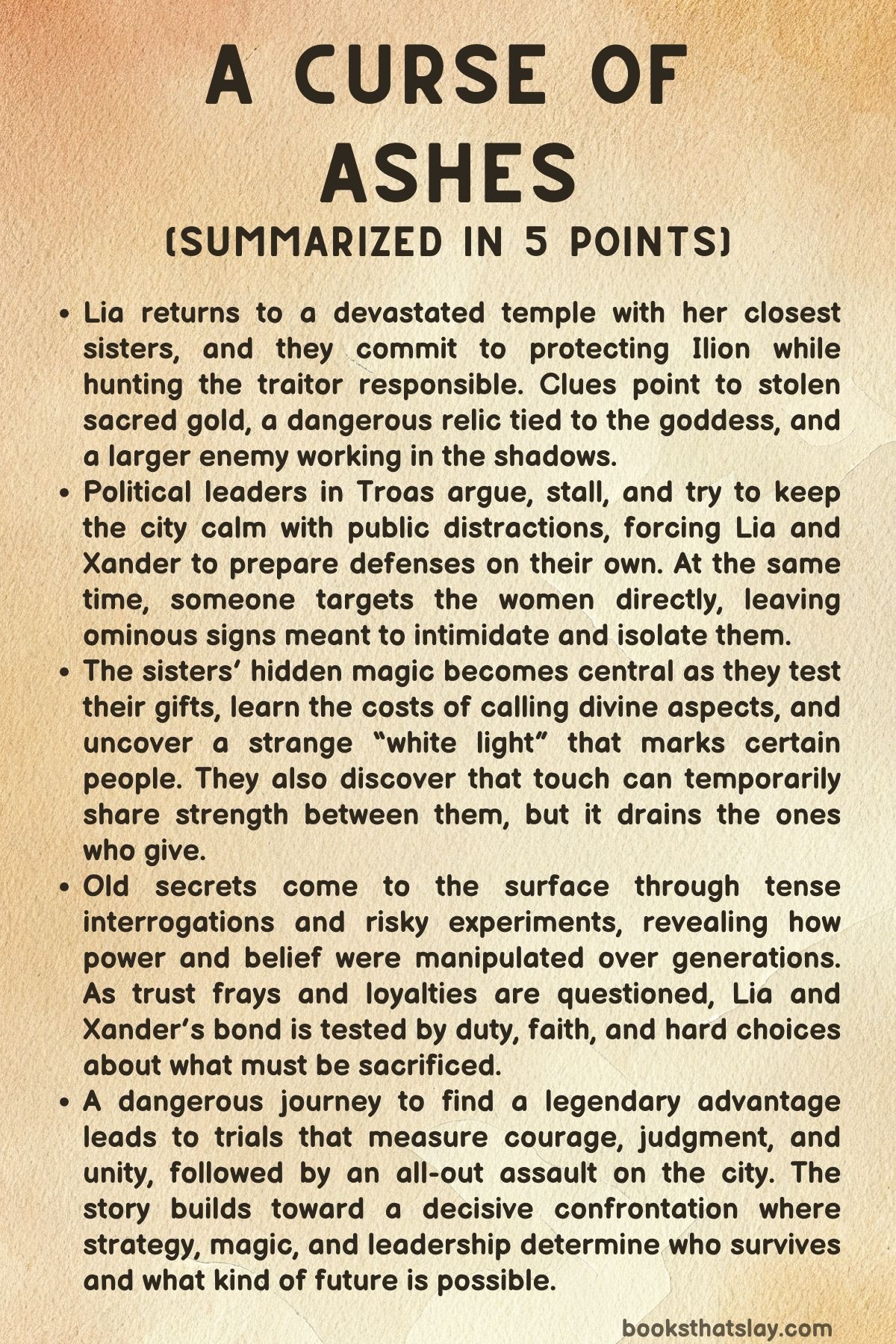
A Curse of Ashes by Sariah Wilson is a fantasy adventure set in a world of rival cities, sacred temples, and magic that answers to a goddess’s many names. After a brutal massacre destroys the temple that once anchored their faith and power, Lia and her remaining adelphia are forced into leadership long before they feel ready
With enemies closing in from outside the walls and betrayal rotting the city from within, Lia must decide what she owes her people, her vows, and her new husband, Xander. The story mixes political tension, mythic trials, and hard choices about love, duty, and survival. It’s the 3rd book in The Eye of the Goddess series.
Summary
A goddess’s warning echoes in Lia’s mind as she climbs the ruined temple steps to reunite with her adelphia: Io, Suri, Zalira, and Ahyana. They stand beside a mass grave for the priestesses and acolytes murdered on temple grounds.
Antiope, the battle master, barely survived long enough to deliver a cryptic message before falling into a coma: “Hammer of Arion.” The survivors swear they will not let the slaughter be the end of their order. They believe Artemisia, a former acolyte, is responsible, aided by an unknown force.
Inside the shattered temple, Lia notices strange red dirt left behind by the attackers and suspects it matters. The goddess’s statue has been smashed and stripped of gold, likely stolen to bankroll soldiers and supplies.
Lia fears something even worse: the ancient high priestess Lysimache, long known as Theano, may have armed Artemisia with a relic called an eye of the goddess. Lia shares what she knows—there are four eyes, not two, because both the Ilionian and Locrian statues had two sockets.
One Locrian eye was split for life mages; the other helped curse Locris. One Ilionian eye has been used to keep Lysimache alive for a thousand years and to strengthen acolytes through the temple fountain water.
That leaves one remaining Ilionian eye somewhere, and Lia is convinced they must find it before Artemisia does.
Lia also reveals Lysimache’s true identity and her long scheme: she manipulated religion, erased texts, and shaped society to believe magic belonged to men, all while hoarding power and waiting for prophecy. Io insists Lia is the prophesied savior, marked by the goddess, but Lia fears the prophecy’s cost: the savior dies after a “trial of the elements,” sacrificed to protect Ilion.
As they leave the temple grounds, they find Xander has stationed a protective force outside. Io privately urges Lia to keep emotional distance from him, terrified of what his grief could become if Lia dies or is forced back to Locris.
Back at the palace, Lia faces a council more interested in appearances than survival. Xander reports coordinated attacks—Lycia destroyed, traps left behind, the weapons quarter raided, and the temple wiped out.
Powerful figures dismiss him, claiming there are no witnesses and blaming unrest on immigrants. They vote to hold a grand celebration for Xander’s birthday to keep the populace calm.
Xander realizes the council’s plan is a mask for denial and ambition, and Lia agrees the gathering could become the perfect cover for another strike. They decide to prepare defenses without the council’s support.
Their fragile calm breaks when Io screams: someone has destroyed the adelphia’s rooms. The wreckage is brutal—furniture slashed, papers shredded, red dirt everywhere.
The attackers even targeted Io’s animals, though Suri finds Io’s ferret alive. Lia discovers bloodstains in her own room and panics until her lizard, Luna, appears.
Luna can answer Lia’s questions by blinking and seems to understand far more than she should. Xander confirms he spent the night helping in the weapons quarter and that Quynh is hidden under guard, protected by Basileia, Thrax’s deadly sister.
Lia tells Xander the temple fountain water strengthens priestesses like men, and he posts guards to protect it. She also reveals the truth the world has forgotten: the temple women can wield magic by invoking different aspects of the goddess.
Io can coax life from plants; Ahyana commands pollinators; Zalira calls water and storms; Suri manipulates earth and senses what’s hidden. Lia believes Artemisia attacked the temple because women with awakened power could oppose her.
Lia and Io interrogate Lysimache in a guarded safe house. Lysimache admits she used the goddess’s fury aspect—“Dea Erinys”—to curse Locris into dust and claims she has been cut off from the goddess ever since.
She confesses she reshaped doctrine over generations and used amulets and fear to keep true power controlled. When she demands temple fountain water, Lia suspects a trap, but Io has a different plan: she wants Lysimache strong enough to be forced into talking.
As the adelphia experiments with their magic, they learn how dangerous it is. Invoking an aspect brings a surge of power and then punishing pain that can knock them unconscious.
Zalira summons a violent storm and holds it longer than anyone has before. When she collapses, her eyes flash emerald, and she sees white light surrounding certain people.
Ahyana confirms the same phenomenon when she calls bats. The sisters begin to suspect this white light marks those who can be empowered.
Lia’s own aspect awakens as fury, and her training often involves Xander. During practice, she sees white light around him too.
They discover touch can share power: one person can feed another’s magic, strengthening the caster while draining the donor. The revelation changes their strategy for war, but it also makes their bond harder to ignore.
Meanwhile, Quynh reveals she may be pregnant by Thrax, and Lia senses the same bright light within her, confirming it.
Io develops potions to help the sisters endure longer and prepares a truth serum disguised in fountain water. Around the same time, Io also completes a potion to break the dangerous physical link between Lia and Xander—a link that once meant if one died, the other might follow.
Lia wants the link broken to protect Xander, but Xander refuses to use intimacy as a tool to do it; he will not be the reason she breaks vows tied to the goddess’s power. In the end, Io’s potion solves it without sacrifice: Lia and Xander drink, test it, and the mirrored pain is gone.
With the link broken, Lia expects Xander to stay behind, but he insists on coming with her to search for a legendary weapon: a golden sword tied to the goddess, possibly hidden in a cave on Mount Idaia. The group travels into the mountains—Xander, trusted men, and the adelphia.
Along the way, Lia faces disasters that feel like prophecy made real: the earth gives way beneath her, nearly burying her alive. Later, crossing a chasm on a rotting bridge, a violent wind tears away her safety rope and almost hurls her into the abyss.
They survive by grit and teamwork, and Io names what they’ve endured: trials of earth and air.
Only Lia and the adelphia can enter the cave. Inside, a series of tests judges them: illusions of fire, poisonous flowers and falling stone, riddles posed by a sphinx, and a final trial that pushes them toward distrust and conflict as they must choose the goddess’s greatest treasure from a table of tempting relics.
The pressure turns the sisters against one another until they force themselves to remember who they are and why they came.
War soon crashes against Troas. Reinforcements arrive, including Demaratus, Lia’s former battle master, and Locrian soldiers.
Antiope wakes from her coma, hungry to fight. The Carian army gathers, spreading red soil that disrupts the sisters’ powers when it touches them.
Siege engines roll forward, dragons batter walls, and the enemy wields the Hammer of Arion. In the chaos, Lia calls on the goddess’s dragon aspect, and dragons answer—air and fire in the sky, water rising to destroy ships.
The tide turns, but Artemisia remains the blade at the center of the storm.
Lia confronts Artemisia directly. When fury threatens to consume her, she steadies herself and invokes a new aspect: “Dea Soteira,” the savior.
With clear power and hard control, she defeats Artemisia. When Artemisia tries to kill Xander with a last strike, Lia reacts without hesitation, ending Artemisia’s threat for good.
The hammer sinks into the earth, and the remaining enemies surrender or flee.
After the battle, Troas rebuilds. Allies depart.
Weddings restore joy where fear had lived: Quynh marries Thrax, and two of the sisters marry in a double ceremony. Political rot is cut away as Pelias and his family are removed.
Lia learns Io and Suri have chosen each other, and the discovery of temple manuals offers a solution to Lia’s promise to restore worship in Locris: Antiope can reopen the Locrian temple with proper guidance.
Two weeks later, they sail to Locris with friends, Luna, and the recovered eye. Lia is sick with pregnancy, and Xander is openly joyful.
In Locris, family reunions bring healing, including the shock of Haemon’s return alive. Finally, Lia takes Xander into the mountains and buries the eye, invoking “Dea Euthalia” to restore the land.
Power floods from her into the soil, and the dead country turns green in moments. Asteria, the goddess’s daughter, appears to reclaim the goddess’s sword, and she confirms the future will not demand Lia’s death.
Lia and Xander return hand in hand, ready to share their news, celebrate new marriages, and rule together—no longer trapped by fear of prophecy, but guided by choice.
Characters
Lia (Thalia)
Lia, later revealed more prominently as Thalia, stands at the emotional and prophetic center of A Curse of Ashes. She is defined by the tension between duty and desire, constantly pulled between what she wants as a person and what she is expected to become as the goddess’s chosen.
Her journey is shaped by sacrifice, as she fears the prophecy that the savior must die, yet she continues forward with courage because she cannot allow fear to dictate the fate of Ilion or Locris. Lia’s growth is marked by the awakening of her fury aspect and later her transformation into “Dea Soteira,” the savior aspect, showing that her strength is not only destructive but also sustaining and redemptive.
Her character ultimately embodies renewal, as she becomes the one who restores Locris and proves that salvation does not always demand death, but sometimes demands endurance, love, and faith.
Xander
Xander emerges as both king and protector, carrying the weight of leadership while battling the frustration of political obstruction and looming war. He is deeply honorable, often choosing restraint even when passion or anger might be easier, particularly in his relationship with Lia.
His devotion is not simply romantic but rooted in responsibility, as he repeatedly prioritizes her worthiness, safety, and vows over his own desires. Xander’s character is also shaped by loneliness, having been forced into power amid crisis, and his bond with Lia becomes the one place where vulnerability breaks through his guarded exterior.
He represents steady devotion, proving himself not only as a warrior king but as a partner willing to share burdens rather than demand submission.
Io
Io is fiercely loyal, protective, and often the most emotionally reactive of the adelphia, driven by love and fear in equal measure. Her belief that Lia is the savior becomes almost absolute, and that conviction fuels her urgency and sometimes her possessiveness, especially regarding Lia’s closeness with Xander.
Io’s magical abilities, tied to life and growth, mirror her personality, as she seeks solutions through creation, potions, and strengthening her sisters. Beneath her sharp protectiveness is profound vulnerability, shaped by grief, trauma, and the terror of losing what remains of her family.
Her eventual romantic connection with Suri also reveals her capacity for tenderness and hope beyond survival.
Suri
Suri is quiet but immensely powerful, embodying steadiness, intuition, and depth. Her earth-based magic reflects her grounding presence, as she is often the one who senses hidden things and provides direction when chaos threatens to overwhelm the group.
Suri’s strength is not loud or performative, but essential, as she becomes crucial in both defense and discovery. Her white light being the strongest suggests an inner reservoir of power that even she may not fully understand at first.
Her relationship with Io adds another layer to her character, showing that beneath her calm exterior is a person capable of profound love and connection.
Zalira
Zalira represents resilience forged through grief, acting as one of the emotional anchors of the adelphia after the massacre. Her connection to storms and water reflects both her capacity for destruction and her role as a force of renewal.
Zalira’s endurance is remarkable, as she holds magic longer than anyone before, demonstrating both willpower and sacrifice. Her struggle is deeply tied to vows, faith, and the pain of invoking divine aspects that demand suffering in exchange for power.
Her eventual marriage and survival signify that devotion does not always end in tragedy, but can lead to healing.
Ahyana
Ahyana’s character blends sharp strength with emotional honesty, often voicing truths others hesitate to confront. Her magic, tied to pollinators and creatures of the air, mirrors her role as both observer and disruptor, someone who sees what is happening beneath the surface.
Ahyana is also deeply affected by betrayal and secrecy, particularly in her relationship with Rokh, where anger becomes a shield for wounded trust. Her growth is marked by her ability to continue loving despite fear, and her eventual happiness reflects the possibility of peace after devastation.
Artemisia
Artemisia is the primary antagonist, embodying betrayal, ambition, and corruption of sacred power. Once an acolyte, she represents what happens when faith is twisted into hunger for control.
Her actions are defined by brutality, from slaughtering priestesses to weaponizing relics and armies. Artemisia is not simply evil for its own sake, but driven by the desire to dominate through fear and destruction.
Her hammer, tied to Arion, symbolizes divine power stolen and misused. Her death at Lia’s hands becomes not only the fall of an enemy but the closing of a chapter of desecration against the goddess’s order.
Lysimache (Theano)
Lysimache is one of the most morally complex figures in A Curse of Ashes, embodying manipulation disguised as devotion. Her thousand-year survival reveals both her fear of death and her obsession with controlling prophecy.
She reshaped religion, suppressed truth, and engineered society’s beliefs in order to maintain power, making her as dangerous as any invading army. Yet she is also tragic, having cut herself off from the goddess entirely, left with only bitterness and schemes.
Lysimache represents the corruption of sacred authority, showing that betrayal can come not only from outsiders but from those entrusted with faith.
Thrax
Thrax provides both strength and unexpected warmth, acting as a fierce ally while carrying the blunt humor of a warrior. His devotion to Quynh reveals a softer dimension beneath his intimidating exterior.
He is also a symbol of loyalty beyond politics, proving that chosen bonds can be stronger than blood or borders. Thrax’s role as protector and future father gives him narrative importance as someone fighting not only for victory but for a life worth living afterward.
Quynh
Quynh represents vulnerability, survival, and hope. Hidden away for safety, she becomes a reminder of what is at stake beyond war: family, children, and futures that might never come if darkness wins.
Her pregnancy symbolizes renewal, the continuation of life even in the shadow of death. Quynh’s quiet strength lies in her endurance, and her bond with Thalia highlights the deep sisterhood that extends beyond the adelphia.
Rokh
Rokh is defined by secrecy, loyalty, and the burden of curses beyond his control. His hidden nature and transformation reveal that even allies carry wounds and truths they fear exposing.
Rokh’s relationship with Ahyana is shaped by conflict, as love must confront deception and pain before it can become peace. He ultimately represents the theme that survival often requires masks, but healing requires honesty.
Basileia
Basileia is a striking embodiment of fierce guardianship, marked literally by the tattoos of her kills. She is unapologetically dangerous, yet her loyalty to Quynh shows her honor beneath brutality.
Basileia represents the harsh realities of war, where protection often demands violence, and her presence reinforces the theme that strength can take many forms, especially in women.
Antiope
Antiope is the battle master, a figure of raw willpower who refuses to remain broken even after near death. Her awakening is symbolic, as if war itself calls her back.
Antiope’s intensity, strength, and surprising romantic turn with Demaratus show that even the hardest warriors are still human. She represents endurance, the refusal to surrender identity even after devastation.
Demaratus
Demaratus embodies discipline, tradition, and the stern world of soldiering. His return with reinforcements signals the widening of alliances and the merging of past and present in Thalia’s life.
Though begrudging and rigid, he is ultimately loyal, showing that even harsh mentors can become vital pillars in moments of crisis.
Luna
Luna is far more than a companion animal, serving as a magical bridge between divine power and human courage. Her intelligence, communication, and ability to guide Thalia through trials make her almost a sacred familiar.
Luna symbolizes transformation and destiny, appearing at crucial moments as both protector and messenger. Her presence reinforces that the goddess’s hand is never entirely absent, even in the darkest moments.
Erisa
Erisa represents political blindness and self-serving ambition, the kind of internal rot that makes kingdoms vulnerable. While others see war approaching, she clings to appearances, distractions, and denial.
Her actions highlight that the threat to Ilion is not only external armies but also leaders who refuse to face truth. Her end is abrupt and symbolic, showing how quickly selfishness collapses under real violence.
Pelias
Pelias embodies complacency and manipulation within governance, dismissing danger as unrest and prioritizing control over preparation. He represents the failure of institutions when leaders value comfort and power more than responsibility.
His removal signals a cleansing of corruption, necessary for renewal after war.
Asteria
Asteria, the goddess’s daughter, appears as a figure of divine closure and promise. She reclaims the sword, confirms prophecy’s fulfillment, and offers assurance of peace.
Asteria represents the benevolent side of the divine, reminding the characters and the reader that sacrifice is not always demanded endlessly, and that restoration is possible.
Themes
Faith under pressure and the cost of devotion
The world of A Curse of Ashes treats faith as something that is tested in public and in private, not as a quiet comfort. After the massacre at the temple, the surviving women are forced to keep moving while they are still raw with grief, and their choices become a form of worship because the formal structures of worship have been shattered.
The goddess is present as warning, as power, and as expectation, but that presence does not make decisions easier. When vows about celibacy and worthiness remain in place even after the guards and punishments are gone, devotion becomes a personal burden rather than a rule enforced by others.
Characters face the question of what the goddess actually asks for: rigid purity, or courage, endurance, and the willingness to protect people. The tests inside the cave sharpen this theme by making worthiness measurable, not theoretical.
Bravery, vigilance, wisdom, and perception become standards that judge the heart and the mind, not only the body. The trials push the sisters to confront fear, to act while uncertain, and to rely on each other’s strengths.
Even when the goddess’s power grants miracles, it also brings pain, unconsciousness, and limits that feel punishing. Faith here is not gentle.
It demands sacrifices of comfort, secrecy, and sometimes love, while still offering the possibility that devotion can restore what was ruined, as seen in the final healing of Locris.
Power, control, and the politics of denial
Authority in A Curse of Ashes is not simply held by leaders; it is defended by people who benefit from pretending danger is manageable. The council’s choice to stall, question witnesses, and distract the city with celebration shows how governance can become a performance meant to preserve status rather than protect lives.
Political denial is treated as an active threat because it creates openings for attack and forces the protagonists to build defenses outside official approval. This theme becomes sharper through the way information is controlled.
The elders and archons demand reports and paperwork while enemies strike again, and the result is a city that must survive despite its institutions. At the same time, control also appears in smaller, more personal forms: surveillance inside the palace, the fear that a servant can be a spy, and the way a “mute witness” might have been used to pass identity to someone with influence.
The story shows that power is often maintained through plausible stories that sound orderly, like blaming violence on unrest or blaming outsiders, even when patterns point to coordinated warfare. Against that, the protagonists rely on practical action: moving villagers behind walls, recruiting spies, strengthening gates, and testing magic.
The contrast makes the theme clear—leadership is proven by responsiveness, not rank, and the cost of choosing appearances over preparedness is measured in bodies and ash.
Truth as a weapon and the danger of rewritten history
The conflict is driven not only by armies and relics but by competing versions of history, and the book makes the struggle over truth feel as violent as battle. Lysimache’s revelations expose deliberate reshaping of religion across generations: texts removed, narratives changed, and society convinced that magic belongs to men while true power is controlled elsewhere.
That kind of long-term manipulation turns truth into something that must be recovered like a stolen artifact. The temple’s smashed statue and missing gold are not only theft; they are an attack on meaning, on communal memory, and on the legitimacy of the women’s authority.
Even within the protagonists’ group, truth has to be handled carefully. Secrets are kept for strategic reasons, for protection, and for fear of betrayal, but secrecy also creates internal strain.
The tension around telling Xander about the eye shows how truth can feel risky even when allies are loyal, because power changes the meaning of information. Io’s plan to force confession through a serum in fountain water also raises a hard question: when survival is at stake, is coercion acceptable?
The story does not treat truth as automatically liberating. It treats truth as power that can be used well or badly, and it shows how a society can be harmed when truth is controlled by those who want obedience.
The eventual restoration of Locris becomes more than magic; it becomes the undoing of a lie that said the land’s ruin was permanent.
Women’s power, autonomy, and the rejection of imposed roles
Women are targeted precisely because their abilities threaten the existing balance. The temple slaughter is not random brutality; it is strategic removal of a group capable of opposing conquest.
The surviving adelphia represent a form of authority that does not depend on council votes or male permission, and that autonomy makes them dangerous to enemies and inconvenient to local leaders who prefer predictable structures. Their magic is diverse and practical—storms, earth-sense, pollinators, plants, fury—and the story insists that this power is neither decorative nor secondary.
It shapes strategy, siege defenses, and the outcome of battle. The theme also runs through bodily autonomy and intimacy.
With the temple’s enforcement gone, the women openly discuss desire and choice, and the narrative treats those conversations as part of reclaiming selfhood after trauma. Yet vows and worthiness still matter, and the tension is not presented as simple repression versus freedom.
Lia’s insistence on remaining celibate to stay worthy of using the eye makes her body a site of responsibility, while Xander’s refusal to use sex as a tool to solve the link problem is framed as respect for her agency rather than moral superiority. The white light phenomenon adds another layer: women can amplify each other through touch, but the donors are drained, which mirrors real dynamics of emotional labor and mutual support.
The group’s power grows most when they cooperate by choice, not when they are commanded. In the end, women do not merely survive the story’s violence; they reshape the future of worship, leadership, and the land itself.
Love as loyalty, restraint, and shared responsibility
Romance in A Curse of Ashes is not treated as an escape from war; it becomes another arena where responsibility is tested. Lia and Xander’s relationship is shaped by duty, prophecy, and the physical link that turns love into literal risk.
Their closeness is repeatedly interrupted by danger, political demands, and fear of what the prophecy may require, and that creates a bond defined by restraint as much as desire. The refusal to consummate the marriage for strategic reasons is not simply about rules; it is about refusing to turn intimacy into a tool that might later feel like exploitation.
That restraint is paired with tenderness that has nothing to do with conquest, such as hair-braiding that carries grief, family history, and protection. Love also appears in the sisters’ relationships with each other, where loyalty includes hard conversations, disagreement, and the willingness to carry one another when magic knocks them unconscious.
Even secondary relationships show how love changes priorities: Quynh’s pregnancy raises urgent questions about safety, futures, and what kind of world a child will enter, while the marriages near the end feel like a choice to claim joy in a world that tried to erase it. The story treats love as a commitment to protection, not possession.
Characters demand promises that include care for partners and children, and love becomes one of the forces that pushes people to act decisively when institutions fail. By the conclusion, love is tied to rebuilding—family reunions, planned weddings, and the intention to rule together—suggesting that affection is not separate from leadership but part of what makes leadership worth pursuing.