A Far-Flung Life Summary, Characters and Themes
A Far-Flung Life by M. L. Stedman is a historical family saga set largely on Meredith Downs, a vast pastoral lease in Western Australia. Beginning with a devastating road accident in 1958 and stretching across decades, the book follows the MacBride family through grief, secrecy, survival, and changing times.
It is a story about how private choices shape future generations, how silence can protect and harm at once, and how love often takes imperfect forms. Against the stark beauty of the outback, the novel examines family duty, shame, memory, and the slow possibility of release.
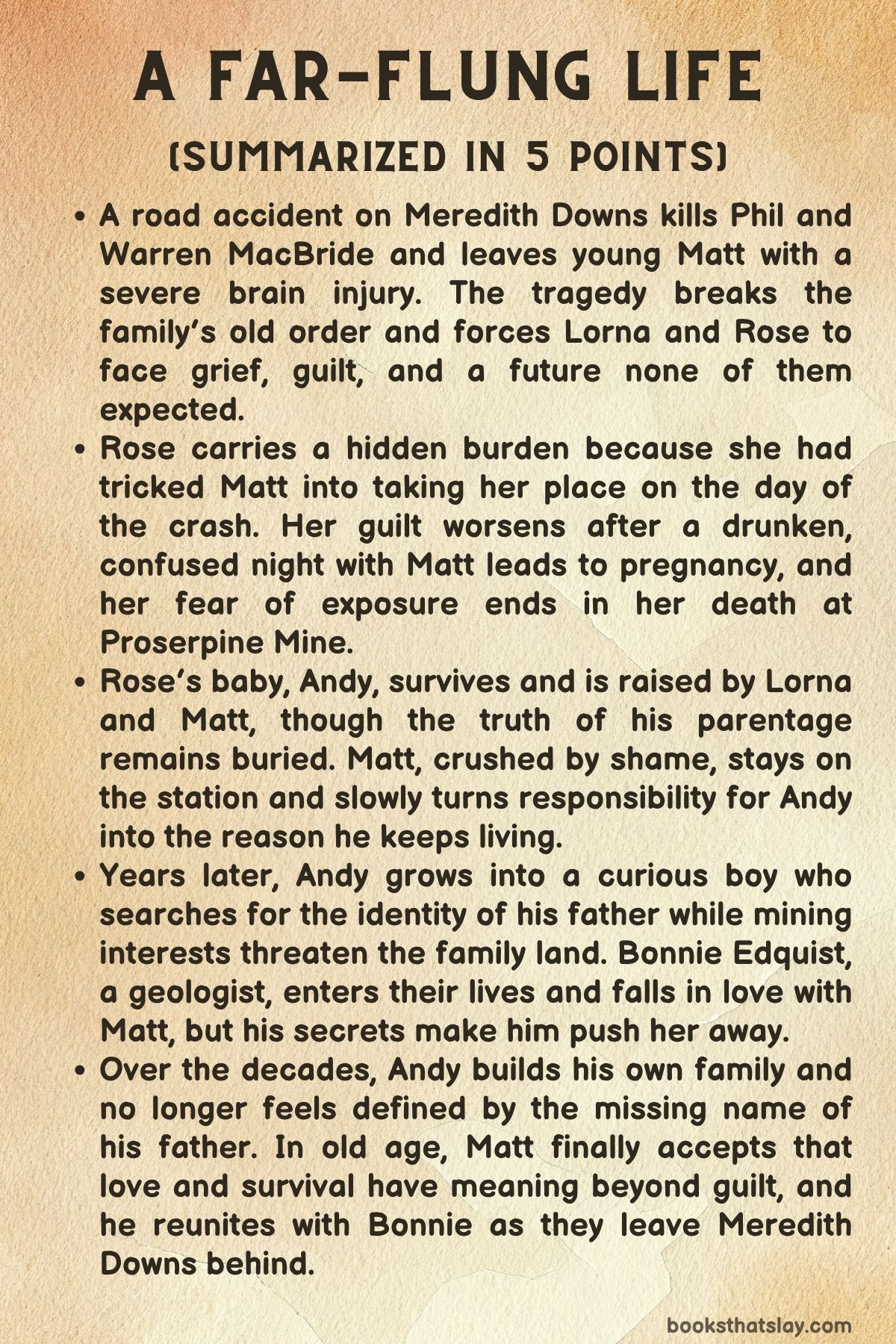
Summary
A Far-flung Life begins on a harsh road in Western Australia, where Phil MacBride drives across Meredith Downs with his two sons, Warren and Matt. The family is rooted in station life, and the landscape around them carries generations of MacBride history, including an old pearling lugger called the Alpha Crucis.
Matt, nearly eighteen, dreams of sailing away and seeing the world, while his father and brother treat the idea with practical skepticism. Their ordinary journey turns catastrophic when a kangaroo appears on the road.
Phil, who has always warned his sons never to swerve for kangaroos, hesitates because he briefly thinks the animal is a person. He brakes, the truck rolls, and the crash leaves Phil and Warren dead while Matt is critically injured.
The accident fractures the MacBride family. Lorna, Phil’s wife, is told that her husband and elder son are gone and that Matt may not survive.
Rose, Matt’s sister, travels to Perth to be near him. The local community rallies around the homestead, but no amount of help can soften the sudden emptiness left by Phil and Warren.
Matt eventually wakes, but his brain injury has changed him. His memory is damaged, his emotions are unstable, and he cannot hold on to the truth of what has happened.
Doctors warn Lorna and Rose that his recovery will be slow and uncertain. The brilliant, ambitious boy they knew has been replaced by someone frightened, impulsive, and confused.
Rose carries a private burden in the aftermath. Before the accident, she had tricked Matt into taking her place on the trip to Wanderrie Creek so that she could spend time alone with Miles Beaumont, a handsome English trainee manager staying at Meredith Downs.
Rose had been infatuated with Miles and saw him as a link to a larger, more glamorous life beyond the station. She had lied to Matt by saying that Pattie Gosden, the girl he liked, would be at the meeting.
While Phil, Warren, and Matt drove away, Rose explored the abandoned Proserpine Mine with Miles and dreamed of escape. After the crash, this lie becomes the center of her guilt.
She believes that if she had gone as planned, Matt would not have been in the truck.
As Matt moves through rehabilitation, the family tries to adjust to a world without Phil and Warren. Lorna learns that the station is financially stable, and Miles agrees to remain temporarily to help.
Matt’s recovery is uneven. He can relearn tasks, but his memory remains full of gaps.
Rose visits him at first, but she becomes increasingly haunted by guilt. During a weekend visit home, she takes Matt around the property.
They are caught by storms at the Top Shed and spend the night there. Both drink heavily.
Matt, disoriented by his injury and alcohol, mistakes the situation around him, and a sexual encounter occurs between him and Rose. The next morning, Rose is horrified.
Matt remembers nothing, but Rose’s sense of guilt deepens into despair.
Rose eventually runs away from Meredith Downs. She forges her dead father’s signature to recover money intended for a secretarial course and finds work under an assumed name at a meatworks.
The routine gives her temporary safety, but she later discovers she is pregnant. Because abortion is illegal and socially dangerous, she has little control over her situation.
Near Christmas, she gives birth to a son. Dr. Finbar Rafferty, a longtime family friend, brings her and the baby back to Meredith Downs.
Rose refuses to name the father. Lorna, ashamed and confused, assumes the child may be Miles Beaumont’s, especially after reading station records from the relevant period.
The baby’s arrival strains the household further. Rose is detached from him, while Lorna and Matt gradually respond with tenderness.
Adoption is considered, but Rose fears that the child may grow up and find her. Her terror grows when Matt speaks of a recurring dream involving rain, lamplight, and a girl.
She realizes that his memory of the night at the Top Shed may not be entirely gone. Unable to live with the possibility of exposure, she takes the baby at night and drives to Proserpine Mine.
She means to end both their lives, but when Pete Peachey finds the car and rushes to the mine shaft, Rose is dead and the baby has survived. Sergeant Wisheart records the death as an accident to spare the family further punishment.
Lorna keeps the baby and names him Andrew Ross MacBride. Matt later finds Rose’s hidden confession, which states that he is the father.
The discovery nearly destroys him. He becomes depressed, drinks, and withdraws from the child.
Pete Peachey, the station’s kangaroo shooter and a man shaped by wartime trauma, helps Matt survive. Pete tells him that life must sometimes be endured one breath at a time.
Matt burns Rose’s confession but cannot erase the truth. Instead, he accepts that he must stay alive for his mother and for Andy.
Years pass, and Andy grows into a curious, lonely boy. He loves rocks, stories, and the landscape of Meredith Downs.
He is raised by Lorna and Matt, knowing little about Rose and nothing about his father. The station itself is changing.
Wool prices decline, and mining companies gain power over pastoral land. Bonnie Edquist, a geologist with Hollamby Mining, arrives to survey Meredith Downs.
Matt is hostile at first, seeing the company as a threat, but Bonnie forms a bond with Andy over rocks and with Matt over sailing, independence, and their shared sense of being outsiders.
Andy begins searching for his father. A school family-history project pushes him toward questions the adults have avoided.
He searches Rose’s belongings, reads letters, and builds a private list of possible fathers, including Miles Beaumont and Pete Peachey. Bonnie, believing truth is better than secrecy, tries to help him despite Matt’s reluctance.
Meanwhile, a new policeman, Sergeant Rundle, reopens old cases that his predecessor had quietly buried. Rundle’s rigid view of justice threatens to expose the truth about Rose’s death and Andy’s birth.
Myrtle Eedle, the postmaster’s wife, also becomes fascinated by the MacBride mysteries, partly because of her own hidden grief over a child she gave up long ago.
Pete Peachey becomes a central figure in the novel’s examination of secrecy. He is respected by the MacBrides, yet he keeps a private ritual connected to his time as a prisoner of war.
During captivity, he once performed in women’s clothing in a camp production, and that experience gave him a fragile space of beauty and survival. After the war, his wife rejected him when she discovered this side of him.
At Meredith Downs, Pete found refuge. When Rundle suspects him of being Andy’s father, Pete allows the false theory to stand in order to protect Matt and Lorna.
Later, Andy accidentally exposes Pete’s secret to other young people, leading to a brutal attack on Pete. Matt rescues him, but Pete leaves Meredith Downs, warning Matt that some secrets must be guarded because the world is not always kind enough to receive them.
Matt and Bonnie fall in love, and for a time it seems that Matt may build a life beyond guilt. A cyclone damages the station and pushes him to admit his feelings.
He asks Bonnie to marry him. Yet when she investigates Miles Beaumont as a possible father for Andy, Matt realizes she is coming too close to the truth.
Terrified that his past will harm Andy and Bonnie, he ends the engagement without explaining. Bonnie leaves, heartbroken, while Matt remains behind, choosing duty over personal happiness.
Decades pass. Andy grows up, studies agriculture, marries Jane, and has children of his own.
Matt eventually leaves Meredith Downs after realizing that Andy, once the center of his shame, has become the proof that his life was not wasted. The station later faces renewed mining interest, and Andy negotiates with Hollamby Mining, now led by Bonnie.
Their agreement protects a rare stand of trees on Wallaby Ridge and gives the MacBrides some control over the land’s future. Bonnie still remembers Andy and Matt, keeping a tektite Andy once gave her.
Near the end of Lorna’s life, she tells Matt that she believes Miles Beaumont was Andy’s father. Matt understands that she has created a gentler version of the past and chooses not to correct her.
After her death, Andy tells Matt that he no longer needs to know who his father was. He has become a father himself, and Matt was always the man who truly raised him.
This frees Matt from a burden he has carried for most of his life. At Wallaby Ridge, Bonnie returns.
She and Matt acknowledge that their love never fully disappeared. With Meredith Downs behind them and the old pearling lugger finally lifted away so Monty’s ashes can be taken to sea, Matt and Bonnie leave together, not knowing exactly what comes next but finally willing to face it.
Characters
Matt MacBride
Matt MacBride is the emotional center of the book, a boy whose life is split in two by the accident that kills his father and brother. Before the crash, he is intelligent, restless, and full of private ambition.
He wants to sail around the world, and the Alpha Crucis represents more than a family relic to him; it is a symbol of self-direction and escape. After the crash, his brain injury makes him dependent, volatile, and uncertain of his own history.
One of the most painful parts of his characterization is that he becomes a person who must be told his own life by others. His damaged memory leaves him vulnerable, but it also creates the conditions for the central secret of the novel.
Matt’s tragedy is not only what happens to him, but what he believes about himself afterward. When he learns that he is Andy’s father, he interprets his life through guilt and moral contamination.
The book does not present him as a villain but as a wounded person trapped inside a truth he cannot bear and cannot undo. His choice to remain at Meredith Downs and help raise Andy becomes his long act of penance.
Yet that same act also becomes his salvation. Matt’s development is slow and quiet: he moves from shame to endurance, from endurance to responsibility, and finally from responsibility to a kind of grace.
By the end of A Far-flung Life, his story suggests that a person can live under the weight of the past without being wholly defined by it.
Rose MacBride
Rose MacBride is one of the most tragic and psychologically complex figures in the book. From childhood, she learns to escape guilt through denial, blame, and a private ritual of burning written confessions.
Her habit of lying begins as childish self-protection, but it becomes a larger pattern in her life. She wants freedom, beauty, admiration, and a world beyond Meredith Downs.
Miles Beaumont becomes the screen onto which she projects these desires. Her decision to send Matt in her place on the day of the crash is not malicious; it comes from longing and selfishness mixed together.
Yet when the accident occurs, Rose cannot separate intention from consequence. She decides that she caused everything.
Her collapse after the Top Shed incident shows a young woman with no safe language for trauma, shame, or pregnancy. She is trapped by social expectations, religious pressure, family honor, and her own lifelong inability to face truth directly.
Her detachment from Andy after his birth is not simple cruelty; it is fear sharpened into rejection. She sees the baby as evidence that her guilt can return in human form and expose her forever.
Rose’s death at Proserpine Mine is the final expression of her belief that erasure is the only solution. The sorrow of her character lies in the fact that she is both responsible for harm and deeply harmed herself.
The story treats her with moral seriousness rather than easy judgment.
Lorna MacBride
Lorna MacBride is the family’s keeper of order, memory, and social dignity. Before the accident, she is a capable station wife who has adapted fully to the demands of pastoral life.
She manages the household, supports Phil, raises children in isolation, and belongs to a generation of women expected to bear hardship without public complaint. After Phil and Warren die, Lorna’s world narrows to survival.
She must manage grief, station responsibilities, Matt’s injury, Rose’s pregnancy, and the birth of Andy while maintaining some appearance of control.
Lorna’s character is built around tension between love and respectability. She is often stern, especially with Rose, because she has internalized the belief that shame can stain an entire family.
Yet she is not cold. Her decision to keep Andy marks a turning point.
What begins as duty becomes attachment, and attachment becomes fierce love. Her later belief that Miles Beaumont was Andy’s father reveals her need for a bearable version of the truth.
Lorna’s strength is real, but it has limits; she survives by arranging facts into forms she can live with. In the book, she represents a generation for whom endurance was often valued above emotional honesty.
Andy MacBride
Andy MacBride grows up as the living consequence of a secret he does not understand. As a child, he is curious, solitary, imaginative, and deeply shaped by the isolation of Meredith Downs.
His love of rocks, letters, family trees, and hidden objects shows a mind drawn toward evidence. He wants origins, patterns, and names.
The absence of his father becomes not merely a social embarrassment but a puzzle that structures his imagination. His word “forgetment” captures one of the novel’s central ideas: that what is forgotten or hidden still occupies space in a life.
Andy’s search for his father is touching because it is driven less by scandal than by a child’s desire not to be incomplete. He looks through Rose’s belongings, questions adults, and reads clues with the seriousness of a detective.
Yet as he matures, the question loses its power. He becomes a husband and father, and he learns that identity is not secured only by biological origin.
His final acceptance of not knowing releases Matt from decades of fear. Andy’s growth shows how the next generation can inherit damage without having to repeat every part of it.
In A Far-flung Life, he becomes proof that a life born from shame can still grow into love, competence, and peace.
Bonnie Edquist
Bonnie Edquist enters the story as an outsider, but she quickly becomes one of its clearest moral and emotional forces. As a geologist, she reads the land differently from the pastoralists.
Where Matt sees threat, Bonnie sees layers, minerals, pressure, and time. Her scientific curiosity connects her to Andy, while her independence draws Matt toward her.
She is practical, intelligent, and direct, but she is not without her own wounds. Her failed engagement has made her wary of secrecy, and this explains why she presses Matt for honesty.
To Bonnie, love requires openness.
Her flaw is that she underestimates the danger of forcing truth into a family system built around silence. She believes that knowledge will free Andy and perhaps free Matt, but she does not fully understand the scale of the secret she is approaching.
Her investigation into Miles Beaumont comes from care, but it also violates boundaries Matt is desperate to protect. Even so, Bonnie is not merely a disruptor.
She represents the possibility of a life Matt might choose rather than simply endure. Their late reunion gives the book its strongest note of earned tenderness.
Bonnie’s return suggests that love delayed by fear may still matter, even after much of life has passed.
Pete Peachey
Pete Peachey is one of the book’s most moving studies of survival, privacy, and misunderstood identity. Outwardly, he is the station kangaroo shooter: quiet, precise, practical, and trusted.
He knows the land, handles death cleanly, and speaks only when necessary. Beneath that surface is a man permanently marked by war, imprisonment, loss, and rejection.
His private ritual with clothing, cosmetics, and music is not presented as a joke or a scandal but as a sacred connection to the part of himself that survived captivity. It is also a memorial to men who died in the prisoner-of-war camp.
Pete’s relationship with Rose and Matt is deeply protective. He mentors Rose when she is young, later rescues Andy from the mine, and helps Matt through suicidal despair.
He understands secrets because his own life depends on them. When Sergeant Rundle suspects him, Pete allows a false implication to protect the MacBrides.
His later assault by drunken young men shows the cruelty of a society unable to tolerate difference. Pete’s departure is one of the book’s saddest losses.
He has given the family safety, wisdom, and loyalty, but the world around him cannot give him equal protection.
Phil MacBride
Phil MacBride’s death occurs early, but his presence shapes the entire novel. He represents the old pastoral order: practical, disciplined, cautious, and deeply connected to Meredith Downs.
He is neither sentimental nor harsh in a simple way. He maintains family traditions, including care for the Alpha Crucis and Uncle Monty’s ashes, and he teaches his children the rules of survival in the outback.
His instruction never to swerve for kangaroos becomes tragically ironic, because his one moment of hesitation leads to the crash.
As a father, Phil believes in duty and competence. He recognizes Rose’s practical gifts, trusts Pete with his daughter, and tries to guide Warren’s ambitions for the station.
His absence leaves more than grief; it creates a leadership vacuum. Lorna must make decisions without him, Matt loses the father whose approval and structure once shaped him, and Rose loses the figure whose authority she both needed and resisted.
Phil’s importance lies in how much the family continues to measure itself against him after he is gone. He is a dead man whose standards remain alive in the household.
Warren MacBride
Warren MacBride is drawn as confident, forceful, and often arrogant. As the elder son, he expects to inherit authority at Meredith Downs and already argues with Phil over station management.
His push for higher stock numbers suggests ambition without his father’s caution. He is also socially assertive and physically dominant, especially in his interactions with Rose.
His attempt to control Rose’s behavior after her school reputation reaches him shows both brotherly concern and patriarchal entitlement.
Warren’s death fixes him permanently in an unfinished state. Unlike Matt, he never has the chance to mature beyond arrogance or soften into self-knowledge.
For Lorna, this becomes part of the grief: he will never grow out of his flaws. In the family memory, Warren remains tied to lost inheritance, masculine confidence, and the old future that vanished with the crash.
His absence also increases the burden on Matt, who must eventually take on a life he never wanted. Warren’s role in the book is brief but structurally important because his death helps redirect the entire MacBride line.
Miles Beaumont
Miles Beaumont arrives at Meredith Downs as a figure from another world. Handsome, aristocratic, polished, and English, he becomes the focus of Rose’s longing for escape.
To her, he seems to offer access to refinement, travel, and reinvention. Yet Miles is also displaced.
He is unsure of himself in station life and knows little about sheep, making him dependent on the very people who are impressed by his background. His charm hides vulnerability, especially around his private relationship with Sandy.
Miles’s importance lies partly in misunderstanding. Rose reads his kindness as possibility, while Lorna later reads his presence in the station diary as evidence that he may be Andy’s father.
Matt eventually learns that Miles had a male partner and protects that information by burning evidence. Miles’s own secret parallels the larger pattern of concealed truths in A Far-flung Life.
He is not central because of what he does, but because of what others imagine about him. He becomes a convenient explanation, a false father, and a reminder that appearances can mislead even those who are desperate for certainty.
Myrtle Eedle
Myrtle Eedle is both comic and sad, a woman whose fascination with funerals and suspicious deaths masks unresolved grief. She studies death notices, attends funerals, keeps records, and treats local tragedies as puzzles.
At first, her curiosity can seem intrusive, especially when she becomes interested in Rose MacBride’s death and Andy’s father. Yet the book gradually reveals that Myrtle’s obsession comes from her own hidden wound.
As a young woman, she gave birth to a daughter and surrendered her for adoption. Her inability to speak of that loss leaves her emotionally attached to stories of women punished by pregnancy, secrecy, and social judgment.
Myrtle’s suspicion of Pete is wrong, but it is not random. She sees in Rose’s fate echoes of other abandoned young women.
Her problem is that sympathy, curiosity, and speculation become mixed together. She wants justice but lacks truth.
Her character shows how secrets do not stay contained within one family; they create rumors, theories, and public hunger. Myrtle is a reminder that communities can both care and pry, mourn and judge, protect and harm.
Sergeant Rundle
Sergeant Rundle represents law without mercy. Unlike Sergeant Wisheart, who sometimes buried cases to preserve fragile families, Rundle believes that rules must be enforced no matter the human cost.
His background in law and statistics makes him suspicious of irregularities, and he treats old files as problems requiring correction. His reopening of past cases shows the danger of applying rigid justice to situations shaped by desperation, violence, poverty, and grief.
Rundle is not corrupt or stupid. In his own mind, he is defending fairness.
This makes him more unsettling, because his harm comes from principle rather than malice. His treatment of the Rose MacBride case threatens to expose wounds that the family has survived only by sealing over.
The book uses him to ask whether truth and justice are always the same thing. Rundle’s flaw is not that he values truth, but that he lacks humility before suffering.
He cannot understand that some official silences, however morally compromised, were acts of mercy in a brutal world.
Sneaky Snook
Sneaky Snook, the mailman, is one of the book’s quiet stabilizing figures. His nickname and rough appearance suggest comic eccentricity, but his actions reveal deep reliability.
He finds the wrecked truck, recognizes that Matt may still be alive, and helps get the injured men to medical care. His role as mailman also gives him a special place in the isolated community.
He carries letters, parcels, news, and emotional connections across distances that would otherwise leave people cut off from one another.
Sneaky’s discretion matters. In a story filled with secrets, he is someone who understands the difference between knowing and exposing.
He does not feed Myrtle’s speculation about Pete, and he respects the private boundaries of others. His loyalty is practical rather than dramatic.
He helps, delivers, observes, and keeps moving. In the moral landscape of the novel, Sneaky represents a form of decency that does not need to announce itself.
Humpty Dumpton
Humpty Dumpton begins as Matt’s school friend, a boy with an exact plan for his future. His paralysis after a cricket accident destroys that imagined life, and his early despair is so intense that he asks Matt for help dying.
Matt’s decision to tell Lorna saves Humpty, even though it risks their friendship. When Humpty returns years later with his wife Coral, he becomes a living counterargument to Matt’s belief that damage makes happiness impossible.
Humpty’s wisdom comes from hard experience. He does not offer easy optimism.
Instead, he tells Matt that every life has constraints and that freedom must be found within them. His marriage to Coral unsettles Matt because it shows that love can exist after physical devastation and altered expectations.
Humpty’s character helps shift Matt toward Bonnie, even if Matt later retreats from that possibility. He stands as evidence that a broken future can still become a meaningful one.
Dr. Finbar Rafferty
Dr. Finbar Rafferty is a figure of medical care, discretion, and continuity. As a Flying Doctor and family friend, he appears at several crucial moments: after the crash, during Rose’s childbirth, and after Matt’s later decline.
He understands both the practical realities of remote medicine and the emotional pressures of a close rural community. His work is not only clinical; he often becomes the person who carries difficult truths between town, hospital, and homestead.
Fin’s handling of Rose’s return with the baby shows his humane instincts. He does not reduce her to scandal, nor does he abandon the family to gossip.
Like Wisheart, he belongs to a moral world in which compassion sometimes requires careful silence. His presence reinforces the importance of people who serve isolated communities not just through skill, but through judgment, restraint, and kindness.
Sergeant Wisheart
Sergeant Wisheart appears most strongly through the traces he leaves behind. He is the policeman who records Rose’s death as an accidental fall rather than a suicide, and later files reveal that he quietly buried other cases when he believed prosecution would create more suffering than justice.
His decisions are ethically complicated. He hides facts and exceeds formal authority, yet his actions often protect vulnerable people from systems that cannot fully account for their circumstances.
In Rose’s case, Wisheart spares the MacBrides from public exposure at a moment when legal truth would not bring Rose back or help Andy. His contrast with Rundle is central.
Wisheart’s mercy is imperfect and perhaps legally wrong, but the book asks readers to see the humanity behind it. He represents an older, informal bush justice shaped by local knowledge, personal relationships, and a willingness to carry moral ambiguity.
Themes
The Weight of Secrets
Secrets in A Far-flung Life do not remain still. They change shape as they pass through time, becoming protection, punishment, rumor, and inheritance.
Rose hides the truth of Andy’s conception because she cannot survive exposure. Matt hides it because he wants to protect Andy, Lorna, and the fragile life they have built.
Lorna accepts a false version because it allows her to love her grandson without facing the full horror beneath his birth. Pete hides his private identity because experience has taught him that honesty can invite cruelty.
These silences are not all equal, but they all show how secrecy can become a survival method in a society that offers little mercy to those who fall outside its rules. Yet the book also shows the cost.
Andy grows up with an absence where knowledge should be. Matt loses Bonnie because he cannot speak.
Myrtle and Rundle fill silence with suspicion. The theme is powerful because the novel refuses a simple answer.
Truth can heal, but it can also injure. Silence can protect, but it can also imprison.
Guilt, Responsibility, and Survival
Guilt moves through the story like a force that attaches itself to the living. Rose believes she caused the crash because she lied to Matt, even though the accident itself was a chain of chance and reaction.
After the Top Shed incident and Andy’s birth, her guilt becomes so absolute that she can no longer imagine any future except erasure. Matt’s guilt is different but equally consuming.
Once he learns he is Andy’s father, he treats his own life as something permanently stained. His decision to stay at Meredith Downs is partly punishment, but it also becomes responsibility.
Pete’s advice teaches him that survival is not a grand victory; sometimes it is simply continuing through the next breath, the next task, the next day. The book’s view of responsibility is mature because it does not pretend that good actions cancel past harm.
Matt cannot undo what happened, and Rose cannot be saved after the fact. Yet Matt’s care for Andy proves that responsibility can become more than self-punishment.
It can become a way of preserving life when life began in pain.
Family, Inheritance, and Chosen Fatherhood
The novel repeatedly asks what makes a family: blood, name, care, memory, or daily presence. Andy’s search for his father begins with the assumption that a missing biological fact is the key to his identity.
He studies family trees, searches Rose’s belongings, and treats possible fathers as missing pieces. Yet the man who truly shapes his life is Matt, the uncle who raises him under the shadow of a truth too painful to reveal.
Lorna also becomes more than a grandmother; she becomes the stable maternal force Andy needs. This theme gains strength as Andy matures.
When he becomes a husband and father, the old question loses its urgency. He realizes that fatherhood is not only a matter of origin but of devotion, patience, and presence.
Matt’s life, which he sees for decades as ruined, is finally reinterpreted through Andy’s gratitude. The unknown father becomes a “forgetment,” but Matt remains real.
The book suggests that inheritance is not limited to names and bloodlines. It is also made from acts of care repeated over years.
Land, Change, and the Passage of Time
Meredith Downs is more than a setting; it is the ground on which family history, economic change, and personal memory meet. At first, the station represents continuity.
The MacBrides live by seasonal rhythms, station diaries, stock work, weather, and inherited duty. Yet the land is never truly secure.
The pastoral lease belongs to a larger legal and economic system, and the rise of mining reveals how fragile the old pastoral world has become. Wool declines, mineral rights gain power, and companies can enter land that families have worked for generations.
Bonnie’s geological vision changes the meaning of the ground itself. To Matt and Lorna, it is home and burden; to Bonnie, it is also rock, pressure, mineral, and deep time.
The rare trees on Wallaby Ridge offer another way of seeing value, one that is not only pastoral or industrial. Across decades, the land records loss but also permits renewal.
People leave, die, return, and are forgotten, while the country remains, altered by weather, memory, work, and time.