A Fate Inked In Blood Summary, Characters and Themes
A Fate Inked in Blood by Danielle L. Jensen is the opening novel in the Saga of the Unfated series, a fantasy rooted in Norse-inspired myth, prophecy, warfare, and dangerous desire. It follows Freya, a young woman trapped in an abusive marriage who discovers that her hidden divine power makes her the center of a struggle for rule, loyalty, and survival.
As rival leaders try to claim her and shape her future, Freya must decide whether fate is something she must obey or something she can challenge. The book blends political ambition, magic, family conflict, and romance into a story about power, freedom, and the cost of being wanted by everyone.
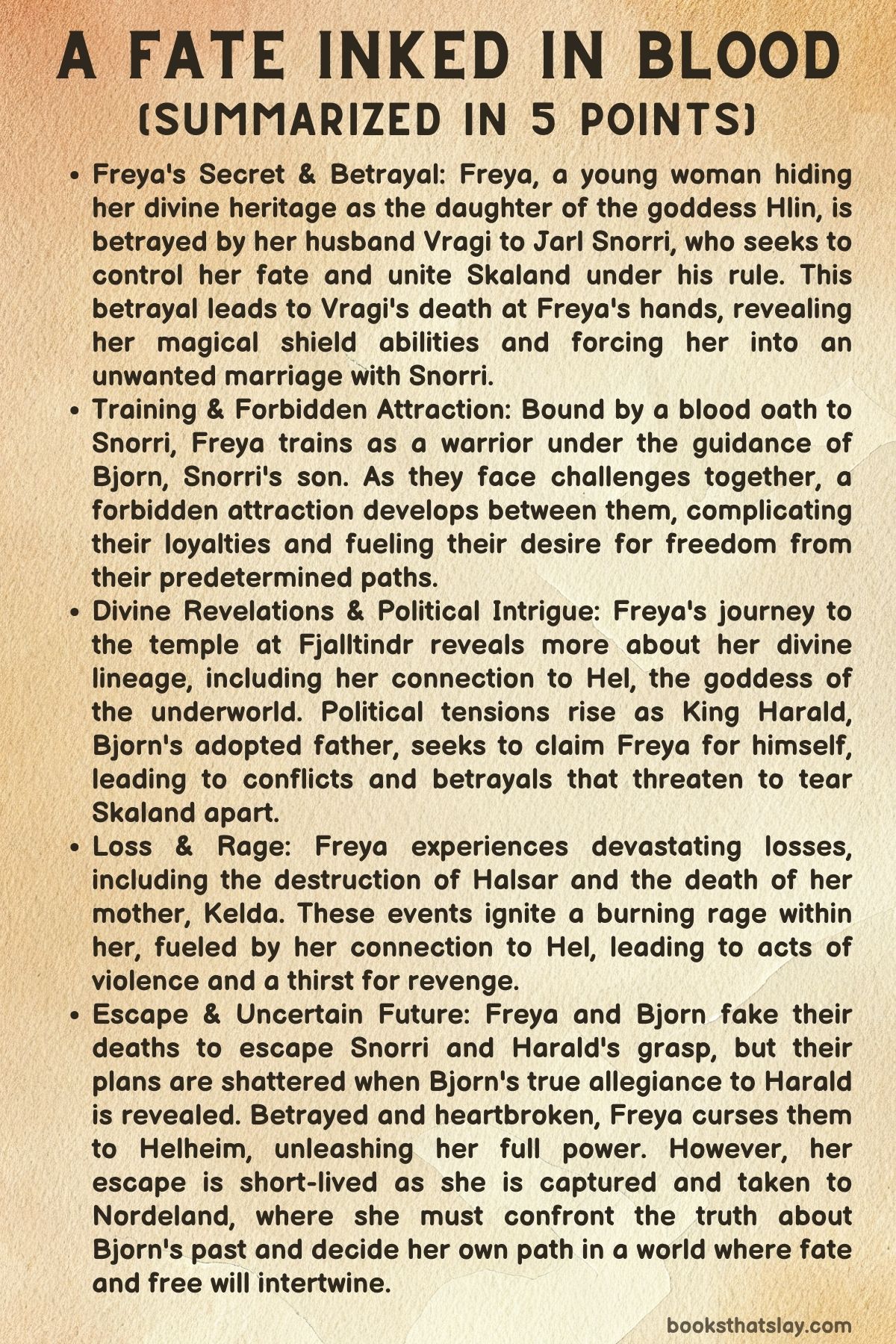
Summary
Freya is twenty years old and lives in the fishing village of Selvegr, where she has spent years enduring a brutal marriage to Vragi. Though he was once praised for using his god-given power over the sea to save the village from famine, he has become cruel and selfish, using his gift for control and profit while treating Freya as property.
She stays because her family depends on the status and wealth that came through this marriage. Her mother benefits from the household security, and her brother Geir has a place among the local jarl’s warriors.
Yet Freya hides an important truth: she possesses divine power of her own, and she has kept it secret since childhood because her father feared powerful men would destroy her life if they learned what she was.
That fear becomes reality when Jarl Snorri arrives in Selvegr. With him is his son, Bjorn, a striking warrior gifted with the fire of Tyr.
Freya first meets Bjorn under playful circumstances and feels an immediate pull toward him, but that moment quickly gives way to disaster. Snorri forces Freya into a deadly test against Bjorn, and in order to survive, she reveals the protection magic she has long hidden.
Her secret confirms that she is the shield maiden of prophecy, a woman foretold to unite Skaland under the rule of the one who controls her fate. Vragi had already sold this knowledge to Snorri, hoping to profit from it.
Snorri wastes no time in claiming her. He announces that Freya will become his wife, believing marriage will let him direct her destiny and rise as king.
Freya agrees only after making sure Geir’s future is protected, but the bargain is poisoned from the start. Snorri punishes Geir anyway and shows Freya that her family will remain hostages to her obedience.
When Vragi threatens yet another ruinous act, Freya kills him with Bjorn’s fire axe in a burst of anger and relief, leaving behind the life that had already become a prison.
At Snorri’s stronghold of Halsar, Freya recovers from the burns caused by touching the divine weapon. There she meets Ylva, Snorri’s first wife, and Liv, a healer with god-blood.
Freya also learns more fully what she has become. Her power comes from Hlin, and from the time she was a child she was marked for use by ambitious men.
Snorri insists on marrying her at once. The ceremony is cold and political, and during a ritual performed by Ylva, Freya undergoes a frightening vision in which her body is torn open and remade, leaving behind magical markings on her skin.
The event suggests that her future carries violence, sacrifice, and meanings that even Snorri does not fully understand. Bjorn is assigned to guard her because his fate appears linked to hers.
Freya quickly discovers that life in Halsar is ruled by fear, strategy, and prophecy. She is bound to Snorri by oath rather than consummation, a secret arrangement made because Ylva cannot bear to share her husband physically.
Even that compromise comes with threats. Ylva warns Freya that betrayal will bring suffering to everyone she loves.
Freya begins looking for ways to understand the prophecy on her own, but before she can act, Halsar comes under attack from a rival jarl seeking to seize or kill her. Snorri orders her to hide, treating her as an asset rather than a person.
Freya refuses to remain useless. She escapes, joins Bjorn in a dangerous plan, and helps burn the enemy ships, turning the battle.
This is her first real act as a fighter rather than a pawn.
Afterward, Snorri decides Freya must be trained. Bjorn becomes both her protector and instructor, and their closeness grows despite both of them resisting it.
Freya learns more of Bjorn’s difficult history, including his years as a captive in Nordeland and the death of his mother, Saga, who was also the seer behind the prophecy. She also meets Leif, Ylva’s son, and begins to see the tensions inside Snorri’s household: questions of inheritance, legitimacy, and divided loyalty.
News arrives that King Harald of Nordeland may be moving against them, and the danger surrounding Freya spreads beyond local politics into a wider struggle for power.
The journey to the sacred temple at Fjalltindr deepens the sense that Freya’s life is being directed by forces larger than any jarl. Along the way she sees a strange burning specter that no one else can perceive.
The figure warns her that sacrifice is required if her thread is not to be cut short. During the trip, Bjorn and Freya’s attraction becomes harder to deny, especially as he tends to her wounded hand and protects her during repeated attacks.
When they are forced to travel through the haunted Path to Helheim, their bond strengthens further. In the tunnels they fight draug, cursed undead guardians, and survive only by working together.
Freya shows courage, instinct, and power beyond what anyone expected, including a frightening ability to call on something dark and ancient when cornered.
At Fjalltindr, the gods appear to acknowledge her directly, naming her child of two bloods. That declaration unsettles everyone because it suggests Freya’s nature is even more unusual than they believed.
Snorri takes it as confirmation that he is meant for greatness, while Freya becomes more uncertain about what the gods want from her. She also starts suspecting betrayal within their ranks.
Half-heard conversations and runic signs lead her to believe Ylva may be working against Snorri, though the truth remains unclear. At the same time, a new ally appears in Jarl Bodil, a respected warrior who can sense truth.
Bodil supports Freya herself rather than Snorri’s ambition, and she encourages Freya to understand her role more clearly.
When Halsar is destroyed in their absence, the cost of Snorri’s choices becomes devastatingly real. Liv is dead, homes are gone, and grief turns quickly into a demand for revenge.
Snorri drives his people toward an attack on Gnut’s fortress at Grindill, seeing vengeance and conquest as the same thing. Bodil helps train Freya further and warns her about both Snorri’s ambition and her forbidden attachment to Bjorn.
Freya is already struggling with guilt, rage, and the unsettling truth that battle changes her. During the assault on Grindill, she fights with terrifying force, helped by Hlin’s shield magic but also driven by a savage fury that leaves others afraid of her.
Though the fortress falls and Snorri’s influence grows, Bodil dies, and Freya is left shaken by what she became in combat.
This internal conflict becomes central to the story. Freya wants to protect people, yet each victory seems to move her closer to becoming the violent figure prophecy may require.
Bjorn sees this and begs her to choose another path, even suggesting that they flee together. Freya cannot accept that while her family remains vulnerable.
Hoping for clarity, she visits her mother and learns the truth of her birth. Hlin did not simply bless her; Freya was conceived under an extraordinary bargain involving divine intervention, a lost child, and a promise that if she chose selflessness over greed, her future need not follow the darkest path laid before her.
This revelation gives Freya hope that fate may still be changed, but it also exposes the painful selfishness of her mother and brother, both of whom have long relied on her suffering for their own security.
Her mother is killed soon after, and grief pushes Freya toward rash accusation. She returns convinced Ylva has betrayed them, but before that conflict can be resolved, Harald’s forces arrive outside Grindill.
Snorri’s cruelty, Bjorn’s divided loyalties, and Freya’s oath all collide in the middle of a siege. Harald offers peace if Freya surrenders.
Civilians begin dying when she refuses, and she decides that as long as she lives, powerful men will keep killing to possess her. In despair, she tries to end her life by throwing herself from the fortress, but Bjorn stops her and escapes with her over the falls.
For a brief time, they are alone together and free of everyone else’s demands. In hiding, Bjorn tells her more about his childhood, and they finally admit their love.
They imagine a quieter future far from war, but the possibility does not last. Harald finds them, and Freya learns the devastating truth: Bjorn has been tied to Nordeland all along.
Her anger unleashes a terrible power that confirms the gods’ earlier words. She is not only Hlin’s child but also tied to Hel, with the ability to send others to death itself.
That revelation explains both the scale of her gift and the fear she inspires.
Freya is captured and taken aboard a ship bound for Nordeland. There, Bjorn finally explains everything he concealed.
His mother, Saga, is alive. Snorri, not Harald, was responsible for the attempt on her life, and many of Bjorn’s choices were made to protect his true family and prevent Freya from being murdered before she had a chance to claim her own future.
Hurt and furious but no longer willing to be ruled by half-truths, Freya resolves to go to Nordeland, seek answers from Saga, and begin shaping her fate for herself. The novel ends with her life torn apart but her purpose sharper than ever: she will no longer be only a weapon, a wife, or a prophecy.
Characters
Freya
Freya is the emotional and moral center of the story, and her character is shaped by the tension between power and personhood. At the start, she is a woman forced into survival mode, trapped in an abusive marriage and accustomed to making herself smaller so that others can live more comfortably through her sacrifice.
What makes her compelling is that her strength exists long before the world recognizes her as extraordinary. Even before her divine identity is exposed, she already has endurance, intelligence, and a fierce instinct to protect.
Once her hidden power comes to light, the conflict of her life changes form but not substance: she is still being used, only now on a much larger scale. Men who once would have controlled her within a household now seek to control her as a weapon, symbol, and path to a throne.
Her inner conflict is the most important part of her characterization. Freya wants to be good, useful, and loyal, yet the role forced upon her repeatedly rewards violence.
She is not written as someone who enjoys cruelty for its own sake, which is why her battle fury unsettles her so deeply. In war, she becomes capable of terrible destruction, and afterward she is horrified by what she has done and what others now see in her.
This split between the self she wishes to be and the self that emerges in bloodshed gives her arc real psychological weight. She is not only fighting enemies outside herself; she is trying to determine whether power inevitably corrupts her or whether she can still choose who she becomes.
Freya’s relationships reveal different parts of her personality. With her family, she is dutiful to the point of self-erasure, and only gradually does she understand how deeply they have relied on her willingness to suffer.
With Bjorn, she experiences desire, tenderness, and the possibility of being seen as a person rather than a prize. With Snorri and Ylva, she learns how power structures work and how easily affection, obligation, and coercion can be braided together.
Her growth comes from beginning to question these systems instead of merely enduring them. By the end, she is no longer simply reacting to the demands placed upon her.
She is beginning to claim the right to define herself, even if she does not yet know what that self will fully look like.
Another important aspect of Freya is that she embodies the story’s argument about fate. She is prophesied, desired, feared, and manipulated because others believe her destiny can be used for their own ambitions.
Yet her deepest struggle is over whether fate is fixed at all. The revelation of her dual divine heritage intensifies this struggle, because it suggests that her capacity for both protection and destruction is built into her nature.
Even then, the novel does not reduce her to destiny. Instead, it presents her as someone standing at the edge of several possible selves, trying to decide whether sacrifice, love, rage, and power will shape her into a savior, a destroyer, or something more difficult and human than either.
Bjorn
Bjorn is written as both a romantic lead and a deeply conflicted political figure. On the surface, he enters the story with ease, charm, confidence, and physical magnetism.
He is the kind of man who appears dangerous but controlled, capable of violence yet often using humor to soften his presence. That early impression matters because it makes the later revelations about his divided loyalties more painful.
He is not a simple hero in waiting. He is a man shaped by abduction, divided parentage, political manipulation, and long years of living between identities.
His outward confidence hides a life built on fracture.
His emotional role in the story is to offer Freya a contrast to those who seek to own her. He trains her, protects her, argues with her, and often challenges the stories being told about her.
Unlike Snorri, he does not want her power only for what it can achieve. Unlike her family, he does not ask her to keep suffering for their benefit.
He sees the cost of the path she is being pushed onto and wants her to choose a life outside prophecy and conquest. That desire makes him feel, for much of the novel, like the clearest expression of freedom available to her.
At the same time, he is never entirely free himself, which gives his love a tragic dimension. He wants to rescue Freya from a fate he cannot wholly escape in his own life.
Bjorn’s greatest complexity comes from his divided loyalties. He has reasons to hate Snorri, to distrust the stories told about his past, and to feel bound to Nordeland in ways Freya does not understand until late in the story.
His secrecy is frustrating, but it is not empty deception. It grows from fear, unresolved grief, and years of living within survival bargains.
He lies, withholds, and maneuvers, but not because he lacks feeling. Rather, he is someone who has learned that truth can be dangerous and that love does not erase political reality.
This makes him more than a conventional love interest. He is both protector and betrayer, honest in feeling but dishonest in action, and that contradiction gives his character force.
His connection to Freya also reveals the novel’s interest in mirrored identities. Both are children marked by divine blood, both are used by older powers, and both are burdened by the ambitions of parents and rulers.
Yet where Freya initially believes duty means staying, Bjorn increasingly believes survival and moral clarity may require leaving. He becomes the voice urging her to choose herself, but he also undercuts that role by concealing crucial truths.
The result is a character who is sympathetic but not fully trustworthy, loving but compromised. By the end, he remains emotionally convincing because his failures come from the same place as his virtues: his desperation to protect the few people he loves in a world where loyalty is always dangerous.
Snorri
Snorri is the clearest representation of ambition hardened into entitlement. He is not merely a ruthless ruler; he is a man who has convinced himself that desire, prophecy, and destiny justify possession.
He sees Freya not as a full person but as the means through which his future greatness will be made real. That belief shapes nearly every action he takes.
He can be strategic, persuasive, and even outwardly reasonable, but beneath those qualities lies a worldview in which people exist according to their usefulness to his plans. This makes him more chilling than a figure driven only by temper.
He is calculating enough to present coercion as necessity and cruelty as political realism.
What makes him an effective antagonist is that he is not always irrational. He understands power, warfare, and symbolism.
He knows how prophecy can motivate followers and how fear can keep them obedient. He also knows how to dress selfish ambition in the language of duty to the realm.
That gives him the ability to attract loyalty even when his decisions are devastating. He can sound like a leader thinking of the future of his people, yet again and again he chooses advancement over compassion.
He sacrifices homes, safety, and personal dignity in pursuit of a crown he believes he deserves. His flaw is not blindness in the ordinary sense.
He sees the cost; he simply believes the cost is acceptable.
Snorri’s relationships reveal his limitations as a man as well as a ruler. He cannot truly understand Freya because he cannot imagine a person rejecting power if it is available.
He cannot fully command Bjorn because love, resentment, and history weaken the obedience he expects. His marriage to Ylva is politically functional but emotionally corrosive, and even within his own household he produces rivalry, distrust, and fear.
He inspires loyalty from some, but not devotion rooted in love. That distinction matters.
He can rule bodies more easily than hearts, and his need to dominate Freya’s fate is part of his broader inability to accept that other people possess inward lives he cannot script.
As the story progresses, Snorri becomes more dangerous because his ambition is increasingly validated by apparent signs from prophecy and divine favor. Every victory deepens his certainty that he is destined for greatness.
This makes him less flexible and more willing to push others beyond endurance. In that sense, he is a study in how belief in one’s special destiny can become morally ruinous.
He does not see himself as a villain. He sees himself as the man history requires, which allows him to excuse nearly anything.
That self-justification is what makes him so threatening.
Ylva
Ylva is one of the most layered characters because she initially appears to fit a familiar role: the jealous first wife guarding her place against a younger rival. Yet as the story continues, she becomes far more complicated.
She is possessive, proud, and often cruel in speech, but she is also intelligent, politically alert, and more morally aware than Freya first assumes. Her use of runic magic gives her an aura of ritual authority, and she understands better than most people around her that prophecy is not only power but danger.
She recognizes that Freya’s arrival does not simply threaten her marriage. It threatens the entire structure of the world she inhabits.
Her hostility toward Freya is real, but it is not simple pettiness. Ylva has built her identity around her role beside Snorri, and Freya’s arrival exposes how fragile that role actually is.
She must help bind the younger woman into Snorri’s orbit while also knowing that this same act diminishes her own standing. That creates a mixture of resentment, pain, and pragmatism.
She can be threatening and manipulative, especially when she uses family harm as leverage, but she is also operating within a system that gives women limited avenues for control. Her sharpness becomes, in part, a survival strategy.
Over time, Ylva gains depth because she proves capable of seeing what Snorri will not. She recognizes the danger in unleashing fear as a political instrument, and she is more sensitive than he is to the moral cost of turning Freya into a symbol of terror.
She also understands the emotional fractures within the household, particularly where Bjorn and Leif are concerned. Her wish for Leif to inherit is not only ambition for her own son.
It comes from her belief that Bjorn’s history has made him an uncertain fit for the future she imagines. This does not make her impartial, but it does make her reasoning more substantial than jealousy alone.
Ylva is especially effective as a character because she repeatedly unsettles first impressions. Freya suspects her, resents her, fears her, and at times misreads her.
Yet Ylva is neither a hidden villain nor a secret saint. She is a woman shaped by love, status anxiety, bitterness, ritual power, and political intelligence.
She has participated in harmful systems, but she is also trapped within them. Her eventual movement toward becoming more of an ally than an enemy feels earned because it grows from shared values and shared disillusionment, not sudden softness.
She remains severe, but she becomes more understandable.
Geir
Geir is important because he embodies the painful limits of familial loyalty. Early on, he appears to be one of the people Freya can trust most.
Their bond is warm, familiar, and rooted in a shared past. He represents the life she might have had if things had been simpler, and his closeness to Ingrid gives Freya something hopeful to hold onto.
However, as the story develops, Geir becomes one of the clearest examples of how dependence can become moral failure. He loves Freya, but not enough to refuse the benefits that come from her suffering.
His character is not written as purely malicious. That is what makes him frustratingly believable.
He accepts compromises, rationalizes them, and gradually comes to see Freya’s burdens as the price of maintaining security and status for the family. In his mind, he is being practical.
He thinks in terms of what must be endured and what can be gained. This makes him a sharply drawn example of ordinary selfishness, not grand villainy.
He does not orchestrate Freya’s exploitation, but he benefits from it and becomes defensive when she finally names that truth.
Geir’s blindness to his sister’s pain reveals the gendered expectations embedded in the world around them. He has the freedom to become a warrior, to build a future, and to imagine honor for himself.
Freya, meanwhile, is expected to endure marriage, sacrifice, and political use. Because Geir has normalized that imbalance, he struggles to understand why her anger becomes so fierce.
He sees her new status and power and mistakes them for privilege, refusing to grasp the violence and coercion beneath them. Their later conflict is effective because it forces the story to confront the difference between affection and moral courage.
Geir may care for Freya, but he repeatedly fails to stand with her in the ways that matter most.
At the same time, Geir remains emotionally significant because Freya cannot stop loving him completely. Her instinct to protect him persists even after he disappoints her.
That lingering attachment adds realism to their dynamic. Family bonds do not disappear simply because truth has been spoken.
His role in the narrative is to test how far Freya’s self-sacrificing nature extends and whether she can ever truly free herself from the people who taught her that love means endurance without reciprocity.
Ingrid
Ingrid begins as a figure associated with friendship, normalcy, and the life Freya might have wanted. Her presence connects Freya to a world outside court ambition, prophecy, and war.
She is tied to Geir, to home, and to the hopes Freya still carries for the people she loves. Even though she is not one of the most dominant personalities in the story, she matters because she reflects Freya’s longing for ordinary happiness and mutual care.
When Ingrid and Geir move toward marriage, it initially feels like proof that some decent future is still possible for those around Freya.
What is notable about Ingrid is how often she is placed in the role of stakes rather than agency. She becomes part of the emotional and political leverage surrounding Freya, which mirrors the broader way women’s lives are often handled in the story’s world.
Yet she is not reduced entirely to passivity. Her gestures toward Freya show concern, loyalty, and practical feeling.
She is one of the few reminders of tenderness from Freya’s earlier life. That gives her a quiet significance even when she is not driving events directly.
Ingrid’s importance grows through what she represents to others. To Geir, she is part of the future he wants.
To Freya, she is proof that her sacrifices have at least secured joy for someone she cares about. To Snorri and the political order around him, she becomes another vulnerable point through which Freya can be controlled.
This layered function gives Ingrid emotional relevance beyond page time. She helps illuminate the web of obligation tightening around Freya and reinforces how personal relationships are constantly being repurposed into instruments of power.
Kelda
Kelda is one of the most painful characters because she is both victim and participant in her daughter’s suffering. She has lived within a harsh world that limits women’s choices, and there is room to understand her fear, dependency, and desire for survival.
However, the story does not allow those realities to erase the harm she causes. She accepts the comfort purchased by Freya’s misery, first through marriage and then through political captivity.
For much of the narrative, Freya’s devotion to her mother is built on the assumption that maternal need is sacred. The slow collapse of that belief becomes one of the book’s most emotionally important reckonings.
Kelda’s revelation about Freya’s conception and divine connection adds mythic weight to her character, but it also sharpens the moral question around her. She knows that Freya’s life has always carried unusual danger, yet she still permits choices that expose her daughter to control and abuse.
Her motivations seem tied to fear, survival, and a habit of prioritizing immediate security over deeper care. In that sense, she is not monstrous in a theatrical way.
She is tragically ordinary in how she compromises, excuses, and clings.
What makes Kelda memorable is that Freya’s eventual anger toward her feels like a breaking of inherited emotional law. Freya has been raised to protect, obey, and absorb blame.
Speaking the truth about her mother’s failures is therefore a major act of self-assertion. Kelda’s inability to respond with generosity in that moment shows how thoroughly she has come to depend on Freya’s silence.
Her final apology introduces a note of regret, but it does not erase the damage. She remains a deeply human portrait of parental weakness: loving in some way, perhaps, but not brave enough to love well.
Leif
Leif serves as a contrast character within Snorri’s household. He is younger, more straightforward, and less burdened by the divided history that defines Bjorn.
His presence sharpens questions of inheritance, legitimacy, and maternal ambition. Though he is not as psychologically developed as some of the others, he matters because he exists at the center of tensions he did not create.
Ylva wants a future for him, Snorri must balance him against Bjorn, and Freya enters a household where his place has already become politically charged.
Leif appears to genuinely care for Bjorn, which is important because it keeps the family structure from becoming too simple. There is affection between the half-brothers even while the adults around them invest meaning in their differences.
Leif therefore represents the possibility that personal feeling can survive even inside competitive dynastic systems. At the same time, he is still part of the machinery that traps Freya, because his value to Ylva and Snorri influences the choices made around succession and alliance.
His relative youth also makes him a reminder of the future these older, more damaged characters are trying to shape. He is not yet fully hardened into the forms of ambition, grief, or divided loyalty that define others.
That gives him a quieter presence, but not an unimportant one. He helps expose the emotional cost of political households where children are never simply children.
Bodil
Bodil enters the story with immediate authority. As a female jarl and a warrior able to read truth from lies, she commands respect in a way few characters do.
Her significance lies not only in her power but in her clarity. Unlike many around Freya, Bodil does not approach her primarily as an instrument for someone else’s ambition.
She recognizes her as a person carrying enormous symbolic weight, and she treats that fact with seriousness rather than opportunism. This alone makes her presence stabilizing.
Bodil’s role in Freya’s development is crucial because she offers a model of strength not based on possession or manipulation. She trains her, encourages her judgment, and invites her to think politically without surrendering her sense of self.
She sees both Freya’s potential and her dangers. Importantly, Bodil does not romanticize battle.
Her support for Freya includes warning her about consequences, particularly where Bjorn is concerned. She functions almost as a mentor figure, though the relationship is cut short.
Her death matters because it removes one of the few figures who combine power with integrity. For Freya, this loss is personal and symbolic.
It fuels the destructive rage that later horrifies her, and it reinforces the bleak reality that wise guidance is fragile in a world ruled by ambition. Bodil’s impact outlasts her presence because she represents a form of leadership Freya might one day learn to embody: strong, perceptive, and not governed by the hunger to dominate.
Steinunn
Steinunn is a fascinating supporting character because she stands at the intersection of art, memory, and power. As a skald whose songs can make listeners feel events from within, she does far more than entertain.
She shapes reputation, emotional truth, and public meaning. Through her, the story explores how legends are built and how frightening it can be to be turned into one while still alive.
Freya often feels exposed by Steinunn’s work because the songs do not merely praise; they interpret, reveal, and preserve.
What makes Steinunn effective is her ambiguity. She can seem intrusive, opportunistic, or unnervingly perceptive.
Bjorn especially distrusts what her gift does to privacy and inner life. Yet Steinunn is not presented as simply exploitative.
She is recording history as it is being made, and in a world driven by prophecy and renown, that act carries real power. She helps show that stories do not merely follow events; they influence how those events are understood and what future actions they make possible.
Her eventual revelation of hidden loyalties adds another layer to her character. She is one of several figures who prove that identity in this narrative is unstable and often concealed.
That hidden self complicates everything that came before and reinforces a central theme: the people closest to great events are often performing roles, masking origins, or serving purposes not immediately visible. Steinunn’s presence reminds the reader that narration itself is never innocent.
Liv
Liv provides one of the novel’s gentler moral presences. As a healer, she stands in contrast to the warriors, strategists, and rulers who dominate the action.
Her gifts are restorative rather than destructive, and her interactions with Freya often carry warmth, honesty, and practical care. In a story so filled with manipulation, Liv’s concern feels direct and humane.
She offers treatment without trying to own, define, or exploit Freya.
Her importance is also thematic. Liv represents what divine power can look like when used in service of repair rather than conquest.
This matters because Freya’s own abilities increasingly become associated with battle, fear, and death. Liv’s presence quietly broadens the moral landscape by showing that god-blood does not inevitably produce domination or spectacle.
It can also mean service, healing, and community.
That is why her death lands with particular force. It is not only the loss of a likable character.
It is the destruction of one of the few figures who embodied care without ulterior motive. Her absence deepens the sense that the world Freya is entering consumes exactly the kinds of people it needs most.
Vragi
Vragi functions as the story’s opening embodiment of domestic tyranny. He is cruel, entitled, and revels in his power over others, whether through his god-given control of the sea or his control over Freya’s body and daily life.
He is not especially complicated, but that simplicity is purposeful. He establishes the intimate scale of oppression before the novel expands it into political and prophetic terms.
Through him, the reader first understands what it means for Freya to live as property.
His role also matters because he shows that power does not need a throne to become abusive. Long before Snorri claims Freya as part of a kingdom-sized ambition, Vragi has already turned marriage into captivity.
The move from husband to jarl is therefore not a total transformation of Freya’s circumstances but an escalation. The forms of control change, yet the underlying logic remains the same.
Freya’s killing of Vragi is a turning point not only in plot but in character. It is an act of anger, justice, and moral complication.
She is relieved, but she also cannot easily justify it to herself afterward. This lingering guilt is important because it prevents the act from being framed as clean liberation.
Vragi’s death frees her from one prison while thrusting her into another, and his shadow persists through the guilt she carries.
Harald
Harald initially appears as a distant threat, the great external enemy against whom Snorri defines his ambitions. As the story unfolds, however, he becomes more interesting because he is not identical to the monstrous image built around him.
He is certainly dangerous, ruthless, and politically predatory, but he also exists inside a web of truths distorted by Snorri’s narrative. His importance lies in forcing both Freya and the reader to question the stories that powerful men tell to justify war.
Harald’s connection to Bjorn is especially significant. He becomes part of the alternate paternal structure in Bjorn’s life, a figure associated with protection as well as threat.
This complicates the simple enemy image and makes him a more unsettling character. He is capable of violence and manipulation, yet he is also bound up with hidden truths that undermine Snorri’s moral authority.
By the time Harald stands directly before Freya, he represents a different form of power struggle. If Snorri wishes to possess her through prophecy and marriage, Harald seeks control through capture and political leverage.
He is not a liberator. He is another ruler who sees her value.
Yet his role is important because he exposes how thoroughly Freya has been trapped inside competing male claims. Through him, the story widens beyond one household and makes clear that her struggle is not only against a single man but against an entire order built around possession.
Tora
Tora is a smaller but sharp-edged character whose presence amplifies the threat posed by Harald’s side. As a child of Thor with command over lightning, she functions as a martial counterpart to Freya and Bjorn, another reminder that divine blood can make war even more terrifying.
Her abilities create some of the most dangerous battlefield moments and reinforce the idea that these conflicts are not simply human contests but struggles shaped by supernatural force.
She is also effective because she is uncompromising. There is little softness or ambiguity in her function during the siege, where her violence against civilians reveals the brutality of the world Freya is trapped inside.
Tora helps strip away any illusions that surrendering oneself to one side or another would bring moral resolution. The systems around Freya remain cruel no matter who is winning.
Skade
Skade appears briefly, but her role is memorable because she acts with shocking decisiveness. She kills Kelda and in doing so closes off the possibility of easier reconciliation between mother and daughter.
That act turns simmering emotional damage into irreversible loss. Skade therefore serves as an instrument of harsh narrative truth: some reckonings come too late, and apology does not always arrive in time to repair what has been broken.
She also reinforces the harsh codes of the world around Freya. Her judgment of Kelda is merciless, and in carrying it out she embodies the story’s atmosphere of hard consequences and violent moral verdicts.
Even with limited page presence, she leaves a mark because her action reshapes Freya’s emotional state and accelerates the turn toward vengeance.
Saga
Saga is one of the most powerful absent presences in the novel. For much of the story, she exists through memory, prophecy, and rumor.
As Bjorn’s mother and the seer connected to the central prophecy, she hovers over events like a buried truth waiting to surface. Her importance comes from the fact that others build political futures out of her words while often misunderstanding or misusing them.
She is both origin point and missing witness.
Saga’s eventual survival transforms her from memory into future consequence. She becomes the keeper of truths that can reframe Freya’s entire understanding of Bjorn, Snorri, and the prophecy itself.
Even before she fully reenters the story, her presence suggests an alternative history beneath the official one. She represents knowledge withheld, maternal influence that does not vanish, and the possibility that the story told about fate has never been complete.
Ragnhild
Ragnhild appears only briefly, yet she leaves an impression because her condition reveals the cruelty of political control in extreme form. Once gifted with the ability to speak mind-to-mind through her tokens, she has been mutilated so that her power serves another’s purposes.
Her severed tongue is both literal and symbolic, showing how rulers weaponize the bodies of the gifted. She is a grim example of what can happen to those with divine abilities when they fall under the control of fear-driven authority.
Her death at Bjorn’s hands is brutal but pragmatic, and that moment captures the novel’s recurring moral harshness. Compassion is often swallowed by strategic necessity.
Ragnhild’s short presence widens the world and warns what Freya herself might become in the hands of men who value power more than personhood.
Hlin and Hel
Though they are divine rather than mortal characters, Hlin and Hel are essential to understanding Freya because they represent the two poles within her identity. Hlin is associated with protection, duty, and shield-born endurance.
Through that inheritance, Freya sees herself as someone meant to guard others, absorb harm, and stand between danger and the vulnerable. This part of her identity feeds her altruism but also her self-denial.
It is the side of her that keeps sacrificing, keeps enduring, and keeps believing that if she gives enough of herself, others may be safe.
Hel introduces a far darker dimension. Through this bloodline, Freya possesses the ability to bring death in a way that exceeds ordinary warfare.
Hel is not just destruction in the abstract. She is the truth that death lives inside Freya’s nature alongside protection.
This revelation does not cancel Hlin; it complicates her. Freya is not divided between good and evil in a simple sense.
She carries within herself both shelter and annihilation, mercy and curse. The tension between these inheritances is really the tension of her character as a whole.
Together, these divine mothers deepen the novel’s central question. If Freya contains both the urge to protect and the power to destroy, what determines which self becomes dominant?
Blood, prophecy, and magic matter, but the story keeps returning to choice. That is why these divine presences are so important.
They are not merely lore. They are the mythic expression of Freya’s deepest struggle over who she is allowed to become.
Themes
Fate, Prophecy, and the Fight for Self-Determination
From the moment Freya’s hidden identity is exposed, her life is no longer treated as her own. Prophecy transforms her from a woman with private fears, desires, and pain into an object of public ambition.
This is what gives fate such force as a theme in A Fate Inked in Blood. The prophecy does not simply predict an outcome; it becomes a political weapon.
Snorri believes that if he can control Freya, he can control the future itself, and this belief shapes marriages, alliances, raids, and acts of coercion. The idea of fate therefore becomes inseparable from power.
The future is not something characters wait to receive. It is something they try to seize, interpret, bend, and weaponize.
What makes this theme especially strong is that prophecy never brings clarity in a simple sense. Instead, it creates confusion, fear, and competing claims.
Different people hear the same foretold future and come away with different conclusions. Snorri hears confirmation of his greatness.
Bjorn hears a warning of slaughter. Freya hears a threat to her freedom but also a question she cannot escape: whether a foretold path must be followed at all.
The story repeatedly returns to the tension between what is spoken in prophecy and what is still unwritten in choice. Freya is told that her destiny carries death and unification, but she is also told that fate may yet be altered if she chooses altruism over avarice.
This keeps the theme from becoming fatalistic. The future may be marked, but it is not entirely sealed.
The emotional force of this theme comes from the fact that Freya’s struggle is not abstract. The question of fate governs her body, her relationships, and her ability to move through the world safely.
Every major authority figure tries to define what her destiny means, and each interpretation comes with demands on her behavior. That is why self-determination becomes such an urgent counterforce.
Freya’s journey is not only about discovering what she is; it is about resisting the idea that everyone else gets to decide what that identity requires. By the end, the theme develops into something larger than personal freedom.
It becomes a confrontation between inherited story and chosen selfhood. The novel suggests that destiny has power, but it also insists that submission to destiny is not the same thing as understanding it.
Freya’s deepest struggle lies in claiming the right to shape meaning out of prophecy rather than merely being consumed by it.
Power, Possession, and the Objectification of Women
Control defines nearly every stage of Freya’s life, first in private and then in public, and this gives the novel one of its most persistent themes: the treatment of women as possessions within systems built by male power. Before prophecy enters the foreground, Freya is already living under ownership in her marriage to Vragi.
Her body, labor, and future are all expected to serve his interests. When she leaves that marriage, she does not step into freedom.
She is transferred into a wider structure of possession under Snorri, whose ambition is grander but whose logic is disturbingly similar. He does not see Freya as a person with an independent destiny.
He sees her as an instrument through which he can legitimize his own rise. This continuity matters because it shows that the scale of domination changes, but the underlying attitude remains the same.
The theme becomes even more effective because the novel shows how possession is often disguised as duty, protection, or necessity. Snorri tells himself that his actions are required by prophecy and by the future of Skaland.
Geir accepts Freya’s suffering because it benefits the family. Even Bjorn, who loves her and often tries to protect her, withholds truths and makes choices for her in the name of keeping her safe.
The story is careful to show that possession is not always loud or openly cruel. Sometimes it appears in the softer language of obligation and care, which makes it more difficult for Freya to resist.
This is one reason her struggle is so painful. She must learn to identify domination even when it comes wrapped in loyalty or love.
The women around Freya also reveal how this theme works across different positions of power. Ylva has status and magical authority, but her life is still shaped by the terms of Snorri’s rule and the insecurity of being displaced.
Ingrid becomes part of the emotional leverage used against Freya. Kelda survives partly by accepting her daughter’s exploitation.
These different examples show that the problem is larger than any one abusive man. It is an entire social order in which women are bartered, bound, judged, and used as pathways to male ambition.
Even extraordinary women are not exempt from this structure.
What gives the theme depth is that Freya’s resistance is not immediate or simple. She has been taught to understand sacrifice as love, endurance as duty, and obedience as protection.
Her growth depends on recognizing that being needed is not the same as being valued. The novel keeps returning to that painful distinction.
By forcing Freya to confront how often others benefit from her suffering, the story turns possession into more than a personal grievance. It becomes the central political and emotional problem she must overcome if she is ever to become fully her own person.
Love, Loyalty, and Betrayal
Affection in this story is never cleanly separated from danger, and that is what makes loyalty such a powerful theme. Freya moves through a world in which nearly every bond carries competing obligations.
Family should mean safety, yet her family repeatedly becomes the reason she remains trapped. Romance should offer refuge, yet her love for Bjorn is bound to secrecy, divided allegiance, and devastating concealment.
Political loyalty should provide order, yet rulers treat allegiance as something to be bought, threatened, or extracted through fear. The novel presents love and loyalty as emotionally necessary but morally unstable.
To care deeply for someone is to become vulnerable not only to loss but also to compromise.
The relationship between Freya and Bjorn gives this theme much of its emotional intensity. Their bond matters because it offers a glimpse of something freer and more mutual than most of what surrounds them.
Bjorn sees her strength, challenges her, desires her, and imagines a life beyond prophecy with her. That possibility gives their relationship tenderness and hope.
Yet the same bond is shadowed by concealment from the beginning. Bjorn cannot tell her everything about his history or his loyalties, and Freya cannot fully separate her feelings for him from the political danger of wanting the wrong man.
The result is a romance shaped not only by passion but by mistrust. Their love is convincing precisely because it is burdened.
It is never allowed to remain private or uncomplicated.
Family loyalty is treated with equal seriousness and perhaps even more bitterness. Freya endures enormous suffering because she believes protecting her mother and brother is her duty.
That instinct defines much of her moral self-understanding. Yet the story repeatedly shows that the people she sacrifices for do not offer equal courage in return.
Geir benefits from her pain while failing to grasp its cost. Kelda chooses security over her daughter’s well-being for years.
This does not make those bonds meaningless, but it exposes how loyalty can become a trap when it is one-sided. Freya’s eventual anger toward her family is therefore one of the novel’s most important emotional developments.
She must confront the possibility that devotion without reciprocity is not virtue but exploitation.
Betrayal hurts so deeply in the novel because it rarely comes from strangers alone. It comes from those whose approval, love, or honesty Freya has built her life around.
That recurring pattern gives the theme a tragic texture. The story does not suggest that loyalty is foolish, but it does question whether loyalty without truth can ever be sustaining.
By the end, Freya’s emotional world has been reshaped by the knowledge that love can coexist with deception and that care can be real even when trust has been broken. This leaves her in a difficult but compelling position: she cannot stop loving, but she can no longer afford innocence about what love may demand or conceal.
Violence, Rage, and the Fear of Becoming Monstrous
Battle in this novel is never treated as glorious in a simple sense. Even when victories matter strategically, violence leaves behind horror, grief, and moral damage.
This gives the story a strong theme centered on rage and the fear of what repeated bloodshed does to identity. Freya is not frightened only of enemies.
She is frightened of what awakens inside her when she fights. In moments of extreme danger and fury, she becomes capable of terrible acts, and afterward she is forced to reckon with the gap between her intentions and her actions.
She wants to protect, yet violence often pulls her beyond protection into destruction. That tension shapes some of the book’s most unsettling emotional moments.
What makes this theme especially effective is that rage is not treated as meaningless savagery. Freya’s anger often comes from understandable sources: abuse, humiliation, grief, betrayal, and the deaths of people she cares about.
The novel does not ask her to stop feeling anger. In many cases, anger is what helps her survive.
It gives her force in battle and allows her to reject passivity. Yet the story is equally clear that rage can become intoxicating.
Once she enters that state, she can lose sight of limits, proportion, and even her own purpose. This is why she begins to fear herself.
The problem is not merely that others see her as frightening. It is that she recognizes moments in which violence feels too easy, too consuming, too close to becoming a second self.
This fear becomes even more powerful when linked to divine inheritance. Freya’s nature contains both protection and death, and the revelation of her darker bloodline confirms that destruction is not external to her.
It is part of what she is capable of at the deepest level. The novel could have used this to flatten her into a chosen destroyer, but instead it uses that revelation to sharpen the moral struggle.
If the capacity for annihilation is truly inside her, then restraint, judgment, and self-knowledge matter even more. The danger is not just that others will use her as a weapon.
It is that she may begin to believe that being a weapon is all she is.
The theme also comments on the wider world of war and leadership. Snorri is willing to turn Freya’s fearsome reputation into a political asset.
Others interpret her violence as proof of destiny. In that sense, the story shows how societies can reward the very brutality that individuals find spiritually corrosive.
Freya’s horror after battle stands against the triumphalism of those who would celebrate what she becomes in war. This creates one of the novel’s most compelling questions: can someone survive repeated violence without losing the self that once wanted only to protect?
The book does not offer an easy answer, which is exactly why the theme remains so resonant.