A Flicker in the Dark Summary, Characters and Themes
A Flicker in the Dark by Stacy Willingham is a psychological thriller that explores the fragile boundaries between memory, trauma, and reality. The story follows Chloe Davis, a psychologist in Baton Rouge whose past is overshadowed by the horrifying truth that her father was once convicted as a serial killer who preyed on young girls in her hometown.
Two decades later, as Chloe is preparing for her wedding, teenage girls begin vanishing again under eerily similar circumstances. Haunted by her past and unsure whom she can trust, Chloe is forced to confront old wounds while unraveling a chilling mystery that suggests her family’s dark history is far from over.
Summary
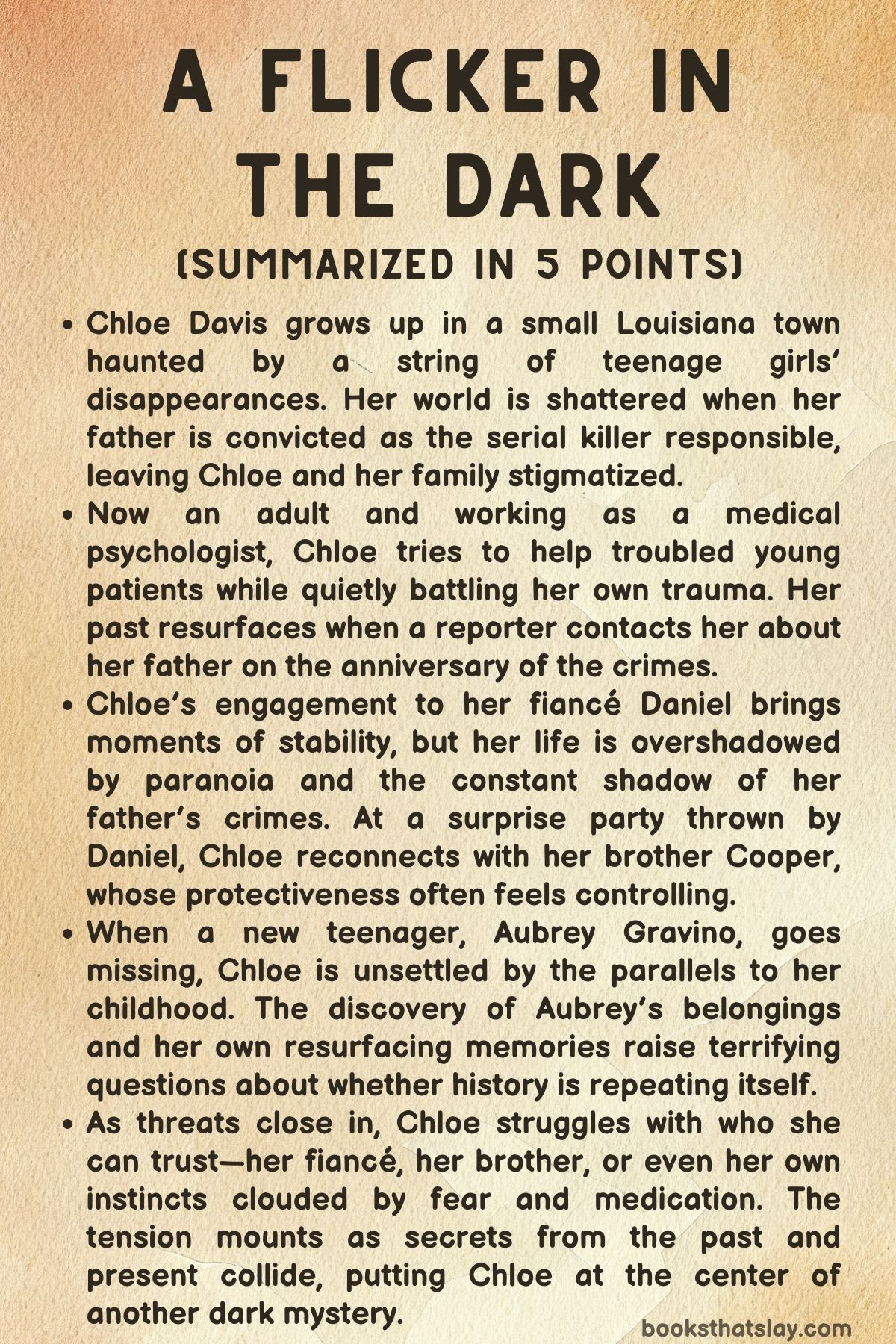
Chloe Davis grew up in a small Louisiana town where six girls went missing during the summer of 1999. At just twelve years old, Chloe’s life was torn apart when her father, Richard Davis, was arrested and later convicted as the Breaux Bridge serial killer.
For Chloe and her older brother Cooper, the arrest shattered their childhood and marked them forever as the children of a murderer. Their father’s last words to her, “Be good,” still haunt Chloe decades later.
Now in her early thirties, Chloe is a psychologist in Baton Rouge, working with teenagers and young adults who carry their own scars of trauma. Outwardly, she has built a normal life with her fiancé Daniel Briggs, but the past continues to weigh on her.
She relies on prescription pills and alcohol to manage her anxiety and memories. Her uneasy peace is disrupted when a reporter named Aaron Jansen contacts her about her father on the twentieth anniversary of the killings.
Chloe brushes him off, unwilling to revisit her past, but his call unsettles her deeply.
Soon after, Chloe learns of the disappearance of Aubrey Gravino, a fifteen-year-old girl from the area. The case rattles her because it mirrors the disappearances from her childhood.
Memories of the first victim, Lena Rhodes, flood back to her, along with the chaos of the summer her father was arrested. Chloe becomes consumed by the idea that someone is copying her father’s crimes.
Her suspicions grow when she stumbles upon Aubrey’s earring during a search effort at the cemetery, confirming for her that the killer is collecting jewelry as trophies, just as her father once did.
As she tries to piece things together, Chloe’s personal life grows strained. She argues with Daniel, who travels often and has unexplained absences.
She also clashes with Cooper, who has always been protective but critical of her choices, particularly her engagement to Daniel. Chloe begins to suspect that those closest to her may not be what they seem.
Her paranoia intensifies when she finds Aubrey’s missing necklace hidden in her own closet, leaving her terrified that Daniel may be involved. At the same time, her interactions with Bert Rhodes, the father of Lena, convince her that he may have reason and opportunity to continue the killings.
Detective Thomas listens to her suspicions but questions whether her reliance on medication is clouding her judgment.
The tension escalates when Riley, the stepdaughter of Chloe’s colleague Shannon, disappears. Following a hunch, Chloe searches her abandoned childhood home in Breaux Bridge and discovers Riley drugged but alive.
There she also encounters “Aaron Jansen,” who has been pretending to be a reporter. When Chloe notices that his badge is fake, she realizes he is actually Tyler Price, a troubled man from Breaux Bridge who has been manipulating her.
Tyler confesses indirectly to the recent crimes but insists he is not to blame. When he advances toward her, Chloe shoots him, ending the immediate threat.
At the police station, Detective Thomas reveals Tyler’s real identity and confirms he had drugs and jewelry from the victims in his possession. Riley survives, and for the first time Chloe feels relief that the nightmare may be over.
Yet her relief is short-lived when Daniel returns home and reveals secrets of his own. His troubled childhood under an abusive father drove him to secretly protect his younger sister Sophie by helping her disappear.
His connections to Chloe’s imprisoned father were part of his effort to uncover the truth about the recent crimes and, more importantly, about Cooper.
Chloe begins to piece together a horrifying possibility: Cooper, not her father, may have been responsible for the original Breaux Bridge murders. Evidence begins to align—Cooper’s knowledge of Tyler, his close presence during the recent crimes, and his lifelong role as her protector.
With Daniel’s help, Chloe sets a trap. She invites Cooper over and confronts him, gradually forcing him to admit the truth.
Cooper confesses that he killed Lena Rhodes and the other victims in their childhood, discovering power in the act. Their father took the blame to protect his son, explaining his final words to Chloe during the arrest.
Cooper had since manipulated Tyler to continue the pattern of killings, hoping to deflect suspicion from himself and frame Daniel.
Chloe doses Cooper with sedatives and signals Detective Thomas and Daniel, who were watching nearby, to arrest him. Finally, the truth is exposed: her father may have been guilty of many things, but he was not the killer of those six girls.
The weight of her family’s dark secret begins to lift, though the scars remain.
In the aftermath, Chloe visits Sophie in Mississippi, where she lives a quiet, safe life supported by Daniel. She reflects on the years of fear, guilt, and uncertainty that defined her, realizing she must now choose how to live beyond her past.
As her father is released after confessing he only took the blame to shield Cooper, Chloe finds herself at the threshold of an uncertain future. In a symbolic moment, she releases a firefly into the night, a gesture of letting go and moving forward.
Characters
Chloe Davis
Chloe is the emotional core of A Flicker in the Dark, a woman whose past and present are in constant collision. As a twelve-year-old, she endured the unimaginable trauma of learning her father was a serial killer, a revelation that defined her adolescence and adulthood.
In her professional life, she becomes a medical psychologist, attempting to heal others while struggling with the deep scars left by her own childhood. Her character is marked by contradictions—she is intelligent and empathetic, yet self-destructive, leaning on alcohol and prescription medication to numb the anxiety and fear that never fully leave her.
Chloe’s vulnerability often clashes with her determination to find the truth, creating a protagonist who is both fragile and resilient. Her relationships—with her fiancé Daniel, her brother Cooper, and her patients—reveal her desperate need for connection, trust, and stability, though her past continually undermines her ability to feel secure.
Daniel Briggs
Daniel at first appears to be Chloe’s anchor, a man who provides her with affection, stability, and the promise of a future unmarred by the past. His presence contrasts sharply with Chloe’s chaos; he is steady, supportive, and outwardly trustworthy.
Yet, as the narrative progresses, Daniel’s secrecy and unexplained absences cast a shadow over his character, making him both a figure of comfort and suspicion. His backstory, tied to his abusive father and the sister he rescued, adds layers of complexity to his motivations.
Ultimately, Daniel is not the villain Chloe fears he might be but rather another survivor of familial trauma, a man who has also been shaped by darkness and has chosen to channel it into protection and love rather than destruction. His relationship with Chloe reveals not only their shared pain but also their shared resilience.
Cooper Davis
Cooper is Chloe’s older brother, and his character arc carries the most devastating revelation in the novel. For much of the story, he is portrayed as protective, watchful, and suspicious of Daniel, reflecting his lifelong role as Chloe’s guardian in the wake of their father’s crimes.
Their sibling bond is both comforting and tense, with Chloe often resenting his interference but also depending on his unwavering presence. Cooper, however, embodies the very darkness Chloe has feared all her life.
The revelation that he, not their father, was the true killer of the Breaux Bridge girls reframes every memory and interaction, exposing a man who learned to mask his brutality under the guise of brotherly devotion. His duplicity—appearing as Chloe’s protector while being the source of her deepest trauma—makes him one of the most chilling characters in the story, a reminder that monstrosity can hide behind love.
Richard Davis
Richard, Chloe’s father, initially serves as the story’s central villain, convicted for crimes that shattered his family and community. To Chloe, he becomes the embodiment of betrayal, the figure who destroyed her childhood and condemned her to a life of stigma.
His arrest and plea deal left Chloe believing he was guilty beyond question. Yet the truth reveals a more complex and tragic figure: a father who discovered his son’s crimes and chose to take the fall to protect him.
Richard’s decision to shield Cooper, sacrificing his own freedom and reputation, complicates the reader’s perception of him. Though deeply flawed and complicit in a terrible lie, Richard’s final confession and apology reframe him not as a monster but as a man who made an unthinkable choice out of love and desperation.
Aaron Jansen / Tyler Price
Aaron Jansen enters the story as a reporter seemingly intent on dredging up the past, but the man Chloe interacts with is in fact Tyler Price, a troubled local masquerading as the journalist. Tyler’s character is a study in manipulation and deception.
By assuming a false identity, he embeds himself into Chloe’s fragile life, fueling her paranoia and fear while playing on her obsession with the murders. His role as a copycat killer and pawn of Cooper underscores his instability and susceptibility to influence.
Tyler is not as calculating as Cooper but is dangerous in his own recklessness, serving as the catalyst that propels Chloe into direct confrontation with her past. His tragic end at Chloe’s hands highlights the peril of his masquerade and the fragility of those drawn to violence.
Bert Rhodes
Bert Rhodes, the grieving father of Lena, the first girl to go missing, represents the lingering devastation left in the wake of violence. His life is defined by rage, grief, and bitterness, emotions that erupt when he confronts Chloe in her home.
His character is unsettling because he teeters between pitiable and menacing—his grief commands sympathy, yet his fixation on Chloe and his thinly veiled violence make him dangerous. Bert embodies the long shadow cast by tragedy, showing how trauma metastasizes into hatred and suspicion, perpetuating cycles of pain.
His presence in the narrative serves as a reminder that the victims’ families carry scars just as deep as Chloe’s, though theirs are marked by loss rather than betrayal.
Detective Thomas
Detective Thomas functions as both skeptic and eventual ally in Chloe’s journey. Initially dismissive of Chloe’s theories, chalking them up to her trauma and substance use, he represents the external doubt that constantly undermines her.
His reluctance to believe her parallels Chloe’s own difficulty in trusting herself, creating tension between them. Yet, when the truth unfolds, Thomas emerges as a stabilizing figure, validating Chloe’s instincts and helping to expose Cooper’s crimes.
His character provides balance to the narrative: a law enforcement officer hardened by experience but still capable of recognizing when he has misjudged someone. In the end, he offers Chloe the affirmation she has long sought—that she is not to blame for the horrors surrounding her.
Themes
Trauma and Its Lingering Presence
In A Flicker in the Dark, trauma is not portrayed as an event confined to the past but as a continuous force shaping identity, relationships, and choices. Chloe Davis, the daughter of a convicted serial killer, grows into adulthood under the shadow of her father’s crimes.
Her professional role as a psychologist reflects an attempt to regain control and to reframe pain into something constructive, but her work is also a mirror to her own unresolved wounds. The text emphasizes how trauma distorts perception—Chloe’s reliance on medication, her suspicion of those closest to her, and her inability to fully embrace safety all emerge from the catastrophic rupture in her childhood.
Even her physical environment reflects this presence; dark roads, broken routines, and unexpected silences trigger fear and paranoia that feel as real as physical threats. The narrative also demonstrates how trauma extends beyond the individual into family and community.
Cooper’s obsession with protection is rooted in shared suffering, while Breaux Bridge itself becomes a town defined by loss and suspicion. Trauma is not simply remembered; it becomes an organizing principle for how Chloe interprets the world, turning every relationship and decision into a negotiation with memory.
This theme underscores the idea that violence and grief leave residues that cannot be erased by time but instead continue to resurface in new forms, haunting survivors long after the original events have ended.
The Fragility of Trust
Trust in the novel is depicted as elusive, fragile, and often betrayed, which deepens the tension throughout the narrative. Chloe’s relationship with Daniel illustrates the dangerous ambiguity of intimacy.
While he is outwardly loving and supportive, Chloe’s discovery of suspicious behavior and hidden connections erodes her ability to believe in him fully. Trust is similarly strained with Cooper; despite their bond as siblings, Chloe oscillates between leaning on him as a protector and suspecting his motives.
Even external figures such as Aaron Jansen, who presents himself as a journalist, become symbols of betrayal when his true identity is revealed. The theme suggests that trust is both necessary and perilous, a human need that simultaneously exposes vulnerabilities.
The fragility of trust is also reflected in the community’s reaction to Chloe’s family, as her father’s crimes made them pariahs. No matter how far Chloe distances herself, she cannot fully escape suspicion.
By repeatedly undermining trust in relationships, the story demonstrates how fragile bonds can collapse under the weight of lies, secrecy, and past betrayals. For Chloe, the act of trusting becomes less about faith in others and more about survival, as she is forced to calculate who might harm her next.
The Burden of Inherited Identity
The novel places significant weight on the theme of inherited identity, especially through Chloe’s struggle to separate herself from her father’s legacy. Being the daughter of a serial killer imposes an identity that she never chose yet cannot fully reject.
This inherited stigma manifests in her professional and personal life, shaping how others perceive her and how she perceives herself. Her patients reflect aspects of her own childhood pain, reminding her that the past continues to define her, while the media seeks to exploit her family history for sensational stories.
The climax, when the truth of Cooper’s guilt surfaces, further complicates the theme, showing how identity is not only inherited but also distorted by secrets and misplaced loyalties. Their father’s decision to confess falsely to the crimes to protect Cooper becomes an act that cements Chloe’s sense of inherited burden—her entire life has been shaped by a lie designed to shield her brother.
This reveals how identity is both imposed externally by the community and constructed internally through the stories families tell or conceal. Chloe’s final act of confronting Cooper and acknowledging the truth represents her attempt to redefine herself, to release the weight of inheritance, and to claim an identity not dictated by the sins of her family.
Violence and Its Echoes Across Generations
Violence in A Flicker in the Dark is not confined to the individual acts of murder but reverberates across generations, shaping lives long after the crimes occur. Chloe’s father’s killings devastate the town and fracture her family, leaving psychological scars that influence the next generation’s behavior.
Daniel’s own backstory, with his abusive father and his decision to remove his sister from danger, further illustrates how cycles of violence force individuals into roles of both victim and savior. Cooper embodies the darkest form of this inheritance, as he becomes not only a victim of circumstance but the true perpetrator of the original crimes.
His killings are depicted as acts of power and control, but they also reveal the way violence breeds more violence, spreading its influence beyond the immediate victims. The theme highlights how destructive patterns are carried forward unless confronted.
For Chloe, understanding this generational echo becomes essential to breaking free, as she chooses to expose her brother rather than repeat the silence and denial that defined her father’s arrest. Violence here is never isolated; it reverberates, infects relationships, reshapes identities, and threatens to reemerge unless directly faced.
The Search for Control Amid Chaos
Another central theme is the human need to exert control in situations that are fundamentally uncontrollable. Chloe, through her career as a psychologist, attempts to guide others toward self-awareness and healing, but in her own life she struggles to regulate her reliance on medication and alcohol.
Her rituals—keeping the porch light on, double-checking doors, watching the shadows—reveal the lengths she goes to create an illusion of safety. Daniel’s actions also reflect a desperate attempt to impose order on chaos; his decision to protect his sister by secretly removing her from their home is a form of control over a situation where he felt powerless.
Cooper, in contrast, seeks control in its most destructive form—through murder and manipulation, exerting absolute dominance over his victims. The theme highlights the tension between perceived safety and actual vulnerability, showing how control often becomes a coping mechanism rather than a reality.
Ultimately, Chloe’s confrontation with her brother represents a shift from avoidance to active reclamation of control. By exposing the truth and making choices that align with her own values, she asserts agency in a life that had long been dictated by fear, secrecy, and other people’s power.