A Forbidden Alchemy Summary, Characters and Themes
A Forbidden Alchemy by Stacey McEwan is a fantasy novel set in a divided society where magic determines power, privilege, and survival.
At its center is Nina Harrow, a miner’s daughter who becomes the first earth Charmer in more than a century. Her gift places her between two warring factions: the ruling Artisans, who control magic and government, and the oppressed Crafters, who labor in dangerous mines. As political unrest grows into civil war, Nina is forced to confront betrayal, loyalty, and the cost of power. The story explores class conflict, revolution, and the tension between love and duty.
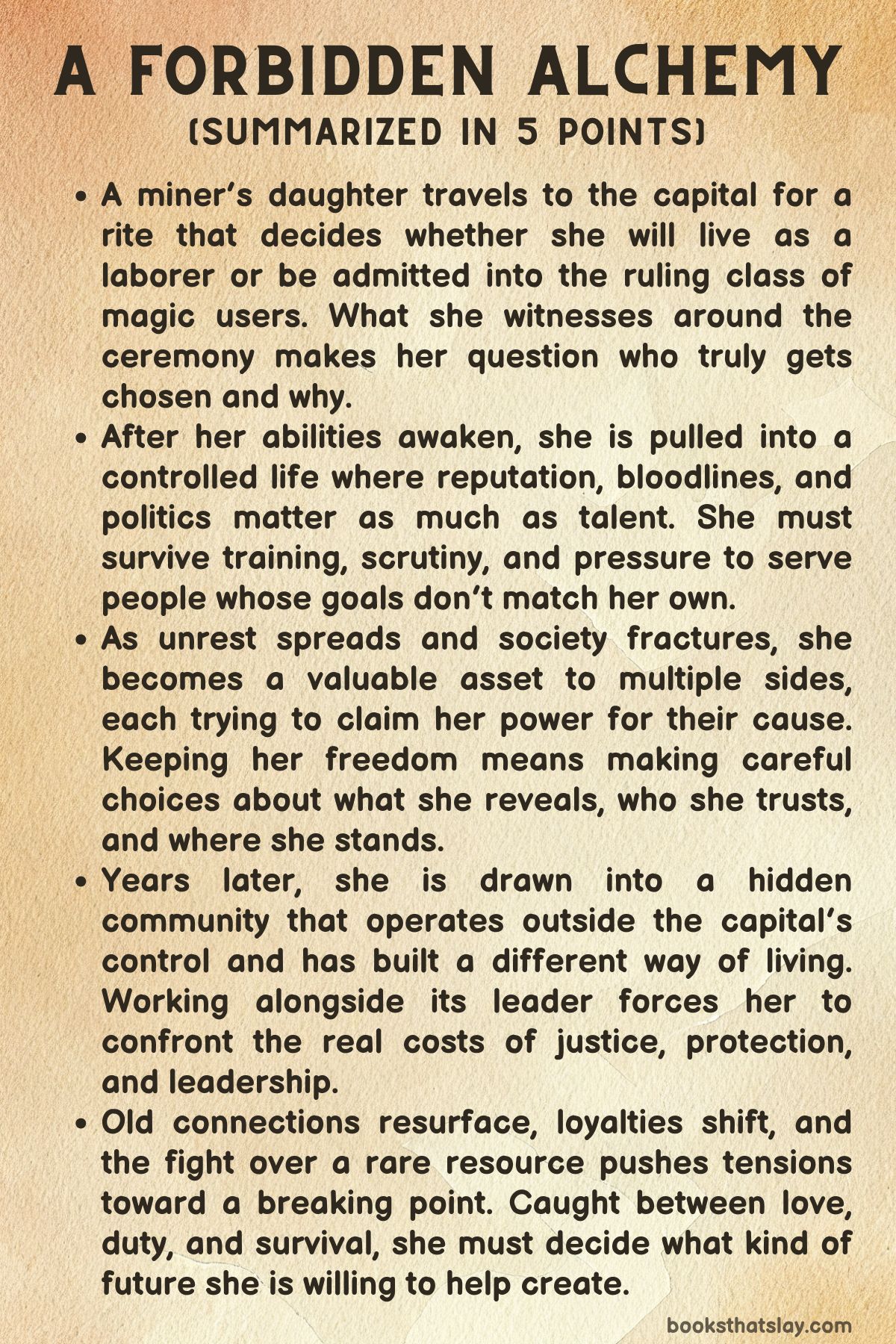
Summary
Nina Harrow grows up in the mining town of Scurry, forever marked by the tragedy that killed more than a hundred men in a mine explosion the day she was born. Her father survived, but the story of the dead canary that warned too late becomes bound to her name and identity. Life in Scurry is harsh, and resentment toward the ruling Artisans runs deep. When Nina turns twelve, she receives an invitation to Belavere, where children drink idium to determine whether they possess magic. If they do, they become Artisans. If not, they return to lives like her father’s.
On the journey to Belavere, Nina meets Patrick Colson, a boy from Kenton Hill who expects to return home and work in the mines. In the capital, the ceremony unfolds with pageantry. Lord Tanner recounts the myth of Idia, whose crystallized blood became the source of magic. Nina and Patrick discover something disturbing before the ritual: crates of idium marked differently, suggesting the results are manipulated. Certain children appear preselected to succeed.
When Nina’s turn comes, she secretly drinks from an unmarked vial. Her senses sharpen, and she commands earth in a sudden storm of dust. She is declared the first earth Charmer in over a century. Immediately she is taken under the control of a woman called Aunt Francis, who forces her to assume a new identity. Nina is rebranded as Nina Clarke and warned that deviation from this story could lead to exile or death. She receives a threatening letter from Lord Tanner implying he knows her true origins.
At the National Artisan School, Nina faces bullying and isolation. Her power is rare and feared. She befriends Theodore Shop, the only water Charmer and son of a powerful lord. Theo is intelligent and ambitious, and their friendship grows into romance. As Nina trains, unrest brews among the Crafters. Mine collapses increase, alchemists grow scarce, and rumors spread that the idium ceremony is fraudulent.
By her later years at school, the political situation deteriorates. Nina and Theo are offered positions in the House of Lords after graduation, symbolic roles meant to demonstrate progress. Theo believes they can change the system from within. Nina feels uneasy about being used as a weapon. On graduation day, violence erupts. The earth collapses beneath the ceremony, and Nina survives only barely. Aunt Francis dies in the destruction. Theo urges Nina to stand with the Artisans against the miners. Instead, she disappears.
For seven years, Nina hides from both sides as civil war consumes Belavere. Without regular doses of idium, her ability fades. Eventually she is captured and brought through tunnels to Kenton Hill.
There she finds Patrick, now leader of the Miner’s Union. He reveals he recognized her years ago and spread word about the falsified ceremony. He offers her a partnership: she will use her restored earth Charming to expand their tunnel network, and he will help her escape the trench.
Kenton Hill astonishes Nina. Freed from dependence on Belavere, the town has become self-sufficient, with shared resources and inventive systems. Patrick rules firmly but claims to act for justice.
He distributes food freely while controlling luxury goods. Nina witnesses both his compassion and his violence. When hawkers selling bluff threaten the town’s stability, Patrick orders ruthless punishment.
Theo reappears in Kenton Hill, claiming exile from the House of Lords after attempting to warn towns about raids. He now assists the union in exchange for idium. Nina learns he has been communicating with Tanner.
Meanwhile, Tanner holds Nina’s mother hostage, forcing Nina to act as a spy. Tanner wants the last alchemist, Domelius Becker, whom the union claims to have captured.
As Nina works in the tunnels, her power returns with intoxicating force. Patrick admires her strength and begins to fall in love with her. Their bond deepens amid danger, dancing, arguments, and shared secrets.
Nina learns Patrick was responsible for bombing the Artisan School years earlier, believing it evacuated. The revelation devastates her, but their connection persists.
Nina and Polly, a former school friend now living in Kenton Hill, secretly plan to mislead Tanner into raiding another location.
Nina intends to trade information about the alchemist for her mother’s freedom. Theo grows increasingly unstable and jealous, revealing he still serves Tanner’s interests.
When disaster strikes in a mine, Nina uses her power to save dozens of trapped workers, earning the town’s gratitude. Her loyalty seems certain.
She promises Patrick she will stay. They confess love and plan a future together. Yet Nina still withholds critical information about Tanner’s imminent invasion.
Eventually Patrick reveals the truth: the alchemist Domelius Becker is dead. Patrick himself is the last living alchemist. His father ordered him to kill Becker so they could leverage the monopoly on idium and force peace.
The union’s claim of holding Becker captive has been a protective lie.
Nina is torn between love and responsibility. Polly’s information reaches Tanner, and an army uses the very tunnels Nina built to invade Kenton Hill. Fires spread through the streets. Civilians flee as soldiers attack.
Nina is briefly knocked unconscious. Patrick returns to find his town under siege. Theo joins him in stopping the fires, revealing divided loyalties.
When confronted by soldiers, Patrick declares himself the final alchemist and threatens to kill himself unless the army retreats.
He demonstrates his power over terranium. The general agrees to withdraw troops in exchange for Patrick’s surrender. Nina attempts to surrender with him, but both are seized. Gunner, Patrick’s brother, is killed trying to intervene.
Bound and forced into the tunnels, Nina hears Patrick urge her to collapse them and bury everyone, ending the cycle of violence.
The weight of earth surrounds her. The fate of both factions rests on her decision, as the sound of a canary echoes from below.
Characters
Nina Harrow / Nina Clarke
Nina is the moral center and main point of tension in A Forbidden Alchemy because she is built from contradictions she never asked for. She grows up as a miner’s daughter who understands hunger, danger, and how easily people are discarded, yet she becomes a rare earth Charmer whose power makes the ruling class treat her like an asset.
That mismatch creates her defining trait: a constant push and pull between wanting safety and wanting justice. Nina’s ambition early on is simple—escape the mines and claim a future—but once she learns the idium ceremony is controlled, her ambition becomes tangled with shame and anger because her “success” is connected to a rigged system.
As she matures, her choices are shaped less by ideology and more by trauma, survival, and the need to protect the few people she loves. Even when she falls in love, she rarely feels free; love becomes another battlefield where she must decide what kind of person she can live with being.
Her earth magic also functions as an emotional mirror: when she is fed, steady, and seen, she can hold the world together; when she is cornered and used, the ground itself becomes a threat. By the end, Nina’s deepest conflict is no longer which side is right, but whether any side deserves the weapon everyone wants her to be.
Patrick Colson
Patrick is both a builder and a destroyer, and that duality makes him one of the story’s most dangerous forces.
He begins as a working-class boy who sees the ceremony’s injustice clearly and refuses to accept it as fate. Over time, outrage becomes strategy, and strategy becomes leadership. As head of the Miner’s Union, Patrick believes order is something he must impose because chaos always punishes the poor first.
That belief pushes him into acts of intimidation and violence that he justifies as necessary, even when they scar him. He genuinely values community—Kenton Hill’s self-sustaining systems and “fair share” philosophy reflect his longing for a world where survival is not bought with blood—but he also accepts that his vision may require executions, threats, and fear.
His relationship with Nina exposes the parts of him that still want tenderness and honesty, yet it also reveals his controlling instincts: he withholds information “for her safety” because he is used to carrying secrets alone. The revelation that he is an Alchemist reframes him completely—he is not only resisting power; he is power. His tragedy is that he wants peace, but he has trained himself to believe peace can only be forced, even at the cost of his own humanity.
Theodore “Theo” Shop
Theo represents privilege that tries to wear the mask of conscience. He is polished, educated, and positioned to inherit influence, and he initially seems like a gentler alternative to the brutality around Nina.
His bond with her begins in a shared sense of isolation within the academy: her rarity and his expectations make them both feel trapped. Yet Theo’s comfort with the system is always present. He imagines reform as something managed from inside elite rooms, through titles and appointments, and he struggles to understand Nina’s instinct to run rather than negotiate.
As war escalates, Theo becomes more compromised. His moral choices start to look less like sacrifice and more like self-preservation—he shifts allegiances, manipulates trust, and keeps one foot in whichever world will protect him. His jealousy of Patrick is not only romantic; it is ideological.
Patrick threatens Theo’s belief that order should come from refinement and governance rather than labor and revolt. Theo’s ugliest moments show how entitlement can turn into menace when it fears losing control, especially toward Nina, whose autonomy undermines his fantasy of being her rescuer.
Even when he helps in the raid aftermath, his actions feel tangled in self-justification: he wants credit for being “better” than the people he condemns, and he wants Nina to validate that story.
Lord Tanner
Lord Tanner is the clearest face of institutional cruelty: calm, ceremonial, and certain that oppression is responsible leadership. He does not need to shout because his power is already built into law, schooling, and the idium supply.
His role is not just villainous in action but ideological in design—he believes the hierarchy is necessary for national stability and defense, and he uses that argument to excuse manipulation of children, suppression of unions, and hostage-taking.
What makes Tanner chilling is his pragmatism: he will use any tool available, including Nina’s mother, propaganda depicting Crafters as monsters, and the threat of killing Nina rather than letting the other side have her. He treats people as pieces on a board and calls it duty.
Even when he frames choices as protection of the realm, his methods reveal that preserving the House of Lords matters more to him than peace. Tanner is not driven by passion but by maintenance—he is the caretaker of a system that feeds on suffering.
Aunt Francis
Aunt Francis is a gatekeeper who shows how complicity can wear the shape of family. She protects Nina from immediate exposure, but her protection is conditional and controlling, rooted in fear of what the House of Lords will do if Nina is discovered. She forces Nina into a false identity, brands her, and repeatedly reminds her that she is disposable.
Yet Francis is not a simple monster; she carries a nervous awareness that the system is unjust and hints at older stories about what happens when everyone has access to idium. Her contradictions reveal someone who has survived by accepting smaller evils to avoid larger ones.
She asks Nina relentless questions about Tanner not because she cares about Nina’s well-being, but because she knows how dangerous power politics are and how quickly a young girl can be swallowed by them.
Her death during the collapse is meaningful because it ends Nina’s last fragile tether to “belonging” in Belavere, leaving Nina with only the identity she chooses, not the one enforced.
Polly
Polly is a quiet portrait of how fear turns into collaboration and how collaboration can still contain real affection. At school she is a scribbler with sharp instincts, the kind of person who hears the lies behind official statements.
Later she becomes an unwilling informant, trading information to survive brutal postings and illness, then slowly finding community in Kenton Hill. Polly’s strength is her honesty about her own compromises. She doesn’t pretend she is brave for the right reasons; she admits she’s acting under pressure.
That makes her one of the most emotionally grounded characters. Her connection to Otto and her loyalty to the town complicate her role as Tanner’s asset, and her partnership with Nina becomes a desperate attempt to choose people over systems.
Polly embodies the book’s central question: when survival requires betrayal, what does redemption look like, and how much truth can a person carry without breaking?
Tess Colson
Tess is the moral backbone of Kenton Hill in a different way than Patrick—she is not chasing victory as much as she is trying to keep her family and town alive. She has lived through the cost of mining and understands that ideals don’t feed children or prevent cave-ins.
Tess is wary of Artisans not only because of politics but because she has spent her life watching powerful people ignore working-class suffering. Her warnings about Nina are protective rather than hateful; she fears what love will do to Patrick’s judgment.
At the same time, Tess is capable of surprising openness once Nina proves she will stand in the fire with them. Her story about her husband and sons carries the book’s generational grief: promises are easy, but poverty forces people to break them.
Tess is a reminder that revolutions are not led only by speeches and weapons—they are also carried by mothers who keep the doors open, ration food, and absorb loss without collapsing.
Donny Colson
Donny’s blindness and deadly accuracy make him an unsettling figure: he is vulnerable in one sense and lethal in another, which fits the book’s theme of how damage and power can coexist.
He is younger, shaped by Patrick’s leadership and the town’s wartime mentality, and he follows orders with frightening calm. His revealed magic as a Smith adds another layer to the Colson family’s hidden truth: they are not only miners fighting Artisans; they also hold forms of the power the Artisans claim as theirs alone. Donny’s character highlights how war trains people into instruments.
He isn’t written as cruel for pleasure; he is written as someone who has accepted violence as normal, which is more disturbing because it feels earned by circumstance.
Gunner Colson
Gunner is the brother who carries the visible scars of coping: drinking, instability, and the constant struggle to stay functional. He shows what the war does to people who cannot turn pain into leadership the way Patrick does. Yet Gunner also has loyalty and a willingness to act, and when the raid comes, he steps into responsibility even while Patrick is absent.
His identity as a Smith mirrors Donny’s, reinforcing that this family is a hidden fault line in the world’s power structure. Gunner’s death during the capture is not just a shock event; it represents the cost of secrets finally surfacing.
He dies at the moment the enemy stops treating Kenton Hill as a stubborn town and starts treating it as the place that holds the last Alchemist.
Otto
Otto is one of Patrick’s most trusted men, and he functions as the bridge between leadership decisions and on-the-ground reality.
He is practical, loyal, and alert to threats, often acting as the one who moves information, people, and plans. Through Polly’s attachment to him, Otto also represents the possibility of tenderness inside a movement built on violence.
He is not romanticized as a savior; instead, he is part of a structure that must sometimes do brutal things to survive. His presence helps show that Kenton Hill is not only Patrick’s vision—it’s upheld by people who believe in it enough to risk becoming targets.
Scottie
Scottie appears as part of Patrick’s inner circle, often in roles that involve restraint, escorting, and tactical action.
He represents the machinery of the union: the part that makes sure plans happen, prisoners stay controlled, and threats are handled quickly. While he is less emotionally foregrounded than Otto, his function in the story matters because he helps define the atmosphere of Kenton Hill as a place where safety exists, but it is enforced.
Through characters like Scottie, the book shows that even a community founded on fairness can develop hard edges when survival is on the line.
Sam
Sam is the clearest example of how fear and dependence operate inside revolutionary spaces. He is anxious, eager to please Patrick, and terrified of being on the wrong side of power. His backstory, including the accusation that he killed a woman’s husband, keeps a shadow over him and suggests that violence in wartime doesn’t stay neatly categorized as “good side” and “bad side.” Nina’s ability to intimidate him into giving her freedom also reveals something important: even in Kenton Hill, where class oppression is supposedly being corrected, hierarchy still exists. Sam’s character shows how ordinary people get trapped between leaders’ decisions and personal guilt, trying to survive while carrying histories they cannot undo.
Lord Shop
Lord Shop is less present directly, but his influence shapes Theo’s life and choices. As a member of the ruling class, he represents the inheritance of authority—how power reproduces itself through family lines, education, and appointment.
Theo’s constant reference point is his father’s expectations, and even when Theo tries to appear independent, his options, safety, and leverage all come from that connection. Lord Shop’s importance lies in what he symbolizes: reform that never risks losing comfort, because the system will always catch its own.
Domelius Becker
Domelius Becker functions more as a political object than a fully realized person, and that is the point. Both sides reduce him to what he represents: the ability to produce terranium and idium, and therefore the ability to raise armies, control healing, and dictate the future.
His capture, rumored survival, and eventual death drive strategic decisions across years. In the end, learning that he is dead and that Patrick is the Alchemist reveals the story’s central irony: the revolution has been organized around a lie that kept people alive, and the truth is even more dangerous than the myth.
Professor Dumley
Professor Dumley embodies the academy’s role in turning children into resources. He recognizes Nina and Theo’s gifts and frames them in terms of value and sacrifice, suggesting their powers are “worth dying for.”
His mentorship is not warmth; it is conditioning. He prepares them to accept that their lives belong to the state and the House of Lords. Dumley is important because he shows that indoctrination doesn’t always arrive as cruelty—it can arrive as praise, attention, and the promise of significance.
Bernie, Ferris, Leon, and Lionel
These supporting figures illustrate the world’s everyday dangers and moral compromises.
Bernie’s aggression shows how vulnerable women are in public spaces even within “safe” towns, and how protection is often enforced through fear rather than justice. Ferris, as a bluff hawker, represents opportunists who profit from war’s shortages, and his fate demonstrates Patrick’s readiness to use public punishment to maintain order.
Leon becomes a tool in that punishment, showing how leadership can outsource violence to others and still claim clean hands. Lionel, the weapons dealer, reveals the grim trade networks that keep conflict alive; his demand for idium and his casual offer to exchange weapons for a woman show how power reduces people to currency.
Themes
Class, Labor, and Manufactured Inequality
Scurry’s mines are not just a backdrop in A Forbidden Alchemy; they are the engine of the entire social order. The working class is treated as a resource to be spent, and the story makes that clearest through Nina’s origin: a birth story tied to a disaster that kills nearly everyone except her father, followed by years of poverty, grief, and normalized danger.
The Artisans benefit from the terranium economy while distancing themselves from its human cost. Their wealth depends on a supply chain built on bodies, yet they wrap that dependence in ceremony, myth, and “national security.”
That contrast shows up again and again: Craftsmen risk death extracting power, while elites debate beauty, prestige, and governance as if those things are separate from the mines.
The idium ceremony exposes inequality as an active design rather than an accident. Marked vials and hidden crates turn a supposedly sacred rite into a selection system that protects privilege.
Children are told fate will decide, but adults are quietly managing outcomes to preserve a class structure. Nina’s success comes from stealing a chance, not receiving one, and her forced reinvention into “Nina Clarke” demonstrates what the system demands: even when someone rises, she must be rewritten into a story that flatters the ruling class.
Later, the Miner’s Union’s “fair share” model in Kenton Hill challenges Belavere’s logic by separating survival goods from profit. Food and heat become communal rights, while luxury remains transactional. That choice isn’t portrayed as flawless or uncomplicated, but it becomes a direct rebuttal to the capital’s insistence that deprivation is normal.
Even war is shaped by labor politics.
The Artisans’ power depends on terranium and alchemists; when alchemists die, the entire machine stalls, and both sides scramble to control the remaining source. The story keeps returning to the same point: inequality survives because it is protected by institutions, rituals, and violence, not because it is inevitable.
Nina’s arc forces the reader to sit with the uncomfortable truth that reform is often offered only as a symbol, while the underlying structure remains untouched.
Power, Control, and the Ownership of Bodies
Nina’s body becomes contested territory the moment she manifests earth magic. She is branded, renamed, and assigned guardians who speak to her as property. The Artisan seal is both a badge and a leash: it marks her as valuable while making it easier to track, claim, and punish her.
The forced identity shift into “Nina Clarke” shows how power works through narrative as much as through weapons. If the ruling class can control the story of who she is, it can control what her power means and how it can be used. Nina is never allowed to simply be talented; she must be usable.
This theme becomes sharper through the way institutions treat “gifted” people. Professor Dumley’s comment that their gifts are “worth dying for” isn’t only motivational rhetoric; it reveals a worldview where the individual’s life matters less than the utility of their magic.
The House of Lords positions Nina as a strategic asset against rebels, and later both factions pursue her for the same reason. The war transforms into a hunt for a living tool. That pursuit continues even after she burns off her brand and tries to disappear. Her attempt to sever herself from power does not free her; it simply changes the methods used to capture her.
The hostage plot with Nina’s mother exposes another layer of bodily control: the leverage of family, caretaking, and love.
Lord Tanner doesn’t only threaten Nina; he weaponizes her bond with her mother to force compliance. Consent becomes impossible when a loved one’s survival is attached to obedience. This is echoed in Kenton Hill, too, even though it operates under a different political ethic.
Patrick insists on safety, but his methods can still become coercive. Nina is guarded, restricted, and reminded she could be hunted “dead or alive” if she breaks the Colsons’ trust. The story refuses to make control a single-side problem. It shows how fear, secrecy, and war can turn even protective instincts into possession.
By the end, Nina’s choice about collapsing the tunnel becomes the ultimate question of ownership: will her body and power remain claimed by others, or can she decide what her power does, even if the decision is catastrophic?
The theme lands with force because it never treats control as abstract. It is always physical: brands, tunnels, ropes, soldiers’ hands, and the constant threat that someone else will decide what Nina is allowed to be.
Truth, Propaganda, and the Politics of Myth
Belavere’s ruling ideology relies on sacred storytelling to justify material exploitation. The origin tale of Idia transforms terranium into a holy inheritance and turns the idium ceremony into a rite of destiny.
That story does political work: it makes inequality feel ordained and discourages questions about who benefits. When Nina and Patrick find evidence of marked vials, it cracks the foundation. The ceremony isn’t fate; it’s administration.
The myth exists to hide management and selection, and the ruling class maintains the illusion because the illusion keeps the social order stable.
The book also shows propaganda as a daily instrument rather than a special wartime tactic. Newspapers depict Crafters as cruel, ignorant, or animal-like, and Nina recognizes the exaggerations while also admitting that desperation can produce ugliness.
This nuance matters: propaganda is most effective when it contains pieces of truth. The story suggests that ruling power thrives by taking the worst outcomes of poverty and using them as proof that the poor deserve their place.
Meanwhile, the union spreads its own simplified narratives of justice and revenge, and Patrick becomes both organizer and enforcer, shaping public perception through fear, punishment, and spectacle. In Kenton Hill, “peace” is maintained partly through the knowledge that Patrick’s judgment can be final.
Secrets become another form of political currency.
The scarcity of alchemists isn’t just a resource crisis; it’s an information crisis. Whoever controls the truth about idium controls the war’s possibilities. Patrick’s hidden identity as an alchemist becomes the single most dangerous fact in the trench. The union’s lie about holding Domelius Becker is not framed as moral purity or deception for its own sake; it is survival.
On the other side, Tanner’s manipulations show how power hoards truth while demanding transparency from everyone else.
Nina’s life becomes a chain of half-truths, false names, and strategic silences, and the story makes clear that people don’t lie only because they’re corrupt. They lie because truth can get them killed.
This theme also plays out emotionally.
Theo’s fall is tied to self-justifying stories: he reframes betrayal as protection, obsession as love, and manipulation as duty. Nina’s growth includes learning how narratives can trap her, whether they come from governments, lovers, or her own longing for escape.
In A Forbidden Alchemy, truth is never just factual; it’s a battleground where survival, morality, and identity collide.
Revolution, Justice, and the Cost of Violence
Kenton Hill represents a revolutionary possibility: mutual aid, shared essentials, and a community built outside the capital’s economy. Yet the book refuses to romanticize revolution as purely liberating.
Patrick describes his work as “justice,” and the town’s survival depends on both care and brutality. People are fed, sheltered, and protected, but order is also maintained through intimidation, punishment, and killings that happen quickly and sometimes publicly.
The coin-toss execution scene demonstrates how violence can become procedural, even playful, when a community is exhausted by threat. The story asks what happens when a movement born from righteous anger must govern itself under siege.
The union’s origin story—police brutality followed by retaliation—shows how quickly cycles form. The movement begins as a response to humiliation and death, and over time it grows into a parallel state with its own borders, surveillance, and enforcement.
Patrick carries the burden of being both symbol and instrument. He listens to townspeople’s concerns and manages rations, but he also decides who is punished and who is spared. The result is a complicated portrait of revolutionary leadership: a person can be sincerely devoted to fairness and still become comfortable with coercion.
On the Artisan side, violence is institutional and sanitized through rhetoric about protecting the country and maintaining order. The House of Lords treats warfare as governance, and Nina is pressured into becoming a strategic weapon because her power fits Belavere’s geography.
The capital’s raids on towns, mass killings, and scorched tactics reveal a state willing to destroy its own citizens to keep control. The book keeps comparing these two kinds of violence—revolutionary and state—and shows that both can claim necessity while producing horror.
Nina’s position between the factions turns justice into a personal problem rather than a slogan. She has seen suffering on both sides, and her refusal to fully endorse either worldview is not indecision; it’s experience.
Her choices are shaped by the question of what justice is supposed to protect: a system, a community, a family, or human life itself. The climax forces that question into one unbearable moment when tunnels, fire, and hostage-taking converge. The idea of collapsing the tunnel is not only tactical; it is moral.
Can violence ever end violence, or does it only choose different victims?
The book doesn’t offer an easy answer. It shows what justice costs when everyone believes they are the injured party.
Identity, Reinvention, and the Self Under Pressure
Nina’s identity is repeatedly rewritten by forces larger than her.
She begins as a miner’s daughter defined by a disaster story, then becomes an Artisan branded into an invented lineage, then becomes a fugitive who burns off her mark and lives through improvisation.
Each version of her is shaped by someone else’s need: her father’s grief, Aunt Francis’s cover story, Tanner’s strategy, the union’s goals, and even Theo’s obsession. The story treats identity as something that can be stolen, reassigned, and used as evidence, not as a private truth.
The “Nina Clarke” fabrication is especially cruel because it requires Nina to deny her own history to survive. She must lie about her parents, her town, and her childhood, and she must do so among people who assume lineage equals worth. That performance fractures her sense of self.
It also teaches her that upward mobility in an unjust system often demands erasure. She can gain access only by becoming someone acceptable to power. The later years on the run show a different kind of identity struggle: when she is no longer branded, she still cannot be free because the world keeps searching for “the earth Charmer.” Her personhood disappears behind her category.
Romantic relationships become mirrors for identity.
Theo offers Nina a version of herself that is lighter, admired, and sheltered from consequences—until he chooses the system over her autonomy. Patrick offers a different reflection: he knows how she got her power and therefore removes the shame attached to it, but he also represents the revolutionary world that demands commitment and sacrifice.
Nina’s shifting love is tied to her shifting sense of who she is allowed to be. The book does not frame her as fickle; it frames her as someone trying to locate a stable self while every surrounding institution insists on defining her.
Even Kenton Hill, which feels freer, pushes Nina toward a new identity: “one of us,” “future family,” “weapon we can trust.”
When Tess says they will find Nina “dead or alive” if she leaves, the warmth of belonging is paired with threat. Nina is asked to become a symbol again, just in different colors. The theme reaches its sharpest point in the tunnel at the end, when Nina is urged to collapse everything.
The question underneath is identity-based: is she a person who chooses, or a force that others aim? Her power makes her visible, but the book keeps insisting that visibility can erase the self as easily as it can honor it.
Love, Loyalty, and Betrayal in a War Zone
Love in A Forbidden Alchemy is never separate from politics; it becomes a channel through which people seek safety, control, redemption, and meaning. Nina’s relationships with Theo and Patrick are shaped by incompatible loyalties. Theo loves Nina, but his love is filtered through ambition and alignment with the ruling class.
He wants her safe, but “safe” often means back inside the system that claims her. His jealousy and manipulations escalate because he cannot accept that Nina’s choice might be real if it doesn’t center him. Even when he takes risks, he frames himself as the rescuer waiting for her to run out of options, which turns affection into entitlement.
Patrick’s love develops in the opposite direction: he begins as an angry boy who hates the ceremony’s fraud and grows into a leader carrying the weight of a movement. When he falls for Nina, love becomes both a refuge and a vulnerability. Their intimacy is tender, but it is always shadowed by secrets.
Nina withholds the truth about Tanner and the planned raid because she believes she can fix it alone. Patrick withholds the truth about the alchemist because knowledge could get Nina killed. Their love is built on real understanding and real desire, yet war makes honesty dangerous, and the story shows how secrecy can feel like protection while still functioning as betrayal.
Loyalty is equally unstable. Nina’s loyalty is pulled between her mother, the union, her own freedom, and the promise of belonging. Tanner exploits loyalty by holding her mother hostage, turning Nina’s love into obedience. Polly’s loyalty shifts from fear-driven cooperation with Tanner to genuine care for Kenton Hill, especially through her bond with Otto.
Tess’s loyalty to her sons clashes with her exhaustion and the desire to stop sacrificing everything to a war that never ends. Even Theo’s loyalty fractures: he serves Tanner, then serves himself, then chooses moments of decency without fully abandoning his self-interest. No one is purely loyal or purely treacherous because survival requires compromise.
The story also shows betrayal as a cumulative process rather than a single act. Nina’s early theft of a fair idium vial is a small rebellion against a rigged world, but later deceptions carry larger consequences.
The invasion of Kenton Hill through tunnels Nina helped build is the nightmare version of unintended betrayal: a structure made for rescue and trade becomes a route for massacre.
That inversion forces Nina to face the moral weight of her choices, even when she did not intend harm. In the final stretch, love and betrayal collide in the most brutal way: Patrick asks Nina to collapse the tunnel, and the request itself tests whether love can survive when it demands destruction.