A Founding Mother Summary, Characters and Themes
A Founding Mother: A Novel of Abigail Adams by Stephanie Dray and Laura Kamoie is a historical novel centered on Abigail Adams, whose domestic labor, political insight, commercial skill, and personal sacrifices shaped both her family and the early United States.
Told across several decades, the book presents revolution and nation-building from the perspective of a woman excluded from formal authority yet deeply involved in public affairs. Abigail confronts war, epidemics, financial instability, political division, slavery, restrictive marriage laws, and repeated bereavement. Her story shows that the nation was created not only in congresses and battlefields, but also in homes maintained by women whose work often went unrecorded.
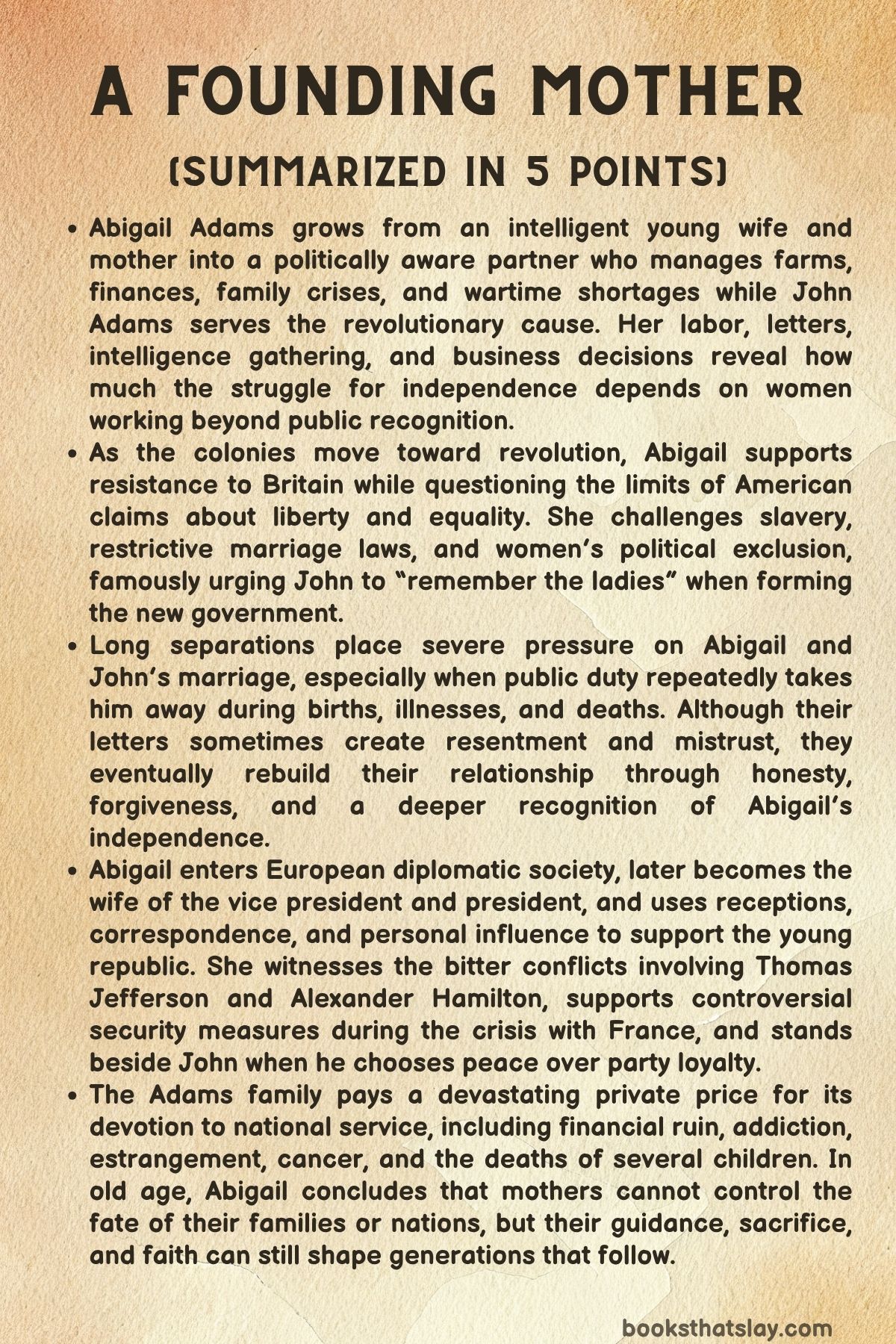
Summary
In 1814, an elderly Abigail Adams tends rosemary near the family tomb at Peacefield while reflecting on the many losses that have marked her life. Four of her six children are dead, and even the surviving children seem distant because of separation, disappointment, or estrangement.
John Adams arrives with terrible news from the War of 1812. British troops have captured Washington and burned important government buildings, including the President’s House, the Capitol, and the Library of Congress.
The destruction makes Abigail question whether the Revolution and her family’s sacrifices achieved anything lasting. As Massachusetts Federalists discuss separating from the Union, she remembers the difficult choices through which she helped sustain both her household and the emerging nation.
Her memories begin in 1765, when she is twenty years old and pregnant with her first child. Parliament’s Stamp Act and restrictions on colonial currency have already made daily life difficult, especially for widows and families dependent upon payments that merchants will no longer accept.
Abigail gives birth safely to a daughter, Abigail Amelia, soon called Nabby. Her marriage to John, a lawyer who respects her intelligence, gives her greater intellectual freedom than many women possess, although the laws still place wives and children under male authority.
By 1770, the Adams family lives in Boston amid British military occupation. Soldiers search homes, intimidate civilians, and create an atmosphere in which political conflict enters ordinary family life.
Abigail’s infant daughter Susanna becomes seriously ill with pleurisy. Dr. Joseph Warren can offer comfort but no dependable cure, and the child dies in Abigail’s arms while military commands echo outside the house.
Soon afterward, British soldiers fire on civilians in the Boston Massacre. John agrees to defend the accused soldiers because he believes legal rights are meaningless unless they apply even to unpopular defendants.
The decision brings insults, financial losses, and attacks upon the Adams home. Abigail nevertheless assists John by helping identify witnesses, and she supports him when most of their community turns against him.
John secures acquittals for Captain Preston and several soldiers, proving his devotion to evidence and justice. His legal practice suffers, forcing the family to return to Braintree, but his reputation as a principled patriot eventually recovers.
Abigail’s friendship with Mercy Otis Warren broadens her understanding of women’s political and intellectual possibilities. Mercy encourages her to educate Nabby and warns that John’s growing public role will demand severe sacrifices from the entire family.
The Boston Tea Party and Britain’s punishment of Massachusetts move the colonies closer to rebellion. When John is selected to attend the Continental Congress, Abigail promises to share the risks of treason, poverty, and separation.
While John is away, Abigail runs the Braintree farm during drought, shortages, and rising political violence. She shelters refugees, manages tenants, preserves food, and begins understanding how much the colonial resistance depends upon women’s unpaid labor.
She also condemns the contradiction between colonial demands for liberty and the continued enslavement of Black people. John agrees with her moral criticism but warns that ending slavery will be politically difficult.
The fighting at Lexington and Concord turns resistance into war. Abigail’s home becomes a refuge for wounded men and displaced families while militia forces surround British-occupied Boston.
From Penn’s Hill, she and young John Quincy witness the distant battle at Bunker Hill. When Dr. Joseph Warren is killed, Abigail melts her pewter spoons into musket balls, symbolically converting domestic property into material support for the Revolution.
George Washington visits the Adams household while traveling to take command of the army. His acknowledgment of women’s sacrifices strengthens Abigail’s belief that managing farms, food, information, and families is a form of national service.
Abigail begins selling scarce pins sent by John from Philadelphia. Her profits create a private financial reserve and reveal her talent for trade, investment, and economic planning.
John also asks her to collect intelligence about British forces, Loyalists, local conditions, and public opinion. Writing under the name Portia, she sends careful reports that John values more highly than many official military accounts.
A dysentery epidemic soon devastates Braintree. Abigail, her children, servants, and tenants become ill, and young Nabby assumes adult responsibilities when her mother can no longer care for the household.
Abigail’s mother comes to nurse the family despite the danger. She saves her daughter and grandchildren but contracts the disease herself and dies, leaving Abigail burdened by grief and guilt.
Benjamin Franklin later assures Abigail that John nearly abandoned Congress after hearing of her mother’s death. Franklin also recognizes the political value of information gathered through female servants, neighbors, markets, and domestic networks.
Thomas Paine’s arguments and Britain’s continuing violence convince Abigail that independence is necessary. She urges John to support a complete separation from the Crown rather than continue seeking reconciliation.
After the British leave Boston, Abigail writes her famous appeal asking John to remember the ladies when creating new laws. She argues that women should not be subject to unlimited male authority when the Revolution itself condemns taxation and government without representation.
John answers playfully rather than seriously, disappointing her. Abigail understands that revolutionary leaders may challenge monarchy while preserving unequal power within marriage and family life.
She takes her children to Boston for smallpox inoculation, accepting a controlled danger to prevent a greater one. The procedure is frightening, but the family survives and witnesses the public reading of the Declaration of Independence.
The Declaration’s promise of equality inspires Abigail while also exposing the nation’s contradictions. Women remain politically excluded, and enslaved people remain in bondage despite the language of universal rights.
John briefly returns home, and the couple renews their emotional and physical closeness. He promises to be present if Abigail becomes pregnant again, but public responsibilities prevent him from keeping that promise.
Abigail delivers a stillborn daughter without John beside her. The loss changes her understanding of their marriage, teaching her that John’s public obligations will repeatedly outrank his private promises.
John later announces that Congress has appointed him a commissioner to France. He plans to take John Quincy and Charles with him, leaving Abigail with Nabby and Tommy.
Abigail resents the fact that men gain education, travel, and public distinction through absences made possible by women who remain behind. She nevertheless continues running the farm, supporting relatives, managing debt, and expanding her commercial ventures.
James Lovell becomes an important correspondent during John’s absence. His letters gradually turn flirtatious and improper, and Abigail eventually realizes that his attention reflects manipulation rather than sincere attachment.
John’s own letters become harsh and dismissive. He complains about her financial requests and loneliness, leading Abigail to fear that Europe has changed him or that he no longer values the wife preserving everything he left behind.
Phoebe helps Abigail see that John’s cruelty may come from guilt and frustration, but she also reminds her that marriage laws give husbands control over a wife’s earnings and property. Abigail responds by expanding her secret investments and seeking financial security that cannot easily be taken from her.
After the war ends, John remains abroad as a diplomat. Nabby falls in love with Royall Tyler, but Abigail investigates his debts, irresponsibility, and character before approving the marriage.
The scrutiny creates conflict between mother and daughter. Abigail wants to protect Nabby from a disastrous husband, yet she recognizes that excessive maternal control can resemble the authority she condemns in men.
Phoebe finally receives her freedom after Abigail’s father dies. She chooses the risks of independence over the security of remaining attached to the family that once owned her.
Abigail eventually decides to travel to Europe with Nabby. She hopes to save her marriage, confront John directly, and claim the broader life she has long imagined.
In London, she reunites with John Quincy and sees how much of his childhood she missed. Her reunion with John is passionate but also honest, as he admits that vanity, loneliness, and professional disappointment caused him to write cruel letters.
The couple begins rebuilding trust through direct conversation. Their marriage survives not because the earlier injuries disappear, but because both acknowledge the cost of their choices.
In France, Abigail enters diplomatic society and discovers that she is highly capable of managing a public household. She studies political customs, meets influential women, handles complex finances, and becomes a respected participant in the social side of diplomacy.
Her friendship with Thomas Jefferson grows through conversations about books, education, gardening, government, and family. She admires his intelligence while becoming increasingly disturbed by the contradiction between his political ideals and his ownership of enslaved people.
Nabby receives fewer letters from Royall Tyler, and evidence of his dishonesty eventually emerges. John strongly supports his daughter’s right to end the engagement, proving that paternal authority can protect female freedom rather than suppress it.
Nabby later marries Colonel William Stephens Smith and has children. Abigail rejoices in becoming a grandmother, although Smith’s ambition, speculation, and financial recklessness will repeatedly threaten the family.
As the first American minister to Britain, John formally meets King George III. Abigail and Nabby enter royal society, where they encounter ceremony, hostility toward Americans, and the complicated demands of representing a young republic.
Thomas Jefferson’s daughter Polly arrives in London accompanied by Sally Hemings. Abigail is outraged that Jefferson, author of a declaration of equality, has sent an enslaved girl across the Atlantic.
Sally chooses to continue to France because French law and wages may give her greater opportunities. Abigail learns that respecting another woman’s agency may require accepting a decision she would not choose for her.
The Adamses eventually return to America. John becomes the first vice president under George Washington, while Abigail enters the social world of the new federal government.
She forms a respectful bond with Martha Washington, who understands the exhausting public duties placed upon political wives. Together they help define republican ceremony without simply copying European monarchy.
Political factions soon divide the government. Alexander Hamilton favors strong federal power and financial centralization, while Jefferson supports states’ rights, agriculture, and sympathy for revolutionary France.
Abigail watches philosophical disagreements become personal feuds. Newspapers, anonymous essays, electoral manipulation, and organized factions transform former allies into enemies.
John finds the vice presidency humiliatingly powerless, while Abigail often returns to Quincy to manage the farm and investments. Her financial success demonstrates that she possesses abilities denied formal recognition by law and custom.
The French Revolution becomes increasingly violent. Abigail, once sympathetic to popular resistance, begins fearing that uncontrolled political passion can destroy law, order, and personal safety.
John Quincy enters diplomatic service, while Tommy accompanies him as a secretary. Once again, public service separates Abigail from her children and places family affection beneath national ambition.
Nabby’s husband loses his fortune through speculation, and Charles mishandles money while trying to help. Abigail sees that courage and charm cannot replace discipline, honesty, and economic judgment.
When Washington retires, John narrowly wins the presidency over Jefferson. Abigail becomes the president’s wife and uses receptions, dinners, correspondence, and personal relationships to strengthen John’s administration.
The conflict with France intensifies after French agents demand loans and bribes from American diplomats. Abigail supports naval expansion and stronger security, believing the country faces foreign subversion and possible war.
Fear leads her to encourage the Alien and Sedition Acts. She celebrates actions against hostile newspaper editors without fully recognizing how the laws threaten the liberties she once defended.
John quietly seeks peace with France despite pressure from Hamilton and other Federalists who want military confrontation. Abigail gradually recognizes that Hamilton’s ambition and influence over the provisional army may endanger the republic.
At home, the family faces a more personal crisis. Charles becomes dependent upon alcohol, loses money, damages his marriage, and earns his father’s condemnation.
John renounces Charles, believing severity will protect the family’s honor. Abigail secretly supports her son and pleads for mercy, but she cannot persuade either father or child to accept the other.
John eventually disbands the provisional army and continues negotiations with France, sacrificing Federalist support to avoid war. His courage as president contrasts painfully with his inability to show patience toward Charles.
Hamilton openly announces his intention to prevent John’s reelection. Abigail confronts him and recognizes that his intelligence is controlled by resentment, vanity, and a desire to dominate his political allies.
Charles becomes gravely ill after years of drinking and emotional decline. Abigail finds him frightened, ashamed, and convinced that his father will never forgive him.
She leaves him to continue to Washington, hoping to persuade John to reconcile. Charles dies before forgiveness can be communicated, leaving both parents consumed by guilt.
John loses the election of 1800 after Federalist divisions and public anger over the Sedition Act. Yet the peace treaty with France proves that his most controversial decision protected the country from unnecessary war.
At her final public dinner, Abigail enters the room on Jefferson’s arm despite their political hostility. The gesture demonstrates that the peaceful transfer of authority matters more than personal resentment.
In retirement, Abigail and John focus on farming, family, and the meaning of their shared life. Reports concerning Jefferson and Sally Hemings force Abigail to reconsider the moral contradictions of a man she once admired.
Her private correspondence with Jefferson becomes a sharp political argument. John accepts that the letters express Abigail’s own opinions, acknowledging her independent political identity.
Mercy Warren publishes a history criticizing John as vain and monarchical. Abigail fears that future generations will forget his contributions and erase the women whose labor sustained the Revolution.
Family suffering continues. Nabby develops breast cancer and undergoes a brutal mastectomy without modern anesthesia, displaying a strength Abigail had often overlooked.
Tommy begins drinking heavily, and revelations emerge about the mistreatment the Adams children suffered while their parents were abroad. Abigail realizes that Charles’s and Tommy’s problems may have roots in childhood wounds their parents never noticed.
Phoebe grows old and dies after years of freedom. Abigail mourns her as a second mother while admitting that affection could never erase the injustice of having once owned her.
Nabby’s cancer returns, and she travels to Peacefield to die among her family. She faces death calmly, thanks her parents for the life they gave her, and dies in her husband’s arms.
The loss destroys Abigail’s remaining confidence in providence. When she learns that Washington has been burned by British troops, she feels that both her family and the nation have collapsed.
Military victories at Lake Champlain and Fort McHenry restore some hope. On their fiftieth wedding anniversary, Abigail asks John to ensure that the wealth she earned will pass to women, servants, widows, and female relatives despite laws that treat her property as his.
John agrees to honor her wishes. His decision becomes a personal recognition of the equality he once dismissed when she asked him to remember the ladies.
In 1817, John Quincy returns after helping negotiate the Treaty of Ghent and receiving appointment as secretary of state. Abigail sees that her surviving son carries forward the values, ambitions, mistakes, and hopes of both parents.
She finally understands that mothers cannot guarantee the survival of their children, principles, or countries. Their responsibility is to nurture, teach, protect, and continue believing even when the final results remain beyond their control.
Characters
Abigail Adams
At the center of A Founding Mother, Abigail Adams develops from an intelligent young wife seeking respect within marriage into an experienced political observer, businesswoman, diplomat’s partner, presidential adviser, and family matriarch. Her intelligence is practical as well as philosophical, allowing her to discuss constitutional principles while also managing crops, tenants, trade, investments, epidemics, and household survival.
Abigail’s defining strength is her refusal to regard domestic work as politically insignificant. She understands that armies cannot fight, legislatures cannot meet, and diplomats cannot remain abroad unless someone preserves farms, raises children, manages money, gathers information, and maintains family loyalty.
Her political beliefs combine revolutionary idealism with the limitations of her historical setting. She condemns slavery, questions unrestricted male authority, supports female education, and asks lawmakers to remember the ladies, yet she sometimes behaves paternalistically toward Phoebe and Sally Hemings.
Her greatest internal conflict concerns the relationship between love and control. She wants to protect her children from bad marriages, financial ruin, addiction, illness, and public humiliation, but she gradually learns that maternal devotion does not grant the power to direct another person’s choices.
Abigail is also capable of serious political error. Fear of foreign attack and domestic disorder causes her to support the Alien and Sedition Acts, showing how someone devoted to liberty can justify repression when frightened.
Her life is marked by repeated bereavement, including the deaths of children, parents, siblings, friends, and Phoebe. Rather than making her emotionally invulnerable, these losses repeatedly break and reshape her understanding of motherhood, faith, ambition, and national service.
John Adams
John Adams is principled, intellectually forceful, emotionally demanding, and deeply committed to public duty. Within A Founding Mother, he is presented neither as an uncomplicated hero nor as a selfish husband, but as a man whose virtues and failures often arise from the same intense sense of responsibility.
His defense of the British soldiers after the Boston Massacre demonstrates his belief that justice must survive public anger. He is willing to lose money, popularity, and safety rather than deny legal protection to unpopular defendants.
John’s commitment to independence, diplomacy, constitutional government, and peace with France makes him essential to the young republic. His refusal to submit to Hamilton’s plans for war becomes one of his most courageous acts because he places national welfare above party loyalty and reelection.
The same devotion to duty repeatedly damages his family. He breaks promises, remains absent during births and deaths, takes his sons abroad, judges Charles harshly, and assumes that Abigail will absorb whatever burdens his public career creates.
John loves Abigail’s intelligence, yet he initially fails to accept the political consequences of her arguments about women. His eventual decision to honor her independent distribution of the fortune she earned represents a personal growth that legislation and public debate never produced.
His treatment of Charles reveals his deepest failure. John can show fairness toward enemy soldiers and political opponents, but shame and fear prevent him from offering mercy to his addicted son until it is too late.
Abigail Amelia “Nabby” Adams Smith
Nabby is Abigail and John’s eldest surviving daughter and one of the quietest yet strongest figures in the story. As a child, she assumes adult responsibilities during the dysentery epidemic, caring for her mother and brothers when almost everyone around her is ill.
Her reserved personality is often misread as coldness or lack of imagination. In reality, Nabby possesses emotional steadiness, moral clarity, and an ability to endure suffering without seeking attention.
Her romance with Royall Tyler reveals the dangers facing women whose futures can be determined by marriage. She resents parental interference, but the discovery of Tyler’s dishonesty confirms the value of careful judgment before entering a legally restrictive union.
Her marriage to Colonel Smith brings genuine affection but repeated financial instability. Nabby survives speculation, poverty, separation, public embarrassment, the deaths of children, and the pressure of protecting her family from her husband’s failures.
Her response to cancer establishes her as one of the novel’s clearest examples of private heroism. She endures a mastectomy without anesthesia and later travels hundreds of miles to die among her family, facing death with greater calm than those around her.
Abigail finally recognizes that Nabby’s courage was always present. Her daughter’s strength does not resemble military glory or political fame, but it sustains families through suffering that public histories rarely record.
John Quincy Adams
John Quincy is shaped from childhood by the expectation that he will carry forward the Adams family’s public mission. Intelligent, disciplined, observant, and ambitious, he receives educational opportunities that his mother and sister were denied.
His travels with John expose him to diplomacy, languages, politics, and European society at a young age. These experiences strengthen his abilities but also separate him from his mother during crucial years of development.
John Quincy generally accepts public service as an obligation rather than a personal preference. His willingness to support policies such as the Louisiana Purchase, even against Federalist opinion, shows an independence that both pleases and frustrates his parents.
He is also affected by the family’s habit of placing national duty above emotional presence. When he considers leaving his own sons in America while serving in Russia, Abigail warns that parental absence can create injuries that achievement cannot repair.
His relationship with Tommy demonstrates both affection and inequality. He values his younger brother’s loyalty, yet the family’s constant praise of John Quincy contributes to Tommy’s feeling that he exists mainly to support someone else’s destiny.
By the end, John Quincy represents continuity rather than perfection. Abigail sees him as the product of parental influence, personal decisions, hardship, privilege, and a national culture that treats service as both honor and burden.
Charles Adams
Charles is the most tragic of Abigail and John’s sons. As a child, he is taken to Europe, separated from his mother, exposed to danger, and required to adapt to adult circumstances before he possesses the emotional stability to understand them.
His return from Europe shows that travel has made him worldly but unsettled. He later studies law, marries Sally Smith, and attempts to build a respectable life, yet financial pressure and family expectations contribute to his decline.
Charles’s alcoholism is presented as a dependency connected to shame, loneliness, failure, and unresolved childhood suffering. His drinking damages his career, marriage, finances, and relationship with his father, but the story does not treat addiction as simple moral weakness.
He becomes involved in Colonel Smith’s failed speculation and loses money belonging to John Quincy. The failure deepens his belief that he has disgraced a family that measures worth through achievement and public usefulness.
John’s renunciation confirms Charles’s worst fear that parental love is conditional. Abigail refuses to abandon him, but even her support cannot repair the years of emotional distance or force him into recovery.
Charles dies believing that his father may never forgive him. His death becomes the sharpest indictment of a family culture that can value discipline and reputation so highly that mercy arrives too late.
Thomas Boylston “Tommy” Adams
Tommy is the least celebrated Adams son and spends much of his life in John Quincy’s shadow. He lacks his brother’s diplomatic brilliance but possesses practical ability, loyalty, and a preference for local service.
He travels abroad as John Quincy’s secretary, a role that gives him experience but also reinforces the idea that his purpose is to assist his more distinguished brother. Even after becoming a judge and mediator, he rarely receives equal recognition from his father.
Tommy’s later drinking suggests that Charles’s addiction was not an isolated family failure. His pain emerges partly from comparison, emotional neglect, childhood fear, bereavement, and the pressure to meet expectations that do not suit his temperament.
His revelation about Reverend Shaw’s abusive household changes Abigail’s understanding of her years abroad. Tommy forces her to confront the fact that children left in supposedly respectable care may suffer privately while their parents receive public praise.
Although Tommy contributes steadily to the farm and family, his efforts are easily overlooked. His story shows how quiet usefulness can remain invisible within a family organized around extraordinary accomplishment.
Phoebe
Phoebe is a formerly enslaved woman who serves as Abigail’s nurse, confidante, household adviser, and moral challenger. Her long presence in the Adams family exposes the contradiction between personal affection and the legal ownership of another human being.
She understands Abigail with unusual clarity and often speaks truths that white relatives avoid. When John’s letters wound Abigail, Phoebe explains both his possible emotional motives and the legal system that gives husbands control over wives and property.
Her desire for freedom is practical rather than symbolic. She knows independence may bring poverty and insecurity, yet she refuses the argument that protection under a master is preferable to self-determination.
After gaining freedom, she marries Mr. Abdee and continues helping vulnerable women. Her choices demonstrate judgment, loyalty, courage, and a moral independence that was present long before the law recognized her personhood.
Abigail loves Phoebe as a second mother, but Phoebe’s life prevents that affection from becoming an excuse for forgetting slavery. Their relationship remains genuine and unequal at the same time.
In old age, Phoebe’s memory fades, but her commitment to universal freedom remains. Her death forces Abigail to acknowledge that kindness within an unjust institution cannot make the institution humane.
Mercy Otis Warren
Mercy Otis Warren is a writer, intellectual, political satirist, historian, and one of Abigail’s most important female friends. She initially serves as proof that a woman can participate in public thought without abandoning family responsibility.
Mercy encourages Abigail to value her intelligence and to educate Nabby. She gives Abigail a language of classical courage, comparing political wives to women such as Portia who endure sacrifice without surrendering dignity.
Their friendship is based on admiration, shared political interests, and mutual understanding of the costs imposed upon prominent families. Mercy also warns Abigail about James Lovell and recognizes dangers that Abigail’s loneliness initially prevents her from seeing.
Over time, ideological differences and personal grievances weaken their bond. Mercy’s published history portrays John as vain and politically suspect, making Abigail feel that a trusted friend has helped distort his place in history.
Their eventual reconciliation reflects the perspective of old age. Neither woman forgets the injury, but both understand that a long friendship can contain rivalry, disappointment, affection, and forgiveness.
Thomas Jefferson
Thomas Jefferson is charming, intellectually curious, eloquent, private, and morally contradictory. Abigail enjoys his conversation and shares his interests in books, education, gardening, government, and family life.
His vision of liberty attracts her, but his ownership of enslaved people steadily undermines her admiration. His relationship with the Hemings family makes slavery a matter of intimate power rather than an abstract political disagreement.
Jefferson repeatedly fails as a father while excelling as a statesman. He leaves others to transport and care for his daughters, and Abigail resents the ease with which celebrated men shift family burdens onto women and servants.
Political rivalry eventually destroys his friendship with John and Abigail. His alliance with partisan journalists and his willingness to benefit from attacks on the Adams administration make Abigail regard him as personally disloyal.
Their later correspondence is marked by grief, accusation, and unresolved disagreement. Jefferson remains important because he represents both the highest language of American equality and the profound exclusions hidden beneath it.
Alexander Hamilton
Alexander Hamilton is brilliant, energetic, persuasive, ambitious, and dangerously sensitive to insult. His economic ideas help establish national credit and strengthen federal authority, but his desire to control political outcomes repeatedly damages colleagues and institutions.
He secretly manipulates electoral votes against John and later attempts to prevent John’s reelection. Hamilton believes his intelligence gives him the right to arrange public affairs through private influence.
His response to criticism is frequently personal and excessive. Crowds, rivals, and disagreements trigger wounded pride rather than restraint, making him unable to separate opposition from betrayal.
Hamilton’s support for a large provisional army alarms John because military power could serve partisan or expansionist ambitions. His plans concerning foreign territory suggest that he sees war as an opportunity for national and personal advancement.
Abigail’s confrontation with him reveals his contempt for female political judgment. His dismissal of her strengthens her determination to resist the assumption that women cannot understand statecraft.
Colonel William Stephens Smith
Colonel Smith is courageous, affectionate, socially accomplished, and financially reckless. His courtship of Nabby offers her a way out of the failed engagement with Royall Tyler, and his love for her appears sincere.
As a husband, he responds tenderly to Nabby’s illness and physical suffering. His acceptance of her after the mastectomy demonstrates a devotion that Abigail comes to value deeply.
His greatest weakness is speculation. He repeatedly risks family security through land ventures, military schemes, and unrealistic expectations of wealth or public advancement.
Smith’s ambition also exposes the difficulty of belonging to a famous political family. John and Abigail hesitate to assist him because they fear accusations of nepotism, even when his service may justify consideration.
He is neither a villain nor a dependable provider. His character shows how bravery and affection can coexist with judgment poor enough to endanger everyone who depends upon him.
Royall Tyler
Royall Tyler initially appears charming, romantic, educated, and attentive to Nabby. His poetry and enthusiasm appeal to a young woman who wants to choose her own future rather than have it arranged by distant parents.
Abigail’s investigation reveals debt, wastefulness, and troubling conduct. Tyler’s decision to withhold or destroy letters demonstrates a willingness to manipulate Nabby’s understanding of their relationship.
His harsh treatment of animals also raises questions about how he might treat a wife or anyone under his authority. The later sexual scandal confirms that Abigail’s concerns were based on character rather than social prejudice.
Tyler’s importance lies in the danger he represents. In a society where marriage gives husbands extensive legal power, a charming but dishonest man can permanently damage a woman’s life.
James Lovell
James Lovell enters Abigail’s life as a political correspondent during John’s long absence. He provides information, sympathy, and attention at a time when Abigail feels lonely, overworked, and emotionally neglected.
His letters gradually become flirtatious and invasive. Because he possesses political influence and access to information concerning John, Abigail feels unable to end the exchange immediately.
Mercy later reveals that Lovell treats other women similarly and publicly humiliates his own wife. Abigail realizes that what she interpreted as special understanding was part of a broader pattern of self-serving behavior.
Lovell’s role demonstrates how emotional isolation can make even a perceptive person vulnerable to manipulation. Abigail’s decision to end the correspondence is both humiliating and liberating.
George Washington
George Washington is presented through Abigail’s eyes as dignified, restrained, considerate, and conscious of the burdens placed upon others. His military reputation matters, but his personal courtesy leaves the deepest impression on her.
He acknowledges women’s domestic sacrifices during the Revolution, giving public value to work that usually remains unseen. His gentleness with the Adams grandchildren similarly reveals the private character beneath national symbolism.
As president, Washington provides stability during an uncertain constitutional experiment. His presence restrains factional ambition, particularly Hamilton’s military and political plans.
His death creates both national grief and a dangerous political vacuum. John realizes that no other figure possesses enough authority to control the increasingly divided Federalists.
Martha Washington
Martha Washington understands the social and emotional demands of national leadership in ways few others can. Her conversations with Abigail create a private fellowship between women expected to symbolize dignity while managing constant scrutiny.
She helps establish forms of republican ceremony suitable for the new government. Her role requires hospitality, restraint, political awareness, and the ability to make public life appear stable even during illness and conflict.
Her discussion of George Washington’s will exposes the cruelty of delayed emancipation. Because his enslaved people are to be freed after her death, she must live among individuals whose freedom is connected to the end of her life.
Martha’s friendship gives Abigail comfort after Charles’s death and John’s electoral defeat. She represents the quiet solidarity available between women who understand both public honor and private grief.
Benjamin Franklin
Benjamin Franklin is politically experienced, socially perceptive, and willing to take Abigail’s intelligence seriously. He delivers delayed letters, explains John’s emotional condition, and reassures her that her husband’s silence does not mean indifference.
Franklin recognizes that domestic networks produce valuable political intelligence. His respect confirms that information collected by women, servants, merchants, and neighbors can matter as much as formal reports.
He also serves as a calming influence during diplomatic disagreements. His presence reminds Abigail that political skill often depends upon patience, humor, and the ability to understand human motives.
Dr. Joseph Warren
Joseph Warren appears as both physician and patriot. He treats Abigail’s dying daughter Susanna with tenderness even though the medical knowledge of the period gives him little power to save her.
His political courage leads him from resistance into direct military action. His death at Bunker Hill transforms the Revolution from a political dispute into a deeply personal loss for the Adams family.
Warren embodies the human cost of independence. Abigail’s grief for him strengthens her willingness to sacrifice property, comfort, and safety for the Patriot cause.
Dr. Cotton Tufts
Dr. Tufts is a dependable family physician, financial assistant, and trusted adviser. He appears during childbirth, epidemics, illness, investment decisions, and the medical crises of Abigail’s later life.
He helps Abigail purchase property and manage investments when marriage law restricts her ability to act independently. His cooperation allows her to build a measure of economic security within an unequal legal system.
His role during Nabby’s cancer is especially painful. He can identify the danger and recommend surgery, but the medicine of the period cannot prevent suffering or guarantee recovery.
Elizabeth Smith Shaw Peabody
Elizabeth is Abigail’s sister, companion, and source of practical support. She assists during illness, grief, travel, family decisions, and the care of children separated from their parents.
Her own marriage reveals the danger hidden behind respectable appearances. Reverend Shaw’s mistreatment of her household demonstrates that women and children may suffer abuse even within families considered morally upright.
Abigail’s failure to understand Elizabeth’s situation contributes to her later guilt. Elizabeth’s experiences expose how distance and assumptions can prevent relatives from recognizing private suffering.
Reverend John Shaw
Reverend Shaw represents respected male authority corrupted inside the household. Although entrusted with members of the Adams family, he creates an environment of fear and violence.
His conduct shows that social position, education, and religious office do not guarantee moral character. Children placed under his care carry injuries that their absent parents never fully understand.
The later revelation of his behavior forces Abigail to reconsider the cost of leaving her children for public service. It also suggests that Charles’s and Tommy’s later struggles cannot be understood solely as personal weakness.
Sally Smith Adams
Sally Smith becomes Charles’s wife and initially offers him the possibility of a stable domestic life. As his alcoholism, infidelity, and financial disorder worsen, she chooses to leave.
Her decision is treated as an act of protection rather than betrayal. Abigail ultimately recognizes that Sally cannot be required to endanger herself and her children in order to prove loyalty to a destructive marriage.
Sally later returns to nurse Charles when he is dying. Her compassion does not cancel her earlier boundaries, showing that forgiveness and self-preservation can coexist.
Sally Hemings
Sally Hemings enters the story as a teenage girl legally enslaved by Thomas Jefferson. Her presence immediately exposes the hypocrisy between Jefferson’s language of equality and his exercise of power over another person.
Abigail initially believes she should persuade Sally to remain in England or return freely to America. Sally instead chooses to continue to France, where wages and legal conditions may provide greater opportunity.
Her decision forces Abigail to respect a form of agency shaped by limited and dangerous choices. Sally is not free in any complete sense, but she is capable of evaluating risks and pursuing the path she considers most advantageous.
Marquis de Lafayette
Lafayette is presented as courteous, idealistic, and emotionally aware of the sacrifices demanded by public service. His grief over separation from his wife and the loss of a child creates an immediate bond with Abigail.
He helps rescue Nabby from embarrassment during a formal diplomatic dinner. His response values kindness over rigid ceremony and reveals the personal character beneath his military reputation.
Lafayette also connects the American Revolution to broader international struggles. Through him, Abigail sees that national causes are sustained by families who endure absence, uncertainty, and bereavement.
Samuel Adams
Samuel Adams is a determined organizer of colonial resistance who recognizes John’s value to the Patriot cause. He encourages stronger opposition to British authority and helps bring John into public leadership.
His political arguments help move Massachusetts toward revolution. At the same time, the movement he represents often speaks of liberty without addressing the exclusion of women or the bondage of enslaved people.
Samuel’s importance lies in his ability to mobilize resistance. He represents the organized political action that transforms private anger into collective rebellion.
John and Abigail’s Mothers and Fathers
Abigail’s mother embodies self-sacrificing maternal devotion. She knowingly enters a disease-stricken household to save her daughter and grandchildren, then accepts her own death as the natural cost of a mother’s responsibility.
Her father is loving but shaped by the customs of his time. His delayed decision to free Phoebe shows that personal decency can coexist with participation in slavery.
The older generation gives Abigail moral instruction, emotional support, and inherited limitations. Their lives help explain both her courage and the boundaries she struggles to overcome.
Themes
Motherhood as Political and Historical Work
In A Founding Mother, motherhood extends far beyond childbirth and private affection. Abigail raises children during war, directs their education, protects them from disease, manages their emotional development, and considers what kind of country they will inherit.
Her domestic work supports John’s public career and the Revolutionary cause. Every congressional session, diplomatic assignment, and military decision depends upon her willingness to maintain the farm, preserve money, feed refugees, gather information, and make decisions without immediate assistance.
The novel also rejects the idea that motherhood guarantees control. Abigail cannot prevent Susanna’s death, Charles’s alcoholism, Tommy’s pain, Nabby’s cancer, or John Quincy’s repeated departures.
Her attempts to protect her children sometimes become restrictive. She investigates Nabby’s suitors, resists John Quincy’s assignments, manages family money, and tries to direct choices that ultimately belong to others.
The deaths of her children repeatedly force her to question whether maternal sacrifice has meaning when the child does not survive. She eventually concludes that motherhood is not measured only by successful outcomes but by the continual act of nurturing possibility.
This understanding also applies to the nation. The country is another uncertain creation that requires cultivation, discipline, courage, correction, and hope, even though its future can never be guaranteed by those who helped bring it into existence.
Liberty and the Contradictions of the American Revolution
The language of liberty inspires Abigail while constantly exposing the limits of the Revolution. Colonists condemn taxation without representation, yet women remain politically voiceless and married women possess little control over property.
The Declaration of Independence proclaims equality while slavery continues. Abigail repeatedly challenges this contradiction, but the men around her respond with delay, political caution, or moral compromise.
Phoebe’s life turns the issue into a personal reckoning. She is loved, trusted, and treated as a family member, yet none of those feelings change the fact that she was legally owned.
Sally Hemings reveals a still more disturbing contradiction. Jefferson’s public commitment to freedom exists beside his private power over an enslaved young woman connected to his own family.
Abigail herself is not free from these inconsistencies. She opposes slavery but sometimes speaks paternalistically, and she defends liberty while supporting the Alien and Sedition Acts during a period of fear.
The novel therefore treats freedom as unfinished work rather than a completed achievement. Political declarations matter, but their principles must be tested inside marriages, homes, laws, financial arrangements, and relationships between people of unequal power.
Public Duty and Private Sacrifice
The Adams family believes that talent creates an obligation to serve. John repeatedly leaves home because he thinks the Revolution, diplomacy, and the republic require his abilities.
Abigail accepts much of this reasoning and eventually discovers that she also values public usefulness. Diplomatic society, political correspondence, and national leadership give her a sense of purpose that farm life alone cannot provide.
The cost, however, is severe. John misses births and deaths, Abigail raises children through crises without him, sons grow up abroad, and daughters endure suffering while parents remain divided by public obligations.
Charles’s death presents the most devastating consequence. Both parents are occupied by politics, reputation, and the presidency while their son becomes convinced that he is unforgiven and beyond rescue.
Tommy’s revelations deepen the indictment. The children left behind during their parents’ European service experienced fear and abuse that went unnoticed because the adults assumed duty justified absence.
The story does not argue that public service is worthless. John’s diplomacy prevents war, Abigail’s work strengthens the household, and John Quincy’s career benefits the nation.
Instead, it asks whether service remains honorable when families are treated as inexhaustible sources of sacrifice. Duty becomes morally dangerous when it is used to excuse emotional neglect, broken promises, or the belief that historical achievement can compensate for personal failure.
Marriage, Equality, and Female Independence
Abigail and John’s marriage begins with intellectual attraction and mutual respect, but affection exists within laws that grant the husband overwhelming authority. Abigail’s labor, earnings, and property legally belong to John, regardless of her contribution.
Their partnership is therefore both unusually equal and structurally unequal. John values her mind, seeks her intelligence, and depends upon her judgment, yet he initially laughs at her political appeal for women’s rights.
Long separations reveal the weaknesses of their relationship. Letters create misunderstanding, John becomes cruel and defensive, and Abigail feels that the independence she has developed is invisible to him.
Her commercial success becomes a form of protection. Through trading, investments, securities, and land, she builds financial security that gives her greater confidence and practical autonomy.
The novel also examines marriage through Nabby, Phoebe, Sally Smith, Martha Washington, and other women. Each must negotiate the relationship between love, dependence, property, safety, and social expectation.
John’s eventual agreement to honor Abigail’s will marks a significant personal transformation. He recognizes that the fortune she accumulated expresses her labor and moral intention, even if the law formally treats it as his.
Their marriage survives because it changes. Endurance does not mean silent submission; it requires confession, forgiveness, argument, respect, and the gradual recognition that a wife possesses a political, economic, and moral identity of her own.