A Grim Reaper’s Guide to Cheating Death Summary, Characters and Themes
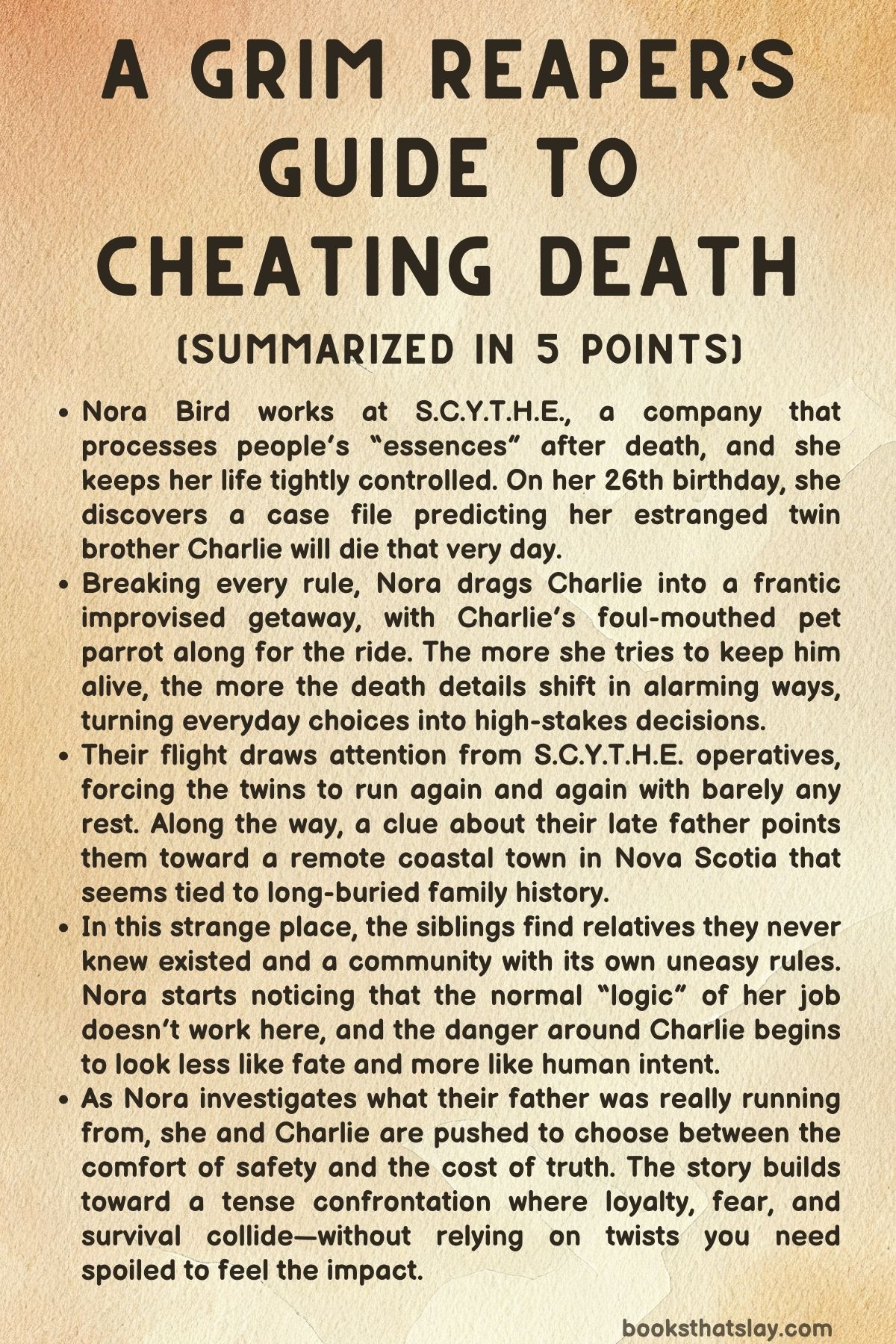
A Grim Reaper’s Guide to Cheating Death by Maxie Dara is a contemporary, darkly funny fantasy thriller about a woman who works in the logistics of death and discovers her twin brother is scheduled to die the same day. Nora Bird’s job at S.C.Y.T.H.E. trains her to treat death like paperwork: a file, a time stamp, a routing decision.
But when the file has Charlie’s name on it, she breaks every rule she’s sworn to follow. What starts as a frantic attempt to keep him alive turns into a road trip that exposes family secrets, a town built around escaping death, and the steep price people will pay for safety. It’s the 2nd book in the S.C.Y.T.H.E Mystery series.
Summary
Nora Bird turns twenty-six with the same private ache she carries every year: her parents died on her eighth birthday, and nothing about birthdays feels celebratory anymore. She works as an administrative coordinator at S.C.Y.T.H.E., a company that processes human essences after death, sorting case files by cause and assigning them to collection agents.
Her office is sterile and windowless, the kind of place where grief is reduced to forms and efficiency. A coworker leaves her a blue-frosted cupcake, but Nora throws it away, unable to stop thinking about how easily bodies fail.
On her phone she sees the annual, awkward exchange with her estranged twin brother, Charlie. They keep contact to a thin thread: a short text, a reply, silence until next year.
Nora reaches for the next case folder and freezes. The name on the file is “Charles Ezra Bird,” age twenty-six.
The details are worse: it lists his death as being struck by a vehicle at 11:15 a.m. on Calton Avenue.
Nora knows what a case file means at S.C.Y.T.H.E. It isn’t a prediction or a possibility. It’s a scheduled collection.
If the file exists, the death is already in motion.
Nora panics and does the one thing she is absolutely forbidden to do: she grabs Charlie’s file and runs out of the building. She understands the risk instantly.
S.C.Y.T.H.E. does not tolerate interference. Still, she drives straight to Charlie’s shabby place, bangs on the door, and demands he come with her.
Charlie is groggy, irritated, and amused by her intensity. Nora can’t explain the truth without exposing her employer, so she improvises, claiming it’s a spontaneous birthday road trip.
Charlie shrugs and agrees, but insists on bringing “Jessica,” a gray parrot in a cage with a talent for mimicking profanity. Nora doesn’t have time to argue.
She hauls Charlie and the bird into her car and speeds away, trying to outrun a time written in ink.
On the highway, Charlie pushes for the real reason. Nora finally tells him the truth: she handles death cases and has proof he is supposed to die today.
She shows him the file. Charlie reads it, then frowns and points out something impossible: the cause of death has changed.
It no longer says he’ll be hit by a vehicle. Now it says choking, with a collection time of 12:00 p.m.
Nora pulls over, shaken. Charlie produces Doritos, and Nora slaps the bag away, insisting he can’t eat anything until after noon.
Charlie complains, but he plays along, and the two of them sit inside a moving countdown, trying not to breathe wrong.
As the minutes crawl, Nora’s fear becomes rigid focus. Charlie grows hungrier and more sarcastic.
Nora decides a smoothie feels safe and stops at a roadside shop. She orders two green drinks and runs to the restroom.
When she returns, her car is gone. So is Charlie.
Her mind snaps to the worst conclusion: S.C.Y.T.H.E. has found her, and the system has corrected itself. The clock reads 11:55.
Nora runs through the parking lot, searching, until she hears Charlie yelling from across the road. He has driven the car to a Wendy’s and is calmly eating a Frosty, arguing he can’t choke on it.
Nora drags him back, furious, but the noon mark passes and Charlie is still alive.
Relief barely lands before the file shifts again. Now the cause of death reads “car accident,” with no exact time and a vague location: “Highway 286.” Nora realizes she may have made things worse.
By preventing specific deaths, she might have knocked the system loose, replacing a precise event with a roaming threat that could strike at any moment. She decides they need to stop driving and disappear.
They pull into a motel and get a room, exhausted and on edge. Nora finally collapses into sleep.
She wakes to Charlie trying, in his chaotic way, to give her a birthday moment: a match stuck into a Moon Pie like a candle, and a gift he found among their late grandmother’s belongings. It’s an old photo of their father, Martin Bird, at age twenty-six, standing with two other people in Virgo Bay, Nova Scotia, dated 1996.
Nora knows almost nothing about her father’s early life, and the photo feels like a door cracked open.
Before they can process it, loud knocking rattles the motel hallway. Nora peers through the peephole and sees black-clad operatives bearing S.C.Y.T.H.E.’s emblem, moving door to door.
They reach the twins’ room and begin pounding. With no easy exit, Charlie throws his duffel bag out the window and jumps into an empty pool below, landing hard among dry leaves.
Nora hesitates, then slips on the Moon Pie and tumbles out after him. They scramble back to the car and flee.
Nora realizes her employee badge is glowing red, acting as a tracker. She throws it out the window, severing the beacon.
With nowhere safe, they decide to follow the photo’s clue and head for Virgo Bay. The drive is full of near misses, each one feeling like the file reaching for Charlie again.
They take a ferry route toward Nova Scotia and stop at a late-night diner to ask about directions. The mood tightens when they say “Virgo Bay.” An older man recognizes the surname “Bird” and warns them that outsiders aren’t welcome, but he offers rough guidance anyway.
On a remote coastal road near their destination, the danger sharpens. A rabbit darts onto the road, and Nora has a sudden certainty that swerving right means Charlie dies.
She swerves left, and the car skids off the road, smashes through a wooden stake, and stops with the hood steaming. Airbags burst.
Charlie’s nose bleeds. Nora’s wrist throbs.
The car won’t start, and both their phones are useless. They walk in the cold, sharing Nora’s jacket and carrying the parrot tucked into Charlie’s bag, until they reach a small café run by a woman named Juliette MacLean.
Juliette feeds them and reacts strangely to the mention of Virgo Bay, refusing to drive them there. Instead she points them toward a grassy path and sends them on foot.
They eventually find the sign: “Welcome to Virgo Bay.” The town is small, tidy, and watchful. Curtains twitch.
People gather. Nora tells Charlie to run, but a woman in peach pajamas grabs Nora’s shoulder and calms the crowd, smiling as she announces that Martin’s children have returned.
The woman introduces herself as Patricia, or Patty, and reveals she is Martin’s younger sister. Nora is stunned.
Their father always claimed he was an only child. Patty insists family history is messy and welcomes them in.
In Patty’s home, Nora checks Charlie’s file and finds the cause of death has become a shifting blur, as if the words can’t settle. The town seems to distort the system itself.
Patty brings them to meet grandparents Ruby and Richard and a web of relatives. The twins are absorbed into a loud meal and an unsettling warmth.
Ruby shows them the preserved basement bedroom where their father grew up, complete with his sketches on the walls, and offers it to them. Nora, used to emptiness, doesn’t know what to do with being wanted.
But safety doesn’t last. Strange phrases come from the parrot.
Nora catches glimpses of danger at the edge of her vision. One night she sees a figure standing over Charlie’s bed with something glinting.
The parrot squawks “Knife,” and the intruder escapes into the dark. Nora checks the file again and realizes the blurred letters she saw earlier were not a warning about stairs.
They meant “stabbed.” Someone here is trying to finish what the file started.
Then smoke pours from the grandparents’ kitchen. Nora storms toward the fire screaming for Charlie.
He isn’t trapped, but he ran back for the parrot, and Patty redirected him to her house alone. The oven wiring appears cut, suggesting sabotage.
Nora starts mapping suspects: Patty’s convenient instructions, Phil’s tools, Ruby’s rigid protectiveness, the family’s shared interest in keeping the town’s secrets quiet.
Nora follows hints toward an old stone house in the woods and discovers signs of someone living there. When she pushes for answers, Ruby and Richard confess the truth: Virgo Bay is a “Blind Spot,” a place where Death can’t claim people through sickness or age.
Inside its borders, residents don’t die the usual way. Only human actions can kill.
That explains the blankness Nora noticed in other case files. The town’s protection also explains why her father’s decision to leave mattered so much, and why his death happened outside.
Nora’s relief is immediate and sickening. A town without natural death sounds like salvation to someone who has built her life around fear.
But Charlie is still at risk, because human hands can still end him, and someone keeps trying. Nora learns the men are working on their wrecked car.
She races to them and saves Charlie from nearly tumbling off seaside cliffs. Afterward she tells Charlie about the Blind Spot and argues they should stay—if they can stop the person targeting him.
Charlie doubts that hiding forever is living, but he’s scared too.
Nora overhears Ruby and Richard speaking with someone who says they need Charlie “taken care of.” The figure leaving is Patty, carrying new rope. Nora’s suspicion hardens.
She confronts Uncle Charles, who seems gentler than the others and explains their father wanted more than Virgo Bay could offer. Nora and Charlie decide the truth must be in their father’s old letters.
They search the preserved bedroom, discover notes hidden behind his sketches, and read them together. The tone shifts over time from casual updates to alarm.
In the final letter, written less than a week before their parents’ deaths, Martin calls Virgo Bay “the town that death forgot,” says it ruins people, and writes that he learned of an organization called S.C.Y.T.H.E. and intends to report the Blind Spot. He begs Charles to destroy the letter and insists life was never meant to be endless.
The parrot becomes another clue. It repeats phrases linked to Martin, and Nora realizes it has a history here.
At midnight, the twins sneak to the stone house and speak to Oliver, Richard’s father, who is 127 and living in isolation. Oliver admits the Blind Spot has been protected through violence and that Martin’s plan threatened everything.
He believes someone in his family killed Nora and Charlie’s parents, but Patty won’t reveal who. The pieces click into a new, sharper risk: Charlie isn’t dying because of fate alone.
He’s a problem to be removed.
Nora decides to call S.C.Y.T.H.E. and expose Virgo Bay, even though it means destroying the one place that seems to defeat death. Ruby, Richard, Patty, and Phil close in as the twins try to flee with Charles’s help.
Charles drives them to a pay phone outside town. There, the parrot suddenly screams in Martin’s voice, reenacting his final moments and calling out “Charles.” Nora understands all at once: Uncle Charles murdered their parents to stop Martin from reporting the town.
Charles tries to persuade Nora that the cost was worth it, that she understands the value of safety. Nora refuses and dials S.C.Y.T.H.E. During the struggle, Charles stabs Charlie in the chest, and Charlie collapses.
Charles turns on Nora, but the parrot distracts him long enough for Nora to fight back. Patty and Phil arrive, and Phil holds Charles at gunpoint.
Nora completes the call, reporting the Blind Spot and giving their location.
S.C.Y.T.H.E. arrives in black vans, arrests Charles, and moves to eliminate Virgo Bay’s protection. Nora breaks beside Charlie’s body, certain she has failed at the one thing she tried to do.
Months later, the town holds its first real funeral and burial as death returns. Oliver dies.
Ruby suffers a heart attack. The world rebalances, and the immortality the town clung to ends.
Then, in the quiet after the loss, Charlie walks back into Nora’s life. He reveals he “played dead,” saved by a thick jacket and timing, and that the corrupted case file has finally corrected itself: it now belongs to Charles Oliver Bird in custody, not Charlie.
Nora is spared punishment for interfering, but only if she never disrupts a death again. With Charlie alive, their family story exposed, and the town changed forever, the twins choose the only honest next step: stop bargaining with fate and live.
Characters
Nora Bird
In A Grim Reaper’s Guide to Cheating Death, Nora Bird is defined by vigilance, control, and a deep dread of randomness that has been welded into her personality since childhood. Her parents’ death on her eighth birthday becomes the emotional origin point that shapes everything she does at twenty-six: she treats safety like morality, rules like life rafts, and uncertainty like an enemy that must be managed.
That’s why her work processing death cases suits her on the surface—sorting deaths into neat categories gives her a sense of order—but the moment Charlie’s file lands in her hands, her identity fractures between loyal employee and desperate sister.
Nora’s growth comes through the slow collapse of her belief that carefulness guarantees protection. Every time she prevents one version of Charlie’s death, the system becomes more chaotic, forcing her to accept that control can create new dangers.
What ultimately makes her compelling is that her courage doesn’t look like fearlessness. It looks like acting while terrified, choosing love over compliance, and finally realizing that safety at any cost is not the same thing as living.
Charlie Bird
Charlie functions as Nora’s mirror and counterweight. Where she tightens, he loosens; where she plans, he improvises; where she fears risk, he treats it like background noise.
At first he appears unserious—groggy, sarcastic, and more attached to snacks than urgency—but that casualness becomes a survival strategy. Humor is how he keeps the situation from turning him into a helpless object of fate.
As events become more dangerous, his attitude evolves into a deeper philosophy. Charlie admits fear without letting it control him.
He frames life as something you actively choose rather than something you postpone until it feels safe. His eventual survival reinforces a central truth about him: he isn’t careless.
He is adaptive, and his instinct is always to move forward instead of freezing inside dread.
Jessica (Silver), the Parrot
Jessica—later revealed to be named Silver—begins as comic chaos, a profanity-mimicking pet that reinforces Charlie’s messy lifestyle. Gradually, however, the bird becomes one of the story’s most unsettling instruments of memory and revelation.
Silver functions almost like a living recorder, repeating fragments of speech that only gain meaning later.
The parrot’s role shifts from joke to warning system to messenger. It blurts out alarms like “Knife,” echoes phrases linked to Martin, and ultimately reenacts the moment of his death.
Because the bird cannot keep secrets, it becomes the one presence that undermines every attempt to hide the truth. Symbolically, Silver represents the past refusing to stay buried.
Martin Bird
Martin Bird is the absent center of the narrative—physically gone, yet shaping events through what he left behind and what others did to silence him. Once a resident of Virgo Bay, he ultimately rejected the town’s promise of immortality.
His departure suggests both ambition and a moral line he would not cross.
The letters hidden behind his childhood drawings reveal his gradual realization that the town’s apparent miracle comes with a terrible cost. What initially looks like a refuge from death is sustained through secrecy and violence.
His decision to expose this truth becomes the reason he is murdered.
Even after death, Martin’s influence remains transformative. The truth he left behind dismantles the town’s illusion of safety and gives Nora a different inheritance—one built not on fear, but on choosing honesty even when it hurts.
Charles Bird (Uncle Charles)
Uncle Charles is one of the most chilling figures in the story because his warmth seems genuine until the truth emerges. At first he appears to be the safest adult in Virgo Bay: calm, approachable, and sympathetic when others feel guarded or controlling.
That kindness becomes the disguise for his real role as a protector of the town’s immortality system. Charles believes safety is worth any price, even murder.
His worldview is built on the idea that someone must be willing to pay the cost of maintaining the town’s secret, and he has convinced himself that he is strong enough to do it.
What makes him terrifying is not only his violence but also his conviction. He believes he is offering Nora a gift by inviting her into the same logic.
His betrayal reveals how easily love and protection can become twisted into possession and control.
Patricia “Patty” Bird
Patty first appears as a welcoming presence—the smiling aunt who diffuses tension and offers Nora and Charlie a place within the family. That first impression matters because she represents the town’s softer form of control.
Her warmth comes with invisible expectations. Hospitality blends with surveillance, and affection quietly pressures people to obey the town’s rules.
Patty embodies the idea that belonging in Virgo Bay requires loyalty to its secrets.
Her actions often occupy a gray area. She may genuinely care about her relatives, yet she also participates in the social pressure that keeps the town’s system intact.
This ambiguity makes her one of the story’s most complex characters: both protector and enabler.
Ruby Bird
Ruby initially seems like an affectionate grandmother, overwhelming Nora with hugs and home-cooked meals while proudly preserving Martin’s childhood room. Beneath that warmth lies an unyielding determination to protect the town’s way of life.
She believes survival depends on controlling information and discouraging curiosity. When Nora asks too many questions, Ruby’s kindness hardens into anger, revealing that love in Virgo Bay often comes with conditions.
Ruby’s life has been shaped by the fear of losing the town’s protection. When death finally returns and she suffers a heart attack, the moment feels tragic yet inevitable.
Her identity had been built around outrunning mortality, and once that illusion breaks, the emotional cost becomes impossible to avoid.
Richard Bird
Richard serves as the town’s calm and reasonable authority figure. He presents Virgo Bay as a sanctuary, explaining its history with careful logic and gentle tone.
His approach makes the town’s system sound protective rather than oppressive.
This framing is important because it shows how communities justify morally questionable structures. By emphasizing safety and tradition, Richard minimizes the harm required to preserve them.
Although he appears compassionate—checking Nora’s injuries and offering measured explanations—he ultimately participates in the effort to corner the twins when they attempt to leave. His character illustrates how power can present itself as paternal care while quietly removing other people’s choices.
Oliver Bird
Oliver is the story’s oldest and most haunted figure. Living alone in the stone house at the edge of town, he is 127 years old and deeply weary.
He represents both the origin of Virgo Bay’s legend and the cost of its unnatural longevity.
Unlike most residents, Oliver openly acknowledges that the town should not exist. His long life has not given him wisdom so much as exhaustion.
He knows violence has been used to preserve the Blind Spot, yet decades of guilt have turned him into an observer rather than a fighter.
When death finally returns and Oliver dies, it feels less like tragedy and more like release. His passing symbolizes the closing of an unnatural chapter in the town’s history.
Phil
Phil embodies physical competence—someone who repairs, builds, and carries tools. Because of that capability, Nora initially suspects him of being involved in the attempts on Charlie’s life.
In a community where secrets are everywhere, practical skill can easily look like menace.
However, Phil ultimately complicates that suspicion. His presence with a rifle near the climax positions him as someone capable of enforcing the town’s will, yet he also plays a role in stopping the worst violence from continuing.
Through Phil, the story explores how ordinary people can become instruments of power within secretive systems, even when they are not the architects of those systems.
Juliette MacLean
Juliette operates as a threshold character between the ordinary world and the strange reality of Virgo Bay. Running a small café outside town, she offers the twins warmth, food, and directions when they arrive injured and exhausted.
Her nervousness about the town signals that something is wrong even to outsiders. She helps Nora and Charlie, but she refuses to drive them there herself, suggesting that the place has a reputation that people nearby understand without fully explaining.
Juliette’s role highlights how the town’s secrecy radiates outward, creating a quiet zone of fear and avoidance among those who live nearby.
Vince
Vince appears mostly in group scenes, yet he contributes to the sense of a tightly connected community where individuals act collectively. He helps during the cliff rescue and moves alongside the other townspeople in ways that sometimes feel protective and sometimes threatening.
His presence illustrates how the town operates less through single villains and more through shared participation. Vince represents the ordinary resident who helps sustain the community’s system simply by being part of it.
Themes
Bureaucratic control over death and the limits of paperwork
Nora’s life is built around processing death as administrative routine, and the story keeps returning to what happens when something vast gets treated like office work. A Grim Reaper’s Guide to Cheating Death shows a company that turns mortality into folders, categories, rules, and handoffs, where a human life becomes a scheduled “collection time” and a location line on a form.
Nora has learned to cope by trusting those procedures more than her own instincts, because procedures feel safer than grief or uncertainty. The moment Charlie’s name appears in a file, that trust breaks in a very specific way: it is not a philosophical crisis first, it is an operational crisis—someone she loves has been converted into a case number, and she has access to the internal machinery that will make it happen.
Her decision to remove the file and run is both a personal rebellion and a collision between lived reality and institutional logic. As the cause of death keeps changing, the book highlights how fragile “certainty” is when it depends on documentation.
The file reads like fate, yet it behaves like a system trying to correct itself, exposing the difference between authority and accuracy. The shifting entries also reveal a darker idea: prevention inside the system doesn’t necessarily create freedom; it can create more volatile outcomes, like a malfunctioning process that keeps searching for completion.
Nora’s fear becomes attached to updates and redactions, as if the document itself is hunting them. The work culture at S.C.Y.T.H.E. reinforces this emotional distance—birthday gestures become suspicious, health risks are calculated, secrecy policies outweigh relationships, and punishment for interference is immediate.
The book ultimately argues that a bureaucratic approach to death creates a false sense of mastery. It can assign, track, and enforce, but it cannot actually resolve the human need for meaning, love, and accountability.
When Nora finally reports Virgo Bay, she is choosing responsibility over compliance, accepting that a system that manages death must also be answerable to the living.
Twinhood, estrangement, and the cost of protection
The relationship between Nora and Charlie is not presented as automatic closeness; it is a bond strained by years of distance, different coping styles, and an old tragedy that shaped them in opposite directions. Nora’s instinct is to manage risk, anticipate outcomes, and prevent harm before it happens.
Charlie’s instinct is to treat danger with humor, appetite, and improvisation, as if refusing to grant fear the power Nora gives it. Their early interactions show how estrangement can exist even inside family intimacy: they share history and a birthday, yet their communication is reduced to a yearly ritual text exchange.
When Nora forces Charlie into the car, she is trying to save him, but she is also taking control of his autonomy without explaining the rules. That imbalance matters, because the book keeps questioning whether protection that ignores consent becomes another kind of harm.
Charlie’s resistance—eating when Nora says not to, treating the file as absurd, testing boundaries—reads like immaturity at first, but it gradually becomes a challenge to Nora’s worldview. He refuses to live as a hostage to a prediction, even when the prediction is terrifying.
As the stakes rise, their estrangement starts to turn into collaboration, not because they suddenly become “close,” but because they have to learn each other’s language under pressure. Nora learns that love cannot be reduced to control, and Charlie learns that optimism without caution can turn into recklessness that endangers both of them.
Their shared trauma also sits under every decision. The parents’ deaths on their eighth birthday create a permanent association between celebration and disaster, and both siblings carry that imprint differently.
Nora tries to make the world predictable so the worst moment never repeats. Charlie tries to live loudly so the worst moment doesn’t define him.
The climax makes their bond brutally clear: Nora is willing to risk punishment, career, and safety for Charlie’s life, and Charlie refuses to let Nora surrender her integrity for the comfort of hiding forever. Even after the apparent death, the ending reinforces that their relationship has shifted from avoidance to commitment.
“Live” becomes a mutual decision rather than a coping slogan, and their twinhood becomes less about similarity and more about choosing each other despite difference.
Fear as a lifestyle and the struggle to choose a life anyway
Nora’s fear is not occasional; it is structured into how she eats, works, celebrates, and trusts. The blue-frosted cupcake matters because it shows a person who cannot accept simple pleasures without scanning for threats.
That same mindset drives her initial decisions: if she follows the rules, if she plans perfectly, if she eliminates variables, she can keep catastrophe from happening again. A Grim Reapers Guide to Cheating Death treats fear as something that can look responsible on the surface while quietly shrinking a person’s world.
Nora’s job reinforces this shrinking, because she is surrounded by evidence that death is everywhere and that outcomes can be scheduled. The file turns her fear into a chase, where every minute becomes a trap and every choice becomes potentially fatal.
The constant updates also teach her a harsh lesson: trying to control fear through prediction can increase fear, because it turns life into a sequence of threats to manage. Virgo Bay offers the ultimate temptation for someone like Nora: a place where the most terrifying category of death—sickness, aging, randomness—does not apply.
The town’s promise aligns perfectly with her desire for safety, and the relief she feels there is genuine. But the story refuses to treat safety as purely good.
It shows how fear can make people accept morally corrupt arrangements if those arrangements reduce personal risk. When Nora admits she wants Virgo Bay because fear controls her, it is one of the clearest statements of the theme: comfort can be a cage when it is built from avoidance.
Charlie’s counterpoint is equally important. He is terrified too, but his fear expresses itself as refusal to waste time.
He is more afraid of not living than of dying. That contrast forces Nora to confront what “survival” means.
Is it simply continuing to exist, or is it choosing a life that includes uncertainty, loss, and responsibility? By deciding to call S.C.Y.T.H.E., Nora chooses a life where death is real again, not because she wants pain, but because she recognizes that pain is part of a truthful world.
The theme lands in the aftermath as well: returning death allows funerals, endings, and accountability. Fear does not disappear, but it stops being the only architect of Nora’s choices.
Immortality as corruption and the violence required to maintain “peace”
Virgo Bay presents immortality not as a miracle but as a moral compromise that demands ongoing harm. Inside its borders, people do not die of sickness or age, which sounds like a dream until the story reveals the cost: death has been blocked, and human violence becomes the only remaining exit.
That condition doesn’t create paradise; it creates a town where murder becomes a tool for preserving the illusion of safety. The fact that residents can live indefinitely also changes the meaning of accountability.
If no natural ending arrives, power structures can harden, secrets can remain unchallenged for generations, and the community can normalize extraordinary wrongdoing as “necessary.” The town’s identity as a sanctuary depends on silence, exclusion of outsiders, and enforcement by family networks. In that environment, ethics become transactional.
People justify cutting wires, staging accidents, stalking, and ultimately killing because the larger goal is “protecting” the town’s condition. The story makes it clear that immortality here is not neutral; it is something people actively guard, and guarding it turns them into perpetrators.
Martin Bird’s decision to leave and report the town shows how unbearable the compromise became for him. His letters shift from family updates to moral warning, arguing that life “was never meant to be forever.” That line frames immortality as distortion rather than gift.
It also shows how immortality can erode empathy: when life becomes endless, other people’s lives can become expendable obstacles. Charles, the uncle figure who appears steady and helpful, embodies the final stage of that erosion.
He believes he understands the “cost” of safety, and that belief permits him to murder to maintain a world without endings. His argument is seductive because it mirrors Nora’s fear-based logic, and that is why it is dangerous.
The book also ties immortality to stagnation. Virgo Bay preserves rooms, drawings, routines, and authority figures, turning memory into museum display rather than living process.
That preservation looks comforting, but it is also refusal—refusal to change, to mourn, to let time move. When death returns, it brings grief, but it also brings truth.
Funerals become possible, the town’s spell breaks, and people can no longer hide behind the excuse of permanence. The theme insists that a peaceful life cannot be built on perpetual avoidance of endings, especially when that avoidance requires sacrificing others.
A world without death does not automatically become kinder; it can become more ruthless, because nothing forces reckoning.
Secrecy, inherited lies, and the fragile architecture of family myths
The twins grow up with a version of their father that contains gaps: no hometown, no sister, no larger family history, just the life he built after leaving. When they arrive in Virgo Bay and learn Patty is their aunt, the revelation is not just surprising—it exposes how family narratives can be engineered as survival strategies.
Martin’s lie about being an only child looks like betrayal on the surface, but the story complicates it by showing the pressures behind it. He left a place built on secrecy, and secrecy follows him even into ordinary life.
That suggests an inherited pattern: to keep danger away, you hide truth; to keep peace, you control information. Nora’s job at S.C.Y.T.H.E. functions the same way, with policies that demand silence and punish disclosure.
So Nora inherits secrecy twice—through her family and through her workplace—and she initially treats it as normal. Virgo Bay amplifies the idea that secrecy is not passive; it is maintained through social pressure, warnings, and threats.
Ruby’s anger when Nora asks questions is not only personal defensiveness; it is community enforcement. The town’s collective watching—the curtains moving, doors opening, bodies gathering—shows how secrets become public property in closed systems.
Everyone participates, whether by intimidation or compliance. The discovery of Martin’s letters hidden behind drawings is a direct confrontation between appearances and truth.
The drawings look like harmless keepsakes, yet they conceal messages that describe fear, guilt, and urgency. That concealment mirrors how the town itself works: ordinary surfaces hiding violent foundations.
Nora’s search for “why” becomes more than curiosity; it becomes an attempt to rebuild identity using facts rather than inherited stories. The parrot, first treated as a joke, becomes a vehicle for memory that cannot be easily controlled.
It repeats phrases, exposes moments, and finally reenacts Martin’s death in a way that collapses the remaining illusions about who can be trusted. The key betrayal is not only that someone killed the parents, but that the person was embedded in the family structure that offered the twins refuge.
That twist sharpens the theme: the most dangerous secrets are often stored inside relationships that feel safe. When Nora chooses to report Virgo Bay, she is refusing to continue the tradition of protective lying.
She accepts that truth may destroy comfort, but she also recognizes that comfort built on deception is unstable and morally contaminated. In the end, the book suggests that healing does not come from preserving family myths.
It comes from facing what was hidden, naming the harm, and choosing a future that is not dictated by old silences.