A Guardian and a Thief Summary, Characters and Themes
A Guardian and a Thief by Megha Majumdar is a near-future novel set in a Kolkata buckling under climate collapse. Heat waves, food scarcity, and an unraveling social order press ordinary people into impossible choices.
The story follows a mother preparing to flee to the U.S. with her little girl and aging father, and a young man from a devastated coastal village who survives by taking what he can. Their lives collide over a theft that becomes a moral tug-of-war: who gets to be saved, who is blamed, and what “home” means when the ground beneath you is failing.
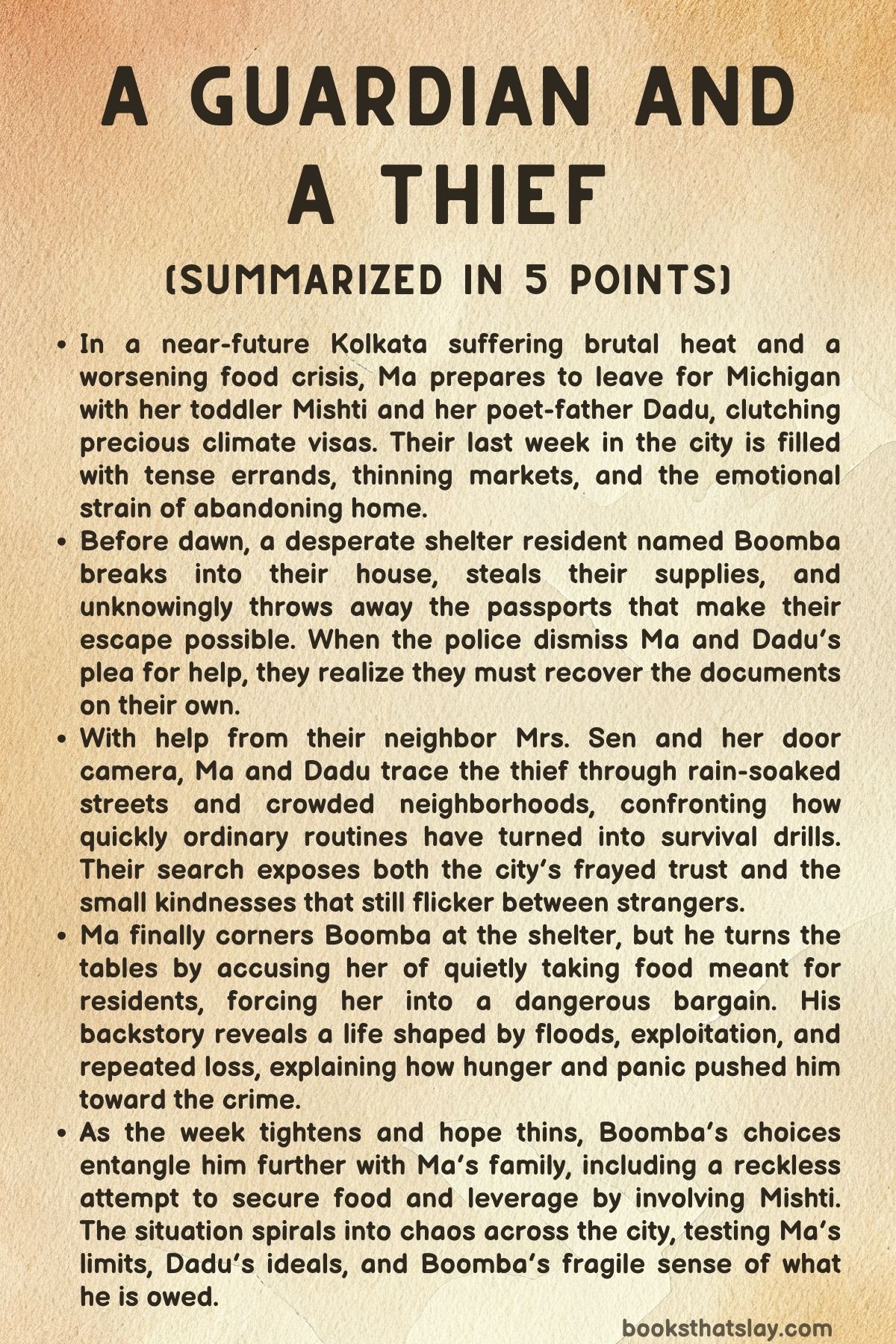
Summary
Kolkata is suffering under brutal heat and a worsening food shortage. Markets are bare, theft is rising, and daily life feels close to breaking.
Ma, a shelter worker, has been quietly saving rice, lentils, eggs, and other staples in a locked storeroom under the stairs. She knows hoarding is dangerous, but she is counting days: in a week she, her two-year-old daughter Mishti, and her widowed father Dadu are meant to leave for Michigan.
Baba, Ma’s husband, has already moved to Ann Arbor for a research job and has secured scarce U.S. climate visas and plane tickets for them. The family’s home is half-emptied and suitcases are ready, as if departure will happen simply because they have planned it.
Dadu spends his evenings writing poems in a battered notebook and entertaining Mishti with stories and an airplane picture book. He acts lighthearted, but he is afraid of leaving behind the city he loves and the identity he has built there.
One night Ma and Dadu take Mishti to the U.S. consulate to collect their passports. The streets are tense and packed.
Public transport is failing because of pollution rules and heat-related strikes, so they take a rickshaw through the night. Inside the consulate, the air-conditioning is icy and the security is heavy.
A blond officer hands them the passports with climate visas stamped inside. Ma and Dadu check the dates over and over, stunned that the abstract idea of leaving has turned into paper they can hold.
Ma tucks the passports deep in her purse.
On the way home they stop at their usual market for Mishti’s favorite vegetable, cauliflower. The hall is nearly empty, offering only scraps and substitutes—seaweed, cricket flour, synthetic fish, contaminated rice.
Their black-market seller has vanished. Ma refuses to buy the algae despite Mishti’s pleading.
At home, Mishti cries, and Dadu tries to soothe her with promises that America will have all the cauliflower she wants. Ma feels the pull of goodbye already tightening around her.
Before dawn a young shelter resident named Boomba breaks into their house. Two days earlier he had seen Ma secretly take donated eggs from the shelter pantry, and in a city where everyone is hungry, that small act convinces him that survival belongs to whoever grabs first.
He slips through a kitchen window Ma left slightly open, steals Mishti’s toy truck for his little brother, and lifts Ma’s purse from the bedroom doorway. On the stairs he discovers a hidden switch behind a child’s drawing that opens the storeroom.
He empties the cached food into bins and escapes. Outside, he sells almost everything quickly to people waiting near a community kitchen.
When he sorts the purse, he drinks their water, pockets the phone and electrolytes, and tosses the passports into a trash heap, not recognizing what they are.
In the morning Ma finds the purse gone, the storeroom ransacked, and Mishti’s truck missing. Their attempt to call the police fails, so they go to the station.
The officer on duty, unimpressed and suspicious, hints that Ma may be hoarding or seeking insurance money. He refuses to file a report.
With no paperwork, the consulate will not help. When Ma and Dadu return there anyway, Ma bribes a guard to enter, but the blond officer insists the visas must be canceled and re-applied for, and there are no appointments for months.
Dadu tries to use his reputation as a writer to pressure her, but she only warns them not to return without the passports. The family goes home shaken and nearly silent.
Their neighbor, Mrs. Sen, a solitary professor protecting two rescued parrots, offers help. Using her security camera footage, she and Ma and Dadu spot a skinny man at 3 a.m. carrying a bin and wearing Ma’s purse. The image is blurry, but Mishti points out his Scooby-Doo T-shirt.
They print a still photo and start searching the neighborhood in rain, showing it to anyone who will look. Most people are exhausted and indifferent, worn down by the crisis.
During a small march for shade and shelter, an activist editor recognizes Dadu from an op-ed and agrees to have the video enhanced. She gives them food for Mishti, and Dadu feels a flicker of hope in the city’s leftover kindness.
At a stationery shop Dadu trades peanuts for crayons to reward Mishti. The shopkeeper sees the photo and recognizes the Scooby-Doo shirt as his son’s, stolen recently.
He remembers chasing the thief and says the man dropped a fine handkerchief with the hexagon logo of a billionaire donor. Ma recognizes that kind of handkerchief from her shelter.
The thief must be one of the residents. That night the enhanced video arrives, clear enough to identify Boomba.
Ma goes alone to the shelter, confronts him, and threatens the police. Boomba calmly turns the threat back at her: he saw her stealing shelter supplies, and if she reports him, he will report her.
Ma understands that exposure could destroy her visa chances and even put her in jail. Desperate, she asks only for the passports.
Boomba admits he threw the “little books” away but remembers where. He offers to lead her there on one condition: when Ma leaves, his family will live in her house.
He wants the keys and legal transfer.
Boomba’s past comes into view. He grew up in a flood-ravaged coastal village where storms repeatedly erased homes and work.
His father was mauled while collecting honey in tiger country. His mother labored planting mangroves.
Boomba himself tried different jobs, was bullied by local strongmen, and became caretaker to his baby brother Robi. After an accident he caused burned their hut, he left for Kolkata at eighteen to find a future.
The city chewed him up: he was robbed by fake policemen, fired for petty theft while delivering online orders, and lost a rented room when a storm felled a tree onto it. Twelve days before the break-in he arrived at Ma’s shelter claiming to be fifteen, got a bed, then fled during a dengue scare and broke into Ma’s home out of fear and hunger.
On the fourth day Boomba takes Ma to the trash hill. A storm hits, and Ma digs for hours, finding nothing.
Boomba slips away. At home Mishti grows weaker from hunger.
Dadu goes out looking for food as the streets turn violent. He ends up taking an orange from another starving child and later breaks into a rich house to steal cauliflower and canned goods.
He is beaten but escapes and brings food home, hiding what he did. Mishti eats happily the next morning, unaware of the cost.
Ma, losing faith in official systems, seeks help from a man who sells forged documents from a back room of a photocopy shop. He shows her counterfeit passports and visas that scan as real, offering to deliver them in two days in exchange for gold.
Ma feels trapped between time and corruption, but she agrees. Soon Boomba appears at their house again, frightened of retaliation at the shelter.
He claims the storeroom as his room and repeats his demand for the house. Ma lets him stay, hoping she can leave before he acts.
Restless and paranoid, Boomba wanders the house at night, hoarding small items and imagining the home as proof he has finally won something solid. He phones his mother and tells her his “boss” is giving him a house; she and the family begin preparing to come.
The next morning Mishti is gone. Mrs. Sen’s camera shows Boomba taking her away in a rickshaw at dawn.
Ma and Dadu chase leads until a driver admits dropping them at the ferry jetty to the Hexagon, the billionaire’s floating island, where a wedding feast for poor children and guardians is underway. Ma tries to chase by ferry but arrives too late and humiliates herself by jumping into the river, failing to swim out.
She and Dadu can only wait.
On the island, Boomba uses Mishti’s presence to get past suspicion. He feeds her at the overflowing feast, careful with fish bones, wiping her face, keeping her close.
For a few hours he plays the guardian. When riots break out as people storm storehouses, Boomba grabs a jeweled miniature globe and a sack of rice.
The ferry back is overloaded, chaos spreads, and the boat sinks. Boomba drops the rice to keep hold of Mishti.
They survive, but the ferryman Shanto, who had helped them board, drowns rescuing children.
Boomba returns Mishti by afternoon. Ma snatches her and Dadu, furious, beats Boomba with his walking stick.
Boomba crawls away, still clutching the globe, screaming that they are the real villains. Mishti is frightened and confused, mixing memories of ice cream and animals with terror.
That night Ma and Dadu barricade the house. In the morning Dadu is dead, his body cold beside the table.
Ma performs the cremation rituals in numb shock, Mishti nearby. A driver gives Mishti protein packets afterward, reminding Ma that her child is still alive and needs her.
Ma picks up the forged passports. On the way she ignores a beggar asking for rice, focusing only on escape.
Baba calls again, unaware of Dadu’s death, and Ma hides the truth. On the day of the flight she discovers the forged visa for Mishti has blurred and is useless.
She panics—until a neighborhood ironing man arrives holding the original passports. A ragpicker found them in a dump and brought them to him.
The real visas are intact, water-wavy but readable. Ma feels as if Dadu’s stubborn luck is still guarding them.
She packs Dadu’s ashes into her purse, hides her cash on her body, and leaves with Mishti for the airport.
At the airport the guard lets them through, but the departures board is grim: their flight is canceled, and so is the next day’s. News explains that U.S. politicians have halted incoming flights after protests against climate immigrants and unrest in Kolkata.
People stand staring, drained. Ma argues at the counter and gets a vague promise of rebooking, but she understands it could take years.
She and Mishti drag their suitcases back through streets full of other stranded travelers. Mishti calls Baba and cheerfully says they are almost there; then she blurts that they are going home again.
While Ma is away, Boomba enters Mrs. Sen’s house, hides, and waits for the family to leave. When he sees the suitcases go out, he breaks into Ma’s home, clears the barricades, and declares it his.
His parents and siblings arrive from the village, including sick little Robi. They believe Boomba’s story that the house was gifted to him.
He gives Robi the jeweled globe as a treasure of their new life.
Ma and Mishti return from the airport and Ma sees movement inside her kitchen. She leaves Mishti with Mrs. Sen and rushes in holding Dadu’s secateur, demanding Boomba leave.
Boomba’s father appears in Dadu’s shirt and insists Ma is mistaken. In the struggle he strikes Ma hard with a pressure cooker.
She falls, choking, unable to speak. Boomba wrests the secateur away as the family drags Ma’s body toward the back of the house.
Then Boomba goes next door, finds Mishti laughing with the parrots, calls her by a pet name, says her mother wants her home, and takes her hand. Mishti, confused but trusting, follows him inside.
Characters
Ma
Ma is the tense, organizing force of A Guardian and a Thief, a woman trying to hold together morality, motherhood, and survival while the city unravels. She is practical to the bone—hiding eggs, packing suitcases, memorizing dates, counting days—yet all that efficiency is driven by fear and love rather than coldness.
The crisis pushes her into contradictions: she works at a shelter meant to distribute aid, but she steals from it to protect her family; she believes in rules and documentation, yet she bribes guards and considers forged passports when the system fails her. Her devotion to Mishti is absolute and sometimes ruthless, narrowing her vision until the world becomes a tunnel with her daughter at the end of it.
Grief does not soften her; it sharpens her into a weapon, first against Boomba, then against fate itself. By the end, Ma embodies the book’s tragic question: what happens to goodness when survival becomes a daily negotiation with desperation?
Dadu
Dadu is the moral memory of the household, a widowed father who carries Kolkata’s cultural soul even as the climate disaster strips the city bare. He writes poems, tells stories, and notices humor in the streets, not because he is naive but because he refuses to surrender his inner life to catastrophe.
His tenderness with Mishti shows a man who has lived long enough to value small joys as resistance. Yet Dadu is not untouched by desperation; his search for food reveals a buried ferocity and a willingness to cross lines he once might have condemned.
That duality makes him feel profoundly human—someone who believes in decency but discovers how easily hunger can bend it. His death is not just a personal loss for Ma and Mishti; it marks a collapse of the family’s emotional shelter, leaving Ma to face the city and its predators without the anchor of his perspective.
Mishti
Mishti is the story’s vulnerable center, a two-year-old whose innocence constantly collides with a world that no longer protects children. She wants cauliflower, stickers, crayons, and airplane stories, and those simple desires highlight the cruelty of scarcity more sharply than any adult commentary.
Mishti’s trust is instinctive—she follows Boomba because he offers play and food, not because she understands danger—and that trust becomes both her power and her peril. Her presence forces adults to reveal their true selves: Dadu’s gentleness, Ma’s fierce protectiveness, Boomba’s conflicted capacity for care.
Even when traumatized, Mishti remains a child first, processing disaster through fragments like ice cream, boats, and animal names. She represents the future everyone is fighting over, and the novel’s bleak ending underscores how easily that future can be stolen.
Boomba
Boomba is both thief and mirror, the character who exposes the thin border between victim and villain in a collapsing society. His early actions are brutal—breaking in, stealing food, discarding passports without a second thought—but the narrative refuses to let him remain a simple monster.
His backstory shows a life shaped by flood, poverty, predation, and repeated erasure of hope, making theft feel to him like a survival skill rather than a moral failure. In Kolkata he is constantly humiliated by false authorities and economic traps, so when he finds Ma’s hidden store he interprets it as proof that the world is divided into takers and taken-from.
His blackmail of Ma is ugly but also desperate, a grasp at stability for his family as the climate crisis rearranges every hierarchy. The trip to the Hexagon reveals his most complicated layer: he uses Mishti as a tool to access the feast, yet he ends up caring for her with genuine attentiveness, dropping stolen rice to save her life.
That makes his final violence even more chilling, because it shows how desperation can corrupt someone who is not empty of love. Boomba becomes the living argument that catastrophe does not create evil from nowhere; it amplifies what people are forced to become.
Baba
Baba, Ma’s husband and Mishti’s father, is physically distant but emotionally central, the symbol of escape and the fragile promise of a safer life. From America he speaks in plans—apartments, partitions, sneakers, meals—trying to keep the family’s future vivid.
His optimism is not foolish; it is a coping strategy built on the belief that the climate visas mean something stable. Yet that distance also makes him blind to how quickly reality is decaying back home.
He cannot travel, cannot intervene, cannot even grasp the pace of desperation Ma is facing, so his calls become bittersweet, almost cruel in their normalcy. Baba is the person Ma is running toward, but also a reminder of how survival increasingly depends on geography and paperwork rather than merit or goodness.
Mrs. Sen
Mrs. Sen is the neighbor who quietly embodies ethical stubbornness in the face of collapse. Unmarried, scholarly, and socially isolated, she channels her remaining resources into protecting Abba and Bee Gees, refusing to treat them as expendable even when relatives advise otherwise.
The parrots are her chosen family, and her care for them becomes a form of resistance against the city’s slow dehumanization. She also serves as a bridge between Ma’s private crisis and community support: her security camera, laptop, and willingness to help show that solidarity still exists, even in small, strained gestures.
Tragically, her compassion and fatigue make her vulnerable to Boomba’s manipulation, and her home becomes the first ground he claims permanently. Mrs. Sen represents how decency can persist without power—and how that very decency is often what predators exploit.
Abba and Bee Gees
Abba and Bee Gees, Mrs. Sen’s rescued parrots, are more than pets; they are living symbols of care persisting amid scarcity. Their presence keeps Mrs. Sen tethered to tenderness, and their needs force her into underground markets, showing how even love becomes a logistical battle in crisis.
The birds also unintentionally influence the plot, especially when Abba is used by Boomba as part of his break-in. That twist is cruelly ironic: creatures saved from danger become instruments of someone else’s danger.
Still, in the final stretch, Mishti’s laughter with them offers one of the only glimpses of unguarded joy left in the story, making their role emotionally potent despite their silence.
Shanto
Shanto, the ferryman to the Hexagon, is a fleeting but weighty figure who embodies the grief and rage simmering beneath public order. Having lost his own child to cerebral malaria, he moves through the world with a wound that the feast cannot heal.
His decision to let Boomba and Mishti aboard feels driven by a mix of empathy for the child and resignation toward the chaos of life. On the island he becomes a spark of revolt, denouncing the elite hoarding of food and medicine and helping trigger the riot that ends in the ferry’s sinking.
Shanto’s death is tragic but thematically precise: the people who resist inequality in disaster often pay first and worst, swallowed by the very waters the rich float above.
Themes
Climate collapse as everyday reality
Heat, hunger, and environmental breakdown are not backdrops in A Guardian and a Thief; they define what life feels like minute to minute. The city’s extreme temperatures shut down buses, kill workers, and erase the small predictabilities that once held neighborhoods together.
Food scarcity isn’t presented as a distant crisis but as something that invades kitchens, markets, and even children’s cravings. Ma’s locked storeroom, once a practical space, becomes a moral and emotional pressure point: a symbol of how survival now requires secrecy, planning, and constant vigilance.
The market scenes show ecological damage translating directly into altered diets and shattered trust; familiar sellers vanish, replacements hawk algae and insect flour, and the absence of cauliflower becomes a daily grief for Mishti. Climate stress also distorts time.
Ma’s seven-day countdown to departure is structured like an emergency evacuation, not a normal relocation. Every hour is measured against heatstroke risk, spoiled supplies, and the chance of theft.
Even rain does not bring relief; it arrives as a violent storm that turns the garbage dump into a place where passports dissolve in mud and hope gets lost among rot. The novel makes clear that ecological collapse reshapes social bonds and personal ethics.
People no longer steal because they are evil; they steal because the planet has made normal living impossible. The heat pushes everyone into a tighter corner, forcing decisions that would have felt unthinkable in a stable climate.
In this sense, the environment is not just a setting but an active force that compresses choices, accelerates desperation, and strips away the illusion that society can stay civilized while the earth is failing.
Moral compromise under scarcity
Right from the opening, survival is shown as inseparable from ethical erosion. Ma hides eggs from the shelter, telling herself they are for Mishti and Dadu, while knowing that others in the shelter are hungry too.
Her act is not framed as simple wrongdoing but as a calculated trade between professional duty and maternal fear. Boomba mirrors her in a harsher register.
He steals because he has learned that waiting for fairness means losing everything. His decision to take before being taken is not a philosophical stance; it is a survival rule shaped by floods, predatory employers, fake policemen, and repeated losses.
The story refuses to sort characters neatly into heroes and villains. Ma threatens Boomba with police, but withdraws when he exposes her own theft.
Boomba kidnaps Mishti, yet he also feeds her carefully, saves her from drowning, and for a short time performs genuine guardianship because he needs her safe. Dadu, normally gentle, becomes violent in his search for food, stealing an orange from another child and breaking into a house to secure cauliflower.
Each of these actions is ugly in isolation, but the novel insists on their context: scarcity turns morality into a series of forced bargains. Even institutions reinforce compromise.
Police suspicion and consulate bureaucracy make honest routes useless, pushing Ma toward forged documents. The result is a world where “goodness” is not a stable identity but a fragile practice repeatedly stressed by hunger, fear, and limited time.
The tragedy is not that people become cruel; it is that they are cornered into cruelty while still longing to see themselves as decent. The novel’s emotional power comes from this tension: characters keep trying to protect someone they love even as their methods damage others.
Scarcity makes ethics situational, and the reader is left with the uncomfortable recognition that under similar pressure, almost anyone might cross lines they once believed unbreakable.
Migration, borders, and the illusion of escape
The promise of Michigan operates like a lifeline, but the narrative steadily questions what migration can actually solve. Climate visas and plane tickets seem miraculous at first, proof that there is still a door open for those lucky or connected enough to find it.
Yet the process is fragile. A single theft can erase access to another country, and even when the passports return, politics can slam the border shut overnight.
The canceled flight shows how migration is controlled not by the needs of the vulnerable but by the fears and moods of distant electorates. Ma’s family is treated as a problem to be managed, not as people fleeing a collapsing home.
The airport crowd—dressed for departure, forced to trudge back—captures the cruelty of hope offered and withdrawn. The novel also exposes the unevenness of mobility.
Ma’s husband reaches the U.S. first due to education, employment, and institutional trust. Ma, Dadu, and Mishti must navigate stolen documents, corrupt police, and forged alternatives.
Boomba’s demand for Ma’s house is his own version of migration: if he cannot cross borders, he will occupy the space of someone who can. His dream is not of America’s streets but of a stable roof and safety for Robi.
The border thus becomes more than a national line; it is a dividing logic that separates those permitted to move from those trapped inside disaster zones. The book suggests that escape is never purely personal.
Even when one family secures a path out, the structures that made departure possible can collapse, and the vacated space becomes contested ground. Migration is portrayed as both hope and mirage: a necessary fantasy for endurance, yet never fully reliable because it depends on systems already failing under climate pressure and political backlash.
Class power, hoarding, and organized violence
Inequality in A Guardian and a Thief is not abstract; it is visible in storage rooms, floating islands, and who gets believed by authorities. The sheltered poor survive on donations while wealthy families stockpile supplies behind walls.
Ma lives in the uneasy middle—privileged enough to have documents and a house, precarious enough to fear losing everything if her own theft is exposed. The Hexagon island dramatizes class division in a single location: a billionaire hosts a lavish feast for the poor, an act that looks like charity but also underscores how abundance is concentrated and performative.
The riot that follows is not irrational chaos; it is a predictable revolt against hoarding. When guards fire warning shots and the ferry sinks, the novel shows how inequality becomes lethal once survival resources are treated as property to defend.
Even small objects carry class weight: the jeweled globe Boomba steals is useless for hunger but priceless as a token of stolen prestige, a reminder that the rich can afford beauty while others starve. Class also shapes state response.
Police dismiss Ma and Dadu because they suspect fraud, not because they care about justice. Meanwhile, Boomba’s earlier life shows how poor people encounter violence first from nature, then from systems that exploit them—landlords, bosses, fake officers, local strongmen.
By the end, the home itself becomes a battlefield. The occupation of Ma’s house by Boomba’s family is not a polite transfer; it is enforced through blunt force and the threat of exposure.
The final assault on Ma reveals how quickly property disputes slide into murder once legal protections evaporate. The novel argues that class is not only about who has more but about who is allowed to be safe, heard, and human.
When resources shrink, inequality intensifies into direct conflict, and violence becomes a method of redistributing shelter, food, and dignity—however brutal that redistribution may be.
Parenthood, guardianship, and the cost of care
Caregiving is shown as a form of endurance that shapes every decision. Ma’s identity as a mother is not soft or sentimental; it is tactical.
She hoards food, braces her body against heat, hides cash inside her underwear, and repeatedly checks passports because her daughter’s survival depends on her vigilance. Dadu’s grandparenthood brings another kind of care: storytelling, gentle humor, and small rituals that keep Mishti anchored.
His poems and animal stories function as emotional nutrition in a world where literal nutrition is scarce. Yet guardianship is not limited to family.
Boomba, despite his exploitation, becomes Mishti’s caretaker for a day because the situation demands it; he removes fish bones, wipes her clean, and even sacrifices stolen rice to keep her from drowning. The book refuses to say that caretaking automatically belongs to the morally pure.
Instead, it frames care as something that can appear inside contradiction, necessity, or even guilt. Mrs. Sen’s devotion to her parrots extends the theme beyond humans, showing care as resistance against a world that keeps telling her to abandon the vulnerable.
The parrots are a test of her refusal to accept collapse as a reason to surrender love. The cost of care is relentless.
Dadu dies after pushing his body too far to secure food, and Ma cannot even grieve fully because Mishti needs her upright. Even at the crematorium, motherhood interrupts mourning.
The novel suggests that in crisis, caregivers carry the double burden of protecting others while absorbing grief in silence. Care is not romanticized; it is shown as exhaustion, fear, and the constant risk of failure.
At the same time, it is the thin line keeping anyone alive. The tragedy lands hardest because every act of guardianship, no matter how fierce, is vulnerable to forces bigger than any one person—hunger, violence, bureaucracy, or a ferry tipping in a riot.
State failure and the rise of informal survival systems
The breakdown of formal institutions is steady and complete. Police are unreachable by phone, indifferent in person, and more interested in accusing victims than protecting them.
The consulate follows rigid rules that become cruel under emergency conditions, refusing help without paperwork that the state itself will not provide. Transportation systems are crippled by pollution checks and labor strikes, showing infrastructure buckling under climate stress.
As official routes close, informal systems expand. Ma turns to bribery just to enter the consulate grounds.
She hires street sellers to spread posters, finds black-market networks through market stalls, and finally considers forged passports when lawful reapplication is impossible. Boomba survives through parallel economies too—selling stolen rice at a community kitchen line, moving through shelters, and exploiting the social distrust that treats a lone man as suspicious unless accompanied by a child.
The Hexagon feast functions as another informal zone, where charity replaces policy and where the poor are managed through spectacle rather than rights. The novel shows that when the state cannot guarantee food, safety, or movement, people rebuild order through opportunism, favor exchanges, and threats.
These systems are not inherently evil; they are adaptive. But they are unstable and morally dangerous, because they rely on power, secrecy, and quick bargains.
The very idea of “legal” becomes hollow when legal pathways are inaccessible to those who need them most. This is why Boomba can occupy a house and why his family can believe the lie of a gifted home: the boundary between rightful ownership and takeover is erased once enforcement depends on rumor and brute force.
In the world of the novel, collapse is not only environmental; it is institutional. People are left to invent their own rules of survival, and those rules reward speed, leverage, and the willingness to harm before being harmed.
Hope, memory, and the stubborn presence of beauty
Against heat and brutality, the story keeps returning to small acts that insist life still matters. Dadu’s poems are not escapist; they are a way of marking human meaning when circumstances try to reduce people to bodies in a food line.
His humor about Kolkata’s spirit is an argument that culture can survive even when markets empty and buses vanish. Mishti’s sticker games, airplane picture book, and joy over crayons are not naïve details but reminders that childhood imagination continues even in catastrophe.
Mrs. Sen refusing to abandon her parrots is another version of hope: a choice to keep something fragile alive simply because it is alive. The return of the original passports through a ragpicker’s chance discovery feels almost like a last gift from a city that is failing yet still capable of unexpected decency.
Even in the airport scene, where the future collapses again, there is a hint of collective feeling in the crowd’s stunned togetherness and in the existence of Americans protesting for climate immigrants. Hope here is not a bright promise; it is a stubborn refusal to accept that cruelty is the only possible human response.
Memory also carries hope. Ma’s final taxi reflections on Dadu’s belief in beauty are not comforting nostalgia—they are a psychological survival tool, a way to keep moving after loss.
The novel suggests that beauty under disaster is not grand or triumphant. It appears as a story told to a toddler, a neighbor sharing a laptop, a stranger giving peanuts, a ferryman rescuing children even as he dies.
These moments do not save the world, but they keep the characters from becoming only what the crisis wants them to be. The book ends in horror, yet it has already planted the idea that hope is not the opposite of despair but something that can exist beside it, held quietly in routines, relationships, and the faint belief that another person might still choose kindness when everything else is breaking.