A Hateful Negotiation Summary, Characters and Themes
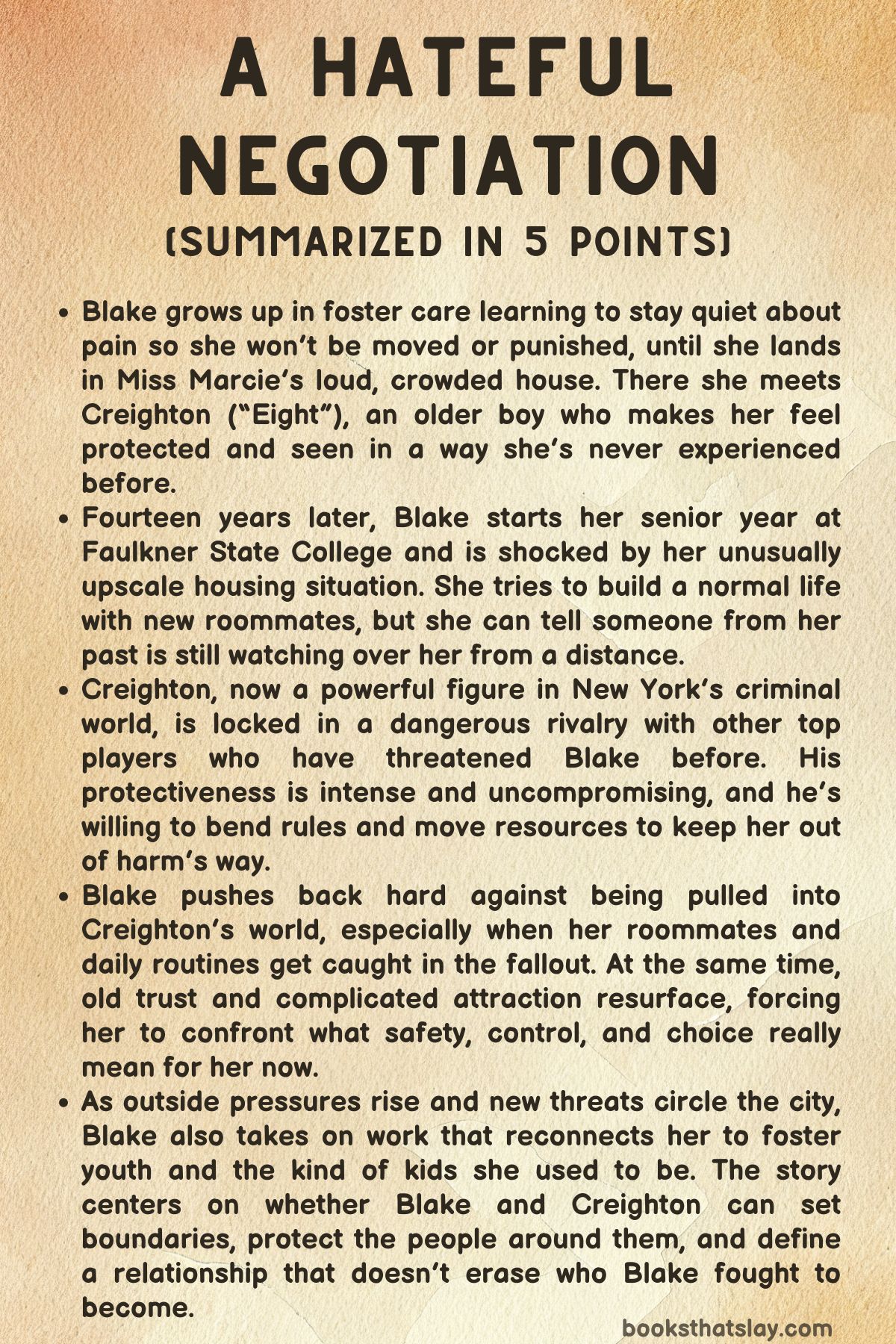
A Hateful Negotiation by Tijan is a contemporary dark romance set between a foster-care past and a dangerous present. As a child, Blake learns survival through silence until she enters Miss Marcie’s crowded foster home and meets Creighton “Eight” Lane, a boy with a cold calm and a promise that she will never need to fear him.
Years later, Blake is a college senior trying to live quietly, but Creighton has become a powerful New York crime boss who still watches over her. Their uneasy agreement—distance, rules, and restraint—starts to crack as rival factions threaten Blake and Creighton answers in ways only he can. It’s the 4th book in the Kings of New York series.
Summary
Blake is eight when she arrives at a new foster home with her social worker, Mr. Nathan. She has learned that honesty can bring punishment and that complaining can mean being moved again, so she keeps saying she is fine.
In the car she stares at the house ahead, clinging to small details—white paint, a green door—because imagining safety feels like a way to make it real. Mr. Nathan warns her the house is full of other kids, and he tells her she must speak up if anyone frightens her.
The home is loud and chaotic the moment they arrive. Boys are arguing and wrestling until a sharp voice orders them to stop.
Miss Marcie opens the door and notices Blake’s bruises right away. She is direct but kind, and she makes a decision quickly: Blake will fit here.
While Mr. Nathan fetches Blake’s bag, Blake finds a boy sitting on the back steps. He is older than the others and carries himself differently—quiet, watchful, and hard around the edges.
He asks questions that feel too specific for a first meeting: her full name, her age, whether she is staying. Blake answers softly, wary of saying the wrong thing.
When Blake touches the bruise on his face, the boy understands immediately what happened to her as well. He tells her she did not deserve it.
Then he offers something that should sound impossible from a stranger: if she ever wants him to hurt the people who hurt her, he will. He also warns her not to mention meeting him because Miss Marcie will lecture him.
Before he disappears, he leaves her with a promise. People will tell her stories about him, he says, but none of them will be true for her.
She will never have to be scared of him. Blake, aching for any certainty, promises something back: he does not have to be scared of her either.
She hears his name before he’s gone—Creighton—and learns she can call him “Eight.”
Years pass. Blake is now twenty-two, arriving at Faulkner State College for her senior year and expecting normal student housing.
Instead, her assignment is a renovated brownstone on the edge of campus, secured by keypad entry and arranged more like a private home than a dorm. The place feels too good to be an accident.
She explores room by room, taking in the polished details and the quiet she’s never really had.
On the second floor she meets Palma Beauregard, her new housemate, who is loud, dramatic, and instantly readable. Palma explains the setup: she and Blake share the second-floor suite; two male roommates, Heath and Marshall, live on the third floor; and a rarely seen roommate named Niko occupies a main-floor bedroom.
Palma is freshly furious about her breakup with a rich boyfriend who cheated, and Blake’s dry humor cuts through Palma’s ranting just enough to make her laugh. Palma shows Blake to her room—queen bed, desk, closet—and Blake is struck by the luxury of having a private space.
She smiles when she is alone, but the feeling is uneasy. Good things have always come with strings.
Across the country, Creighton is in New York City, running his nightclub and the organization built around it. He narrates his world with clinical distance.
He knows what he is—someone diagnosed with psychopathic tendencies, someone who reads people like puzzles and controls outcomes by anticipating needs and fears. Those who grew up with him in Miss Marcie’s house have become his chosen circle.
Levi, a foster brother, works for him and stays close. Creighton orders Levi to check on Blake, but Levi refuses.
He is more afraid of Blake’s reaction than Creighton’s anger, which says a lot about who Blake has become to them.
Creighton is also in the middle of expanding his territory, and that puts him at odds with Tristian West and Ashton Walden, heirs to a Mafia structure that runs parts of the city. When they meet in a private booth, the conversation turns aggressive fast.
Creighton accuses Walden of being linked to a past kidnapping attempt involving Blake, enabled through a dorm connection and a man named Jake Worthing. Creighton reveals Worthing is his cousin through a DNA test and mocks West and Walden for pushing Worthing out of the city.
Tension explodes into violence when Walden lunges. Creighton stops him cold with a hidden blade at his throat while Levi raises a gun at West.
Creighton makes it clear he already neutralized the men West and Walden planted in the club. The message is simple: he is not someone they can intimidate, and Blake is not someone they can touch.
Back at school, Blake tries to focus on classes and the life she built by keeping her past at arm’s length. Dr. Langen praises her work and offers her an unpaid internship supervising a lounge for foster youth at a community center.
Blake hesitates. She came to New York to escape the system, not circle back into it.
As she leaves the meeting, she notices a man watching her and understands immediately what it means. Creighton is still monitoring her.
That night Creighton enters the brownstone at 4 a.m. using a cloned fob.
He moves through the home without noise, mapping routines and reading vulnerabilities. He checks the rooms of the other tenants, even cloning Heath’s phone and noting that Heath sleeps armed.
He disapproves of Palma’s careless sleeping posture as if he owns the right to judge who is safe around Blake. In Blake’s room, he studies her books and her lists.
One item stands out: she needs money, and she does not want to rely on “you know who.” He watches her sleep, then makes a decision based on the threats he just received. He sends a one-word command to his teams: go.
Soon after, Creighton shifts into retaliation. At one of his warehouses, his lieutenant Lassiter brings disturbing information about a proposed security program—advanced surveillance that includes AI and drones.
It looks real, and it looks dangerous for Creighton’s world. Lassiter insists Creighton read the file himself, because it changes the board.
But Creighton’s immediate focus is still the men who threatened Blake.
He captures Ashton Walden and brutalizes him, not for sport but for punishment and control. He makes Walden understand the rule he lives by: if someone harms one of Creighton’s people, he returns it tenfold, and he prefers consequences that break more than bones.
He targets what West and Walden value, setting fires that destroy a fiancée’s livelihood and a wife’s art gallery and upcoming show. He makes sure Walden lives to carry the message.
Blake remembers what it meant to grow up under Creighton’s shadow. In middle school, when boys accidentally injured her during a fight, Creighton’s people responded with a level of violence that made the whole school fearful.
One boy ends up mutilated; another disappears. Blake learned early that proximity to Creighton offered protection, but it also dragged her into outcomes she could not control.
In the present, her roommates invite her out for Palma’s birthday. Blake goes, determined to act normal even as she senses she is being tracked.
At the club, the bouncer knows her by name. Inside, she spots Levi and realizes Creighton is near.
She hugs Levi, then tells him plainly: keep her roommates safe. She goes upstairs to Creighton’s office, because avoiding him is no longer possible.
Blake confronts Creighton for breaking their agreement. He claims he kept it in his own way: he promised to stay away physically, not to stop watching her.
Blake sees how he engineered her life—her housing, the environment around her—so she cannot fully disappear from him again. She demands he stop killing people.
Creighton insists he targets “bad” people and follows her rules. But Blake realizes the real shift: by coming to him, she has voided the deal as it used to exist.
Now Creighton believes he has the right to come to her.
Blake tries to reclaim independence by getting a job. She applies at Octavia, a club that functions as neutral territory owned by Cole Mauricio.
The manager, Spence Calloway, recognizes who she is and lays down strict rules: West and Walden can enter as patrons only; there is no violence on the premises; and if Creighton brings trouble, Blake will be fired. Blake accepts anyway.
She needs money and control, even if it is limited.
Creighton keeps appearing in Blake’s bedroom at night. Sometimes he says nothing.
Sometimes he holds her hand. Sometimes he lies beside her in the dark.
Blake is furious, unsettled, and drawn in at the same time. She knows what he is capable of, but she also remembers the boy who told her she did not deserve the bruises.
The boundary between those two versions of him is thinning.
One night after her shift, Blake witnesses Ashton Walden meeting a suited man in an alley and receiving an envelope. Before she can escape, she is attacked, drugged, and taken.
She wakes tied to a chair with West and Walden. They claim they only want answers, but they are nervous and angry, and Blake knows what desperate men do when they feel cornered.
She works her bonds loose, disables a camera, crawls through ceiling vents, and forces herself toward an exit. With no good options, she prepares to climb down the exterior of a tall building using narrow grooves, choosing danger over staying in their hands.
The next crisis hits closer to home. Blake and her roommates are in a diner when masked robbers storm in.
Blake refuses to panic because she knows where they are—close enough that Creighton’s people will respond. She’s right.
Lassiter arrives with a gun. Levi moves with practiced speed.
The robbery collapses into something else entirely: an operation handled outside the law. Creighton arrives, and Blake’s roommates finally see the scale of who he is.
The robber begs for mercy, claiming he was pressured and has family to support. Creighton looks to Blake, waiting for her decision.
Blake refuses to let him kill someone in front of her friends. Creighton spares the robber, but the “mercy” is structured: the man will take full blame, plead guilty, serve time, and be protected and paid through Creighton’s system so his family survives.
It is control disguised as generosity.
Back at the brownstone, the roommates demand answers. Blake tells them the truth: she grew up in foster care with Levi and Creighton, and her attempt at a normal life keeps getting invaded by Creighton’s world.
She starts to pack, thinking leaving will protect them. Palma refuses to let her go.
She unpacks Blake’s bags while insisting Blake is their friend and they will not abandon her. For Blake, it is unfamiliar comfort, and it lands harder than she expects.
Blake decides she needs clarity, so she forces a conversation the only way she knows Creighton will respect: she ambushes him in her bedroom, handcuffing him to her bed. Creighton is amused, but he answers.
He reveals he has an inside man and learned she was taken almost immediately. Blake tells him about the envelope exchange she witnessed in the alley.
Creighton realizes the conflict is widening and now involves bigger forces, possibly including Cole Mauricio. Blake makes her priorities clear: protect her roommates.
Creighton makes his own clear: he wants Blake, and he cannot step away from ruling without someone worse stepping in.
Blake uncuffs him, asks him to kiss her, and chooses to stop fighting the pull between them. Their relationship becomes physical, and the shift is intense because Blake has kept so much of herself locked down for so long.
Creighton responds with possessive focus, promising he will not touch anyone else. Blake falls asleep knowing she has crossed a line she cannot uncross.
Creighton then confronts the quiet roommate, Niko, identifying her as connected to the Yakuza. He tells her he knows the truth about her family and her father, and he confirms what Blake suspected: Niko’s presence in the house is strategic.
Her connections discourage West and Walden from attacking the brownstone directly. Creighton has turned Blake’s home into a shielded zone using politics, fear, and alliances.
The next morning, Creighton makes Blake coffee again and again, as if he is trying to build something domestic out of a world that cannot be domestic. Their conversation turns jagged when Blake asks about other women.
Creighton interprets it as her considering other men and threatens violence against anyone who touches her. Blake is furious at the threat and shaken by how it affects her.
The possessiveness is wrong, and yet it strikes a part of her that has always wanted to be chosen, fully and permanently.
Tension spreads through the house. Palma tries to restore normalcy with a movie night, and Levi practically moves into the basement, equal parts protection and chaos.
The group almost manages an ordinary evening until Creighton arrives, and the fragile calm snaps again.
Then Creighton crosses Blake’s hardest boundary. Levi ends up in the hospital and Marshall is hospitalized longer.
Blake learns Creighton took innocent people as leverage, breaking the one rule she demanded: don’t harm people who have nothing to do with the war. Blake feels betrayed and trapped.
Lassiter announces he is leaving, and Blake panics, her old abandonment wounds flaring. When Creighton appears, Blake refuses to talk and tells him she never wants to see him again.
Creighton leaves.
Without Blake’s influence, the war becomes a negotiation. Creighton meets West and Walden at Octavia and agrees to a truce.
He will stop recruiting in their territory if Blake and his people remain safe. Walden demands no human or sex trafficking, and the agreement locks in boundaries and shared defense against outside threats.
Creighton adds that he will help protect the city against other criminal forces, but only if they share the responsibility. Even while dealing terms, he remains fixated on Blake and on the foster center where she works.
At the community center, Blake notices a fifteen-year-old girl, Satya, lingering after closing. Blake follows her and discovers Satya has been living in an abandoned warehouse, trying to build a case for keeping her little sister when she turns sixteen.
Creighton intercepts Blake outside, angry but controlled. Instead of forcing her away, he gives her a tool: use his name if she gets in trouble.
Then he disappears into the shadows, letting her choose.
Inside, Blake gains Satya’s trust by admitting she used to run too. Satya explains she chose this area because “Boss Lane” enforces rules that keep men from approaching underage girls.
Blake is stunned. Creighton built protections for minors without ever telling her.
Satya asks if Creighton can help reunite her with her sister’s foster placement. Blake agrees to try using back channels, aware she is not yet a mandated reporter and can still maneuver.
When Satya leaves, Creighton’s men arrive, emphasizing that Creighton called them in for Satya’s safety. Blake begins to see that Creighton’s power, while dangerous, also creates rules that keep certain people alive.
Back home, Palma talks Blake through the guilt. She insists Blake is not responsible for Creighton’s actions, and she points out that Creighton is changing in small ways: giving Blake space, helping Satya, steering the truce, and even influencing the city’s surveillance plan to protect his territory and, by extension, the vulnerable people within it.
Tristian West later approaches Blake at the center and reveals he funds it. He invites everyone—including Blake’s housemates and Creighton—to a Christmas event meant to surprise Walden’s fiancée, Molly.
He calls Blake a “player,” not as praise, but as recognition: she affects outcomes in a world where most people don’t get a vote.
That night Creighton appears in Blake’s room again. They reconnect physically, then finally talk in full.
Blake confronts him for taking innocents. Creighton insists he did not kill anyone, but he admits he makes calculated moves to control people around him, including pushing Lassiter away and placing protections around Blake through alliances, doctors, and the brownstone itself.
He also admits that much of his early violence came from a specific target: sex traffickers who hunted kids near Miss Marcie’s house, including Blake. He wiped them out and built rules meant to stop that from happening again.
Blake breaks down, saying she was not worth all of it. Creighton answers with the truth he has avoided naming.
It is not only obsession. He loves her.
Blake believes him, and she says she loves him too.
A month later, they attempt something close to normal. They go on dates across New York City, with Creighton’s security always present in subtle ways.
They attend the Christmas event together by subway, and Blake sees how naturally Creighton now moves through her life. Later she runs into Walden and negotiates a small mercy: lifting a ban so Sawyer Matsen can visit family.
She leverages what Creighton saved for Molly. Walden agrees, half amused and half wary of Blake’s influence.
Blake also sees Lassiter again and understands he still carries complicated feelings, but he cares about her.
At home, Blake tells Creighton a story about the “quokka” nickname from when she was sick as a child and he stayed with her. She admits she hated it when people used it to mock her.
Creighton tries to make her smile, but he also asks for something he never asked for when they were kids: honesty. Tell me when you’re hurt.
Blake admits she still feels like no one, like she doesn’t deserve devotion that is this fierce. Creighton tells her he feels unworthy too, but his choice is fixed.
He will keep loving her as long as she lets him. They trade promises, new nicknames, and a version of peace that isn’t clean or simple, but is theirs.
Characters
Blake “Blake” (Lane’s)
Blake begins A Hateful Negotiation as an eight-year-old who has learned survival through silence: she says she’s “fine” because speaking up has historically led to punishment, rejection, or being moved again. That early conditioning becomes the emotional engine of her adult life—she craves stability and “normal,” but her instincts still default to scanning for danger, minimizing her needs, and managing other people’s reactions so she can stay safe.
Fourteen years later, her private room in the brownstone feels like a miracle because it represents ownership of space, something foster life rarely gives. Yet even in that comfort, she’s pulled between two identities: the capable, competent senior and budding mentor at the foster-youth lounge, and the former foster kid who wants distance from anything that resembles the system that shaped her.
Blake’s defining power is that she refuses to be purely afraid; when violence erupts around her, she stays startlingly present, thinking in exits, leverage, and timing, whether that’s escaping a kidnapping via vents or reading a robbery for what it is because she understands whose territory she’s standing in. Her moral line is clear—she doesn’t want innocents harmed and she doesn’t want blood on her conscience—yet she’s forced into a gray world where her boundaries are constantly tested by someone who will bend reality to protect her.
What complicates Blake is that her attachment to Creighton isn’t just romantic tension; it’s braided with a lifetime of him being the one consistent protector, which makes her “freedom” feel like abandonment and her “boundaries” feel like betrayal even when they’re necessary. Over the story, her growth isn’t becoming fearless; it’s learning to claim agency without running, to let people like Palma in, and to stop treating her own worth as negotiable.
Creighton “Lane” (Eight)
Creighton is introduced in A Hateful Negotiation as the older foster boy with a blank, controlled exterior, and the book never lets you forget that his gentleness and brutality are two sides of the same organizing principle: control is safety, and safety is possession. As a teen, he reads Blake instantly—recognizing bruises, naming the truth she can’t say, offering protection with the terrifying sincerity of someone who means it literally.
As an adult, that same sincerity scales into empire. He frames himself as someone with psychopathic tendencies, which shows up less as chaos and more as calculation: he watches, collects information, predicts behavior, and treats emotion like a variable he can manage.
His love is therefore expressed as infrastructure—surveillance teams, controlled neighborhoods, planted roommates, cloned fobs, preemptive strikes—because affection, to him, is an operational problem to solve. But the narrative also makes clear that Blake is the one variable he can’t fully model; she can stop him more effectively than threats can, not because she overpowers him, but because she changes what winning means.
Creighton’s cruelty is deliberate and often psychological—burning what people value, breaking stability, punishing betrayal tenfold—yet he also enforces boundaries that are, in his world, “protective,” particularly toward minors, implying that his violent code grew out of encountering predators near the foster home and deciding no one else would get to touch what he considers “his.” The romance becomes dangerous precisely because Creighton doesn’t experience love as a softening; he experiences it as a narrowing. When he says she is his “in every way,” it isn’t poetry—it’s a claim of jurisdiction.
Even when he tries to behave by her rules, he treats rules like negotiated constraints rather than moral truths, which is why his worst ruptures with Blake happen when he convinces himself that the end—her safety, his stability—justifies methods she cannot live with. His arc isn’t redemption in a traditional sense; it’s containment—learning, imperfectly, to let Blake’s consent and emotional needs be the governing limits of his power.
Mr. Nathan
Mr. Nathan functions as the first adult who explicitly names the hidden risk in Blake’s behavior: a child who says “everything is fine” may be doing it because truth has never been safe. His insistence that Blake promise to speak up if someone scares her shows a social worker trying to create a small bridge between policy and reality, and it highlights how the system relies on children self-reporting harm even when those children have been trained not to.
He is also a contrast figure—calm, procedural, and cautious—standing at the threshold between Blake’s old pattern of neglect and the possibility of care in Miss Marcie’s home. Even though he isn’t present for the later conflict, his early role matters because he introduces the theme that protection requires voice, a theme Blake struggles with for years as she tries to advocate for herself without risking abandonment.
Miss Marcie
Miss Marcie is the foster mother who embodies organized chaos: loud, commanding, and visibly in control of a house full of boys, yet immediately attentive to the bruises on Blake’s face. She represents a kind of imperfect safety—there are too many kids, too much noise, and too many complicated histories under one roof, but there is also directness and follow-through.
Her quick decision that there’s room for Blake despite the house already being full signals a caretaker who operates from instinctive inclusion rather than bureaucratic convenience. She also serves as the boundary-setter around Creighton; his warning that she’ll lecture him implies she is one of the few people who can still “parent” him, which matters because it suggests his moral code did not develop in a vacuum.
Miss Marcie’s presence in the backstory anchors the idea that family can be made and that loyalty can be learned, which later explains why so many foster siblings remain in Creighton’s orbit: they didn’t just grow up together, they were welded together by one adult who insisted they mattered.
Levi
Levi is Creighton’s foster brother and his closest ongoing human tether—both collaborator and conscience-adjacent observer. Levi’s fear isn’t of Creighton’s violence but of Blake’s reaction, which says everything about where the real authority lies emotionally: Creighton may run the city, but Blake determines whether Levi’s world stays intact.
Levi moves between roles—enforcer, protector, comic pressure valve—and that flexibility makes him a stabilizer in scenes where everyone else is panicking. He also becomes the uncomfortable “background support” in the brownstone, a living reminder that Creighton’s safety always comes with surveillance and implicit threat.
What makes Levi interesting is that he doesn’t romanticize the life; he accepts it, manages it, and still reacts like a person when lines are crossed. When Blake is furious at Creighton’s choices, Levi’s presence in the hospital and the house shows how collateral damage spreads through a “family” built inside criminal power structures: loyalty protects, but it also traps.
Lassiter
Lassiter reads like the operative with the most independent interior life: competent, blunt, and willing to challenge Creighton even while serving him. He is often the first to say the quiet truth—that Creighton’s proximity is becoming obvious, that the neighborhood takeover will be noticed, that the war is widening, that certain actions will cost Blake.
His relationship to Blake is particularly charged because he treats her as a person rather than a symbol; he respects her boundaries, calls her “the best of us,” and yet is willing to make hard choices he believes are necessary, even if she hates him for them. When he steps back after the hospital incident and Blake spirals into abandonment feelings, it reveals how deeply she depends on certain “safe” men within Creighton’s world who feel less consuming than Creighton himself.
Lassiter also becomes a mirror for Creighton’s possessiveness—his hints about Creighton calling Blake “his woman” underline that something has shifted from obsession-as-protection into love-as-claim, which changes the stakes for everyone around them.
Palma Beauregard
Palma begins as comic velocity—bright, blunt, furious about a cheating ex—and turns into the emotional architecture of the brownstone. Her oversharing is not just humor; it’s how she builds intimacy quickly and forces the house into being a real social unit rather than a set of roommates.
Palma’s importance sharpens when Blake tries to flee after the diner robbery: Palma refuses the familiar foster pattern of “you’re too much, so you must go,” and instead insists Blake is their friend and belongs there. That choice is transformative for Blake because it offers belonging without price, something Blake’s relationship with Creighton can’t fully provide.
Palma’s curiosity about Creighton—gently probing, teasing, and noticing patterns—doesn’t come from nosiness alone; it’s an attempt to map danger so she can stand next to Blake without being naïve. In a story dominated by power plays and threats, Palma’s power is relational: she creates normalcy as an act of protection, and she shows Blake what it looks like to stay when things get scary.
Marshall
Marshall functions as the voice of the “ordinary world” colliding with Creighton’s gravity. He is the roommate who most visibly resists the intrusion of organized violence into their home, and his anger after the diner incident isn’t just fear—it’s a demand for understandable rules.
His conflict with Levi and discomfort with Creighton at breakfast highlight the humiliation of realizing you’re living inside someone else’s power structure without consenting to it. Marshall’s later hospitalization, and his shift to studying online, show the real cost of proximity: even if Creighton claims he avoids harming innocents, the ecosystem of his war still reaches the innocent.
Marshall’s character matters because he represents what Blake wanted—friendships and a home untouched by her past—and his suffering becomes part of why Blake draws harder lines with Creighton.
Heath
Heath is introduced as one of the male housemates in the brownstone, and his role becomes a quiet reminder that “normal” in this story is often an illusion. Details like him sleeping armed and being connected to the Cincinnati area suggest he’s not simply a random roommate; he sits at the intersection of campus life and Creighton’s broader network.
The revelation that Heath has brothers within Creighton’s organization reframes his presence as part of the protective lattice around Blake—whether he asked for that role or not. Heath’s function is therefore twofold: he helps sell the brownstone as a believable shared home while also signaling that Creighton’s idea of safety is to embed assets everywhere, including inside Blake’s domestic space.
Niko
Niko is the “rarely seen” roommate whose absence is its own form of presence. Her eventual identification as connected to the Yakuza turns the brownstone into more than upscale student housing; it becomes neutral ground reinforced by overlapping criminal deterrence.
Creighton’s confrontation with her shows how he thinks strategically about shields and threat calculus, and it also reveals how the house is engineered as a buffer zone: West and Walden are less likely to strike if it risks international escalation. Niko’s characterization is therefore less about emotional intimacy with the group and more about geopolitical texture—she represents the wider world of criminal power beyond the Mafia heirs, and her quiet existence in the house implies that Blake’s safety is being negotiated not just by love and violence, but by alliances and fear.
Tristian West
Tristian West is one of the Mafia heirs and serves as the more strategic counterweight to Walden’s volatility. He understands escalation math—threatening that any move will be answered threefold, negotiating to protect loved ones, and later pushing a structured truce when emotions could keep the war burning.
His funding of the foster center adds complexity: he isn’t a pure antagonist, because he can value community and optics while still participating in predatory power games. West’s interactions with Blake reveal that he recognizes her as leverage and as a genuine player; he respects competence, and he sees that Blake’s influence over Creighton is a stabilizing force that can be used to keep the city from tearing itself apart.
West’s primary trait is controlled self-interest, which makes him dangerous in a different way than Walden—he can rationalize almost anything if it preserves his world.
Ashton Walden
Ashton Walden is the hot-blooded heir whose pride keeps dragging him into losing positions. He threatens Blake and lunges first, which prompts Creighton’s immediate dominance, and his later torture sequence underscores how recklessness becomes vulnerability in a world built on leverage.
Walden’s hostility is also rooted in fear—fear of what Creighton will do, fear for Molly, fear of losing territory and status—so he postures harder to compensate. Yet he also shows a capacity for pragmatic boundaries when negotiating terms like rejecting trafficking, suggesting that even within his cruelty there is a sense of lines that must not be crossed for the “business” to remain survivable.
His later interactions with Blake, where she pressures him to lift bans and he complies, show that he can be manipulated by favors and debts, and that Blake’s moral authority can force concessions even from men who once treated her like a tool.
Jake Worthing
Jake Worthing appears more as a shadow than a present character, but his shadow matters. He is tied to Blake’s prior kidnapping and is revealed to be Creighton’s cousin through a DNA test, which adds a personal contamination to Creighton’s enemies: the threat isn’t only external, it’s in the bloodline.
Jake functions as a symbol of betrayal and entitlement—someone willing to use a dorm mate and predatory tactics to access Blake—and his banishment becomes a point of dominance for Creighton and a bargaining chip in later negotiations. Even absent on the page, Jake’s role clarifies why Creighton’s obsession hardens into war; he doesn’t just fear losing Blake, he fears someone else taking her to prove they can.
Sawyer Matsen
Sawyer is referenced as someone whose banishment and family ties matter enough for Blake to negotiate on his behalf. His importance lies in what he represents: the ripple effects of criminal sanctions on ordinary relationships and the way bans function like informal law.
The mention of intimidating aunts and family dynamics hints that Sawyer’s world carries its own social power, which Blake knowingly “unleashes” by requesting access for him. He’s less a developed on-page personality and more a marker of how Blake is learning to operate inside this ecosystem—using favors, debt, and social consequence rather than pleading.
Cole Mauricio
Cole Mauricio, as owner of Octavia and “neutral territory,” embodies rule-based criminal order. He represents the idea that even violence-heavy worlds need sanctuaries where business can continue and reputations can be maintained.
His club is less a setting and more a legal system: the rules matter because everyone agrees they matter, and because violating them carries costs powerful people don’t want. Cole’s significance also grows when the conflict widens and the unknown man’s meeting with Walden hints at larger players; Cole sits at the center of that widening circle as someone who can broker access and shape what is permissible.
Spence Calloway
Spence, as Octavia’s manager, is the practical guardian of neutrality. He recognizes Blake immediately and responds the way someone does when they know the cost of getting involved: he hires her with strict conditions and makes it clear she’ll be cut loose if Lane brings trouble.
His attempted knife play against Creighton in the alley shows he performs toughness as part of his job, but Creighton’s effortless disarming also shows the hierarchy Spence cannot escape. Spence’s role is to police boundaries—no violence, no power plays—yet his existence also proves the limits of such policing, because neutrality only holds as long as monsters agree to behave.
Dr. Langen
Dr. Langen is a small but meaningful axis in Blake’s “normal life” storyline. He validates her academic competence and offers her an internship that would pull her back toward foster youth support, forcing Blake to confront her desire to escape her past versus her capacity to transform it into purpose.
He represents a world where authority is earned through merit and mentorship rather than fear, which is precisely why Blake feels conflicted: it’s safer emotionally to run from the system than to re-enter it with open eyes. Dr. Langen’s presence highlights that Blake’s future could be built on care and structure, but only if she believes she deserves a life not defined by violence.
Hector
Hector appears as one of Creighton’s people in Blake’s school memories, and his later missing hand is a brutal illustration of the cost of proximity to Creighton’s justice. Hector represents the foot soldiers who live inside Creighton’s code: they enforce dominance, they carry out punishment, and they pay with pieces of themselves when the war demands it.
His injury also serves as a warning sign that even the “protected” are disposable to the machine when stakes rise, reinforcing Blake’s fear that everyone around her becomes collateral.
Will
Will is the other boy in the seventh-grade incident, the one who disappears and is assumed dead, believed to be killed by Creighton. Will functions as legend fuel—proof to outsiders and insiders alike that crossing certain lines ends you.
Whether or not the assumption is accurate matters less than the social effect: the belief itself becomes enforcement. Will’s disappearance is part of how Creighton’s myth becomes a living fence around Blake, one that can keep threats out while also keeping her trapped inside the narrative of what “belongs” to him.
Molly Easter
Molly is Walden’s fiancée and primarily operates as leverage within the war. She is targeted symbolically through the burning of her bowling alley, which demonstrates Creighton’s preference for emotional destruction over simple killing.
Molly’s role also becomes a measuring stick for the truce: her safety is one of the conditions everyone implicitly negotiates around, and she is used to test whether Creighton can restrain himself when Blake withdraws. Molly represents the way women are treated as vulnerable points in male power games, which parallels Blake’s own experience of being targeted—except Blake fights back and refuses to stay a pawn.
Satya
Satya is the clearest mirror of young Blake, and her storyline exposes the parts of Creighton’s “protection” that Blake never fully understood. Satya is fifteen, living in a vacant warehouse, planning for custody of her sister, and surviving by choosing territory where “Boss Lane” enforces rules that keep predators away from minors.
Her intelligence is practical and future-facing—she understands systems, age thresholds, requirements for custody, and the need for legal stability—and she responds to Blake because Blake speaks from lived truth rather than savior fantasy. Satya’s presence forces Blake to confront an uncomfortable complexity: Creighton’s violence may be monstrous, but some of his rules have created a safer corridor for girls like Satya.
That realization doesn’t absolve him, but it changes Blake’s understanding of what his empire is doing in the spaces the state fails to protect. Satya becomes proof that Blake’s work matters, and also proof that Creighton’s world has seeped into that work whether Blake wants it or not.
Themes
Trauma, Survival, and the Cost of Staying Quiet
Blake’s earliest instincts are shaped by the repeated lesson that honesty is dangerous. As a child in foster care, she learns to perform “fine” because admitting fear or pain can mean punishment, relocation, or worse.
That habit doesn’t disappear when she becomes an adult; it simply evolves into a more polished version of emotional containment. Even when she is physically safer, her nervous system stays trained for risk.
You see it in how she studies spaces before relaxing, how she monitors people’s moods, how she tries to be low-maintenance so nobody decides she is “too much.” Her longing for a private room at college is not about luxury; it is about control over a boundary she never had. The same survival pattern shows up in her resistance to the foster-youth internship.
The work threatens to reopen a history she has spent years trying to outrun, not because she lacks compassion, but because compassion pulls her back into the identity of someone who needed saving. The story also refuses to treat trauma as something that vanishes once circumstances improve.
Blake can joke, work, study, and build friendships, yet the old wiring still dictates what feels normal to her: hypervigilance, distrust of comfort, and a reflex to leave before she is left. When she starts packing after the diner incident, it is not melodrama; it is her body choosing the strategy that once kept her alive.
The theme becomes even sharper because her relationship with protection is complicated—she wants safety, but safety often arrives wearing the face of coercion. That contradiction forces her to ask what healing means when the person who makes you feel safest is also the person most capable of making your life unsafe.
Her growth is not a straight line toward calm; it is a negotiation between the child who survived by disappearing and the adult who wants to exist fully without bracing for impact.
Power, Control, and the Seduction of Protection
Creighton’s power is not presented as abstract status; it is operational, immediate, and physical. He can reroute housing assignments, place watchers, alter the behavior of institutions, and decide what happens to people who threaten Blake.
That reach creates a world where safety is delivered through dominance, and it forces everyone around Blake to redefine what “normal” authority looks like. In the brownstone, the roommates’ confusion after the diner robbery highlights how quickly everyday assumptions collapse when a private system of enforcement replaces public systems like police or campus security.
Blake lives at the center of this, torn between gratitude and fury. Creighton frames surveillance as care—he claims he promised to stay away physically while still ensuring she is safe—yet the practical effect is the same: Blake’s autonomy becomes conditional.
She is protected, but also managed. The story makes that tension uncomfortable on purpose, because the emotional appeal of protection is real when someone has grown up unprotected.
Creighton offers certainty: if you are his, you are guarded; if someone harms you, they pay. For Blake, that promise lands in a part of her that is tired of being vulnerable.
At the same time, Creighton’s rule of returning harm “tenfold” exposes how protection can mutate into an excuse for cruelty. He prefers emotional damage, targeting partners, livelihoods, and reputations, which shows that control is not only about eliminating threats; it is about teaching the world to anticipate his reaction.
Blake tries to set limits—no killing, no innocents harmed, roommates protected—but the story stresses how fragile limits are when one person holds disproportionate power. Even when Creighton “follows her rules,” he interprets them in ways that still keep him in charge.
The theme also extends beyond their relationship into the larger criminal ecosystem. Negotiations, truces, and “neutral territory” clubs show power as something regulated by agreements that only matter as long as everyone fears the consequences of breaking them.
In that environment, Blake’s influence becomes a form of power too, but it is an unstable kind—based on Creighton’s attachment rather than a system she controls. The seduction, then, is not just physical; it is the temptation to let someone else’s control substitute for your own safety, even when that substitution carries a price.
Love, Obsession, and the Line Between Devotion and Possession
Creighton’s attachment to Blake begins as a fierce protectiveness when she is eight, and it hardens over time into a bond that refuses to loosen. The adult version of that bond has romantic and sexual intensity, but the emotional core is older: she is the one person he decided was untouchable, the one he built his identity around defending.
What makes this theme compelling is that the story does not pretend obsession and love are easy to separate here. Creighton watches Blake sleep, enters her space without consent, and positions himself as the final authority over who can get close to her.
His jealousy is not framed as insecurity; it is framed as a threat, a promise of violence if another man touches her. That is possession, stated plainly.
Yet the same man learns Blake’s preferences, tries to make her mornings good, keeps returning not for sex but for closeness, and reshapes parts of his strategy based on what will keep her from leaving him. The narrative insists that devotion can be sincere while still being dangerous.
Blake’s response is equally layered. Her anger at his intrusions is real, but so is her attraction to the intensity of being wanted without ambiguity.
After a life where she felt disposable, Creighton’s singular focus can feel like proof that she matters. That is the emotional trap: what looks like unconditional love can also be a cage, especially when the lover has the means to enforce his feelings through surveillance and force.
The story shows Blake trying to reclaim agency inside this dynamic—handcuffing him to the bed to force a conversation, demanding answers, naming rules, choosing to give in rather than being cornered into it. Even her decision to become sexually involved is framed as a choice made with full awareness of the consequences: she fears what it will unleash in him because she understands that intimacy may deepen his sense of ownership.
The theme reaches a turning point when Creighton finally says he loves her and Blake says it back. That mutual confession is tender, but it also raises a harder question: can love be healthy when it is built on years of monitoring, violence committed “for her,” and a worldview where protecting someone means deciding for them?
The story’s version of romance is therefore not about softening a dangerous man into harmlessness; it is about whether two people can transform a bond that began in survival into something that includes choice, respect, and restraint.
Chosen Family, Belonging, and the Fear of Being Allowed to Stay
Miss Marcie’s foster home is chaotic, crowded, and loud, but it is the first place where Blake is treated as someone worth noticing. That early welcome matters because it offers an alternative definition of family: not blood, not perfection, but persistence.
Levi, Lassiter, and the other boys orbiting Creighton function like a distorted sibling network—protective, teasing, loyal, and sometimes frightening in how quickly they move to violence on Blake’s behalf. As adults, that same network follows Creighton into his work, showing how chosen family can become both a support system and an engine that keeps a dangerous empire running.
Blake’s college roommates introduce another version of chosen family, one that is softer and more ordinary. Palma’s decision to unpack Blake’s bags is emotionally significant because it challenges Blake’s expectation that people only tolerate her until she becomes inconvenient.
Palma does not treat Blake like a scandal; she treats her like a friend who is staying. Marshall’s discomfort and fear after seeing Creighton’s world are equally important, because they show the cost of belonging to Blake: being close to her means being close to danger.
The theme is not simply that Blake “finds friends,” but that friendship becomes a test of whether she can accept care without paying for it through self-erasure. Her instinct to leave after the diner is an old reflex—remove yourself so nobody else suffers or rejects you.
Palma counters that reflex with insistence and humor, building trust through small acts rather than grand speeches. The foster center storyline adds another layer: Blake is drawn to protect kids like Satya because she recognizes her own history in them, and because helping them is a way of making meaning out of what happened to her.
Satya’s belief that “Boss Lane” enforces rules protecting minors complicates Blake’s view of Creighton’s world and suggests that even a criminal structure can offer a kind of twisted community safety when official systems fail. Still, the emotional heart of the theme is Blake’s hunger to belong without being claimed.
She wants normal routines—movie nights, shared meals, inside jokes—because normalcy proves she is more than her past. The struggle is that belonging requires staying visible, and visibility has always been risky for her.
By the end, the story suggests that chosen family is not only about being taken in; it is about allowing yourself to remain, even when you are convinced you do not deserve the seat at the table.
Moral Compromise, Justice, and the Story People Tell Themselves to Live With Harm
Violence in A Hateful Negotiation is not random; it is justified, categorized, and narrated by the people who commit it. Creighton insists he only targets “bad” people, that he follows rules, that his actions are protective rather than predatory.
This is not presented as a lie he tells others; it is a framework he uses to function. His preference for emotional punishment—burning down livelihoods, destroying beloved work, threatening partners—shows a calculated understanding of what truly breaks people.
At the same time, the narrative repeatedly forces the question of what counts as “bad” and who gets to decide. West and Walden are criminals, yet they are also spouses and fiancés who fear for loved ones, which makes them human rather than cartoon villains.
Blake becomes the moral pressure point in this environment. She does not have the power to dismantle Creighton’s world, but she tries to shape it with constraints: don’t kill, don’t harm innocents, don’t drag her roommates into this.
When Creighton breaks that boundary by using four innocent people as leverage, Blake’s reaction is not only personal betrayal; it is moral injury. She realizes that her presence can become an excuse for harm, even if she never asks for it.
That is why she is devastated by the implication that his war might have begun because of her. Her guilt is not logical, but it is emotionally inevitable in a world where men keep saying they do terrible things “for” her.
The diner robbery scene shows another kind of moral compromise: Blake silently signals a decision about a robber’s fate, and Creighton designs a punishment that looks almost humane on the surface—prison time with family support—while still being coercive and controlled. It is justice without due process, mercy with strings attached.
The foster center element complicates the moral picture further because it shows failures in official systems. Kids run, placements break, and danger finds them anyway.
In that context, Creighton’s rule against approaching minor girls can appear protective, even admirable, which is exactly the danger of moral compromise: it makes harm easier to accept when it sometimes produces a good outcome. The theme ultimately asks whether someone can build an ethical code inside unethical power, and what it does to the person who loves them.
Blake is positioned as “the best of us” because she still cares about collateral damage, still wants accountability, still believes people deserve safety without intimidation. Her challenge is learning to hold love and condemnation in the same hands without letting either one erase the other.