A House Between Sea and Sky Summary, Characters and Themes
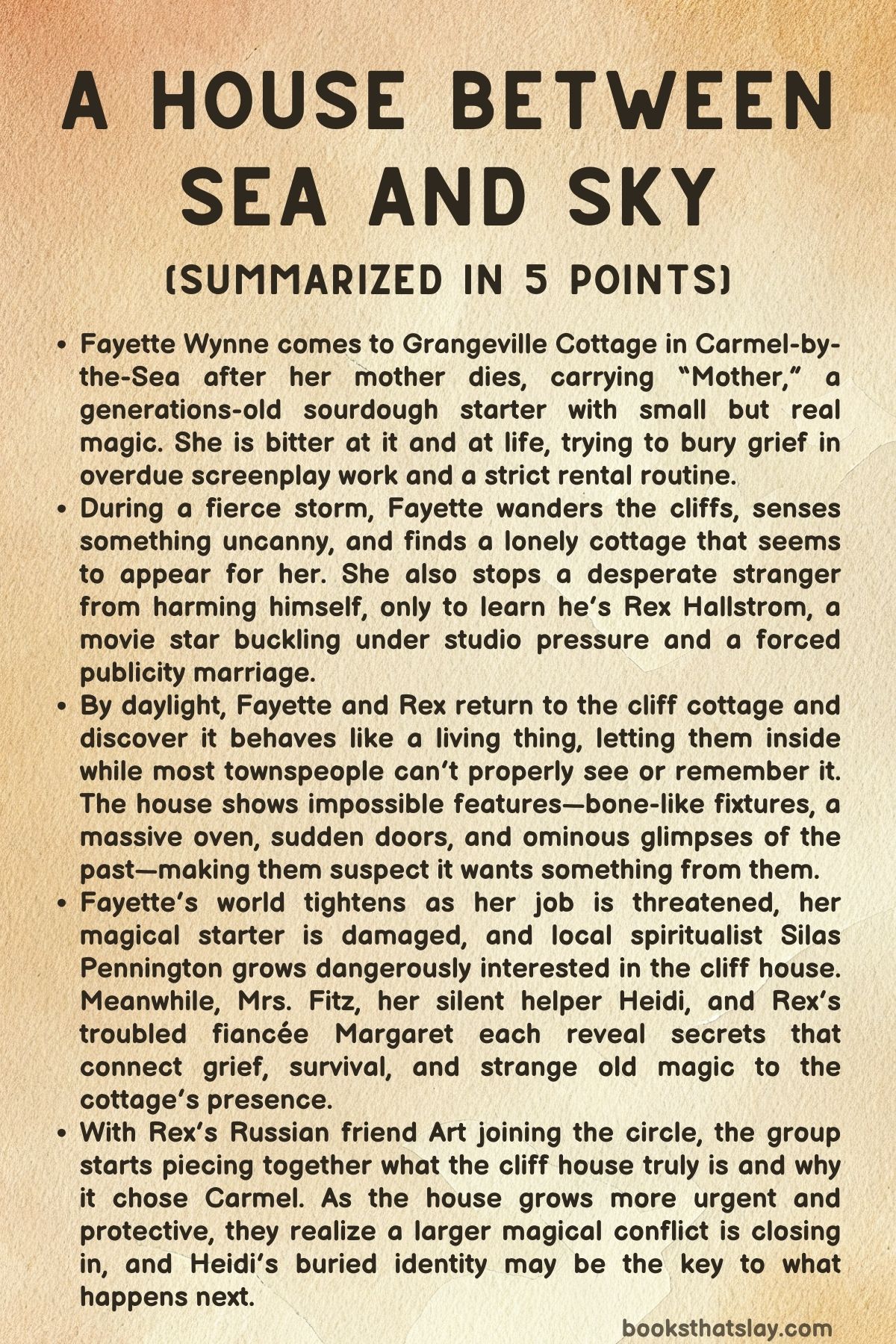
A House Between Sea and Sky by Beth Cato is a historical fantasy set in 1918 Carmel-by-the-Sea, where grief, old magic, and unexpected friendship collide. Fayette Wynne, a Hollywood scenarist mourning the loss of her entire family, retreats to a rented cottage with a strange inheritance: a living sourdough starter called Mother that can heal through bread.
When Fayette saves a despairing film star, Rex Hallstrom, she’s drawn into the mystery of a cliffside cottage that most townspeople can’t truly perceive. The house is alive, Russian in spirit, and urgently seeking a new guardian—pulling Fayette toward a fate bigger than her sorrow.
Summary
Fayette Wynne arrives in Carmel-by-the-Sea carrying a heavy mixture of exhaustion, anger, and grief. Her mother has just died, and with that loss Fayette believes she is the last survivor of her family.
She settles into Grangeville Cottage, a rental owned by the strict Mrs. Fitz. Along with her suitcase and work papers, Fayette brings a large glass jar containing “Mother,” the family’s magical sourdough starter.
The starter has been passed down for generations, and its bread can ease sickness and injury. Fayette, however, sees it as a false promise; its limited healing never saved her mother, brother, or sister.
She sets the jar on the table like an unwanted relic and tries to bury herself in her studio job, typing a detective screenplay on her Corona typewriter.
Mrs. Fitz arrives to enforce rules about quiet living and proper behavior, accompanied by Heidi, her mute hired helper. Heidi is friendly in a shy way, communicating by writing.
Fayette notices Heidi’s discomfort around Mother’s jar, but she doesn’t push for answers. A storm rolls in, and after a few tense exchanges with her landlady, Fayette spends the evening working and eating food Mrs. Fitz provides.
When the storm briefly fades, the silence makes Fayette restless. Missing the nighttime walks she used to take while caring for her dying mother, she heads out toward the sea.
On the cliffs, Fayette senses a prickly awareness similar to the feeling she gets when Mother is paying attention. She forces her way through bushes and discovers a dark, isolated cottage perched impossibly close to the ocean.
Before she can study it, lightning reveals a tall man at the cliff’s edge, preparing to jump. Fayette calls to him, realizes what he intends, and tackles him away from the drop.
They crash onto wet rocks. Fayette injures her left shoulder but refuses to let him go.
The man admits he has a loving family—parents and six younger siblings. Fayette, raw with loss, lashes out at him for throwing away what she no longer has.
The storm worsens, her flashlight disappears, and she leads him into the strange cottage for shelter.
Inside, the house behaves unlike any normal building. The door swings open on its own, the air stays dry despite their soaked clothes, and the walls seem to drink in water and blood.
By lightning flashes Fayette recognizes the man as Rex Hallstrom, a famous Hollywood actor. Rex admits he fled his wedding night.
He was supposed to marry his costar, Margaret Proudlock, in a studio-driven publicity move, but he could not go through with it. Their tense meeting softens into tired, wary conversation.
When the storm breaks, they step outside and the cottage door closes by itself behind them. Both are unsettled and decide to return in daylight.
As they walk toward Rex’s cottage, Fayette bluntly checks whether he needs someone nearby to keep him safe. Rex insists he will manage.
At his home they’re confronted by Margaret and two studio handlers who have been hunting him. The men insult Fayette, implying she is a prostitute.
Fayette coolly plays along, claiming Rex slipped and hit his head and that she escorted him back. Rex explodes at the handlers, rejects the marriage, and withdraws.
Margaret looks as devastated as Rex had been, but she leaves with the men. Fayette returns home shaken, her shoulder aching, and her mind circling the strange cliff house.
The next day Fayette tries to distract herself with errands and the odd charm of Carmel. She notices small-town routines like trust-based milk boxes and eccentric residents.
She also meets Marshal August Englund, the town’s lone lawman, as he warns a traveling medium, Silas Pennington, against fraud. Fayette promises to keep an eye out.
Still worried about Rex, she checks on him. He seems calmer, and when she mentions the cliffside cottage he agrees to go with her.
In daylight, the cottage is even stranger. A fence of bone-like posts tied with hair-rope surrounds it, and the door hardware seems made of bone too.
Inside sits a huge white-brick oven like a Russian peasant stove. Rex is fascinated and suggests checking town records.
Fayette heads to the library, but no fairy tales or records help. Librarian Cecilia Rogers can see the roof in the distance, yet her mind goes oddly foggy whenever Fayette asks about the house itself.
Fayette instead learns the cliff land belongs to Gerald Fitz, Mrs. Fitz’s husband, who lies gravely injured from the war.
When Fayette tells Mrs. Fitz about sheltering in the cliff cottage, the older woman grows grim. She calls it cursed and says it appeared overnight in July 1918.
Most townspeople cannot truly see it or remember it afterward. Mrs. Fitz invites Fayette to a séance to seek help for Gerald.
Fayette asks if Rex can attend, and Mrs. Fitz allows it under strict conditions.
Fayette’s relationship with Mother worsens. She resents how hungry and demanding the starter feels, and she dumps much of it into the garden, keeping only a smaller remnant.
She visits Rex and finds Margaret there. Margaret has refused to return to the studio men and has called off the wedding.
She plans to leave Carmel, admitting privately to Fayette that she is addicted to cocaine and terrified for Rex’s mental health. She urges Fayette to stay close to him.
That night Fayette brings baking supplies to the cliff house, intending to use Mother to make bread. Rex arrives late, and Fayette finds him standing near the fatal edge again.
He swears he wasn’t attempting anything, only revisiting the place. They go inside.
Fayette pumps clean water from a well that should not exist in such a location, and she kneads the dough to rise overnight. A new door forms in the ocean-facing wall, revealing a tiny room hanging over open air.
Inside lies the spotless skeleton of a woman in bright Russian village clothes. Rex panics and pulls Fayette away.
When they return, the doorway has vanished. The house seems to be showing them pieces of its story.
During the séance at the Fitz home, Silas collapses with a fierce headache. When he revives, he explains this happens only when he gets close to ancient, powerful magic.
Mrs. Fitz confirms other mediums have reacted similarly around Heidi and that Heidi once drowned in the ocean and returned. Silas insists Fayette and Rex carry no harm.
He leaves with Rex escorting him.
Fayette returns home to find a lamp lit though she left none on. Someone has broken in.
She hears movement, then a fleeing figure. In the kitchen, she finds Mother’s jar smashed and the starter spilled across the floor.
Panicked, she rescues what she can into a new jar. The remaining starter warms and regains its strength, but Fayette is rattled and sleeps with it beside her and a rolling pin within reach.
A young courier, Koichi Matsumoto, later recognizes a black cloth Fayette found outside as part of a glow-in-the-dark ghost costume used to fake séance effects. Fayette realizes Silas’s performance was staged and warns Koichi not to repeat such tricks at the Fitz house.
Rex brings a newspaper clue: Heidi was found near-drowned on July 18, 1918, just before the Russian cliff house appeared. The timing suggests a bond between Heidi and the cottage.
Fayette goes back to the cliff house to bake. The house welcomes her, heating the oven and readying the fire.
Mother becomes lively and webbed, and the dough rises with impossible speed. Rex arrives with food, and they share worries: Fayette has been warned her studio may fire her, and Rex has received a threat implying he will be blamed if Margaret dies.
Their fragile calm breaks when a door forms again and a black mist pounds from the other side. The house defends them fiercely—boards slam into place, furniture shifts like a barricade, and the mist is driven back.
When it ends, the room resets as if nothing happened. They leave shaken but grateful the house protected them.
Fayette finishes her screenplay in a surge of focus, then tries to speak with Heidi about magic. Heidi refuses and flees.
Soon Margaret arrives with Rex hidden in her car; studio executives tried to force a wedding with a priest, but Margaret and Rex told the truth, and the priest rebuked the executives. Margaret buys a car on impulse to help Rex escape and then drives off to face her own future.
Rex hires Silas to assess the cliff house. When Silas arrives to perform a ritual inside, the house reacts badly.
It quivers, convulses, and lashes a flame from the oven, scorching Silas’s coat. It then throws his satchel out as if ejecting him.
Fayette insists the house rejected him. Rex, recognizing the fraud in Silas’s earlier séance, confronts him.
Silas protests, but his patchwork magic has already been judged by the house.
A new figure enters the circle: Art, Rex’s Russian émigré lover. Fayette and Rex explain everything to him, including the skeleton and the moving doors.
Art immediately identifies the cliff cottage as Baba Yaga’s hut—alive, mobile, and missing its witch. He translates a Russian letter the hut reveals.
The message says it was Baba Yaga’s home, wants friendship with Fayette, Rex, and Mother, and urgently needs a new witch soon or the cliff will collapse. It warns that another Baba Yaga is coming to kill it and take its parts.
Rex and Fayette suspect the hut has chosen Heidi.
Heidi rushes to Fayette in distress, writing that Gerald’s wheeled chair is gone. Fayette realizes Silas has taken Mr. and Mrs. Fitz to the hut in a renewed attempt to heal Gerald.
As they hurry to the cliff, the hut mentally cries out for Fayette and Rex. Terrified, Heidi speaks aloud for the first time, begging them not to go and warning the hut’s power is dangerous.
Then she runs.
At the hut, the ground trembles and birds scatter. Art speaks an old Russian command, and the hut turns to face them, opening a path.
Inside, Silas has drawn chalk circles and runes and begun a ritual around Gerald. Magic surges into a violent, silent rainbow maelstrom.
The hut shakes in agony, bleeding power. Fayette storms into the circle to stop it.
She feels the hut’s pain through the runes, crosses into the inner ring, and takes Gerald’s hand. Her mind slides into him.
Gerald’s soul is intact and loving, but his brain is too damaged for him to awaken. He cannot be cured.
Fayette breaks the chalk boundary, ending the ritual. The hut relaxes, and Mrs. Fitz collapses in grief when Fayette tells her the truth, but also the comfort that Gerald knows and loves her.
Heidi enters again, speaking clearly now. She confesses she has always been able to talk but chose silence.
She reveals she is Russian, and her true identity is Grand Duchess Anastasia Nikolaevna. In 1918, after her family’s execution, she met Baba Yaga, passed the witch’s tests, and bargained to survive by taking on the role.
Baba Yaga transferred Anastasia’s soul into a new body, sent the hut across the ocean, and died. Anastasia fled the hut in terror upon arrival, nearly drowning, and later lived quietly as “Heidi.” Now the hut has called her back.
She begins repairing it with instinctive magic, pulling wood and stray feathers into place. She senses the rival Baba Yaga approaching and orders everyone out.
The rival arrives in an icy, winged hut, swooping from the sky. Anastasia and her hut take flight to meet it.
In the air they work as a single will. Anastasia’s hut feigns weakness and lands lightly on the unstable cliff ledge.
The heavier icy hut lands too, and the cliff collapses under its weight, injuring the attacker. Anastasia’s hut escapes, and the rival flees over the ocean.
The hut lands safely near town. Exhausted but steady, Anastasia insists she will remain “Heidi” to the Fitzes and friends.
She plans to relocate the hut and use her new role to help others. Fayette retrieves Mother and makes a final choice: she gives the magical starter and her baking supplies to Heidi so the healing gift can travel with the hut.
The group returns to the Fitz home for food and warmth, while Heidi and the hut prepare to move on together—no longer trapped between sea and sky, but headed toward a new purpose.
Characters
Fayette Wynne
Fayette Wynne stands at the emotional center of A House Between Sea and Sky, defined first by grief and then by a stubborn will to keep living. Arriving at Grangeville Cottage after her mother’s death, she is raw with survivor’s guilt: Ma, Thayer, and Briar are gone, and she is the last Wynne left.
That loneliness hardens into a prickly, defensive temperament—she snaps, glares, and tries to hold herself together through work, typing overdue continuity like sheer productivity could keep her from collapsing. Yet Fayette is not cold so much as scorched; her anger toward “Mother” is really anger at loss, at a universe where inherited magic could not save the people she loved.
Underneath that resentment is a caretaker’s instinct she can’t erase. Even when the starter’s jar shatters, her panic and tenderness in saving the remnant reveal how deeply she is still tied to family legacy.
Fayette’s arc is about relearning trust—trust in herself, in chosen allies like Rex and Art, and in a magic that doesn’t operate by human ideas of fairness. Her courage is messy but real: she tackles Rex off a cliff with no plan besides “not tonight,” leaps into a lethal ritual circle to spare Gerald and the hut, and tells hard truths even when they hurt.
By the end, her most meaningful act is not heroic combat but relinquishment—giving Mother to Heidi so healing can travel onward, showing Fayette has moved from clinging to inheritance toward shaping a future by choice.
“Mother” (the sourdough starter)
“Mother” is a character in her own right: an inherited, living magic that is equal parts blessing, burden, and mirror to Fayette’s turmoil. She embodies the Wynne lineage—ancient care, hunger, and protection passed down through generations.
Her magic is practical and bodily, focused on bread that heals and nourishes, which makes Fayette’s resentment toward her especially intimate: this is a family member that survived when others didn’t. Mother’s “appetite” and palpable presence create a relationship dynamic rather than mere tool-use; she watches, presses at Fayette’s senses, swells with power when fed, and fades when discarded.
That gives her a moral ambiguity Fayette must grapple with—Mother is not a saintly relic but a force that expects tending and gives gifts on her own terms. Importantly, Mother responds to Heidi with a kind of recognition, “choosing” her as a baking partner; this underscores that her loyalty is to continuity of care, not to one person’s grief.
Mother also links the human story to the hut’s story: both are old magics longing for partnership, stewardship, and survival. When Fayette ultimately gives Mother away, it is not rejection but maturation—she accepts that legacy’s purpose is larger than her pain, and Mother’s character fulfills her role as a migratory, communal healer.
Rex Hallstrom
Rex Hallstrom enters A House Between Sea and Sky as a glittering public figure hollowed out in private. He is introduced at the cliff’s edge, poised to jump, which frames him as someone for whom fame has become an unbearable costume.
Rex’s despair isn’t melodramatic; it’s rooted in coercion—studio handlers engineering his marriage as a publicity stunt, reducing his life to a commodity. That pressure has trapped him between the image of wholesome star and the reality of being a man who loves Art and feels compassion for Margaret without romantic desire.
Rex’s tenderness shows in how quickly he shifts from suicidal numbness to protective loyalty: he defends Fayette against the handlers, makes space for her worries, and listens to her story-writing with genuine interest. His humor and craft appreciation in the hut signal a soul that still wants wonder, not oblivion.
Rex’s guilt over Margaret’s cocaine addiction reveals another layer: he is not indifferent to the collateral damage of celebrity machinery, and his compassion sometimes curdles into self-blame. Through Fayette, he finds a kind of truth-telling companionship that doesn’t ask him to perform.
By the time Art arrives, Rex is able to live more openly rather than merely survive, and his bond with Fayette becomes a bridge between worlds—Hollywood and Carmel, despair and agency, ordinary love and dangerous magic.
Mrs. Fitz
Mrs. Fitz is a stern, rule-bound landlady on the surface, but her rigidity is a shell forged by fear and devotion. She governs Grangeville Cottage with strict prohibitions—no men, no parties, no trouble—because she lives in a fragile ecosystem of reputation, grief, and war’s aftermath.
Her husband Gerald lies catatonic and gravely injured, and Mrs. Fitz’s life has narrowed into vigil and hope. This makes her both practical and vulnerable: she maintains control where she can, yet is willing to risk séances and dubious mediums because love has left her desperate.
She also contains the town’s wary folklore, acting as living memory for the cliff house. Calling it hell-cursed reflects not cruelty but survival knowledge, and her matter-of-fact acceptance of Heidi’s drowning-and-returning as miracle shows how long she has lived near the porous boundary of magic.
Mrs. Fitz’s tragedy is not ignorance but refusal to let go; she wants healing to mean restoration, not comfort without cure. Fayette’s truth-telling shatters that hope, and Mrs. Fitz must finally face grief uncloaked.
Even so, she is not portrayed as foolish—her faith in trying again is human, and her home remains a place of soup, warmth, and reluctant community.
Heidi / Grand Duchess Anastasia Nikolaevna
Heidi is one of the novel’s most layered figures, spending most of the story as a mute helper whose silence is both protective mask and unresolved trauma. Early on, her fear of Mother and the cliff house marks her as someone with buried proximity to magic.
Her muteness makes her appear powerless, but her actions—breaking Mother’s jar, fleeing at the mention of the hut, watching anxiously during rituals—reveal a person in constant negotiation with terror and responsibility. The revelation that she is Grand Duchess Anastasia reframes everything: her silence becomes a choice, a way to disappear after a life where visibility meant death.
She is a survivor of imperial collapse and personal execution, carrying the grief of slaughtered family much like Fayette does, which sets up a quiet thematic kinship between them. Her bargain with Baba Yaga—accept salvation at the cost of becoming a witch—creates a character torn between yearning to be ordinary and being magnetized toward duty.
When she finally speaks, it’s not for drama but necessity: she must stop others from hurting the hut and accept her own role. The transformation into a witch-figure is less about gaining power than embracing identity.
Anastasia/Heidi’s magic is instinctive and compassionate, oriented toward repair and protection rather than control. By choosing to remain “Heidi” to the Fitzes while also claiming the hut, she reconciles past and present, royalty and anonymity, fear and agency.
Silas Pennington
Silas Pennington is a study in performance versus authenticity. As a traveling spiritualist medium, he lives by spectacle, tricks, and the era’s hunger for séances, yet he is not purely fraudulent.
His “full sight” reaction to old magic suggests a genuine sensitivity that he neither entirely understands nor ethically honors. Silas believes in his own importance, framing his collapse as proof of rare talent, and he uses that narrative to gain access, money, and authority.
His charisma is opportunistic; he slides easily from victim of headaches to hired expert on the hut, eager to insert himself into mysteries bigger than him. But his core flaw is arrogance toward living magic.
He treats the hut as an artifact to be measured and exploited through chalk circles and patchwork runes. The result is catastrophic: he tortures the house and nearly drains Gerald in a ritual he cannot control.
Silas’s role in the story is that of a cautionary mirror to Fayette’s inheritance and Rex’s fame—someone who commodifies the sacred, and whose partial gift is corrupted by ego. Even when confronted, he clings to rationalizations, showing how dangerous self-deception can be when mixed with real power.
Margaret Proudlock
Margaret Proudlock is introduced as the glamorous intended bride, but she is far more than a publicity pawn. She is trapped in the same studio machinery as Rex, promoted as wholesome perfection while privately struggling with cocaine addiction and emotional exhaustion.
Her hopeless look in the storm scene reveals someone already mourning a marriage she knows is wrong yet feels forced to enact. Margaret’s honesty with Fayette—confessing addiction and urging her to stay close to Rex—shows her moral clarity even in collapse.
She cares about Rex as a person, not a brand, and her choice to cancel the wedding and later buy the roadster to help him escape marks a quiet heroism. Margaret is not redeemed through romance or punishment; she is portrayed as a young woman battered by fame’s expectations who nonetheless acts with integrity when it matters.
Her arc implies survival rather than resolution, leaving her future open but emphasizing her agency amidst coercion.
Art
Art arrives like a warm gust of lived-in truth. As Rex’s lover and a Russian émigré, he brings both emotional steadiness and cultural knowledge that reorients the narrative.
Where Fayette and Rex circle the hut with suspicion and wonder, Art names it: Baba Yaga’s hut. His immediate belief in their story is not gullibility but familiarity with folklore and the kind of history that makes magic feel plausible.
Art’s humor and affection soften Rex’s self-loathing and provide Fayette a model of chosen family built on honesty. Crucially, Art is also active in conflict; his Russian command to the hut is not just a plot key but a symbol of respectful communication with the old world.
He reads and translates the hut’s letter, grounding the stakes, and his fury at Silas’s tainted ritual frames him as a moral compass. Art embodies the possibility of living with trauma without letting it calcify into bitterness—he survived displacement and still carries joy, which is exactly what Fayette and Rex are trying to relearn.
Gerald Fitz
Gerald Fitz is physically absent for most of the story, yet emotionally central to his wife and to the ethical crisis around healing. A war-injured man lying catatonic, he represents the limits of both medicine and magic.
When Fayette enters his consciousness, she finds not emptiness but a peaceful, intact soul trapped behind ruined neural pathways. Gerald still loves his wife and exists in a quiet waiting state, which makes him a poignant figure of the body’s fragility versus the spirit’s endurance.
His character forces the story to confront uncomfortable truth: not every wound can be fixed, and insisting otherwise can become cruelty. Gerald is the reason Mrs. Fitz clings to false hope, Silas overreaches, and Fayette must practice the hardest compassion—ending a ritual not to save her own heart, but to spare Gerald and the hut suffering.
Marshal August Englund
Marshal August Englund functions as the grounded civic conscience of Carmel. He is a practical lawman aware that fraud thrives in grief, which is why he warns Silas about spiritualist conning.
Yet he is not dismissive of the town’s strangeness; his willingness to listen to Fayette and his presence amid eccentric residents show a man who keeps order without needing to explain everything. August’s role is to anchor the story’s moral realism: magic may be real, but exploitation is also real, and communities need protectors who can tell the difference.
Cecilia Rogers
Cecilia Rogers, the librarian, is a subtle illustration of how the hut manipulates perception. She is helpful, observant, and informed about land ownership, yet her mind goes foggy when asked directly about the cliff cottage.
Cecilia isn’t weak-willed; rather, she demonstrates the town-wide enchantment that erases the hut from memory. Her character reinforces the theme that some truths cannot be accessed through ordinary research, and that magic chooses its witnesses.
Koichi Matsumoto
Koichi Matsumoto, the ten-year-old courier, offers a sharp, almost whimsical counterpoint to the adults’ grief and danger. He is savvy enough to work as a messenger and secretly assist Silas’s staged séance effects, revealing a child already navigating adult economies.
Koichi’s upset over his costume and Fayette’s gentle correction create a small but meaningful moral scene: deception has consequences even when done for play or pennies. He helps expose Silas’s fraud, but more importantly, he embodies the book’s everyday life continuing around supernatural events.
April
April appears briefly through her letter, yet she personifies the precariousness of Fayette’s professional world. As Fayette’s friend and ally, April is the voice of workplace reality—studio politics, looming job loss, and the ruthless replacement of talent with nepotism.
Her warning galvanizes Fayette’s fears about survival in a world where even skill and loyalty don’t guarantee security. Though offstage, April deepens the stakes by making clear that Fayette’s crisis isn’t only magical or emotional; it is also economic and gendered.
Ma Wynne, Thayer Wynne, and Briar Wynne
Though deceased before the story begins, Ma, Thayer, and Briar shape Fayette’s psyche as vividly as living characters. Ma is remembered through illness, nightly walks, and the family’s stewardship of Mother, embodying both tenderness and the ache of helpless watching.
Thayer and Briar are felt as absences that sharpen Fayette’s anger at the starter’s “limited powers” and at fate itself. They function as the haunting baseline of what Fayette has lost, and their memory is what turns her acts of protection—toward Rex, Gerald, and Heidi—into a bid to keep loss from repeating.
Themes
Grief, survivorship, and the problem of being the one left behind
Fayette arrives in Carmel carrying a jar that is both literal starter and a portable mausoleum. Her family is gone, and her anger is as active as her loss.
She measures the worth of Mother’s magic against the deaths it didn’t prevent, so every crust of bread becomes a reminder of absence rather than comfort. What makes her grief sharp is not only sorrow but the unfair arithmetic of survival: Ma, Thayer, Briar are dead, and Fayette remains, with no one to witness the days that follow.
That loneliness turns into a kind of moral outrage when she meets Rex at the cliff. His intent to die reads to her as an insult to the love still available to him.
Her confrontation is less a lecture than a howl from someone who would give anything to trade places. The novel keeps returning to the ways grief distorts time and appetite—Fayette forgets to eat, loses hair, and works herself raw on the screenplay because productivity is easier than feeling.
Healing, in this context, is not a clean reversal. Mother’s bread used to be the family’s symbol of care, but Fayette resists baking because to accept the starter again would mean admitting that comfort can exist alongside loss.
The cliff house intensifies this emotional landscape: it absorbs rain and blood, shelters two strangers at their worst, and later shows Fayette a skeleton locked away like a secret memory. The house behaves like grief itself—uninvited, half-seen by others, demanding attention, sometimes protective and sometimes dangerous.
By the end, Fayette doesn’t “get over” anything. Instead, she learns to live with what can’t be fixed, as in Gerald Fitz’s condition, and to stop using blame as a substitute for mourning.
In A House Between Sea and Sky, survivorship becomes an active choice: Fayette’s survival is not a passive fact but a responsibility she slowly reshapes into connection, work, and generosity.
Agency versus the machinery of public image
Hollywood in this story is a pressure system that tries to choreograph private lives into saleable myths. Rex is a star on paper, a wholesome fantasy paired with Margaret for audience consumption, and the studio men treat marriage like a contractual stunt.
Their insults toward Fayette show how easily the industry polices women’s reputations; if she is near Rex, she must be a threat or a commodity. Rex’s near-suicide is tied to this suffocation.
He is not only afraid of marriage but exhausted by being a product who can’t refuse the brand story. Margaret’s side of the arrangement reveals the same trap.
She looks glamorous in magazines, yet she is trapped in addiction and fear, and her refusal of the wedding is her first real act of self-direction in years. Fayette, though far less famous, is caught in another mechanism of control: Poverty Row deadlines, bosses waiting to replace her, an economy that punishes a woman without family backup.
Her typewriter is both tool and tether, a way to earn survival but also a reminder that her labor is disposable to the studio. Against these forces, the cliff house becomes a space where agency can exist.
It opens its door to Fayette and Rex without asking permission from any institution, and it refuses Silas when he tries to take control through ritual. Even magic, which could be a shortcut to authority, doesn’t behave like a system here; it is choosy, personal, and resistant to exploitation.
The climax makes the conflict literal. Silas attempts to use the hut to “heal” Gerald Fitz for his own prestige, and the hut’s pain shows what happens when authority is exercised without consent.
Fayette’s decision to step into the circle and then break it is a decisive rejection of coercion, even though it robs Mrs. Fitz of hope. Agency in A House Between Sea and Sky is therefore not defined by getting what you want, but by refusing to let others write your story.
Rex chooses truth over career safety, Margaret chooses departure over spectacle, Fayette chooses honesty over comforting lies, and the hut chooses partnership over being a tool. Each refusal is costly, which is the point: real agency is never free in a world built to deny it.
Magic as inheritance, appetite, and relationship
Mother’s starter is not a neutral family heirloom; it is alive, hungry, and emotionally charged. Fayette’s resentment reveals a crucial tension: inherited gifts can feel like burdens when they arrive wrapped in grief.
The starter represents tradition, but tradition here is not sentimental. It consumes resources, demands attention, and carries expectations of what the Wynne line is supposed to do—heal, nurture, keep faith in the ritual of bread.
When Fayette dumps most of Mother into the garden, she is not simply being reckless; she is trying to renegotiate the terms of inheritance. She wants to keep what is useful without surrendering her autonomy.
The break-in and shattered jar sharpen the theme: magic is fragile in the physical world, subject to theft, jealousy, and accidents. Yet it returns stronger when Fayette feeds it, suggesting that care is not owed to the past but can be chosen in the present.
The cliff house mirrors this dynamic in another register. The hut is ancient, powerful, and treated by townspeople as a half-forgotten curse.
Its magic is not spectacle but behavior—it dries clothes, grows doors, lays out warnings, fights off black mist, and calls for help. Like Mother, it is not an object but a participant.
The strongest statement the novel makes about magic is that it cannot be reduced to utility. Silas wants to categorize it with waylines and folklore, to master it through technique, but the hut rejects him because he approaches as an owner rather than a companion.
Even Fayette has to learn to listen rather than command. The skeleton room, the Russian letter, and the hut’s need for a new witch define magic as something with continuity and needs of its own.
Magic carries history, but history is not destiny; it is a conversation between what survives and what comes next. That is why Fayette ultimately gives Mother to Heidi.
The transfer is not abdication but trust: blessings should travel, not stagnate in a grief-locked kitchen. In A House Between Sea and Sky, magic is less about power than about stewardship.
It asks whether a legacy can be carried without being controlled, and whether the living can make peace with what the dead left them—not by worshiping it, but by relating to it honestly.
Identity, disguise, and the right to be reborn
Heidi’s arc turns the concept of identity into something both precarious and self-authored. For most of the story she is mute, a helper defined by other people’s rules and expectations.
Her silence is read by many as weakness or trauma, and Mrs. Fitz frames her survival from drowning as a miracle she doesn’t fully interrogate. Yet Heidi’s quietness is a chosen mask.
When she finally speaks, the reveal that she is Anastasia Nikolaevna reframes everything: she has been living inside two identities at once, a grand duchess who escaped execution through an impossible bargain, and a local servant who wants safety more than remembrance. The novel doesn’t present her “true” self as a return to royal status.
Instead, it emphasizes the right to decide what truth to inhabit. Anastasia does not reclaim power through aristocratic restoration; she chooses to remain Heidi to the Fitzes because that life, humble and real, is one she has built.
The hut’s need for a witch pulls her toward the past, but she meets it on her own terms, not as a girl trapped in legend but as an adult willing to accept responsibility. Fayette’s identity is also in flux.
She is a grieving daughter, a working writer, and a reluctant inheritor of magic. Her move to Carmel is a physical attempt at reinvention, but she discovers that walking away from a name doesn’t erase the person who carried it.
Rex embodies a third version of disguise: a man whose public persona is so dominant that even he mistakes it for a cage. His connection with Art further underscores how much of his real life has been hidden for survival.
Across these threads, the book treats identity as layered rather than singular. People are not bound to what others call them, nor to what history tried to make of them.
Rebirth is possible, but it is messy, requiring both loss and choice. The rival Baba Yaga represents the violent side of identity inheritance—an insistence that a role exists only to be seized and consumed.
Heidi rejects that model by partnering with the hut rather than dominating it. In A House Between Sea and Sky, the self is not a fixed artifact to be uncovered; it is an ongoing act of permission, offered to oneself and to others.
Chosen family and care as a practice
Connection in this novel forms under pressure, not through ideal circumstances. Fayette and Rex meet at a moment when both are saturated in despair; their bond grows from mutual recognition rather than romance-as-rescue.
Fayette doesn’t “save” Rex by becoming his reason to live. She keeps him alive in a storm, then refuses to be intimidated by studio threats, and later offers steady presence when guilt and fear return.
Her care is practical, blunt, and unglamorous, which is why it works. Rex’s care for Fayette is equally grounded: he listens to her anxieties about work and money, asks about her script, and deflects her spirals without dismissing them.
Their friendship becomes a shelter that neither expected to need. The circle widens to include Margaret, Art, Koichi, and eventually Heidi, each providing a different kind of support.
Margaret’s warning about Rex’s suicidality is not jealousy but responsibility; she is stepping out of a false engagement while still trying to keep him safe. Art arrives with warmth and immediate belief, a contrast to the town’s foggy denial of the hut.
His acceptance gives Rex permission to be fully himself. Koichi, a child entangled in Silas’s fraud, shows how intergenerational care works both ways: Fayette protects him from further exploitation, and he offers crucial information in return.
The Fitz household provides another model of chosen family. Mrs. Fitz’s sternness hides a desperate tenderness toward her husband and a fierce protectiveness of Heidi.
Even when her hope becomes a vulnerability Silas exploits, her love is never portrayed as foolish; it is framed as human, a force that deserves honesty. The climactic moment—Fayette telling Mrs. Fitz the truth about Gerald—shows care as an ethical practice, not a soothing lie.
Chosen family here is not defined by perfection or permanence. It is defined by people repeatedly showing up, sharing risk, and respecting each other’s agency.
The final act of gifting Mother to Heidi is a crystallization of this theme. Fayette is no longer clinging to the starter as her last link to blood relatives; she is translating legacy into community.
She trusts Heidi to carry the blessing forward, and in doing so she affirms that family can be made, not just mourned. In A House Between Sea and Sky, care is the thing that lets characters keep living without erasing what hurt them.
Home, displacement, and the ethics of belonging
Places in this story are not passive scenery; they are active participants in the characters’ emotional and moral journeys. Grangeville Cottage is intended as a temporary refuge for Fayette, yet it quickly becomes a test of whether she can inhabit a home without her family inside it.
The rental rules Mrs. Fitz repeats—no men, no parties, no trouble—outline how belonging is policed, especially for a single woman. Fayette’s walks, her typing rituals, and her refusal to bake are all attempts to negotiate space on her own terms.
The cliff house takes the theme further by being a home that is literally out of place. It appears where it “shouldn’t” be, on a narrow shelf of rock, half-seen by townspeople who cannot hold it in memory.
Its Russian construction, bone fittings, and shifting rooms mark it as displaced across oceans and histories. It is a refugee home, carrying loss of its own: it misses its witch, fears destruction, and needs a successor to survive.
Heidi’s past mirrors that displacement. She is ripped from imperial Russia, re-bodied through magic, and washed up in California with no stable claim to who she is allowed to be.
Rex and Art are displaced in subtler ways—Hollywood fame makes ordinary privacy impossible, queer love must travel in disguise, and the studio rules follow them even into a coastal town. The novel raises an ethical question: who gets to call a place home, and what does a home owe to those inside it?
The hut refuses to be owned by Silas, but welcomes those who treat it as a partner. That distinction turns belonging into a relationship built on consent.
When the rival Baba Yaga arrives to strip the hut for parts, the threat is not just physical. It is colonial in spirit, treating home as loot.
The resolution—Anastasia flying the hut away to relocate and help others—rejects the idea of home as static property. Home becomes something you carry, repair, and share.
Fayette’s surrender of Mother aligns with this shift: she stops trying to anchor herself to one kitchen and instead invests in a moving sanctuary of healing. In A House Between Sea and Sky, belonging is not guaranteed by land deeds or birthright.
It is earned through care, choice, and the willingness to make space for lives that arrive from elsewhere.