A Killer Kind of Romance Summary, Characters and Themes
A Killer Kind of Romance by Letizia Lorini is a small-town romantic suspense novel that starts with a woman trying to catch a serial killer and ends with her realizing love isn’t the trap she feared. Scarlett Moore is a true-crime podcaster in Willowbrook who prefers facts, patterns, and distance over feelings.
When a real murder mirrors a bestselling thriller she just discussed on-air, Scarlett is pulled into a case that keeps tightening around her. Then Rafael Gray returns to town—her former neighbor with a history she can’t forget—and their unresolved past collides with a present full of copied crimes, planted evidence, and secrets close enough to live next door.
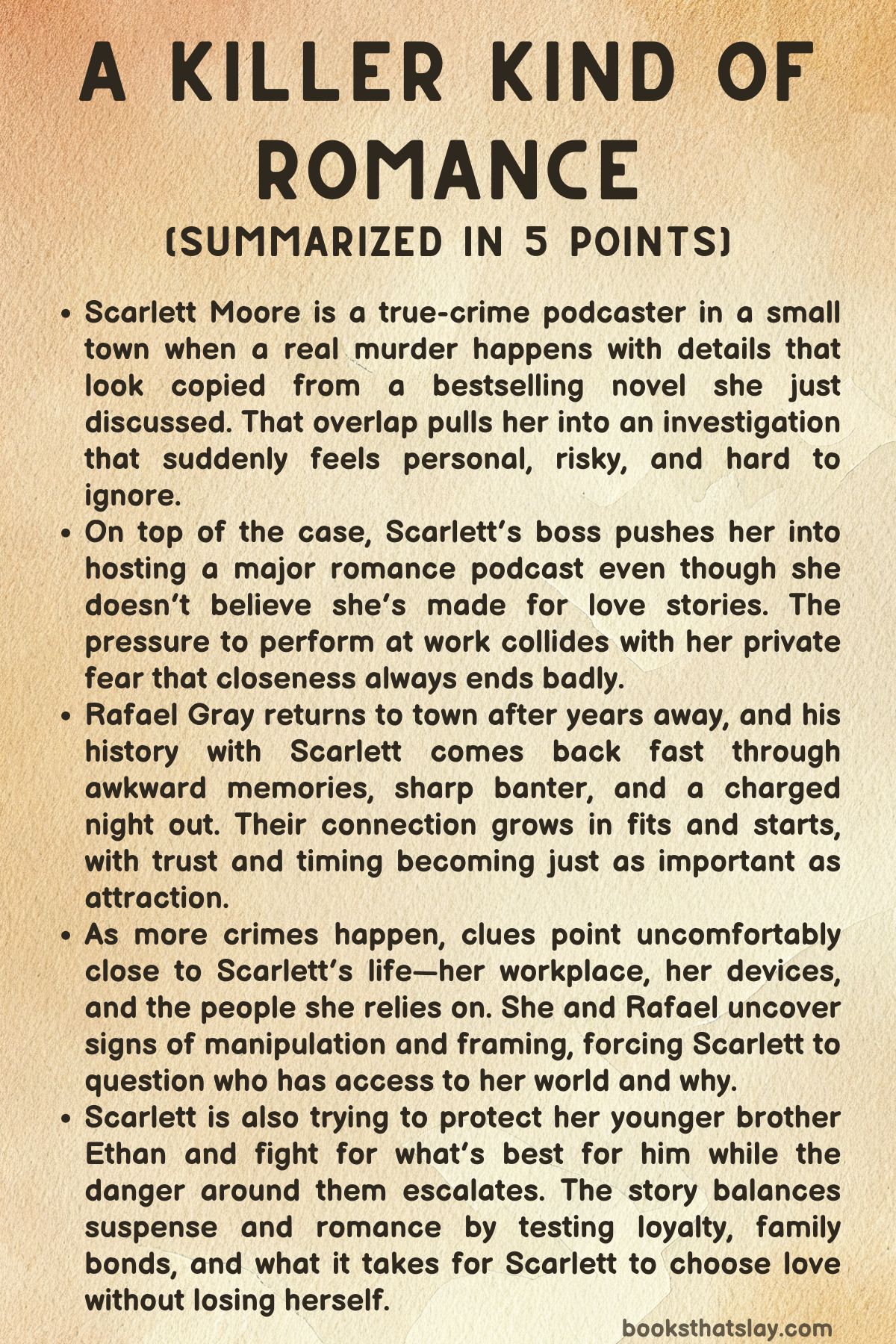
Summary
Scarlett Moore stalks through a dark library late at night with a pink taser in her hand, trying to convince herself she’s brave enough to confront the person she believes is a serial killer. She hears movement, spots a man at the end of an aisle, and steels herself.
But when she closes the distance, he turns instantly, recognizes her, and draws a gun. He mocks her taser, calls her “Freckles,” and orders her to walk ahead.
Scarlett obeys because she knows she can’t outrun him, silently furious that her life has become the kind of mess she usually only talks about on a podcast.
Two weeks earlier, Scarlett’s life feels smaller and lonelier. She wakes up to her cat, Sherlock, demanding breakfast, checks her phone, and sees no messages—especially not from her younger brother, Ethan, who has been distant and hard to reach.
It’s Scarlett’s birthday, and even sending him a simple text takes too much thought, like every word might be wrong. On her way out the door, her neighbor Mrs. Brattle stops her with fresh gossip: John Gray, Scarlett’s longtime next-door neighbor, has died.
The news lands strangely because the Grays have always been part of Scarlett’s landscape, whether she wanted them to be or not.
Scarlett heads to work with her true-crime podcast playing in the car. She hosts a show focused on murders and books, and she has just covered a popular thriller, The Thornwood Butcher.
Mid-episode, her stereo glitches and cuts to a local news report: a Willowbrook professor named Catherine Blake has been found murdered in her home after being last seen walking her dog. When Scarlett arrives at her workplace, Booked It, her coworkers are already sharing the article.
Catherine’s body was staged in a way that matches details from the novel Scarlett discussed the night before—down to disturbing specifics, including flowers and a message written in blood. The timing is too clean to be coincidence, and Scarlett feels the floor tilt under her.
That same day, Scarlett’s boss Celeste calls her into her office and delivers a surprise: a raise so big it doubles Scarlett’s salary. The catch is worse than the number is good.
Celeste wants Scarlett to take over Booked It’s most successful romance podcast, Passion & Pages, because the current host is leaving. Scarlett tries to refuse on instinct.
Romance is not her brand, not her comfort zone, and not the thing she’s good at pretending to enjoy. Celeste doesn’t accept the refusal.
Scarlett needs the money, Celeste needs a replacement, and Scarlett is told to record a few test episodes. She agrees because she feels cornered, not because she believes she can pull it off.
That night, Scarlett’s best friend Paige drags her to a town event at The Oak, Willowbrook’s main bar. The party has masks, a red-and-black theme, and the kind of energy Scarlett usually avoids.
Paige even shoves Scarlett into a red lace dress and insists she participate. In the bathroom, Scarlett finally gets a text from Ethan: a short birthday message that cracks through the day’s heaviness.
She returns to the party feeling slightly steadier—until she sees Rafael Gray.
Rafael is John Gray’s son, back in town for the first time in five years. He’s dressed in a sharp red suit and a black mask, and he draws attention without trying.
Scarlett has a knot of old history tied to him, including an embarrassing teenage mistake and the strange way Rafael vanished from her life right before everything else fell apart. Paige notices Scarlett freeze and begins whispering about “The Incident,” but Scarlett can’t look away.
Rafael approaches her directly, calls her out for watching him, and admits he’s flirting. Then he reveals his friends bet him money that he couldn’t get her number.
Scarlett is offended and ready to leave, but she turns the bet into a deal: she’ll give him a fake number, and they’ll leave the party together and spend the bet money on a night out. They’ll alternate choosing what they do, and Scarlett chooses first.
She takes him to an upscale restaurant, La Belle Vue, where they keep their masks on to avoid town gossip. Over dinner and wine, Scarlett insists it’s not a date while Rafael behaves like he knows exactly what it is.
Afterward, her feet hurt from her heels, and Rafael shocks her by taking off his own shoes and swapping with her. He walks shoeless through town carrying her heels like it’s nothing.
When it’s his turn, he takes her to a psychic shop for a love reading. The tarot cards are The Lovers and The Wheel of Fortune, and the psychic’s tone turns serious.
She warns Scarlett about “Gray with a dark heart,” a line that sticks under Scarlett’s skin. They end the night with ice cream, where Scarlett admits she doesn’t like anyone and suspects something is wrong with her ability to love.
Rafael challenges the idea, suggesting the problem might not be incapacity, but refusal. The night ends with tension neither of them names.
Scarlett even makes an impulsive suggestion that they go somewhere private, offering physical closeness because she can control that better than feelings. Rafael stops himself.
He says he doesn’t want to rush it. He wants to know her slowly, and he leaves before she can twist it into rejection.
Scarlett is left standing there, wearing his shoes.
The next morning, Scarlett tells Paige everything at The Oak café. Paige is thrilled and frames it like Scarlett has stepped into a romance storyline.
Scarlett pushes back, reminding Paige that she doesn’t do love, and that Rafael was never part of her life in that way. When Theo drops by, Paige pushes Scarlett into explaining the old humiliation: as a teenager, Scarlett wrote Rafael a messy confession letter and put it in his mailbox.
Not long after, Rafael left town, and soon after that Scarlett’s parents died, leaving her to cope with grief, responsibility, and a life that narrowed around survival. Theo advises her to ignore gossip and trust her instincts.
Scarlett’s instincts pull her toward the Catherine Blake case. She visits the police station and speaks to Chief Donovan, arguing that Catherine’s murder appears to be an imitation of the fictional murder from The Thornwood Butcher.
Donovan dismisses her as a podcaster chasing a theory, but Scarlett keeps pressing with details—details that aren’t supposed to be public. When she quotes the phrase written in blood at the crime scene, Donovan’s dismissal collapses into suspicion.
If Scarlett knows that phrase, she’s either involved or she’s right that the book matters.
Back home, Scarlett sees Rafael outside and panics, trying to avoid him. He knocks anyway, offers condolences for her parents, and casually calls her “Freckles,” making it clear he recognized her immediately at the party.
He tricks his way inside with leftover food and settles into her space like he belongs there, even remembering small things about her, like how she used to read at lunch in school. Scarlett mentions her new romance podcast assignment, and Rafael treats it like a challenge he can help her with.
When Scarlett finally asks about the old letter, Rafael admits he received it. He explains why he didn’t respond back then: she was younger, tied to his cousin, and he didn’t know what he was allowed to want.
Before he leaves, he asks for a second chance—not a relationship label, just space to be around her.
Soon after, Chief Donovan calls Scarlett and asks what she knows about Rafael Gray. The question hits like a threat.
At work, Scarlett struggles with the romance podcast, writes a harsh script, and gets scolded by Celeste. She also feels watched in a way she can’t explain.
Police officer Vanessa—Paige’s girlfriend—mentions they’re canvassing for the murder case and that Rafael is being considered because of old trouble. A witness described someone fleeing: tall, broad-shouldered, wearing a green visor and a gray shirt with a tree print.
Then Ethan appears at Scarlett’s house unexpectedly, bruised and beaten. He refuses to explain what happened, insisting he didn’t want their grandparents to see him that way.
Before Scarlett can pull the truth from him, Vanessa shows up and has Rafael cuffed against his car, claiming he was snooping in Scarlett’s backyard. Scarlett panics and blurts out that Rafael is her boyfriend, using the lie as a shield to get him released.
Vanessa backs off, suspicious. Ethan watches the whole scene with bitterness and tells Scarlett to “let it go,” as if she has a history of giving up when things get hard.
Scarlett tries to distract herself by shopping for books, and Rafael tags along. He helps carry her stack, teases her into reading romance aloud, and turns the moment into something charged and personal.
On the drive home, he admits he’s dreading his father’s funeral and the town’s sympathy. Scarlett shares her own memories of being alone after her parents died and admits she was adopted and never felt accepted by her grandparents.
Rafael urges her to be honest with Ethan.
Rafael later pulls Scarlett into something bigger. He brings her to his apartment and shows her walls covered in photos, notes, and connections between people around town—including Scarlett’s coworkers and friends.
He tells her someone is trying to frame her for the murders. He shows evidence: an online flower order placed in Scarlett’s name, a signature resembling hers, staged photos, and a Reddit post posted from her laptop even though she insists she never wrote it.
Scarlett is furious and scared. She also can’t forget the way Rafael recently held her at gunpoint to control a situation near police, claiming he was trying to protect her.
Trust becomes a problem they can’t solve with attraction.
Rafael reveals another shock: his father’s death may not have been natural. The police originally called it a stroke, but new findings suggest digitalis poisoning.
A letter of apology addressed to Rafael was left behind, echoing a case Scarlett covered on her podcast about a lonely killer. The pattern suggests the murderer is not only copying books, but using Scarlett’s work as a guide.
Overwhelmed, Scarlett walks away from Rafael and decides isolation is safer than needing anyone.
As the investigation tightens, a neighbor is murdered, staged in a way that doesn’t match the trap episode Scarlett planned. That means the killer knew her original plan—before it aired—suggesting access to her scripts, drafts, or workplace files.
Scarlett realizes Paige is the first person she sends scripts to. Rafael points out Ethan also has access to her laptop.
Fear spreads through Scarlett’s closest relationships.
A box appears on Scarlett’s porch that seems to contain something dead. For a terrifying moment she thinks it’s Sherlock, but it’s a decapitated plush cat smeared with blood—a warning to back off.
Ethan’s behavior grows more secretive. When he returns home bruised again, Rafael changes tactics and talks to him privately.
Rafael reveals the abuse he endured from his father, including the night his father discovered Scarlett’s old letter and forced Rafael to read it aloud before beating him. Rafael fought back and fled town with help from Scarlett’s father.
The honesty breaks Ethan open. He finally admits who hurt him: Hunter Sullivan and his friends at the skate park.
Scarlett, Ethan, and Rafael go to the skate park. Rafael intimidates Hunter into leaving Ethan alone, making it clear the threat is real.
The moment brings relief to Ethan and a new intimacy between Scarlett and Rafael. That night, Scarlett and Rafael finally give in to what they’ve been circling.
It’s quiet, careful, and full of things they don’t say outright. They also begin to suspect Ethan might be gay, and Rafael encourages Scarlett to support him without pushing.
Days later, Scarlett and Rafael separate again under pressure, and Scarlett sinks into a numb routine while preparing for a custody hearing. She needs Ethan to show up in court, but he stops answering her.
When Sherlock disappears for a day and then returns, Scarlett checks the tracking collar Rafael gave her. The footage shows something crucial: a man in a hoodie leaving a yard near a crime scene, breaking a garden gnome exactly as described in a police report.
Scarlett recognizes the walk. It’s Quentin—Rafael’s cousin and Scarlett’s ex.
Paige calls and reveals Rafael sold his house and is leaving town. Scarlett rushes next door and confronts him.
He claims leaving will make it easier for her to move on, but their argument cracks into honesty: they’re both hurting. Scarlett tells him about the footage showing Quentin near a sealed crime scene.
Rafael agrees Quentin has shown up around multiple scenes and lied, but they still need motive.
On the day of the hearing, Scarlett sits in court terrified because Ethan still hasn’t arrived. Her grandparents wait smugly with their lawyer.
At the last moment Ethan walks in and takes the stand. Instead of quietly supporting Scarlett’s case the way they planned, Ethan comes out as gay in open court and explains his grandparents’ homophobia and control.
He tells the judge Scarlett supported him, kept his secret until he was ready, and sacrificed her own happiness to protect him. The grandparents’ lawyer doesn’t even cross-examine.
The judge grants Scarlett custody.
That night, the town celebrates at The Oak. Scarlett is relieved but restless, thinking of Rafael leaving.
Quentin approaches and hands Scarlett a framed photo from The Oak’s opening day: Scarlett’s parents, Celeste, and Rafael’s father wearing matching gray shirts with a tree print. The witness description clicks in Scarlett’s mind.
She realizes the missing gray shirt belongs to Celeste. Another comment lands with new meaning: Celeste is having an affair with Quentin.
Scarlett suddenly sees the structure of the crimes—Celeste with access to Scarlett’s scripts and equipment, Quentin doing the physical work, both motivated by money and desperation.
Scarlett orders Paige to take Ethan home and rushes to the Booked It office. Inside, Celeste is frantic.
Scarlett confronts her with what she knows: Quentin at crime scenes, online activity traced to Scarlett’s laptop, and Celeste’s manipulation of the investigation. Celeste tries to stall, then reveals Rafael figured it out too and came to the office.
Scarlett spots Rafael on the floor, bleeding. Celeste has a gun and admits she shot him.
She threatens to kill him if Scarlett makes a sound.
Rafael wakes enough to urge Scarlett to leave and call police, but Scarlett refuses to abandon him. He tells her to take his gun.
When Celeste returns, Scarlett points the gun and begs her not to force Scarlett to shoot. Celeste breaks down, saying she can’t shoot Scarlett and that the murders were driven by debt and the desperate need to keep the podcast profitable.
Scarlett pretends to comfort her and uses her taser to knock Celeste unconscious. She calls 911 and presses her hands to Rafael’s wounds while sirens approach.
Rafael tries to speak, and Scarlett realizes he is trying to say he loves her. She panics at the idea of hearing it as a final statement.
He insists she say it too, and Scarlett admits she loves him. She kisses him as paramedics arrive, but he stops responding as she’s pulled away.
Rafael survives but remains unconscious for days in the hospital. Scarlett refuses to leave his side.
Paige brings money collected by the town to help her manage bills and food. Scarlett reads a romance novel aloud to Rafael, scribbles notes in the margins for him, and talks as if he can hear every word.
When Rafael finally wakes, the doctors say he’s likely to recover. Scarlett tells him she loves him without holding it back.
Ethan arrives, relieved. They learn the legal outcomes: Quentin is sentenced to life without parole, Celeste receives life with the possibility of parole, charges against Scarlett are dropped, and Ethan’s custody is secure.
In the aftermath, Rafael encourages Scarlett to continue podcasting on her own terms instead of being trapped by other people’s plans. Scarlett begins to imagine a future where her work and her life aren’t dictated by fear.
In the epilogue, Scarlett hosts a successful new podcast titled A Killer Kind of Romance, and it becomes profitable enough to stabilize her life. Years later Ethan is thriving, and Rafael runs a PI office famous for catching the “Lit Killer.” On Scarlett’s birthday, Rafael leads her on a scavenger hunt using romance books he annotated for her, guiding her through meaningful places in town.
The trail ends at the library—where their story began in danger—and Rafael proposes with a black diamond ring. Scarlett says yes, choosing a life that belongs to them, not to the violence that once tried to define them.
Characters
Scarlett Moore
In A Killer Kind of Romance by Letizia Lorini, Scarlett is built around contradictions that the story keeps forcing into the open: she’s cautious but impulsive when cornered, private yet constantly “on-air” through her work, and emotionally guarded even while her mind is trained to notice patterns other people miss. Her true-crime instincts are not a quirky hobby but a coping mechanism—she regulates fear by turning it into research, narration, and logic, which is why the copycat murder hits her so hard: it weaponizes the very lens she uses to feel safe.
Scarlett’s romantic resistance isn’t just about disliking clichés; it’s about control and the terror of wanting someone when she has learned that loss comes without warning. The book also positions her as someone who defaults to self-reliance to an unhealthy degree—she tries to solve murders, manage a career pivot, and protect Ethan largely alone—yet she’s at her most powerful when she finally accepts help without surrendering autonomy.
Her arc is a slow dismantling of the belief that needing people equals weakness, culminating in her choosing love openly while still keeping her voice, her career, and her agency intact.
Rafael Gray
Rafael functions as both romantic catalyst and narrative disruptor: he is the person Scarlett can’t categorize cleanly, which is exactly why he gets under her skin. His flirtation is confident and teasing, but it’s also strategic—he tests boundaries, pushes her into honesty, and refuses the easy “hookup to avoid feelings” route even when it’s offered, revealing a surprisingly patient emotional core beneath the swagger.
The story gives him a dual identity: to the town he’s suspicious, marked by absence and rumor; to Scarlett he becomes intimate familiarity, someone who remembers her habits and grief in detail. His moral complexity is central—he lies, with suggestive secrecy around his work, and he does intimidating things that blur the line between protection and control, especially early when he holds her at gunpoint “for her safety” and to manage police response.
What ultimately stabilizes Rafael’s character is that his possessiveness is challenged by genuine tenderness: he keeps choosing “slow” over “easy,” confession over evasion, and accountability over image. His backstory of abuse reframes his intensity—not as mere brooding romance archetype, but as someone who learned violence up close and now channels it into a fierce, sometimes dangerous protectiveness.
By the end, his love is not portrayed as rescuing Scarlett; it’s portrayed as meeting her in the place where she finally believes she deserves to be chosen without being controlled.
Ethan Moore
Ethan is the story’s emotional pressure point because his silence creates the kind of uncertainty Scarlett cannot solve with logic. He initially appears as avoidance—missed calls, short texts, bruises with no explanation—but the book gradually reveals that his evasiveness is self-protection shaped by shame, fear, and the suffocating expectations of their grandparents.
His relationship with Scarlett is messy in a believable way: he loves her but resents how she “moved on” in his eyes, and he lashes out because anger is safer than vulnerability. Ethan’s courtroom coming-out is not just a plot twist; it’s a turning point in his identity as a character—he moves from being acted upon to choosing public truth despite the cost.
Importantly, his arc also corrects Scarlett’s tendency to infantilize him; he doesn’t just need saving, he needs respect, and his testimony makes clear that Scarlett’s real protection is not control but acceptance. By the epilogue, Ethan’s thriving signals that the story isn’t only about catching a killer—it’s about dismantling a family system that punished authenticity and replacing it with chosen safety.
Paige
Paige is the engine of Scarlett’s social life and the story’s primary counterweight to Scarlett’s isolation. She can read Scarlett’s avoidance almost instantly, and she responds with a mix of humor, pressure, and genuine care that keeps Scarlett from shrinking into her grief and anxiety.
Paige’s role isn’t only “best friend who ships the romance”; she’s also a stabilizing witness—someone who remembers who Scarlett is outside of the murders, the job stress, and the town gossip. At times her nudging crosses into meddling, but it rarely feels malicious; it reflects Paige’s belief that Scarlett deserves joy and that Scarlett’s cynicism is a protective story rather than a true personality.
She also serves as a social connector in Willowbrook, bridging friendships, relationships, and information, which makes her presence feel constant and influential even when she’s not in the investigative center. By the end, Paige becomes part of the community care that keeps Scarlett functioning after trauma, and her unwavering loyalty helps Scarlett accept that support can exist without strings.
Theo
Theo operates like a grounding voice in Scarlett’s circle—less excitable than Paige, more pragmatic, and generally the person who encourages Scarlett to trust her instincts rather than chase approval. He remembers the history that Scarlett would rather bury, including her connection to Rafael through Quentin and the embarrassment of “The Incident,” and he treats that history as context instead of ammunition.
Because suspicion briefly brushes him through the investigation, Theo’s presence also highlights the story’s theme that proximity is dangerous: the people closest to Scarlett are the ones who can access her scripts, her laptop, her habits, and therefore her vulnerabilities. Even so, Theo reads as fundamentally steady—someone who doesn’t romanticize danger, doesn’t dismiss Scarlett’s fears, and doesn’t ask her to become a different person to be worthy of love or safety.
He’s an important reminder that not every relationship in Scarlett’s life is high-stakes; some are simply consistent, and that consistency is part of what lets her survive the chaos.
Celeste
Celeste is a particularly effective antagonist because she begins as a mentor figure whose cruelty is disguised as opportunity. She manipulates Scarlett with a raise and a career pivot, framing it as confidence in Scarlett’s talent while ignoring Scarlett’s boundaries and preferences, which establishes Celeste’s core trait: she values outcomes over people.
Her eventual reveal as the mastermind fits the story’s obsession with media, performance, and exploitation—she turns murder into content strategy and treats Scarlett’s life as a product pipeline, not a human life. The debt motive adds a practical desperation, but the more frightening layer is ideological: Celeste believes the ends justify everything, and she justifies emotional coercion as “business.” Her betrayal lands hard because she has access—workplace access, creative access, and psychological access—and she uses that intimacy to frame Scarlett and silence dissent.
When Celeste breaks down in the final confrontation, it doesn’t redeem her; it clarifies that her empathy is selective and self-serving, and that her inability to shoot Scarlett is less morality than fixation on keeping her “asset” intact.
Quentin
Quentin is the physical instrument of violence and also the embodiment of how the past keeps leaking into the present. His connection to Scarlett through earlier dating history makes him feel like a forgotten chapter that returns with teeth, and that personal closeness amplifies the threat: he isn’t a random villain, he’s someone who had proximity long before the murders.
The story uses him to underline how easily charm and familiarity can camouflage danger, especially in a small town where everyone’s history is shared currency. His repeated appearance near crime scenes and his ability to slip into places he shouldn’t be point to a character who feels entitled—entitled to access, to secrecy, and to control over narratives.
The revelation of his affair with Celeste ties his motives to ego and appetite as much as to strategy: he benefits from the chaos while enjoying the power of being the hidden hand behind it. His final punishment—life without parole—lands as the narrative’s firm line that the violence wasn’t an accident of circumstance; it was chosen, repeated, and deliberately inflicted.
Vanessa
Vanessa represents institutional force filtered through personal bias, which makes her both understandable and dangerous. As a police officer close to Paige and familiar with Scarlett, she becomes emotionally invested in what should be professional judgment, and that tension is visible when she cuffs Rafael in Scarlett’s yard and watches Scarlett’s reaction like it’s evidence.
Vanessa’s suspicion is partly grounded—Rafael has a murky past and shows up at strange times—but she’s also too willing to accept a convenient narrative when it aligns with existing town gossip. The book uses her to show how “protective” actions can become coercive, especially when someone believes they’re acting for the greater good.
She isn’t depicted as malicious in the same way as Celeste, but she is depicted as fallible: she can be steered, misled, and kept out of key information, which is why the killer’s manipulation spreads so effectively. In the broader structure of A Killer Kind of Romance by Letizia Lorini, Vanessa is a reminder that justice systems are made of people, and people bring pride, assumptions, and personal relationships into the room.
Chief Donovan
Chief Donovan is the gatekeeper archetype: the authority who initially dismisses the protagonist until evidence becomes undeniable. His skepticism toward Scarlett’s theory reads as both practical and ego-driven—he dislikes being challenged by someone outside law enforcement, especially someone whose expertise comes from books and podcasts.
When Scarlett reveals knowledge that hasn’t been released publicly, his posture shifts from condescension to alarm, and that shift marks his main function in the story: he validates that Scarlett’s instincts are not mere obsession, they are actionable intelligence. Donovan is also shown as controlling information within the department, including limiting what Vanessa knows, which suggests a leader who prioritizes containment and strategy over transparency.
He is not the hero of the investigation; he is the institution catching up to what Scarlett and Rafael are already doing. Still, his willingness to re-engage, to reconsider suspects, and to act on Scarlett’s tips positions him as a pragmatic figure who can adapt when the cost of pride becomes too high.
Mrs. Brattle / Mrs. Prattle
Scarlett’s neighbor is the story’s mouthpiece for small-town surveillance: the person who always knows something, always shares something, and always turns tragedy into a conversational event. Her gossip is sometimes comic relief, but it also carries menace because it shows how little privacy exists for Scarlett—every movement can be observed, interpreted, and broadcast.
The neighbor’s presence reinforces Scarlett’s discomfort with visibility, which ties neatly to Scarlett’s work as a public voice who craves private control. When violence reaches her orbit and her house becomes part of the crime web, the neighbor shifts from nuisance to symbol: even the nosy, seemingly harmless figures are within reach of the killer’s narrative.
She also becomes an accidental node of evidence through the details around her yard and home, proving that “background” characters in a tightly knit town can become crucial simply because everything is connected. Her function is to keep pressure on the social fabric of Willowbrook, where reputation and rumor can become weapons.
Sherlock
Sherlock, Scarlett’s cat, is more than a pet cameo; he is Scarlett’s emotional tether and a practical plot device that bridges comfort and investigation. In Scarlett’s loneliest moments, she talks to him because he provides connection without demanding vulnerability, which mirrors how Scarlett prefers relationships that feel safe and controllable.
The tracking collar and camera footage turn Sherlock into an accidental investigator, but what matters is why that works: Scarlett trusts the cat’s movements more than she trusts people’s words. The fake “dead cat” threat is one of the story’s clearest examples of psychological intimidation—attacking Scarlett’s softness to force her back into fear—so Sherlock also represents what Scarlett refuses to lose: the small domestic stability she built after her parents’ death.
When he returns and becomes the key that exposes Quentin’s presence at a crime scene, it’s fitting that the creature Scarlett loves without conditions becomes the witness that helps her reclaim agency and truth.
Steve
Steve, the lawyer, brings procedural reality into a story full of emotional urgency. He outlines the constraints of custody law and forces Scarlett to translate love and panic into evidence and strategy, which is a hard shift for someone who wants to solve problems through instinct and sheer will.
His presence also highlights Scarlett’s loneliness: she needs formal help because the system doesn’t run on good intentions. Steve’s offhand comment about avoiding his wife and her “boy toy” becomes a small but pivotal social clue, showing how peripheral characters can leak truth in casual language long before Scarlett is ready to hear it.
He functions as a reminder that even when murder is the loudest danger, the quieter threat—losing Ethan through legal custody—can be just as terrifying, and it requires a different kind of courage: patience, documentation, and restraint.
Catherine Blake
Although Catherine appears only through the aftermath of her death, she matters as the spark that transforms Scarlett’s life from observer to participant. Her murder being staged to mirror fiction is what collapses the boundary between Scarlett’s professional persona and her real-world safety.
Catherine’s role is largely symbolic: she represents the victimization of ordinary life by someone seeking spectacle, which is why her death is “performed” with flowers, messages, and ritual. The fact that her case pulls Scarlett into conflict with police and ultimately makes Scarlett a target underscores the book’s central idea that stories can be used as weapons—especially when someone is desperate to control attention.
Catherine is also the proof that the killer’s goal is not just killing; it’s authorship, and the early resemblance to The Thornwood Butcher frames the entire mystery as a battle over narrative ownership.
Tanya
Tanya’s importance comes from what she represents: the porous boundary of workplace access and the lingering footprints of people who have moved on. As a former host of the romance podcast, she sits at the intersection of content, credentials, and opportunity—someone who could plausibly still know workflows, logins, or unpublished material.
Her presence in Rafael’s investigation expands suspicion beyond the obvious circle and reinforces the idea that “former” doesn’t always mean “gone,” especially in a business built on shared files and shared pipelines. Tanya’s interactions also trigger Scarlett’s insecurity and jealousy, which reveals how fragile Scarlett’s trust still is even after intimacy with Rafael.
In that sense, Tanya isn’t just a suspect-shaped figure; she’s a mirror that shows how Scarlett’s fear of being replaceable can flare into self-sabotage.
John Gray
John’s death initiates Rafael’s return and reopens old wounds for both leads, but his deeper narrative function is as the origin point of Rafael’s trauma. Through revelations about abuse and control, John becomes the shadow hanging over Rafael’s choices: the reason Rafael learned to hide, to leave, to survive, and to be wary of exposing what he wants.
Even after death, John continues shaping events through the poisoning revelation, which flips his exit from natural closure into another act of violence that reverberates outward. The story treats him as a reminder that harm doesn’t end when the abuser is gone; it can persist as fear, secrecy, and the habits people build to stay alive.
John’s presence is felt most strongly in Rafael’s insistence on pacing and consent—almost like Rafael is trying to build a love story that refuses to replicate the power dynamics he grew up under.
Hunter Sullivan
Hunter functions as a localized, personal form of threat—less grand than a serial killer plot, but more immediate in how it affects Ethan’s daily safety. His bullying is the kind that thrives in small-town environments where social groups police difference, and his attacks on Ethan are intertwined with Ethan’s emerging sexuality and fear of being seen.
Hunter’s scenes also expose Rafael’s protective aggression in a non-murder context, showing that Rafael’s capacity for intimidation is not theoretical; it’s a tool he will use when someone he cares about is harmed. The confrontation at the skate park is a turning point for Ethan because it shifts him from victimhood into relief and laughter, and it shifts Scarlett from helpless worry into active defense of her brother.
Hunter’s purpose is to demonstrate that danger isn’t only the headline case; it can also be the everyday cruelty that pushes people into silence.
Themes
Storytelling as a tool of influence and control
Scarlett’s life is shaped by stories long before she realizes someone else is actively weaponizing them. Her true-crime podcast and the novels she reviews are not just entertainment in Willowbrook; they become templates that another person uses to choreograph real violence, steer suspicion, and manipulate institutions.
The murders echo details from a popular thriller she covered, and that mirroring turns Scarlett’s work into a kind of public script—one that can be performed by a killer and then interpreted by police, coworkers, and neighbors. That dynamic exposes how storytelling can grant power: the person who controls the narrative can control the audience’s conclusions.
Scarlett’s frustration with law enforcement is partly about this. Chief Donovan initially treats her as a hobbyist, yet he is shaken when she knows details that were not released, proving that information—who has it, how they got it, and when they reveal it—can rearrange the hierarchy of credibility.
This theme expands beyond the crimes and into Scarlett’s workplace. Celeste treats content as currency and people as equipment, pushing Scarlett into a romance podcast role she did not choose because the brand needs a host, not because Scarlett’s voice matters.
Later, Celeste’s motive is tied to the business itself: debt, performance metrics, and the belief that manufactured drama can be monetized. The murders become a grotesque marketing engine that drives attention back toward the platform.
Scarlett’s realization that the killer had access to her unaired material underscores a chilling idea: creative work can expose vulnerabilities when it is shared widely, stored carelessly, or handled by people with ulterior motives. By the end, Scarlett reclaims authorship.
She reorients her career so the story belongs to her again, not to a boss, not to an audience’s appetite, and not to someone staging scenes for shock value. A Killer Kind of Romance keeps returning to the question of who gets to frame reality—because the answer determines who is protected, who is blamed, and who is believed.
Intimacy under suspicion
Romance in this story is never a safe, separate lane; it develops in the same space where surveillance, fear, and accusation live. Scarlett and Rafael are pulled toward each other while the town treats them as spectacle and the police treat them as potential threats.
Their attraction is real, but it is constantly filtered through risk: the wrong text, the wrong visit, the wrong timing can look like complicity. Even their earliest “date” depends on masks and secrecy, which makes their connection feel both thrilling and unstable.
Scarlett’s guardedness is not simple cynicism. She has learned that closeness can become leverage, that people can disappear, that affection can embarrass you, and that the world will happily interpret your private choices as proof of guilt or foolishness.
Rafael complicates the theme because he embodies both comfort and danger. He is tender in small acts—switching shoes, noticing Scarlett’s habits, refusing to rush physical intimacy—but he also crosses a line when he corners her at gunpoint under the claim that it is the only way to keep her alive and buy time.
That moment forces the story to ask what protection looks like when someone takes control “for your own good.” Scarlett’s anger is justified because safety without consent still feels like violation. Trust, then, becomes not a sentimental ideal but a practical problem they must solve: how to be close without overriding each other’s agency.
Their conflict also shows how suspicion infects desire. Scarlett’s feelings are repeatedly interrupted by doubts: is Rafael sincere, is he using her, is he hiding something, is he part of the frame-up.
The town’s gossip and the police’s interest intensify that doubt, turning romance into evidence. The couple’s eventual commitment does not arrive as a sudden transformation; it arrives as repeated choices to stay, to confess, to listen, and to accept accountability.
When Scarlett finally says she loves him, it is not about dramatic timing or fantasy payoff. It is about refusing to let fear dictate her emotional truth again.
In A Killer Kind of Romance, intimacy is portrayed as something built inside a pressure cooker, where love is not only a feeling but also a decision to stop treating vulnerability as a trap.
Identity, self-worth, and the fear of being chosen
Scarlett’s insistence that she doesn’t do romance isn’t just a joke or a brand preference; it’s a shield shaped by abandonment, instability, and the sense that she is never fully secure in anyone’s life. Her parents’ death leaves a crater that changes how she interprets relationships: connection becomes something that can vanish without warning, and grief becomes an argument for staying emotionally small.
Her adoption and the lack of warmth from her grandparents add another layer—an internal belief that belonging is conditional and that love must be earned through usefulness, good behavior, or sacrifice. That belief shows up in how she communicates: she drafts texts like legal documents, tries to make herself easy to ignore, and expects disappointment as the default outcome.
Even her birthday becomes a stress test, measuring who remembers her and who doesn’t.
Rafael challenges that self-concept because his attention is persistent and specific. He notices her reading during chaos, remembers her habits, keeps her letter, and carries her as a meaningful part of his life history rather than as a passing crush.
What matters is not that he finds her attractive; it’s that he treats her as someone worth knowing over time. Scarlett’s discomfort with that attention reveals how low self-worth can feel safer than hope.
If she expects nothing, she cannot be humiliated by wanting. If she rejects romance as a concept, she cannot be rejected as a person.
The story also places Scarlett’s identity under threat through the frame-up. Someone uses her laptop, her name, her professional output, and her personal connections to manufacture a version of her that the town can fear.
That forced identity—Scarlett as monster—mirrors her internal fear of being fundamentally unlovable or suspect. Her journey is not just solving a case; it is refusing the narratives imposed on her by family, work, and the killer.
By the end, she chooses a life that reflects what she actually values: caring for Ethan, building a stable home, and pursuing work on her own terms. That stability becomes proof that she can be chosen and can choose back, without shrinking herself to avoid loss.
A Killer Kind of Romance treats self-worth as something rebuilt through evidence: consistent care, honest confrontation, and the slow replacement of shame with belonging.
Power, coercion, and the failure of institutions
The story repeatedly exposes how easily authority can misread situations and how quickly people with power can turn personal bias into “reasonable suspicion.” Chief Donovan’s initial dismissal of Scarlett is not only irritating; it reflects a structural pattern where expertise outside official channels is treated as nuisance until it becomes inconvenient to ignore. Scarlett’s knowledge is valuable, but it is only respected when it threatens the police narrative.
Vanessa’s actions amplify this theme: handcuffing Rafael, canvassing with partial information, and operating with assumptions shaped by history and rumor. The town’s small size intensifies the problem because reputation becomes evidence, and relationships blur professional boundaries.
Coercion appears in many forms, not only in violence. Celeste’s offer of a huge raise tied to a role Scarlett doesn’t want is a polished form of pressure that exploits financial need.
Scarlett is not freely choosing that job shift; she is being cornered by reality. Later, Celeste’s broader manipulation shows how workplace power can become personal domination: control over scripts, access to accounts, influence over what gets recorded and when.
The presence of large “donations” hints at financial motives that operate behind the friendly façade of a creative company. The fact that the killer can access drafts and unaired plans suggests a workplace culture where access is loose and accountability is performative.
The ultimate institutional failure is how close Scarlett comes to being convicted in the court of public opinion and possibly in law, based on planted evidence and a believable narrative. The framing works because systems prefer simple stories: a true-crime host obsessed with murder becomes the obvious suspect when the murders resemble books she discusses.
That circular logic is exactly what manipulators rely on. The resolution does not imply the system suddenly becomes competent; it shows that survival requires Scarlett’s own investigation, Rafael’s parallel work, and a final confrontation that ends with Scarlett physically stopping Celeste.
The book critiques power by showing how coercion can hide behind procedure, money, and “concern,” and how institutions often protect themselves first, leaving individuals to prove their innocence rather than authorities proving guilt.
Healing through truth, accountability, and second chances
The closing movement of the story is less about defeating villains and more about what happens after fear loosens its grip. Scarlett and Rafael do not heal through forgetting.
They heal through naming what happened, accepting responsibility for the harm they caused each other, and choosing openness over self-protection. Scarlett’s biggest shift is her willingness to say what she feels before it is too late, even though that honesty terrifies her.
Her earlier refusal to speak love is rooted in superstition about grief: if you say it, you can lose it. When Rafael is bleeding and fading, that superstition collapses, and Scarlett is forced to confront what silence costs.
Accountability matters because the relationship would not be believable without it. Rafael apologizes and explains, but he is not excused automatically.
His decision to control her at gunpoint, even if he claims it was tactical, becomes something they must reckon with. Scarlett’s anger and boundaries are part of the healing, not obstacles to it.
Similarly, Ethan’s apology after the custody hearing is not treated as a tidy reset; it is a recognition that fear made him lash out at the person safest to blame. Healing here is shown as relational: people repair bonds by admitting what they did, why they did it, and what they will do differently.
The community’s response also reinforces the theme. The envelope of money Paige brings is practical solidarity rather than sentimental speech.
It suggests that healing often requires material support—food, bills, stability—not only emotional comfort. Scarlett’s act of reading romance to Rafael while he is unconscious is a meaningful reversal: she once rejected the genre as irrelevant to her life, but now uses it as a language for hope and commitment.
Her later professional pivot reflects the same change. She chooses a direction that is no longer anchored to trauma or exploitation.
Second chances are not portrayed as magic; they are portrayed as work—showing up repeatedly, making better choices, and allowing love to exist without treating it as a liability. In A Killer Kind of Romance, recovery is a process of rebuilding a life that cannot be hijacked by fear, shame, or someone else’s narrative ever again.