A Killer Wedding Summary, Characters and Themes
A Killer Wedding by Joan O’Leary is a modern gothic mystery that unfolds across decades and continents, blending glamour, scandal, and family intrigue. The story moves between Charleston’s high society and the haunting beauty of an Irish castle in 2025.
At its center is Gloria Beaufort, a cosmetics empire founder whose iron will shapes generations of her family. When she dies under suspicious circumstances on the eve of her grandson’s wedding, secrets long buried within the Beaufort-Ripton dynasty resurface. Told through multiple perspectives, including that of an ambitious journalist, the novel examines ambition, manipulation, and the dark cost of legacy.
Summary
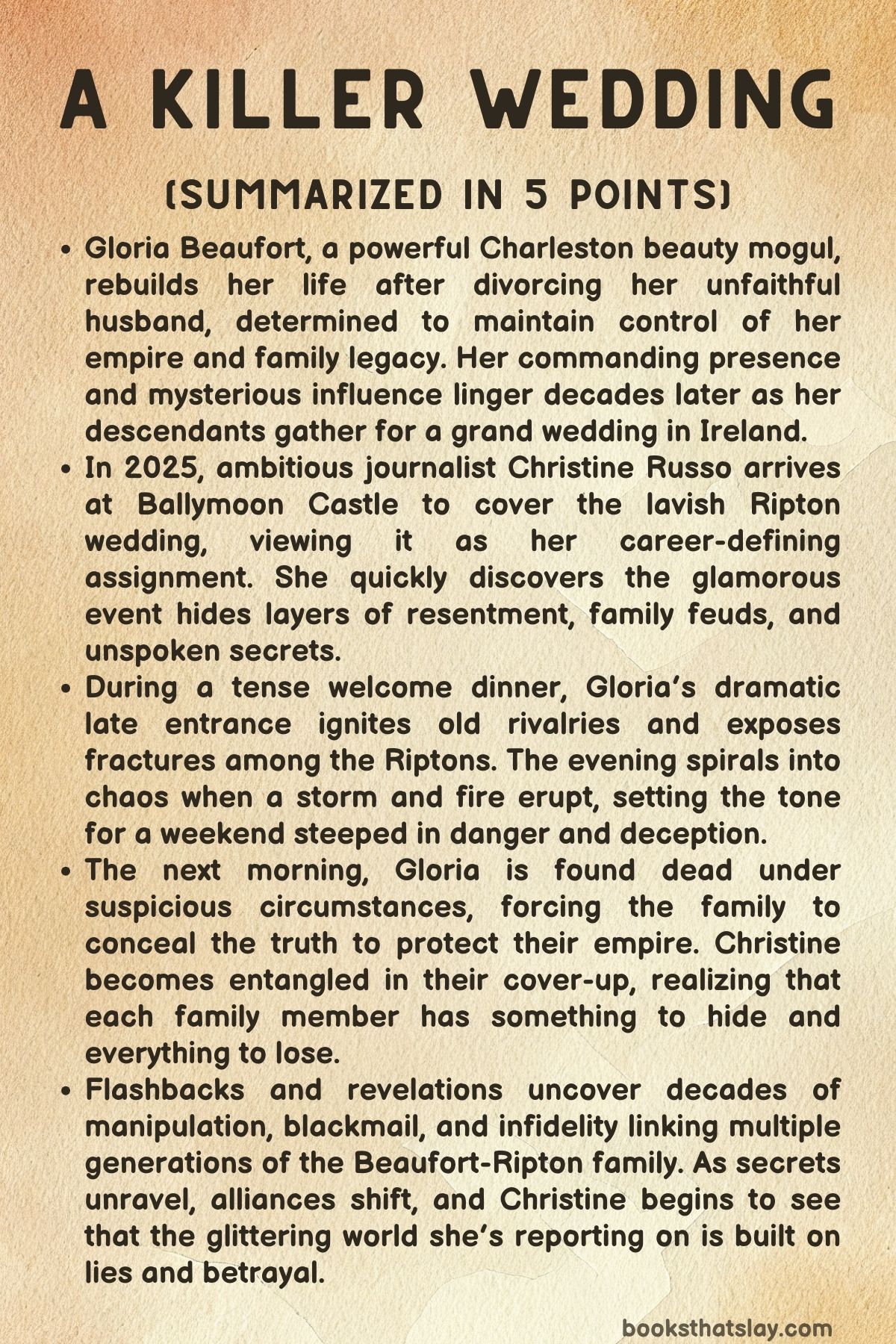
The story begins in Charleston, South Carolina, in 1974, where Gloria Beaufort finalizes her divorce from her unfaithful husband and business partner, John Ripton. Together they built Glo, a multimillion-dollar cosmetics empire, but Gloria believes she alone deserves the credit.
Furious at having to share the company, she maintains her outward poise, reflecting bitterly on a loveless marriage built on convenience. On her way home, she insists her driver take her to church, claiming she wants solace, though her thoughts suggest vengeance.
A year later, John dies unexpectedly of heart failure, leaving open the question of whether divine or deliberate forces brought him down.
Decades pass, and in 2025, the story shifts to Ireland, where Ballymoon Castle prepares to host a wedding that unites wealth, power, and ambition. Christine Russo, an editor for Bespoke Weddings, arrives to cover the exclusive marriage of Jane Murphy and Dr.
Graham Ripton, heir to the Glo empire. This is her first major assignment, and Gloria Beaufort herself has requested her.
The invitation feels like a professional triumph but carries an air of unease, especially after Christine’s boss warns her that Gloria’s “favors come with strings. ” The castle’s opulence, its legends, and the eccentric guests—all orbiting Gloria’s influence—create a sense of mounting tension before the celebration even begins.
Christine attends a family dinner meant to welcome the guests. There she meets the colorful and fractious Ripton clan: Gloria’s son Trey, his artistic wife Clementine, their sons Ben and Graham, Ben’s poised wife Lyle, and Jane’s outspoken mother, Maggie Murphy.
Resentment simmers under the polite small talk—resentment toward Gloria, jealousy among spouses, and contempt toward outsiders. When the matriarch finally appears, draped in white silk and diamonds, her commanding presence silences the room.
She praises Christine by name, unsettling everyone. Gloria mocks Clementine’s drunken poetry reading, and her toasts about marriage’s futility provoke outrage.
As thunder shakes the castle, lightning shatters a window, igniting the lavish dinner table. Amid the chaos, Gloria calmly raises her glass to the flames, declaring, “Now it’s a party.
” The eerie moment cements her as both terrifying and magnetic.
The narrative turns back to a year before the wedding. In Charleston, Gloria hosts a dinner to meet Graham’s new girlfriend, Jane Murphy.
The family views Jane—a schoolteacher from modest means—with suspicion. Gloria challenges her to a chess game, testing her intellect.
When Jane deliberately loses, Gloria realizes the young woman is not naive but calculating. She allows the engagement but quietly vows to uncover Jane’s secrets.
Gloria’s approval seems like a blessing, but it binds Jane to her in unseen ways.
As the family gathers again at Ballymoon Castle for the wedding, tension deepens. The storm, the failed dinner, and whispers of corporate troubles foreshadow disaster.
Lyle, elegant but tightly wound, warns Christine not to trust Gloria. That night, Christine overhears a heated confrontation between Gloria and wedding planner Elliot Adler.
The next morning, Jane goes to Gloria’s suite for a private meeting about a “wedding gift. ” When she enters, she finds Gloria’s belongings scattered and the television playing unattended.
Moments later, she discovers Gloria dead, lying in a pool of blood.
The discovery triggers panic. Graham confirms his grandmother is dead; Jane collapses in shock.
Ben, a corporate lawyer, immediately forbids anyone from calling the police, fearing the scandal will destroy Glo. Under his leadership, the family conspires to hide the body, placing it in a freezer and scrubbing away evidence.
Elliot, offered money, agrees to dispose of the remains discreetly. Christine, horrified, becomes trapped in their cover-up, realizing that silence may be her only protection.
A flashback to two years earlier shows the ruthless side of Gloria’s power. At Lyle and Ben’s wedding, Gloria blackmails the bride.
She presents photographic proof of Lyle’s affair with an Italian photographer named Sebastiano Giovanni and forces her to sign a prenuptial agreement. In exchange, Gloria promises to make Lyle the future CEO of Glo.
Lyle’s wedding gift, a diamond bracelet, becomes a symbol of captivity rather than love. The moment reveals how Gloria shapes everyone’s fate through manipulation.
Back in the present, the family acts as if nothing happened. During the bridal brunch, they pretend Gloria is ill.
Raquel Williams, Glo’s glamorous perfume ambassador, arrives late and clueless, adding to the tension. When she innocently asks about Gloria, the lie that she is “resting” barely holds.
Lyle, increasingly unstable, warns Christine to keep quiet if she wants to survive, claiming that the Beauforts have ways of making their problems disappear.
The story flashes back again to 1993, to Clementine Fitzgerald’s chaotic wedding day. Her groom, Trey Beaufort, goes missing, and Gloria—ever the manipulator—forces her to proceed with the ceremony.
Clementine’s dreams of love dissolve into bitterness and dependence. Decades later, at her son’s wedding, Clementine’s mental health has deteriorated.
She lashes out when she sees Raquel wearing Gloria’s aquamarine ring, suspecting her husband of an affair. The scene turns violent, and Clementine’s breakdown makes her a possible suspect in Gloria’s death.
Meanwhile, Ben confronts Raquel privately, threatening her to end her involvement with Trey. Raquel refuses, declaring her desire to become “the next Gloria Beaufort.
” Christine, observing from a distance, begins to piece together the connections linking the family’s scandals. Lyle later confides that her former lover, Sebi Giovanni, vanished shortly after she told Gloria about his threats.
Lyle suspects Gloria arranged his disappearance, but with Gloria dead, the truth remains buried.
During the rehearsal dinner, chaos strikes again. The garden sprinklers suddenly erupt, drenching the guests and cutting Maggie Murphy’s speech short.
Christine grows suspicious after noticing a shadowy figure and missing jewelry. Her investigation reveals that both Ben and Sebi were at a tequila event weeks earlier, contradicting Ben’s alibi.
When she confronts Lyle, the shaken woman admits that Sebi disappeared right after she sought Gloria’s help. Lyle’s guilt and fear make her both victim and accomplice in Gloria’s shadowy dealings.
Later that night, Christine has drinks with Danny, the charming hotel bartender who has been flirting with her. In a moment of misplaced trust, she confides everything about Gloria’s death.
But Danny’s behavior changes when his second phone rings. Christine realizes too late that he isn’t who he claims to be.
The final revelation confirms that Danny is an undercover Irish detective investigating Seamus O’Reilly, a criminal believed to have infiltrated the wedding—and possibly connected to Sebi’s disappearance. The investigation hints that Gloria’s empire, built on beauty and deceit, may have been entangled with something far darker.
In the end, A Killer Wedding is a story of ambition, betrayal, and the haunting weight of legacy. From Charleston’s gilded mansions to the windswept halls of Ballymoon Castle, the Beaufort family’s polished image conceals a lineage of manipulation and murder.
Gloria Beaufort’s death is not the end of their secrets—it is only the spark that exposes how far each of them will go to protect power, reputation, and the illusion of perfection.
Characters
Gloria Beaufort
At the core of A Killer Wedding stands Gloria Beaufort, a woman who embodies ambition, control, and the seductive power of wealth. Once a self-made cosmetics mogul who built her empire “Glo” from the ground up, Gloria is both the architect of her own success and the manipulator of everyone within her orbit.
Her presence commands every room—impeccably dressed, diamond-clad, and unflinchingly assertive. Beneath that polished surface lies a woman shaped by resentment and revenge: her marriage to the unfaithful John Ripton was more transactional than romantic, and his death—shrouded in suspicion—casts an ominous light on her moral compass.
Gloria’s relationships are transactional; love, for her, is a form of leverage. She weaponizes affection, secrets, and status alike.
Even in death, her control lingers, orchestrating chaos through the inheritance of grudges and ambitions she nurtured. Gloria is less a matriarch than a queen whose reign leaves scars on everyone tied to her empire.
Christine Russo
Christine Russo represents ambition on the rise, an outsider thrust into the privileged world of the Beaufort-Ripton dynasty. As an editor from Bespoke Weddings, she arrives at Ballymoon Castle full of dreams and insecurity, hoping to prove herself in a career that has demanded sacrifice and resilience.
Christine’s awe and moral discomfort mirror the reader’s as she becomes entangled in Gloria’s labyrinth of deceit. Initially flattered by Gloria’s personal invitation, Christine soon realizes she has been chosen not for her talent but for her utility.
Her evolution—from eager observer to reluctant participant in the family’s conspiracy—reveals her moral crisis: torn between journalistic duty and self-preservation. By the time she uncovers the tangled web of lies surrounding Gloria’s death, Christine stands transformed, no longer naive but wary, hardened by proximity to the elite’s corruption.
Clementine Ripton (née Fitzgerald)
Clementine is a tragic portrait of fragility and defiance. Introduced as a bohemian spirit—a lover of poetry, art, and yoga—she marries into the Beaufort family in a haze of youthful optimism, only to find herself trapped in a gilded cage.
Her husband Trey’s infidelity and her mother-in-law Gloria’s manipulation erode her spirit over time, leading to mental instability and dependence on medication. Decades later, Clementine remains volatile, oscillating between lucidity and hysteria.
Her outbursts at the wedding and her fixation on symbols like Gloria’s aquamarine ring reflect a lifetime of humiliation and suppressed rage. Yet Clementine also emerges as one of the novel’s most sympathetic figures: she is a casualty of Gloria’s empire, her mental collapse serving as both rebellion and surrender to a system built to consume her.
Trey Ripton
Trey Ripton is a man defined by weakness—charming but aimless, a perpetual disappointment to the powerful women around him. As Gloria’s only son, he inherits opportunity but not discipline, squandering privilege through hedonism and infidelity.
His marriage to Clementine is marked by absence and betrayal; his flirtations with younger women, including Raquel, underscore a desperate need for validation. Trey’s dynamic with his mother is one of dependence and quiet resentment: she sees him as unfit to lead, and he alternates between rebellion and submission.
Ultimately, Trey symbolizes the decay of inherited power—a man who has all the trappings of success but none of the backbone to wield it.
Lyle Ripton
Lyle Ripton embodies the duality of elegance and imprisonment. Initially presented as the quintessential socialite—beautiful, poised, and married into wealth—she hides a turbulent inner life marked by secrets and fear.
Her relationship with Gloria begins as blackmail but evolves into a twisted mentorship, with Gloria grooming her as Glo’s future leader. Lyle’s affair with photographer Sebi Giovanni and the paternity doubts surrounding her son expose her vulnerability beneath the façade.
Unlike Clementine, Lyle plays the long game—calculating, strategic, and quietly ambitious. Yet her intelligence becomes her torment, binding her to Gloria’s machinations even after the older woman’s death.
In many ways, Lyle is Gloria’s most faithful reflection: polished, ruthless, and forever trapped by the cost of survival.
Ben Ripton
Ben Ripton, Lyle’s husband and Gloria’s grandson, represents the logical but morally compromised branch of the family. A corporate lawyer for Glo, Ben is driven by control and the maintenance of appearances.
He is protective of the family name to the point of cruelty, prioritizing reputation over truth, even in the aftermath of Gloria’s murder. His discovery of Lyle’s affair and the questions of his son’s paternity unravel him emotionally, exposing the insecurity beneath his legal precision.
Ben’s actions—covering up Gloria’s death, coercing silence, confronting Raquel—reveal how easily intellect collapses under emotional betrayal. He becomes both victim and villain, a man destroyed by the very ambition and secrecy that define his family.
Graham Ripton
Graham, Gloria’s younger grandson and the groom at the center of the novel’s titular wedding, is perhaps the most idealistic member of the Ripton clan. A doctor and apparent moral counterpoint to his scheming relatives, he strives for decency and normalcy.
His relationship with Jane Murphy, a modest schoolteacher, seems to offer redemption for the family’s corruption. Yet Graham’s good nature blinds him to manipulation—by Jane, by his family, and by circumstance.
His tragedy lies in his helplessness: despite his best intentions, he is repeatedly drawn into moral compromise. In the chaos surrounding his wedding and grandmother’s death, Graham becomes a passive observer, a man struggling to reconcile love with legacy.
Jane Murphy
Jane Murphy enters the story as an outsider, her modest background starkly contrasting the opulence of the Riptons. Initially portrayed as a shy, genuine schoolteacher, she quickly reveals deeper layers of calculation and ambition.
Her willingness to let Gloria win their chess match signals her instinct for survival—a quiet cunning masked by humility. Jane’s relationship with Graham is genuine yet strategic; she navigates the family’s treacherous dynamics with a restraint that suggests both fear and foresight.
By the time she discovers Gloria’s corpse, her sobbing could be read as grief—or guilt. Jane becomes the mirror through which themes of manipulation and power are refracted: she may be a victim, or she may be the final player in Gloria’s deadly game.
Elliot Adler
Elliot Adler, the flamboyant wedding planner, injects both levity and menace into the narrative. Renowned for his perfectionism and eccentricity, he thrives on spectacle and control, yet beneath his glittering exterior lies exhaustion and resentment.
His long-standing association with Glo binds him to Gloria, whose favors come with invisible chains. Elliot’s breaking point—his argument with Gloria before her death—reveals the cost of his complicity.
His role in concealing her body in exchange for money cements his transformation from enabler to criminal. Elliot represents the corruption of artistry in service of wealth: a man who sells beauty but lives surrounded by moral decay.
Raquel Williams
Raquel Williams, the glamorous actress and perfume ambassador for Glo, embodies the seductive chaos that surrounds fame and ambition. Superficially vain and theatrical, she is far more cunning than she appears.
Her affair with Trey Ripton, her entanglement with Sebi Giovanni, and her open defiance of the family all expose her hunger for recognition and power. Raquel’s audacious declaration that she wants to be “the next Gloria Beaufort” captures her delusion and her drive.
She is both Gloria’s heir and her parody—a woman chasing control without understanding its cost. In her, the novel critiques the modern obsession with image and legacy, showing how ambition untethered from empathy inevitably leads to ruin.
Sebastiano “Sebi” Giovanni
Sebi Giovanni exists mostly in the shadows of the narrative, but his absence drives much of its tension. As Lyle’s lover, Raquel’s collaborator, and a possible blackmail target, Sebi is the link between personal sin and public scandal.
Charismatic and dangerous, he thrives in the world of beauty and illusion, photographing faces that hide corruption. His disappearance—possibly orchestrated by Gloria or her accomplices—casts a pall over the narrative, tying the family’s moral rot to literal violence.
Sebi symbolizes the ghost of consequence, the unseen price of deception that haunts every character in A Killer Wedding.
Danny / Detective (Undercover Officer)
Danny, the charming Irish bartender at Ballymoon Castle, emerges as one of the story’s most surprising figures. Initially presented as a sympathetic confidant to Christine, he later reveals himself as an undercover detective investigating the criminal ties surrounding the Riptons and the mysterious disappearance of Sebi Giovanni.
His double identity highlights the novel’s core theme of deception: every role, whether social or moral, is a mask. Danny’s presence bridges the worlds of glamour and crime, suggesting that beneath the silken veneer of weddings and wealth lies something profoundly rotten.
Through him, justice flickers faintly in a story otherwise consumed by manipulation and secrecy.
Themes
Power and Control
In A Killer Wedding, power operates as the central current shaping every decision, relationship, and secret across generations of the Beaufort and Ripton families. Gloria Beaufort’s empire, Glo, becomes not merely a business but a symbol of dominance—her life’s proof that control is both her weapon and her shield.
Her relationships with her family are transactional, orchestrated to preserve her supremacy within both her brand and her bloodline. From manipulating her son’s marriage to blackmailing Lyle into corporate servitude, Gloria’s control manifests through charm, coercion, and calculated generosity.
The wedding setting—a celebration meant to mark unity—ironically exposes fractures caused by her lifelong need to command others’ fates. Even after her death, her influence lingers like a haunting, compelling those around her to act in fear and loyalty rather than love.
This dynamic extends beyond Gloria; other characters mirror her patterns of control in subtler forms. Lyle exerts power through emotional manipulation, Ben through intimidation, and Christine through the control of narrative as a journalist.
Yet every attempt at dominance carries a cost. The castle, filled with hidden rooms and ghostly presences, reflects the illusion of control that defines their world—an ornate prison for people who believe they can dictate destiny.
Ultimately, power in the novel is cyclical and corruptive; no one truly possesses it, only borrows it until it consumes them.
Family Legacy and Inherited Corruption
The Beaufort-Ripton lineage embodies how legacy can rot from the inside when built on ambition rather than integrity. The novel’s generational structure exposes how the family’s wealth, prestige, and business success are inseparable from deceit, moral compromise, and emotional neglect.
Gloria’s initial rise from self-made entrepreneur to cosmetics magnate begins with legitimate drive but curdles into tyranny as she mistakes legacy for ownership of others’ lives. Her children and grandchildren inherit not just her fortune but her emotional isolation and ruthless instincts.
Trey’s failure as a husband and father echoes Gloria’s manipulative tendencies, while Lyle’s strategic compliance demonstrates how corruption adapts to survive in new forms. The younger generation—Ben and Graham—inherit this toxic inheritance without realizing its full weight until Gloria’s death forces them into complicity, covering up her murder to protect their family’s image.
The concept of inheritance becomes a curse rather than a privilege, binding each member in cycles of deceit and moral decay. The wedding, intended as a fresh chapter, instead exposes how the past cannot be buried—it festers, resurrecting old sins in glittering new packaging.
A Killer Wedding thus portrays legacy as both the foundation and downfall of its characters, suggesting that inherited power without accountability perpetuates corruption disguised as tradition.
Gender, Image, and Performance
Throughout A Killer Wedding, gender and appearance operate as tools of both survival and deception. The women in the novel—Gloria, Lyle, Clementine, Jane, and Christine—navigate a world that rewards beauty, obedience, and spectacle while punishing vulnerability.
Gloria weaponizes femininity, mastering the art of performance to command respect in a patriarchal society that once underestimated her. Her cosmetic empire, Glo, literalizes this obsession with surfaces: it sells the illusion of perfection that conceals the bruises beneath.
Clementine’s eccentricity and instability reveal another side of gendered expectation—she is mocked for her emotional volatility, even as it stems from years of repression under a domineering husband and mother-in-law. Lyle’s compliance within her gilded cage demonstrates how societal beauty and ambition can coexist with deep entrapment.
Christine, meanwhile, represents the modern iteration of this theme: a professional woman who masks insecurity with ambition and style, only to find herself manipulated by the same power structures she hoped to expose. Across these intersecting arcs, the novel portrays femininity as a performance honed for survival.
The wedding—drenched in glamour, diamonds, and media attention—becomes the ultimate stage where identity is curated for public gaze. Beneath every polished façade lies exhaustion, guilt, and the quiet rebellion of women who understand that control over their image is the only power they are allowed to hold.
Secrets, Deception, and the Illusion of Truth
Deception permeates every corner of A Killer Wedding, transforming the castle into a labyrinth of lies where truth exists only in fragments. Secrets drive the novel’s structure, linking past betrayals with present crimes until the boundaries between them blur.
Gloria’s manipulation of information—concealing affairs, forging alliances, and using blackmail as currency—sets the tone for a family culture where silence is survival. Each character learns to craft their own version of truth: Lyle hides her affair and her child’s uncertain paternity, Ben hides his jealousy behind moral outrage, and Christine hides her fear behind professionalism.
Even the detective disguised as a bartender participates in this masquerade, suggesting that deception extends beyond personal motives to institutional ones. The wedding itself is an illusion of purity, staged to distract from the rot beneath its gold-trimmed surface.
Joan O’Leary constructs deception not merely as plot device but as psychological inheritance—the family’s instinctive method of control and self-preservation. The constant concealment of facts mirrors the cosmetics empire’s ethos: what matters is not what is true but what appears flawless.
The novel’s tension between truth and performance ultimately collapses in Gloria’s death, exposing how every lie leaves a residue that corrodes trust, love, and even sanity.
Ambition and the Cost of Success
Ambition in A Killer Wedding operates like an addiction, intoxicating every character who tastes even a fragment of power. Gloria’s drive to build her empire from scratch is born from genuine determination but metastasizes into obsession, blinding her to human connection.
Her ambition creates an empire but destroys her family, turning love into leverage and loyalty into debt. Lyle’s ambitions mirror Gloria’s in miniature—she seeks influence within Glo, believing success will shield her from vulnerability, yet she becomes a puppet in Gloria’s larger scheme.
Christine’s hunger for professional recognition propels her into the family’s orbit, where she learns that ambition without caution invites danger. The Riptons’ collective pursuit of wealth and prestige becomes a moral contagion, binding them to appearances and forcing them to commit unspeakable acts to protect the illusion of success.
Even the detective, masquerading as a bartender, exhibits ambition of a different kind—the pursuit of justice within a morally compromised system. O’Leary suggests that ambition, untempered by conscience, erases boundaries between survival and greed.
Every achievement in the novel carries a hidden cost: a secret buried, a relationship destroyed, or a conscience silenced. In the end, ambition becomes indistinguishable from self-destruction—a force that drives the characters forward even as it ensures their ruin.