A River Enchanted Summary, Characters and Themes
A River Enchanted by Rebecca Ross is a lyrical fantasy tale set on the mystical Isle of Cadence, where folklore and clan rivalries shape every aspect of life. The novel follows Jack Tamerlaine, a bard who returns after years of exile to a land divided by ancient feuds and haunted by restless spirits.
Summoned under mysterious circumstances, Jack finds himself drawn into a perilous mystery involving missing girls, clan secrets, and dangerous bargains with otherworldly beings. As tensions rise between east and west, and loyalties are tested, Jack must uncover not only the truth behind the disappearances but also his own destiny, bound tightly to the island he once left behind. It’s the 1st book in the Elements of Cadence series.
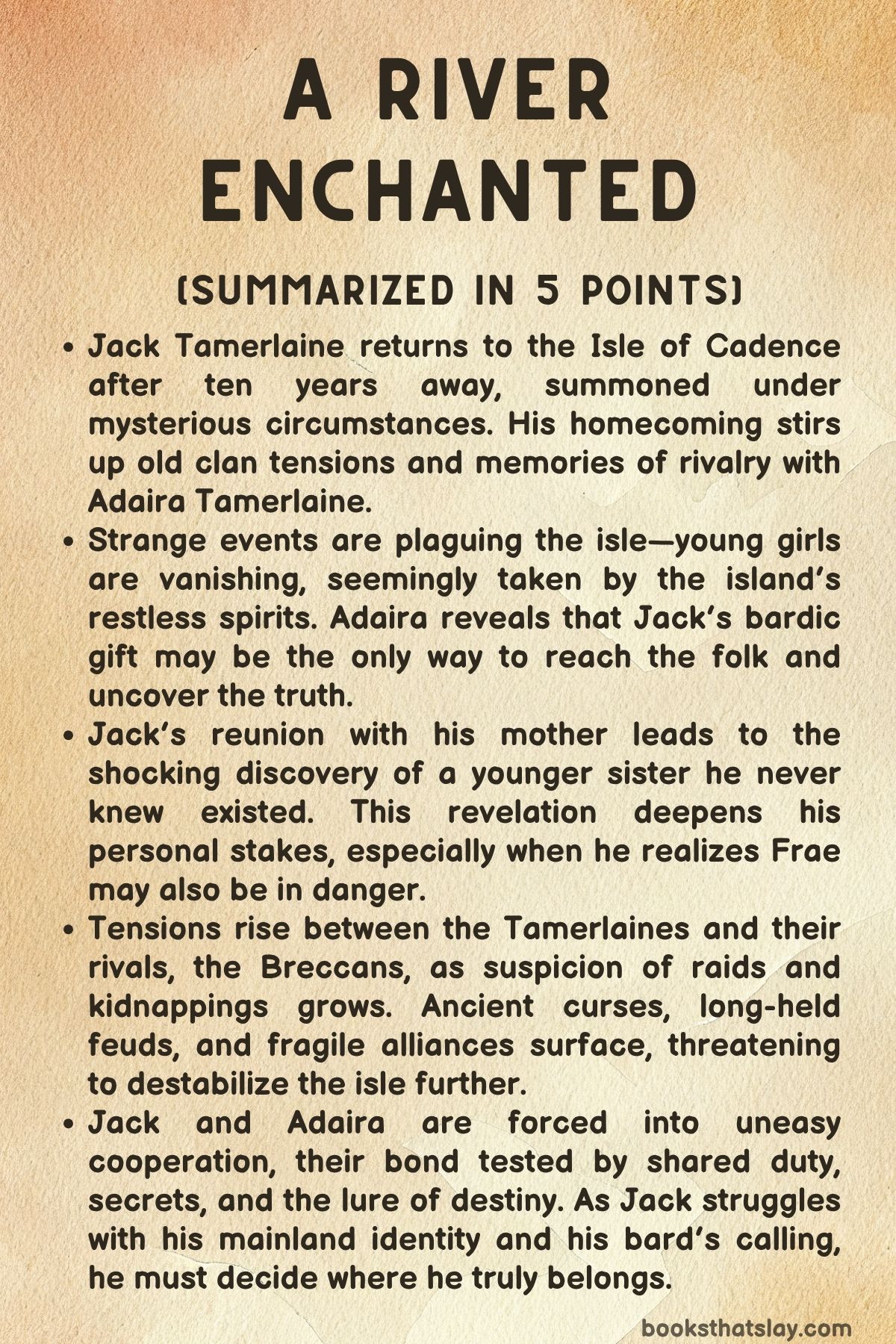
Summary
Jack Tamerlaine returns to the Isle of Cadence after a decade away, summoned by what he believes is his clan’s urgent call. His journey begins with unease when the sailor who once ferried him as a boy is absent, replaced by the man’s son, who demands enchanted dirks for passage.
Despite fear of the folk who inhabit the waters, Jack convinces him to row across at night. As they travel, Jack is reminded of the ancient feud between the Tamerlaines of the east and the Breccans of the west, a conflict rooted in the tragic love story of Joan Tamerlaine and Fingal Breccan.
The crossing turns dangerous when water spirits disturb the boat, forcing Jack to leap into the sea with only his harp and enchanted plaid. He washes ashore on Breccan land but is soon recognized and saved by Torin Tamerlaine, captain of the guard and Jack’s childhood hero.
At Torin’s camp, Jack learns that the isle is plagued not just by clan skirmishes but by a darker threat: girls from the east have begun vanishing without a trace. He is brought before Laird Alastair, once strong but now frail, and discovers that the summons he received was forged.
The true author is Adaira Tamerlaine, the laird’s daughter and Jack’s former rival. She reveals her plan—she needs him to use his bardic gifts to summon spirits and uncover what has happened to the missing girls.
Though reluctant, Jack agrees, realizing his harp may be the only tool to reveal the truth.
Reuniting with his mother, Mirin, Jack is stunned to learn he has a younger sister, Frae. Their bond grows quickly, though he is disturbed by mysterious rattling at her shutters at night, signs of spirits growing bolder.
Determined to protect her, Jack deepens his involvement with Adaira’s mission. Meanwhile, Torin continues his searches and encounters a mysterious crone who speaks of an ancient curse that left the Breccans with magic but barren land, and the Tamerlaines with abundance but steep magical costs.
As tensions mount, another child vanishes, and the fear among the clans intensifies.
Jack and Adaira’s relationship evolves as they work together. She reveals that his late aunt Lorna had once seen him as the future Bard of the East.
Burdened by the weight of destiny yet moved by Adaira’s trust, Jack agrees to summon the spirits. Their cooperation deepens into partnership and soon love, culminating in a quiet wedding ceremony.
Jack embraces his new role as bard, though the toll of his music on his health is evident. Through song, he learns that the missing girls are alive, though their captors remain hidden, and he discovers the spirits view Adaira as significant to their realm.
The political situation worsens as Adaira engages in delicate negotiations with Moray Breccan, heir of the west. Jack remains wary of him, and his instincts prove right when Frae is later abducted by Moray himself.
Using his harp in desperation, Jack forces Moray to return her, though at great cost to his own strength. Moray’s capture reveals a shattering truth: Adaira is not truly Tamerlaine but the daughter of Innes Breccan, switched at birth by the Keeper of the Aithwood.
Moray claims she is Cora Breccan, his sister, stolen away to the east. Jack later confirms that his own father, the Keeper, delivered Adaira to the Tamerlaines after their own child died.
The revelation spreads through Sloane, leaving Adaira distrusted by her people. Though Jack stands by her, she abdicates her position, naming Torin laird in her place.
She arranges an exchange with Innes Breccan, offering herself in return for the missing girls and Moray’s imprisonment in the east. The agreement is carried out, and the girls are safely returned, including Torin’s daughter, Maisie.
Yet Adaira’s sacrifice means leaving behind her clan, her title, and Jack.
In a final confrontation, Jack vows to follow her, but Adaira resists, fearing his bardic gifts would be wasted in the west, where music is forbidden. Their parting is painful, filled with love and loss.
She departs with Innes, leaving Jack broken but determined to remain connected to his family and his destiny as bard. Adaira rides into the harsh western lands, where the north wind welcomes her as one of its own, her future uncertain but bound to her true heritage.
The story concludes with both Jack and Adaira transformed—he as the bard anchoring the east in hope and resilience, and she as a woman stepping into an unfamiliar legacy in the west. Their separation leaves open questions of loyalty, belonging, and the costs of peace, while the isle itself remains a place of peril, divided by blood, magic, and the will of the spirits.
Characters
Jack Tamerlaine
Jack stands at the heart of A River Enchanted, a figure torn between two worlds: the mainland where he built a quiet, scholarly life, and the mystical Isle of Cadence where he was born. His return is reluctant, colored by resentment at past humiliations and the weight of exile.
Yet beneath his bitterness lies a deep yearning for belonging, one that resurfaces as he reconnects with his clan, his mother, and the sister he never knew. Jack’s gift as a bard becomes both a blessing and a curse, a source of power capable of summoning spirits but one that exacts a terrible toll on his body and soul.
His growth lies in reconciling this power with his sense of identity, realizing that music ties him to the isle more deeply than exile ever severed. His marriage to Adaira reflects both his personal transformation and his acceptance of a role greater than himself, though his love for family, especially Frae, continues to shape his choices.
Adaira Tamerlaine
Adaira is introduced as Jack’s childhood rival, sharp-tongued and commanding, yet she emerges as one of the novel’s most complex figures. Fiercely intelligent and ambitious, she defies expectations by forging her father’s summons to bring Jack back, convinced of his importance in restoring the isle’s bond with the spirits.
Her sense of leadership and loyalty to her people is genuine, even if it is sometimes uncompromising. Adaira’s vulnerabilities appear in her longing for kinship—something she finds in Frae—and in her conflicted relationship with Jack, marked by rivalry, trust, and eventual love.
The revelation of her Breccan heritage shatters her standing and forces her into exile, but rather than diminishing her, it reveals her resilience. She is a character defined by her duality: both East and West, both leader and exile, both lover and sacrificial daughter.
Torin Tamerlaine
Torin, captain of the East Guard, embodies duty, strength, and a stoic commitment to protecting his clan. To Jack, he begins as a childhood idol, and he fulfills that role by rescuing and guiding him upon his return.
Yet Torin is not unscarred; his past is marred by violence and his present burdened by guilt. His marriage to Sidra reveals a softer side, but also highlights his struggles with trust and faith in the isle’s spirits, which sets him at odds with his wife.
As father to Maisie, Torin’s fears grow more urgent as the disappearances escalate, grounding his heroism in very human vulnerability. His reluctant rise to lairdship after Adaira’s abdication illustrates his evolution from warrior to leader, though his heart remains restless, haunted by questions of vengeance, peace, and legacy.
Sidra
Sidra is the quiet strength of the Tamerlaine household, a healer whose life is steeped in the traditions of the isle and faith in the spirits. Her role is not as overtly commanding as Torin’s or Adaira’s, but she exerts influence through compassion and wisdom.
Her resistance to Torin’s insistence on physical protections reflects her belief in harmony with the folk rather than fear of them. Sidra’s gift for listening, both to people and to the whispers of the wind, places her in a liminal space between the human and the supernatural.
She becomes a figure of calm in chaos, guiding Torin through his tempests and offering Jack the care of a surrogate family. Her reunion with Maisie after the child’s disappearance captures her defining essence: the fierce, quiet devotion of a mother and healer.
Mirin
Mirin, Jack’s mother, is a weaver of both cloth and secrets. Her decision to hide Frae’s existence reveals the lengths she will go to protect her children, even at the cost of Jack’s trust.
She is deeply tied to the heritage of the isle, yet her choices complicate her relationship with her son, straining their reunion. Mirin embodies sacrifice, her life shaped by burdens she carries alone, but her love for Jack and Frae is constant, if imperfectly expressed.
She also plays a pivotal role in the revelation of Adaira’s origins, showing her as a woman caught between duty and compassion, secrecy and truth. Mirin represents the older generation of the isle—guardians of traditions, but also keepers of painful truths.
Fraedah (Frae)
Frae is one of the most luminous characters in the story, her innocence and bravery a counterpoint to the dark tensions of the isle. Her open-hearted acceptance of Jack contrasts with his guarded bitterness, and in her, he finds a source of joy and responsibility.
Frae’s eagerness to bond with her brother, her pride in his music, and her unshakable belief in his love render her a symbol of hope. Yet she is not merely a passive child; her courage in resisting Moray and her spirited curiosity prove her resilience.
Frae anchors Jack to his humanity, reminding him of what he stands to lose and why his sacrifices matter. She represents the future of Cadence, unburdened by the feuds of the past but vulnerable to their consequences.
Moray Breccan
Moray embodies the hostility of the west, but his character is shaded with complexity. As heir to the Breccans, he carries both entitlement and desperation, his actions driven by loyalty to his family and their fractured legacy.
His kidnapping of the Tamerlaine girls and confrontation with Jack and Adaira mark him as an antagonist, yet his revelations about Adaira’s heritage reveal motives beyond cruelty. He is a mirror to Torin: a warrior bound by clan duty but scarred by choices.
His violence is undeniable, but so too is his role in exposing truths long hidden. Moray stands as both villain and tragic figure, a reminder of how history and curses shape destinies.
Laird Alastair Tamerlaine
Alastair, once a proud and commanding laird, appears aged and diminished when Jack returns. His frailty contrasts with the strength he once embodied, leaving a vacuum that Adaira and Torin must step into.
His decline symbolizes the fading of an older generation’s power and the need for renewal. Yet his presence remains significant, as he represents the lineage and legacy of the east, and his weakening state underscores the urgency of restoring the isle’s balance.
Alastair’s arc is quieter than others, but it serves as a backdrop to the struggles of younger characters forced to carry burdens before their time.
Themes
Exile and Belonging
In A River Enchanted, the theme of exile and belonging runs like a shadow across Jack’s journey from the very first moment he sets foot on the Isle of Cadence again. Having lived a decade in exile, Jack carries with him the pain of rejection, the shame of being viewed as an outsider, and the lingering question of where his true home lies.
His initial encounters—whether with the wary fisherman, the guards who nearly mistake him for an intruder, or even his strained reunion with his mother—underscore how fractured his sense of belonging has become. He is both familiar and foreign to Cadence, caught between mainland rationality and the magical traditions of his people.
His rediscovery of family, particularly the sudden knowledge of his sister Frae, forces him to confront the part of himself that has always yearned for connection to his roots. Belonging here is not merely physical presence; it is intertwined with duty, bloodlines, and the dangerous role of bardship that fate seems to demand of him.
Jack’s eventual acceptance of his place as Bard of the East and his commitment to Adaira is not simply a personal choice but a reclamation of identity that had been denied to him. Yet the bittersweet undercurrent lies in how belonging always exacts a cost—whether through service to the clan, vulnerability to the spirits, or sacrifices in love.
His arc demonstrates that exile is not only a physical state but also an internal fracture, and belonging is not gifted freely; it must be fought for, endured, and continually reaffirmed.
Family and Hidden Truths
The story constantly presses against the idea that families are built as much on secrets as they are on love. Jack’s reunion with his mother reveals the deepest of concealed truths: the existence of Frae, a sister he never knew, and the lies Mirin told to protect her children from the volatile dangers of the isle.
This revelation destabilizes Jack’s already fragile trust and amplifies his resentment, for concealment has defined his entire life. Yet this theme broadens beyond Jack.
Adaira’s heritage unravels into one of the novel’s most shocking revelations—that she is not a Tamerlaine but the daughter of Innes Breccan, switched at birth. This redefinition of family destabilizes clan loyalties, political hierarchies, and personal identities, illustrating how fragile and conditional kinship can be in a world governed by both human will and supernatural bargains.
Still, the novel suggests that hidden truths do not only fracture families but also reveal opportunities for renewal. Jack’s love for Frae, despite his bitterness toward Mirin, gives him a sense of purpose beyond personal grievances.
Similarly, Adaira’s acceptance of her origins complicates but does not negate her bond with Jack, showing that family can expand and transform rather than simply disintegrate. Ultimately, Ross frames family not as a static inheritance but as a shifting, contested space where love, secrets, betrayal, and loyalty coexist uneasily.
Power, Duty, and Sacrifice
The tension between personal desires and communal duty pervades A River Enchanted, crystallizing in Jack’s role as bard and Adaira’s position as heir. Jack’s mainland life as a teacher represents freedom from clan burdens, yet his return forces him into a role that is both privilege and curse.
Playing the harp to summon the spirits restores hope and balance to his people but leaves his body and soul battered by the toll of magic. Adaira’s own arc parallels his in how her sense of duty eclipses personal happiness.
Even after seizing authority through boldness and cleverness, she sacrifices her lairdship when her hidden heritage comes to light, choosing to abdicate for the clan’s stability. Both characters must abandon dreams of individual autonomy in order to preserve others, highlighting how leadership and responsibility inevitably demand self-denial.
This theme is reinforced through Torin, whose devotion to his clan and family wars against the shadows of guilt and vengeance from his past. In all cases, sacrifice is not portrayed as noble simplicity but as something painful, burdensome, and often isolating.
The novel insists that true power is inseparable from the weight of responsibility, and those who hold it must reckon with the reality that personal fulfillment is rarely compatible with the demands of duty.
The Conflict Between Tradition and Change
The Isle of Cadence itself embodies a society torn between ancient enchantments and the encroachment of human skepticism. The Tamerlaines’ reliance on bards to maintain harmony with the folk reflects the enduring belief in music as a conduit to power, yet figures like Torin question the reliability of the spirits, preferring tangible protections such as weapons and guard dogs.
This divide highlights the generational and ideological tension between reliance on ancestral customs and the desire to adapt in order to survive. Jack, with his dual experience of mainland rationality and island mysticism, becomes a bridge between these two ways of living.
Adaira’s boldness in forging alliances and asserting herself as leader further signals a push toward transformation, though her eventual displacement reveals how resistant the isle remains to drastic redefinitions of tradition. The Breccans’ contrasting fate—barren lands yet easy magic—serves as a foil, underscoring how the distribution of power, resources, and tradition can both define and doom a people.
The novel poses a haunting question: must tradition be preserved even when it erodes, or must it yield to change even if change threatens identity? The uncertainty of this balance shapes nearly every decision the characters make, driving home the fragility of cultural survival when bound to forces beyond human control.
Love, Loyalty, and Betrayal
The relationships in A River Enchanted are fraught with the constant testing of love and loyalty. Jack and Adaira’s union, though born from rivalry and resentment, blossoms into a bond that unites them not only as partners but also as leaders.
Their marriage is not merely a personal vow but a political and spiritual alliance, carrying the weight of their clan’s future. Yet loyalty in the novel is often complicated by betrayal.
Adaira’s revelation as a Breccan by blood casts suspicion on her every action, unraveling the trust of her people despite her steadfast dedication. Similarly, Torin wrestles with loyalty to his clan against the guilt of his past violence, and Sidra must balance her faith in the spirits against the skepticism of her husband.
Even the spirits themselves embody betrayal, offering glimpses of aid while withholding truths that could save lives. Ross crafts love and loyalty not as simple absolutes but as constantly tested commitments that must be reaffirmed in the face of shifting allegiances and painful truths.
The betrayals woven through family ties, clan politics, and spiritual dealings remind readers that loyalty is never guaranteed but must be continuously earned through choice and sacrifice.