A Serial Killer’s Guide to Marriage Summary, Characters and Themes
A Serial Killer’s Guide to Marriage by Asia Mackay is a dark and twisted psychological thriller that explores the complexities of identity, marriage, and morality. At the heart of the story is Haze Matthews, a woman whose life is entangled in violence, secrets, and personal conflict.
She lives with her husband, Fox, and their daughter, Bibi, in a seemingly idyllic suburban setting, but beneath the surface, their marriage is anything but normal. The couple shares a disturbing past—they are serial killers, targeting men who they believe deserve to die. The story follows Haze as she grapples with her past actions, her strained relationship with Fox, and her struggle to reclaim control over her life. With an intricate mix of domestic drama, crime, and betrayal, the novel delves into Haze’s internal battles as she navigates the complicated dynamics of her violent relationship.
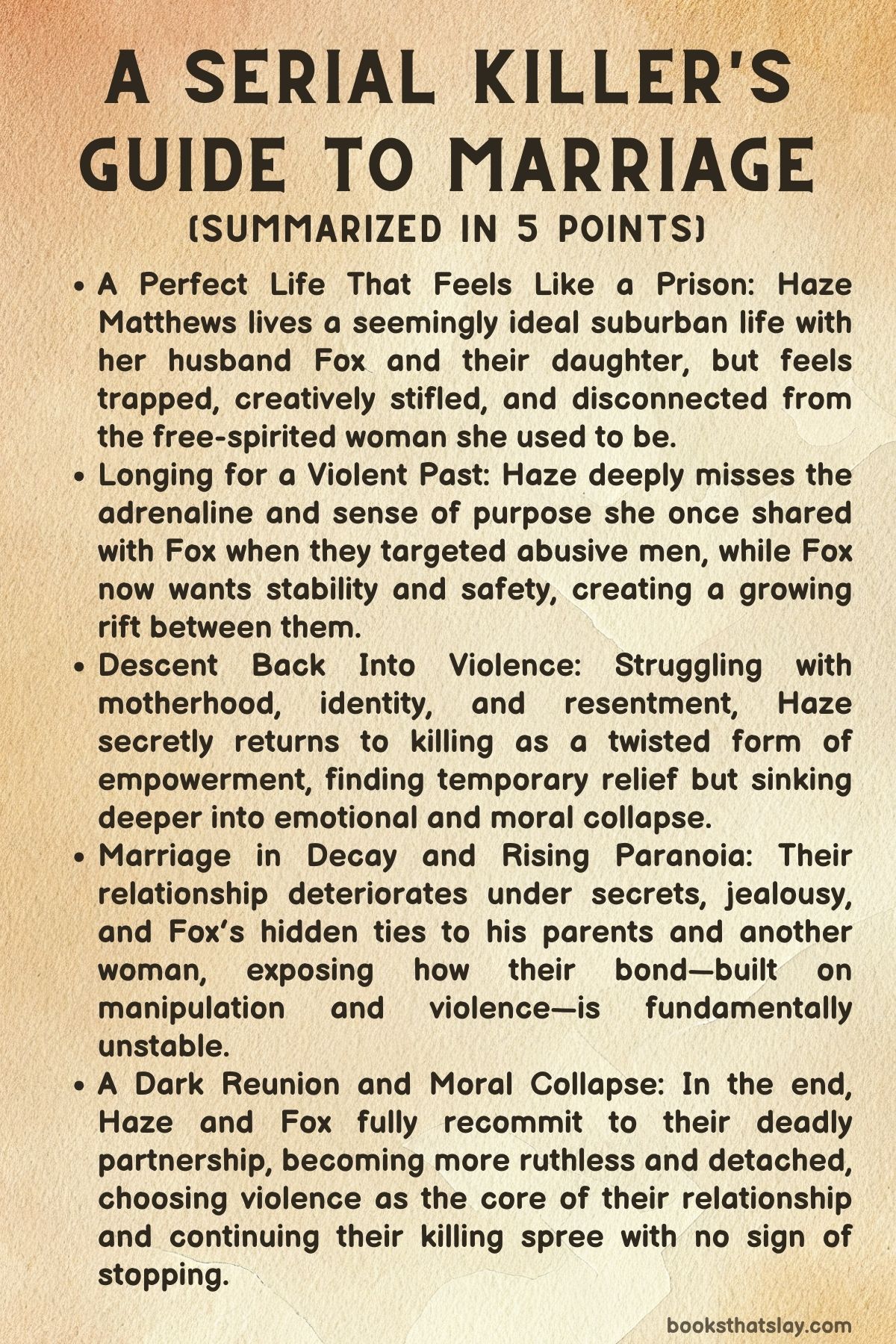
Summary
Haze Matthews’ life seems perfect on the outside. She lives in a luxurious house in Sunningdale with her husband, Fox, and their daughter, Bibi.
Yet beneath this facade of suburban bliss, Haze feels trapped in a life she never expected. Once a free-spirited artist and an independent woman, Haze now finds herself overwhelmed by motherhood and domestic life.
She is constantly battling with the sense that her creativity and passion have been stifled by the mundane chores of motherhood. The intense connection she once shared with Fox, particularly in their shared violent past of targeting men who mistreated women, is slowly fading.
Fox has embraced fatherhood and the stability of a conventional family life, while Haze feels increasingly alienated and dissatisfied.
Haze reflects on her life and feels a deep longing for the past, when she and Fox would take down the “bad” men together, using their violence as a form of empowerment. She resents how her life has shifted from one of excitement to one of monotony, and she cannot shake the feelings of discontent.
She misses the thrill of their past actions, the adrenaline rush, and the sense of purpose it gave her. Now, she finds herself lost, unsure of how to navigate her new role as a wife and mother.
Despite her attempts to bond with other mothers in the neighborhood, Haze feels increasingly isolated. Her art, once an integral part of her identity, is now an afterthought, a hobby she no longer has time for.
Fox, on the other hand, seems content with their new life. He embraces the role of fatherhood, but Haze resents him for wanting to settle into a conventional life, abandoning their former violent escapades.
Fox, who was always the more calculated and methodical one, wants to protect their family from the dangers of their past, but Haze cannot let go of her need for action and excitement. As Fox becomes more focused on protecting their family, Haze grows increasingly frustrated with their relationship, feeling that it lacks the fire it once had.
She finds herself wanting to break free from the constraints of her new life, but she does not know how.
Haze’s frustration builds as she feels herself becoming more disconnected from Fox, who seems more distant as he focuses on fatherhood. She is left to grapple with the emotional toll of motherhood and the domestic life she never wanted.
In an effort to regain some sense of control, Haze begins to reconnect with her past, revisiting the violence she once felt empowered by. She targets men she believes have wronged women, using murder as a twisted form of self-expression.
Each act of violence provides her with a temporary sense of relief, a fleeting moment of control over her life. However, this path also leads her to deeper emotional turmoil, as she realizes the toll her actions are taking on her.
While dealing with her own internal struggles, Haze forms an unlikely bond with Jenny, a woman who is trapped in an abusive relationship. Haze tries to help Jenny regain control over her life, offering advice and support.
However, despite helping others, Haze remains deeply dissatisfied with her own life. Her connection with Fox continues to deteriorate as she becomes more consumed by her need for power and control.
Fox, too, struggles with his role in their shared violence, questioning the morality of their actions as their partnership becomes more centered around their deadly pursuits.
The tension between Fox and Haze grows as they confront the reality of their situation. Their marriage, built on violence and manipulation, begins to show cracks.
Haze becomes increasingly paranoid, suspecting Fox of hiding something from her. She discovers disturbing clues about his actions, including his secretive behavior and his strange interactions with a woman.
Haze’s jealousy and frustration boil over, but Fox refuses to open up to her, and their relationship continues to unravel.
In the midst of their crumbling marriage, Haze is forced to confront her own identity. She is no longer the woman she once was—the confident, independent artist who took pride in her actions.
She is now a woman trapped in a life of lies, violence, and emotional turmoil. Despite the comforts of suburban life, she feels hollow inside, unable to reconcile her past with her present.
As she navigates this internal conflict, she realizes that her violent actions, which once gave her a sense of purpose, are now the very things that are destroying her.
Fox, on the other hand, becomes increasingly entangled in his own web of lies and manipulation. He is confronted by his parents, who threaten to expose his past and use it to control him.
He is torn between protecting his family and fulfilling his obligations to his parents. Fox’s internal conflict adds another layer of tension to their already strained relationship.
As the story progresses, the couple’s deadly partnership intensifies. Fox and Haze become more efficient in their killings, working together as a team to execute their twisted sense of justice.
Their relationship becomes centered around their shared violence, and they begin to feel invincible, believing that their love and commitment to each other can overcome any obstacle. However, beneath the surface, their partnership is built on a fragile foundation of secrets and lies.
The climax of the story comes when Haze is confronted with the reality of her actions. She is forced to confront the consequences of her violent path and question whether she can ever return to the woman she once was.
As Fox and Haze continue their killing spree, they become more ruthless and detached from the world around them. Their relationship, which was once fueled by passion and shared goals, is now driven by a dangerous sense of power and control.
In the final moments of the novel, Haze and Fox are portrayed as a couple who have become unstoppable, bound by their love, their shared violent past, and their mutual devotion. Together, they continue to hunt down those they deem deserving of death, their love and partnership forged through blood and crime.
The novel ends with the couple on another mission, their deadly partnership stronger than ever, as they continue their reign of terror with no end in sight.
Characters
Haze
Haze is the protagonist of A Serial Killer’s Guide to Marriage and serves as the lens through which the reader explores the dark, complex world of the novel. Initially, Haze is a woman torn between her past as a fearless, violent avenger and her present as a wife and mother, struggling to fit into suburban life.
Despite the outward perfection of her life with her husband, Fox, and their daughter, Bibi, Haze is deeply dissatisfied with the life she has built. Her previous life, marked by her involvement in violent acts aimed at avenging women, has left a lasting imprint on her identity, and she feels disconnected from the role of a mother and wife that society expects her to embrace.
Her internal conflict is compounded by her resentment toward the mundane routine of motherhood, which stifles her creativity and passion. Throughout the story, Haze seeks empowerment through violent acts, including the murder of men she perceives as wrongdoers.
These killings serve as a twisted form of self-expression, helping her regain a sense of control over her life. However, despite her actions, she remains emotionally distant from her husband and feels alienated from the world around her.
As the novel progresses, Haze’s journey becomes a struggle to reconcile her violent past with her desire to preserve her family and the identity she has forged for herself.
Fox
Fox, Haze’s husband, is a pivotal character in A Serial Killer’s Guide to Marriage. In the beginning, Fox is portrayed as the more methodical and calculated partner in their violent marriage, carefully planning each of their killings.
However, as the novel progresses, it becomes evident that Fox has changed over time, shifting his focus from their past life of crime to a more conventional existence centered around family and fatherhood. He begins to embrace the role of a provider and protector for their daughter, Bibi, and shows a growing disinterest in continuing the violent lifestyle that once defined his relationship with Haze.
This change causes tension between the couple, as Haze, who still yearns for the thrill of their earlier life, feels increasingly disconnected from him. Fox, while still capable of violence, becomes more focused on ensuring their family remains safe from the dangers of their past actions.
This evolving dynamic strains their marriage, as Haze struggles to reconcile her desires with Fox’s shift in priorities. Throughout the story, Fox grapples with the conflict between his loyalty to his family and the dark, violent side of his personality that he has tried to suppress.
His relationship with Haze is complex, marked by moments of tenderness, suspicion, and betrayal, and his internal struggle ultimately mirrors the tensions in their marriage.
Jenny
Jenny is a secondary yet crucial character in A Serial Killer’s Guide to Marriage, and her role in the story adds a layer of complexity to the relationships at the heart of the novel. Initially, Jenny appears as a victim of an abusive ex-partner, but her relationship with Haze evolves as the two women form an unlikely friendship.
Haze, despite her dark and violent tendencies, offers guidance to Jenny, helping her navigate her abusive relationship and empowering her to take control of her own life. However, as the plot unfolds, Jenny’s role shifts from a victim to an active participant in the story’s darker undercurrents.
When she uncovers the truth about Fox and Haze’s murderous activities, she uses her position as a detective to manipulate the situation, opting to collaborate with them rather than expose their crimes. Jenny’s pragmatic approach and her ability to navigate the murky waters of the criminal world allow her to align herself with Haze and Fox, creating a partnership that benefits all three.
She becomes an integral part of their killing operation, providing valuable insider information and covering their tracks from within the police force. Despite her complicity, Jenny is not portrayed as merely a villain; her own past of abuse and her deep understanding of the system’s failures give her a complex moral compass.
Her collaboration with Haze and Fox ultimately demonstrates her adaptability and willingness to embrace a dangerous world to enact her own version of justice.
Helga
Helga, the housekeeper in A Serial Killer’s Guide to Marriage, plays a more peripheral yet significant role in the story. She is an observant character who occasionally serves as a sounding board for Haze’s internal turmoil.
While Helga does not have an extensive presence in the novel, her comments and actions highlight the tension within the Matthews household, particularly between Haze and Fox. Helga is one of the few characters who sees through the surface-level normalcy of the Matthews family, subtly hinting at the deeper, more sinister elements of their relationship.
Her brief appearances act as a foil to Haze’s increasingly paranoid and fractured state, as Haze becomes consumed with suspicion about Fox’s behavior and secrets. Though Helga is not a central character, her presence underscores the precarious balance Haze must maintain between her seemingly perfect family life and the dark, violent truth that lurks beneath.
Bibi
Bibi, the daughter of Haze and Fox, represents the innocence and purity that contrasts sharply with the violent world her parents inhabit. While she is a minor character in A Serial Killer’s Guide to Marriage, Bibi’s presence serves as a symbol of the life Haze and Fox are trying to protect.
Throughout the story, Haze struggles with her role as a mother, feeling trapped between her love for her daughter and the darker aspects of her past. Bibi is largely shielded from the violence and dysfunction that characterize her parents’ relationship, yet she remains an unspoken motivation for many of their actions.
Her existence forces Haze and Fox to reconcile their criminal activities with their desire to provide a safe, stable environment for her. However, as the novel progresses, the weight of their past actions and the consequences of their violent lifestyle threaten the very life they are trying to protect.
Bibi’s innocence becomes a focal point in Haze’s emotional turmoil, and her role, though subtle, underscores the deeper themes of family, sacrifice, and the complexities of parenthood in a morally ambiguous world.
Themes
Identity and Self-Discovery
Haze’s internal struggle with her identity is central to A Serial Killer’s Guide to Marriage. At the start of the story, Haze grapples with the dissonance between who she was before becoming a wife and mother and who she has become in her domestic life.
Her previous life, defined by freedom, art, and a sense of purpose in exacting vengeance, stands in stark contrast to the mundane routine of suburban motherhood. Haze reflects on her past with longing, reminiscing about a time when she felt alive and empowered through violence.
However, this past identity no longer seems to fit in her current life, leaving her feeling trapped in a role that stifles her creativity and sense of agency. This tension between her former self and her present life leads to deep dissatisfaction and a search for meaning.
As she engages in violence again, Haze seeks to reclaim a sense of power and self-control, though the act itself becomes a double-edged sword—while it gives her temporary satisfaction, it also distances her further from the woman she once was, leaving her questioning whether she can ever return to her former self. This theme of identity is not only about self-reflection but also about navigating the expectations placed on her as a mother, wife, and individual, which causes her to feel estranged from the life she once knew.
Her journey throughout the novel is one of self-exploration and ultimately, self-destruction, as she comes to terms with the parts of her past that she cannot escape.
The Impact of Parenthood on Personal Identity
Parenthood, especially motherhood, plays a significant role in shaping Haze’s sense of self and her relationship with her husband, Fox. For Haze, motherhood represents a loss of her previous identity.
Once a woman who lived freely and carried out violent acts of vengeance, she now finds herself in a world dictated by the needs of her daughter, Bibi. The shift from being an independent, self-sufficient woman to a mother with demanding responsibilities causes Haze to feel disconnected from her past and stifled in her present.
Her inability to reconcile the woman she used to be with the expectations of being a mother creates a deep sense of inner conflict. Fox, on the other hand, embraces fatherhood with pride, but for Haze, his transition to this more conventional role highlights the gap between them.
As Fox embraces his new role, Haze feels increasingly isolated, unable to find fulfillment in the life he wants to create for their family. This disconnect grows more pronounced as Haze resents the stifling nature of suburban life and motherhood, believing that her desires and ambitions have been sacrificed for the sake of her family.
While Fox may view parenthood as a path toward normalcy, Haze sees it as a trap that binds her to a life she never envisioned, ultimately forcing her to question her own identity and what it means to be a mother in a world that seems to offer no space for personal fulfillment outside of that role.
Violence as Empowerment and Control
In A Serial Killer’s Guide to Marriage, violence serves as a form of empowerment for Haze, a way for her to reclaim the control she feels she has lost. Haze finds herself in a deeply unsatisfying domestic life, where she is expected to conform to the roles of wife and mother.
As she feels increasingly trapped in these roles, she turns to violence as a way to regain a sense of agency. The act of killing men who have wronged others becomes a means of both personal and social justice in her eyes, though it is also an outlet for her frustration and disillusionment with the life she has found herself in.
Her kills—while framed as acts of vengeance—allow Haze to temporarily feel powerful and alive again. This sense of empowerment is especially evident when she takes pleasure in the adrenaline rush that accompanies her acts of violence.
However, this empowerment comes at a cost, as Haze’s involvement in these killings only deepens her sense of loss and disconnect from her true self. While she seeks control through violence, she is simultaneously consumed by the very acts that once gave her strength.
This paradox highlights the destructive nature of violence, as it ultimately alienates Haze from the woman she once was and leads her down a path of moral decay. The theme explores how violence, while offering an illusion of power, also carries with it profound psychological and emotional consequences.
The Strain and Complexity of Marriage
The relationship between Haze and Fox is one of the central focuses of the novel, and it showcases the complexity of marriage, particularly when built on shared secrets and criminal activity. Initially, their bond is founded on mutual passion and a shared mission—killing men who have wronged others.
Their violent partnership gives them a sense of purpose, and they find fulfillment in their shared acts of revenge. However, as the years go on and they settle into suburban life, the strain of balancing parenthood with their violent past begins to take a toll on their marriage.
While Fox transitions into a more conventional role, embracing fatherhood and attempting to create a stable family environment, Haze becomes increasingly disillusioned with the life they have built. The tension between them grows, as they find themselves on different paths—Fox trying to leave the violence behind, while Haze yearns for the excitement and control it once gave her.
The complexity of their marriage is further amplified by their shared dark secret and the emotional distance that grows between them. At times, they are allies in crime, but at other moments, they become adversaries, with Haze resenting Fox’s desire for a “normal” life and Fox struggling with the weight of their violent past.
This constant push and pull highlight the fragility of their relationship and how, even in the context of marriage, trust and emotional connection can be eroded by shared guilt, divergent goals, and the pressure of maintaining a façade of normalcy.
Justice and Moral Ambiguity
The theme of justice in A Serial Killer’s Guide to Marriage is fraught with moral ambiguity. Haze and Fox initially embark on their killing spree under the belief that they are executing justice by eliminating men who have harmed women.
Their idea of justice is deeply personal and unconventional, as they take matters into their own hands, operating outside the law. For them, these acts of violence are justified by the wrongdoings they perceive in their victims, and they see themselves as enforcers of a more brutal form of justice.
However, as the story unfolds, the line between justice and vengeance becomes increasingly blurred. Haze’s personal satisfaction with each kill begins to overshadow any sense of righteousness, and what began as a noble cause morphs into a dangerous obsession.
Fox, too, becomes complicit in this distorted sense of justice, and the couple’s actions raise questions about whether their violent acts are truly just or simply a form of self-serving revenge. The novel ultimately explores the complexities of morality and justice, showing that when individuals take the law into their own hands, the concept of justice becomes subjective and increasingly difficult to define.
This theme challenges the reader to consider the ethics of revenge and whether any form of justice can be achieved through violence.