A Song to Drown Rivers Summary, Characters and Themes
A Song to Drown Rivers by Ann Liang is a historical fantasy novel inspired by the legend of Xishi, one of ancient China’s famed beauties. Set during the conflict between the kingdoms of Yue and Wu, the story follows a young woman chosen to become a political weapon in a dangerous court scheme.
Trained to charm, observe, and deceive, Xishi enters enemy territory carrying her people’s grief and the burden of revenge. What begins as a mission for her homeland becomes far more complicated as loyalty, desire, guilt, and power begin to clash. The novel combines romance, tragedy, and political intrigue with a strong emotional core.
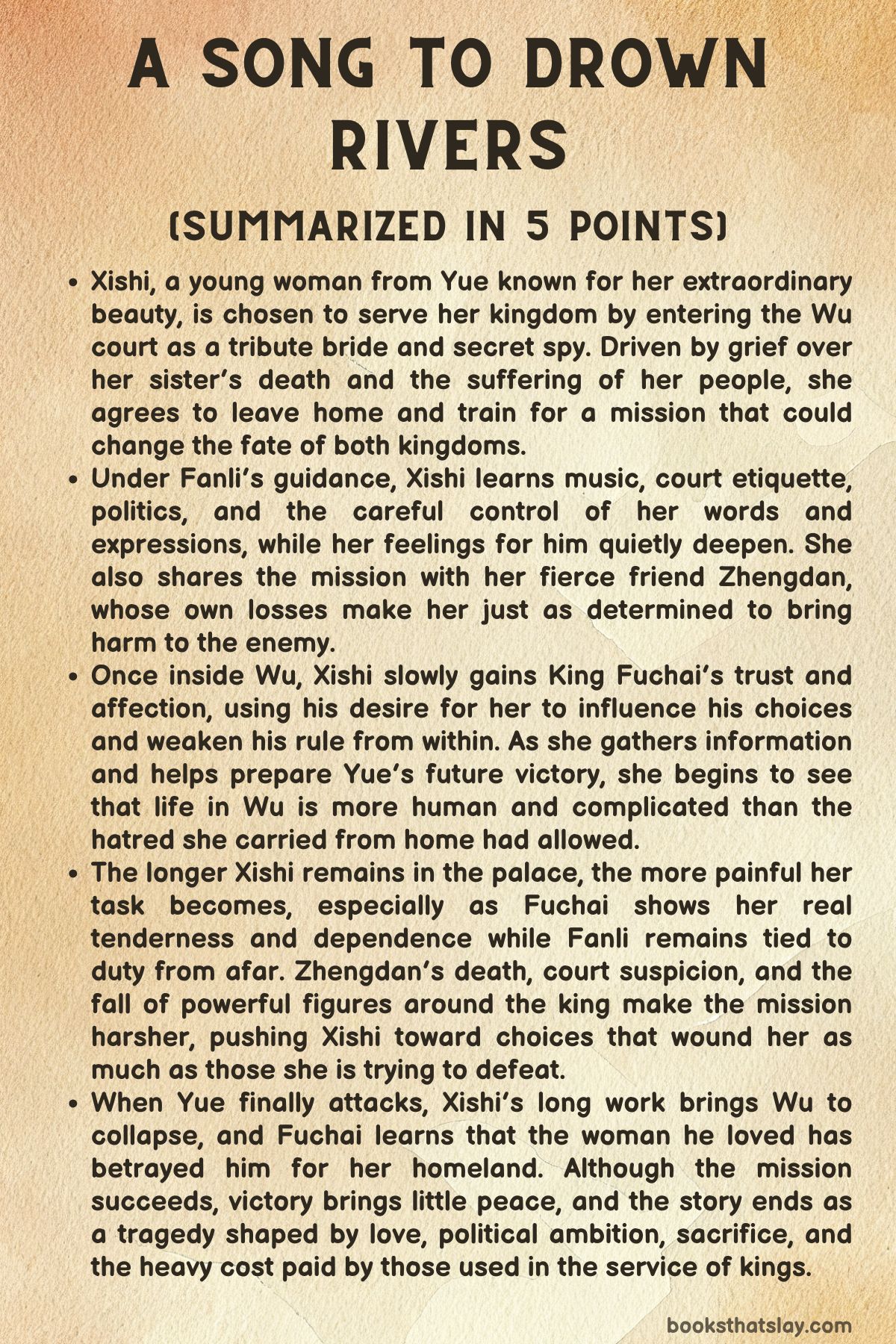
Summary
Xishi lives in Yue, a kingdom still marked by invasion, death, and humiliation after its defeat by Wu. Her beauty draws constant attention, so she hides her face behind a veil when she leaves home.
One day at the river, she sees a Wu soldier attacking a starving child who stole fruit. Xishi intervenes and is nearly killed, but a stranger saves her.
He later reveals himself as Fanli, the respected advisor to King Goujian of Yue. Soon after, he comes to Xishi’s home with an extraordinary proposal.
Because of her beauty, intelligence, and courage, she has been chosen to become a tribute bride for King Fuchai of Wu. Officially, she will be a gift offered in peace.
In truth, she will spy for Yue and help destroy the enemy from within.
Xishi is horrified, but the wounds left by Wu run deep in her life. Her little sister was murdered during the invasion, and the suffering of her people surrounds her every day.
When she learns that her closest friend, Zhengdan, will join the mission as a palace lady, she accepts. The two leave their homes and families behind and begin months of training under Fanli’s strict guidance.
They learn court manners, music, poetry, politics, and the art of shaping every expression and movement. Fanli teaches Xishi that beauty alone will not save her.
She must control herself completely and understand how men think, what they fear, and what they desire.
As the training continues, Xishi changes. She becomes more disciplined, more observant, and more aware of the power she carries.
At the same time, she and Fanli begin to develop feelings for one another. Their attraction is quiet but intense, sharpened by the fact that neither of them believes there is room in their lives for personal happiness.
Fanli has given himself wholly to Yue and to King Goujian’s cause. Xishi knows she is being prepared for another man’s court.
Even so, their connection deepens through shared lessons, private moments, and unspoken longing. Zhengdan notices more than Xishi wishes, while also carrying her own grief and fury over the Wu general Ma, who killed her father.
Before the women depart, Xishi nearly gets the chance to name what she feels, but duty stops both her and Fanli. On the journey to Wu, their carriage is attacked.
Xishi is wounded while trying to save Fanli, and this only makes their bond harder to deny. Yet when they finally near Wu, Fanli withdraws, unable to watch her enter the enemy king’s world.
He leaves her with his sword, a sign of trust and protection, and Xishi steps into the palace alone.
Wu is not the monstrous place she imagined. It is beautiful, orderly, and full of ordinary people, which unsettles her.
Inside the palace, the greatest obstacle is not King Fuchai at first, but his advisor Wu Zixu, who suspects the Yue women and tries to keep them isolated. Realizing she must act, Xishi injures herself to draw the king’s attention.
Her plan succeeds. Fuchai visits, is struck by her beauty and composure, and begins to seek her out.
Xishi follows Fanli’s advice and remains just out of reach, refusing easy access and making herself unforgettable.
Her influence grows steadily. At a royal celebration, her original gift is sabotaged, but she recovers gracefully by presenting the king with a simple stone and speaking about the value of quiet pleasures rather than empty grandeur.
Fuchai is fascinated. He begins sleeping in her chamber, then spending more and more time with her.
Xishi, meanwhile, gathers information, studies the palace, and builds alliances. Zhengdan watches the guards and servants.
Xishi turns even danger to advantage when a jealous concubine, Lady Yu, tries to poison her. Instead of exposing her, Xishi bargains with her, creating a future debt she can later use.
As months pass, Xishi becomes central to court life. Fuchai is increasingly ruled by his desire for her, and his ministers grow uneasy.
She uses his trust to influence political decisions, especially when Wu Zixu urges war against Yue. Xishi speaks in Yue’s favor, softening Fuchai’s suspicions and encouraging delay.
At the same time, Fuchai begins constructing a lavish palace for her and indulging in costly pleasures. To outside observers, she appears to be the cause of his weakening judgment.
To herself, she is carrying out the mission she accepted.
Yet nothing stays simple. Fuchai is not merely cruel or foolish.
He can be vain, self-indulgent, and blind, but he is also lonely, vulnerable, and sincere in his love for Xishi. These qualities unsettle her.
She still hates what Wu did to her family and kingdom, but her growing knowledge of Fuchai as a person makes her task harder. That conflict sharpens after Zhengdan publicly defeats General Ma in a combat display, avenging her father before the whole court.
Though Fuchai applauds the spectacle, Zhengdan pays for it later. General Ma frames her for theft, and she is forced to drink poison.
She dies in Xishi’s arms, unrepentant and proud. Her death hardens Xishi again, turning grief back into resolve.
Fuchai briefly suspects Xishi when she accidentally says Fanli’s name, and he later stages a brutal test by bringing Fanli to court and pretending not to know their connection. Xishi and Fanli both hide their feelings while Fanli is stabbed in front of her.
Xishi maintains her composure, and the deception holds. Later, she secretly tends Fanli’s wounds and begs to leave with him, but he refuses.
Their duty remains unfinished.
From that point onward, Xishi acts more decisively. She manipulates Fuchai into extending a canal to Lake Tai, a military advantage Yue needs.
She completes a detailed map of the palace and surrounding routes and secretly passes it to Yue agents. When Wu Zixu tries one final time to warn Fuchai that Yue is preparing to strike, Xishi turns the king fully against him.
Accused of treachery, Wu Zixu is ordered to die by his own hand. Before his death, he warns that loyal servants are often destroyed once they are no longer needed.
That warning proves prophetic. Yue sends Xishi a coded message through poetry, and she understands that the final attack is near.
During a grand banquet, Goujian and Fanli arrive as honored guests. In a stolen private moment, Xishi and Fanli finally confess what they mean to each other and dream aloud of a life beyond politics.
But the attack begins that same night. Lady Yu’s promised favor helps weaken the palace defenses, Yue forces enter through the canal, and chaos consumes Wu.
Fuchai escapes with Xishi to a mountain refuge. There, with his kingdom collapsing, he tells her that none of it matters if he can still be with her.
When Yue’s envoy arrives, Goujian offers Fuchai exile and praises Xishi for completing her mission. Only then does Fuchai fully understand that she has betrayed him from the beginning.
He asks whether she has anything to say. Xishi tells him she hates him, but the moment is filled with grief rather than triumph.
He gives her his sword and asks her to kill him. Remembering both the horrors done by Wu and the tenderness he showed her, she does.
She holds him as he dies.
Xishi returns to Yue expecting peace, but victory feels hollow. Her people praise her as a savior, yet Zhengdan’s mother bitterly reminds her that common people are sacrificed by kings no matter which kingdom wins.
Xishi begins to understand that the machinery of power has used her just as it used countless others. Soon after, she is ambushed and drowned in the river, likely on Goujian’s orders, because a ruler who secures power through deception cannot afford witnesses who know too much.
Fanli arrives too late to save her. Destroyed by grief, he blames Goujian and nearly seeks revenge, but Xishi appears to him in dreams and asks him not to plunge the kingdoms into more suffering.
Instead, she urges him to help ordinary people and live according to something better than royal ambition. Fanli resigns and leaves the court.
To preserve Xishi from the fate imposed on her by history and rulers, he spreads a different story: that she is alive and has gone away with him, free at last. In the final movement of the novel, their reunion takes place beyond death, where Xishi waits for him and darkness finally gives way.
Characters
Xishi
Xishi stands at the emotional and moral center of A Song to Drown Rivers, and her character is shaped by a painful tension between agency and sacrifice. At the beginning, she appears to understand her beauty mostly as a burden.
It draws attention, creates danger, and makes her visible in ways that deny her peace. Yet the story gradually transforms that same beauty into a political instrument, forcing her to confront the unsettling fact that what others prize in her can also be turned into a weapon.
Her growth is not a simple movement from innocence to strength. Rather, she becomes stronger while also becoming more divided within herself.
She learns discipline, calculation, and restraint, but these skills come at the cost of spontaneity and emotional safety. What makes her compelling is that she is never reduced to a symbol of beauty or revenge.
She thinks deeply, feels intensely, and keeps changing in response to what she sees.
Her inner life is marked by grief that never truly fades. The murder of her sister becomes one of the deepest wounds guiding her decisions, and her loyalty to Yue is not abstract patriotism but something rooted in memory, rage, and loss.
She agrees to serve her kingdom because she believes that this mission can give meaning to suffering that would otherwise remain unbearable. At first, this gives her purpose.
But as her time in Wu stretches on, her certainty becomes harder to maintain. She begins by seeing the enemy kingdom in clear terms, only to discover that real life resists that simplicity.
She meets servants, women, guards, and even a king who cannot be understood only through the language of hatred. This does not erase the crimes of war, but it unsettles the version of justice she once imagined.
Her character becomes richer because she is forced to live in contradiction: she is both victim and deceiver, both patriot and betrayer, both instrument and person.
Xishi’s relationship with power is one of the most revealing aspects of her characterization. She does not possess official authority, military command, or political rank, yet she becomes one of the most influential figures in the narrative.
What makes this significant is that her influence exists within structures designed by men who believe they control her. Fanli trains her, Goujian deploys her, and Fuchai desires her, but none of them fully anticipate the complexity of what she becomes.
She learns how attention works, how desire can alter decisions, and how softness can sometimes carry more force than aggression. Even so, the novel never romanticizes this form of power.
Her influence depends on danger, emotional self-erasure, and constant performance. She is admired, but not safe.
She is effective, but not free. This gives her arc a tragic depth because her power is real, yet it never protects her from being used.
Her emotional conflict with Fuchai and Fanli reveals the full sophistication of her character. Fanli represents the life she might have chosen freely, shaped by mutual understanding, longing, and shared devotion.
Fuchai represents the life she must enter for political reasons, yet he becomes more human to her than she ever intended. Her feelings for both men are not equal, but they are both important in showing how difficult it becomes to separate duty from emotion.
She does not merely pretend so well that she begins to confuse herself; rather, she is a person whose heart remains alive even when politics would prefer it to become mechanical. This is why her final choices carry such force.
By the end, Xishi understands that kingdoms speak of honor and victory while ordinary people bear the price. Her death completes her tragic arc, but it also reveals her final clarity.
She is no longer the village girl hoping to avenge one wound. She has seen enough to recognize how ambition devours the innocent on every side.
Fanli
Fanli is drawn as a man defined by control, intelligence, and severe self-denial. At first, he appears almost impossibly composed, the kind of figure who has trained himself to place reason above desire in all things.
His reputation for incorruptibility is not simply a public image; it is the structure by which he lives. He measures words carefully, keeps his emotions hidden, and treats personal longing as something dangerous.
This restraint makes him impressive, but it also makes him deeply lonely. He is not cold because he lacks feeling.
He is cold because he feels too much and believes feeling can ruin judgment. That belief shapes every part of his conduct, from the way he trains Xishi to the way he refuses to claim any future for himself.
He is a patriot in the strictest sense, but the story steadily exposes how patriotism, when fused with repression, can turn into a form of self-destruction.
His role as Xishi’s teacher is central to his characterization. He is the one who teaches her how to survive in court, how to read danger, and how to transform instinct into strategy.
Yet there is irony in this dynamic. In making her capable of deception, he also creates the conditions for his own suffering.
He trains her to master expression, conceal vulnerability, and use beauty as calculated force, all while trying to deny the emotional bond growing between them. This makes his role more tragic than heroic.
He is not simply the wise mentor standing outside the action. He is implicated in the very machinery that causes pain to the woman he loves.
His guilt later in the novel is powerful because it is not only grief over what happened to Xishi. It is also recognition that his discipline, however noble in intention, helped place her in harm’s way.
Fanli’s love is defined by refusal. He loves Xishi, but almost every important moment between them is marked by his attempt to hold back, redirect, or deny what he feels.
This is not because his feelings are weak. On the contrary, they are so strong that he fears them.
He believes private desire threatens public duty, and because of that belief, he repeatedly chooses silence when openness might have changed both of their lives. His sword inscription and his philosophy about mind and heart reflect this internal struggle.
He wants to live by reason, but reason cannot erase attachment. This gives his character a painful tension: he is brilliant in political judgment yet inadequate in protecting what matters most to him personally.
His tragedy lies partly in timing. By the time he openly speaks of a life with Xishi, the world around them has already been shaped by too much violence and too many decisions made in the name of kingdoms.
He also serves as one of the novel’s clearest examples of moral awakening. At first, he is wholly committed to Goujian’s cause, and even when he suffers for the kingdom, he accepts that suffering as necessary.
But after Xishi’s death, he reaches a point where loyalty to ruler and loyalty to justice split apart. That distinction is crucial.
He does not cease to care about his homeland, but he stops believing that service to a king automatically serves the people. Xishi’s memory helps bring him to this realization.
In the end, Fanli becomes significant not because he avenges her through more bloodshed, but because he refuses to continue living inside the logic that destroyed her. His departure from court marks a quiet but profound change.
He moves from serving power to rejecting it, and in doing so becomes one of the few characters who learns something lasting from tragedy.
King Fuchai
Fuchai is one of the most layered figures in the novel because he cannot be contained within the role of villain, even though he stands at the head of the enemy kingdom. He begins as the object of a political mission: the king who must be seduced, manipulated, and weakened for the sake of Yue’s revenge.
Yet once he enters the story fully, he becomes more than the target of a plan. He is vain, proud, indulgent, and often politically careless, but he is also emotionally transparent in ways that make him unexpectedly vulnerable.
He wants admiration, comfort, and love with an intensity that exposes how lonely he is beneath royal power. That loneliness becomes one of the keys to understanding him.
Though he commands armies and rules a great court, he is deeply susceptible to personal devotion because he has so little trust in the sincerity of those around him.
His political weakness does not come from stupidity alone, but from the way his desires distort his priorities. He is capable of charm and generosity, and there are moments when he appears genuinely open-hearted.
But he lacks steadiness. He wants to be cherished more than he wants to govern wisely, and he resents figures like Wu Zixu when they appeal to duty, memory, or discipline in ways that make him feel constrained.
His inability to bear being overshadowed by the legacy of his father also shapes him strongly. He does not want to be ruled by the past, yet because he has not made peace with it, he reacts against it emotionally rather than thoughtfully.
This insecurity helps explain why he is so easy for Xishi to influence. She offers not only beauty but also a version of attention that seems intimate and affirming, and he clings to it.
What gives Fuchai real tragic force is that his love for Xishi is not entirely false, shallow, or theatrical. He does desire her intensely, and that desire contributes to his political fall, but the novel also shows moments of care that feel genuine.
He protects her instinctively, seeks her closeness without always demanding possession, and reveals parts of himself that are not merely kingly performance. These qualities complicate the moral field of the story.
Xishi cannot dismiss him as a monster, because he repeatedly shows tenderness, dependence, and emotional sincerity. That does not erase his kingdom’s violence or his own responsibility as ruler, but it prevents easy judgment.
He becomes a tragic figure precisely because he loves truly within a structure built on conquest and domination. He is both guilty and pitiable, both complicit and human.
His end is devastating because it reveals the gap between public history and private experience. Politically, his fall can be read as the deserved collapse of a king undone by vanity and pleasure.
Personally, his death is the death of a man who entrusted himself to someone he loved and was destroyed by that trust. His final response to betrayal is not simply rage but wounded recognition.
Even then, he still tries to understand what Xishi feels. This makes his death one of the novel’s most painful moments.
Fuchai is not redeemed, but he is humanized so fully that his destruction becomes more than victory. Through him, the narrative shows that political enemies are still people, and that this fact makes revenge morally costly even when it seems justified.
Zhengdan
Zhengdan brings fire, boldness, and directness to the story, serving as an important contrast to Xishi’s more inward and reflective nature. Where Xishi often thinks through emotion before acting, Zhengdan is more openly fierce.
She carries anger close to the surface and is less willing to disguise it. This makes her immediately compelling because she represents a form of resistance that is physical, outspoken, and difficult to contain.
Yet she is not reckless in a simple way. Her anger is rooted in grief, especially over her father’s death, and that grief gives moral force to her desire for justice.
She is not chasing violence for its own sake. She wants to confront the people who have treated her family and her kingdom as disposable.
Her importance also lies in the friendship she shares with Xishi. Their bond gives the novel some of its strongest emotional grounding because it shows female loyalty outside competition.
They do not exist as rivals for male attention or status. Instead, they are companions shaped by shared danger, shared patriotism, and shared sacrifice.
Zhengdan helps preserve part of Xishi’s original self during the mission. In the palace, where everything is performance and surveillance, her presence acts as a reminder of home, memory, and truth.
At the same time, the differences between them become sharper over time. Zhengdan holds more tightly to open vengeance, while Xishi becomes increasingly entangled in ambiguity.
This contrast deepens both characters, showing that there is more than one possible response to trauma and political violence.
Zhengdan’s challenge to General Ma is one of the clearest expressions of who she is. It is not only an act of courage but also an act of reclaiming dignity.
In defeating him publicly, she refuses the silence expected of women and the submission expected of the conquered. She demands visibility on her own terms.
That moment matters because it gives her a brief victory that is emotionally real, even though it brings later punishment. She knows the danger, and she acts anyway.
This shows a character who values honor not as abstract nobility but as a refusal to let fear define her. Her death is especially painful because it reveals how little room there is in palace politics for direct justice.
What she wins through skill and bravery is taken from her through corruption and revenge.
After her death, Zhengdan’s significance actually grows. She becomes a lasting moral presence in Xishi’s conscience and a reminder of the personal costs hidden beneath national triumph.
Her mother’s later grief sharpens this further by refusing to let Zhengdan be reduced to patriotic symbolism. Through Zhengdan, the story asks whether heroic sacrifice means anything to those left behind.
She embodies courage, but her fate also exposes the cruelty of systems that praise sacrifice while treating individual lives as expendable. In that sense, she is both warrior and warning.
King Goujian
Goujian represents political ambition in its most severe and calculating form. He is not presented as a grand ideal of resistance but as a ruler whose hunger for restoration and revenge overrides nearly all softer impulses.
His kingdom has suffered humiliation, and he has suffered it personally, but the novel makes clear that this pain does not make him morally elevated. Instead, it hardens him.
He sees people in terms of usefulness, loyalty, and strategic value. From the moment Xishi and Zhengdan are brought into his orbit, he treats them less as individuals than as pieces within a larger design.
This gives him a cold force that can be effective in statecraft but deeply destructive in human terms.
What makes Goujian significant is that he complicates any easy division between good kingdom and bad kingdom. Yue has been wronged, and its desire for survival is understandable, but Goujian’s conduct reveals that victimhood does not guarantee virtue.
He is willing to exploit beauty, devotion, and even love in order to secure victory. He benefits from Fanli’s brilliance, Xishi’s sacrifice, Zhengdan’s danger, and Bo Pi’s treachery, but gratitude never seems central to his nature.
His thinking is dominated by outcome. If a person serves the restoration of Yue, that person matters; if they become inconvenient, they can be discarded.
This utilitarian cruelty becomes more chilling because it is not emotional. It is calm, rational, and kingly.
His eventual betrayal of those who helped him fits his character precisely because he cannot tolerate loose ends. A ruler who ascends through deception becomes suspicious of everyone shaped by the same politics.
This is why he becomes such a haunting figure by the end. He wins the war, but his victory carries moral emptiness.
The narrative does not present him as triumphant in any generous sense. Instead, he appears diminished by the very logic that secured his success.
Power has preserved him, but it has also hollowed him out. He becomes the embodiment of a political order that can restore a kingdom while damaging the people who made that restoration possible.
The haunting after Xishi’s death serves as a fitting extension of his characterization. Whether read literally or symbolically, it suggests that some acts cannot be fully absorbed into royal narrative.
Goujian may command armies and shape history, but he cannot silence memory. He is left not with peace, but with recurring fear.
In that sense, his punishment is deeply appropriate. He survives, rules, and wins, yet he remains trapped by what he has done.
The story uses him to show that success without humanity breeds a different kind of ruin.
Wu Zixu
Wu Zixu serves as the sharpest political mind in Wu and as one of the few figures who sees events clearly before anyone else. He is suspicious, stern, and often severe, but he is not paranoid without reason.
He recognizes Xishi’s danger long before Fuchai is willing to admit it, and he understands that kingdoms fall not only through battlefields but through vanity, delay, and intimate corruption at court. In another kind of story, a character like him might appear merely as an obstacle, but here he becomes more interesting because so much of what he fears turns out to be true.
His severity is politically justified, even if his manner makes him hard to love.
His characterization is shaped by exile, memory, and long-nursed vengeance. Having already been formed by loss and displacement, he brings an intensity to statecraft that comes from personal history.
This gives him something in common with several other characters, especially those whose political loyalties are rooted in family destruction. But unlike Xishi, who becomes morally divided by proximity to the enemy, Wu Zixu remains committed to strategic clarity.
He does not let sentiment obscure threat. This makes him admirable in one sense and limited in another.
He sees correctly, but he cannot persuade a king who wants emotional comfort more than difficult truth.
His conflict with Xishi is especially rich because the two occupy opposite sides of a silent war fought through influence rather than weapons. Both are intelligent, both are shaped by grief, and both understand that desire can redirect politics.
The difference is that Xishi works through performance while Wu Zixu works through warning. He appeals to memory, prudence, and national survival, but these are no match for a court ruled increasingly by fascination and indulgence.
His death is therefore more than the elimination of an advisor. It marks the moment when truth is defeated by flattery and appetite.
That he dies recognizing the future collapse of Wu only intensifies the tragedy.
His final warning about loyal servants being destroyed after their usefulness ends carries significance beyond his own life. It becomes a statement about the whole political world of the novel.
In that sense, Wu Zixu is not only a character but also a voice of hard insight. He understands the nature of power even if he cannot escape it.
His fall proves that wisdom without control over the ruler is fragile, and that being right is no guarantee of survival.
Lady Yu
Lady Yu begins as a conventional palace rival, but the novel gradually gives her more depth than a simple jealous antagonist. Her attempt to poison Xishi comes from fear rather than pure malice.
She understands the brutal economy of palace life, where a woman’s position is tied not only to the king’s attention but also to the fortunes of her family. Her father’s standing depends on her security, and this pressure shapes her choices.
Seen from this angle, Lady Yu becomes another woman trapped in structures built by male power, trying to preserve herself by the limited means available to her. That does not excuse her actions, but it does make them legible.
Her relationship with Xishi is especially revealing because it evolves from rivalry into uneasy alliance. Xishi does not destroy her when given the chance.
Instead, she recognizes in Lady Yu another person fighting for survival in a cruel system. Their bargain reveals a great deal about both women.
For Lady Yu, it shows adaptability and intelligence; she is capable of shifting from hostility to cooperation when she sees advantage in it. For Xishi, it shows a widening ability to understand motive rather than merely condemn action.
This exchange is one of the moments where the palace becomes more than a stage for seduction. It becomes a field of female negotiation, where women maneuver inside structures that rarely give them honest freedom.
Lady Yu also matters because she reflects what Xishi might have become under different circumstances. Both live under scrutiny, both must manage perception, and both know that a king’s favor can preserve or ruin lives.
The difference is that Lady Yu is trying to survive inside the palace, while Xishi is trying to bring the palace down. This contrast gives their connection a quiet tension.
When Lady Yu ultimately repays the debt owed to Xishi, she becomes part of the chain of events that topples Wu. Her role is not central in terms of page time, but it is meaningful in showing how even secondary figures can influence history when they act at crucial moments.
Luyi
Luyi serves as a grounding presence in a story dominated by rulers, strategists, and dangerous emotional conflicts. He is loyal to Fanli, observant, and often more emotionally open than the major political figures around him.
His importance lies partly in balance. Where Fanli tends toward silence and self-denial, Luyi is capable of warmth, humor, and plainspoken insight.
He often notices what others are unwilling to say directly, especially when it comes to Fanli’s feelings and suffering. This makes him valuable not only as a supporting figure in the plot but also as a moral and emotional counterweight.
His loyalty is not blind in a simplistic sense. He respects Fanli deeply because Fanli changed his life, yet he also worries about him as a person rather than seeing him only as a great statesman.
That distinction matters. Luyi’s care introduces a form of devotion that is humane rather than political.
He stands beside Fanli not because of abstract ideals alone, but because of personal gratitude and affection. In a novel where many relationships are strained by secrecy and strategy, this kind of direct fidelity matters.
Luyi also helps humanize the world around the main conflict. He reminds the reader that history is not shaped only by kings and legendary beauties but also by attendants, guards, and retainers whose lives are bound to those they serve.
His continued presence after Xishi’s death reinforces the scale of loss. He becomes one of the witnesses left behind, carrying memory and sorrow in a quieter way than Fanli but no less sincerely.
Xiaomin
Xiaomin may seem at first like a minor servant figure, but she becomes important because she reveals the intimate human cost of war and deception. Her attempted poisoning under Lady Yu’s orders introduces her through fear and coercion, yet she later grows into someone more sympathetic and emotionally resonant.
What makes her especially significant is that she is one of the clearest reminders that the enemy kingdom is populated not just by abstract foes but by ordinary individuals with loyalties, loves, and wounds of their own. She is not politically powerful, yet she is deeply affected by the conflict.
Her growing connection with Xishi is painful because it is built on trust that Xishi cannot honestly return. Xiaomin offers service, conversation, and eventually personal disclosure, including her own losses and hopes for marriage.
Through her, the novel emphasizes that affection across enemy lines is possible even inside deception. Xishi’s guilt around her becomes increasingly sharp because Xiaomin is not cruel, vain, or dangerous in any grand sense.
She is simply a person trying to live, love, and endure. This makes her presence morally important.
She embodies the innocent attachments that political missions inevitably damage.
Xiaomin’s perspective also widens the narrative’s view of suffering. Just as Xishi has been marked by Wu’s violence, Xiaomin carries pain linked to Yue.
That symmetry matters because it disrupts nationalist simplicity. Loss exists on both sides, and the ordinary people living through conflict rarely control the forces that shape their grief.
Xiaomin’s role may be quiet, but it is essential in showing how betrayal reaches beyond courts and battle plans into the fragile spaces of everyday trust.
Themes
Beauty as Power, Burden, and Erasure
Beauty in A Song to Drown Rivers is never treated as a simple gift. From the very beginning, beauty makes Xishi vulnerable before it makes her powerful.
It exposes her to unwanted attention, limits her freedom, and turns her body into something that others believe they have a right to notice, discuss, or claim. This matters because the novel refuses the fantasy that beauty naturally grants control.
Instead, beauty first appears as a condition of danger. It marks Xishi out in a world where being seen too clearly can place a woman at risk.
Only later, through Fanli’s training and the demands of political strategy, does beauty become something she can wield with conscious intent. Even then, the transformation is not liberating in any complete sense.
Her beauty becomes useful because men in power choose to value it, which means her agency remains tied to structures she did not create.
What the novel explores with unusual sharpness is the cost of turning a person into an emblem. Xishi is selected not because the kingdom knows her whole self, but because her appearance can be mobilized in service of state ambition.
Her intelligence, courage, and discipline certainly matter, yet beauty is the gateway through which the political machine claims her. This turns admiration into erasure.
People project meanings onto her face and body long before they understand her heart or judgment. In Yue, she is the ideal sacrifice; in Wu, she becomes an object of desire, suspicion, and rumor; in legend, she risks becoming an icon stripped of inwardness.
The story constantly pushes against that reduction by showing her thoughts, doubts, grief, and moral exhaustion. It insists that the beautiful woman at the center of history is still a person being consumed by history.
The theme also develops through the way beauty shapes power at court. Xishi influences Fuchai not by public office or military strength but through attention, absence, timing, emotional intelligence, and carefully managed presence.
This reveals how beauty can operate as a social and political force in systems that deny women formal authority. Yet the novel does not celebrate this as a triumph without qualification.
Such influence is unstable and dangerous because it depends on remaining desirable, unreadable, and strategically valuable. It gives Xishi room to act, but never safety.
At the same time, beauty disturbs others because it can redirect institutions supposedly governed by rank and policy. Ministers fear not merely a woman, but the possibility that desire can reorder the state.
By the end, beauty has become inseparable from tragedy. Xishi’s face and presence shape kingdoms, but they do not protect her from disposability once her purpose has been fulfilled.
This final turn is crucial. The very quality that made her legendary also made her usable.
In that sense, the novel offers a deeply critical meditation on how societies elevate beautiful women while denying them lasting personhood. Beauty can influence history here, but it cannot guarantee dignity.
The result is a theme that feels both intimate and political: the body becomes a site where admiration, violence, fantasy, and statecraft all meet.
Love in Conflict with Duty
Love in this novel is not presented as a refuge outside politics. It develops inside obligation, secrecy, war, and manipulation, which means it is always under pressure from competing loyalties.
The emotional force of the story comes partly from the fact that its central relationships are never allowed to become simple. Xishi and Fanli are bound by mutual recognition, longing, and restraint, but their feelings arise in the very period when he is training her to belong, in appearance, to another man.
Their love is shaped by delay and discipline. Every intimate moment between them carries awareness of what cannot be claimed.
This makes their relationship powerful not because it is idealized, but because it is constantly threatened by the political world they serve. Love here becomes something real precisely because it survives denial, even as that denial contributes to catastrophe.
The relationship between Xishi and Fuchai deepens this theme in a more unsettling direction. She enters his life as part of a mission, and deception structures every step of her approach.
Yet the novel refuses to keep feeling neatly separated from performance. Fuchai’s affection grows from desire into dependency and trust, and Xishi, despite herself, begins responding to parts of him that are wounded, tender, and human.
This creates one of the story’s strongest tensions. Her mission requires emotional closeness without emotional surrender, but the human heart does not obey such clean commands.
She can hate what he represents while still being moved by specific acts of care. That does not turn their relationship into romantic equality, because it remains shaped by power, conquest, and deceit, but it does make betrayal painfully complex.
Love, or something close to it, enters spaces where it should have been impossible.
What makes the theme especially strong is that duty is not shown as false or meaningless. Xishi’s loyalty to Yue is rooted in real suffering.
Fanli’s commitment to his king and country is sincere. Even Fuchai’s role as ruler shapes what he can and cannot understand.
The tragedy comes because duty is not a villainous excuse; it is a genuine moral claim that collides with equally genuine feeling. No one escapes this collision cleanly.
Fanli’s commitment to duty keeps him from claiming joy when it might still have been possible. Xishi’s duty makes her betray a man who loves her.
Fuchai’s position as king prevents him from fully seeing how vulnerable he is until it is too late. Duty gives meaning, but it also demands sacrifice that may exceed what any person should be asked to bear.
By the final act, love and duty have damaged each other so thoroughly that neither remains pure. Love has been delayed, misdirected, weaponized, and mourned.
Duty has produced victory, but also death, guilt, and hollow triumph. The novel’s emotional achievement lies in showing that love does not cancel duty, and duty does not erase love.
Instead, each exposes the limits of the other. Love reveals what duty destroys, and duty reveals how little private happiness can survive in a world organized by war and ambition.
The Human Cost of War and Political Ambition
War in this story is not confined to battle scenes or royal strategy. Its deepest effects appear in memory, grief, displacement, damaged families, and the way entire lives are redirected by decisions made far above ordinary people.
Nearly every major character has been marked by violence before the central mission even begins. Xishi’s sister was murdered.
Zhengdan lost her father. Fanli bears scars from humiliation and punishment.
Wu Zixu’s worldview was shaped by earlier loss. Even secondary figures carry private histories of injury connected to one kingdom or the other.
This matters because the novel does not treat war as a grand historical backdrop. It treats it as a force that enters homes, bodies, loyalties, and futures.
The result is a world in which no emotional choice can be separated from political damage already done.
Political ambition worsens this human cost by converting suffering into strategy. Goujian’s desire to restore Yue is understandable, yet the methods used to pursue that restoration expose how rulers turn wounded people into instruments.
Xishi and Zhengdan are praised for their sacrifice, but praise does not lessen what is demanded of them. They are asked to risk not only their lives but their identities, their emotional integrity, and their chance at ordinary happiness.
The court calls this honor. The novel quietly asks whether that language disguises exploitation.
The same pattern appears elsewhere. Fuchai’s indulgence is not just personal weakness; it creates conditions in which servants, soldiers, and palace women bear the consequences of his misplaced priorities.
Ambition at the top becomes suffering below, whether the ruler is conquering, avenging, or merely indulging himself.
One of the most striking aspects of this theme is the refusal to let victory resolve grief. Yue wins, Wu falls, and the political mission succeeds, but the emotional atmosphere after triumph is not one of cleansing justice.
Instead, it is marked by shock, guilt, exhaustion, and unease. Xishi does not return home to inward peace.
She returns to celebration that feels partly false because it cannot account for everything she has seen and done. Zhengdan’s mother’s grief becomes especially important here.
She rejects patriotic consolation and insists that ordinary families lose their loved ones to the wills of kings. This is one of the clearest moral statements in the novel because it breaks the spell of national narrative.
It reminds the reader that public victory and private devastation often exist together.
The story’s final movement completes this theme by showing that political ambition does not stop feeding on lives once war is won. Xishi, after serving her kingdom completely, becomes expendable.
Fanli, after all his service, realizes that continued loyalty to power would only perpetuate the same logic of sacrifice. Through these outcomes, the novel argues that war is not merely a clash between states.
It is a system that reorganizes moral value itself, rewarding usefulness over humanity. What survives this system is not glory, but haunting.
Memory becomes the only honest witness to what ambition costs.
Women, Survival, and Constraint within Patriarchal Power
The novel pays close attention to the ways women survive within systems that deny them direct authority while still making their bodies, beauty, fertility, and obedience politically meaningful. Xishi enters the story already marked by this reality.
Her beauty attracts attention she does not want, and later that same beauty becomes the basis for her recruitment into statecraft. What is striking is that the novel never imagines freedom for women as a simple matter of inner strength.
Strength matters, but structure matters too. Women here must improvise survival within courts, families, and kingdoms arranged by male priorities.
This gives their actions a special complexity. They are often strategic not because they are naturally manipulative, but because direct avenues of power have been closed to them.
Xishi’s training illustrates this theme in especially revealing ways. She is taught etiquette, performance, conversation, and emotional concealment because these are the available tools through which she can operate in a male court.
Her body becomes political terrain, and her expression becomes a form of language. The same is true, in different ways, for Lady Yu and the other palace women.
Their safety, rank, and even family fortunes may depend on a ruler’s favor. That arrangement produces rivalry, fear, and calculation, but the novel refuses to reduce these women to stereotype.
It shows the pressure that creates such behavior. Lady Yu’s attack on Xishi is morally wrong, yet it emerges from a structure in which a woman’s decline in the palace can damage her father as well.
The court does not encourage solidarity; it encourages insecurity. When women form alliances anyway, those moments carry unusual force.
The novel also examines different models of feminine resistance. Xishi operates through discipline, adaptation, and emotional endurance.
Zhengdan operates through physical courage and open defiance. Xiaomin survives through service and careful loyalty.
Lady Yu survives through negotiation inside danger. None of these methods is fully sufficient, and that is part of the point.
There is no perfect way for women to remain whole in a system built to use them. What the novel honors is not flawless resistance, but the intelligence with which women navigate impossible conditions.
Even tenderness between women becomes politically meaningful because it offers a brief form of care in spaces designed around surveillance and competition.
This theme reaches its full power through the contrast between how women are celebrated and how they are treated. Xishi is admired, desired, praised, and remembered, yet none of that admiration keeps her safe once she is no longer useful.
Zhengdan performs an act of courage that should make her legendary, but she is silenced through accusation and poison. Women can shape events dramatically in this world, yet they remain vulnerable to being rewritten, discarded, or turned into symbols.
The novel’s response is to restore depth to those lives. It insists that behind every legendary beauty, palace favorite, or sacrificial heroine is a person navigating fear, calculation, loyalty, and longing.
That insistence gives the story much of its moral force.