A Thousand Broken Pieces Summary, Characters and Themes
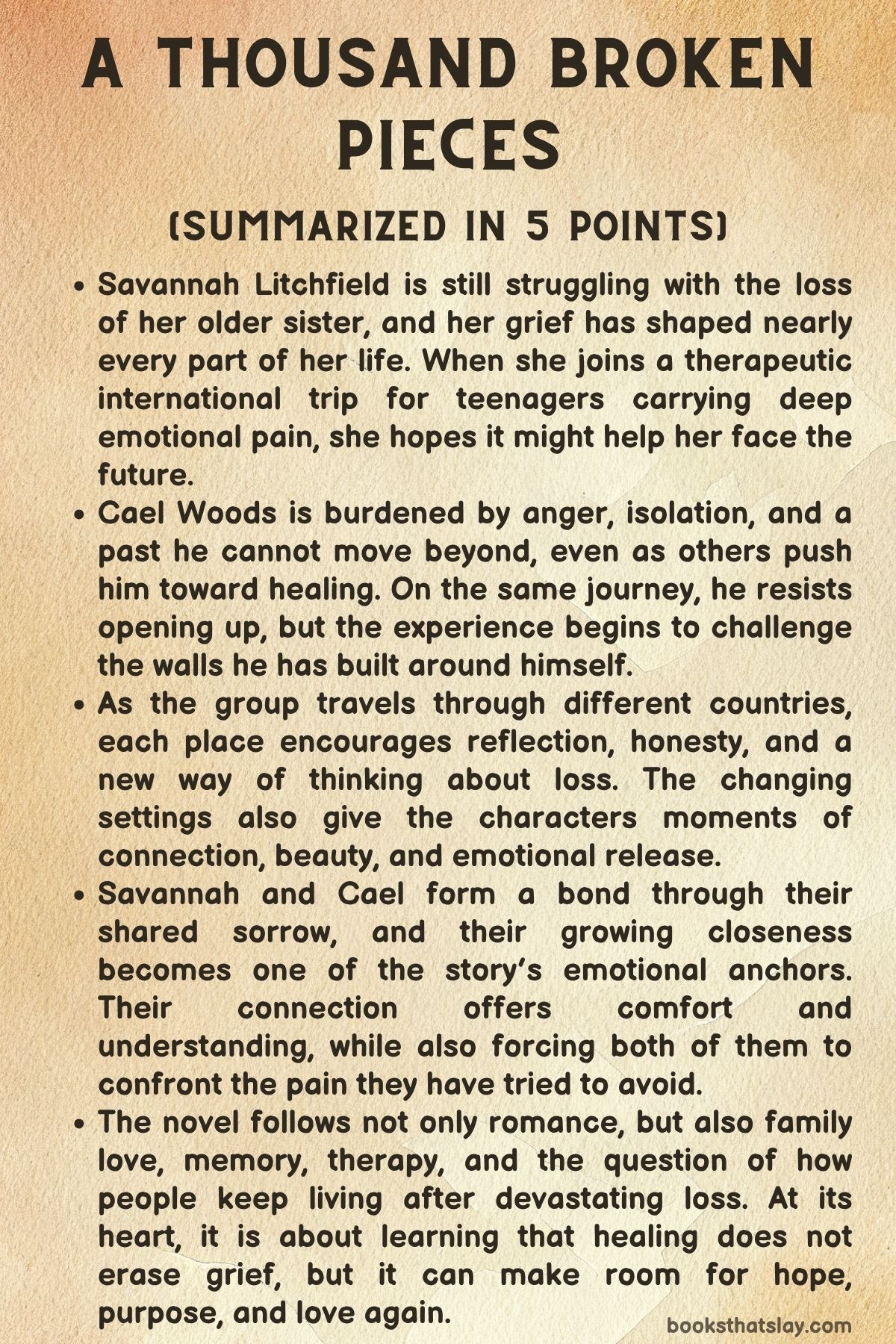
A Thousand Broken Pieces by Tillie Cole is a contemporary romance and grief-recovery novel about two teenagers trying to live after devastating loss. Savannah Litchfield has never recovered from the death of her older sister, Poppy, while Cael Woods is trapped in anger after his brother Cillian’s suicide.
They meet on an international therapy trip for grieving teens and slowly recognize in each other a rare kind of understanding. The novel mixes first love with emotional healing, asking what it means to carry sorrow without letting it stop life entirely. At its core, it is about memory, survival, forgiveness, and choosing hope after deep pain. It is the second installment in the A Thousand Boy Kisses series.
Summary
Savannah Litchfield is still marked by the day her sister Poppy died. Years later, she lives in Georgia with the weight of that loss shaping her every thought, her relationships, and even her sense of self.
She loves her family, especially her younger sister Ida, but she has become quiet, fearful, and withdrawn. Her grief often turns into anxiety, and she struggles with the idea of leaving home for Harvard in the fall.
During therapy, she is offered a place on a special trip for grieving teenagers that will take them across several countries, with the goal of helping them face their losses and learn how to move forward. Though frightened, Savannah agrees, partly because she knows she cannot keep living in the same frozen state forever.
Before leaving, Savannah visits Poppy’s grave and reflects on the journal Poppy left behind for her before dying. Savannah has never had the courage to read it.
She also notices that Rune, Poppy’s former boyfriend, still leaves photos from his travels at the grave, showing that his love for Poppy has never disappeared. Savannah carries all of this with her as she begins the trip.
At the same time, Cael Woods is introduced as a young man living in Massachusetts, furious at the world and especially at his parents. He has cut himself off from the future everyone expected for him.
Once a gifted hockey player bound for Harvard, he has abandoned the sport since the death of his older brother Cillian. Cillian was not only his brother but also his closest companion, the person tied to all his ambitions and happiest memories.
Cael’s grief is tangled with anger because Cillian died by suicide, and Cael cannot understand why he was left behind. Forced by his parents to join the same therapy trip as Savannah, Cael begins the journey resentful, closed off, and convinced that nothing can help him.
When the group gathers, Savannah immediately notices Cael. He is striking, silent, and clearly carrying pain as heavy as her own.
He notices her too, sensing her fragility and her sadness. Their first interactions are cautious and awkward.
Cael pushes people away whenever they get too close, and Savannah is prone to panic and self-doubt. Yet there is an almost immediate pull between them because each recognizes something familiar in the other.
The first stop in England begins the emotional movement of the story. The group hikes, attends therapy sessions, and learns to talk about the people they have lost.
Savannah reads the first entries in Poppy’s journal and discovers that Poppy wrote it as a guide for her after death, hoping Savannah would still learn how to live, love, and grow. These words reopen Savannah’s grief, but they also bring comfort.
Cael, meanwhile, reacts badly to therapy and resists every attempt to make him speak honestly. Still, the closeness between him and Savannah grows.
He steadies her during a hike, rows her out on a lake, and listens when she begins to talk about Poppy. She becomes one of the first people who does not demand that he perform strength.
He becomes one of the first people who sees her fear without judging it.
Their bond deepens because they offer each other what neither has found elsewhere: recognition. Savannah does not try to fix Cael’s anger, and Cael does not dismiss Savannah’s panic.
Instead, they slowly begin to trust each other. In Norway, that trust turns into tenderness.
Surrounded by snow, ice, and the northern lights, they allow themselves brief moments of joy. Savannah sees signs of Poppy in the sky and feels comfort instead of only pain.
Cael begins to reconnect with hockey by standing near the rink, then eventually returning to the ice. Savannah’s presence helps him imagine that skating does not have to belong only to his grief.
Their first kisses come in this section of the trip, and their relationship becomes both romantic and deeply emotional.
As the journey continues through India, the novel broadens its focus from personal sorrow to cultural ways of honoring death. The group visits places where death is remembered, ritualized, and accepted as part of life.
Savannah grows stronger as she continues reading Poppy’s journal, learning that Poppy wanted her to embrace laughter, love, and purpose. Cael at last begins to speak more openly about Cillian.
He tells Savannah about the day Cillian died and the horror of witnessing it. He also reveals the seven-word note Cillian left behind.
This confession is one of the most painful moments in the novel because it exposes the raw center of Cael’s grief: not only sadness, but betrayal, guilt, helplessness, and love.
Savannah also reveals the darker corners of her own pain. She admits how trapped she has felt since Poppy’s death and how often she has lived as though part of her died too.
Their relationship becomes physical as well as emotional, but the novel presents this intimacy not as a cure, rather as an expression of trust and closeness between two damaged people trying to feel alive again. They begin to imagine a future together, even while both understand that healing is unfinished work.
In the Philippines, the trip becomes more demanding. The teens are asked to face suffering beyond themselves.
Cael works with a child who has lost his brother and finds, to his surprise, that he can help. Teaching the boy to play hockey gives Cael a glimpse of himself before grief hollowed him out.
For Savannah, the challenge is more direct. She visits a hospital and meets children with cancer, including a girl named Tala who has the same disease that killed Poppy.
This experience is deeply painful, but instead of breaking her, it clarifies her purpose. Savannah realizes she wants to become a pediatric oncologist so that she can fight for children and families facing what hers endured.
Poppy’s death, while still devastating, begins to take on meaning through the future Savannah chooses.
Cael’s major turning point comes when another therapist helps him understand that depression is an illness, not a moral failure. For the first time, he considers Cillian’s suicide not simply as abandonment, but as the end of a disease his brother could not survive.
This changes the structure of his grief. Anger gives way to sorrow, and sorrow makes space for forgiveness.
He begins to let himself miss Cillian without only blaming him.
The final section in Japan centers on acceptance. The group learns about kintsugi, the art of repairing broken pottery with gold, turning damage into part of the object’s beauty.
This becomes the novel’s central image. Neither Savannah nor Cael will return to who they were before loss.
The point is not restoration to an untouched state, but repair that acknowledges the cracks. Savannah finishes Poppy’s journal and finally says goodbye through the Wind Phone, finding peace in the act of speaking to her sister and releasing her.
Cael, however, is not yet ready. When he tries, he collapses under the weight of everything still unresolved.
That crisis leads to a hard but necessary choice. Leo, one of the therapists, decides Cael needs immediate residential treatment back home.
Cael leaves abruptly, writing Savannah a note instead of saying goodbye in person because he knows he would not be able to go if he faced her. Savannah is hurt and angry at first, but she quickly understands that his leaving is an act of survival, not rejection.
They promise to find each other again at Harvard.
Back home, Savannah returns to her family changed. She is still grieving, but she is no longer ruled by grief.
She talks openly with her parents and Ida, claims her future, and prepares for college. Cael, in treatment and ongoing therapy, begins rebuilding his relationship with his parents, facing Cillian’s memory more honestly, and returning to hockey.
When they reunite at Harvard, their love feels tested and real rather than impulsive. Savannah watches Cael skate again, sees him honor his brother publicly, and gives him a repaired version of the torn note, fixed with gold in the spirit of kintsugi.
This gift captures the novel’s message: what is broken may never be unchanged, but it can still be made whole in a new way.
The epilogue shows that their healing lasts. Years later, Savannah has become a doctor, Cael has built a hockey career, and they still carry the people they lost with love rather than only pain.
On a lake in England, where their story began, Cael proposes. Savannah says yes, looking to the sky and feeling that the dead remain present in memory, in love, and in the life they helped shape.
Characters
The characters in A Thousand Broken Pieces are shaped by grief, memory, guilt, love, and the slow work of recovery. The novel gives its central figures emotional depth while also allowing supporting figures to carry their own forms of pain, resilience, and meaning.
Savannah Litchfield
Savannah is the emotional center of the novel and one of its most carefully developed figures. She begins the story as someone who has not simply mourned her sister but has almost stopped living beside that loss.
Poppy’s death has left her anxious, inward, and deeply afraid of change. She is intelligent, observant, and loving, yet she struggles to believe that her own life has value apart from the people she has lost.
Her grief is tied to survivor’s guilt, to the fear of being left behind, and to the pressure of trying to remain emotionally present for her family while she herself is barely functioning. What makes Savannah compelling is that her pain never erases her softness.
Even while wounded, she is still empathetic, curious, and capable of seeing goodness in others.
Her growth is tied to movement, not in the sense of forgetting, but in learning to carry sorrow without surrendering to it. The journal Poppy leaves behind becomes a bridge between the dead and the living, and Savannah’s gradual willingness to read it shows her growing readiness to face pain directly.
Her relationship with Cael matters because she does not become stronger by rescuing him or by being rescued herself. Instead, she becomes stronger by being seen honestly.
By the end, Savannah has not become carefree; she has become purposeful. Her decision to pursue pediatric oncology proves that she transforms grief into vocation, memory into service, and love into action.
Cael Woods
Cael is introduced through rage, resistance, and emotional paralysis. At first he seems defined by hardness: tattoos, silence, hostility, and a refusal to participate in anything that requires vulnerability.
Beneath that surface, however, he is a young man shattered by confusion and guilt after his brother’s suicide. His grief is violent because it is tied to unanswered questions.
He cannot understand why Cillian left, and because he cannot understand it, he converts pain into anger. He pushes away his parents, abandons hockey, and lives as though the future has already been canceled.
Cael’s pain is not hidden from the reader, but it is hidden from most of the people around him, which makes him one of the clearest examples in the novel of how grief can harden into self-destruction when it goes unspoken.
His arc is powerful because the story does not soften the scale of his struggle. Healing for Cael is uneven, humiliating, and often frightening.
He has to face not only the fact of Cillian’s death but also his own mistaken belief that anger is the only way to remain loyal to his brother. Savannah helps him begin that process, but the novel wisely refuses to let romance act as a complete solution.
He still needs treatment, family reconciliation, and a fuller understanding of mental illness. His return to hockey is especially meaningful because the sport first stands for trauma and lost dreams, then later becomes a reclaimed bond with Cillian rather than a ruined one.
By the end, Cael is still carrying grief, but he is no longer living inside its most destructive form.
Poppy Litchfield
Poppy is dead before the main action begins, yet her presence shapes nearly every emotional thread in the story. She is remembered as bright, loving, graceful, and deeply attentive to the people around her.
In memory, she becomes larger than life, especially in Savannah’s mind, where she represents beauty, courage, and a kind of emotional radiance Savannah feels she cannot match. There is a risk in stories like this that the dead become idealized symbols rather than people, but Poppy avoids that fate because her journal restores complexity to her.
Through her own words, she is not only brave but afraid, not only accepting but human. She knows she is dying, she knows her family will break under that loss, and she tries to prepare them with tenderness rather than false hope.
Poppy’s role in the novel is not merely to be mourned. She actively guides Savannah’s growth long after death.
Her journal is almost a second voice in the book, one that speaks from love rather than from fantasy. It matters that Poppy does not ask Savannah to worship memory or remain faithful to sadness.
She wants her sister to laugh, to love, to study, to become, and to keep moving. That makes her an unusually generous dead character: she is not written as a burden that must be preserved, but as a source of living influence.
Poppy represents what it means for love to survive loss without becoming a prison.
Cillian Woods
Cillian is another absent yet central figure, though he functions differently from Poppy. Where Poppy’s death is mourned with sorrow and loving memory, Cillian’s death leaves behind confusion, fury, and unanswered emotional wreckage.
He is remembered as talented, loyal, charismatic, and deeply bonded to Cael. Hockey connects the brothers and gives their relationship purpose, affection, and shared ambition.
Cael’s memories make clear that Cillian was not distant or cruel, which is precisely why his death is so destabilizing. He loved his family and Cael deeply, yet he still chose to die.
This contradiction is what Cael cannot accept for much of the novel.
Cillian becomes the novel’s clearest lens into the devastation left by suicide. He is not reduced to his death, but the story also does not romanticize him.
His final act leaves trauma behind, and the people who survive him have to live with both love and damage. This complexity is important.
Cillian remains someone who taught, encouraged, and cherished his younger brother, yet he is also someone who was suffering in ways the family did not fully see. The later reframing of his depression as an illness gives his character tragic depth.
He comes to represent not betrayal, but the terrible limits of what love alone can prevent. His memory shifts from accusation to grief, then finally toward forgiveness.
Ida Litchfield
Ida is one of the most important supporting characters because she shows how grief affects those who are not at the center of attention. While Savannah’s suffering is visible and consuming, Ida has been quietly carrying fear, loneliness, and emotional burden of her own.
She has watched her older sister collapse inward and her parents struggle, and she has been left trying to hold warmth and normalcy inside a grieving household. Her humor, energy, and brightness make her easy to read at first as comic relief or emotional sunlight, but the novel gives her more weight than that.
Her confession that she checks whether Savannah is breathing at night is one of the clearest signs that she lives with constant fear of further loss.
Ida represents endurance without spectacle. She keeps loving, teasing, and encouraging Savannah even when Savannah cannot fully reciprocate.
That emotional generosity makes her essential to the story’s understanding of family grief. She is also important because she complicates Savannah’s self-image.
Savannah often sees herself as failing her family, and Ida’s love becomes part of the reason Savannah eventually chooses to recover. Ida is not only the younger sister left behind; she is one of the living ties that calls Savannah back into life.
Rune Kristiansen
Rune is a figure of enduring love and memory. His connection to Poppy continues long after her death, and his habit of leaving photographs at her grave shows that he has built an entire life around keeping her included in the world.
He could have been written as a tragic relic of the past, but instead he becomes proof that grief can mature into devotion rather than emotional ruin. He travels, photographs, remembers, and still speaks to Poppy, yet he does not do so in a way that feels stagnant.
He has suffered, but he has also found a path through suffering.
His later appearance in Japan is emotionally important because he becomes a living example of what Savannah and Cael might one day become. He honors the dead without surrendering the living self.
His conversation with Savannah shows wisdom shaped by pain, and his support of her relationship with Cael reveals generosity rather than possessiveness over the memory of Poppy. Rune stands for continuity, reminding the novel that grief does not end, but its shape can change.
Even his death in the epilogue reinforces the story’s larger belief that love outlasts physical absence.
Leo
Leo is one of the strongest adult presences in the story. As a therapist guiding the group, he is calm, perceptive, and emotionally literate, but he is never written as an unrealistically perfect healer.
His importance comes from the fact that he understands grief from within, not only from clinical distance. When he later reveals his own experience with suicide loss, his role becomes even richer.
He is not merely a guide speaking from theory; he is someone who knows how devastating and confusing this kind of loss can be.
Leo is especially important in relation to Cael. He recognizes both Cael’s progress and his danger.
He does not mistake moments of joy for complete healing, and when Cael reaches crisis point, Leo makes the painful but necessary decision to remove him from the group and get him more intensive help. That choice shows moral strength.
He is willing to be misunderstood if it means protecting someone in his care. Leo represents compassionate authority: a person who can make room for feeling while still acting decisively when needed.
Mia
Mia brings a different but equally valuable energy to the therapeutic structure of the novel. She is gentle, attentive, and particularly responsive to Savannah’s emotional needs.
She helps create a sense of safety without making healing seem easy. Her interactions with Savannah are often grounded in patience rather than pressure, which matters because Savannah’s trauma is closely tied to anxiety and emotional shutdown.
Mia understands that silence, panic, and hesitation are not refusal; they are symptoms of pain.
Her role also broadens the story’s treatment of grief by helping frame each country and each exercise as part of a deeper emotional process. She supports, comforts, redirects, and observes with care.
Like Leo, she understands that the trip is not a miracle cure, and her approach helps keep the story emotionally credible. Mia’s strength lies in her steady presence.
She does not dominate scenes, but she quietly makes many of the important emotional breakthroughs possible.
Dylan
Dylan initially appears outgoing, warm, and sociable. He is one of the first teens to greet Savannah with openness, and his friendliness creates contrast with Cael’s guarded behavior.
As the story develops, however, Dylan’s cheerful surface is revealed to be a form of emotional protection. He is grieving Jose, who was not only his best friend but also his romantic partner, a relationship hidden from their families because of fear of rejection.
This hidden grief makes Dylan one of the novel’s most moving secondary characters because he is denied public recognition of his loss. He cannot openly mourn the relationship that mattered most to him.
That tension gives Dylan unusual emotional depth. He is not only bereaved; he is erased.
The world around him recognizes friendship where he experienced love. This makes his grief lonelier and more complicated than many others in the group.
His trust in Savannah, and later the sense of lightness he gains after speaking with Rune, show how badly he needs witness and validation. Dylan represents the pain of disenfranchised grief, the kind of sorrow society does not fully allow or name.
Travis
Travis is thoughtful, talkative, and socially eager, but his behavior covers a profoundly traumatic history. As the sole survivor of a school shooting among his immediate friends, he carries survivor’s guilt and the terror of sudden, senseless violence.
His tendency to speak a great deal, sometimes awkwardly, can be read as nervous energy, a way of filling silence that might otherwise become unbearable. The novel treats him with compassion, showing that his social habits are not quirks for amusement but signs of a deeply shaken interior life.
His presence expands the book’s understanding of grief beyond family loss and illness. Travis has lived through collective trauma, which means he carries memory not only of who died, but of how they died and how randomly survival was distributed.
His gradual connection with the group suggests that shared mourning can rebuild trust in other people. By the end, his relationship with Dylan also signals the possibility of love after fear and companionship after isolation.
Jade
Jade is one of the quieter examples of resilience in the story. She has lost both her mother and brother in a car accident, leaving her and her father to rebuild life after a sudden family fracture.
Jade’s grief is marked by maturity, sadness, and a cautious openness that deepens as the trip continues. She is not written as dramatic or dominant, but her steadiness makes her memorable.
She participates, reflects, and slowly forms meaningful bonds, especially with Lili.
Her significance lies in the way she embodies adaptation. She is wounded, but not emotionally frozen.
She is trying, and the novel respects that kind of effort. Her mention of cultural remembrance and the ways her family honors the dead helps the story show that grieving is both personal and communal.
Jade represents a form of healing built not on dramatic breakthrough alone, but on consistency, companionship, and the willingness to remain open after devastation.
Lili
Lili has lost both parents in a boating accident, which places her among the characters carrying catastrophic family absence. Yet she is not defined by emotional collapse.
Instead, she brings a quieter, reflective presence to the group. Her developing friendship with Jade shows how grief can create solidarity among those who have very different lives but similar wounds.
She is one of the characters through whom the group begins to feel less like a program and more like a temporary chosen family.
Lili also contributes to the novel’s exploration of ritual, memory, and identity. Her references to Jewish mourning traditions help widen the story’s emotional and cultural frame.
She reminds the reader that grief is not only internal feeling but also practice, language, and community. Though she is not as central as Savannah or Cael, she adds texture and emotional credibility to the group dynamic.
Rob
Rob appears briefly but serves a meaningful structural role in Savannah’s journey. He is the therapist who first presents the travel program as an opportunity and gently pushes Savannah to consider it.
His importance lies less in complex characterization and more in what he represents: the first institutional step toward healing. He recognizes Savannah’s fear but also sees that remaining in place will not save her.
His suggestion links her upcoming move to Harvard with the deeper emotional need to learn how to function beyond the safety of home.
Savannah’s Mother
Savannah’s mother is shaped by maternal grief and helpless devotion. She watches one daughter die and another withdraw into emotional darkness, and her pain sits beneath many of the family’s interactions.
She is loving, physically demonstrative, and full of concern, yet she cannot protect Savannah from what grief has done to her. This limitation is part of what makes her believable.
She is not distant or cold; she is simply human in the face of unbearable circumstances.
Her role also shows the painful reality that family love does not always know how to repair suffering. She tries to comfort, encourage, and remain hopeful, but she too is grieving Poppy.
That shared pain gives the household its fragile emotional atmosphere. She represents the sorrow of parents who survive their children and then must continue caring for those still living.
Savannah’s Father
Savannah’s father processes grief differently, and that difference matters. He is loving, but his pain sometimes appears through anger, silence, or emotional awkwardness.
The novel suggests that after Poppy’s death he struggled in ways that affected the family atmosphere, and this helps explain why Savannah often reads the adults around her as emotionally unstable or unavailable. Yet he is not presented as unkind.
He is a father trying to hold his family together while carrying his own collapse.
His later support of Savannah’s relationship with Cael and his acceptance of her future show a more grounded side of him. He reflects one of the novel’s recurring truths: grief can distort people without erasing their love.
He is not a polished emotional guide, but he remains present, loyal, and deeply attached to his daughters.
Cael’s Mother
Cael’s mother represents patient love under strain. She has watched her son disappear into rage after Cillian’s death, and yet she continues trying to reach him.
There is pain in her insistence that he go on the trip and later in her relief when he finally returns to treatment and openness. She carries both grief for one son and fear for another, which gives her an especially heartbreaking position in the story.
She is not as outwardly forceful as Cael’s father, but her emotional endurance is clear. Her tears, concern, and willingness to keep showing up reveal the labor of surviving a child’s suicide as a parent.
She stands for the kind of love that suffers rejection but remains.
Cael’s Father
Cael’s father, a police officer, initially appears stern and authoritative. He forces the issue of the trip and refuses to let Cael stay trapped in inaction.
At first, Cael experiences this as control or pressure, but the story later reframes it as desperation born from love. He is a father who has lost one son and fears losing another in a slower way.
His firmness is not emotional coldness; it is panic channeled into action.
The later revelation that he repaired the broken hockey stick is one of the clearest signs of his character. It is a quiet, deeply tender gesture that reveals hope, patience, and faith in Cael’s eventual return to himself.
He is a strong example of how the novel grants emotional complexity even to adults who first appear one-dimensional.
Stephan Eriksson
Stephan begins as a reminder of everything Cael has abandoned: friendship, hockey, ambition, and ordinary teenage life. Because he was present on the day of Cillian’s death, he is tied to trauma as well as memory.
At first he stands at the edge of Cael’s anger, someone Cael avoids because being seen by him means being seen by the past. Yet Stephan never becomes resentful or self-righteous.
He misses Cael, he keeps reaching out, and he remains loyal.
His later return during Cael’s recovery is important because it marks reentry into community. Stephan represents the possibility that friendships can survive grief, silence, and time.
He is also a reminder that secondary survivors exist beyond family, carrying their own memories and losses. His easy welcome back into Cael’s life helps complete the emotional restoration of the hockey world.
Cara
Cara appears later as Savannah’s roommate at Harvard, and though she does not receive extensive development, she serves a useful purpose in the narrative. She belongs to Savannah’s future rather than her grief-stricken past.
Through Cara, the novel shows Savannah functioning in ordinary student life, forming new connections, and existing in a world not entirely defined by mourning. Her reactions to Cael and campus life help emphasize how far Savannah has come.
Tala
Tala is one of the most important minor characters because her brief appearance has major emotional impact on Savannah. As a young cancer patient with the same illness that killed Poppy, she becomes a living bridge between memory and future purpose.
Tala is not only there to trigger grief. Her courage, fear, and openness allow Savannah to face the kind of suffering she has long avoided.
Through Tala, Savannah’s desire to become a doctor turns from abstract goal into moral calling. Tala represents innocence under threat, but also dignity in vulnerability.
Jacob
Jacob functions in a parallel way for Cael. He is a grieving child who has lost his brother, and his initial isolation mirrors Cael’s own emotional shutdown.
By speaking to Jacob, Cael unknowingly begins speaking to himself. Teaching him hockey is not just kindness; it is a rehearsal for hope.
Jacob matters because he allows Cael to become a source of comfort rather than merely someone receiving it. That shift is crucial for Cael’s healing.
Simon
Simon’s importance lies in a single major interpretive intervention. By asking Cael whether he would hate Cillian if he had died of a disease, Simon reframes the brother’s suicide in a way Cael has not been able to reach on his own.
This does not solve Cael’s grief, but it changes its moral structure. Simon represents the power of language and perspective at the right moment.
He offers no easy comfort; he offers a truth Cael is finally ready to hear.
Dr. Susan
Dr. Susan is central to Savannah’s exposure experience in the hospital. She is professional, compassionate, and committed to helping Savannah face difficult realities rather than hide from them.
Her presence grounds Savannah’s future in something concrete. Through Dr. Susan, the dream of medicine ceases to be symbolic and becomes visible work.
She also acts as a guide into a world Savannah is emotionally linked to but has never fully entered.
Miriam
Miriam, the therapist who leads the painting exercise, serves as a facilitator of nonverbal emotional expression. Her contribution is brief but meaningful because she helps show that grief does not always emerge through direct speech.
The art exercise allows feelings to appear in shape and color before they can be translated into language, especially for someone like Cael.
Fatima
Fatima, the guide at the Taj Mahal, helps situate grief within history, architecture, and acts of memorial love. Her explanation of the monument enlarges the novel’s emotional field by connecting personal mourning to grand gestures of remembrance.
She reminds both characters and readers that love after death has long sought form, beauty, and permanence.
Kabir
Kabir’s role in Varanasi helps challenge the group’s fear-based understanding of death. He introduces them to a worldview in which mourning and celebration can coexist, where the dead are honored through ritual and the living are urged to continue fully.
His presence matters because he does not erase pain, but he offers another cultural language for facing it.
Aika
Aika’s lesson on kintsugi gives the novel one of its clearest symbolic frameworks. By inviting the group to break and then repair plates, she turns abstract healing into a visible act.
Her explanation that broken things can still become beautiful and whole gives Cael and Savannah an image strong enough to carry beyond the trip. Though she is a minor character, her thematic importance is enormous.
DeeDee
DeeDee appears in the opening loss surrounding Poppy’s death and helps establish the family environment of shock and sorrow. Her presence at that moment broadens the grief beyond the immediate household, showing how a single death radiates through the wider family.
She is a small but emotionally useful figure in the opening tragedy.
Alton
Alton, Rune’s younger brother, appears only briefly, but he stands as a quiet sign of continuity between families and histories. His appearance when Savannah returns home helps connect the present to the past while also showing that memory now feels less crushing to Savannah than before.
Themes
The themes in A Thousand Broken Pieces develop through grief, first love, illness, family fracture, memory, and the difficult choice to keep living after devastating loss. The novel returns again and again to the question of how broken people continue without betraying those they mourn.
Grief as a Lasting Presence Rather Than a Problem to Be Solved
The novel treats grief as something that alters identity rather than something a person simply “gets over.” Savannah and Cael do not begin from sadness alone; they begin from lives reorganized by loss. Savannah’s anxiety, fear of separation, and emotional withdrawal all come from living too long beside the memory of Poppy’s death.
Cael’s anger, silence, and refusal to imagine a future come from carrying a form of grief that has curdled into blame and self-punishment. The story’s strength lies in refusing the easy idea that one breakthrough, one speech, or one romance can erase this damage.
Instead, sorrow keeps returning in different forms: panic, guilt, bodily memory, avoidance, tenderness, even desire. It becomes part of how each character moves through the world.
What makes the treatment of grief especially effective is that the story shows how different kinds of loss create different emotional afterlives. Poppy dies from illness in a setting where goodbye is painful but possible.
Cillian dies by suicide, which leaves behind confusion, accusation, and unfinished emotional business. Dylan cannot openly claim the love he lost, which turns grief into secrecy.
Travis survives violence that kills others, which leaves him with survival itself as a burden. In each case, grief is not generic.
It is shaped by circumstance, relationship, and social context.
At the same time, the novel refuses hopelessness. It does not argue that grief disappears, but that people can develop the capacity to live beside it without being ruled by it.
This distinction matters. Healing is not presented as emotional erasure.
Savannah still loves and misses Poppy. Cael still carries Cillian with him.
The change is that memory slowly becomes less suffocating and more integrated into daily life. The dead are not abandoned; they are carried differently.
That idea gives the novel emotional maturity because it honors the fact that deep loss leaves permanent marks while still making space for movement, purpose, and joy.
Love as Recognition, Responsibility, and Emotional Shelter
The central romance works because it is built on recognition before it is built on desire. Savannah and Cael are drawn to each other not simply because they are attractive, but because each sees in the other a kind of pain that is difficult to explain to anyone else.
This creates an intimacy based less on fantasy and more on emotional permission. Savannah does not expect Cael to be charming, sociable, or healed.
Cael does not expect Savannah to be bright, easy, or endlessly composed. That mutual allowance becomes the ground on which affection grows.
The love story therefore matters not because it rescues them from grief, but because it gives grief a witness.
The novel is careful, however, not to make love simplistic. The therapists repeatedly warn that emotional dependence can become dangerous, and the story eventually proves them right.
Cael’s collapse near the end shows that loving someone deeply does not remove the need for treatment, accountability, and personal work. This protects the novel from the common mistake of treating romance as cure.
Love here is sustaining, but it is not magic. It offers comfort, courage, and a sense of future, yet it cannot do the work that only the wounded person must do alone.
This theme also extends beyond the central couple. Poppy’s love survives in her journal.
Rune’s love survives through memory, photographs, and continued devotion. Family love appears in flawed but persistent forms through the parents who do not always know how to help but keep trying.
Dylan’s hidden relationship with Jose shows how love can remain real even when the surrounding world refuses to fully recognize it. Across all these forms, love is shown less as a mood than as a practice of attention.
It remembers, waits, protects, names, and returns. The novel suggests that love cannot prevent death, illness, or trauma, but it can create the emotional shelter in which people survive those things without becoming empty.
Mental Illness, Illness, and the Challenge of Moral Understanding
One of the novel’s most serious achievements is the way it places physical illness and mental illness in conversation without flattening their differences. Poppy dies of cancer, and her suffering is visible, medicalized, and socially legible.
People know how to grieve her. They know how to speak about her illness, even when the reality is unbearable.
Cillian dies by suicide after an unseen struggle with depression, and that death generates a very different moral reaction. Cael experiences not only sorrow but anger, betrayal, and shame.
He cannot initially understand depression as illness, so he interprets Cillian’s death as a choice made against the people who loved him. This distinction between visible disease and stigmatized suffering becomes one of the novel’s deepest areas of inquiry.
The story gradually works toward the idea that depression can be terminal in the same tragic way other illnesses can be terminal. This reframing does not erase accountability or pain, but it changes the emotional ground on which Cael stands.
He begins to understand that love for his brother and rage at his death have been colliding because he lacked a language strong enough to hold both. Once mental illness is named as disease rather than weakness, his anger begins to shift toward grief and compassion.
This is not presented as instant enlightenment. It is a devastating realization, one that forces him to confront how much Cillian must have been suffering.
Savannah’s hospital experience sharpens this theme further. By meeting Tala and seeing children with cancer, she confronts illness not as memory but as living reality.
This encounter connects her personal history with a social and professional future. She chooses medicine not from abstract ambition but from moral urgency.
In this way, the novel argues that suffering becomes more understandable when it is named, witnessed, and approached with care rather than denial. Whether the illness is physical or psychological, the failure to recognize it deepens harm.
The story therefore insists on compassion as a form of knowledge: people can only respond justly to pain when they stop treating it as mystery, weakness, or personal failure.
Repair, Acceptance, and the Possibility of a Meaningful Future
The later sections of the novel are driven by the idea that brokenness need not mean permanent ruin. This idea reaches its clearest symbolic expression in the kintsugi lesson, where shattered pottery is repaired with gold.
The image works because it resists two false ideas at once. First, it rejects the belief that damage makes a person worthless.
Second, it rejects the fantasy that healing restores a person to an untouched original state. The repaired object still bears the history of its fracture.
In fact, that history becomes visible. The same is true of Savannah and Cael.
Neither returns to who they were before loss. Instead, each becomes someone new, shaped by sorrow but no longer destroyed by it.
Acceptance in the novel is not passive resignation. It does not mean approving of death or pretending pain is meaningful simply because it happened.
Rather, acceptance means ceasing to build one’s identity entirely around the moment of loss. Savannah reaches this state through Poppy’s journal, the Wind Phone, and her decision to turn grief into a medical calling.
Cael reaches it through treatment, the rethinking of Cillian’s death, and his return to hockey. In both cases, acceptance allows the future to reopen.
They stop feeling that loyalty to the dead requires the rejection of happiness.
This theme also appears in the story’s many rituals of goodbye and remembrance. Floating offerings on the Ganges, speaking into the Wind Phone, revisiting ice, music, and places tied to pain, all become acts through which memory is transformed rather than erased.
The final repaired ticket that Savannah returns to Cael is the perfect closing image for this theme. What was torn in anger is not restored invisibly.
It is mended in a way that acknowledges breakage and gives it new form. That gesture summarizes the novel’s emotional argument: a meaningful future does not belong only to the unhurt.
It can also belong to those who have cracked open, survived, and chosen to go on with the marks still showing.