A Vow in Vengeance Summary, Characters and Themes
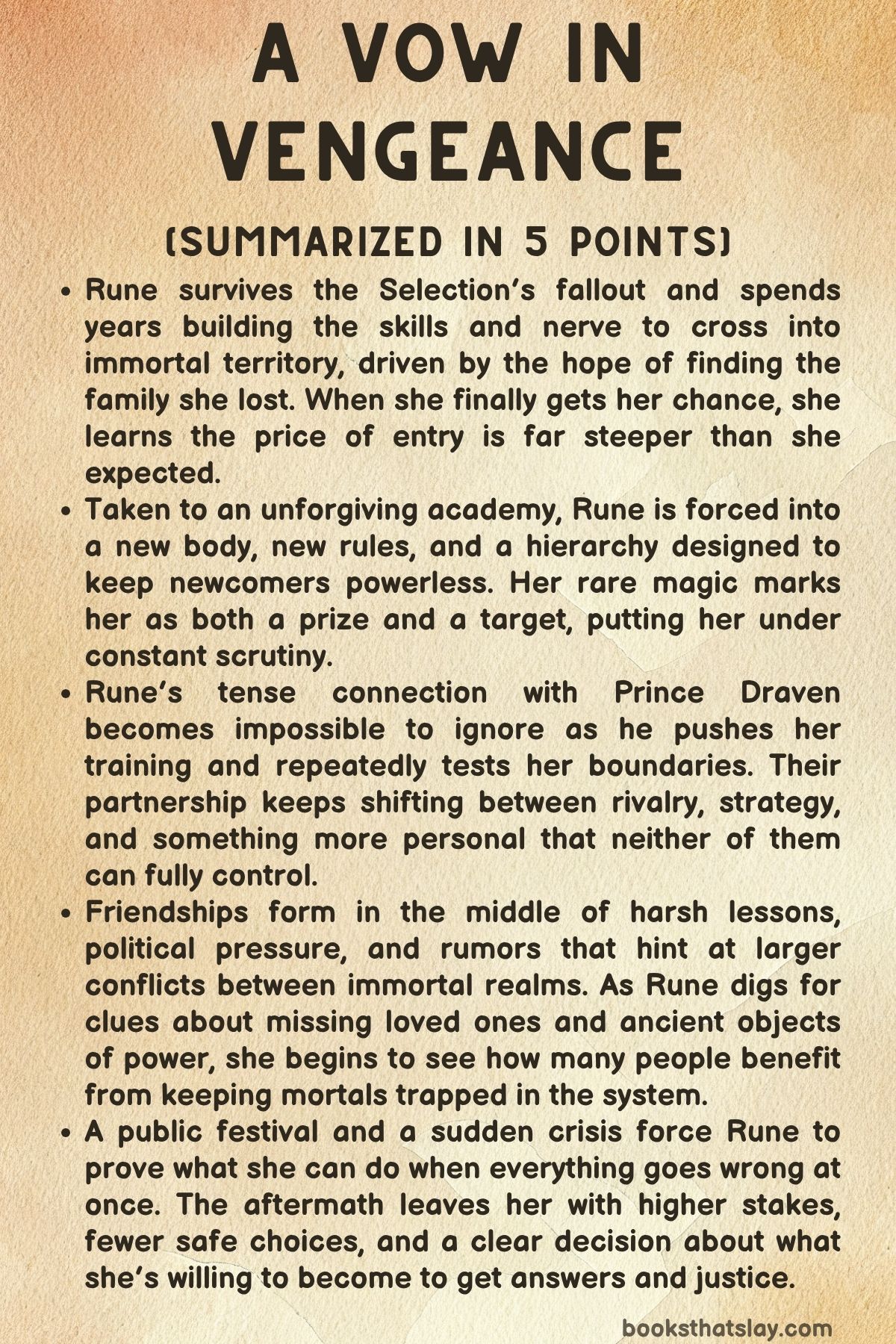
A Vow in Vengeance by Jaclyn Rodriguez is a fantasy romance set in a world where immortals rule and mortals pay for a long-ago rebellion through an annual Selection. Rune Ryker has spent her life running, surviving, and hunting for the family stolen from her—her twin, her father, and her mother.
On Selection day, Rune deliberately steps into the danger she has avoided for years, because being taken is her only path across the Immortal Wall. What she finds on the other side is not rescue, but forced transformation, brutal training, and politics sharpened into weapons. And at the center of it all stands Prince Draven—powerful, dangerous, and far too interested in Rune.
Summary
Six years after watching her mother taken and their hiding place burned, Rune Ryker returns to the ruined capital of Westfall on Selection day with a single goal: get chosen. She is already a wanted criminal, branded the Wraith of Westfall after defecting from the lord she once served and leaving his manor in flames.
Bounty posters plaster the streets, and desperate civilians would sell her out for reward money, but Rune forces herself into the crowd near the Immortal Wall. She believes the Selection is the only route into immortal lands where her father, mother, and twin brother were taken—and the only chance she has to bring them back.
The Selection is punishment: every year, one hundred mortals are taken from one of nine territories, and those who vanish never return. As the air thickens with fear, druid royals arrive with terrifying authority.
King Silas appears with Queen Vesta and his sons, Prince Draven and Prince Ansel, who will choose the mortals. The druids compel the crowd to their knees with magic.
Rune draws attention to herself on purpose, revealing her distinctive moon-white hair. Draven notices her immediately and watches her with unsettling focus.
The choosing begins quickly and carelessly. Rune expects to be picked, but at the last moment Ansel points to a blond young man nearby—Kasper—instead.
Desperate, Rune breaks protocol and speaks directly to royalty, whispering for Ansel to choose her. The breach shocks everyone.
Draven steps in smoothly, framing Rune’s offense as something they can hide, and Ansel makes Rune the final selection.
The chosen are separated and marched toward the Wall. Rune feels triumphant; she is finally going where her family went.
Draven briefly catches her when she stumbles and taunts her for failing to address him correctly, offering to spare her some hardship. Rune refuses on principle.
They climb a punishing stairway built into the Wall until they reach a terrace crowned by flags, a massive willow, and a threshold into immortal territory. Along the way, Rune finds a very small child abandoned and crying.
Ignoring warnings from Kasper, she carries him upward and sings softly until he sleeps.
At the terrace, King Silas orders all selected under eighteen to step forward. Guards try to take the child from Rune, and she begs to go with him, even lying about her age.
Silas ignores her plea and sends only the children away through a shadow portal. Then he turns to the remaining mortals and announces their real fate: they are being brought into the druid kingdom of Sedah, and they must swear undying loyalty.
The alternative is a plank extending off the Wall—a public death.
They are forced to drink from a silver bowl filled with crimson liquid, and the oath is dragged out of them by power they cannot resist. Rune fights it until agony overwhelms her and the command to yield pounds through her body.
When she breaks, the transformation starts. Her senses sharpen, her ears taper, fangs form, her eyes glow, and her hair shifts.
One woman refuses and leaps from the plank. The distant sound of impact is unmistakable.
Silas calls them changelings: neither mortal nor fully immortal yet. They will train and later face a deadly trial called the Descent.
He introduces tarot as the channel for their gifts—Major Arcana that define their core power, with Minor Arcana that expand and refine it. Each changeling draws a Major Arcana card.
Kasper receives the High Priestess. A ginger-haired girl, Ember, draws the Star.
When Rune touches the deck, a card shoots out violently: The World. Alarm flashes across the king and his vizier.
They demand she draw again. Rune repeats the draw and gets The World again.
Silas reacts as if this should not be possible.
The changelings are transported to the Forge, a volcanic academy set amid lava rivers and a looming black castle. Commander Soto explains that for a year they will endure training, tests, and constant scrutiny.
Those who excel may earn a path toward full immortality through the Descent; those who fail are redirected into lesser roles. On arrival, they must surrender every relic from their former lives to be burned as an offering.
Rune tries to hide a small figurine she values—a broken king—but it disappears anyway. Then a guard demands the bone pendant around her neck, the last thing she has from her father.
Rune refuses until Prince Draven intervenes. He removes his mask, calmly tells her that her attachment is the problem, and forces the issue until she gives it up.
The humiliation lands like a warning.
The academy sorts students into Hearths according to their Major Arcana. Most Hearths teem with students, but Rune’s—the World—has almost no one.
It is quiet, elegant, and unsettlingly empty. That night, Rune hears someone enter.
She opens the door and finds Draven on the couch as if he owns the place. He informs her that he is her roommate.
Furious, Rune attacks with whatever she can throw. Draven counters effortlessly with tarot magic—returning objects through portals, freezing projectiles in midair, turning a blade into a harmless creature, then binding Rune to a chair with animated blankets.
When Rune demands her pendant, Draven produces it but makes her ask for it politely before putting it back on her neck. He reveals that only two people have been chosen by the World in five hundred years: him and her.
The World is coveted because it can potentially access and replicate many powers, giving its bearer enormous influence. He warns her not to get in his way and not to try to kill him.
Rune begins classes with Ember and another student, Morgan. In tarot lectures, professors explain the origins of the decks, the danger of using magic without control, and how Major Arcana determine affinity.
Students are warned that tarot can burn a caster from the inside out, and that the deck must be protected. Rune struggles to summon her World card reliably, drawing public doubt about whether she is worthy.
She also learns that the Minor Arcana map onto the realms: wands for druids, swords for seraphs, coins for elves, cups for mortals. In sparring, Rune is outmatched, then manages a hard-earned win that leaves her injured and promptly healed.
Draven continues to provoke her. Rune retaliates in small ways, like eating his labeled food.
Draven pushes back by exposing how much he knows about her past as the Wraith. He also reveals a more disturbing advantage: he can read her thoughts.
When Rune tries to snatch his active tarot card, it burns her palm and leaves a mark. Draven heals her with another card and warns her never to touch an active spell again.
Rumors and tensions circulate at the Forge. Rune hears hints of a lingering Curse tied to ancient war, and she starts to suspect the Selection has deeper purpose than punishment.
During a sparring session, seraph visitors arrive led by Princess Reva. Rune’s world stops when she sees a captain among them—her father, alive, now a winged immortal.
Rune runs to him and embraces him, overwhelmed by relief and rage at what was done to him. Her father asks Reva to let Rune transfer to the seraph realm, Nevaeh, but the negotiation turns cold.
Draven refuses to barter Rune for money, saying the World makes her too valuable, and demands instead that Reva’s forced betrothal to him be ended. The trade treats Rune like property, and she learns that her safety is now entangled in immortal politics.
Violence escalates at the Forge. A changeling boy is killed during sparring, his neck snapped by a student named Mira.
Draven performs a grim spell using multiple cards, briefly animating the body long enough to whisper a message before releasing the soul. Rune demands he truly save the boy, but Draven insists the boy was already gone.
Soon after, angry changelings accuse the immortals of lying and using them for breeding. One throws a knife at Draven.
Rune reacts without thinking, tackling Draven to shield him. Draven’s response is swift and terrifying—shadow magic pins attackers, guards arrive through portals, and punishments are ordered.
Then Draven drags Rune through darkness to remove her from the scene, making it clear that being near him is both protection and danger.
Training intensifies. Rune is pulled into private sessions with Draven and powerful professors.
She learns that the World can mirror and combine powers if she understands intent and control. Under brutal instruction, she practices shielding her mind, healing, defense, weapon making, and bodily control.
She also sees how far Draven is willing to go to make others fear him, including frightening Rune’s friends to reduce anyone’s claim on her attention. Their relationship becomes a volatile mix of resentment, fascination, and reliance.
Rune discovers signs of spying and manipulation. She overhears Magda reporting to someone that she cannot prove Rune and Draven are truly bonded because spying crystals keep being found.
She learns a Nevaeh envoy is coming, and betrothal talks could resume. Draven decides they must sell the bond more convincingly to protect Rune from political threats.
He suggests they share a bed so their scents mingle; Rune agrees, partly for strategy and partly because she wants to believe it means something real. That same night, Draven returns the small broken king figurine Rune lost—revealed as her brother’s—and the gesture cracks something open between them.
They talk honestly. Draven reveals he was selected as a child too, his father was executed, and he was adopted by King Silas only after the World chose him.
Rune admits she lost someone she loved in Westfall. They begin to plan: find Rune’s stolen family and the legendary artifacts of Arcadia, then use power to remake the realms.
To cement the bond publicly, Draven proposes claiming: exchanging blood through visible bites that permanently change scent. Rune agrees.
The bite shocks Rune’s body with intense sensation, and her bite in return affects Draven just as strongly. The next day, everyone sees the mark and understands what it means.
Rune’s friendships shift under the weight of it, especially with Wynter, who had been growing close to her.
At Hollow Fest, Rune and Draven suggest unity with matching masks and ornate costumes. Draven dances with Rune in full view and bites her neck again, ensuring the entire Hearth watches her reaction.
Afterward they drink enchanted cocktails in a kitchen while Rune’s friends gather and meet Draven. Kasper’s hostility sharpens, and the strain among the group becomes obvious.
Soon after, disaster strikes during a mission to gather dark zenith crystal. A toxic drake erupts into the cavern, killing and scattering soldiers and elves.
Rune and Draven fight side by side. Rune struggles to summon the Star for a weapon until Draven pushes her to find hope—hope for him, fear of losing him.
That emotion unlocks her power. She forms a starlight shield and a blazing sword, then helps bring down the drake while hatchlings swarm.
They barely escape as the cavern detonates behind them. In the aftermath, Rune reveals she secretly recovered a wand from the cave—an artifact tied to their growing plans.
Draven warns her to hide it and tell no one.
Draven is summoned to the palace and kept away for days while suspicion grows that the drake attack was engineered. Rune and Draven communicate through paired enchanted pens, exchanging strategy and affection.
Draven investigates Rune’s missing family, narrowing possible identities for her brother and confirming that Rune’s mother will be delivered to him under coercive terms. He also produces the most valuable tool of all: Oathbreaker, an ancient grail that can sever bonds and oaths.
On Rune’s soul-day, Draven returns with gifts—information about her brother, proof her mother is close, and Oathbreaker itself. Then he offers a real choice: a mutual bond and a shared life.
Rune accepts and tells him she loves him.
The celebration shatters instantly. Kasper appears and stabs Draven, then holds a knife to his throat.
He steals Draven’s deck and forces Rune to surrender her cards. Kasper reveals he is working for King Altair of the seraphs—and that the seemingly innocent crystal frog Ember gave Rune was a spying device.
He demands Rune’s mother, the artifact wand, and Rune as a hostage. Rune gives up the wand to keep Draven alive, bargaining for Draven’s safety.
Kasper panics anyway and slits Draven’s throat. Chaos erupts as friends rush in.
Felix is stabbed while protecting Ember. Kasper escapes through a portal route arranged by allies.
Rune uses the World, the Empress, and other cards in a frantic attempt to save Draven. She pours everything she feels into the magic and manages to heal his throat enough to keep him alive.
Felix cannot be saved. He dies in Ember’s arms, leaving the group stunned and furious.
They race to the palace as seraph forces arrive, summoned by Kasper’s signal. Rune learns the larger motive: Altair wants Rune and her mother to control a cure for the Curse and force Sedah into war.
Draven, still weak, goes inside to warn the king and protect their families and Rune’s mother. Rune leads the defense outside, using the Star and Judgment in open battle.
Seraphs crash onto the lawns in lightning, and at their center stands Altair—alongside Rune’s father, bound by vows.
Rune tries to force a turning point by reaching for her father’s agency. When he attempts to strike, invisible bindings stop him, and Altair kills him in front of Rune.
Rune responds with raw violence, wrenching the artifact wand and driving it into Altair’s eye, injuring him badly. Druids arrive on wyverns and force the seraphs to retreat, but Altair escapes with the wand—and during the confusion, Rune’s mother is abducted from her guarded quarters.
Rune cradles her dying father, unable to save him with her magic. He calls her by the childhood name he once used, and then he is gone.
The next day, grief spreads through the Forge: Felix dead, Rune’s father dead, Rune’s mother taken, and war now a living threat. Draven offers Rune an escape route—use Oathbreaker to sever their bond and run.
Rune refuses. She chooses him, chooses the plan, and chooses vengeance.
She puts on the bracelet he gave her, and together they drink from Oathbreaker to seal a shared vow: recover the artifacts, rescue Rune’s mother, find Rune’s brother, take their thrones, and destroy King Altair and anyone who stands in their way.
Characters
Rune Ryker
Rune is defined by survival and purposeful rage: a girl who learned, at fourteen, that love can be weaponized against you when the people you cherish are used as leverage by powers that never have to answer for their cruelty. By twenty, she has turned that early trauma into strategy—she doesn’t simply want safety; she wants access, answers, and retribution, which is why she deliberately engineers her own Selection as a means of crossing the Wall.
What makes Rune compelling is the tension between her hardened competence and her stubborn, almost involuntary compassion: she can move through mobs, courts, and kill-or-be-killed training with a Wraith’s instincts, yet she still stops for a crying child on the stairs and carries him upward even when it risks her goal. Her arc is shaped by identity theft at multiple levels—her name on bounty posters, her body altered by the Oath, her hair and features changed without consent—and she responds by clinging to the few artifacts that prove who she was, like her father’s pendant and her brother’s figurine.
Rune’s magic mirrors this theme: the World terrifies the druid court because it implies she can become a living breach in the rigid hierarchy of Arcana, and her struggle to summon power consistently is less about talent than about emotion—she can’t access hope until she has something real to lose in the present, not just a vendetta rooted in the past. By the end, Rune’s grief becomes a vow with teeth, not a collapse; she chooses love and partnership with Draven without surrendering her autonomy, and her vengeance shifts from a personal crusade to a political warpath aimed at the structures that made her family disposable.
Draven
Draven is the story’s most dangerous kind of character: someone who understands power as theater and uses intimacy as both shield and knife. He presents himself as a taunting prince in control—appearing from shadows, provoking Rune into breaking etiquette, forcing her to say “please,” leaving her bounty poster like a joke—yet those performances mask a more complicated engine underneath: a boy Selected at six, stripped of origin, remade into a royal instrument because the World chose him, and raised inside the very regime he despises.
His cruelty often functions as preemptive defense; he tests boundaries constantly because vulnerability is the one position he can’t afford in a court built on leverage. At the same time, he is intensely strategic in a way that is not merely self-serving: he repeatedly frames his actions as a plan to change Arcadia from within, suggesting his ambition is partly revolutionary even if his methods are brutal.
Draven’s bond with Rune begins as political camouflage and control, but it shifts because Rune repeatedly does what no one in his world does—she chooses him when it costs her. She shields him from a thrown blade; she heals him; she becomes a real variable in a life that had turned into equations.
His jealousy and possessiveness are not romantic gloss—they are expressions of fear, because attachment creates vulnerabilities that enemies like Altair can exploit. That makes Draven’s most revealing moments the ones where he loses composure: the claiming that overwhelms him, the confession in the drake cavern, the refusal to trade Rune for convenience, and the final offer to sever their bond with Oathbreaker.
He is still morally sharp-edged, but the narrative positions him as someone trying to reforge himself—like the academy that shaped him—into a weapon that points upward at the throne rather than downward at the disposable.
King Silas
King Silas embodies institutional violence dressed as order. He is not a villain who rages; he is a ruler who normalizes atrocity through ceremony—Selection as punishment, loyalty as “choice,” transformation as “opportunity,” and death as a plank you step onto yourself.
His power is psychological as much as magical: he forces kneeling, forces oaths, forces yielding, and then frames compliance as the natural state of the world. His interest in Rune’s World card is especially telling because it reveals where the king’s real fear lives: not in rebellion from mortals, but in uncertainty within his own system.
The moment the World repeats, Silas reacts as someone watching a controlled experiment produce an impossible result. He is also politically careful; he delegates discipline through structures like the Forge, Commanders, and professors, allowing cruelty to be distributed and therefore deniable.
Silas functions as the architect of the changeling pipeline—reaped, broken, repurposed—and his role sets the moral stakes of the story: even when individual immortals show nuance, the crown’s machinery remains predatory.
Queen Vesta
Queen Vesta appears less directly than Silas, but her presence as part of the Selection tableau matters because she represents the polished face of the druid monarchy—the component that makes horror look legitimate. She is the stillness beside the blade: a reminder that the system is upheld not only by overt enforcers, but also by those who sanction it through composure, tradition, and silence.
In that sense, Vesta’s characterization is political rather than intimate: she signals that Sedah’s cruelty is not a rogue king’s excess but a shared royal culture, one capable of smiling while it takes children.
Prince Ansel
Ansel is the story’s portrait of innocence used as a tool. He performs the Selection under Draven’s guidance, and his discomfort reads as genuine, yet he still participates in a ritual that destroys lives—illustrating how monarchies reproduce themselves by turning even the “good” young royals into operators of oppression.
His choice to select Kasper before Rune and his startled reaction when Rune speaks highlight his inexperience, but the key point is that his inexperience doesn’t protect anyone; it simply makes the violence feel more arbitrary. Ansel exists to show how power corrupts by assignment: you can be gentle and still become the hand that condemns people, because the system needs your innocence to look like fairness.
Commander Soto
Commander Soto represents the militarized bureaucracy of Sedah—the person who turns royal decrees into daily routine. He is the one who welcomes the changelings to the Forge with language about training and advancement while making it clear that failure and punishment are built into the path.
Soto’s significance grows later because he also becomes a wartime leader in the palace defense, suggesting he is competent and loyal to the realm rather than personally sadistic. That competence is precisely what makes him dangerous in a broader sense: he is an effective gear in a machine that consumes people, and he can be both protector and oppressor depending on what Sedah needs from him.
Kenzo
Kenzo is the Forge’s embodiment of brutal honesty and brutal training, but he is not merely a tormentor; he is a pressure system designed to reveal who someone becomes when pain is routine. His sparring with Draven exposes that Draven still hides portions of his capability, implying Draven’s habit of concealment is survival strategy even in “safe” spaces.
With Rune, Kenzo functions like a harsh corrective lens: he strips away her confidence in knives and espionage and forces her into fundamentals, insisting she must become Draven’s equal rather than his accessory. His warning that Draven never lets people in is not romantic commentary—it’s tactical advice, delivered by someone who understands that intimacy in their world is a battlefield position.
Professor Atum
Professor Atum serves as proof that transformation at the Forge is not only physical but social: a former changeling who now teaches, he embodies the promise Sedah sells—that you can be remade and elevated. Yet his lessons also subtly reinforce the regime’s ideology by framing tarot as disciplined craft rather than the tool of coercion it also is.
His demonstrations and emphasis on keeping decks intact underscore the theme that power demands control and wholeness; what is scattered becomes vulnerable. Atum’s presence complicates the narrative’s moral landscape because he suggests some changelings do survive and even thrive, but his role also indicates how the system assimilates its victims into maintaining the pipeline.
Professor Vexus
Professor Vexus represents the Forge’s harsh gatekeeping: he polices worthiness, humiliates weakness, and reinforces the idea that power is earned through compliance and performance. His warnings about magic burning from within are both practical and ideological—fear is a leash, and he knows it.
His assumption that only Draven could hold the World reveals how hierarchy is enforced even in the classroom; Rune’s correction threatens that hierarchy and makes her a target. Vexus’s teaching style intensifies Rune’s internal conflict: she is already afraid of what she’s becoming, and he amplifies that fear by suggesting her inadequacy is inherent rather than situational.
He is the kind of educator who doesn’t merely train students—he shapes them into people who accept domination as the price of competence.
Professor Fenrys
Fenrys functions as the narrative’s intelligence conduit, a character whose importance lies in what he reveals about the broader political weather: rising tensions, rumors, prophecy talk, and the consequences of Draven’s public decisions. His role reinforces the story’s central escalation—from personal survival to international conflict—and frames Rune and Draven not as private lovers but as pieces that can tilt kingdoms.
Fenrys’s presence also highlights how information itself is weaponry in Arcadia; the most dangerous spells may be gossip, prophecy, and official perception.
Eldarion
King Eldarion appears as a political counterweight within the druid sphere—someone whose communications and bargains shape whether Rune’s family becomes bargaining chips or liabilities. His confirmation that Rune’s mother will be released to Draven, tied to secrecy, positions him as pragmatic and transactional: a ruler who treats people as clauses.
His reaction after the drake disaster—performative surprise, shifting blame—also suggests the kind of leadership that survives by never being the one holding the knife, even when everyone knows where the cut came from. Eldarion’s characterization strengthens the theme that in Arcadia, even “help” is a form of control.
Kasper
Kasper is betrayal wearing the face of camaraderie. Introduced as a fellow fugitive with sharp instincts, he builds trust by matching Rune’s survival logic and by positioning himself as someone harmed by the same world—an adopted son, a runner, a boy with his own reasons.
That mirroring is what makes his eventual revelation effective: he isn’t simply a villain who tricked them; he is a character who weaponizes the group’s hunger for connection. His role as Altair’s bastard son adds another layer: Kasper is also disposable within his own lineage, a tool sent to infiltrate and extract, which parallels what Sedah does to changelings.
The difference is that Kasper chooses to become that tool fully, crossing the line from coerced agent to active perpetrator when he slits Draven’s throat and causes Felix’s death. His use of the spying crystal disguised as a gift is especially cruel because it corrupts the story’s rare moments of softness, turning friendship tokens into surveillance.
Kasper ultimately embodies the book’s bleakest warning: when systems teach people that power is the only safety, some will decide love is a weakness worth exploiting.
Ember
Ember functions as Rune’s first anchor inside the Forge—a character who chooses connection in a place engineered to isolate. Her Arcana, the Star, fits her role: she represents hope as something practical, not naïve, often reframing situations in terms of usefulness and survival while still caring about people.
Ember’s relationships also show how intimacy becomes complicated under oppression: her public pairing with Kasper and the fallout with Felix highlight how quickly trust and affection can become collateral damage when loyalties are unclear. She is emotionally brave in the way Rune struggles to be at first, offering affection and community even when it might hurt, and her grief at Felix’s death crystallizes the cost of this world’s politics on ordinary bonds.
Morgan
Morgan’s storyline is defined by fear, secrecy, and punishment, making them a living example of what happens to students who end up caught in the web around Draven and Rune. Their vanishing and later sentencing to the Boiler positions Morgan as both a victim and a warning: the Forge does not simply train; it disciplines through disappearance, isolation, and rumor.
Morgan’s function in the narrative is to underline Rune’s growing realization that proximity to power—especially Draven’s power—spreads consequences outward. Even when Rune isn’t directly responsible, the system and the students will assign blame, because scapegoats are another way hierarchies stay intact.
Wynter
Wynter represents the seduction and horror of Judgment—power over bodies, wills, and the boundary between life and death. He is introduced with charisma and a hint of danger, yet his interactions with Rune show that he is also capable of restraint and genuine interest.
His fear when Draven crushes his attempt at control reveals a hierarchy even among gifted students: Wynter’s Arcana is terrifying until it meets a prince who refuses to be touched by anyone else’s will. Wynter’s feelings for Rune add emotional friction to the bond narrative, but his deeper purpose is thematic: he embodies how power can make even friendship feel like a threat.
His presence forces Rune to confront what it means to be controlled, and it highlights Draven’s possessiveness not as romance alone but as dominance—a stance that Rune must continually negotiate to keep her autonomy.
Amaya
Amaya operates at the edge of the story’s most important secret—the reason wealthy families value changelings and the deeper consequence of the Great War. Her near-reveal, cut off by authority, is characterization through obstruction: she knows more than she’s allowed to say, and that knowledge is dangerous enough to censor in real time.
As a Death Hearth student, she also reinforces the moral ambiguity of Sedah’s culture: Death is not simply evil here; it is institutional, everyday, and taught. Amaya’s role among the friend group strengthens the sense that survival requires alliances across different Arcana and backgrounds, and that everyone is carrying a private understanding of what the realms have done to each other.
Mira
Mira is cruelty that has decided it is entitled to exist. Her killing of a student in sparring without remorse shows how violence is normalized at the Forge and how some students internalize that normalization as personal license.
Yet Mira’s most revealing moment is not her brutality—it’s her fear when Draven threatens her privately. That reaction suggests Mira is not fearless; she is emboldened by the assumption that no one will stop her, until a higher predator does.
She represents what happens when the academy’s ethos—hurt or be hurt—becomes identity rather than circumstance.
Magda
Magda is the story’s portrait of compromised survival: someone who collaborates not out of devotion to evil but out of desperation to go home, and in doing so becomes part of the machinery that destroys others. Her use of spying crystals and her entanglement with Kasper’s scheme show how oppression turns ordinary people into informants, often by offering the one thing they crave most: escape.
Magda’s confession makes her both condemnable and tragic; she is responsible, but she is also proof that “choice” is a distorted concept when every option is punishment.
Felix
Felix functions as the quiet cost of betrayal and war, the friend whose death makes the story’s stakes irreversible. He is characterized largely through loyalty—rushing in, grappling Kasper, protecting Ember—and that loyalty is precisely why his death lands as moral indictment: the world doesn’t only kill the ruthless; it kills the kind.
Felix’s inability to be saved, even with Rune’s power, also sets a boundary for the magic system and a boundary for Rune emotionally: vengeance becomes less abstract when love and skill still cannot undo the harm.
Malik
Malik is a smaller but meaningful thread of tenderness and support, marked by gestures that preserve humanity inside the Forge’s cruelty—delivering a letter, offering the twinsoul pen that becomes a lifeline between Rune and Draven. His role underscores that connection in this story often comes through objects and tools—pens, pendants, figurines, cards—because open vulnerability is too risky.
Malik contributes to the sense that Rune is gradually building a network, not just a romance, even as that network is repeatedly targeted.
Scorpius
Scorpius appears as part of the protective response system around Rune and Draven, someone who moves decisively when danger breaks through the walls of their private world. His presence in the confrontation after Draven is stabbed frames him as action-oriented and loyal, and he helps shift the story from personal betrayal to open conflict at the palace.
Scorpius’s narrative function is to show that Draven is not entirely alone; there are people who will fight beside him, which makes the political battle feel less like a duet and more like a coalition forming around a volatile center.
Princess Reva
Princess Reva represents diplomacy as possession. She arrives with authority and a clear political agenda, treating Rune less as a person and more as an asset to be traded between realms, which exposes how every kingdom mirrors the others in at least one way: they all commodify bodies when it benefits them.
Her confrontation with Draven about a forced betrothal reveals the kind of alliance-building that ignores consent entirely, and her willingness to bargain with Rune’s placement shows how family bonds and individual futures are secondary to treaties. Reva also serves as the doorway to Rune’s most shocking emotional pivot—finding her father alive as a seraph—making her both a political threat and the messenger of hope that immediately curdles into further entrapment.
Riordan
Riordan is the story’s most painful example of transformation without freedom. As Rune’s father, he represents the goal that drives her—proof that family might still exist beyond the Wall—but his seraph form reveals the cost: survival has come with vows, altered identity, and enforced loyalty.
His desire to protect Rune is real, and his attempt to negotiate her transfer shows parental love persisting even when autonomy has been stripped away. Yet his inability to act against Altair at the critical moment, and his death in Rune’s arms, crystallize the tragedy of vow-bound existence: he is physically powerful and emotionally present, but politically chained.
Riordan’s final tenderness—calling her by her childhood name—turns Rune’s vengeance from mission to inevitability.
King Altair
Altair is conquest refined into policy. He operates with the confidence of someone used to owning outcomes, whether through bloodline claims, vows, propaganda about cures, or direct violence on palace lawns.
His interest in Rune and her mother is not personal; it is strategic, tied to the Curse and the ability to force kingdoms into war, which makes him a symbol of how rulers turn suffering into leverage. Altair’s cruelty is not impulsive; it is deliberate, especially in the way he uses binding oaths to neutralize Riordan and treats Rune’s family as tools.
Even when Rune wounds him—driving the wand into his eye—Altair remains terrifying because he escapes with what he came for, proving that power in this world is measured by what consequences you can evade. He stands as the primary target of Rune and Draven’s final vow not simply because he is brutal, but because he embodies the principle they now oppose: that people are resources.
Themes
Power, Subjugation, and the Machinery of Rule
The opening image of a family hiding under floorboards sets up a world where control is not occasional cruelty but an organized system that reaches into homes, bodies, and even language. The Selection is presented publicly as a decree, but it functions like an annual ritual of domination: it forces communities to gather, kneel, and watch their own people get taken, teaching everyone that resistance is costly and compliance is survival.
Even the rule against speaking to royals matters because it turns a simple human act—using your voice—into a punishable breach, reinforcing the idea that authority is not just political; it is sacred, untouchable, and absolute. Once Rune crosses the Wall, that same system shifts from external enforcement to internal ownership.
The Oath does not persuade; it extracts consent by pain and compulsion, turning loyalty into something manufactured rather than chosen. The forced transformation into a changeling extends that logic: power is encoded into the body, and the body becomes proof that the kingdom can rewrite what a person is.
This theme becomes sharper at the Forge, where the academy resembles a training ground and a sorting mechanism more than a school. Hearth assignments, restrictions on violence, surveillance crystals, and punishments like the Boiler all show a regime that pretends to value order while relying on fear and uncertainty.
The court-level negotiation where Rune is treated like property—discussed as an exchange item between Princess Reva and Draven—reveals how institutions normalize ownership. It is not only the druids who do this: the seraph king uses vows and binding obligations as chains, and even Rune’s father, remade into a seraph captain, is constrained by them.
Power in this story is not a single villain’s trait; it is a structure that repeats across realms, using oaths, bargains, propaganda, and spectacle to keep everyone in their assigned place. Rune’s growing strength does not remove her from this machinery; it forces her to decide whether she will dismantle it, exploit it, or become one of its most effective operators.
Survival as Identity and the Cost of Endurance
Rune’s survival begins as a physical struggle—smoke, snow, hunger, the terror of being found—but it quickly becomes the way she understands herself. She is shaped by the fact that she lived when others disappeared, and that survival did not come with closure.
Her determination to get Selected is not a desire for honor or advancement; it is a calculated decision that treats danger as a gateway. That choice signals how endurance has trained her to accept harm as normal if it moves her closer to her goal.
Even in moments where compassion breaks through—like carrying the abandoned child up the Wall—Rune’s kindness has to fight against the survival logic that tells her to conserve strength, avoid risk, and stop caring so much. The story keeps returning to these moments to show that her identity is not only “the one who lived,” but “the one who refuses to let survival erase her humanity.”
The Oath and transformation intensify this theme by forcing Rune to endure changes she never asked for. Her horror at her altered reflection is not vanity; it is the shock of realizing that survival now requires becoming something she despises.
The body becomes a site of loss: her ears, fangs, senses, even her hair change, and each change is a reminder that staying alive in Sedah means being remade by Sedah. At the Forge, survival becomes social as well.
Rune has to navigate hostility from Sedah-born students, suspicion from teachers, and the constant risk that any mistake becomes a sentence. When violence erupts—like the boy killed in sparring—survival gains a brutal moral edge: some people adapt by turning cruel, some by turning numb, and some by turning desperate enough to attack princes.
Rune’s reaction is revealing. She tackles Draven to stop a knife, not because she trusts him, but because her instincts prioritize immediate life over long-term hatred.
This theme culminates in the palace battle and the aftermath. Rune survives, Draven survives, but Felix does not, and her father dies in her arms.
Endurance is not rewarded with peace; it is rewarded with the chance to keep fighting. The grief is not a pause in the story; it becomes fuel, and the decision to drink from Oathbreaker seals a new version of survival—one that no longer aims simply to stay alive, but to stay committed to vengeance and change regardless of what it costs.
Survival here is not portrayed as inspiring by default; it is shown as exhausting, identity-shaping, and sometimes morally compromising, because the longer Rune lasts, the more she has to decide which parts of herself she is willing to sacrifice.
Vengeance, Justice, and the Line Between Them
Rune’s central drive begins with a clear emotional logic: her family was taken, her home destroyed, and the people responsible rule with impunity. That reality makes vengeance feel like justice because the official system is built to protect immortals and punish mortals.
When she enters the Selection crowd hoping to be chosen, her goal is not only reunion; it is retribution, the desire to make the immortals pay in the way they made her pay. The story supports this motivation by repeatedly showing institutional cruelty, so Rune’s anger never reads as random aggression.
It reads as a response to a world where lawful channels are a trap, and where “order” is simply the immortals’ preferred arrangement.
As Rune gains access to power, the theme complicates itself. Revenge is no longer only a feeling; it becomes strategy.
The World Arcana makes her valuable, and that value turns her into a political object. She cannot just strike; she must plan, hide, bargain, and sometimes cooperate with people she hates.
The presence of artifacts like the Darkstone wand and Oathbreaker turns vengeance into something even larger: not a personal settling of scores, but a potential reshaping of the realms’ balance of power. The story forces Rune to confront the fact that revenge can look like liberation from one angle and tyranny from another, depending on who ends up holding the tools of domination.
Draven’s role sharpens this tension. He claims to hate the immortal royals and to want to change the realms from within, which sounds like justice, but he also behaves like someone accustomed to control—reading thoughts, issuing commands, using fear to manage other men around Rune.
Rune, in turn, learns to use control-based magic like Judgment, and she trains to manipulate illusions and power structures. The more she grows, the more her path resembles the machinery she wants to destroy.
The palace battle shows this collision in action. Rune fights to stop Altair, but she also kills, wounds, and acts with ruthless clarity.
When she drives the wand into Altair’s eye, it is both a necessary act in war and a symbolic moment where vengeance and justice merge into a single decision: harm the oppressor before he harms more people. The story does not pretend this is clean.
It shows the emotional satisfaction and the moral weight at the same time.
The ending solidifies the theme by turning vengeance into a vow shared with Draven. After multiple losses, Rune does not choose healing or retreat; she chooses commitment.
The act of drinking from Oathbreaker is not a peaceful sealing of love; it is a deliberate acceptance that their future is built on retaliation, rescue, and conquest. Justice in A Vow in Vengeance is not framed as a courtroom outcome or a moral resolution; it is framed as taking back agency in a world where the powerful never face consequences.
That makes vengeance understandable and even compelling, while also raising the question the story keeps pressing: if vengeance becomes a method of ruling, what separates the avenger from the tyrant?
Choice, Consent, and the Violence of Forced Bonds
Consent is repeatedly treated as the dividing line between love and captivity, between loyalty and slavery, and between transformation and violation. The Selection itself is framed as mandatory participation: show up or lose your life and property.
That coercion makes every “choice” inside the system suspicious, because the system has already decided the cost of refusal. The Oath is the clearest example.
It is not an agreement reached by understanding; it is words torn out through pain until the person yields. The language of “Yield” matters because it turns consent into surrender, and surrender into a condition for survival.
Once that happens, even Rune’s body becomes evidence that her will was overridden. The fangs and glowing eyes are not simply fantasy traits; they are marks of a contract she never freely signed.
This theme deepens through smaller moments that show how forced bonds distort relationships. Rune wants to get across the Wall to find her family, but the method requires her to submit to the druid kingdom’s process.
She is compelled to surrender personal possessions to be burned, a symbolic stripping of past identity. Her necklace—her last link to her father—is taken under pressure, and even though Draven later returns it, the exchange reveals a dynamic where he can grant or withhold what matters to her.
The academy’s rules about who can touch tarot decks create another consent boundary: a simple touch becomes an invasion that forces a thirteen-hour reset, showing how bodily autonomy has been replaced by magical vulnerability.
The “fated mate” storyline takes this theme into intimate territory. On the surface, the bond offers protection and political leverage, but it also becomes a public performance demanded by the court.
The pressure to look convincing—bed sharing, scent mingling, visible bites—turns intimacy into a tactic. Rune agrees, which might seem like consent, but her agreement is shaped by threats: surveillance, envoy politics, and the risk that Draven’s betrothal will remove her shield.
That context makes their decisions feel both chosen and cornered. The claiming bites intensify this ambiguity.
They are described as deeply pleasurable, which could suggest mutual desire, but pleasure does not erase the fact that the act permanently alters scent and status in a way that others can read, judge, and use.
The story then contrasts coerced bonds with deliberate ones. Draven offering Rune the chance to use Oathbreaker to sever their connection is a pivotal reversal: it presents an exit, a real option, not a forced arrangement disguised as romance.
Rune’s decision to stay becomes meaningful because it is made after loss, grief, and clear knowledge of the costs. The mutual vow is still dangerous and still tied to vengeance, but it is not extracted by pain or threat in the way the original Oath was.
By placing forced bonds and chosen bonds side by side, A Vow in Vengeance keeps asking what it means to belong to someone or something, and whether love can remain love when it is shaped by political coercion and magical ownership.
Identity, Transformation, and the Fear of Becoming the Enemy
Rune’s transformation into a changeling is not treated as a power-up; it is treated as identity dislocation. She arrives wanting to infiltrate immortal lands and recover her family, and she ends up becoming partially immortal herself.
That twist forces her to confront a frightening possibility: the enemy’s world is not only around her; it is inside her. Her reaction to her reflection—fangs, glowing eyes, straight hair—shows that the worst part is not ugliness but alienation.
She has spent years defining herself against immortals, and now her body betrays that boundary. This makes identity feel unstable, something that can be rewritten by external forces, which is one of the story’s most persistent sources of tension.
The World Arcana adds another layer because it marks Rune as rare and valuable in a way she never asked for. Her identity becomes a contested resource: teachers doubt her worth, royals react with alarm, and classmates resent her.
Even her Hearth being nearly empty reinforces isolation as a condition of her uniqueness. The loneliness is not just social; it is existential.
If the World can “wield everything,” then Rune’s potential is frightening even to the people who supposedly rule her. That fear around her power suggests that identity in this world is not self-defined; it is assigned by institutions, cards, and kings.
Rune has to fight to reclaim any sense of self that is not simply “asset,” “weapon,” or “prophecy.”
Draven embodies the same theme in a different way. He was also Selected as a child, adopted, and shaped by royal agendas.
His charm, cruelty, and control can be read as survival adaptations: he learned to stay alive by being useful and feared. When he heals wounds repeatedly in sparring, the scene does more than show toughness; it shows how violence is normalized, how pain is training, and how identity becomes “the one who endures and wins.” His desire to change the realms from within raises the question of whether reform is possible without becoming what you oppose.
Rune’s relationship with him reflects that struggle. She is drawn toward him while fearing what closeness means for her mission and moral boundaries.
When he reads her thoughts and asserts dominance around her friends, it highlights a version of intimacy that edges toward possession, and Rune has to decide whether she will accept that or reshape it.
The theme reaches a harsh clarity through the revelation of Rune’s father as a seraph captain and later his death. His transformation shows how identity can be stolen by vows and remade into service for another power.
His presence proves Rune’s fear is justified: becoming immortal does not guarantee freedom, and it can mean becoming an instrument of the very system that caused the original loss. After he dies, Rune’s grief is layered with the horror of how little control he had over his own fate.
That pushes Rune closer to embracing her power without apology, which is both empowering and dangerous. The final vow with Draven signals that Rune is no longer only resisting transformation; she is choosing what kind of transformed person she will be.
The book frames identity as a battlefield where magic, politics, trauma, and love all compete, and where the scariest question is not whether Rune will gain power, but what she will become while using it.