A Well-Trained Wife Summary and Analysis
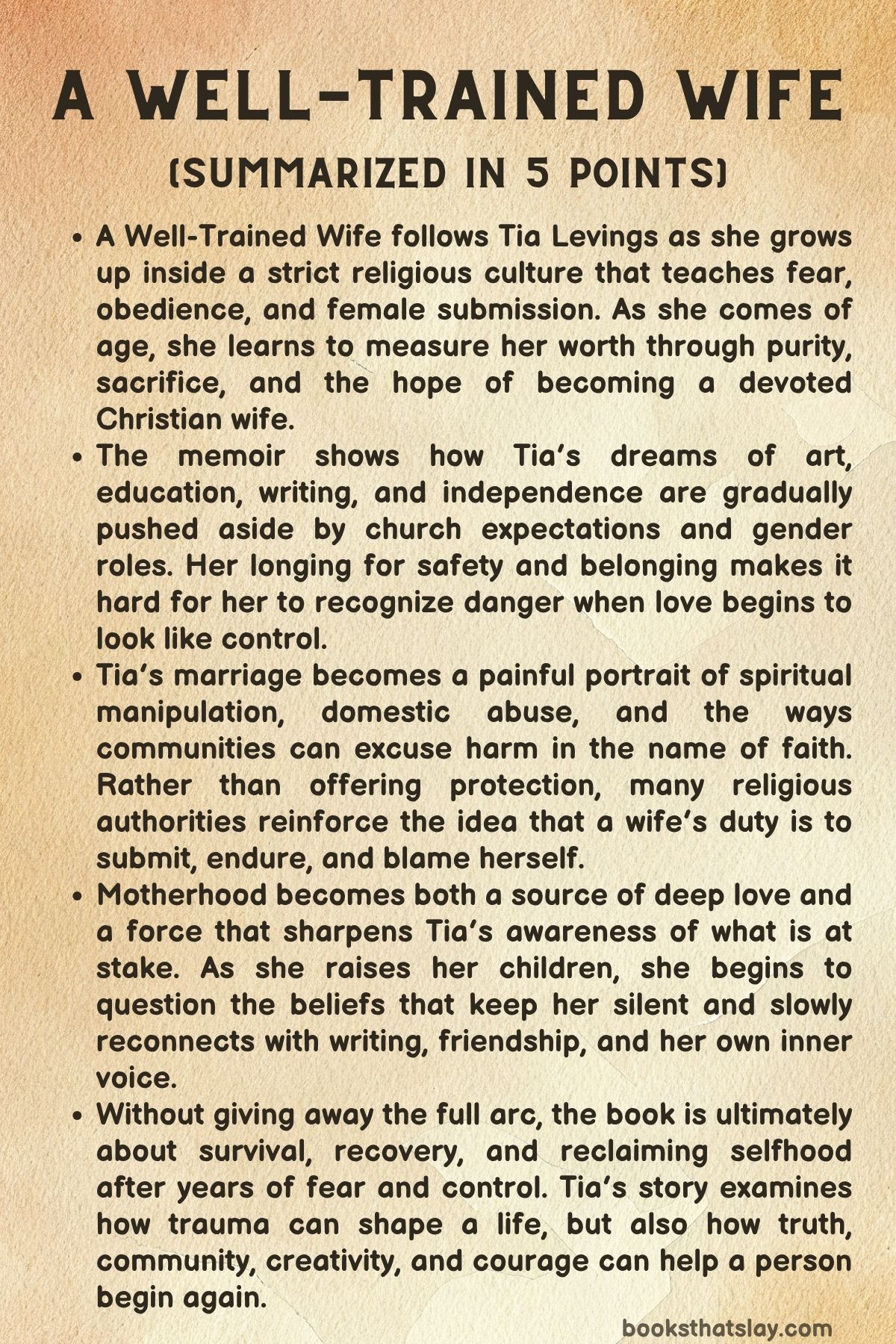
A Well-Trained Wife by Tia Levings is a memoir about coercive control, religious extremism, domestic violence, and the slow return to selfhood. Levings traces how teachings about female submission, purity, marriage, and obedience shaped her from childhood and made it harder for her to recognize abuse once she entered marriage.
The book is not only about one violent relationship; it is also about the systems that trained her to endure it, excuse it, and call it faithfulness. In plain, searching prose, Levings shows how escape began when she understood that saving her children required saving herself.
Summary
A Well-Trained Wife opens with Tia Levings on the floor in 2007 after her husband, Allan, strikes her during an argument. In that moment, she understands that staying is teaching her children that violence belongs inside family life.
Her church has not protected her. Instead, it has urged her to submit, endure, and treat Allan’s behavior as a spiritual problem rather than abuse.
Allan sees demons, threatens her, refuses medical help, and grows more dangerous. Tia realizes that no one inside the religious structure around her is coming to rescue her.
She will have to save herself and her children.
The memoir then returns to Tia’s childhood. At ten, she loses the Michigan farm she loves when her family moves to Jacksonville, Florida.
The move strips away the woods, books, imagination, and freedom that once made her feel alive. In Florida, she feels lonely and out of place.
Her mother draws the family into a large Baptist church, where belonging comes with fear and rules. Tia learns that church participation pleases her parents, even when it makes her anxious.
At church and at Christian school, she is taught to fear hell, punishment, the rapture, sin, sex, abortion, and worldly culture. When her friend Hannah’s mother dies after adults have framed illness as God’s discipline, Tia absorbs a frightening lesson: God can take anyone, and obedience may still not make her safe.
She develops stomachaches and becomes consumed by salvation anxiety. At Grace Christian Academy, classmates mock her appearance, and religious instruction deepens her belief that she must become pure, modest, and obedient to be acceptable.
As a teenager, Tia tries to master the rules. She briefly finds freedom through a rebellious friend who introduces her to music, books, profanity, shopping, and boys, but after an older boy assaults her, she blames herself.
Instead of seeing the attack as violence done to her, she treats it as proof of her own failure and recommits to being a good Christian girl. Church culture teaches her that girls are meant to become wives and mothers, and that strict obedience is evidence of holiness.
In high school, Tia lives between two worlds. She loves art, books, movies, music, and her friendship with Michael, a boy who sees her as a person.
She dreams of studying art after her talent is recognized, but the church’s expectations narrow her future. When she seeks financial help for Bible college, she is told that church funds are for men called to ministry.
The message is clear: boys are allowed missions and futures; girls are trained to sacrifice.
After high school, Tia works in daycare, struggles with depression, restricts food, and searches for the husband she has been taught to need. At a church Christmas hayride, she meets Allan, a charming sailor who is intense, ambitious, and quick to pursue her.
He talks about marriage early and makes her feel chosen. Tia sees him as God’s answer and imagines that her love can heal his pain.
The warning signs appear quickly. Allan is jealous, possessive, sexually aggressive, and violent.
He hits her throat at the beach, drives recklessly, pressures her sexually, isolates her from friends, and demands that she stop seeing Michael without a chaperone. Tia cuts Michael off, even though it breaks her heart, because she believes obedience is proof of faithfulness.
Allan apologizes after cruelty, and those moments of tenderness help her cling to a romantic version of the relationship.
Premarital counseling exposes serious problems, and the counselor advises them not to marry. Allan becomes enraged, but Tia moves forward.
On the wedding day, her father asks if she is sure. She does not know where she could go if she runs, so she walks down the aisle and vows to love, honor, and obey.
On the wedding night, Allan has sex with her roughly despite her pain and pleas for him to stop. The marriage she was taught to expect as sacred immediately becomes a place of fear and violation.
Tia tries to make sense of the pain through the teachings she has received. She studies submissive womanhood, domesticity, and complementarian marriage, believing that if she becomes a better wife, the home will become peaceful.
She learns to cook, clean, soften her voice, and anticipate Allan’s needs. When he abuses her over a supposedly dirty floor, he later frames her reaction as the real sin and forgives her, leaving her to blame herself.
Pregnancy and motherhood bring Tia love and new vulnerability. Her son William is born at home, and she falls completely in love with him.
Church mothers pressure her into strict parenting methods that require letting him cry through the night. She feels guilt but receives praise for producing an orderly child.
As more children arrive, she is drawn deeper into teachings about headship, homeschooling, modesty, quiverful families, and harsh discipline. She resists some practices, but Allan learns from patriarchal men that control of wife and children is godly leadership.
The family moves through increasingly rigid Christian circles. During a later pregnancy, doctors discover that Tia’s baby, Clara, has a severe heart defect.
Tia fights for surgery and medical care, and Clara survives birth and the first operation but remains critically ill. During this crisis, Allan continues to control and endanger Tia, even forcing her away from Clara on Mother’s Day and pushing her out of the car on an overpass.
Tia hides the truth. Clara eventually dies just before she is supposed to go home.
Tia is devastated by grief, and Clara’s death opens older wounds from abuse, fear, and religious control.
After Clara’s death, Tia begins to rediscover herself in secret. Through homeschooling forums and an online group called Trapdoor Society, she finds books, art, conversation, writing, and women with broader views of the world.
She reads, visits libraries, and begins imagining that her mind and creativity still matter. She gives birth to Liam in a peaceful home birth, while Allan moves deeper into patriarchal Calvinist circles.
Outwardly, Tia remains the Christian wife and mother she has been trained to be. Inwardly, she begins to question submission, discipline, politics, and the meaning of faith.
Allan’s control intensifies. He audits her clothing, writing, church activities, and sexuality.
He orders her to attend a wifehood Bible study and to call him “my lord.” He discovers Christian Domestic Discipline and presents wife-spanking as a righteous correction for rebellion. Tia seeks help from a Baptist counselor by describing the abuse in detail, but he tells her to honor and submit more.
Under pressure, she signs a handwritten contract promising not to accuse Allan of domestic violence because he calls the beatings Christian discipline. He later beats her with a belt for sharing photos without approval.
The family moves to Tennessee to join a covenantal Reformed church. At first, the church seems wholesome, but Tia soon sees that men rule households, women submit, and membership functions as control.
When Allan travels for work, Tia gains small freedoms. She takes the children to libraries, co-ops, hikes, farms, and historic sites.
She starts a blog, Living Deliberately, which becomes popular. Church elders object that her writing should be under Allan’s authority.
Allan allows it only with oversight.
Another move brings the family to a colder, more isolated life in Lutherville. Allan monitors her mileage, restricts outings, and threatens renewed discipline.
A stranger bringing firewood makes Tia realize that waiting passively for rescue is dangerous. A postcard from Michael reconnects her with the friend who once saw her clearly.
His recognition of her lifelessness helps wake her up. Searching for another form of Christianity, Tia finds Eastern Orthodoxy and is drawn to its mystery, saints, reverence for Mary, and sense that women have names and souls.
The family is excommunicated from their Reformed church for moving toward Orthodoxy, and Tia feels both wounded and released.
For a time, Orthodoxy brings peace. Tia’s blog becomes a career.
She gains clients, opens her own bank account, and earns money. Allan’s control eases while he studies the new faith.
But after the family dog dies, stability collapses again. Allan becomes paranoid, accuses Tia of cheating, threatens to take the children, and rages.
Tia tries to manage her work, children, house, and fear, but her private fantasies of Allan dying show how trapped she feels.
The escape comes after Allan explodes over Tia’s new boots and leaves the house. Tia hears an inner command to run.
She loads her sleeping children, laptop, laundry, Allan’s phone, and two kittens into the van and drives away. She passes Allan’s car and realizes he may be going back for his gun.
She takes the children to Father Justin and Jodie, who shelter them. With help, she arranges a goodbye between Allan and the children so he cannot accuse her of kidnapping, then drives to Florida.
For the first time, she tells her parents the truth about fourteen years of abuse. They tell her to come home.
In Florida, Tia is traumatized and afraid. Allan later calls drunk and suicidal, with a gun nearby, blaming her for destroying the family.
Police intervene and arrest him after he threatens officers. Tia files for protection and seeks legal help.
When she returns to Tennessee to collect belongings, Allan violates the order and is arrested again. A custody investigator warns her to hide with the children.
Through online friends, she travels for months, staying in safe homes while the legal process continues.
Therapy gives Tia language for what happened: rape, abuse, coercive control, trauma, and religious conditioning. She grieves not only the marriage but the belief system that promised safety through obedience.
The divorce is finalized in 2008, and she begins rebuilding. She closes the old blog, paints, joins a domestic violence support group, enrolls the children in public school, and accepts help.
She later falls in love with a man she calls Cary Grant, returns to the old house to pack, burns clothing from her former life, and starts again.
Marriage to Cary Grant does not erase her trauma. Migraines, visual disturbances, nausea, and pain force her into deeper healing.
EMDR, Al-Anon, Brainspotting, and other therapy help her process escape, childhood religious fear, abandonment, codependency, and people-pleasing. As scandals expose abuse in fundamentalist and evangelical communities, Tia recognizes that her story is part of a larger pattern.
She begins making videos about high-control religion, patriarchy, and abuse. Her audience grows, she finishes a manuscript, appears in Shiny Happy People, signs with an agent, and sells her book.
Years later, Cary Grant asks for a divorce. Tia is hurt, but she does not collapse into the old terror.
On the anniversary of her escape, she counts what remains: grown children, grandchildren, friends, solitude, work, survival, and a life that belongs to her. She chooses uncertainty over submission and plans to travel slowly by sea and train to Europe.
The memoir ends with a private spirituality rooted in love, truth, gratitude, poetry, and self-belonging.
Characters
Tia Levings
Tia Levings is the central figure of A Well-Trained Wife, and her character is built around the painful movement from fear and obedience toward truth, self-recognition, and freedom. At the beginning of the book, she appears as a woman trapped inside a violent marriage and a religious system that has taught her to doubt her own instincts.
Her decision to leave Allan is not sudden rebellion but the result of years of emotional, spiritual, physical, and sexual harm. What makes Tia especially compelling is that she does not begin as someone who clearly sees herself as oppressed.
As a child and young woman, she wants safety, belonging, love, and divine approval. Because of this, she absorbs the rules around her deeply, believing that submission, purity, modesty, and self-denial will protect her and make her worthy.
Tia’s childhood shows how sensitive, imaginative, and creative she is before religious fear begins shaping her inner life. Her love of the Michigan farm, woods, reading, art, and writing reveals a girl with a rich private world and a natural hunger for beauty.
The move to Florida wounds her because it separates her from a place where she felt rooted. In Jacksonville, she becomes lonely and anxious, and the church offers structure at the same time that it teaches her fear.
Tia’s stomachaches, repeated salvation prayers, and terror of punishment show how deeply religious messages enter her body. She is not merely learning beliefs; she is being trained to fear disobedience, female desire, and independent thought.
As a teenager, Tia becomes divided between two selves. One self loves art, music, movies, friendship, and the possibility of a creative future.
The other self tries to become the pure, obedient Christian girl her church praises. Her relationship with Michael and her dream of art school reveal the life she might have chosen if her gifts had been encouraged.
Instead, the religious world around her narrows her choices and teaches her that boys are given futures while girls are expected to prepare for sacrifice. This becomes one of the most important wounds in her character: she gradually learns to trade her own desires for the approval of men, church leaders, and family expectations.
Tia’s marriage to Allan exposes the full danger of this training. She repeatedly interprets his cruelty through the language of faith, duty, forgiveness, and submission.
Even when Allan hurts her, humiliates her, controls her, or violates her, she searches for a way to become a better wife rather than immediately naming his behavior as abuse. This does not make her weak; it shows how thoroughly she has been conditioned to distrust herself.
Her tragedy lies in the fact that her conscience, compassion, and desire to do right are weaponized against her. She wants to heal Allan, preserve the family, please God, and protect her children, but the system around her keeps telling her that endurance is holiness.
Motherhood becomes one of Tia’s deepest sources of strength. Her love for William, Katie, Clara, Liam, and Gavin gives her moments of clarity even when she is trapped.
Clara’s illness and death are especially transformative because they break open Tia’s buried grief and force her to confront suffering that cannot be solved by obedience. Her grief after Clara’s death becomes a turning point, not because it immediately frees her, but because it cracks the false promise that perfect submission produces safety.
Through motherhood, Tia begins to understand that protecting her children may require disobeying the very rules she was taught were sacred.
Tia’s intellectual and creative awakening is equally important. The Trapdoor Society, books, libraries, writing, blogging, and friendships with women outside her narrow world help her recover the parts of herself that had been buried.
Her blog becomes more than a hobby; it is a sign that her voice still exists. The more she reads and writes, the harder it becomes for her to remain invisible.
Her movement toward Eastern Orthodoxy also shows her search for a faith that honors mystery, beauty, women, and embodied spirituality rather than control and fear. Tia is not simply rejecting religion; she is searching for a version of truth that does not require her disappearance.
By the end of the book, Tia becomes a survivor who understands that freedom is not a single moment but a long, uneven process. Leaving Allan saves her life, but healing requires therapy, memory work, boundaries, grief, public truth-telling, and the recovery of her own desires.
Her later divorce from Cary Grant shows that she is still vulnerable to loss, but no longer destroyed by it in the same way. Tia’s final strength lies in self-belonging.
She does not end as someone who has solved every wound, but as someone who has reclaimed authority over her body, voice, faith, work, and future.
Allan
Allan is the primary antagonist in the book and one of its most disturbing figures because his abuse is both personal and ideological. He begins as charming, intense, romantic, and wounded, which makes him attractive to Tia when she is searching for a husband and a divine sign.
His early pursuit of her is filled with language of destiny and difference, making Tia feel chosen. Yet the warning signs appear almost immediately: jealousy, possessiveness, sexual pressure, reckless behavior, isolation, rage, and physical violence.
Allan’s danger lies in how quickly tenderness and threat become intertwined. His apologies and emotional vulnerability keep Tia attached, while his violence teaches her to fear him.
Allan’s character becomes more frightening after marriage because he uses religious teaching to justify control. He does not merely want a wife who loves him; he wants a wife who obeys him, serves him, sexually submits to him, and accepts his authority as sacred.
His belief in headship gives him a language through which domination can appear righteous. When he embraces complementarianism, patriarchal Calvinism, Federalist theology, Vision Forum ideas, and Christian Domestic Discipline, he finds systems that strengthen his worst impulses.
The book shows that Allan’s abuse is not separate from these beliefs; he uses them as permission, structure, and cover.
Allan’s treatment of Tia reveals a pattern of coercive control. He monitors her friendships, writing, clothing, travel, sexuality, money, and spiritual life.
He demands access to her body and calls it marital duty. He frames her resistance as rebellion and his violence as correction.
His insistence that she write a contract denying domestic violence shows his need not only to control her actions but also to control the story itself. He wants Tia to participate in erasing the truth of what he does to her.
This makes him not just physically abusive but psychologically and spiritually manipulative.
Allan’s relationship with the children is complicated but deeply troubling. At times, he shows affection, especially with William, and he can participate in family life with energy and charm.
Yet his love is unstable because it exists inside his need for authority. He teaches, disciplines, and leads in ways shaped by rigid doctrine.
His threats to take the children, his paranoia, and his violent instability make him a danger to the entire family. The children become part of the world he wants to control, and Tia’s eventual escape is driven by the realization that staying teaches them violence as normal.
Allan’s mental deterioration later in the story intensifies his danger, but the book does not present his cruelty as only a medical problem. His paranoia, demon visions, rage, suicidal threats, and refusal of help are serious signs of instability, yet his abusive behavior predates these crises.
The church’s tendency to frame his behavior as spiritual warfare rather than abuse or illness allows him to remain unchecked. Allan is therefore both an individual abuser and a representation of what can happen when violent male authority is protected by religious language.
As a character, Allan embodies the destructive fusion of entitlement, insecurity, doctrine, and violence. He is not portrayed as a simple monster without human moments, which makes him more realistic and more unsettling.
His charm, grief, and occasional tenderness do not cancel his abuse; they help explain why escape is so difficult for Tia. In A Well-Trained Wife, Allan represents the terrifying power of a man who believes his control is divinely authorized.
William
William is Tia and Allan’s first child, and his arrival changes Tia’s emotional world. His birth awakens a fierce love in her and gives her a new sense of purpose.
Before William, Tia’s life is largely organized around becoming the right kind of wife. After William, motherhood becomes one of the strongest forces in her identity.
Her attachment to him is immediate and tender, and through him she experiences a form of love that feels pure, embodied, and undeniable.
William also becomes the child through whom Tia first encounters the harsh parenting rules promoted by her religious community. The pressure to let him cry through the night, follow strict schedules, and avoid indulgent mothering places Tia in conflict with her instincts.
Her guilt over letting him cry shows that her natural compassion is still alive, even when she obeys the group. William’s infancy therefore reveals the tension between Tia’s maternal intuition and the authoritarian systems trying to shape her parenting.
As the eldest child, William also represents what is at stake in Tia’s marriage. When Tia realizes that staying with Allan teaches her children that violence is normal, William is part of the moral awakening that pushes her toward escape.
He is not only a child she loves; he is a witness to the world she must either accept or reject. His presence helps transform Tia’s suffering from private endurance into an urgent question of protection.
Katie
Katie is Tia’s daughter, and her birth deepens Tia’s awareness of female vulnerability inside patriarchal culture. Tia loves Katie fiercely and promises to protect her, which is significant because Tia herself was not adequately protected as a girl or young woman.
Katie’s presence forces Tia to confront what it means to raise a daughter in a world that teaches girls obedience, modesty, silence, and submission. Through Katie, Tia begins to see the danger of passing down the same training that harmed her.
Katie also reflects the emotional stakes of generational inheritance. Tia has been shaped by fear of male authority, fear of sexual sin, and fear of disobedience.
With Katie, those teachings become more frightening because Tia can imagine them being placed onto her daughter’s body and future. Her protective love for Katie becomes a quiet form of resistance, even before Tia has the language to call it that.
Katie’s character matters because she helps Tia see that what was done to her must not be repeated.
Clara
Clara is one of the most emotionally significant children in the book, even though her life is brief. Her severe heart defect brings Tia into a world of medical crisis, fear, hope, and helpless love.
Clara’s birth and fight for survival reveal Tia’s strength as a mother. Tia pumps milk, learns hospital routines, stays close, and insists on surgery because she cannot surrender her child without fighting for every possible chance.
Clara’s life becomes a concentrated expression of love under extreme suffering.
Clara’s death shatters Tia, but it also changes her. The loss breaks through the numbness that has helped Tia survive abuse.
Her grief opens older wounds and forces her to confront the reality that obedience cannot protect her from pain. Clara’s death also exposes Allan’s cruelty more starkly, especially when he forces Tia away from Clara on Mother’s Day and then endangers her.
In this way, Clara’s storyline reveals both Tia’s maternal devotion and the emotional brutality of the marriage.
Clara represents innocence, fragility, and the collapse of easy religious explanations. Her gravestone’s message, “Every day was a gift,” captures the tenderness surrounding her short life, but the grief that follows also becomes part of Tia’s awakening.
Clara’s death does not free Tia immediately, but it leaves her less able to believe in the old promises of safety through submission.
Liam
Liam is born after Clara’s death, and his peaceful home birth contrasts with the trauma that surrounds much of Tia’s life. His arrival brings comfort, continuity, and a renewed experience of motherhood.
While Tia is still living inside a controlling marriage, Liam’s birth shows that beauty and tenderness continue to exist even in a damaged household. He becomes part of the daily life that keeps Tia moving forward.
Liam also belongs to the period when Tia is beginning to question more deeply. Around the time of his birth, she is outwardly still performing the role of Christian wife and mother, but inwardly she is reading, thinking, and wondering whether writing might become her own hidden calling.
Liam’s presence therefore sits within a transitional stage of Tia’s life: she is still trapped, but the inner rebellion has begun.
Gavin
Gavin is Tia’s fifth child, born during one of the most controlled and diminished periods of her marriage. His pregnancy occurs after Allan’s abuse has escalated into written contracts, wife-spanking ideology, and deeper patriarchal control.
Tia is emotionally and physically shrinking during this time, making Gavin’s birth part of a painful stage in which motherhood is both beloved and exhausting.
Gavin’s birth also reveals Allan’s destructive effect on Tia’s support systems. When Allan refuses to pay the midwives the remaining money, he damages Tia’s relationship with Jo, one of the women who had offered her care.
This moment matters because it shows how Allan’s control isolates Tia not only from friends and family but also from practical female support. Gavin is loved, but his arrival occurs in a context where Tia is increasingly cut off from the people who might help her.
Tia’s Mother
Tia’s mother is a complicated figure because she loves her daughter but does not fully understand the danger Tia is in until much later. In Tia’s childhood, her mother seeks belonging and stability through church life, especially after the family’s move to Florida.
Her desire to join First Baptist gives the family structure, but it also places Tia inside a religious environment that intensifies her fear and self-doubt. Tia learns early that cooperating with church makes her parents happy, which teaches her to trade her own resistance for family approval.
Later, Tia’s mother represents both limitation and eventual support. When Tia calls her during the marriage and says the fighting is unbearable, her mother urges counseling, not realizing the full extent of the violence.
This response is painful because it shows how abuse can remain hidden when victims cannot safely tell the whole truth. Yet when Tia finally tells her parents about fourteen years of abuse, her mother helps her come home and assists during the crisis with Allan’s suicidal call.
Tia’s mother is therefore not portrayed as a perfect protector, but as someone whose role changes once the truth becomes visible.
Tia’s Father
Tia’s father is also a figure of imperfect love and belated protection. Before Tia marries Allan, he asks whether she is sure, suggesting that some part of him senses the seriousness of the choice.
However, he does not stop the wedding, and Tia proceeds because she cannot imagine where she would go if she ran. This moment shows the tragic gap between concern and effective intervention.
Later, Tia’s father becomes part of her practical rescue and rebuilding. He comes to help renovate the house, supports her return to Florida, and accompanies her when she goes back to the Blue House to pack her belongings.
His presence in these later scenes offers a form of grounded support that Tia badly needs. Like Tia’s mother, he does not fully protect her early enough, but he becomes part of the network that helps her leave and begin again.
Hannah
Hannah is an important childhood figure because her mother’s illness and death shape Tia’s early understanding of God, suffering, and punishment. Hannah herself is kind, and her friendship offers Tia a brief sense of connection in the church world.
However, when their Sunday School teacher frames suffering as possible divine discipline and Hannah’s mother dies, Tia absorbs a terrifying lesson: God can take anyone, and disobedience may invite punishment.
Hannah’s disappearance from church deepens Tia’s fear. To a child already anxious and displaced, Hannah’s loss becomes evidence that safety is fragile and conditional.
Hannah’s character is not developed through many actions of her own, but her role in Tia’s inner life is significant. She becomes part of the emotional foundation for Tia’s later fear-based faith.
Hannah’s Mother
Hannah’s mother represents innocent suffering filtered through harmful religious teaching. Her cancer becomes a lesson in the church classroom, where adults attempt to explain pain through discipline, prayer, and divine will.
For Tia, Hannah’s mother’s death is not only sad; it is spiritually destabilizing. It teaches her to associate tragedy with possible punishment.
As a character, Hannah’s mother matters less through direct interaction and more through what her death does to Tia’s imagination. She becomes one of the first signs that the religious world around Tia may offer explanations that wound children rather than comfort them.
Her illness and death help create the atmosphere of fear that follows Tia into adolescence and adulthood.
Marci
Marci represents freedom, rebellion, and the tempting possibility of life beyond church rules. She introduces Tia to music, books, profanity, the mall, boys, and a looser way of moving through the world.
To Tia, Marci is exciting because she seems unafraid of the boundaries that define Tia’s life. Their friendship gives Tia a taste of independence and pleasure.
However, after Troy assaults Tia, Marci becomes associated in Tia’s mind with danger and sin, even though Marci is not responsible for Troy’s actions. Tia cuts her off and recommits to obedience because she has been trained to blame herself and interpret harm as the result of stepping outside approved boundaries.
Marci’s role is therefore tragic. She offers Tia a glimpse of freedom, but Tia’s trauma and religious conditioning turn that glimpse into fear.
Troy
Troy is a predatory figure whose assault of Tia becomes one of the formative traumas of her adolescence. His violence in the camper, combined with his threat involving the dog, teaches Tia that male desire can be dangerous and that she may not be protected from it.
Because of her religious environment, she interprets the assault through guilt rather than victimhood. Instead of being helped to name what happened, she blames herself and repents.
Troy’s role in the book is brief but deeply consequential. He reinforces the destructive lessons Tia has already been absorbing: that girls are responsible for male behavior, that sexual harm contaminates the victim, and that safety comes from stricter obedience.
His assault helps push Tia away from freedom and back into the rules that later make her vulnerable to Allan.
Michael
Michael is one of the most important non-family figures in Tia’s life because he represents friendship, recognition, and an alternate path. In high school, he is close to Tia in a way that feels emotionally nourishing and sincere.
Their friendship belongs to the part of Tia that loves art, school, movies, music, and ordinary youthful connection. Michael sees her as a person rather than merely a future wife.
Allan’s demand that Tia stop seeing Michael is one of the early signs of coercive control. When Tia cuts Michael off, she experiences real grief, but she convinces herself that the sacrifice is obedience.
This moment shows how Allan begins isolating her before marriage and how Tia’s religious training makes that isolation easier to accept. Michael’s later postcard is powerful because it reconnects Tia to someone who remembers her before she became so diminished.
When he recognizes the lifelessness in her blog photo, he sees what others have ignored. His recognition helps awaken her because it confirms that something has gone terribly wrong.
Brad
Brad is one of Tia’s brief dating relationships before Allan, and his role is mainly to show her longing for marriage and direction. Tia is searching for a husband partly because her religious world has taught her to see wifehood as her central future.
Brad’s presence reflects this stage of her life, when romance is not simply personal attraction but part of a spiritual and social mission to become chosen.
Although Brad does not become a central figure, his relationship with Tia helps show the pressure she feels to find the right man. The end of the relationship contributes to her vulnerability when Allan appears.
By the time she meets Allan, she is emotionally prepared to read intensity and pursuit as divine provision.
Scott
Scott, like Brad, belongs to the period when Tia is trying to locate her future through dating and marriage. His relationship with her is brief, but it contributes to the pattern of searching and disappointment that precedes Allan.
Tia is not merely dating casually; she is looking for confirmation that she can become the woman her religious environment has trained her to be.
Scott’s significance lies in contrast. He does not become the husband Tia imagines, and his absence clears the way for Allan’s dramatic entrance.
Because Allan seems more intense, certain, and purposeful, Tia interprets him as an answer. Scott’s role helps establish why Allan’s pursuit feels so meaningful to her at the time.
Dr. Vines
Dr. Vines represents institutional sexism within the church. When Tia seeks financial help for Bible college and is told that church money is reserved for men called to ministry, she receives a clear message about whose futures matter.
His response wounds her because it confirms what she has already begun to suspect: boys are encouraged to pursue callings, while girls are expected to sacrifice theirs.
Dr. Vines is not physically violent or openly cruel, but his role is damaging because he speaks with institutional authority. He helps narrow Tia’s future by denying support and reinforcing the belief that women’s ambitions are secondary.
His character shows that oppression in the book does not come only through obvious abuse. It also comes through policies, assumptions, and religious gatekeeping that quietly redirect women away from their gifts.
Tina
Tina, the midwife who supports Tia during William’s birth, represents warmth, practical care, and female competence. Her presence comforts Tia during pregnancy and birth because she offers a kind of embodied knowledge that differs from the fear-based authority of the church.
Tina’s care helps Tia feel held and capable at a time when she is entering motherhood.
Allan’s dislike of Tina’s influence is significant because he senses that supportive women can weaken his control. Tina does not need to openly oppose Allan to threaten him; her simple care for Tia creates a relationship outside his authority.
Through Tina, the book shows how women’s networks can become lifelines, even when those lifelines are fragile.
Judith
Judith represents the policing power of religious motherhood communities. She and the other church mothers pressure Tia toward strict parenting methods, rigid gender roles, modesty rules, rejection of birth control, and harsh child discipline.
Judith’s influence is especially painful because it comes from another woman. She does not appear as an enemy in the obvious sense; she appears as someone enforcing what the community defines as godly motherhood.
Judith’s character shows how patriarchal systems often depend on women to train and correct other women. Through praise, pressure, and spiritual language, she helps pull Tia deeper into headship, quiverful ideals, and authoritarian parenting.
Tia’s resistance to some practices, such as blanket training and infant switching, reveals that Judith’s influence is strong but not total. Tia’s conscience continues to push back, especially where her children are concerned.
Jo
Jo is Tia’s trusted midwife during Gavin’s birth, and she represents another form of female support that Allan damages. Her care matters because Tia needs women who understand birth, bodies, and vulnerability outside the control of male authority.
Jo’s presence should have been a stabilizing source of trust.
When Allan refuses to pay the remaining money owed to the midwives, he ruins Tia’s relationship with Jo. This incident is important because it reveals how abuse isolates victims indirectly.
Allan does not only hurt Tia in private; he also breaks the relationships that might have sustained her. Jo’s loss teaches Tia that concealment has consequences.
The women who might help her cannot protect her if they do not know the full truth.
Leah
Leah is Tia’s quiet friend in Tennessee, and her role shows the hunger for female companionship inside restrictive religious communities. Tia befriends her in an environment where independent friendships between women are discouraged.
This makes Leah’s presence meaningful, even if limited, because friendship itself becomes a small act of resistance.
Leah represents the kind of ordinary connection Tia is repeatedly denied. In a healthier world, such friendship might have grown naturally and offered mutual support.
In the church culture Tia enters, however, women’s relationships are monitored because they might create loyalties outside male authority. Leah’s character helps show how isolation is maintained not only through direct commands but also through suspicion of women’s private bonds.
Father Justin
Father Justin becomes important during Tia’s escape because he offers practical help at a moment of crisis. When Tia flees with the children, she goes to him and Jodie, and their home becomes a place of immediate refuge.
Father Justin’s role is especially significant because he does not respond by sending Tia back into danger or spiritualizing Allan’s abuse.
By arranging a brief goodbye between Allan and the children, Father Justin helps Tia protect herself legally and practically. His intervention contrasts sharply with earlier religious leaders who told Tia to submit more.
He represents a form of spiritual authority that can act with wisdom and protection rather than control. His presence shows that faith communities can either endanger victims or help them survive, depending on whether they choose truth over appearances.
Jodie
Jodie offers one of the clearest moments of gentleness in the escape sequence. When Tia arrives with the children, Jodie receives them with warmth and tea.
This simple domestic care matters enormously because Tia has spent years in a home where domestic life is associated with fear, performance, and control. Jodie’s welcome shows what safety can feel like.
Jodie’s role is not dramatic in the sense of confrontation, but it is emotionally powerful. She gives Tia and the children a calm place to land during one of the most dangerous nights of their lives.
Her kindness becomes part of the bridge between captivity and rescue. In a book filled with harmful religious responses, Jodie represents hospitality that protects rather than judges.
The Baptist Counselor
The Baptist counselor is one of the most damaging authority figures in the book because he receives direct evidence of abuse and responds by reinforcing submission. Tia writes him a detailed letter describing Allan’s violence and control, expecting rescue.
Instead, he tells her to honor and submit to Allan more. This response is devastating because it confirms Tia’s fear that even when she tells the truth, religious authority may still side with the abuser.
His character represents institutional betrayal. He has the opportunity to name abuse, protect Tia, and challenge Allan’s behavior, but he chooses doctrine over safety.
His advice does not merely fail to help; it places Tia in greater danger by strengthening the logic Allan uses against her. Through him, the book shows how counseling rooted in patriarchal assumptions can become another instrument of control.
Stephanie
Stephanie, Tia’s therapist after escape, plays a crucial role in helping Tia name what happened to her. She identifies rape, abuse, control, and trauma in experiences Tia had been taught to reinterpret as marital duty, discipline, or spiritual struggle.
This naming is transformative because Tia’s healing depends on recovering truthful language.
Stephanie also helps Tia confront the religious beliefs that shaped her choices. Rather than treating Tia’s trauma as only marital, she recognizes the larger system that trained Tia to endure harm.
Her role is important because she gives Tia a framework for understanding herself without blame. Through Stephanie, Tia begins grieving not only the marriage but also the lost dream that purity and obedience would earn safety and divine reward.
K
K appears during Tia’s early rebuilding period after the divorce is finalized. His role is brief, but he belongs to a stage when Tia is beginning to reenter the wider world as a working woman with possibilities beyond survival.
Meeting him in New York marks a moment of movement, travel, professional opportunity, and emotional openness.
K’s significance is less about a lasting relationship and more about what he represents. He appears when Tia is no longer only fleeing; she is starting to imagine a future.
In that sense, K is part of the transitional space between trauma and reinvention, where Tia begins to discover that other lives and connections are possible.
Cary Grant
Cary Grant is a major figure in Tia’s post-Allan life because he helps her feel desire, safety, and possibility again. When they meet at church, Tia is immediately drawn to him, and their passionate relationship becomes part of her reawakening.
After years of sexual coercion and fear, Cary Grant offers an experience of being wanted without the same immediate sense of threat. He helps her reconnect with her body and with the possibility of joy.
His presence during Tia’s return to the Blue House is symbolically important. Along with her father, he helps her pack what remains of her old life, burn clothing associated with that past, leave the key, and move into her own apartment.
In these scenes, he becomes part of Tia’s transition from victimhood into chosen life. He is connected to movement, release, and the reclaiming of space.
However, Cary Grant is not presented as a final rescue fantasy. Tia eventually marries him, but her unresolved trauma continues to surface through migraines, pain, and neurological symptoms.
Later, when he asks for a divorce, Tia is devastated but does not collapse in the same way she once might have. His character therefore serves two purposes in A Well-Trained Wife: he represents genuine love and renewal, but also the truth that no relationship can substitute for deep healing and self-belonging.
Bette
Bette is the trauma therapist who helps Tia process the night she fled the Blue House through EMDR. Her role is important because she guides Tia back into a terrifying memory and helps transform its meaning.
What had lived in Tia’s body as horror begins to become evidence of courage. This shift is central to trauma recovery because it changes Tia’s relationship to her own past.
Bette represents skilled therapeutic care, especially care that understands trauma as something stored in the body, not just remembered in the mind. Through her, Tia begins to see that survival was not passive.
The night she fled was not only a night of fear; it was a night when she acted decisively to save herself and her children. Bette helps Tia reclaim that truth.
Pat
Pat is another therapist who helps Tia reach deeper layers of trauma through Brainspotting. While Bette helps with the escape memory, Pat helps address childhood religious trauma and abandonment.
This matters because Tia’s wounds did not begin with Allan. They began earlier, in the training that taught her to fear God, distrust herself, and seek safety through obedience.
Pat’s role expands the book’s understanding of healing. Tia does not only need to recover from a violent marriage; she needs to recover the buried parts of herself that existed before fear took over.
Through Pat’s work, Tia begins reconnecting with her younger self, her creativity, and her sense of worth. Pat helps her understand that trauma recovery is not only about escaping danger but also about returning to oneself.
Themes
Religious Control and the Loss of Self
Tia’s faith environment turns belief into a system of fear, obedience, and self-erasure. In A Well-Trained Wife, religion is not presented only as comfort or community; it also becomes the language through which control is justified.
From childhood, Tia learns that suffering may be punishment, that safety depends on perfect obedience, and that doubt is spiritually dangerous. These lessons shape the way she understands pain later in marriage.
When Allan hurts, humiliates, or coerces her, the teachings around submission make her look inward for fault instead of outward for danger. Pastors, counselors, church mothers, and patriarchal books repeatedly tell her that a wife’s duty is to become quieter, softer, more available, and more submissive.
This traps her because the very community that should name abuse instead gives abuse religious cover. The theme becomes especially powerful because Tia’s oppression is not caused by one cruel person alone; it is sustained by a whole belief structure that trains her to distrust her own fear, anger, intelligence, and desire for freedom.
Domestic Abuse and the Normalization of Violence
Violence in Tia’s marriage grows through repetition, apology, spiritual language, and social silence. Allan’s abuse is physical, sexual, emotional, financial, and psychological, but it often appears beside moments of tenderness or religious seriousness, which makes it harder for Tia to name clearly.
He isolates her from friends, controls her clothing and writing, pressures her sexually, threatens her, beats her, monitors her movements, and later uses theology to turn cruelty into “discipline.” The horror lies not only in the acts themselves but in how often Tia is pushed to interpret them as marital struggle, spiritual testing, or her own failure. She hides injuries, protects Allan’s reputation, and tries to repair the relationship by becoming more obedient.
This theme shows how abuse survives when victims are trained to preserve the family image at all costs. Tia’s eventual realization that staying teaches her children that violence is normal becomes a turning point.
Her escape is not framed as abandonment but as protection, truth, and moral clarity.
Motherhood, Protection, and Moral Awakening
Motherhood becomes both a source of vulnerability and the force that helps Tia resist. Her children tie her to the marriage in practical, emotional, and religious ways, especially because her community treats motherhood as a woman’s highest calling.
At the same time, loving them gives her moments of clear judgment that cut through fear. She sees how teachings about obedience, harsh discipline, gender roles, and submission threaten not only her own life but also her children’s understanding of love and safety.
Clara’s illness and death deepen this theme because Tia’s grief exposes how little support she receives from Allan when she most needs tenderness. Her children keep her moving after loss, but they also make escape more urgent when Allan’s paranoia and violence worsen.
The decision to flee is therefore not only personal survival; it is an act of maternal refusal. She rejects the idea that a “good” wife must endure anything and replaces it with a stronger truth: a good mother must not teach her children to confuse fear with love.
Recovery, Self-Belonging, and Rebuilding a Life
Freedom does not arrive all at once after Tia escapes; it has to be rebuilt through truth, therapy, work, community, and repeated acts of self-trust. After leaving Allan, she still carries terror in her body through migraines, fear, weight loss, confusion, and trauma responses.
Legal protection and custody are necessary, but they do not instantly heal the beliefs that kept her trapped. Therapy helps her name rape, abuse, codependency, religious trauma, and people-pleasing, while creative work helps restore parts of herself that had been buried since childhood.
Painting, writing, public advocacy, friendships, support groups, and new forms of spirituality all become ways of reclaiming ownership over her own life. The ending of A Well-Trained Wife is not a simple rescue story, because even later love and remarriage do not erase trauma.
Its deeper resolution comes when Tia can face another loss without surrendering herself. Her final freedom lies in belonging to herself, trusting uncertainty, and choosing a spirituality based on love rather than fear.