Abraham Lincoln and the Second American Revolution Summary and Analysis
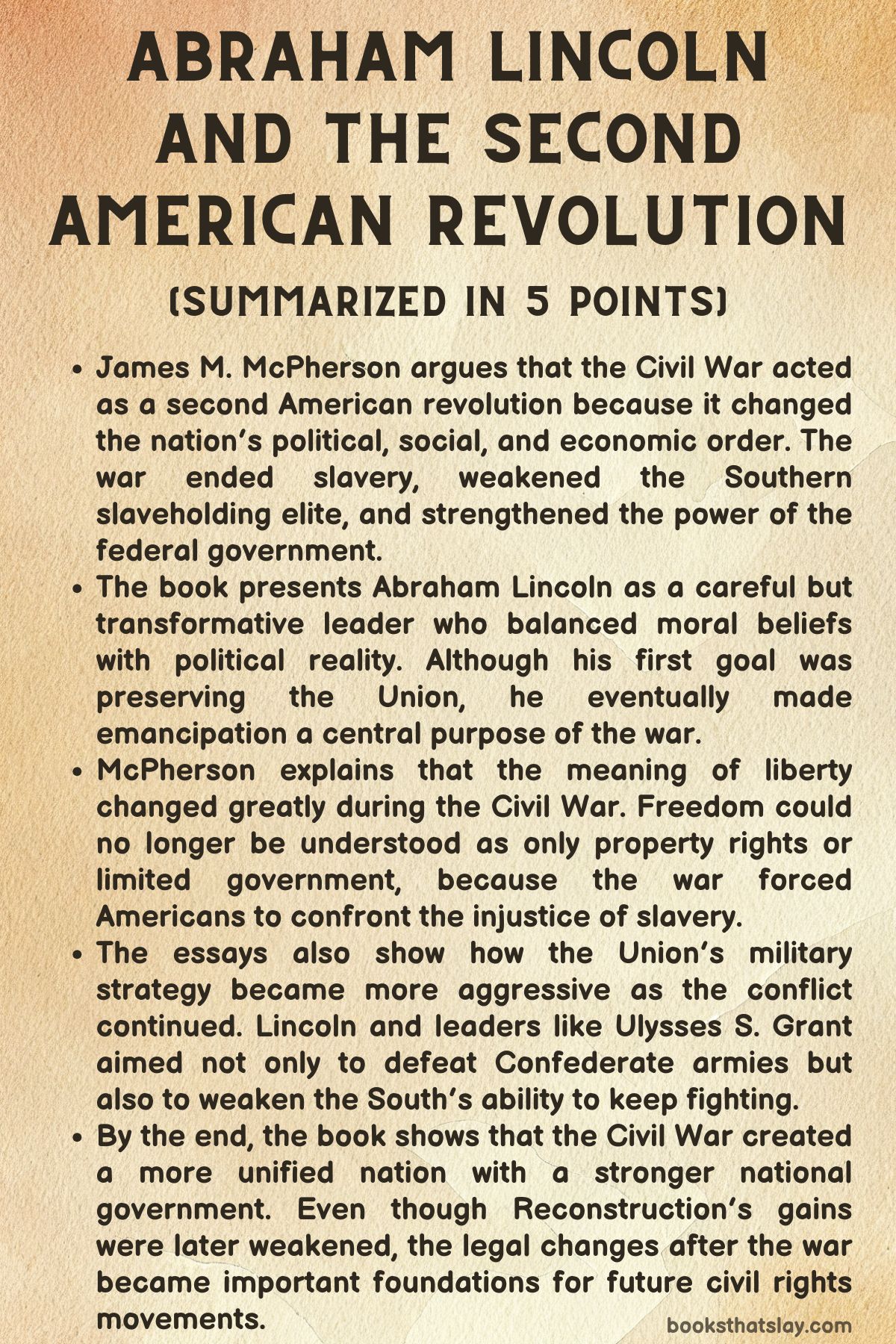
Abraham Lincoln and the Second American Revolution by James M. McPherson is a collection of historical essays that examines how the American Civil War transformed the United States politically, socially, and economically. The book argues that the Civil War functioned as a “second American revolution,” reshaping the nation in ways comparable to the original Revolution of the eighteenth century.
McPherson focuses especially on Abraham Lincoln’s leadership and the ideas that guided his decisions during the conflict. Through discussions of liberty, government power, military strategy, and political change, the book explains how Lincoln and the Civil War altered the meaning of freedom, strengthened national authority, and ended slavery, leaving a lasting influence on American democracy and identity.
Summary
Abraham Lincoln and the Second American Revolution examines how the Civil War reshaped the United States and how Abraham Lincoln guided the nation through that transformation. The book begins by describing how observers after the war felt that the country had fundamentally changed.
The war destroyed the institution of slavery and freed millions of enslaved people, shifting the nation from a slave-based economy to one built on free labor. Government structures also changed dramatically.
New systems of taxation and national banking emerged, federal courts gained broader authority, and the federal government took on greater responsibility than it had before the war. Even the way people referred to the country changed, as “the United States” began to be treated as a single nation rather than a loose union of states.
The first essay explores whether the Civil War should be considered a second American revolution. Some politicians during the war already believed this to be true.
They saw the conflict as more than a military struggle; it was a profound change in society and politics. Observers compared the upheaval to the French Revolution because it overturned an established system of power.
In the United States, the war destroyed the influence of the slaveholding elite that had dominated the South and held considerable national political power.
Historians have interpreted this transformation in different ways. Some argued that the war represented an economic struggle between two competing systems.
The North developed a form of industrial capitalism that relied on free labor, while the South depended on plantation agriculture and enslaved workers. These contrasting systems produced opposing beliefs about slavery and freedom.
As the two societies grew further apart, conflict became increasingly likely. When Southern states seceded from the Union, the resulting war changed the balance of power in the country.
With Southern representatives gone from Congress, the Republican Party passed legislation that encouraged industrial growth and national economic development.
The abolition of slavery had immense consequences. Enslaved people were treated as property, so emancipation represented the largest confiscation of property in American history.
The South suffered severe economic damage during and after the war. Plantations and agricultural resources were destroyed, and the region struggled to rebuild.
Freed people faced their own challenges. Many were forced into sharecropping arrangements that kept them economically dependent.
Despite these difficulties, the period after the war also brought progress. Literacy rates among African Americans increased, more children attended school, and some Black citizens began participating in politics.
Although later developments limited many of these gains, the war created legal and political foundations that would influence later civil rights movements.
The book then turns to Abraham Lincoln’s role in these changes. Some historians describe Lincoln as cautious and conservative, especially in the early years of the war when he did not immediately pursue emancipation.
McPherson argues that even though Lincoln often preferred gradual change, the events of the Civil War pushed him into revolutionary action. Lincoln believed that people had the right to alter their government when necessary, but he did not view the Southern rebellion as a legitimate revolution.
Instead, he saw secession as an unlawful act that threatened the survival of the Union.
Lincoln’s main objective at the beginning of the conflict was preserving the United States. Because the Constitution protected slavery where it already existed, Lincoln initially avoided policies that would directly challenge it.
He also needed the support of border states that still allowed slavery but had not joined the Confederacy. For these reasons he resisted strong abolitionist measures during his first year in office.
As the war continued, circumstances changed. Confederate forces made use of enslaved labor, and antislavery voices in the North demanded stronger action.
Lincoln attempted to persuade slaveholding border states to adopt gradual emancipation voluntarily, but they refused. Eventually he concluded that ending slavery would help weaken the Confederacy and strengthen the Union cause.
In 1863 he issued the Emancipation Proclamation, declaring enslaved people in rebellious states to be free. This step changed the nature of the war.
The conflict now aimed not only to restore the Union but also to eliminate slavery. The Thirteenth Amendment later made emancipation permanent.
Another major theme in the book is the meaning of liberty. During the war Americans used the word “liberty” in different ways.
For many people in the North, liberty meant freedom from slavery. For defenders of slavery in the South, liberty meant the right to own property without government interference.
Southern leaders argued that the Constitution protected their right to enslave people, and they believed that limiting slavery threatened their own freedom.
Lincoln rejected this interpretation. He believed that the principles of the Declaration of Independence applied to all people.
In his view, slavery contradicted the founding ideals of equality and liberty. However, the war forced him to confront difficult choices about civil liberties.
In order to suppress rebellion, he suspended the writ of habeas corpus in some areas and authorized the arrest of individuals suspected of aiding the Confederacy. Critics accused him of abusing power, but Lincoln believed such actions were necessary to protect the nation during a crisis.
Military strategy formed another crucial part of Lincoln’s leadership. At first he treated the rebellion as an internal uprising rather than a war between separate nations.
Early efforts focused on restoring order and maintaining federal authority. After repeated setbacks, Lincoln adopted a more aggressive approach.
The Union government expanded the army, blockaded Southern ports, and targeted Confederate resources. Military leaders such as Ulysses S. Grant carried out campaigns designed not only to defeat Confederate armies but also to damage the South’s economic capacity to continue fighting.
Emancipation also became part of the war strategy. Freed people were allowed to join the Union army, strengthening Northern forces while weakening the Confederacy.
By the final years of the war, Lincoln insisted that peace negotiations could occur only if the South accepted both reunification and the abolition of slavery. Even when many Americans grew tired of the conflict and demanded compromise, Lincoln maintained these conditions.
McPherson also highlights Lincoln’s communication style. Lincoln had little formal education, but he possessed a remarkable ability to express complex ideas in simple language.
He often used stories, comparisons, and vivid imagery to explain political issues. These techniques allowed him to reach ordinary citizens and help them understand the stakes of the war.
His speeches, including the Gettysburg Address, presented the Union as a nation dedicated to liberty and equality, giving people a powerful reason to support the war effort.
Another discussion in the book examines Lincoln’s approach to decision-making. Some political thinkers describe leaders as either “hedgehogs,” who focus on one central idea, or “foxes,” who pursue many different strategies.
Lincoln fit the first description. His central aim was preserving the Union and protecting the democratic ideals on which it was founded.
Many advisors proposed complicated plans or compromises, but Lincoln often returned to this basic objective. Even when the outcome of the war seemed uncertain, he remained committed to victory and national unity.
The final essay considers how the Civil War changed the relationship between liberty and government power. Before the conflict, American political traditions emphasized limiting federal authority in order to protect individual rights.
The war required the government to exercise stronger powers, including military rule in parts of the South during Reconstruction. These measures raised questions about how much authority the federal government should have.
At the same time, the end of slavery forced Americans to reconsider what liberty meant. Freedom could no longer coexist with human bondage.
Constitutional amendments after the war granted citizenship and voting rights to African Americans and gave the federal government greater responsibility for protecting those rights. These changes shifted the balance between states and the national government.
Although Reconstruction brought important reforms, many of its achievements were later weakened. Southern resistance, political compromises, and the withdrawal of federal troops allowed discriminatory systems to develop.
Even so, the legal changes created during and after the Civil War remained important foundations for later movements that sought equality and civil rights.
Through its essays, Abraham Lincoln and the Second American Revolution presents the Civil War as a turning point that reshaped the United States. The conflict ended slavery, expanded federal authority, and redefined the nation’s understanding of freedom and democracy.
Lincoln’s leadership, shaped by both principle and practicality, played a central role in guiding the country through this period of profound change.
Key People
Abraham Lincoln
Abraham Lincoln stands at the center of the historical narrative as the leader whose decisions shaped the transformation of the United States during the Civil War. His character is presented as a combination of moral conviction, practical judgment, and political patience.
Lincoln strongly believed in the principles of the Declaration of Independence, particularly the idea that all people are created equal. However, he also recognized the complex political realities of the time.
Early in the war he prioritized preserving the Union above all else, even if that meant temporarily tolerating the continued existence of slavery in certain states. His leadership style was cautious and strategic rather than impulsive.
Lincoln understood that sudden revolutionary change could divide the country further, so he initially pursued moderate policies while carefully observing how events unfolded.
Lincoln’s development as a leader reveals a gradual shift from cautious preservation to transformative action. As the war intensified, he came to see that ending slavery was not only morally right but also strategically necessary to defeat the Confederacy.
The Emancipation Proclamation reflected this turning point. Although Lincoln personally opposed slavery long before the war, he waited until emancipation would strengthen the Union cause.
This demonstrates his ability to balance ethical principles with practical strategy. His decision-making process often involved deep reflection, consultation with advisors, and a willingness to change course when circumstances demanded it.
Another defining feature of Lincoln’s character is his intellectual clarity and communication skill. He possessed the ability to express complicated political ideas in simple and memorable language.
Through speeches and public statements he explained the meaning of the war to ordinary citizens, emphasizing the importance of preserving democracy and liberty. His words helped unite people behind the Union cause and gave moral purpose to the struggle.
His speeches frequently connected the conflict to the founding ideals of the nation, reinforcing the belief that the United States represented a unique experiment in democratic government.
Lincoln also demonstrated remarkable determination in the face of criticism and political pressure. Throughout the war he faced opposition from many sides.
Some critics argued that he moved too slowly against slavery, while others believed he had gone too far in expanding federal authority. Despite these pressures, Lincoln remained focused on his central objective: preserving the Union and ensuring that the nation lived up to its founding principles.
His leadership combined patience, resilience, and an unwavering commitment to the long-term survival of American democracy. In Abraham Lincoln and the Second American Revolution, Lincoln emerges as a pragmatic revolutionary whose actions reshaped the nation’s political structure and moral direction.
James A. Garfield
James A. Garfield appears as an early observer who recognized the revolutionary nature of the Civil War while it was still unfolding. As a political leader and later a soldier, Garfield understood that the conflict was more than a dispute between states.
He believed that the war represented a fundamental transformation in American society and government. His writings and speeches during the early years of the conflict framed the struggle as a second revolutionary movement comparable to other major historical revolutions.
This perspective demonstrates Garfield’s ability to interpret events within a larger historical framework.
Garfield’s character also reflects the intense political passions of the era. During the war he supported strong measures against the Confederacy and even suggested drastic actions against the Southern planter class.
These views reflected the anger and urgency many Northerners felt toward those who had led the rebellion. Although Garfield later moderated some of his earlier statements, his ideas reveal how deeply the war challenged traditional political boundaries.
His thinking illustrates how some leaders saw the conflict as an opportunity to restructure Southern society and redistribute power away from slaveholding elites.
Garfield’s role in the narrative highlights how influential political figures interpreted the Civil War as a moment of radical change. His belief that the war represented a revolutionary transformation shows that contemporaries themselves recognized the magnitude of what was happening.
By connecting the American conflict with earlier revolutions in Europe, Garfield placed the Civil War within a global context of struggles over power, liberty, and social order. His observations help emphasize the central argument of Abraham Lincoln and the Second American Revolution, which portrays the war as a decisive turning point in American history.
Ulysses S. Grant
Ulysses S. Grant appears as the military leader whose strategies helped bring the Civil War to its conclusion. Grant’s character is defined by determination, practicality, and a willingness to pursue decisive military action.
When Lincoln appointed him general in chief, Grant introduced a strategy focused on continuous pressure against Confederate forces. Rather than relying on isolated victories, he sought to weaken the enemy through coordinated campaigns that targeted both armies and resources.
Grant’s partnership with Lincoln was an important element in the Union’s eventual success. Both men shared an understanding that the war could not end through partial victories or negotiated compromises that left the Confederate military intact.
Grant’s campaigns in major battle regions steadily reduced the Confederacy’s ability to continue fighting. His leadership demonstrated a commitment to total victory, reflecting the broader shift in Union strategy toward complete defeat of the rebellion.
Grant’s military approach also contributed to the transformation of the war into a larger struggle affecting civilian life and economic structures. By targeting infrastructure and resources, Union forces aimed to undermine the South’s capacity to sustain the conflict.
Grant’s methods represented the harsh realities of modern warfare, where victory often depended on exhausting the enemy’s entire system of support. His success reinforced Lincoln’s confidence in a strategy that combined military strength with political goals such as emancipation and national reunification.
Jefferson Davis
Jefferson Davis, the president of the Confederate States, represents the opposing leadership during the Civil War. Davis believed strongly in the right of Southern states to leave the Union and defend the institution of slavery.
His leadership was shaped by the belief that the Confederacy represented a legitimate political movement defending constitutional rights and regional autonomy. From his perspective, secession was a justified response to what Southerners saw as threats to their economic and social system.
Davis possessed considerable education and political experience, yet his leadership style often struggled to maintain unity among Confederate states. Unlike Lincoln, who emphasized a single central goal of preserving the nation, Davis faced the challenge of coordinating independent-minded states that valued local authority.
This tension weakened the Confederacy’s ability to operate as a cohesive national government. Davis also faced severe logistical challenges, including limited industrial resources and a fragile economy.
Despite these difficulties, Davis remained committed to the Confederate cause throughout the war. His dedication reflected the deep ideological divisions that existed between North and South.
Davis believed that protecting slavery and state sovereignty justified the immense sacrifices demanded by the conflict. His leadership highlights the fundamental differences in political vision that defined the Civil War era.
In Abraham Lincoln and the Second American Revolution, Davis represents the competing interpretation of liberty that defended slavery as a form of property rights rather than viewing freedom as universal equality.
William Cullen Bryant
William Cullen Bryant appears as an influential public voice supporting the Union cause. As a newspaper editor, Bryant used journalism to shape public opinion during a time of national crisis.
His writings criticized the logic behind Southern secession and challenged the idea that slavery could be defended in the name of liberty. Bryant argued that claiming freedom while maintaining a system of human bondage revealed a profound contradiction in the Confederate position.
Bryant’s role demonstrates how intellectuals and journalists contributed to the ideological battles surrounding the Civil War. Through newspapers and public commentary, writers like Bryant helped explain the stakes of the conflict to readers across the country.
His arguments supported the idea that the Union represented a broader struggle for human rights and democratic values. By emphasizing the moral implications of slavery, Bryant reinforced the growing belief that the war should lead to emancipation.
His presence in the narrative shows that the conflict was fought not only on battlefields but also in the realm of ideas. Writers and editors shaped the language people used to discuss liberty, citizenship, and national identity.
Bryant’s work contributed to the intellectual environment that supported Lincoln’s policies and encouraged the public to view the war as a struggle for justice as well as national unity.
Horace Greeley
Horace Greeley appears as a political commentator and advisor who often challenged Lincoln’s decisions during the war. As a prominent newspaper editor, Greeley represented a strong current of public opinion that sometimes pushed for faster action against slavery or, at other times, urged negotiation with the Confederacy.
His character illustrates the pressures Lincoln faced from allies as well as opponents.
Greeley’s interactions with Lincoln reveal the complexities of wartime leadership. At certain points he advocated compromise or peace negotiations, reflecting widespread exhaustion from the prolonged conflict.
Lincoln, however, believed that accepting peace without reunification and emancipation would undermine the purpose of the war. Their exchanges demonstrate the tension between immediate political concerns and long-term national goals.
Through Greeley’s role, readers see how public opinion influenced political decisions during the Civil War. Newspaper editors held significant power to shape national debates, and their criticism could affect public support for government policies.
Greeley’s eventual recognition of Lincoln’s determination highlights how the president’s consistent focus on Union victory ultimately proved persuasive.
William H. Seward
William H. Seward, Lincoln’s secretary of state, represents the experienced political strategist within the administration. Seward initially believed he could guide Lincoln’s presidency and proposed several complex plans to address the crisis of secession.
His ideas included conciliatory measures toward the South and even suggestions of foreign conflict as a way to unify the nation. These proposals reveal Seward’s tendency to think in elaborate strategic terms.
Lincoln’s relationship with Seward illustrates the contrast between different styles of political thinking. While Seward often suggested complicated solutions, Lincoln maintained a simpler and more focused objective: preserving the Union and defending federal authority.
Over time Seward came to respect Lincoln’s judgment and accepted his leadership. The relationship evolved from rivalry to cooperation, showing Lincoln’s ability to manage strong personalities within his administration.
Seward’s presence highlights the internal debates within the Union government during the Civil War. Even leaders who shared a commitment to preserving the nation disagreed about the best methods to achieve that goal.
His evolving loyalty demonstrates how Lincoln gradually gained the confidence of his advisors as the war progressed and his leadership proved effective.
Themes
The Civil War as a Transformative Revolution
The idea that the American Civil War functioned as a revolutionary transformation forms a central theme in Abraham Lincoln and the Second American Revolution. The conflict reshaped the nation’s political structure, economic organization, and social hierarchy in ways comparable to the original American Revolution.
Before the war, the United States operated as a loose federation of states with limited federal authority. Southern plantation elites held immense political influence, and the national economy was deeply tied to slavery.
The war overturned this structure. The destruction of slavery dismantled the economic and social foundation of the Southern aristocracy and removed the slaveholding class from its long-standing political dominance.
The war also created a new balance of power between the federal government and the states. During the conflict, the national government implemented policies that would have been difficult to pass earlier because Southern political leaders had often blocked them.
Congress enacted legislation supporting industrial growth, national banking systems, and stronger federal taxation. These changes accelerated the development of a modern national economy and strengthened the authority of the federal government over the states.
The transformation did not end when the war concluded; instead, it continued through Reconstruction and the constitutional amendments that abolished slavery and expanded citizenship rights.
The revolutionary character of the conflict also appeared in the scale of social change it produced. Millions of enslaved people gained legal freedom, which represented one of the most dramatic changes in social status ever experienced by a population in the United States.
This shift redefined labor systems, family structures, and political participation across the country. Although the lives of many freed people remained difficult and unequal after the war, the legal framework of American society had fundamentally changed.
The Civil War therefore functioned not merely as a military conflict but as a moment that reshaped the entire national order.
This revolutionary interpretation also highlights how the conflict altered Americans’ understanding of the nation itself. The United States increasingly came to be seen as a single political entity rather than a fragile union of independent states.
The war established the idea that the nation was permanent and indivisible. By preserving the Union while destroying slavery, the conflict reshaped both the structure and the ideals of the American republic.
The Changing Meaning of Liberty
Competing interpretations of liberty form a powerful theme throughout Abraham Lincoln and the Second American Revolution. Before the Civil War, many Americans defined liberty primarily as protection from excessive government power.
This idea of liberty emphasized individual rights and the importance of limiting federal authority. Within this framework, the institution of slavery could coexist with claims of freedom because liberty was often interpreted as the right to control one’s property without interference.
Slaveholders used this reasoning to argue that owning enslaved people was a legitimate exercise of their constitutional rights.
The Civil War forced Americans to confront the contradictions within this definition of liberty. The existence of slavery revealed that a society could defend personal freedom for some citizens while denying it completely to others.
Southern political leaders attempted to resolve this contradiction by redefining liberty as a privilege reserved for white citizens. They argued that the prosperity and independence of white society depended on the continued subjugation of enslaved people.
This interpretation treated slavery not as a violation of liberty but as a system that protected the social order.
The conflict challenged this idea and gradually replaced it with a broader understanding of freedom. The abolition of slavery transformed liberty from a narrow concept tied to property rights into a more expansive principle connected to human equality and justice.
This shift influenced the nation’s legal and political institutions. Constitutional amendments after the war extended citizenship and voting rights to formerly enslaved people, marking a fundamental change in how the nation understood freedom and participation in government.
This transformation also affected the relationship between government power and individual rights. Protecting liberty for all citizens required the federal government to take a more active role in defending civil rights.
Laws and constitutional amendments placed greater responsibility on national institutions to ensure that states respected the rights of their citizens. The idea of liberty therefore expanded from a negative concept focused on freedom from government interference to a positive concept involving the protection of equality and justice.
Leadership and Moral Pragmatism
The theme of leadership appears prominently through the portrayal of Abraham Lincoln’s political and moral decision-making. Lincoln’s leadership style combined strong ethical beliefs with practical political judgment.
He opposed slavery on moral grounds long before becoming president, yet he recognized that immediate abolition might fracture the fragile coalition needed to preserve the Union. This tension between principle and practicality shaped many of his decisions during the Civil War.
Lincoln approached leadership with a long-term perspective. His central goal remained the preservation of the Union, which he believed represented the best hope for democratic government in the world.
Because of this commitment, he sometimes delayed policies that aligned with his personal beliefs if he believed they might weaken the war effort. His early reluctance to endorse immediate emancipation reflected this cautious approach.
Lincoln understood that political support from certain states was essential to maintaining the Union army and sustaining public morale.
As the war continued, circumstances gradually shifted Lincoln’s strategy. The military advantages of weakening the Confederate economy and workforce made emancipation increasingly appealing.
At the same time, public opinion in the North began to move toward stronger opposition to slavery. Lincoln recognized this changing environment and used it to advance both moral and strategic objectives.
The Emancipation Proclamation symbolized the point at which moral conviction and military necessity aligned.
Lincoln’s leadership also involved communication and persuasion. He possessed the ability to explain complex political ideas in language that ordinary citizens could understand.
Through speeches and public statements he framed the Civil War as a struggle to preserve democracy and uphold the ideals of equality. This communication helped maintain public support during a long and difficult conflict.
The theme of leadership therefore highlights the importance of adaptability in political decision-making. Lincoln’s success did not result from rigid adherence to a single strategy but from his ability to balance moral principles with practical realities.
His leadership demonstrates how a statesman can guide a nation through crisis by combining patience, determination, and a clear vision of long-term national goals.
The Expansion of Federal Power and National Identity
The Civil War significantly altered the relationship between government authority and individual freedom. Before the conflict, American political thought emphasized decentralization of power and strong state governments.
Many citizens feared that a powerful national government could threaten personal liberty. As a result, federal authority remained relatively limited during much of the early history of the United States.
The demands of war forced the government to expand its authority in unprecedented ways. The Union administration implemented new forms of taxation, created national financial institutions, and strengthened federal legal authority.
These measures allowed the government to mobilize resources on a scale necessary to sustain a large modern army. The expansion of power was not merely administrative; it represented a fundamental shift in how Americans understood the role of the national government.
Military policies also reflected this transformation. Federal authorities sometimes suspended certain civil liberties during the war, including the writ of habeas corpus in areas affected by rebellion.
Such actions generated controversy and accusations that the government was violating constitutional rights. Supporters of these measures argued that extraordinary threats required extraordinary responses.
They believed that temporary limitations on certain liberties were justified in order to protect the survival of the nation itself.
The expansion of federal power continued after the war through constitutional amendments that redefined citizenship and civil rights. The national government assumed greater responsibility for protecting individual rights against discrimination by state governments.
These changes created a new understanding of national identity in which citizens looked increasingly to federal institutions as guarantors of liberty.
This transformation also reshaped the concept of the United States as a political entity. The war strengthened the idea that the nation was a single, permanent union rather than a voluntary association of states that could dissolve at any time.
National identity became more prominent in American political culture, influencing how citizens understood their relationship with the government and with one another. In Abraham Lincoln and the Second American Revolution, this shift represents one of the most significant outcomes of the Civil War, marking the emergence of a more unified and powerful national state.