Accidentally Wedded to a Werewolf Summary, Characters and Themes
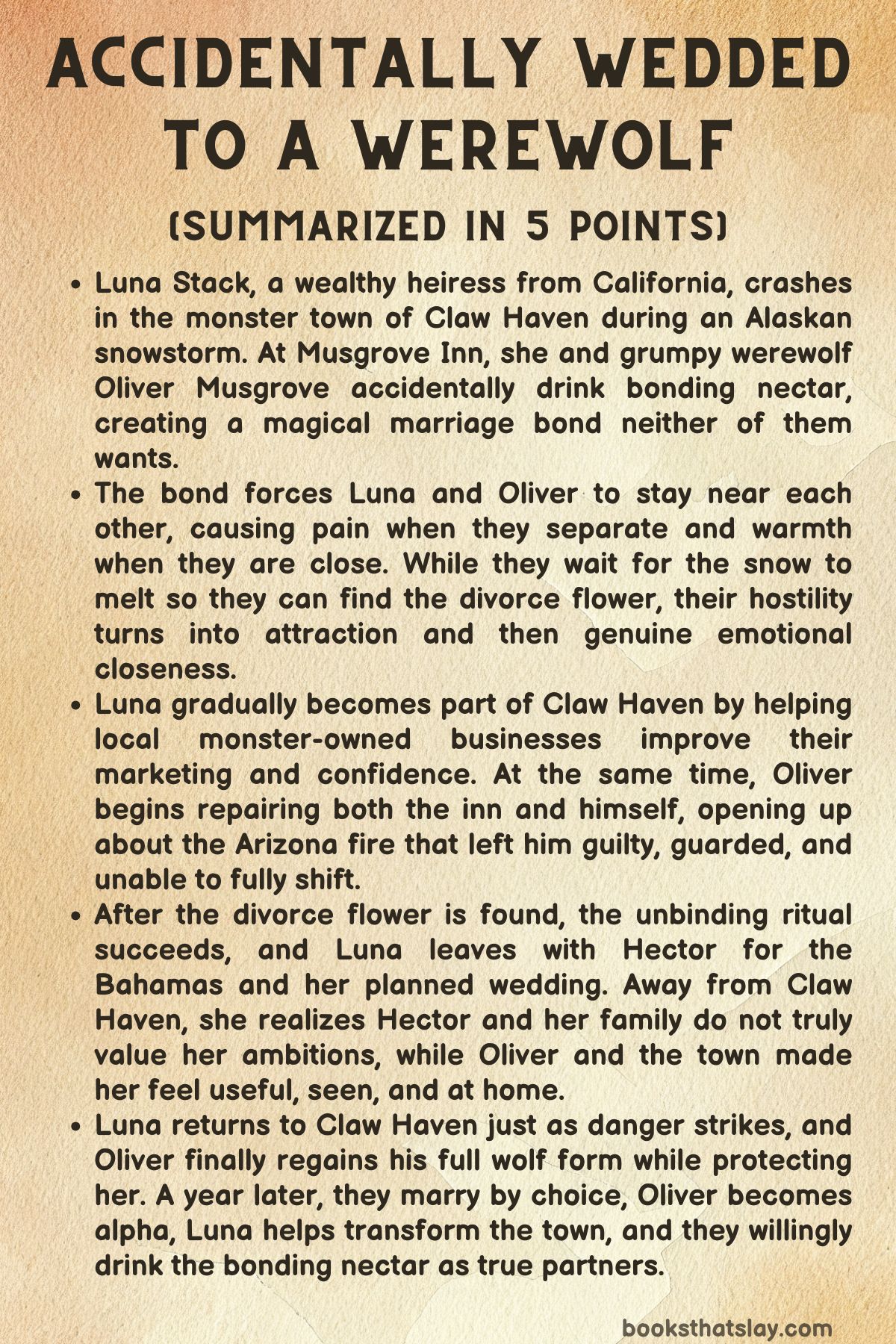
Accidentally Wedded to a Werewolf by Isabelle Taylor is a paranormal romance about a wealthy heiress whose life changes after one wrong turn in an Alaskan snowstorm. Luna Stack expects nothing more than a delayed trip home after a dull conference, but a crash in Claw Haven brings her into the world of werewolves, monster-owned businesses, old pack customs, and one very difficult innkeeper.
The story mixes forced proximity, accidental marriage, small-town charm, family pressure, and emotional healing as Luna and Oliver Musgrove move from resentment to trust, then to a love chosen freely.
Summary
Luna Stack begins the story as a rich Californian heiress whose life looks easy from the outside but feels oddly empty beneath the surface. After attending a boring company conference in Alaska, she gets caught in a heavy snowstorm while trying to make her way to her flight connection.
Her cell service drops, the roads become dangerous, and she loses control of her car. She crashes into the sign outside Musgrove Inn, a struggling family-run inn in Claw Haven, a remote town where monsters and supernatural beings live openly among one another.
The inn belongs to the Musgrove werewolf family. Oliver Musgrove, one of the main people keeping the place running, is immediately irritated by Luna’s arrival.
He is already under pressure from every direction. The inn is old, damaged, and leaking.
Repairs are overdue, money is tight, and the roof is close to giving way. Oliver also feels the weight of family expectations.
His grandmother, the respected alpha of the Musgrove pack, still refuses to hand over leadership to him because she believes he is not ready. Oliver wants control, responsibility, and proof that he can protect his family, but his anger and fear often make him push others away.
Luna and Oliver clash almost as soon as they meet. She comes from wealth, comfort, and a world of glossy appearances, while he is practical, guarded, and suspicious of outsiders.
His distrust is not random. Years earlier, in Arizona, Oliver made a mistake that still haunts him.
He left his pack vulnerable while spending time with a woman named Georgia. During his absence, a hunter set a fire that forced the pack to flee.
Oliver has blamed himself ever since. The trauma damaged his confidence, isolated him from others, and left him unable to fully shift into his wolf form.
During a housewarming party at the inn, Oliver drinks from a sacred bottle without knowing what it contains. The bottle holds Musgrove bonding nectar, a powerful substance tied to werewolf marriage customs.
Later, Luna also drinks from the same bottle, unaware of its meaning. By doing so, she completes an accidental marriage bond with Oliver.
The timing could not be worse: the inn’s roof caves in, the family is thrown into chaos, and everyone realizes that two people who barely tolerate each other are now magically bound.
The bond changes everything. Luna and Oliver feel warmth and comfort when they are near each other, but physical pain when they are apart for too long.
They also begin sensing pieces of each other’s emotions. At first, both treat the bond as a disaster.
Luna is already engaged to Hector, a relaxed and careless man vacationing in the Bahamas. When she tells him what happened, his reaction is surprisingly casual.
He does not seem deeply troubled by the accidental bond and even tells her not to worry too much if it leads to physical intimacy. His response reveals something about the shallow nature of their relationship, though Luna is not ready to face that truth yet.
Oliver wants the bond undone immediately. He learns that a rare divorce flower can break the magic, but the flower cannot be gathered until the snow thaws.
Refusing to wait, he tries to go into the mountains to find it anyway. The pain of being separated from Luna overwhelms him, and he collapses.
His brother Ben has to carry him back. The failed attempt forces both Oliver and Luna to accept that they are stuck together for a while.
As the days pass, the forced closeness begins to shift their relationship. Their arguments do not vanish, but they start seeing more of each other.
Luna notices the burden Oliver carries and the way he tries, often clumsily, to hold his family together. Oliver sees that Luna is not only a spoiled heiress passing through.
She is intelligent, capable, and lonely in ways he understands more than he expects. The bond increases their attraction, but their growing connection comes from more than magic.
They spend time together during repairs, errands, family meals, and attempts to manage the inn’s problems. Eventually, they become intimate, and the bond between them grows stronger.
Luna also begins to find a place in Claw Haven itself. She notices that the town’s businesses have real charm but weak marketing.
Beth’s chocolate shop, the café, and other monster-owned businesses all have potential, but they need clearer branding, stronger presentation, and better ways to attract visitors. Luna starts giving advice for free, then organizes a presentation for local business owners.
To her surprise, people listen. They value her skills.
In Claw Haven, her knowledge is not treated as a hobby or a decorative talent. It has real impact.
This matters deeply to Luna. In her old life, her family and Hector often treated her ambitions as minor or unserious.
She had wealth and status, but not much purpose. In Claw Haven, she becomes useful.
She helps people improve their businesses and begins imagining a version of herself that is active, respected, and needed. The town gives her something her polished old life never did: a reason to care and a place where her efforts matter.
Oliver changes too. Instead of trying to solve everything alone, he starts accepting help.
He works with locals, including Jackson, a dragonborn contractor, and begins making practical plans to repair and improve Musgrove Inn. His defensiveness softens.
He learns that leadership is not about carrying every burden alone or proving himself through stubbornness. It is about trust, responsibility, and allowing others to stand beside him.
As Luna and Oliver search for the divorce flower, Oliver slowly opens up about Arizona, Georgia, the hunter’s fire, and the shame he has carried ever since. Luna sees the fear beneath his anger.
Oliver, in turn, sees the insecurity behind Luna’s polished confidence. Their emotional bond becomes more honest, and by the time the flower is finally within reach, ending the bond no longer feels simple.
The first attempt at unbinding fails because Oliver’s grandmother becomes ill and must be taken to the hospital. Her illness frightens the family and reminds Oliver of how much he still has to learn.
Luna stays close to the Musgroves during this crisis and grows even more attached to them. She no longer feels like a stranded outsider.
She feels like someone who belongs.
Eventually, Ben and Sabine retrieve the correct divorce flower, and Hector arrives in Claw Haven. His presence forces Luna to compare her old life with the new one she has found.
Hector represents comfort, wealth, ease, and a future that once seemed obvious. Oliver represents effort, risk, truth, and a kind of love that asks more of her but also sees more in her.
The unbinding ritual succeeds, breaking the magical tie between Luna and Oliver. Without the bond, Luna is free to return to her planned life.
She leaves with Hector for the Bahamas, where their wedding is supposed to take place. But once she is back in that world, everything feels wrong.
The luxury, the ease, and the familiar expectations no longer satisfy her. Hector’s casual attitude now feels empty rather than charming.
Her family still does not take her dreams seriously. She realizes that in Claw Haven she was not just wanted; she was respected.
Oliver saw her clearly, challenged her, and valued what she could become. Luna finally admits that marrying Hector would mean choosing a life that no longer fits.
She calls off the wedding and leaves him.
Back in Claw Haven, Oliver is struggling after the broken bond. He is also trying to reconnect with his wolf during the full moon.
The loss of Luna hurts, but he knows he cannot rely on magic to bring her back. He has to face himself.
When Luna returns, danger erupts before they can fully reunite. Uncle Roy loses control in wolf form and attacks her.
In that moment, Oliver finally breaks through the fear and guilt that have trapped him since Arizona. He shifts completely into his wolf, protects Luna, and claims her as part of his pack.
Luna tells Oliver that she belongs with him. This time, their choice is not caused by an accidental drink or a forced magical bond.
It is made freely, with full knowledge of who they are and what they want. Oliver has regained his wolf and proven his readiness to lead.
Luna has found a home, a purpose, and a love that respects her strength.
One year later, Luna and Oliver marry properly in a forest ceremony beside Musgrove Inn. Their families and the people of Claw Haven gather to celebrate.
Grandmother has passed the alpha role to Oliver, showing that he has grown into the leader the pack needs. Luna has helped transform the town and its businesses, bringing new life to Claw Haven while becoming part of its community.
This time, when Luna and Oliver drink the bonding nectar, they do it knowingly and willingly. Their first bond began by accident, but their true union is built on trust, healing, and a shared future.
Characters
Luna Stack
Luna Stack is the central heroine of Accidentally Wedded to a Werewolf, and her character arc is built around the movement from comfort without purpose to belonging with responsibility. At the beginning of the book, she appears to have everything that should make life easy: wealth, social status, an engagement, and a carefree future waiting for her.
However, her accident in Claw Haven exposes how empty that life has become. Luna is not helpless, but she is initially disconnected from genuine emotional commitment.
Her engagement to Hector shows this clearly, because it offers luxury and freedom but little seriousness, partnership, or deep understanding. Once she is trapped by the accidental bond with Oliver, Luna is forced into a life that is inconvenient, strange, and emotionally demanding, yet it brings out parts of her that her old world ignored.
Luna’s greatest strength is her ability to see potential where others see only problems. In Claw Haven, she does not remain only an outsider waiting for the snow to melt.
Instead, she begins studying the town’s monster-owned businesses and recognizes that they have charm, quality, and community value but lack strong marketing. This reveals her intelligence, practical business sense, and emotional generosity.
She does not help because she wants control or praise; she helps because she gradually begins to care. Her work with the chocolate shop, the café, and other businesses gives her a new sense of purpose.
Through this, the book shows that Luna’s talent was always real, but her old life never took it seriously enough.
Emotionally, Luna is torn between two kinds of love and two kinds of life. Hector represents ease, glamour, and the identity she already knows.
Oliver represents struggle, honesty, vulnerability, and a future that requires her full self. Her confusion after Hector arrives is important because it proves that her choice is not simple or automatic.
The magical bond may push her toward Oliver at first, but her final decision comes after the bond is broken. This makes her love more meaningful.
When she leaves the Bahamas and returns to Claw Haven, she is choosing not a spell, but a home. Luna becomes a character who discovers that belonging is not about where life is easiest, but where she is most valued, most useful, and most truly seen.
Oliver Musgrove
Oliver Musgrove is one of the most emotionally guarded and wounded figures in the book. At first, he appears grumpy, suspicious, and difficult, especially toward Luna, whom he sees as an outsider who has disrupted his already unstable life.
His harshness comes from more than ordinary bad temper. Oliver is carrying deep guilt from the Arizona fire, where his decision to go off with Georgia left his pack vulnerable to a hunter’s attack.
That trauma shapes nearly every part of him. He distrusts outsiders, resists emotional closeness, and tries to carry responsibility through control rather than openness.
His inability to fully shift is also symbolic, because it shows that his guilt has separated him from an essential part of himself.
Oliver’s relationship with Musgrove Inn reflects his inner condition. The inn is damaged, leaking, and in need of repair, just as Oliver himself is emotionally damaged and unable to move forward.
His desire to become alpha is sincere, but Grandmother understands that he is not ready because he mistakes burden for leadership. He wants authority, but he has not yet learned trust.
As the story develops, Oliver slowly begins to change by accepting help from others, especially Jackson and the local community. This is a major step for him because it shows that leadership is not only about protecting everyone alone.
It is also about allowing others to contribute and recognizing that strength can exist in cooperation.
His connection with Luna forces him to confront both desire and vulnerability. The accidental bond begins as a source of irritation and pain, but it gradually becomes a path toward emotional honesty.
Luna challenges his assumptions about outsiders and proves that she is not careless or shallow. Through her, Oliver starts to believe in a future beyond guilt.
His final full shift when Uncle Roy attacks Luna is a powerful sign of healing. He regains his wolf not through anger alone, but through love, protection, and acceptance of his role.
By the end of the story, Oliver becomes worthy of the alpha title because he has learned that true leadership requires courage, humility, emotional openness, and the ability to claim love without fear.
Grandmother Musgrove
Grandmother Musgrove is the respected alpha of the Musgrove pack and one of the main moral anchors of the story. She represents tradition, authority, and emotional wisdom within the werewolf family.
Her refusal to pass the alpha title to Oliver at the beginning is not an act of cruelty or control. Instead, it shows her clear understanding of leadership.
She knows that Oliver is responsible and devoted, but she also sees that he is still ruled by guilt, fear, and isolation. Her judgment is firm because she understands that an alpha must do more than protect a pack physically.
An alpha must also be emotionally steady enough to guide others.
Grandmother’s presence gives the Musgrove family a sense of structure and history. She understands the sacred nature of the bonding nectar and the seriousness of pack bonds, even when the accidental marriage creates chaos.
Her role is especially important because she stands between the old customs of the pack and the new future that Luna and Oliver begin to create. She is not presented as someone who blindly clings to tradition.
Rather, she protects tradition because she understands its emotional and spiritual weight. At the same time, she is capable of accepting change when she sees that Luna truly belongs.
Her illness also plays an important role in the emotional development of the story. When she is hospitalized, the focus shifts from magical rules to family loyalty.
Luna’s concern for her and growing closeness to the Musgroves reveal that Luna’s connection to the family is becoming real. Grandmother’s eventual decision to pass the alpha role to Oliver confirms that she recognizes his growth.
She is a wise elder figure whose authority is based not only on power, but on patience, insight, and her ability to wait until the next generation is truly ready.
Hector
Hector is Luna’s fiancé from her old life, and his character functions as a contrast to Oliver. He is not portrayed as violently cruel or openly villainous, but his casual attitude reveals the emotional emptiness of Luna’s previous world.
When Luna tells him about the accidental bond, his relaxed response is striking. Instead of reacting with deep concern, jealousy, or urgency, he treats the situation almost like an inconvenience or an amusing complication.
His willingness to tell Luna not to worry even if the bond leads to physical intimacy shows how shallow their engagement really is. He offers freedom, but not devotion.
Hector represents a comfortable life without emotional depth. His vacation in the Bahamas while Luna is stranded in Alaska emphasizes the distance between them.
He belongs to the world of leisure, wealth, and low commitment, where serious feelings can be avoided or softened by luxury. For Luna, this once seemed normal, but after her time in Claw Haven, Hector’s world begins to feel hollow.
His arrival later in the story forces Luna to compare what she had with what she has discovered. This comparison is necessary because it proves that Luna’s love for Oliver is not merely the result of being trapped with him.
Hector’s importance lies in what he reveals about Luna’s transformation. He does not need to be monstrous for the reader to understand that he is wrong for her.
His problem is emotional carelessness. He does not truly see Luna’s ambitions, her intelligence, or her need to matter.
When Luna ultimately calls off the wedding, she is rejecting not only Hector but also the version of herself who accepted being underestimated. Hector is therefore a symbol of the easy but empty future Luna leaves behind.
Ben Musgrove
Ben Musgrove is Oliver’s brother and an important supporting figure within the Musgrove family. His most important quality is loyalty.
When Oliver tries to run to the mountain despite the bond’s painful effects, Ben carries him back, showing that he is willing to step in when Oliver’s stubbornness puts him in danger. This moment also reveals the family’s concern for Oliver, even when Oliver himself resists help.
Ben is not as central or emotionally troubled as Oliver, but his presence helps show the strength of the Musgrove pack as a family unit.
Ben also represents a calmer form of support. Unlike Oliver, who is intense, guilt-ridden, and defensive, Ben seems more capable of acting practically in moments of crisis.
His role in retrieving the proper divorce flower with Sabine is significant because it shows that the resolution of Luna and Oliver’s bond is not achieved by the main couple alone. The broader family participates in solving the problem, which reinforces the importance of community in the story.
Ben’s actions help move the plot forward while also showing that the Musgroves are bound together by duty and affection.
As a character, Ben helps reveal Oliver’s flaws and needs. Oliver often acts as if he must handle everything alone, but Ben’s presence proves that he has people willing to stand beside him.
This makes Ben important not because he undergoes the biggest transformation, but because he supports the transformations of others. He embodies dependable family love and practical loyalty.
Sabine
Sabine is a supporting character connected to the Musgrove family and the eventual solution to the accidental bond. Her role becomes especially important when she helps Ben retrieve the proper divorce flower.
This act shows that she is reliable, capable, and willing to help resolve a painful and complicated situation. Like Ben, Sabine contributes to the sense that Claw Haven is not just a setting, but a functioning community where people act for one another.
Sabine’s importance also lies in the way she supports the story’s emotional structure. The accidental marriage between Luna and Oliver affects more than the two of them.
It draws in the family, the pack, and the town. Sabine’s involvement reminds the reader that bonds in this book are communal as well as romantic.
The werewolf world is built around shared responsibility, and Sabine participates in that responsibility without needing to dominate the story.
Although she is not described with the same depth as Luna or Oliver, Sabine helps reinforce the themes of loyalty and cooperation. Her actions matter because they help give Luna and Oliver a real choice.
By helping retrieve the correct flower, she contributes to breaking the magical tie, which allows Luna and Oliver’s final relationship to be based on genuine love rather than compulsion. In that sense, Sabine indirectly strengthens the romance by helping remove the spell’s influence.
Jackson
Jackson, the dragonborn contractor, is an important figure in Oliver’s development because he represents the help Oliver must learn to accept. At the beginning of the story, Oliver is overwhelmed by the failing condition of Musgrove Inn, but his pride and fear make him resistant to depending on others.
Jackson’s involvement in the repairs becomes more than a practical solution. It becomes a sign that Oliver is beginning to understand that leadership does not mean doing everything alone.
As a contractor, Jackson is connected to rebuilding, and that gives his role symbolic weight. The inn is not only a building; it reflects the damaged state of Oliver’s life and the uncertain future of the Musgrove family.
By helping repair it, Jackson becomes part of the wider restoration taking place in the story. His dragonborn identity also adds to the richness of Claw Haven as a monster town, where different supernatural beings live and work together.
He helps show that the town has a strong communal structure beyond the Musgrove pack.
Jackson’s character highlights the practical side of healing. Emotional recovery in the story is not shown only through confessions or romantic moments.
It also happens through work, repair, planning, and trust. Jackson helps Oliver move from panic and isolation toward cooperation and improvement.
Even as a supporting character, he plays an important role in showing how community support allows both the inn and Oliver to become stronger.
Beth
Beth, the owner of the chocolate store, represents the local business community that Luna helps transform. Through Beth’s shop, the story shows Luna’s ability to recognize hidden value in Claw Haven.
Beth’s business already has charm and potential, but Luna’s marketing insight helps make that potential more visible. This relationship is important because it gives Luna a role beyond being Oliver’s accidental bondmate.
She becomes someone who can contribute to the town in a meaningful and practical way.
Beth also helps reveal the warmth of Claw Haven. Her shop is part of the small-town world that slowly draws Luna in.
The chocolate store suggests comfort, craft, and local personality, all of which contrast with Luna’s old world of corporate conferences and luxury vacations. Through Beth and other business owners, Luna discovers a place where her skills matter and where people are willing to value her for what she can do, not only for her wealth or social position.
As a character, Beth may not have a large personal arc, but she is important to Luna’s transformation. She helps create the conditions in which Luna can see herself differently.
By working with Beth and the local businesses, Luna begins to understand that success can be personal, communal, and emotionally fulfilling. Beth therefore represents the town’s openness to Luna and the new life Luna eventually chooses.
Georgia
Georgia is a significant figure from Oliver’s past, even though her role is largely connected to memory and trauma. She is the woman Oliver went off with in Arizona before the hunter’s fire changed the fate of his pack.
Because of that, Georgia becomes tied to Oliver’s guilt. Whether or not she intended harm, her presence in his past represents the moment when Oliver believes he failed his family.
This makes her important not as a present romantic rival, but as a symbol of the mistake Oliver cannot forgive himself for.
Georgia’s role helps explain why Oliver distrusts outsiders and resists attraction to Luna. His past experience taught him to associate desire with danger and distraction.
In his mind, letting himself want someone led to catastrophe. This is why his growing feelings for Luna frighten him as much as they attract him.
Georgia’s memory becomes part of the emotional wall Oliver must overcome before he can accept love again.
The story uses Georgia to show that Oliver’s problem is not simply grumpiness. He is someone who has turned guilt into self-punishment.
His inability to shift fully is connected to this unresolved past, and until he faces what happened, he cannot become whole. Georgia therefore functions as a shadow in Oliver’s character arc, representing the past mistake that must be understood, accepted, and finally released.
Uncle Roy
Uncle Roy is a dangerous figure near the end of the story, and his loss of control creates the crisis that allows Oliver’s full transformation to emerge. When he attacks Luna in wolf form, he becomes a direct physical threat, but his role is also symbolic.
He represents the destructive side of uncontrolled werewolf nature, the danger that exists when instinct is not guided by responsibility or emotional balance. His attack forces Oliver to act not from fear or guilt, but from love and rightful authority.
Uncle Roy’s presence is especially important because it gives Oliver a chance to prove that he has truly changed. Earlier, Oliver’s trauma prevented him from fully shifting, but Luna’s danger awakens the part of him that had been blocked.
By protecting her and claiming her as pack, Oliver demonstrates that his wolf is no longer trapped by the past. Uncle Roy’s violence becomes the test that confirms Oliver’s readiness to lead.
As a character, Uncle Roy is less emotionally developed than Luna or Oliver, but his function in the story is crucial. He creates the moment where private emotional healing becomes public action.
Oliver’s victory is not only about saving Luna; it is about proving that he can protect without being consumed by guilt. Uncle Roy therefore serves as the final challenge before Oliver fully accepts his identity as mate, protector, and alpha.
Luna’s Family
Luna’s family represents the wealthy, dismissive world she comes from. They are important because they help explain why Luna begins the story feeling underused and emotionally unseen.
Even though she has privilege and comfort, her ambitions are not treated with the seriousness they deserve. Her family’s attitude reveals that wealth can provide opportunity while still limiting emotional growth.
They do not appear to understand the depth of Luna’s abilities or her desire to do meaningful work.
Their treatment of her becomes clearer when Luna compares them to the people of Claw Haven. In her old life, Luna is surrounded by people who assume she will remain within a familiar pattern of comfort, marriage, and social ease.
In Claw Haven, however, her ideas matter. The town gives her the chance to act, build, and be useful.
This contrast makes her family essential to her character arc, even if they are not central to the main action.
Luna’s decision to leave the Bahamas and return to Oliver is also a decision to separate from the expectations of her family. She is not rejecting wealth itself, but she is rejecting a life where her inner self is ignored.
Her family represents the shallow security she must move beyond in order to choose a more authentic future.
The Musgrove Family
The Musgrove family is central to the emotional world of the story because they represent pack, tradition, loyalty, and belonging. At first, Luna enters their lives by accident and disruption, but over time, she becomes attached to them in ways that surprise her.
The family’s shock over the accidental bond is understandable, yet they also become part of the process through which Luna learns what real closeness feels like. Their dinners, concerns, rituals, and shared responsibilities create a sense of home that Luna has been missing.
The Musgroves also reveal the pressures Oliver lives under. He is not simply a man trying to repair an inn; he is a member of a family with history, expectations, and wounds.
The Arizona fire affected them all, and Oliver’s guilt is tied to his belief that he failed them. Through the Musgroves, the book shows that family can be both a source of pressure and a source of healing.
They expect much from Oliver, but they also remain connected to him even when he becomes isolated.
By the end of Accidentally Wedded to a Werewolf, the Musgrove family becomes Luna’s chosen family as well. Her final marriage to Oliver is not only a romantic union but also her full entrance into the pack and the community.
The Musgroves help transform the accidental bond into a true belonging, proving that family in the story is defined not only by blood, but by loyalty, acceptance, and shared commitment.
The Claw Haven Community
The Claw Haven community is almost a collective character because it shapes Luna and Oliver’s growth throughout the book. The town begins as a strange and unexpected place for Luna, especially after her crash outside Musgrove Inn.
However, what first seems inconvenient gradually becomes meaningful. Claw Haven is filled with monster-owned businesses, local personalities, and people who are trying to survive and improve despite limited resources.
Its charm lies in its imperfections.
The town gives Luna the chance to become useful in a way her old life never allowed. By helping local businesses with marketing and strategy, she becomes part of the community rather than merely a stranded visitor.
This is one of the most important parts of her transformation because it shows that she is not only falling in love with Oliver. She is also falling in love with a place where her talents have purpose.
Claw Haven gives her work, belonging, and respect.
For Oliver, the community represents the support he has resisted for too long. Accepting help from local people and business owners allows him to become a better leader.
The town’s presence at Luna and Oliver’s proper wedding shows that their love story has become part of something larger than themselves. Claw Haven is the place where damaged people, struggling businesses, old traditions, and new hopes come together.
It is the heart of the story’s vision of home.
Themes
Belonging and Found Family
In Accidentally Wedded to a Werewolf, Luna begins as someone surrounded by privilege but not truly understood. Her life in California gives her wealth, comfort, and social status, yet it does not give her a place where her ideas matter or where her deeper self is valued.
Claw Haven changes that because the town first appears strange and inconvenient, but slowly becomes the first place where she is needed for more than her money or appearance. Her help with the local businesses allows her to feel useful, capable, and respected.
The Musgrove family also becomes important because they accept her gradually through shared meals, crisis, care, and emotional honesty. Luna’s return to Claw Haven shows that belonging is not about where a person is expected to fit, but where they are seen clearly.
The theme becomes stronger because she chooses a difficult, imperfect home over an easy life that leaves her emotionally empty.
Healing from Guilt and Trauma
Oliver’s emotional struggle is shaped by guilt from the fire in Arizona, which left him convinced that his selfishness endangered his pack. Because of that pain, he becomes guarded, harsh, and unwilling to trust outsiders or even himself.
His inability to shift fully reflects how deeply his trauma has damaged his sense of identity. He wants to become alpha, but he cannot lead while still trapped in shame and fear.
Luna’s presence forces him to face the parts of himself he has avoided. She does not simply cure him; instead, her honesty, closeness, and belief in him help create the conditions in which he can begin to forgive himself.
His final full shift becomes more than a supernatural victory. It shows that healing requires courage, responsibility, and the willingness to reconnect with the self after loss.
Oliver becomes ready to lead only after he stops defining himself by his worst mistake.
Choice Beyond Magical Bonding
The accidental bond creates physical closeness, emotional flashes, attraction, and pain when Luna and Oliver are apart, but the story does not treat magic as a complete substitute for real love. At first, the bond traps them together and removes some of their control, making their connection confusing and uncomfortable.
This matters because their early intimacy could have remained only the result of supernatural force. Instead, the story tests whether anything true exists after the bond is removed.
When the unbinding succeeds, Luna is free to return to Hector and the life already planned for her. That freedom is essential because her final decision has meaning only when it is not forced by magic.
Oliver also has to face his feelings without relying on the bond. Their final union works because they choose each other knowingly.
The theme suggests that love becomes genuine when desire, loyalty, and commitment survive after obligation disappears.
Purpose, Self-Worth, and Personal Growth
Luna’s journey is not only romantic; it is also about discovering her own value. In her old life, her ambitions are treated lightly, and her future seems arranged around comfort rather than purpose.
Claw Haven gives her a chance to use her intelligence in practical ways. By helping the businesses improve their marketing and by supporting the town’s growth, she realizes that she has skills that can create real change.
Oliver’s growth follows a similar path. He begins as someone who wants authority but resists help, yet he slowly learns that leadership depends on trust, cooperation, and service.
The repairs to Musgrove Inn reflect this larger emotional repair. Both characters become stronger because they are challenged by a place and a relationship that demand honesty from them.
Their happy ending feels earned because they do not simply fall in love; they become more capable, grounded, and purposeful people through that love.