Accidentally Yours Summary, Characters and Themes
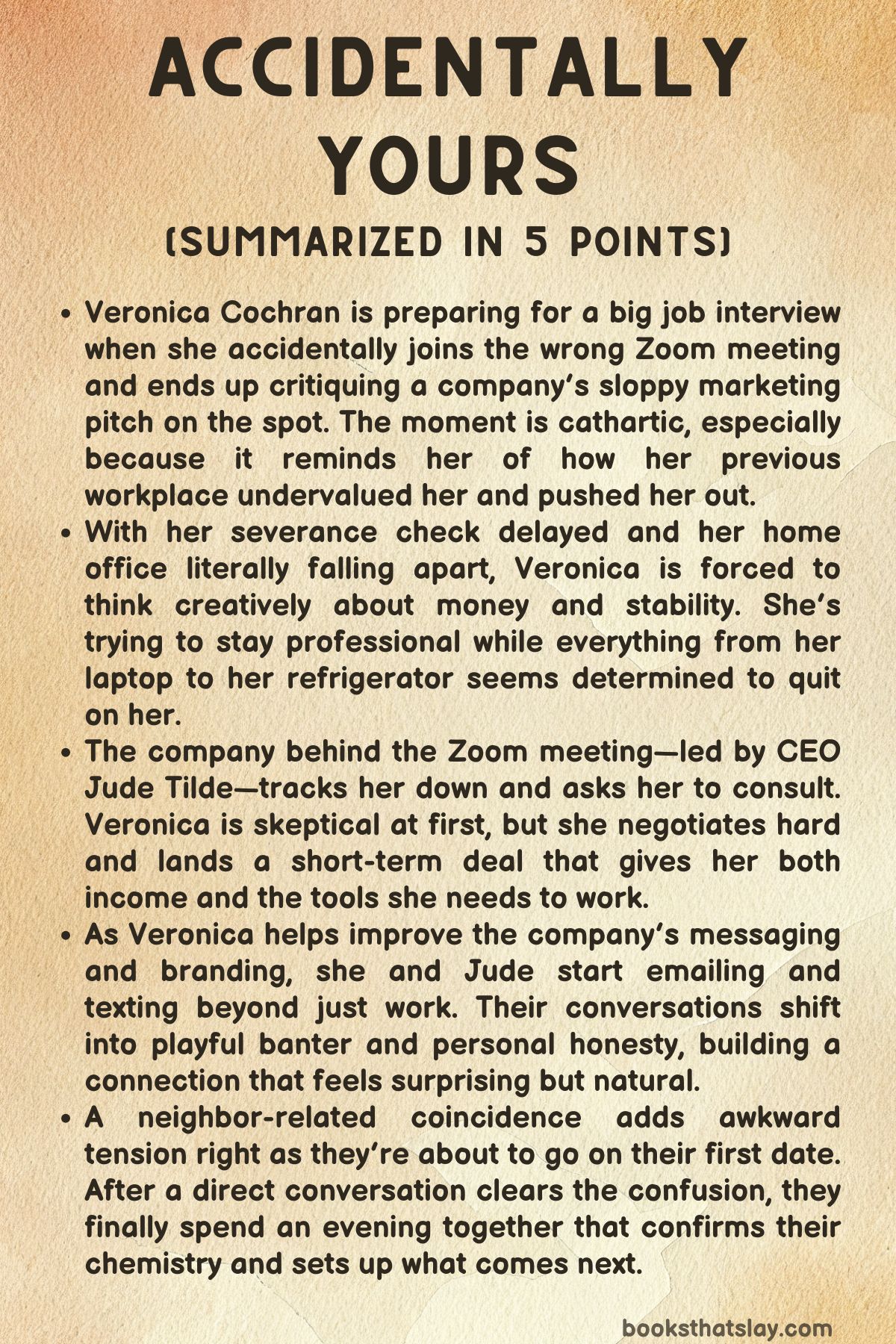
Accidentally Yours by Christina Lauren is a contemporary romantic comedy about a burned-out marketing pro who’s trying to rebuild her life after a messy layoff. Veronica Cochran is smart, blunt, and tired of watching underqualified men fail upward.
When she clicks into the wrong Zoom meeting and critiques a startup’s awful pitch deck, she doesn’t expect it to change anything—until the company’s CEO reaches out with a paid consulting offer. As work emails turn into flirty texts and a first date approaches, Veronica discovers the “mysterious” CEO is also her very attractive next-door neighbor.
Summary
Veronica Cochran starts her morning like many others lately: anxious, practical, and trying to sound upbeat for her sister, Clara. She texts Clara to share a story before heading into yet another job interview, this one scheduled over Zoom for what she believes is a Chief Marketing Officer position at a company called BioLight.
She signs in early and keeps her camera off, waiting for others to turn theirs on first. Instead of an interviewer, she finds herself in a meeting filled with overly confident men and a slide deck that looks like it was slapped together minutes before the call.
At first, Veronica listens quietly, half-amused and half-horrified. The presenter talks with the certainty of someone who doesn’t realize how weak the strategy is.
Veronica recognizes the familiar pattern: vague claims, buzzwords, and a plan that doesn’t match the product. The longer she listens, the more her frustration with her former job rises to the surface.
She spent years correcting other people’s half-baked ideas while they got praise and promotions. She asked for the advancement she’d earned, went to HR when she was ignored, and ended up laid off with a severance package that now seems to be arriving at a crawl.
Something in her snaps. She changes her Zoom name to her initials and unmutes.
With sharp precision, she points out what’s wrong: the unclear positioning, the empty claims, the weak structure, and the lack of a real market story. Her critique is fast, direct, and impossible to ignore.
Then she logs off. The moment after she exits the call, she feels lighter than she has in weeks.
It’s not exactly professional, but it’s honest, and honesty has been hard to come by since her layoff.
Her days since losing her job have been a mix of job applications and small humiliations. Her home office is literally coming apart.
Her chair breaks, her laptop struggles, her earbuds are ruined, and even her refrigerator gives up. Money is tight.
Veronica keeps checking her bank account and keeps waiting for the severance check that should already be in her hands. Payroll insists it has to arrive by paper check, which only makes her feel more powerless.
Every trip to the lobby is another reminder that she’s stuck in limbo.
Downstairs, she sees her neighbor from apartment 2C—an effortlessly attractive man she’s nicknamed “Friday” because she only seems to bump into him at the end of the week. He’s polite, calm, and looks like he belongs in a different version of Veronica’s life, one where she’s not worried about a check arriving late.
While Veronica is trying to stabilize her own life, the startup from the Zoom meeting is doing damage control. At Codeify, employees chatter about the anonymous critic who crashed their call.
Some are offended; others admit she wasn’t wrong. The CEO, Jude Tilde, is curious rather than furious.
He tracks down the person behind the initials and learns her identity: Veronica Cochran. Instead of blasting her, Jude emails her an offer to consult.
Veronica answers quickly with a firm refusal.
Jude doesn’t let it end there. He asks why she said no, and Veronica—against her better judgment—tells him the truth.
His meeting reminded her of everything that went wrong at her last company: the sexism, the constant clean-up work, the way she was used until she spoke up. She also explains that she didn’t even mean to be in that meeting.
She was trying to join an interview. Jude responds with surprising respect.
He admits he can’t hire her full-time, but he can pay her freelance rate. He asks her to reconsider.
Veronica meets Clara and their friend Jordan for drinks, and she lays out the offer like it’s a problem to solve. She’s still waiting on severance.
Her expenses are stacking up. She doesn’t want to step back into a situation that looks like the past, but she also needs income.
She decides that if she’s going to do it, she’ll make the terms worth the risk. She asks for what she thinks is an almost ridiculous amount: a $10,000 monthly retainer, a new laptop, and a new desk chair.
Jude counters with less money and fewer extras. Veronica refuses to back down, drawing a line in the weirdest place: the chair.
Jude asks what the deal is, and Veronica explains that her chair broke and she can’t properly work without one. It’s a small detail that carries all the weight of her recent life—how quickly stability can collapse, and how expensive it is to rebuild.
Jude finally agrees to a one-month arrangement: $7,000, a laptop, and the “desk chair of your dreams.” He sends a contract, and Veronica signs.
Once the work begins, Veronica shows why Jude reached out. She doesn’t just fix slides; she reshapes the story.
She improves the structure of Codeify’s pitch, clarifies their message, and offers strategic direction that makes their product sound real and valuable. Jude responds quickly, asking questions, taking notes, and actually using her feedback.
Their emails become rapid and conversational. Veronica expects the dynamic to feel like her old workplace—her carrying the load while a man takes credit—but Jude doesn’t act like that.
He treats her like a partner. He’s direct, appreciates her bluntness, and keeps returning to the central point: he wants this to be better, and he wants her to help.
The professional banter starts to slide into something more personal. Veronica and Jude trade jokes and small confessions.
Jude mentions his divorce and hints at family responsibilities that complicate his schedule. Veronica shares pieces of her own history, including how tired she is of environments that reward confidence over competence.
Their messages move from company email to Jude’s personal email, then to texting. Veronica is surprised by how much she looks forward to his replies—and by how quickly she starts to trust him.
They agree to meet for dinner on February 13. It feels like a clean line between work and whatever this new thing might be.
Veronica tells herself it’s a date, but also a test: can she be with someone who reminds her of the tech world without replaying old patterns?
Then a small accident adds a new complication. Veronica receives her long-delayed severance check at last, but she also gets a letter meant for “Jude Tilde, Apartment 2C.” The name hits her like a spotlight.
Jude Tilde is her client. Jude Tilde is the CEO.
Jude Tilde is Friday—the neighbor she’s been quietly admiring in the lobby.
Veronica keeps the discovery to herself, thinking it will be funny to reveal later, but the secrecy makes her tense. Now every interaction feels loaded.
She doesn’t know if Jude recognizes her yet, or if he’s been standing a few feet away in the elevator all this time without realizing. When Jude returns from a trip, another neighbor named Sami flirts with him in the lobby.
Jude looks uncomfortable and says he’s “in a relationship.” Veronica’s heart jumps, and she assumes he means her, that he’s telling this neighbor he’s taken.
But seconds later, Jude answers a phone call and says, “Hey, sweetheart,” to someone named Calliope. Veronica’s excitement drops straight into panic.
In her mind, the pieces click into a painful picture: Jude has a girlfriend, and she’s the side story he didn’t bother to mention. She feels foolish for believing the texting meant what she wanted it to mean.
Before she can talk herself into waiting for an explanation, she cancels their date.
Jude is clearly disappointed, and he doesn’t understand what changed. Veronica tries to retreat into silence, but that only makes things worse.
Then Jude sees her Instagram follow request and realizes something is going on. On Valentine’s Day, he goes to her apartment to confront her in person.
Veronica is mortified to open the door in pajamas, unprepared for a serious conversation with a man she’s been flirting with for days. In a burst of awkward self-defense, she makes Jude wear a scarf as a blindfold before letting him inside.
Once he’s there, she confesses: she’s known he’s her neighbor for a week, and she pulled away after hearing his phone call. Jude takes off the blindfold and explains the truth.
Calliope isn’t a girlfriend—she’s his niece. And when he told Sami he was “in a relationship,” he meant Veronica, or at least the possibility of her.
He’d hoped it was true.
The explanation doesn’t erase Veronica’s embarrassment, but it does soften the tight knot she’s been carrying. She realizes how quickly fear filled in the gaps.
Jude isn’t angry that she suspected him; he’s more focused on being clear, showing up, and giving her the chance to choose him with full information.
They separate briefly so Veronica can get ready, then meet in the lobby dressed for the evening. Jude takes her to Cindy’s Rooftop, using a reservation his sister gave up.
Over dinner, the conversation flows easily. They trade stories, tease each other, and learn the details that deepen attraction into real interest.
Veronica discovers a playful connection from their past: a college rivalry that makes their present chemistry even funnier. Jude listens to her in a way that feels rare—like he respects her mind as much as he likes her.
By the time dessert is an afterthought, the tension between them has shifted into certainty. They kiss at the table, not as a dramatic announcement, but as a natural next step.
Veronica feels the relief of being seen clearly and chosen openly. Jude seems equally steady, as if he’s been heading toward this all along.
The night ends with both of them excited, aligned, and ready to see what happens when work and attraction turn into something they don’t have to hide.
Characters
Veronica Cochran
Veronica Cochran is introduced as a sharp, highly competent marketing professional whose confidence has been badly bruised by a long stretch of workplace sexism and corporate hypocrisy. Her accidental entry into the wrong Zoom meeting becomes a pressure-valve moment: she finally says out loud what she has spent years swallowing—clear-eyed critiques, impatience with sloppy thinking, and anger at men repeatedly being rewarded for the very incompetence she’s expected to clean up.
That blunt takedown isn’t just a funny mistake; it reveals her core traits—precision, courage, and a refusal to soften her expertise to make others comfortable—while also showing how close she is to burnout. At home, her collapsing equipment and missing severance check mirror her emotional state: she’s capable and motivated, but she’s been forced into scarcity, uncertainty, and indignity after being treated as disposable.
What makes Veronica compelling in Accidentally Yours is how her guardedness is not portrayed as coldness; it’s protection earned through experience. Even when she negotiates aggressively for the freelance contract, it isn’t greed so much as a boundary—proof that she will not keep subsidizing broken systems with her own unpaid labor and discomfort.
Her romantic arc flows directly from this: she wants connection, but she is primed to expect disappointment, so one ambiguous moment—the “sweetheart” call—triggers self-preservation. By the end, Veronica doesn’t become someone else; she simply allows herself to trust what she already is—worthy of respect, stability, and affection without having to perform for it.
Jude Tilde
Jude Tilde functions as both the catalyst for Veronica’s professional re-entry and the romantic counterbalance to her defensive instincts. As CEO of Codeify, he is portrayed as unusually attentive: rather than dismissing the “Zoom bomber,” he investigates, reaches out, and—crucially—values the competence behind the disruption.
His pursuit of Veronica professionally suggests a leader who recognizes that strong feedback is an asset, not a threat, and who is willing to pay for real expertise instead of expecting women to “help out” for free. Jude’s negotiation style shows a mix of pragmatism and adaptability; he pushes back on the retainer but also listens closely enough to understand that the chair isn’t a silly demand—it’s symbolic of Veronica’s day-to-day reality and her need to be taken seriously.
Personally, Jude is written with a quiet steadiness that makes him emotionally legible: he flirts, but he also clarifies, follows up, and shows up. His divorce and family ties give him texture beyond the “tech bro” space Veronica distrusts, and his awkwardness in the lobby—especially when confronted with flirtation—suggests someone who is trying to be honorable even when social situations get messy.
Importantly, Jude’s attraction isn’t framed as conquest; it’s recognition. He likes Veronica because she is incisive and unfiltered, and his willingness to risk rejection by confronting her on Valentine’s Day shows a preference for honest communication over ego.
Rather than simply being the love interest, Jude becomes the proof point that power can look like respect, consistency, and accountability.
Clara Cochran
Clara Cochran operates as Veronica’s emotional anchor and private audience, the person Veronica instinctively turns to when her life feels unstable. Even in the framing—Veronica texting her sister to tell the story—Clara becomes the safe container for Veronica’s messier feelings: anger, embarrassment, anxiety, and hope.
Clara’s role is significant because she reinforces Veronica’s internal reality at times when the world has been telling Veronica she’s overreacting or not “pleasant” enough. She doesn’t need to solve Veronica’s problems to be effective; her presence signals belonging, and that steadiness makes Veronica more willing to take risks, like negotiating hard or agreeing to a date.
Clara represents the kind of familial intimacy that isn’t performative—support that exists before and after the plot, and therefore makes the plot survivable.
Jordan
Jordan serves as a grounding friend who helps translate Veronica’s stress into something actionable and social rather than isolating. Meeting at a bar to workshop the offer with Clara, Jordan becomes part of the small “board of directors” Veronica relies on when she’s too close to her own panic to strategize cleanly.
Jordan’s function is partly comedic—witnessing the absurdity of a negotiation hinging on a chair—but it also underscores the seriousness beneath it: Veronica needs allies who validate her worth and encourage her not to undersell herself out of fear. Jordan’s presence also prevents the romance from swallowing the story; by existing as an engaged friend with opinions and energy, Jordan keeps Veronica tethered to a wider life and reminds the reader that Veronica’s self-respect is socially reinforced, not magically produced by romantic attention.
Jordan represents chosen family—the friend who turns a crisis into a plan and makes resilience feel a little less lonely.
Sami
Sami—known in Veronica’s mind through the building’s informal labeling—adds a crucial dose of social friction that exposes both Veronica’s insecurity and Jude’s intentions. By flirting with Jude in the lobby, Sami unintentionally becomes the trigger that escalates Veronica’s anxiety: Veronica already distrusts workplace power dynamics and male sincerity, so watching another woman interact with Jude makes uncertainty feel like impending humiliation.
Sami isn’t positioned as a villain so much as a realistic presence: attractive people get approached, misunderstandings happen, and not every woman in a romance narrative needs to be an enemy to create tension. Sami also highlights Jude’s awkward decency; his response that he is “in a relationship” is clumsy because it’s hopeful rather than official, and that awkwardness reads as sincerity rather than smooth manipulation.
In Accidentally Yours, Sami functions as the mirror that reflects Veronica’s fear of being second choice—and the plot device that forces direct clarification.
Calliope
Calliope is less a fully developed on-page personality in this summary and more a narrative lever that reveals character truths about the leads. As Jude’s niece, she becomes the innocent explanation behind the “sweetheart” phone call, but her importance lies in what the misunderstanding exposes: Veronica’s reflex to retreat when she senses deception, and Jude’s willingness to correct the story face-to-face rather than letting it dissolve into silence.
Calliope’s existence also deepens Jude by anchoring him to family responsibility and tenderness, qualities that contrast with the “tech bro” environment that initially repels Veronica. Calliope serves as the reminder that intimacy can be misread when someone is braced for betrayal—and that clarity, when offered kindly, can reset the entire emotional landscape.
Themes
Workplace Power, Gender Dynamics, and Professional Exhaustion
Veronica’s accidental Zoom intrusion carries the heat of years spent being asked to translate mediocre male confidence into polished results. Her outburst isn’t random; it comes from a career built on doing invisible labor while watching less capable men advance.
The summary shows how her previous job rewarded image and bravado, not competence, and how that imbalance corrodes a person’s sense of worth. Veronica’s frustration is sharpened by the contrast between the roles she held on paper and the compensation and respect she actually received.
She had the titles, yet the security and recognition stayed out of reach, and the moment she pushed for fairness through formal channels, she was dismissed with a controlled HR conversation and a severance package that becomes another tool of power when it arrives late and only as a paper check. That delay turns “policy” into a threat: she can’t plan, she can’t pay for essentials, and she’s forced to negotiate from a place of immediate pressure.
The book also highlights how modern work can weaponize performance culture—flashy retreats, a “cool” company reputation, and the promise of rapid growth—while quietly normalizing disrespect and instability. Veronica’s home office literally falling apart mirrors what that system does to workers: it takes more than it returns until even basic functioning becomes difficult.
Her decision to negotiate aggressively with Jude isn’t greed; it’s the first time she treats her expertise as something that must be purchased on her terms. In that sense, the theme isn’t only about sexism and burnout, but about the psychological shift from hoping to be rewarded to insisting on being valued.
Modern Romance Through Digital Intimacy and Real-World Proximity
A large part of the emotional momentum comes from how Veronica and Jude connect through screens before they fully connect in person. Their bond starts with a mistake, escalates through work emails, then slides into personal email and texting, where humor and responsiveness create a feeling of safety.
Digital communication allows them to reveal themselves in a controlled way: they can choose their timing, craft their words, and build a rhythm of banter that feels intimate without being physically vulnerable. That makes the eventual discovery—Jude is “Friday,” the neighbor—more potent, because the person she’s been getting to know privately is also part of her daily environment.
The romance is not only about attraction; it’s about the collision of curated distance and unavoidable closeness. The building lobby becomes a stage where their worlds overlap: missed packages, flirtatious neighbors, overheard conversations, and small encounters that carry more meaning once feelings exist.
The physical proximity raises the stakes, because there is no clean escape route. If things go badly, they still share walls, elevators, and common spaces.
At the same time, that closeness creates a groundedness that pure digital romance often lacks; Jude isn’t a fantasy, he’s a person who lives nearby and shows up. The blindfold scarf scene captures the delicate balance between vulnerability and control: Veronica wants to be seen, but on her terms, after she has regained confidence.
Their Valentine’s dinner then becomes the moment where digital ease is tested in reality—and it succeeds. The theme suggests that modern love often begins in mediated spaces, but it becomes real when both people bring that same attentiveness into face-to-face moments, where there’s less room to hide behind carefully typed lines.
Financial Precarity, Material Breakdown, and Emotional Stress
The summary makes Veronica’s environment feel fragile long before anything romantic becomes complicated. Her chair breaks, her laptop fails, her AirPods are ruined, and her refrigerator dies—each detail adding weight to the sense that she is one more surprise away from collapse.
Financial stress here isn’t abstract; it is physical and immediate. A delayed severance check is not just inconvenient, it’s destabilizing, because it blocks her ability to replace essential tools and maintain daily life.
That pressure shapes her choices: she doesn’t take Jude’s offer because she trusts him, she takes it because she needs income and because the terms can protect her. Even the way Payroll insists on a paper check reflects how systems ignore the lived reality of someone waiting for money they’ve already earned.
The book uses these material problems to show how quickly dignity can be threatened when resources run thin. Veronica isn’t just worried about career trajectory; she’s worried about getting through the week without another appliance failure.
This makes her negotiation feel both bold and necessary. By demanding equipment, she is refusing to subsidize her work with personal loss.
The “desk chair of your dreams” line works because it’s funny, but the need beneath it is serious: when life is unstable, comfort and functionality become forms of survival. The emotional impact of precarity also shows in how Veronica reacts to uncertainty in her personal life.
When someone’s finances are shaky, ambiguity can feel dangerous, because there is no extra capacity to absorb disappointment. This theme ties the professional and romantic plots together by showing that security—money, tools, predictability—is not separate from emotional well-being.
It sets the foundation for why Veronica needs reassurance and clarity, and why being taken seriously, both at work and in love, matters so much.
Vulnerability, Trust, and Choosing to Be Seen
Veronica’s behavior is guarded, but the summary shows that her guard is not cynicism—it’s self-protection after being hurt in predictable ways. Trust becomes a choice she has to make deliberately, not a default setting.
She reveals pieces of her history to Jude, explaining why his meeting felt like her old workplace, and that admission is a form of vulnerability because it acknowledges fear and disappointment. Jude’s response matters: he doesn’t mock her, he adjusts his offer, and he respects her freelance rate.
Their relationship progresses through small acts of showing up—fast slide revisions, thoughtful emails, honest disclosures about divorce and family, and the gradual move from professional channels to personal communication. The story highlights how trust is built through consistency rather than grand gestures.
When the misunderstanding happens, Veronica retreats, which is a familiar pattern for someone who has learned that leaving early hurts less than being left. Jude, however, does the opposite: he comes to her door, asks for an explanation, and stays present long enough for truth to replace panic.
The scarf blindfold moment is telling because it shows Veronica negotiating how she will be seen. She’s embarrassed, unprepared, in pajamas, and she creates a playful barrier so she can regain composure without shutting him out completely.
That kind of vulnerability—awkward, imperfect, sincere—is where trust starts to become mutual. Their final evening works not because it’s flawless, but because they communicate, laugh, and allow the connection to move from potential to reality.
The theme suggests that being “ready” for closeness is less important than being willing to practice honesty, to apologize, and to accept someone’s care without assuming it comes with hidden conditions.