Afterlives Summary, Characters and Themes
Afterlives by Abdulrazak Gurnah is a historical novel about ordinary lives shaped by empire, war, displacement, and the long shadow of colonial rule in East Africa. Set mainly in German-occupied Tanzania and later under British control, the novel follows people who are rarely allowed to shape history but must live through its damage.
Through Khalifa, Afiya, Hamza, and Ilyas, Gurnah examines survival, memory, love, loyalty, and the cost of belonging to powers that exploit and abandon them. Afterlives is quiet, humane, and deeply attentive to how violence continues inside families, bodies, and memories long after war ends.
Summary
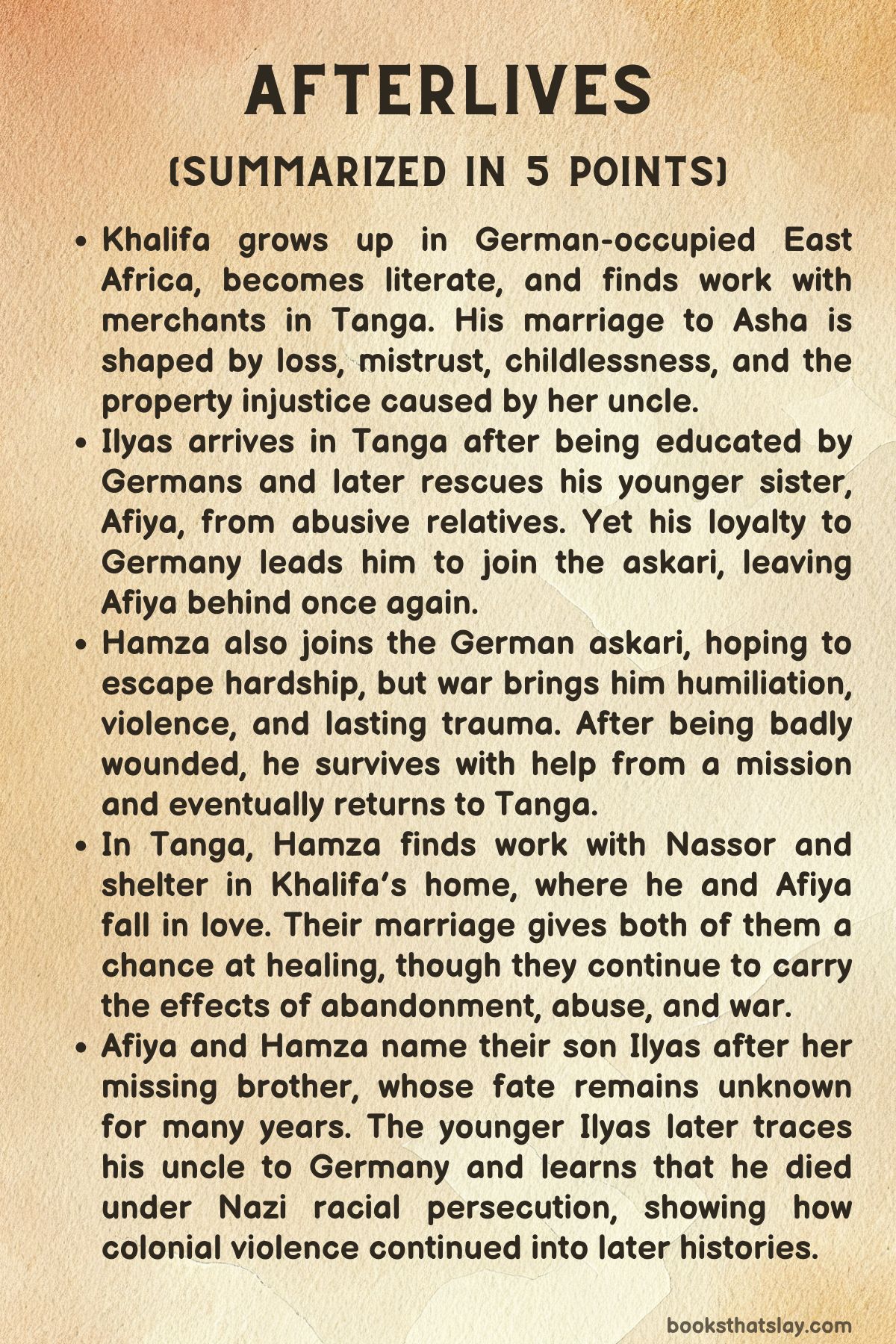
Afterlives begins in East Africa during the final years of German colonial rule. Khalifa, the son of an Indian father and an African mother, grows up with the advantage of literacy because his father teaches him to read and write.
This education gives him access to work that many others cannot get. He first works for an African-owned bank in Tanga, a coastal town where merchants, colonial officials, and local communities cross paths.
Later, he is hired by Amur Biashara, a wealthy and dishonest merchant who values Khalifa’s obedience, discretion, and ability to deal with German regulations.
Khalifa’s life changes after the deaths of his parents, which leave him feeling guilty because he had not visited them for years. Soon afterward, Amur arranges for Khalifa to marry his orphaned niece, Asha.
Khalifa meets her only after the wedding. He is attracted to her, but Asha is wary, forceful, and suspicious of her uncle, who has taken control of the house that should have belonged to her.
Their marriage becomes a long, difficult partnership marked by frustration, religious pressure, and childlessness. Asha suffers several miscarriages and turns to spiritual explanations for her pain, while Khalifa often yields to her demands to keep peace in the house.
The world around them is equally unsettled. German forces use African askari soldiers to crush rebellions with great cruelty.
After defeating resistance, the Germans build roads, schools, clinics, and administrative systems, but these changes serve colonial control first. Amur’s son Nassor benefits from this world by training as a carpenter under the Germans.
When Amur dies suddenly, his debts and unfinished affairs leave little behind, and Asha loses any hope of reclaiming ownership of the house.
Into this town comes Ilyas, a young man who has been educated by Germans and has a letter of introduction for work on a sisal farm. He meets Khalifa, and the two become friends.
Ilyas speaks warmly of the Germans because they educated him and gave him opportunities after he was taken from his childhood life. Khalifa is more skeptical, having heard and seen the harm done under German rule.
Ilyas eventually returns to his childhood village and learns that his parents are dead but that his younger sister, Afiya, is alive.
Afiya is living with an aunt and uncle who treat her as a burden and force her into hard labor. She has grown up in fear, ignorance, and neglect, knowing little beyond the household that controls her.
Ilyas takes her away and brings her to the coast, where she experiences kindness, medical care, and education for the first time. He teaches her to read and write, giving her a freedom she has never had.
Yet Ilyas is drawn back toward the Germans. As talk of war spreads, he decides to join the askari and fight for Germany.
Before leaving, he sends Afiya back to her relatives, promising that he will return soon. Khalifa tells her to write if she is harmed.
Afiya’s return becomes a nightmare. Her aunt and uncle treat her even worse than before, and her male cousin harasses her.
When her uncle discovers that she has been practicing writing, he beats her so badly that her wrist is fractured. Once she can move, Afiya sends a message to Khalifa, who keeps his promise and brings her to his home.
There, Asha and Khalifa raise her. Asha teaches her religion and household duties, while Khalifa quietly protects her.
As Afiya grows into a young woman, Asha becomes increasingly anxious about marriage, reputation, and control.
The novel then follows Hamza, another young man drawn into the German military world. Unlike Ilyas, Hamza joins the askari to escape a desperate life.
He endures harsh training in a German boma, where recruits are insulted, punished, and disciplined into obedience. Because he can read and understands some German, he is chosen not as a signalman, as he hopes, but as a personal servant to a German lieutenant.
The lieutenant is strange, possessive, and educated. He teaches Hamza German and takes an interest in him, but this attention separates Hamza from the other soldiers and makes him vulnerable to the hatred of a brutal sergeant.
When the Great War reaches East Africa, the German forces fight the British and their allied troops using African soldiers and carriers. The campaign becomes a disaster for Africans on all sides.
Villages are raided for food, the sick and wounded are abandoned, and hunger, disease, rain, and exhaustion kill many. Hamza tries only to survive.
The sergeant grows more violent, and the lieutenant becomes increasingly withdrawn. After many askari desert, the sergeant accuses Hamza of causing the desertion and slashes him across the hip with a sword.
Badly wounded, Hamza is left at a German mission, where a pastor, his wife, and an African convert named Pascal nurse him through fever and weakness. Before leaving, the lieutenant gives Hamza a book by Schiller, a reminder of their strange and unequal bond.
After the war, Hamza returns to Tanga. He is physically damaged, poor, and alone.
He finds work through Nassor, first as a night watchman and later in the woodworking shop under the master carpenter Sulemani. Khalifa discovers that Hamza has nowhere to sleep and offers him a small room at his house.
Asha distrusts him at first, but Hamza stays, eats with the family, and slowly becomes part of the household.
Hamza and Afiya notice each other almost immediately. Their attraction grows through brief meetings, exchanged looks, and quiet conversations.
Afiya is careful because she knows how closely women are watched and judged. Hamza, unsure of her place in the household, wonders whether she belongs to Khalifa.
When Afiya learns that Hamza can read German, she asks him to translate a poem. This leads to a secret exchange that confirms their feelings.
They begin meeting privately, and their relationship becomes intimate. Afiya tells Hamza about her injured hand and her missing brother, while Hamza tells her about the war and his wounded leg.
Khalifa realizes what is happening and decides that the couple should marry before Asha arranges another match for Afiya. Hamza explains his past, including his childhood servitude to a trader.
Khalifa accepts him and guides him through the proper steps. Hamza proposes to Afiya, she accepts, and they are married soon afterward.
They continue living in Khalifa’s house, despite Hamza’s unease around Asha.
Marriage brings Hamza and Afiya a measure of peace, though both carry deep fears. Hamza suffers night terrors from the war.
Afiya worries that he may one day disappear like others she has loved. Hamza promises he will not leave her, because he too knows what abandonment means.
Afiya miscarries her first pregnancy, and Asha cares for her with unexpected tenderness. Afiya later becomes pregnant again, while Asha grows seriously ill.
After refusing medical help for some time, Asha is diagnosed with a parasitic disease and cancer. Afiya gives birth to a son, named Ilyas after her missing brother, and Asha dies soon afterward.
Khalifa is devastated by the finality of her death.
Years pass. Hamza’s position improves, and he arranges to rent the house so the family can remain there with Khalifa.
Afiya and Hamza raise their son in a period of fragile happiness, though Afiya suffers more miscarriages and the Great Depression brings hardship. Khalifa loves the boy as a grandchild and teaches him to read.
But young Ilyas begins to speak in a strange woman’s voice, calling the name Ilyas. An exorcist claims that a female spirit is troubling him and will not rest until the family learns what happened to the elder Ilyas.
Hamza writes to the pastor’s wife in Germany, hoping she can help. Her reply reveals that Ilyas survived the war and went to Germany, but rising tensions between Britain and Germany prevent further contact.
During the Second World War, Khalifa dies, and the younger Ilyas later joins the King’s African Rifles in a noncombat role. After the war, he trains in radio and eventually receives a scholarship to study broadcasting in Germany.
In Germany, the younger Ilyas searches archives and records to uncover his uncle’s fate. He learns that the elder Ilyas changed his name to Elias Essen, worked as a singer on ships, married a German woman, and had children.
He also finds a photograph of him at a Nazi rally, showing how deeply the older Ilyas had tried to attach himself to Germany, the country he once admired. The discovery ends in sorrow: Ilyas was arrested in 1938 for a relationship with a white woman under Nazi racial laws, and he died in a concentration camp in 1942, along with a son who chose to go with him.
Afterlives closes by showing how colonial violence does not end when armies leave or wars finish. It survives in missing people, damaged bodies, family silences, and unanswered questions.
Yet the novel also shows forms of care that resist destruction: Khalifa’s loyalty to Afiya, Hamza and Afiya’s love, and the younger Ilyas’s search for truth. Through these lives, Gurnah presents history not as a record of rulers and battles, but as the burden carried by those forced to endure them.
Characters
Khalifa
Khalifa is one of the moral centers of Afterlives, a man shaped by literacy, compromise, caution, and an instinctive sense of responsibility. Born to an Indian father and an African mother, he belongs to more than one world but is fully protected by none.
His education gives him access to employment and status, yet he remains dependent on powerful men such as Amur Biashara and later Nassor. Khalifa is not heroic in a dramatic sense.
He survives by being observant, polite, useful, and careful. He understands how power works and rarely challenges it directly, but his quiet decency becomes clear through his actions.
His decision to rescue Afiya from her abusive relatives reveals the strongest part of his character: he may avoid open conflict, but he does not abandon those placed under his care.
His marriage to Asha shows another side of him. He is patient, often passive, and sometimes too willing to tolerate harshness in order to preserve peace.
Asha sees this as weakness, and at times she is not entirely wrong. Khalifa often avoids confrontation, even when confrontation might be necessary.
Yet his gentleness is not the same as emptiness. He builds a home where damaged people can recover, including Afiya and later Hamza.
He gives them food, shelter, time, and dignity without demanding gratitude. His love for young Ilyas late in life shows his capacity for tenderness, especially after years of disappointment and childlessness.
Khalifa represents a form of goodness that is modest but lasting. He cannot change history, defeat colonial rule, or undo violence, but he can protect a child, welcome a wounded man, and hold a broken household together.
Asha
Asha is a complex woman whose severity grows out of loss, fear, religious conviction, and the bitterness of being denied control over her own life. She enters marriage as an orphan whose inheritance has been manipulated by her uncle, and this early injustice shapes her distrust of others.
She is sharp, proud, devout, and often difficult to live with. Her marriage to Khalifa is marked by tension because she considers him too weak and too easily influenced, while he finds her hard and demanding.
Her miscarriages deepen her pain, and her turn toward healers and spiritual explanations reflects both desperation and the limited choices available to her.
Asha’s treatment of Afiya is especially important because it shows both her cruelty and her capacity for care. She raises Afiya, teaches her, feeds her, and gives her a place in the household, yet she also becomes controlling once Afiya grows into womanhood.
Her anxiety about reputation and marriage leads her to restrict Afiya’s movements and judge her behavior harshly. Part of this comes from social pressure, but part of it also seems rooted in jealousy and grief.
Asha has been denied motherhood, property, and emotional security, and Afiya’s youth and beauty may remind her of what she has lost. Still, she is not written as simply harsh.
When Afiya miscarries, Asha cares for her with tenderness, revealing the buried warmth beneath her bitterness. Her painful illness and death make her final presence tragic rather than merely stern.
She is a woman damaged by patriarchy, colonial uncertainty, infertility, and dispossession, and she often passes that damage on to others.
Afiya
Afiya’s life is defined by abandonment, abuse, rescue, and the gradual recovery of selfhood. As a child, she is left with relatives who treat her as a burden and use her labor without kindness.
Her aunt’s frightening stories and her uncle’s brutality create a childhood ruled by fear. She does not initially understand that she is being treated like an enslaved person because mistreatment is the only life she knows.
Ilyas’s arrival gives her a brief opening into a different world: she receives care, education, and the first sense that she is worthy of protection. When he leaves and she is sent back, her suffering becomes worse, but her ability to write becomes the very tool that saves her.
The note she sends to Khalifa is a small act of courage and self-preservation.
As she grows older in Khalifa and Asha’s household, Afiya becomes more aware of herself as a woman living under watchful social rules. She learns how easily a woman’s reputation can be damaged and how little freedom she has in choosing her future.
Her love for Hamza is therefore not only romantic but also an act of agency. She risks judgment because she wants to choose the person with whom she will build a life.
In marriage, Afiya becomes both tender and strong. She listens to Hamza’s trauma, shares her own wounds, and insists on emotional honesty between them.
Her miscarriages connect her to Asha’s suffering, but unlike Asha, she eventually finds a more balanced form of strength. Her lifelong concern for her missing brother shows how unresolved loss remains alive inside her.
Afiya’s character represents survival through memory, literacy, love, and the slow claiming of a voice.
Hamza
Hamza is one of the most deeply wounded figures in the novel, a man whose quietness conceals the violence he has survived. His childhood includes servitude, displacement, and loneliness, and his decision to join the askari comes less from loyalty than from the desire to escape a hopeless life.
Military service, however, only gives him another form of captivity. He is trained through insult and punishment, then singled out by the German lieutenant because of his literacy and sensitivity.
This attention makes him both protected and exposed. The lieutenant treats him as special, but still within a colonial relationship built on ownership, control, and racial hierarchy.
Hamza’s injury during the war marks him physically, while his nightmares reveal the lasting psychological damage. After returning to Tanga, he is cautious, nearly silent, and unsure of his place among people.
Khalifa’s household gives him shelter, but it is Afiya’s love that allows him to begin speaking about what happened to him. His relationship with her is based on shared injury: both have been abandoned, both have been harmed by those with power over them, and both fear being left again.
Hamza is gentle not because he is untouched by violence, but because he knows its cost. His growth is quiet.
He becomes a worker, husband, father, and caretaker of a family home. He does not erase his past, but he learns to live beside it.
In Afterlives, Hamza shows how survival after war is not a single moment of escape but a long effort to trust ordinary life again.
Ilyas
Ilyas is shaped by displacement and by his complicated loyalty to the Germans who educated him after he was taken from his childhood world. As a boy, he is pulled into colonial systems through kidnapping, labor, schooling, and conversion-centered instruction.
Yet because the Germans give him literacy, language, and employment prospects, he interprets them through gratitude rather than suspicion. This makes him one of the novel’s most conflicted characters.
He is not foolish, but his personal experience blinds him to the wider brutality of German rule. When others speak of German violence, he resists their accounts because they threaten the story by which he understands his own life.
His rescue of Afiya shows that he is capable of love and responsibility. He recognizes the cruelty of her relatives and gives her education, comfort, and hope.
Yet his later decision to join the German forces repeats the pattern of abandonment that has already shaped her life. He leaves behind the sister who depends on him, trusting that he will return, but history swallows him.
His later fate in Germany gives his character a tragic dimension. He tries to belong to the empire that once appeared to save him, even changing his life to fit within German society.
Under Nazism, however, the racial order he attached himself to destroys him. Ilyas represents the danger of mistaking individual favor for true acceptance.
His life shows how colonial power can seduce, use, and discard those who seek dignity through it.
Young Ilyas
Young Ilyas, the son of Afiya and Hamza, carries the name of a missing man and therefore inherits a family wound before he is old enough to understand it. As a child, he is loved deeply by his parents and by Khalifa, who treats him like a grandchild.
He grows up in a household shaped by care, but also by silence, grief, and unanswered questions. His strange episodes, in which he speaks in a woman’s voice calling for Ilyas, suggest how unresolved history can return through the next generation.
Whether read spiritually or psychologically, his condition shows that the past has not been settled simply because the family has survived.
As an adult, young Ilyas becomes the one who seeks answers. His work in broadcasting and his scholarship to Germany place him in a position to investigate what his parents could not discover.
His search for his uncle turns private family grief into historical recovery. He moves through archives, photographs, records, and names, piecing together the truth hidden by war, migration, and racial violence.
Through him, the novel shows the importance of documentation and memory. He cannot save the elder Ilyas, but he can restore knowledge of what happened to him.
His character stands for the generation after trauma, the one that must live with inherited questions and decide whether to leave them buried or confront them.
Nassor
Nassor is practical, self-interested, and shaped by the new economic order created by colonial rule. As Amur Biashara’s son, he inherits not only business connections but also a habit of looking after his own advantage first.
His training as a carpenter gives him skill and status, and he becomes an important employer in Tanga. Unlike his father, he is not presented as openly corrupt in the same way, but he is still hard, calculating, and often ungenerous.
His ownership of the house where Khalifa lives shows how property becomes a source of quiet power over others.
His relationship with Khalifa is full of irritation and dependence. The two men do not like each other, yet their lives remain connected through work, property, and family history.
Nassor can be kind in limited ways, as when he gives Hamza work and recognizes his usefulness. He also helps create the conditions in which Hamza can rebuild his life.
Still, he rarely acts without self-interest. Even when he congratulates Hamza, he frames himself as the person responsible for Hamza’s improvement.
Nassor represents the merchant class adapting to changing rulers and changing markets. He is not a villain in simple terms, but he is a man who understands advantage better than compassion.
Amur Biashara
Amur Biashara is a figure of wealth, manipulation, and patriarchal control. He recognizes Khalifa’s usefulness and hires him because Khalifa is literate, discreet, and willing to cooperate.
Amur operates through favors, bribes, loans, and hidden arrangements, and his treatment of Asha’s inheritance reveals his moral character. He uses financial power to take control of property that should have offered security to an orphaned woman.
His arrangement of Khalifa and Asha’s marriage is not presented as an act of care so much as a transaction that serves his own convenience.
Amur’s sudden death exposes the instability beneath his authority. Because he has not properly settled his affairs, creditors and merchants descend, and the wealth he seemed to command begins to dissolve.
His death also leaves Asha without the justice she hoped for. As a character, Amur embodies a local form of exploitation that exists alongside colonial exploitation.
The novel does not present harm as coming only from European rulers. Men like Amur also use social custom, money, and gendered power to control others.
His influence continues after his death through property disputes, family resentment, and Nassor’s position.
The German Lieutenant
The German lieutenant is one of the most unsettling characters because his behavior toward Hamza combines education, fascination, control, and colonial arrogance. He sees something unusual in Hamza and teaches him German, even imagining him reading Schiller.
This might appear generous, but it remains bound to domination. Hamza is still his servant, still subject to military hierarchy, and still trapped in a relationship where the lieutenant has nearly all the power.
The lieutenant’s interest isolates Hamza from the other askari and exposes him to resentment.
He is also a man divided between culture and brutality. He can speak of literature and show moments of tenderness, yet he serves an empire built on violence.
He admits that the war is not truly Hamza’s war, but he does not free him from it. His final act of leaving Hamza at the mission and giving him a book suggests guilt, attachment, and perhaps a desire to be remembered differently.
Still, his kindness is limited by the system he never truly rejects. He represents the disturbing intimacy of colonial power: the colonizer may educate, notice, or even care for the colonized individual, while still participating in the machinery that harms him.
The Sergeant
The sergeant is the blunt face of military cruelty. Unlike the lieutenant, he does not hide violence beneath culture or conflicted feeling.
He despises the African soldiers and especially hates Hamza, whose closeness to the lieutenant offends him. His anger grows as the war becomes more desperate, and he channels his fear and frustration into punishment.
When he slashes Hamza, the act is not only personal rage but also a display of colonial military power breaking a vulnerable body.
His role is important because he strips away any illusion of noble service in the colonial army. The askari may be given uniforms and a sense of pride, but they remain disposable under German command.
The sergeant’s violence reveals the contempt beneath the discipline. He is less psychologically complex than some other characters, but he is necessary to the novel’s vision of war.
Through him, military hierarchy appears as a structure that encourages cruelty and gives angry men permission to destroy those below them.
Pascal
Pascal is a quieter character, but he plays an important role in Hamza’s survival. As an African Christian convert at the mission, he occupies a position shaped by religion, colonial contact, and service.
When Hamza is left wounded and feverish, Pascal helps care for him with patience and steadiness. His presence contrasts strongly with the violence of the military world.
Where the askari camp is defined by command, insult, and injury, the mission temporarily becomes a place of recovery.
Pascal also represents another path created by colonial encounter. Like Ilyas and Hamza, he has been changed by European institutions, but his role is not military.
He is attached to the mission and its Christian world, yet his care for Hamza is practical and humane rather than ideological. He does not dominate the story, but his kindness matters because Hamza’s life depends on people who choose care over abandonment.
Pascal shows how secondary figures in the novel often become crucial witnesses and caretakers in moments when larger systems fail.
The Pastor and His Wife
The pastor and his wife are German missionaries whose clinic becomes a temporary refuge from war. Their role is morally mixed.
They offer medical care and shelter, and they help save Hamza’s life after he is badly wounded. In this sense, they are part of the novel’s pattern of imperfect but real acts of kindness.
The pastor’s wife later becomes a link to Germany when Hamza seeks information about the missing Ilyas, showing that memory sometimes depends on fragile human connections across distance and time.
At the same time, they are not outside colonial history. Their mission exists within the broader European presence in Africa, and their work is connected to religious conversion and paternal authority.
The British later shut the clinic down for being inadequate, which complicates any simple view of the mission as purely benevolent. These characters represent the ambiguity of missionary care: they may heal individuals, but they also belong to a world that assumes the right to enter, instruct, and reshape African lives.
Afiya’s Aunt and Uncle
Afiya’s aunt and uncle represent domestic cruelty hidden behind family obligation. They take Afiya in after her parents die, but they treat her as a burden rather than a child deserving love.
The aunt frightens her with stories, works her constantly, and teaches her to accept fear as normal. The uncle is colder and more openly violent.
His beating of Afiya after discovering her writing is especially revealing because it shows that her literacy threatens the control he has over her. Writing gives her a route to help, and he responds by trying to break both her body and her will.
Their household is a smaller version of the novel’s larger systems of domination. Like colonial rulers, they justify control through authority and dependency.
They feed and house Afiya, but only to exploit her. Their abuse also explains why Afiya’s later home with Khalifa matters so deeply.
She has known family as danger before she learns family as protection. Through these relatives, the novel shows that violence is not confined to battlefields or colonial offices.
It can live inside ordinary homes and be excused as discipline, custom, or duty.
Themes
Colonial Power and the Damage of Empire
Colonial rule in Afterlives appears not only through armies and flags but through schools, jobs, languages, property, and personal loyalties. German authority reshapes East African life by force, using askari soldiers to suppress resistance and impose order.
The violence is direct and severe, but the novel also pays close attention to softer forms of control. Characters such as Ilyas and Hamza learn German, receive training, and are drawn into colonial institutions that promise advancement while keeping them subordinate.
This creates a painful contradiction. The colonizer can appear as teacher, employer, protector, or patron, even while remaining the source of oppression.
Ilyas’s loyalty to Germany grows from his personal experience of being educated and valued, yet that loyalty blinds him to the wider cruelty inflicted on others. Hamza’s relationship with the lieutenant shows an even more troubling form of colonial intimacy, where attention and instruction exist beside ownership and humiliation.
Empire also reshapes local economies, allowing men like Amur and Nassor to profit from changing systems of trade and property. The novel presents colonialism as a force that enters the mind as well as the land.
It changes how people imagine power, belonging, dignity, and opportunity, and its damage continues long after formal rule shifts from one European nation to another.
War, Trauma, and Survival
War in the novel is not treated as a distant political event but as a force that consumes ordinary bodies and ordinary futures. The East African campaign of the Great War is fought largely by Africans serving European powers, and the result is hunger, displacement, disease, injury, and death.
Hamza’s experience makes this theme especially clear. He joins the askari to escape hardship, but military life subjects him to insult, fear, forced obedience, and violence.
His wound from the sergeant marks him permanently, while his night terrors show that survival does not end the war inside him. The novel is deeply interested in what happens after visible violence stops.
Hamza returns to civilian life, finds work, marries, and becomes a father, yet his memories remain active. His body carries pain, and his sleep returns him to scenes he cannot control.
Afiya also survives trauma, though hers comes from domestic abuse rather than combat. Her injured hand, like Hamza’s damaged leg, becomes a lasting sign of past violence.
The novel suggests that survival is not simple victory. It is an ongoing effort to eat, work, love, speak, and remain present despite fear.
Healing comes slowly through shelter, routine, tenderness, and the willingness to tell another person what happened.
Abandonment, Family, and Chosen Care
Many characters are marked by abandonment, but the novel also shows how chosen forms of care can repair some of its damage. Afiya loses her parents, is left with abusive relatives, is rescued by Ilyas, then abandoned again when he goes to war.
Hamza is separated from family and forced into servitude before entering the army. Khalifa loses his parents and carries guilt over not visiting them.
These personal losses echo the larger abandonments caused by war and empire, where people are recruited, displaced, used, and forgotten. Against this pattern, the household becomes a crucial space.
Khalifa’s decision to take Afiya in is one of the novel’s strongest acts of moral responsibility. He is not her father, but he becomes her protector.
Later, he offers Hamza a room, food, and trust before Hamza has done anything to earn social standing. Afiya and Hamza’s marriage also grows out of mutual recognition: each understands the terror of being left behind.
Their promise not to abandon one another carries emotional weight because both know how fragile such promises can be. Family in the novel is therefore not limited to blood.
Blood relatives can exploit and injure, while unrelated people can become guardians, witnesses, and sources of safety. Care is shown as a daily practice rather than a grand declaration.
Memory, Silence, and the Search for Truth
Unanswered questions shape the lives of the characters as strongly as known events. The disappearance of the elder Ilyas becomes a wound that never fully closes for Afiya.
His absence is not only personal; it represents the many lives swallowed by colonial armies, migration, and European wars without clear records for the families left behind. Silence protects people at times, but it also traps them.
Hamza is reluctant to speak about the war because memory is painful, yet his relationship with Afiya deepens when he finally tells her what he endured. Afiya’s own story of abuse must also be spoken to be fully understood.
The younger Ilyas’s strange episodes suggest that what remains unknown can return in disturbing forms. Whether seen as spirit possession, inherited grief, or family anxiety, his condition shows that buried history continues to demand attention.
His later search in Germany turns memory into investigation. Archives, photographs, letters, and names become tools for restoring the truth.
Yet the truth he finds is devastating: the elder Ilyas survived one war only to be destroyed by another racial empire. The novel treats memory as painful but necessary.
To know the past does not undo loss, but it gives shape to grief and returns dignity to those who vanished.