Ain’t No Makin’ It Summary and Analysis
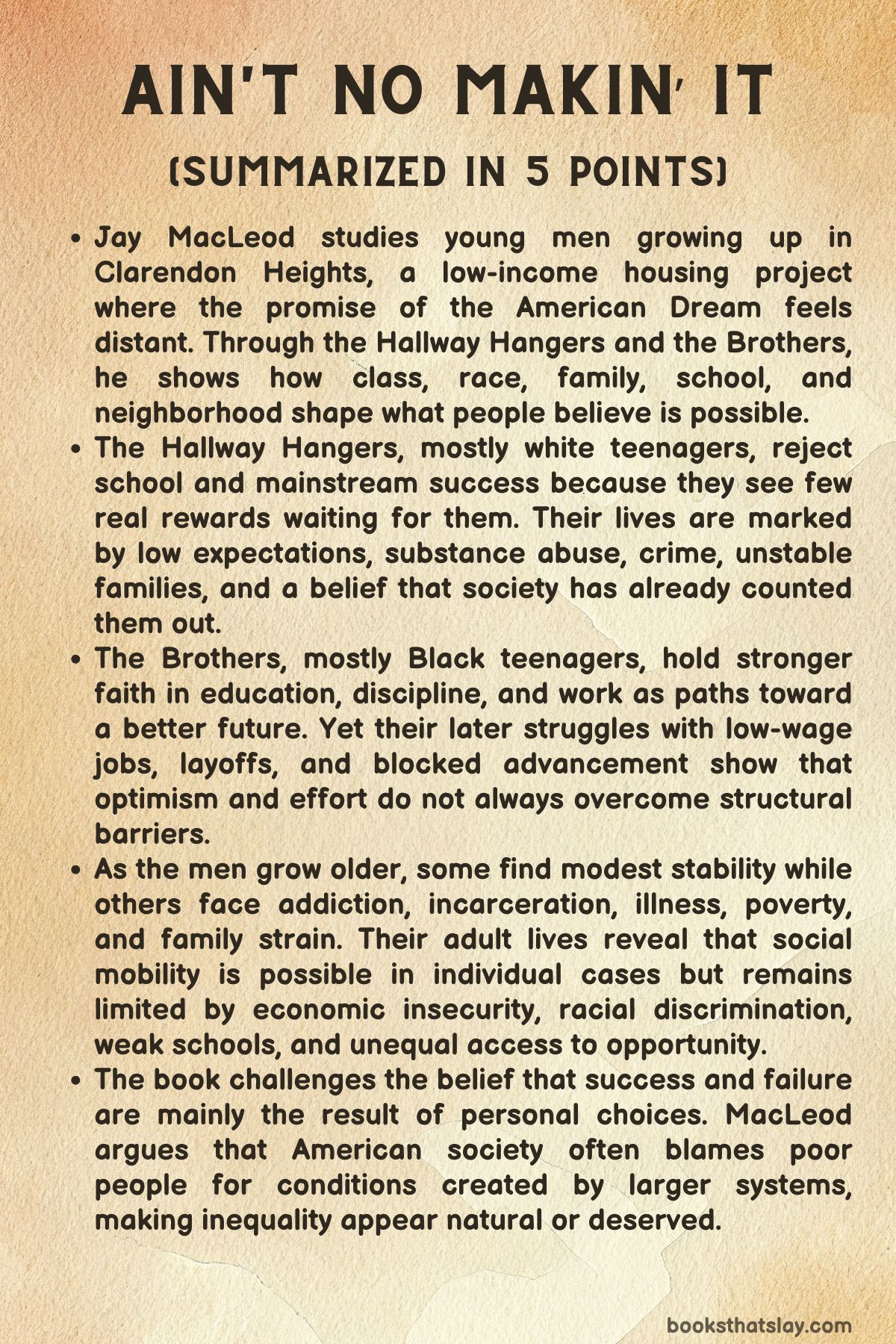
Ain’t No Makin’ It by Jay MacLeod is a sociological study of class, race, education, work, and blocked mobility in the United States. Centered on young men growing up in Clarendon Heights, a low-income housing project, the book follows two groups: the mostly white Hallway Hangers and the mostly Black Brothers.
MacLeod studies their hopes, choices, families, schools, jobs, and adult lives to test the American belief that hard work naturally leads to success. The book is not a simple story of failure or ambition. It shows how people make choices within systems that already limit what those choices can achieve.
Summary
Ain’t No Makin’ It begins by challenging one of America’s most powerful national beliefs: that society is open, fair, and full of opportunity for anyone willing to work hard. Jay MacLeod sets this belief beside the lives of young people in Clarendon Heights, a poor housing project where opportunity feels distant and often unreal.
The book opens with Freddie Piniella, an 11-year-old whose bleak view of the future undercuts the promise of the American Dream. Freddie does not see school, effort, or ambition as reliable paths out of poverty.
His attitude becomes an entry point into the book’s central question: why do people born into poverty so often remain there, even in a country that says success is open to all?
MacLeod uses Clarendon Heights to study social reproduction, the process by which class position tends to pass from one generation to the next. Rather than treating poverty as a result of laziness or weak character, he looks at the institutions and beliefs that shape young people’s expectations.
Schools, families, neighborhoods, job markets, and racial hierarchies all influence what the teenagers believe is possible for them. Education is especially important in the book because it is commonly presented as the main route to mobility.
MacLeod questions that promise by showing how schools can also sort students into different tracks, reward middle-class habits, and make inequality look like the result of individual merit.
The first major section introduces two peer groups in Clarendon Heights: the Hallway Hangers and the Brothers. The Hallway Hangers are mostly white teenagers known for defiance, drinking, drug use, fighting, and trouble with police.
They reject school and mainstream respectability, but their rejection is not random. They believe the system has already written them off, so they treat school and work with cynicism.
Their identity depends on toughness, loyalty, and street status. Figures such as Frankie, Chris, Boo-Boo, Stoney, Jinx, Shorty, and others reveal a world where masculinity, crime, racism, addiction, and anger are bound up with poverty and blocked prospects.
The Brothers, by contrast, are mostly Black teenagers who accept many conventional values. They take school more seriously, avoid the Hallway Hangers’ open criminal behavior, and speak more confidently about future careers.
They believe education, discipline, and steady work can help them rise. Their optimism does not mean they have an easy path.
They live in the same project and face poverty, racial discrimination, and weak schools. Still, their families and peer culture often support respectability, effort, and belief in the future.
This contrast between the two groups allows MacLeod to show that poor youth do not all respond to inequality in the same way.
Family background plays a major role in shaping each group’s outlook. Many Hallway Hangers come from unstable households, absent fathers, low-wage employment, or long-term reliance on public support.
Their family histories give them few examples of education leading to secure work. The Brothers also face economic hardship, but their families often place more value on school, discipline, and conventional success.
Some have parents or relatives who push them toward college, professional work, or steady employment. MacLeod does not claim family alone determines the future.
Instead, he shows how family expectations become part of a larger social world that teaches young people what to hope for and what to dismiss.
The book then turns to work. MacLeod separates aspirations from expectations.
Aspirations are what people might ideally want; expectations are what they think they can realistically get. The Hallway Hangers have low expectations because their experiences teach them that good jobs are out of reach.
They expect low-paid, unstable work, if they expect work at all. For them, employment is less a source of identity than a burden or necessity.
The Brothers have higher aspirations and clearer career hopes. They imagine jobs that bring status, income, and independence.
Yet the book steadily shows that belief alone cannot overcome a labor market structured against them.
School becomes another crucial setting. At Lincoln High School, students are divided into academic, vocational, and alternative programs.
These tracks appear to respond to student ability and need, but they also reinforce social divisions. The Hallway Hangers see school as useless because it does not seem connected to real opportunities.
Many disengage or drop out. The Brothers participate more, even when they are not academically outstanding, because they believe school matters.
MacLeod uses this contrast to reconsider theories of social reproduction. The Hallway Hangers’ low aspirations seem to confirm structural theories of class reproduction, while the Brothers’ optimism complicates any simple claim that class position alone determines consciousness.
As the book moves forward eight years, the earlier expectations meet adult reality. Clarendon Heights and the surrounding neighborhood have changed through gentrification, but the men’s economic prospects remain poor.
The Hallway Hangers face unemployment, prison, addiction, violence, and unstable work. Some turn to the drug economy because it offers money unavailable through legal jobs, but that economy deepens their risks and damages their relationships.
Chris’s addiction to crack cocaine, along with theft and despair, shows how limited opportunity can merge with personal destruction. Steve, Stoney, Shorty, and others cycle through jobs, legal trouble, and efforts to survive in an economy that has little use for men with limited education.
The Brothers’ adult lives are more respectable but still disappointing. Their youthful belief in mobility has not produced the middle-class stability they imagined.
They move through low-wage service jobs, layoffs, and insecure employment. Mokey holds many jobs over several years, repeatedly facing closures and setbacks.
Craig, despite earning a college degree, struggles to find a well-paying job and eventually accepts work far below what he expected. The Brothers’ stories are especially important because they show that ambition, education, and clean records do not guarantee escape.
Their experience challenges the comforting idea that poor people only need better attitudes to succeed.
The conclusion of the second part directly attacks the myth of meritocracy. MacLeod argues that American society is shaped like a pyramid, with far more people at the bottom than stable positions at the top.
The young men of Clarendon Heights are judged as failures, but the book shows that their choices take place inside an unequal structure. Racial discrimination, class background, weak schools, changing labor markets, and low wages all restrict their chances.
The dominant American belief in individualism makes these conditions harder to see because it turns structural disadvantage into personal blame.
The final section returns to the men at midlife. Clarendon Heights has been physically renovated, but renovation has not erased the wounds of poverty.
The Hallway Hangers’ later lives include loss, addiction, crime, recovery, fatherhood, and reflection. Boo-Boo has died of AIDS.
Steve looks back on drinking, legal trouble, and the difficulty of rebuilding a life. Shorty wants his children to avoid the patterns that shaped him.
These men are not presented as symbols only. Their voices show regret, humor, anger, endurance, and a desire for respect.
The Brothers, too, have changed. Some find modest stability.
Mokey becomes a night-shift manager after years of movement, alcoholism, arrests, and effort. Craig builds a new life away from Clarendon Heights as a fitness trainer.
Others continue to struggle. Their stories suggest that relocation, family support, relationships, discipline, and chance can matter, but none of these fully cancels the force of class and race.
The book closes by reconsidering reproduction, redemption, and respect. Some men have found steadier lives than expected, while others remain poor or close to it.
Stable relationships, family support, and moving away sometimes help, but success remains limited and uneven. Freddie’s final update adds a complex ending.
He earns a college degree and becomes a medical technician, proving that movement is possible. Yet he still works hard to support his family and does not experience success as simple escape.
Ain’t No Makin’ It ultimately shows that people can resist, adapt, and sometimes rise, but their lives are shaped by barriers that personal effort alone cannot remove.
Key People
Jay MacLeod
Jay MacLeod is both the author and the observing presence behind the study. His role is not that of a distant commentator who simply describes poverty from the outside.
He spends time with the young men of Clarendon Heights, listens to their language, watches their relationships, and tries to understand how their ideas about school, work, race, and success are formed. His perspective matters because he constantly tests American beliefs about opportunity against the actual lives of the people he studies.
MacLeod does not present the boys and men as passive victims, but he also refuses to blame them for conditions they did not create. His analysis is shaped by a concern for fairness: he wants readers to see that choices are real, but choices are made inside social conditions that are deeply unequal.
In Ain’t No Makin’ It, his work becomes a challenge to the comfortable belief that success and failure are simply earned.
Freddie Piniella
Freddie Piniella is one of the clearest early voices of disappointment in the book. As a child, he already doubts the idea that education and hard work will lead him to a better life.
His cynicism is important because it shows how early class consciousness can form among children who grow up surrounded by unemployment, low wages, public housing, and social rejection. Freddie does not lack intelligence or awareness; in fact, his view of society is sharp because he understands the limits around him before many adults would expect him to.
His later life complicates his earlier pessimism. He earns a college degree and becomes a medical technician, which shows that social movement is possible.
Yet his success is not simple or effortless. He still works hard to support his family and remains aware of how difficult it is to hold onto stability.
Freddie represents both the possibility of individual movement and the continuing weight of class barriers.
Frankie
Frankie is one of the central figures among the Hallway Hangers and stands out as a natural leader within the group. His status comes from confidence, toughness, family reputation, and his ability to command attention.
His family background, including connections to organized crime, gives him a kind of street authority that matters greatly in his peer world. Frankie’s character shows how leadership can develop outside conventional institutions when school, work, and respectability feel irrelevant or inaccessible.
He does not seek status through grades or career planning; he gains it through loyalty, daring, and a reputation for toughness. As an adult, Frankie’s path also shows that change is possible even for those deeply shaped by the street culture of their youth.
His life challenges any simple reading of the Hallway Hangers as doomed or one-dimensional. He is shaped by his environment, but he is not only a product of it.
Chris
Chris is one of the most painful figures in the study because his life shows how poverty, addiction, and despair can reinforce one another. His family situation is unstable, and he grows up without the kind of steady adult guidance that might have helped him imagine a different future.
As a teenager, he belongs to the Hallway Hangers’ world of defiance, substance use, and distrust of mainstream institutions. Later, his addiction to crack cocaine becomes a major force in his decline.
His involvement in theft and his damaged relationships reveal how addiction is not only a private struggle but also a social consequence tied to limited opportunity and emotional distress. Chris’s story is tragic because he is not presented as naturally self-destructive.
His life shows what can happen when someone already living with low expectations encounters drugs, unemployment, and a social world that offers little support for recovery or reinvention.
Boo-Boo
Boo-Boo represents the vulnerability hidden beneath the Hallway Hangers’ hard public image. His background includes an absent father and a mother who works in a steady but low-skilled job, placing him within the pattern of working-class survival without real mobility.
Like the others in his group, he learns to rely on peer loyalty, toughness, and street identity. His later death from AIDS gives his character a sense of loss that reaches beyond individual biography.
Boo-Boo’s life shows how poverty can expose people to overlapping risks: weak health support, unstable relationships, substance abuse, and limited access to long-term care or security. His decline also demonstrates that the consequences of social marginalization are not only economic.
They affect the body, family ties, emotional life, and the future itself. Boo-Boo’s story reminds readers that the cost of inequality is measured not only in wages or jobs, but in shortened lives.
Stoney
Stoney’s life is shaped by modest family progress and the limits of that progress. His mother’s work history suggests effort, sacrifice, and some advancement, but it does not place the family securely outside poverty.
Stoney therefore grows up close enough to see the value of work, yet not close enough to believe that work guarantees real mobility. As a member of the Hallway Hangers, he shares the group’s suspicion toward school and the formal labor market.
His later struggles with low-paying jobs and instability reflect the book’s larger argument about the decline of secure work for men with limited education. Stoney is not simply unwilling to work; rather, the work available to him rarely offers dignity, advancement, or stability.
His character helps show how low expectations are formed through observation. When young people see adults labor without rising, they may conclude that ambition is not practical but naive.
Jinx
Jinx is important because he openly expresses the Hallway Hangers’ lowered expectations about work. He does not speak about a dream career or a hopeful professional future.
Instead, he treats employment as something to take if it appears, usually in whatever low-wage form is available. His attitude is easy to misread as laziness, but the book frames it as a realistic response to his surroundings.
Jinx has absorbed the lesson that people like him are unlikely to receive meaningful opportunities. His lack of aspiration is not a lack of imagination alone; it is a defense against disappointment.
By refusing to invest emotionally in a future he believes will not arrive, he protects himself from the humiliation of wanting too much. Jinx shows how social reproduction works internally, through expectations.
The system does not only restrict jobs and schooling; it also teaches people what desires are safe to have.
Shorty
Shorty’s character becomes especially significant in adulthood because he reflects on the life he has lived and the life he wants for his children. As a youth, he is part of the Hallway Hangers’ culture of defiance, racial hostility, illegal activity, and rejection of school.
Later, however, his reflections reveal a more complex person who recognizes the damage caused by the patterns around him. His desire to keep his children from repeating those mistakes shows his struggle against social reproduction at the family level.
Shorty understands that poverty is not only inherited through money; it is inherited through habits, neighborhoods, schools, peer groups, and expectations. His character carries both regret and responsibility.
He does not become a simple example of redemption, but he does show the possibility of moral awareness. His adult voice adds depth to the book’s portrayal of men often dismissed by outsiders as failures.
Steve
Steve’s life reflects the long-term damage caused by alcohol, legal trouble, and unstable social conditions, but it also shows self-awareness and the desire for change. As a member of the Hallway Hangers, he grows up in a world where drinking, toughness, and trouble with authority are normalized.
In adulthood, he looks back on those choices with more reflection, recognizing the ways they limited him. His continued reliance on family support, including living with his mother, shows how difficult full independence can be for men whose work histories, legal records, and personal struggles keep them near the bottom of the class structure.
Steve is not portrayed as simply weak or irresponsible. His story shows how hard reintegration can be once a person has been marked by addiction, poverty, and the criminal justice system.
He represents survival without full escape, a life marked by damage but not without insight.
Mokey
Mokey is one of the most important members of the Brothers because his life captures the distance between youthful ambition and adult economic reality. As a teenager, he believes more strongly than the Hallway Hangers in education, work, discipline, and self-reliance.
He wants to avoid dependence on welfare and public housing, and he takes pride in trying to stand on his own. Yet his adult life is marked by job instability, layoffs, repeated employment changes, alcoholism, arrests, and eventual efforts to rebuild himself.
Mokey’s story is powerful because he does many of the things society tells poor young men to do: he earns a diploma, seeks work, rejects dependency, and keeps trying. Still, he remains vulnerable to the low-wage labor market.
His eventual stability as a night-shift manager matters, but it is hard-won and modest. He proves that effort matters, while also proving that effort alone is often not enough.
Craig
Craig represents the promise and disappointment of education more clearly than almost any other character. Coming from a family that values schooling and achievement, he has stronger academic encouragement than many of the other young men.
His immigrant family background and higher educational expectations help shape his belief in conventional success. He eventually earns a college degree, which should place him on a more secure path.
Yet even with that credential, he struggles to find stable and well-paid employment. His experience shows that education can help, but it does not erase race, class background, weak networks, or labor market constraints.
Craig’s later move to the West Coast and work as a fitness trainer suggest reinvention and independence, but not the smooth professional mobility he once imagined. His character challenges the idea that a degree automatically solves poverty.
He shows both the value and the limits of educational achievement.
Super
Super belongs to the Brothers and reflects the group’s closer connection to conventional expectations about school, work, and respectability. His family life includes conflict and discipline, but it also contains a stronger emphasis on education and employment than is often found among the Hallway Hangers.
This makes Super an important example of how family structure can shape outlook even under conditions of poverty. He is not free from hardship, and his later life includes dependence on family support, especially through his mother’s role in raising his children.
Super’s story shows that personal responsibility and family discipline do not automatically produce middle-class stability. He also reveals how kinship networks become essential for survival among working-class and poor families.
In his case, family is both a source of expectation and a safety net. His character complicates any easy division between the “successful” Brothers and the “failed” Hallway Hangers.
Derek
Derek appears as one of the men whose adult life suggests modest stability, especially through a steadier relationship and a more secure household situation. His character is important because he shows that not every outcome in Clarendon Heights is defined by collapse.
At the same time, his stability remains limited and should not be confused with dramatic upward mobility. Derek’s life suggests that intimate relationships, emotional support, and household structure can influence economic outcomes.
A stable partnership can help someone manage work, parenting, and daily responsibilities more effectively. Yet his example also confirms the book’s larger point: even better outcomes among these men are often modest.
Derek does not become an image of the American Dream fulfilled in grand terms. Instead, he represents a quieter form of survival, where steadiness itself becomes an achievement in a social world that has made even basic security difficult.
Isaac
Isaac is significant because he challenges how success from Clarendon Heights is interpreted. As someone who attains a middle-class position, he could easily be treated as an exception who proves the system works.
Instead, his conversation with MacLeod questions that assumption. Isaac’s presence forces the reader to ask whether individual success should be used to defend a social order that leaves many others behind.
His life matters not because it cancels the book’s argument, but because it sharpens it. If one person rises while many remain trapped, that does not prove equal opportunity; it may instead show how rare and difficult mobility is.
Isaac also raises questions about respect and recognition. He does not want middle-class achievement by someone from the project to be viewed as miraculous, as though people from Clarendon Heights are naturally expected to fail.
In Ain’t No Makin’ It, he helps expose the low expectations society places on the poor.
Mrs. Carlucci
Mrs. Carlucci serves as a memory keeper for Clarendon Heights. As a long-standing resident, she connects past and present, helping trace what has happened to people after time has passed.
Her role is important because the neighborhood itself changes physically through renovation and gentrification, yet she preserves knowledge of the older community and its losses. Through her stories, readers learn about deaths, estrangements, and the altered lives of the young men MacLeod once studied.
Mrs. Carlucci represents the local memory that official accounts of urban improvement often ignore. Buildings may be repaired, public spaces redesigned, and neighborhoods made more attractive to outsiders, but residents carry histories of grief, conflict, endurance, and displacement.
Her character helps show that Clarendon Heights is not merely a research site. It is a lived community, shaped by relationships and remembered through the voices of those who stayed.
Themes
Social Reproduction and Limited Mobility
Social reproduction shapes the lives of the young men from the beginning, not as a theory imposed from outside but as a daily reality visible in family histories, school experiences, work prospects, and neighborhood expectations. The boys grow up in a society that tells them mobility is available, yet most of what they see suggests the opposite.
Parents and relatives work low-wage jobs, struggle with unemployment, rely on public assistance, or become caught in the criminal justice system. These patterns teach lessons long before formal institutions do.
The Hallway Hangers respond by lowering their expectations and rejecting mainstream promises, while the Brothers hold onto belief in education and discipline for longer. The contrast matters because the book does not claim that poverty produces one uniform attitude.
Instead, it shows that different cultural responses can emerge within the same class position. Still, both groups eventually confront the same narrow opportunity structure.
Even when attitudes differ, outcomes remain constrained. Mobility is possible for a few, but the general pattern is downward pressure, blocked advancement, and survival inside limits created before adulthood begins.
Education and the Myth of Equal Opportunity
School is presented as the institution that should make opportunity fair, but the young men’s experiences show how education often reflects and reinforces inequality. Lincoln High School sorts students into different programs, tracks, and expectations, making social class appear as academic ability.
Students who already possess the language, confidence, habits, and family support valued by schools are more likely to be rewarded. Those who do not fit those standards are treated as less capable, even when their difficulties come from poverty, unstable homes, racial discrimination, or weak preparation.
The Hallway Hangers see school as irrelevant because they do not believe it leads to meaningful work. Their rejection of education is self-defeating, but it is also based on observation.
The Brothers accept the school’s promise more fully, yet their later struggles reveal the limits of that faith. Diplomas and even college credentials do not guarantee secure employment.
Education matters, but it operates within a larger labor market and class system. The book therefore questions the comforting belief that schooling alone can correct deep social inequality.
Work, Class, and Economic Insecurity
Work is central to the men’s hopes and disappointments because employment is supposed to provide independence, dignity, and mobility. For the Hallway Hangers, work often appears as low-paid necessity rather than a meaningful path.
Their expectations are shaped by a labor market that offers little to people without strong credentials, social networks, or middle-class polish. As manufacturing declines and service work expands, the jobs available to them become unstable, poorly paid, and lacking advancement.
The Brothers enter adulthood with stronger belief in steady employment, but they too encounter layoffs, job closures, low wages, and limited prospects. Mokey’s repeated job changes and Craig’s difficulty finding work after college show how insecurity reaches even those who try to follow conventional rules.
Ain’t No Makin’ It uses these lives to show that work cannot be understood only as a matter of personal effort. The structure of available jobs matters.
When the economy provides mostly insecure positions at the bottom, ambition alone cannot create stability. The men’s struggles reveal a society that demands responsibility while withholding reliable opportunity.
Race, Respect, and Social Judgment
Race shapes the lives of both groups, though not in identical ways. The Brothers face racial discrimination even when they embrace school, work, and respectability.
Their optimism is constantly tested by a society that judges Black men through suspicion and limits their access to good jobs. The Hallway Hangers, though mostly white, also live under class stigma and develop racial hostility partly as a way to claim status in a world where they feel powerless.
Their racism is not excused, but it is shown as part of a damaged social environment where poor whites seek superiority over others because they have little recognized status themselves. Respect becomes a crucial emotional need throughout the book.
Outsiders often dismiss the men as lazy, irresponsible, or criminal without understanding the conditions that shaped them. The men want to be seen as more than failures, even when their choices cause harm.
This theme is especially clear in adulthood, when regret, fatherhood, recovery, work, and survival all become ways of seeking dignity. Social judgment wounds because it reduces complex lives to simple blame.