Al Capone Does My Shirts Summary, Characters and Themes
Al Capone Does My Shirts by Gennifer Choldenko is a historical middle-grade novel set on Alcatraz Island in 1935, when the prison housed some of America’s most notorious criminals. The story follows Moose Flanagan, a twelve-year-old boy who moves there because his father has taken prison jobs to support the family.
Moose is trying to adjust to a strange new home, a new school, and the heavy responsibility of helping care for his older sister, Natalie, who is autistic. Written with humor, honesty, and warmth, the book explores family pressure, disability, friendship, guilt, and growing up under unusual circumstances. It’s the 1st book in the Tales from Alcatraz series.
Summary
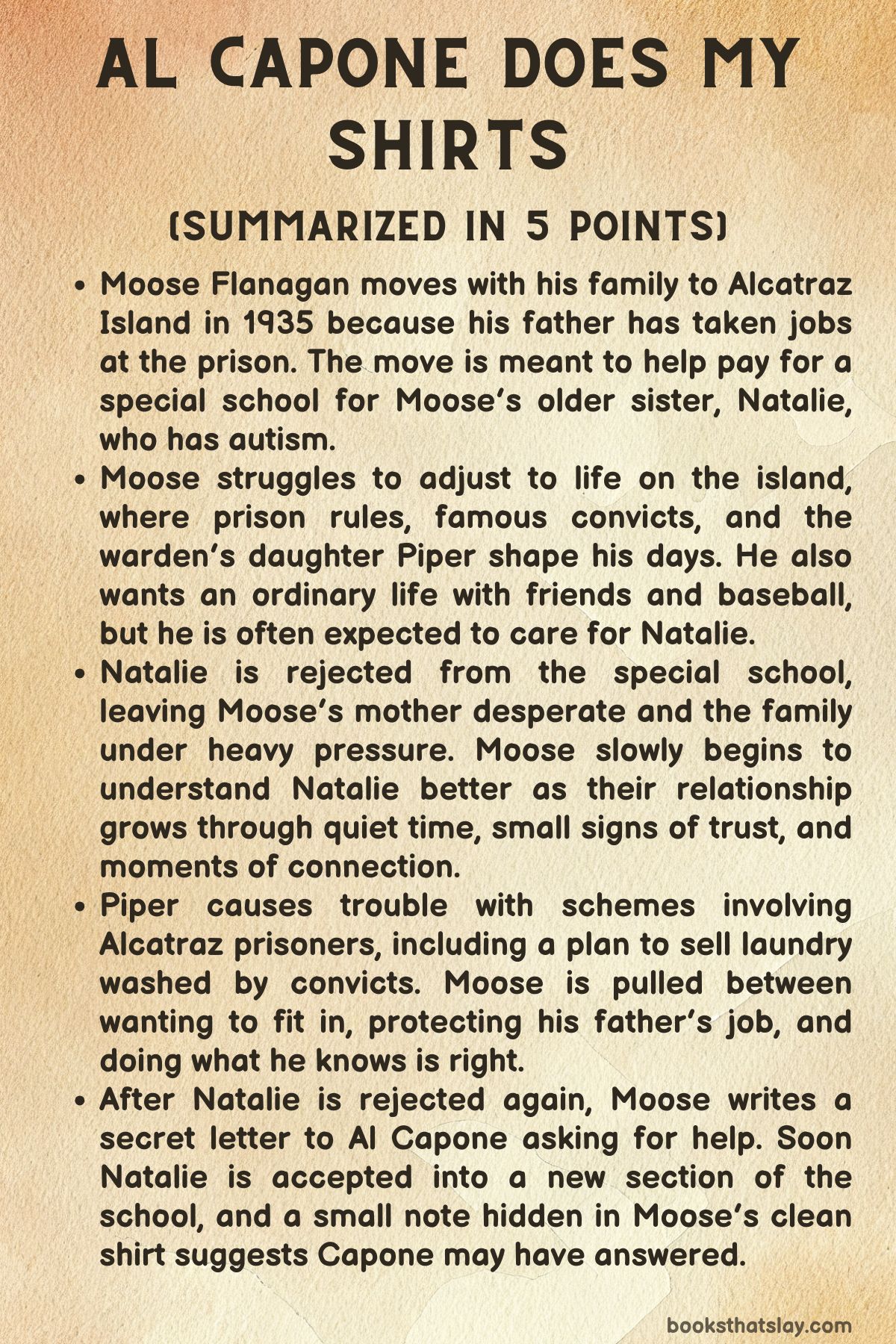
Moose Flanagan’s life changes when his family moves to Alcatraz Island, a place he sees as a bare rock covered in cement, surrounded by cold water and guarded by prison walls. His father, Cam, has taken work there as both an electrician and a guard.
The extra income is important because Moose’s mother, Helen, is determined to send Moose’s older sister, Natalie, to the Esther P. Marinoff School, a special school that may be able to help her. Natalie is sixteen, though the family often says she is ten because the school has an age limit.
She has difficulty with ordinary social interaction, becomes overwhelmed easily, and relies on routines, counting, and familiar objects to feel safe.
Moose is twelve, nearly six feet tall, and tired of feeling responsible for everything. He loves Natalie, but he also resents how much of family life revolves around her needs.
He misses his old friends, especially baseball, and he feels uneasy living beside a prison full of dangerous men. His mother often leaves him in charge of Natalie, and Moose worries that new people will not understand her behavior.
Soon after arriving, Moose meets Theresa Mattaman, a younger girl who lives on the island, and Piper Williams, the warden’s daughter. Theresa is friendly and curious, while Piper is confident, pretty, and manipulative.
Piper quickly shows that she enjoys using her father’s position and the prison’s reputation to impress others. She makes rude comments about Natalie and treats Moose as someone she can control.
Moose dislikes her but also feels drawn into her schemes because he wants to fit in and avoid trouble for his father.
Natalie’s first attempt at the Esther P. Marinoff School fails almost immediately. She becomes upset after being left there, and the school sends word that she is not ready.
Helen is devastated but refuses to give up. She contacts Mrs. Kelly, a special tutor who believes Natalie must be pushed away from her fixations, including her button box, so she can function better in the world.
Helen accepts this advice because she is desperate for progress. Moose is less sure.
He sees how much comfort Natalie’s familiar habits give her, and he feels that removing them may be cruel.
At school in San Francisco, Moose struggles at first. His teacher embarrasses him by pointing out how large he is for his grade, but he eventually connects with a boy named Scout through baseball.
Baseball becomes Moose’s chance at a normal life. He wants badly to play, make friends, and be known for something other than living on Alcatraz or having Natalie as a sister.
Yet his mother’s piano lessons often leave him responsible for Natalie after school, which interferes with his chance to join games. When Moose cannot show up, Scout becomes angry and rejects him from the team.
Meanwhile, Piper starts a money-making plan at school. She sells students the idea that their clothes can be washed by famous Alcatraz convicts such as Al Capone, Machine Gun Kelly, and Roy Gardner.
Moose knows the plan is wrong, but Piper pressures him by promising to be nice to Natalie. The scheme eventually reaches the warden, who is furious.
Although Moose has not truly taken part, he knew about it and said nothing. The warden warns the children that another incident could cost their fathers their jobs.
Cam later punishes Moose by taking away his baseball gear, not because Moose led the scheme, but because he failed to speak up.
Life on the island becomes dull and tense for Moose. Piper is sent away for a time, but when she returns, she is as full of plans as before.
She learns that Al Capone’s mother will visit the prison and arranges for the children to be on the boat when she arrives. The meeting is not exciting in the way Piper hoped.
Mrs. Capone is gentle with Theresa’s baby brother, but when the prison’s metal detector goes off, she is humiliated by a search and leaves. Moose is troubled by what he sees.
For the first time, he thinks of Al Capone not only as a criminal but as someone’s son.
Moose’s relationship with Natalie slowly changes. Because he must take her outside with him, they begin spending quiet time together.
Moose talks to her, even when he is not sure she understands, and he notices small signs of connection. Natalie makes eye contact more often and seems calmer in his presence.
Their bond becomes more important than Moose realizes.
One day Moose searches near the prison yard for a baseball hit over the wall by the convicts. He leaves Natalie alone for a short time, and when he returns, he finds her sitting with a prisoner wearing the number 105.
The man gives Moose a baseball and calls Natalie “sweetie” before leaving. Moose is horrified.
He has no idea how long Natalie was with the man or what may have happened. His fear and guilt overwhelm him.
Piper, however, sees the incident as an exciting connection to the prisoners and wants to use Natalie to communicate with 105. Moose refuses, determined to keep Natalie safe.
Moose tries to warn his mother that Natalie should not be allowed to follow him everywhere anymore, but Helen focuses only on the fact that Natalie is showing signs of improvement. Helen is still thinking of the school interview and refuses to change Natalie’s routine.
Soon after, when Helen takes away Natalie’s button box, Natalie has a severe outburst. Moose loses control and shouts that he hates her, blaming her for the family’s pain.
Almost immediately, he regrets it. He calms her by wrapping her tightly in a rug, remembering what once helped her feel secure.
During this moment, Natalie says, “I want to go outside,” using “I” in a new way. Moose is stunned by her progress.
Cam later reassures Moose that Natalie’s condition is not his fault. Moose has carried a private fear that Natalie became worse after he was born, but his father tells him clearly that he did not cause it.
Cam also begins to defend Moose more openly to Helen, arguing that Moose’s relationship with Natalie matters and should be trusted.
As Natalie’s birthday and school interview approach, Helen wants everything kept calm. But Natalie becomes distressed and leads Moose and Piper to prisoner 105, apparently wanting to say goodbye.
Moose is disturbed by the sight of Natalie holding hands with a convict, yet he also sees something strangely ordinary in it: Natalie is reaching out to another person. Later, Helen holds a birthday party for Natalie, and the children come.
When Moose tells Piper that Natalie is sixteen, he realizes that everyone can see the truth.
That night, Moose confronts his mother. He tells her that lying about Natalie’s age is wrong and that the school must know who Natalie really is.
Helen resists, unable to let go of the dream she has built, but Cam sides with Moose. When asked her age, Natalie answers clearly that she is sixteen.
Her parents are moved, and Cam is proud of both his children.
Natalie’s interview goes well, but the school rejects her again. The family is crushed.
Moose calls Mrs. Kelly, who tells him how important he is to Natalie. Desperate, Moose asks the warden for help, but the warden says he cannot do anything.
Moose then decides to write to Al Capone. With Piper’s help, he creates a letter asking Capone to help Natalie, adding a note about liking Capone’s mother because he believes mentioning someone’s mother may make him act better.
A short time later, Moose learns that Natalie has been accepted after all. Mr. Purdy is opening a section for older children, and Natalie will be the first student.
Moose does not know whether his letter made the difference. The next day, while putting on a clean shirt, he finds a scrap of paper in the sleeve.
It says, “Done.” The message suggests that Al Capone may have helped, leaving Moose with a strange, quiet answer from the prison world that has shaped his new life.
Characters
Moose Flanagan
Moose Flanagan is the emotional center of Al Capone Does My Shirts. He is twelve years old, unusually tall for his age, and caught between childhood and adult responsibility.
At first, Moose sees Alcatraz as a miserable, strange place that has taken him away from the life he wanted. He misses normal things: baseball, friends, freedom, and time with his father.
Yet his life is shaped by duties that most children his age do not have. He is often expected to watch over Natalie, protect her, understand her, and sacrifice his own desires for her needs.
This makes Moose both loving and resentful. He cares deeply for Natalie, but he also feels frustrated that her condition controls so much of the family’s life.
Moose’s growth comes from learning to understand responsibility without losing his own voice. Early in the story, he is obedient almost to a fault.
He does what his mother asks, even when it costs him friendships or happiness. He wants to be good, but being “good” often means staying silent.
Over time, he learns that real loyalty sometimes requires speaking up. His confrontation with his mother about Natalie’s age is one of his strongest moments because he chooses honesty over comfort.
Moose also becomes more emotionally mature in the way he sees Natalie. At first, he often thinks of her as a burden or a problem to manage.
Later, he begins to enjoy her company, notice her progress, and understand that their bond matters to her more than he knew. By the end, Moose is not simply Natalie’s caretaker; he is her brother in a fuller, more equal sense.
Natalie Flanagan
Natalie Flanagan is Moose’s older sister, though much of the family’s life is built around pretending she is younger. She is sixteen, autistic, and deeply dependent on routine, familiar objects, numbers, and patterns.
Her button box, counting habits, and quiet rituals help her manage a world that often overwhelms her. Many people around her misunderstand these behaviors, seeing them as obstacles or signs of stubbornness.
The story, however, presents Natalie as a person with intelligence, feeling, fear, and desire, even when she cannot express herself in expected ways.
Natalie’s development is quiet but meaningful. She does not change suddenly or become “fixed,” and that is important.
Her progress is shown through small shifts: holding Moose’s hand, making eye contact, allowing Theresa to touch her, using first-person speech, answering questions clearly, and showing attachment to people in her own way. These moments matter because they reveal that Natalie has been aware and emotionally connected all along, even when others could not easily see it.
Her relationship with Moose is especially important. She responds to him because he knows her rhythms and understands how to reach her without forcing her to be someone else.
Natalie also challenges the other characters’ assumptions. Her ability with dates and numbers proves that she is not unintelligent, while her distress shows that pressure and dishonesty can harm her.
She is not a symbol of tragedy; she is a complex person whose needs expose the limits, fears, and hopes of everyone around her.
Helen Flanagan
Helen Flanagan, Moose and Natalie’s mother, is one of the most complicated characters in the novel. She is devoted to Natalie and will do almost anything to help her daughter avoid institutionalization.
Her love is intense, active, and exhausting. She searches for schools, treatments, tutors, and methods that might give Natalie a better future.
Yet this devotion often becomes controlling. Helen is so focused on saving Natalie that she sometimes overlooks Moose’s needs and emotional strain.
She expects him to sacrifice baseball, friendships, and ordinary childhood freedoms because the family’s larger crisis always seems more urgent.
Helen’s greatest flaw is denial, especially about Natalie’s age. She insists on presenting Natalie as younger because she believes that is the only way to secure a place at the school.
Her lie comes from fear, not cruelty, but it still damages the family. She cannot bear the thought that Natalie may not fit into the future Helen has imagined for her.
This makes her resistant when Moose tells the truth. Still, Helen is not a villain.
She is a mother under immense pressure in a time when autism was poorly understood and options for children like Natalie were limited and often harsh. Her apology to Moose shows that she can recognize when she has misjudged him.
She begins to understand that Moose’s honesty was not betrayal but love. Helen’s character shows how fear can distort care, and how even loving parents can hurt one child while trying desperately to protect another.
Cam Flanagan
Cam Flanagan, Moose’s father, is calm, steady, and often caught between his wife’s desperation and his son’s quiet suffering. He works two demanding jobs on Alcatraz so the family can afford Natalie’s schooling.
This makes him physically absent much of the time, but when he is present, he often brings balance. He understands baseball, speaks to Moose with warmth, and offers advice that helps Moose think about uncertainty and effort.
Cam does not pretend that life can be controlled. His view is more practical: people try their best, and outcomes are rarely exactly what they expect.
Cam’s weakness is that he avoids conflict for too long. He lets Helen make many of the decisions about Natalie because her need to act is stronger than his.
This leaves Moose feeling unsupported at times. However, Cam’s love for Moose becomes clearer as the story continues.
He reassures Moose that Natalie’s condition is not his fault, which releases Moose from a painful burden he has carried alone. Cam also defends Moose when Helen pushes him too hard, saying that Moose’s relationship with Natalie deserves respect.
His decision to support Moose in telling the truth about Natalie’s age marks a turning point for the family. Cam represents quiet strength, but his growth lies in becoming more willing to speak when silence is no longer enough.
Piper Williams
Piper Williams is the warden’s daughter, and she uses that position to gain attention, control, and power. She is charming when it benefits her, especially around adults, but with other children she is often bossy, selfish, and manipulative.
Piper enjoys the dangerous glamour of Alcatraz. She sees the prison and its famous inmates as tools for excitement and popularity.
Her laundry scheme is a clear example of her personality: she turns the prisoners’ labor into a schoolyard business, ignores the risks, and expects others to help her while she takes credit.
Piper is not simple, though. She can be cruel, especially in the way she first talks about Natalie, but she also shows moments of curiosity and occasional concern.
She is clever and brave, but her courage often lacks judgment. Her desire to meet Al Capone and use prisoner 105 as a pathway to him shows how easily she treats real danger as a game.
Piper’s role in Al Capone Does My Shirts is partly to test Moose’s moral boundaries. Around her, Moose has to decide whether he will follow along to be accepted or resist when something feels wrong.
Piper also exposes the difference between appearance and truth. She looks polished and acts sweet around her father, yet she repeatedly breaks rules.
Her character adds energy and conflict, but she also represents the temptation to turn serious things into entertainment.
Theresa Mattaman
Theresa Mattaman is younger than Moose, but she often shows more openness and kindness than many older characters. She is talkative, enthusiastic, and eager to include people.
From the beginning, she accepts Natalie more naturally than others do. She may not fully understand Natalie, but she does not treat her as frightening or shameful.
This makes Theresa important because she gives Natalie a form of social acceptance that is simple and unforced.
Theresa’s warmth contrasts sharply with Piper’s manipulation. While Piper often uses people, Theresa tries to connect with them.
She brings Natalie along, holds her hand, invites her into activities, and seems genuinely interested in her presence. Her innocence can lead her into trouble because she follows Piper’s schemes, but her intentions are rarely cruel.
Theresa also helps soften life on Alcatraz for Moose. She introduces him to the island children and makes the strange new environment feel less lonely.
Her character shows that acceptance does not always require expert knowledge. Sometimes it begins with patience, friendliness, and the willingness to treat someone as part of the group.
Jimmy Mattaman
Jimmy Mattaman, Theresa’s brother, is Moose’s age and one of the island children. He is less interested in baseball than Moose would like, preferring gadgets, machines, and inventions.
This makes him different from the kind of friend Moose first hopes to find, but Jimmy still becomes part of Moose’s Alcatraz circle. His mechanical interests give him a distinct identity and reflect the odd, confined world of island childhood, where children must create their own entertainment with whatever is available.
Jimmy is not as forceful as Piper or as emotionally central as Moose, but he plays an important supporting role. He participates in the children’s schemes and gets pulled into the consequences, even when he is not the main instigator.
Like the other island children, he lives under the shadow of adult rules and prison authority. The warning that their fathers could lose their jobs makes clear that even childish misbehavior carries serious stakes on Alcatraz.
Jimmy’s character helps show the community of children who are growing up beside a prison, trying to act like normal kids in a place where normal childhood is almost impossible.
Annie
Annie is one of the most grounded children on the island. She is especially important to Moose because she can play baseball well, challenging his early assumption that girls are not serious players.
Her skill surprises and impresses him, and through her, Moose begins to expand his idea of who belongs on a ball field. Annie is direct, practical, and less easily dazzled by Piper than some of the others.
Annie often serves as a voice of warning. She understands that Piper can cause trouble and tells Moose he needs to get along with her because Piper’s actions can affect their fathers’ jobs.
Annie is not naïve about island politics. She knows that the children’s lives are tied to the prison hierarchy, and she recognizes danger before Moose always does.
Her honesty during the laundry scandal also shows that she has a stronger sense of accountability than Piper. Annie’s role may be secondary, but she helps Moose find friendship, normal play, and moral clarity in a setting full of pressure.
Scout
Scout is Moose’s school friend and a link to the normal mainland life Moose wants. Baseball brings them together, and Scout represents the kind of ordinary boyhood Moose longs for: games, teams, jokes, and friendship without family crisis.
At first, Scout’s friendship gives Moose hope that his new life may not be so bad. When Moose plays well, he earns Scout’s respect, and this matters deeply to him.
Scout also reveals how hard it is for Moose to balance two worlds. When Moose cannot attend the baseball game because he must care for Natalie, Scout takes it personally.
He does not understand Moose’s family responsibilities, and Moose is too embarrassed or guarded to explain everything. Scout’s anger hurts Moose because it confirms his fear that Natalie’s needs will cost him friendships.
Still, Scout is not heartless. Their friendship later recovers, suggesting that childhood conflicts can heal when there is shared interest and time.
Scout’s attraction to Piper also creates tension, pushing Moose into rivalry and jealousy. Through Scout, the story shows Moose’s desire to belong beyond his family.
Warden Williams
Warden Williams is the chief authority figure on Alcatraz. He is strict, rule-bound, and deeply aware of the dangers surrounding the prison.
His warnings to Moose are severe because he believes discipline is necessary in a place where one mistake could have serious consequences. As Piper’s father, he is also somewhat blind.
He can control prisoners and employees, but he does not fully control or understand his own daughter’s behavior.
The warden’s sternness makes him intimidating, yet he is not entirely unfair. When the laundry scheme is exposed, his anger is understandable because the children have used the prison’s reputation in a reckless way.
His threat that their fathers could lose their jobs shows how fragile the families’ lives are on the island. Later, Moose turns to the warden for help with Natalie, seeing him as the most powerful person available.
The warden cannot directly solve the problem, but his position indirectly connects Moose’s private family struggle to the larger world of the prison. He represents institutional power: strong in some ways, limited in others.
Al Capone
Al Capone is mostly unseen, but his presence shapes the entire story. To the children, he is a legend, a source of danger, fame, and fascination.
Piper treats his name as a tool for schemes, while students at school are excited by the idea that their clothes might be washed by him. The public image of Capone is larger than the man himself, and much of the novel’s humor and tension comes from the gap between rumor and reality.
Capone becomes more human through his mother. When Moose sees Mrs. Capone humiliated during her visit, he begins to think differently about the famous prisoner.
Capone is still a criminal, but he is also someone’s son. This recognition matters because it leads Moose to write to him not as a legend, but as a person who might respond to a mother’s pain and a family’s need.
The final note suggests that Capone may have helped Natalie get accepted into school. Whether this is certain or not, his unseen action gives him a strange moral complexity.
He remains dangerous, but he is not reduced to a simple monster.
Prisoner 105
Prisoner 105 is a disturbing and important figure because he brings the danger of Alcatraz directly into Moose’s family life. He is first connected to Natalie through her repeated use of the number 105, and when Moose discovers her sitting beside him, the moment terrifies him.
The prisoner’s casual tone and use of “sweetie” toward Natalie make Moose feel protective and afraid. Moose cannot know what happened while Natalie was alone with him, and that uncertainty becomes one of the story’s most frightening emotional moments.
At the same time, 105 is not presented in a completely simple way. Natalie seems drawn to him, and he gives Moose a baseball, which makes the situation more confusing.
Piper assumes he is harmless because he has some freedom on gardening detail and is close to release, but Moose understands that he cannot risk Natalie’s safety based on guesses. 105’s role is to force Moose into a sharper awareness of danger, responsibility, and guilt.
He also reveals Natalie’s desire for connection beyond the family, even when that connection frightens others.
Mrs. Kelly
Mrs. Kelly is Natalie’s tutor and a figure of hope for Helen. She believes Natalie can make progress if the family changes how it responds to her habits and routines.
Her approach is firm, and some of her advice troubles Moose, especially the idea of taking away the things Natalie loves. To Moose, it feels as if Natalie is being punished for being herself.
To Helen, Mrs. Kelly represents a possible path forward when every other attempt has failed.
Mrs. Kelly’s importance becomes clearer near the end. She tells Moose that when Natalie lost focus, asking about Moose helped bring her back.
This reveals that Natalie’s bond with Moose is not one-sided. Moose has spent much of the story feeling burdened by Natalie, but Mrs. Kelly helps him see that he is central to her emotional world.
Mrs. Kelly is not perfect, and the story does not ask the reader to accept all of her methods without question. Still, she helps Natalie communicate more clearly and helps Moose understand his own importance.
Mr. Purdy
Mr. Purdy, the head of the Esther P. Marinoff School, represents the gatekeeping power of institutions. He decides whether Natalie is acceptable for the school, and his decisions deeply affect the Flanagan family.
His first rejection of Natalie feels quick and cold, especially because Moose questions how anyone could decide so much after such a short time. His explanation focuses on Natalie’s disruptive behavior, showing how institutions often judge children by whether they can fit into existing structures.
Mr. Purdy is not portrayed as cruel for cruelty’s sake. He has rules, limits, and a school community to manage.
Still, his decisions expose the pain families face when help is conditional. Natalie needs support, but she must prove herself worthy of receiving it.
His later decision to open a section for older children changes Natalie’s future and suggests that institutions can adapt, though often only after great pressure. Mr. Purdy’s character shows both the harm and necessity of systems meant to help vulnerable children.
Mrs. Capone
Mrs. Capone appears briefly, but her scene has a strong effect on Moose. She is introduced not as the mother of a famous criminal in a dramatic sense, but as a woman who responds tenderly to a crying baby.
Her gentleness makes her feel ordinary and human. This matters because the children, especially Piper, have treated the Capone name as exciting material for stories and schemes.
Her humiliation at the prison changes Moose’s understanding of Alcatraz. The search she endures is not an adventure or a joke; it is painful and degrading.
Moose sees her shame and begins to understand that the prison affects more than the prisoners. Families are pulled into its rules and suspicions too.
Mrs. Capone’s presence also influences Moose’s letter to Al Capone. By mentioning her, he appeals to whatever humanity Capone may still have.
Her role is brief but powerful because she changes Capone from a distant criminal name into a son with a mother.
Themes
Family Responsibility and Personal Sacrifice
In Al Capone Does My Shirts, family responsibility is shown through Moose’s daily life rather than through grand speeches. He is expected to help with Natalie because his parents are exhausted, financially strained, and emotionally focused on her future.
His sacrifices are not small to him. He gives up baseball games, risks friendships, misses ordinary childhood freedom, and carries fears that adults do not always notice.
The novel treats this responsibility with honesty. Moose loves Natalie, but he also resents the burden placed on him.
This makes his character believable because care and frustration can exist together in the same person. Helen also sacrifices, but her sacrifice has a different shape.
She gives her energy, money, pride, and peace of mind to the hope that Natalie can have a better life. Cam sacrifices through work, taking on exhausting jobs to support the family.
The theme becomes especially powerful because the family members do not always sacrifice equally or fairly. Moose is still a child, yet he is often asked to act like an adult.
The novel questions how much a family can ask of one member in order to save another, while still showing that love often requires effort, patience, and painful choices.
Truth, Denial, and Acceptance
The Flanagan family’s lie about Natalie’s age reveals how denial can begin as protection but become harmful over time. Helen insists that Natalie is younger because she believes this may help her enter the school.
Her dishonesty comes from fear, not selfishness. She knows the world has few good options for Natalie, and she is trying to force open one narrow door.
Yet the lie also prevents Natalie from being seen as she truly is. It reduces her to the version of herself that might be accepted by an institution.
Moose’s decision to confront his mother is therefore not just about age; it is about dignity. He understands that Natalie’s only real chance must be based on truth.
Acceptance does not mean giving up on Natalie’s growth. It means recognizing her actual needs, abilities, limits, and identity.
Cam’s support of Moose strengthens this theme because he finally stops avoiding conflict and helps the family face reality. Natalie’s own statement of her age is one of the clearest moments of selfhood in the story.
She claims the truth for herself, and in doing so, forces her family to see her more fully.
Disability, Understanding, and Human Dignity
Natalie’s character challenges the way people define intelligence, maturity, and worth. Many characters misunderstand her because she does not communicate in expected ways.
Piper initially insults her, adults focus on whether she can fit into school routines, and even Moose sometimes thinks of her through frustration before he learns to see her more patiently. The novel shows that Natalie’s inner life is not absent simply because it is hard for others to read.
She has preferences, fears, attachments, intelligence, and emotional responses. Her skill with numbers and dates proves that she has abilities others may overlook, but the deeper point is not that she must be talented to deserve respect.
She deserves care and dignity because she is a person. Moose’s changing relationship with her is central to this theme.
When he begins spending quiet time with Natalie, he discovers that connection does not always require ordinary conversation. Her progress is shown through small but meaningful acts, such as eye contact, touch, and first-person speech.
The story also reflects the limited understanding of autism in its historical setting. Treatments and advice often seem harsh or misguided, reminding readers how easily disabled people can be pressured to become more convenient for others rather than supported as themselves.
Power, Rules, and Moral Choice
Alcatraz is a world ruled by strict boundaries: prison walls, locked doors, guard towers, official warnings, and rules about contact with convicts. These rules are necessary because danger is real, but the novel also shows that rules alone do not create moral understanding.
Piper knows how to bend rules while appearing innocent. Moose often follows rules, yet he still makes mistakes when he stays silent about the laundry scheme or leaves Natalie alone while searching for a baseball.
The real test is not whether a character can avoid punishment, but whether they can judge right from wrong when no adult is watching. The prison setting sharpens this theme because every childish action carries adult consequences.
A laundry prank may threaten fathers’ jobs. A search for a baseball may place Natalie near a convict.
A letter to Al Capone may cross a forbidden boundary, yet it is written out of love and desperation. This creates moral complexity.
Moose must learn that good choices are not always the same as obedient choices. Sometimes he must resist Piper, sometimes confess, and sometimes take a risk for Natalie.
The story treats morality as something learned through fear, guilt, courage, and care.