All My Rage Summary, Characters and Themes
All My Rage by Sabaa Tahir is a young adult contemporary novel about grief, anger, survival, and the painful work of forgiveness. Set between Pakistan and a small town in California, it follows Salahudin, Noor, and Misbah, three people bound by love, loss, family wounds, and impossible choices.
The book examines addiction, abuse, racism, poverty, faith, and trauma without offering easy answers. At its center is the question of how people carry rage when they have been failed by those meant to protect them, and whether love can still make room for truth, accountability, and healing.
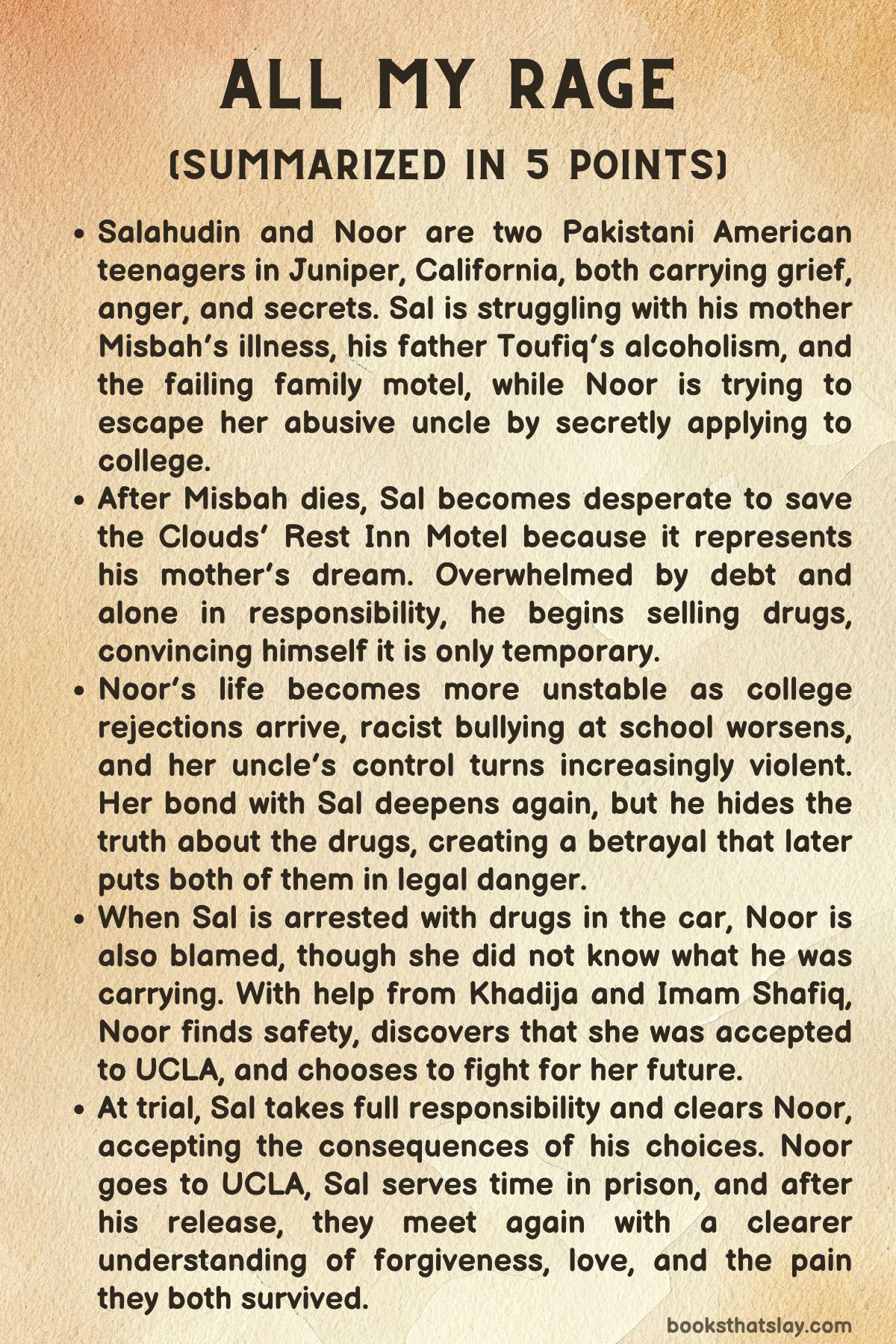
Summary
Misbah is a young woman in Lahore, Pakistan, when her parents arrange her marriage to Toufiq. She feels too young for marriage, but she steps into this future with hope and uncertainty.
Before the wedding, a fortune teller tells her that her husband is restless, that she will cross the sea, and that she will have three children but fail them all. At first, the prediction is strange and frightening.
Only much later does its meaning become clear.
Misbah meets Toufiq before the wedding, and their conversation gives her hope. She tells him she dreams of running a restaurant or inn where travelers can gather and share their lives.
Toufiq listens seriously and encourages her. He dreams of visiting Yosemite and speaks with wonder about its mountains.
Their marriage begins with difficulty, especially because Toufiq’s mother drinks heavily and behaves cruelly. After Toufiq learns painful truths about his family and then loses both parents in a tragic accident, he turns to alcohol.
Misbah and Toufiq eventually leave Pakistan for California, hoping for a new beginning.
In Juniper, California, they buy a rundown motel and name it Clouds’ Rest Inn Motel. For Misbah, the motel becomes more than a business.
It is the life she imagined, a place where strangers pass through and leave pieces of their stories behind. She works hard to keep it alive, even when money is tight and Toufiq’s drinking worsens.
Their son, Salahudin, grows up there, a sensitive boy who struggles with touch and carries a trauma he cannot fully remember. When he was very young, he was assaulted by a motel guest in the laundry room.
Misbah and Toufiq take him to Dr. Ellis, who tells them he may not remember the event clearly, though his body may still respond to it. Misbah tries to protect him, while Toufiq’s guilt and helplessness push him deeper into addiction.
Noor enters their lives when she is a child. She survived an earthquake in Pakistan that killed her family, and her uncle Riaz, whom she calls Chachu, rescued her from the rubble and brought her to America.
Riaz gave up his own plans to raise her, but he is controlling and abusive. He rejects Islam and Pakistani culture, forbids Noor from connecting with her heritage, and expects her to work in his liquor store after graduation so he can finally pursue his own dreams.
Misbah ignores his rules and gives Noor food, language, kindness, and a sense of belonging. Noor and Salahudin become best friends, both recognizing something wounded in the other.
In the present, Misbah is seriously ill with chronic kidney disease. She has missed dialysis appointments because the family lacks money and health insurance, and because she has spent years holding the motel together.
Salahudin, called Sal, is still in high school. His father is usually drunk, the motel is drowning in debt, and Sal is frightened of losing the place his mother loved.
He is also estranged from Noor after she admitted she loved him and kissed him. Sal pushed her away, confused by his feelings and by his aversion to touch, and they have barely spoken since.
Noor is trying to escape Juniper by secretly applying to colleges. She has excellent grades, high test scores, hospital volunteer work, and strong recommendations, but she cannot tell Riaz about her applications.
He wants her trapped in his store. When Misbah collapses, Noor gets her to the hospital, but Misbah dies soon after.
Her final word to Noor is “forgive,” a word Noor does not understand.
Misbah’s death devastates Sal. At the funeral, Noor stands beside him and plays one of Misbah’s favorite songs, a small act that begins to repair their friendship.
Still, the pressures on Sal grow worse. The motel is behind on bills, the bank threatens to take it, and his father cannot stay sober long enough to help.
Sal finds unpaid bills, collection notices, and a looming deadline. Desperate to save the motel, he contacts Art Britman, a school drug dealer, and begins selling pills.
He tells himself it is temporary and that he is doing it for his mother’s legacy.
As Sal sells drugs, Noor faces her own collapse. College rejections arrive one after another.
Her English essays suffer because she avoids writing honestly about her pain. At school, Jamie Jensen bullies her, competes with her, mispronounces her name, and makes racist comments.
At home, Riaz becomes more suspicious and violent. Noor tries to hide her bruises and her fear.
Sal notices signs that something is wrong but does not know how to ask without frightening her away.
Their feelings for each other return slowly. Sal helps Noor with English, comforts her after rejection letters, and realizes he is falling in love with her.
Noor feels safe with him, though his lies about Art worry her. Sal’s touch, usually unbearable after a few moments, begins to feel different with Noor when trust is present.
Yet both of them are hiding dangerous truths: Noor is hiding Riaz’s abuse, and Sal is hiding that he is dealing drugs.
The consequences arrive quickly. Sal sells pills to his ex-girlfriend Ashlee, who later overdoses after also receiving drugs from Art.
She survives, but Sal is horrified by his role in what happened. At school, Jamie exposes Noor’s expired green card in front of the class and calls her illegal, even though Noor has current documents at home.
When Jamie grabs Noor, Noor punches her and is suspended. Jamie then goes to Riaz’s store and reveals the suspension, setting off Riaz’s rage.
At home, Riaz confronts Noor about her college applications and attacks her brutally. Noor finally fights back, throws an object at him, grabs the backpack she has long kept ready for escape, and runs.
Sal finds her injured and drives her to Veil Meadows. There, away from Juniper, they spend a peaceful day together.
They talk, listen to music, fly a kite, and kiss. Sal admits that he thinks something happened to him that his body remembers even if his mind does not.
Noor admits a little about Riaz but still blames herself for ruining his life. Sal still does not confess the truth about the drugs.
On the drive back, Sal is pulled over for speeding. He panics because he has drugs in the car and asks Noor to hide some items without explaining what they are.
The police find drugs, arrest him, and take Noor in too. Noor realizes Sal has lied to her and that his choices have put her future in danger.
In jail, both are questioned by an officer who assumes Noor is more guilty than she is. Sal learns he could face years in prison, while Noor is released into the care of Khadija, a criminal defense attorney married to Imam Shafiq.
Khadija and Shafiq give Noor shelter, food, patience, and a glimpse of the family life she never had. Noor is angry, frightened, and unsure of her faith, but they help her keep going.
Sal is bailed out by his father, but he is ordered to stay away from Noor. Riaz tries to force Noor home, but she refuses.
Sal, trying to make one thing right, realizes Riaz may have hidden Noor’s UCLA acceptance. With Art’s help, he breaks into Riaz’s study and finds the letter.
Noor has been accepted after all. Sal brings it to her, urging her not to take a plea deal and not to surrender her future.
Noor is moved but still furious. She tells him he does not deserve forgiveness.
At graduation, Noor begins to see a path forward. Ashlee has recorded Jamie’s racist behavior and sent it to Princeton and a news outlet, leading to Jamie’s admission being rescinded.
Noor decides to fight the charges and claim the future she earned. Meanwhile, Sal accepts that the motel must be sold.
A young couple buys it, and Sal recognizes that they see the place with the same love Misbah once did.
At trial, Sal’s lawyer tries to blame Noor, but Sal refuses to let her suffer for his crimes. On the stand, he tells the full truth: he sold the drugs, he hid them, and Noor did not know what she was carrying.
The charges against Noor are dropped. Sal is found guilty and sentenced to three years, though he may serve less with good behavior.
In prison, he struggles with the unavoidable touch of guards and inmates, but he begins to accept responsibility. He chooses not to learn every detail of his childhood trauma from Dr. Ellis, deciding that knowing his body remembers is enough.
Noor, now at UCLA, sends him books. Her anger fades into love, though she still has to heal from all that happened.
When Sal is released, he visits Misbah’s grave and asks for forgiveness. Noor comes too.
They forgive each other, kiss, and begin again with honesty between them. Sal shows Noor a letter from Dr. Ellis revealing that Misbah had suspected Riaz was abusing Noor and wanted to help, but illness overtook her.
Noor finally understands that Misbah’s last word was not a command for Noor to forgive everyone who hurt her. It was Misbah asking Noor for forgiveness.
In the end, Misbah’s spirit senses Noor’s love and release. The three “children” she feared she had failed—Sal, Noor, and the motel—have all been wounded, but not destroyed.
Love, truth, and accountability do not erase rage, but they give it somewhere to go.
Characters
Salahudin
Salahudin, also called Sal, is one of the emotional centers of All My Rage. He is a teenager forced into adulthood by his mother’s illness, his father’s alcoholism, and the collapse of the family motel.
At first, he appears responsible, quiet, and self-contained, but much of that restraint comes from fear. He is afraid of losing his mother, afraid of his father’s drinking, afraid of poverty, and afraid of his own body’s reactions to touch.
His discomfort with physical contact is not simply a personality trait; it is the lasting sign of a childhood trauma he cannot consciously remember. This makes him a deeply layered character because he is trying to understand himself without having access to the central wound that shaped him.
Sal’s love for his mother drives many of his choices, including his worst ones. After Misbah dies, he becomes obsessed with saving the Clouds’ Rest Inn Motel because he sees it as proof of her labor, sacrifice, and dreams.
His decision to sell drugs comes from desperation, not cruelty, but the novel does not excuse him. He lies to Noor, endangers Ashlee, and nearly destroys Noor’s future by involving her in his crime.
His arc is built around the movement from avoidance to responsibility. For much of the story, he hides from grief, from truth, and from consequences.
By the end, he accepts blame publicly, even when it costs him his freedom. His testimony is the moment he becomes morally clear.
Sal’s growth is not about becoming perfect; it is about telling the truth, accepting punishment, and learning that love without honesty can become another form of harm.
Noor
Noor is a survivor whose anger is both justified and dangerous. She has lived through the loss of her family in an earthquake, displacement from Pakistan, racism in America, emotional isolation, and years of abuse from her uncle.
Her dream of attending college is not just ambition; it is survival. College represents escape, selfhood, and the chance to become someone beyond Chachu’s control.
This makes every rejection letter feel like a closing door, and every act of cruelty from Jamie or Riaz feels like proof that the world is determined to trap her.
Noor’s character is shaped by the tension between gratitude and resentment. She knows Riaz saved her life, and that knowledge becomes a chain he uses against her.
She feels indebted to the person who abuses her, which makes it difficult for her to name what is happening. Her rage often turns inward because she has been taught to see herself as a burden.
Music becomes one of her main forms of emotional survival. It gives her language when ordinary speech fails, and it helps her hold herself together when anger threatens to overtake her.
Her relationship with Sal is complicated because he is both home and betrayal. He understands parts of her that no one else does, yet his lies put her in danger.
Noor’s eventual forgiveness is not automatic or easy. She does not forgive because Misbah told her to, nor because Sal loves her.
She forgives after truth, accountability, distance, and healing. Her journey in All My Rage is a movement from silence to voice.
By choosing UCLA, testifying, accepting help, and refusing to return to Riaz, she claims a future that once seemed impossible.
Misbah
Misbah is the moral and emotional anchor of the novel, even after her death. Her life begins in Pakistan with an arranged marriage that she enters with uncertainty but also with openness.
She has dreams of hospitality, food, stories, and community, and those dreams eventually take shape in the motel she runs in California. Misbah’s warmth is not sentimental; it is active.
She feeds people, shelters them, teaches Noor pieces of Pakistani culture, protects Sal as best she can, and keeps the family business alive under crushing pressure.
Her greatest tragedy is that love alone cannot save everyone. She sees Toufiq’s alcoholism, Sal’s pain, Noor’s bruises, and the motel’s financial decline, but she is also trapped by illness, money problems, immigration pressures, and emotional exhaustion.
She carries guilt for what she could not prevent, especially Sal’s childhood assault and Noor’s abuse. The fortune teller’s prediction that she would fail her three children becomes painfully meaningful: Sal, Noor, and the motel all suffer in ways she cannot fully repair.
Misbah’s final word, “forgive,” is one of the most important emotional turns in the story. For much of the novel, Noor believes it may be a command to forgive those who harmed her.
Later, it becomes clear that Misbah was asking Noor for forgiveness. This changes Misbah from a figure of saintly wisdom into a more human, sorrowful, and honest character.
She loved deeply, but she also failed in ways that haunt her. Her ending offers release, not because every wrong is undone, but because Noor and Sal survive, remember her, and carry forward the best parts of what she gave them.
Toufiq
Toufiq, Sal’s father, is a tragic portrait of addiction, grief, and inherited damage. In his youth, he is intelligent, romantic, and full of longing.
He loves poetry, dreams of Yosemite, and encourages Misbah’s hopes. Yet beneath that gentleness is a history of instability, shame, and fear.
His mother’s alcoholism wounds him early, and the deaths of his parents intensify his emotional collapse. Alcohol becomes his escape from grief, guilt, and helplessness.
As a father, Toufiq fails Sal in serious ways. His drinking leaves Sal alone with adult responsibilities, forces Misbah to carry the family, and makes the motel’s decline worse.
Most painfully, Toufiq is unable to face Sal’s childhood trauma. His silence does not protect Sal; it isolates him.
At the same time, the novel refuses to make Toufiq a simple villain. He loves his son, mourns his wife, and feels deep shame over the people he could not save.
His addiction is destructive, but it is also tied to wounds he never learned how to process.
Toufiq’s later attempts at sobriety are fragile but meaningful. When he admits his failures and accepts help from Imam Shafiq and Janice, he begins the difficult process of becoming present again.
Selling the motel is part of that honesty. He recognizes that holding onto the building is not the same as honoring Misbah.
Toufiq’s arc shows that recovery does not erase harm, but it can begin the work of repair.
Riaz
Riaz, Noor’s uncle, is one of the novel’s most disturbing characters because he combines rescue with abuse. He saves Noor from the rubble after the earthquake, brings her to America, and gives up his own plans to raise her.
These facts are true, but he uses them as emotional weapons. He turns sacrifice into ownership, making Noor feel that her life belongs to him because he saved it.
His hatred of Pakistan, Islam, and cultural memory reveals his own unresolved pain. Rather than helping Noor grieve and connect with what she lost, he cuts her off from language, food, faith, and community.
His control over her future is also a form of violence. By forbidding college applications and planning to keep her in the liquor store, he tries to shrink her world until escape feels impossible.
Riaz’s physical abuse is the clearest expression of his need for control, but his emotional abuse is just as damaging. He makes Noor feel guilty for existing, guilty for wanting freedom, and guilty for needing care.
His arrest later in the story does not deliver perfect justice, especially because he avoids meaningful punishment for what he did to Noor. That outcome is important because it reflects the painful reality that survivors do not always receive full justice through institutions.
Noor’s victory is not that Riaz is completely punished; it is that he no longer controls her life.
Imam Shafiq
Imam Shafiq represents compassionate faith rather than judgmental authority. He is religious, but he is not rigid or cruel.
He understands that people struggle, fail, relapse, and hide pain. His description of life as struggle captures his role in the story: he does not offer easy answers, but he offers presence.
He visits Toufiq without shaming him, supports Sal without reducing him to his crime, and recognizes signs of Noor’s abuse before many others do.
His kindness matters because both Noor and Sal have been failed by adults. Shafiq becomes one of the few adults who sees suffering clearly and responds with patience.
He does not force Noor to speak before she is ready, and he does not treat Toufiq’s addiction as a moral defect beyond repair. His faith is practical: food, shelter, phone calls, visits, concern, and advocacy.
Through him, religion becomes not a system of punishment but a source of steadiness.
Khadija
Khadija is sharp, protective, and deeply principled. As a criminal defense attorney, she understands systems of power and how easily they can crush vulnerable people.
Her arrival in Noor’s life is transformative because she offers not only shelter but also legal protection, structure, and belief. She does not pity Noor or treat her as broken.
Instead, she insists that Noor’s future still matters.
Khadija’s love is firm. She pushes Noor to return to school, to reject the plea deal, and to tell the truth.
This firmness is not coldness; it is faith in Noor’s strength. She becomes a model of adult womanhood that Noor has rarely seen up close: capable, loving, disciplined, and committed to justice.
Her relationship with Shafiq also gives Noor a glimpse of a healthy partnership, something very different from the fear and control she has known with Riaz.
Ashlee
Ashlee begins as Sal’s girlfriend, but her role expands beyond that label. She is a young mother living with pain, addiction, and denial around her.
Her dependence on painkillers is treated with seriousness, especially after her overdose. Through Ashlee, the novel shows that addiction does not belong to one family, culture, or class.
It appears in different forms across Juniper.
Ashlee also changes over the course of the story. At first, she asks Sal for Misbah’s medication and later buys drugs from him, making her part of Sal’s moral downfall.
Yet she is not presented only as a victim or temptation. After surviving the overdose, she helps Noor return to school and records Jamie’s racist behavior, which leads to real consequences for Jamie.
Ashlee’s actions show that people who are struggling can still act with courage and loyalty.
Jamie Jensen
Jamie functions as a symbol of everyday racism, entitlement, and cruelty disguised as achievement. She is competitive with Noor, obsessed with grades and college status, and quick to belittle Noor’s name, immigration status, and academic integrity.
Her attacks are not random; they are attempts to protect her own superiority by humiliating someone she sees as an outsider.
Jamie’s racism becomes public when Ashlee’s video exposes her. The loss of her Princeton admission is one of the story’s few institutional consequences.
Still, Jamie is not important only because she is punished. She shows how racism often works through classrooms, casual comments, social status, and accusations of dishonesty.
Her character helps reveal the emotional labor Noor has carried for years: having to remain calm while being insulted, doubted, and watched.
Art Britman
Art is the school drug dealer and a catalyst for Sal’s collapse. He offers Sal an easy route to quick money, but that route comes with escalating danger.
Art is not shown as deeply reflective; he operates in a world where drugs, favors, threats, and profit are normal. He understands people’s desperation and benefits from it.
His connection to Ashlee’s overdose makes clear that Sal is not entering a harmless side business. Art’s presence strips away Sal’s excuses.
Once Sal works with him, he becomes part of a chain of harm that reaches other vulnerable people. Art also helps Sal recover Noor’s UCLA letter, but that does not make him heroic.
It shows how morally compromised people can still perform useful acts while remaining dangerous.
Dr. Ellis
Dr. Ellis is a quiet but important figure because she connects Sal’s present symptoms to his buried past. She was there after Sal’s childhood assault and later tries to reach him about his medical history.
Her role is not to force revelation but to preserve the truth until Sal is ready to decide what he wants to know.
Her letter also helps Noor understand Misbah more fully. By revealing that Misbah had suspected Noor’s abuse and sought advice, Dr. Ellis changes Noor’s interpretation of Misbah’s final word.
She becomes a bridge between hidden pain and late understanding. Through her, the novel respects the complexity of trauma: some truths need to be known, while others may be approached only when the survivor chooses.
Mrs. Michaels
Mrs. Michaels is one of the few teachers who sees potential beneath Noor and Sal’s distress. She encourages Sal to write and notices Noor’s pain when Noor’s academic performance begins to suffer.
Her classroom becomes a place where both characters are challenged to express what they usually hide.
She is not able to fix their lives, but she offers something important: recognition. When she praises Noor’s essay and encourages her not to give up, Noor receives a reminder that her mind and voice still matter.
For Sal, the writing contest becomes a path toward telling his mother’s story and processing grief. Mrs. Michaels represents the adult who cannot rescue a student completely but can still help keep a future alive.
Principal Ernst
Principal Ernst represents school authority that is sometimes helpful but limited. He warns Sal about skipping classes and later handles Noor’s fight with Jamie.
His decision to offer Noor leniency if she apologizes shows that he recognizes Jamie’s role in provoking the conflict, yet he also fails to fully grasp the deeper racism and abuse surrounding Noor’s outburst.
His character shows how institutions often respond to visible behavior rather than hidden causes. Noor’s punch is easy to punish; Jamie’s long pattern of cruelty is harder for the school to confront until outside exposure forces consequences.
Principal Ernst is not cruel, but his limitations matter.
Brooke
Brooke, Riaz’s wife, is a minor but revealing character. She shows occasional kindness to Noor but does not fully protect her.
Her silence reflects the way abuse can exist in a household where others sense the truth but do not or cannot intervene effectively. When she helps Noor after the suspension by hiding the truth from Riaz, she offers temporary protection, but not enough to stop the larger danger.
Later, Riaz’s violence toward Brooke leads to his arrest. This moment confirms that Noor’s abuse is part of a broader pattern.
Brooke’s character shows how abusers often harm multiple people around them and how fear can make witnesses passive.
Abu’s Sponsor, Janice
Janice represents the practical side of recovery. She is not heavily developed, but her presence matters because Toufiq cannot recover through shame or willpower alone.
He needs community, accountability, and someone who understands addiction. Janice’s role helps show that sobriety is not a single emotional decision; it is a daily practice supported by others.
Santiago
Santiago appears in jail and later becomes Sal’s prison cellmate. He is calm, friendly, and spiritually reflective, offering Sal a form of companionship in a frightening environment.
His tattoo and his connection to the same song Misbah loved make him feel like one of the coincidences that Sal eventually interprets as meaningful.
Santiago helps Sal survive prison emotionally. He does not erase Sal’s fear, but he makes the space less lonely.
His presence supports Sal’s growing belief that life cannot always be controlled and that meaning can appear in unexpected places.
Nargis
Nargis, Toufiq’s mother, is important because her alcoholism shapes Toufiq before the main events of the novel. Her public drunkenness at Misbah’s wedding and her later cruelty reveal the instability Toufiq grew up around.
She is not present for long, but her influence lasts through Toufiq’s shame, grief, and addiction.
Her death alongside Junaid becomes a turning point. Toufiq’s drinking worsens after losing them, showing how unresolved family pain can pass from one generation to the next.
Nargis’s character helps explain Toufiq without excusing his failures.
Junaid
Junaid, Toufiq’s father figure, offers a gentler contrast to Nargis. He accepts Toufiq as his son despite the complicated truth of Toufiq’s birth, and he forms a warm bond with Misbah after her marriage.
His kindness gives Misbah some comfort in a difficult household.
His death deepens the tragedy of Toufiq’s life. Losing Junaid means losing one of the few stable parental figures Toufiq had.
Junaid’s role is brief, but he represents the possibility of chosen love and quiet decency within a damaged family.
Faisal
Faisal, Misbah’s brother, appears mainly through absence and refusal. He once chaperones Misbah and Toufiq before their marriage, but in the present, he refuses to help Sal financially despite having the means.
His lack of support adds to Sal’s isolation and desperation.
Faisal’s character shows that family ties do not always translate into care. In a novel full of chosen family, his refusal becomes even more noticeable.
Noor, Shafiq, Khadija, and even Ashlee offer forms of help that some blood relatives do not.
Mrs. McCann
Mrs. McCann, Ashlee’s mother, responds to Ashlee’s overdose with denial. She wants to believe her daughter had a reaction to food rather than accept that addiction is involved.
Her reaction mirrors the denial Sal has seen in his own family around Toufiq’s drinking.
She is not portrayed as uncaring. Her denial comes from fear.
Through her, the novel shows how families sometimes protect themselves from truth because truth would demand painful change. Sal’s honesty with her about his father’s alcoholism becomes one of his early steps toward facing reality.
Themes
Rage as a Response to Injustice
Rage in All My Rage is not treated as a flaw to be corrected but as a response to repeated injury. Noor’s anger grows from racism, abuse, grief, and the constant feeling that no one sees her clearly.
Her rage is not irrational; it is the natural result of being trapped by Chachu, humiliated by Jamie, doubted by institutions, and cut off from her own future. Sal’s rage is quieter but no less powerful.
He is angry at his father for drinking, angry at his mother for dying, angry at poverty, and angry at himself for not being able to save the motel without breaking the law. Toufiq’s rage turns inward through alcohol, while Misbah’s grief becomes guilt.
The novel shows that rage can protect a person by proving that some part of them still knows they deserved better. Yet it can also become dangerous when it has nowhere safe to go.
Noor’s punch, Sal’s drug dealing, and Toufiq’s drinking are all different forms of pain seeking release. Healing begins only when rage is joined by truth, support, and accountability.
Trauma, Memory, and the Body
Trauma in the novel does not always appear as clear memory. Sal’s body remembers what his mind cannot.
His nausea around the laundry room, his panic at touch, his nightmares, and his need for breathing exercises all point to a wound buried beneath conscious understanding. This treatment of trauma is powerful because it shows that the body can carry history even when language fails.
Sal does not need a full visual memory of the assault for its effects to be real. His choice not to hear every detail from Dr. Ellis is also significant.
The novel respects his right to decide how much he wants to know. Noor’s trauma is different because she remembers much of what happened to her, but she has trained herself to hide it.
Her bruises, flinching, anger, and constant escape planning reveal the truth before she can speak it aloud. Misbah also carries traumatic guilt, especially around what happened to Sal and what she could not stop for Noor.
The book suggests that healing does not require perfect knowledge or instant confession. It begins when people are believed, protected, and allowed to reclaim control over their own stories.
Family, Obligation, and Chosen Belonging
Family in the novel is both shelter and danger. Riaz saves Noor’s life, but he also uses that rescue to control and abuse her.
Toufiq loves Sal, but his addiction makes him unreliable and harmful. Misbah loves Sal and Noor deeply, yet illness, fear, and financial pressure limit what she can do.
These relationships make the idea of family complicated. Blood ties do not guarantee safety, and sacrifice does not justify possession.
Noor’s guilt toward Chachu is one of the clearest examples of obligation becoming a trap. Because he rescued her, she believes she must endure him.
Sal feels a different obligation to Misbah through the motel. He thinks preserving the building is the same as preserving her, even when that belief leads him into crime.
Against these painful bonds, the novel offers chosen belonging. Misbah becomes a mother figure to Noor.
Shafiq and Khadija become a safe household. Noor and Sal become home for each other, though their bond must be repaired after betrayal.
The story ultimately argues that real family is measured not by ownership or sacrifice, but by care, honesty, protection, and the freedom to grow.
Forgiveness and Accountability
Forgiveness in the novel is never presented as a simple moral command. Noor spends much of the story struggling with Misbah’s final word because she thinks she may be expected to forgive people who have harmed her.
That interpretation feels impossible and even unfair. Chachu abused her, Jamie humiliated her, and Sal betrayed her trust.
The novel carefully separates forgiveness from denial. Noor does not owe forgiveness to anyone who refuses accountability, and her anger is not treated as a failure.
Sal’s arc makes this clear. He cannot be forgiven simply because he is sorry or because he loves Noor.
He must tell the truth, accept legal consequences, and stop allowing Noor to carry the cost of his choices. His courtroom confession is meaningful because it protects Noor at his own expense.
Misbah’s final word also changes meaning by the end. She was not ordering Noor to forgive others; she was asking Noor for forgiveness because she felt she had failed to protect her.
This revelation turns forgiveness into a mutual act of honesty and release. The novel’s version of forgiveness does not erase harm.
It allows characters to face harm directly without letting it define the rest of their lives.