All of Us Murderers Summary, Characters and Themes
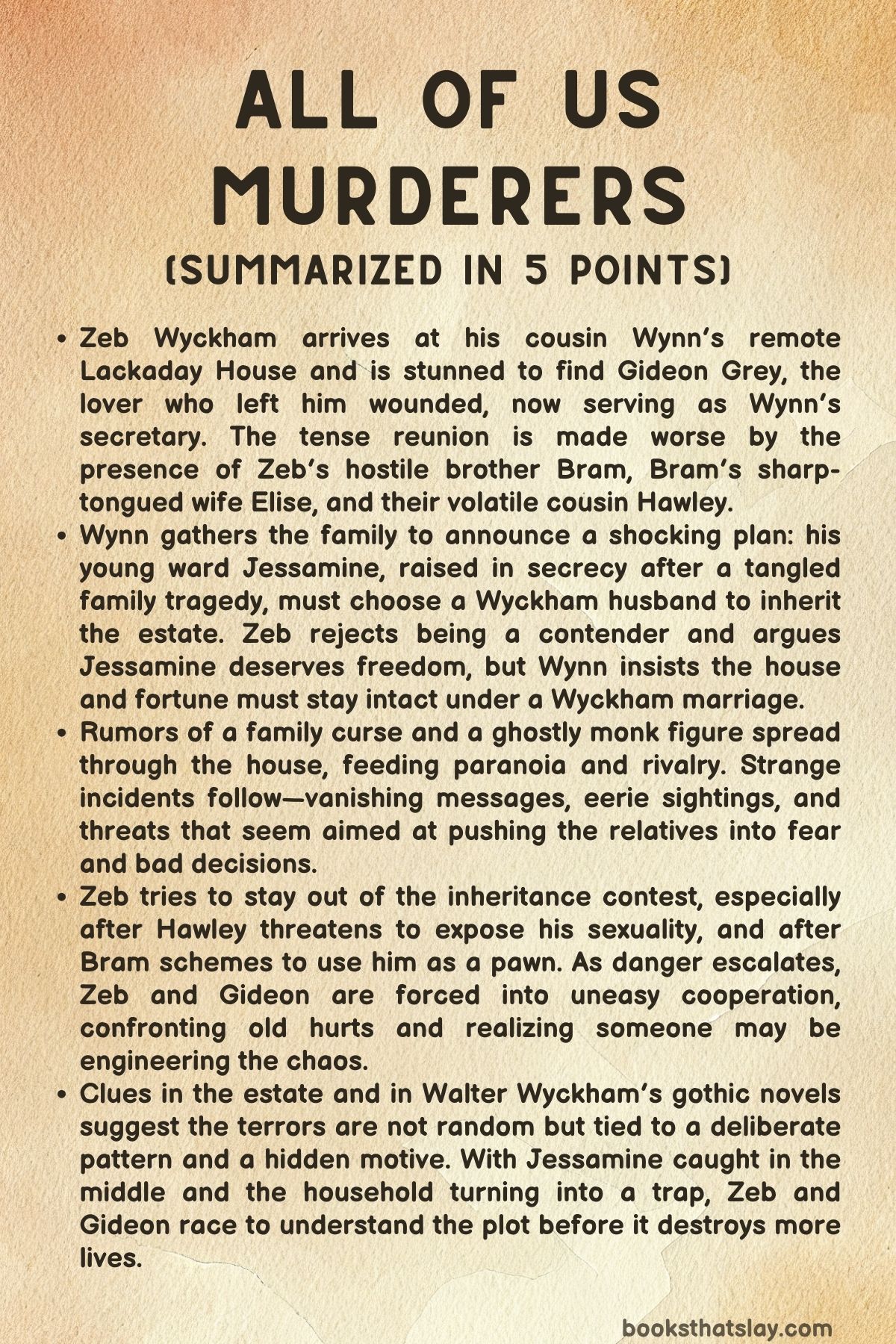
All of Us Murderers by KJ Charles is a gothic-leaning historical mystery set in a remote Dartmoor estate where family rot has had generations to harden. Zeb Wyckham, the younger son with a messy past and little to his name, arrives at Lackaday House expecting an awkward visit with relatives he barely likes.
Instead he finds a household simmering with grudges, a sheltered young heiress at the center of a forced-marriage scheme, and Gideon Grey—his former lover—now serving as the master’s secretary and clearly nursing old anger. As fog closes in around the house, secrets, threats, and staged “hauntings” turn a family gathering into a fight for survival and truth.
Summary
Zebedee “Zeb” Wyckham reaches Lackaday House late on a bitter November night, already uneasy about spending two weeks with the Wyckham relatives who have never cared for him. The estate feels like a fortress: high walls, iron gates, and a mansion that looks more like a mausoleum than a home.
His arrival is made worse when he sees a young woman fleeing the front steps in tears, and then realizes the man who ushers him inside is Gideon Grey, the lover he left behind years ago. Gideon is now confidential secretary to Zeb’s cousin Wynn Wyckham, owner of the house, and the frost in his manner makes it clear he has not forgiven Zeb.
Dinner quickly becomes a battlefield. Wynn greets Zeb warmly, but the rest of the family falls into old patterns.
Zeb’s older brother Bram is sharp-tongued and openly contemptuous, Bram’s wife Elise is cold and watchful, and their cousin Hawley is charming in the way a blade can be charming—smiling while it cuts. Colonel Dash, another cousin, offers only polite remarks.
The missing young woman is Jessamine Wyckham, Wynn’s ward, whose absence hangs over the table. Wynn explains that Jessamine is the granddaughter of his aunt Laura, whose illegitimate line was erased and hidden by earlier Wyckhams.
Determined to protect Jessamine from the cruelty that destroyed her mother and grandmother, Wynn has raised her in secrecy and now wants to place her safely within the family.
Then Wynn announces his real purpose: the Lackaday fortune and estate will not be divided. Instead, one of the men present will marry Jessamine, and the couple will inherit everything.
Jessamine will be allowed to choose during this fortnight; if she chooses no one, Wynn will decide the heir himself. Bram assumes the estate is his by right and explodes with rage.
Hawley treats the scheme as sport. Zeb is horrified.
Gideon watches Zeb as if expecting him to lunge for the prize.
The next day Zeb tries to leave, but first meets Jessamine properly. She is eighteen, lively, starved for companionship, and curious about the house.
She tells Zeb stories about an old monastery that once stood on the land and insists something unquiet remains. Zeb, who expects to dislike her on principle, finds her company easy and sincere.
When he confronts Wynn in private, he refuses to be a candidate for marriage and argues that Jessamine should be given independence, not turned into a gateway to property. Wynn stands firm.
He adds a grim urgency: the Wyckhams are shadowed by what he calls a curse. Since their grandfather Walter, no Wyckham spouse or child has lived past fifty.
Wynn says Walter supposedly bargained to save himself by trading away the long lives of his descendants, and that Wynn himself—now forty-nine—has been told by his doctor he has less than a year to live. Wynn makes Zeb promise to stay the full fortnight and keep the illness secret.
Zeb, shaken, agrees.
Strange occurrences begin to spread through the house like a bad smell. Jessamine claims she has seen a cowled figure in the west wing—a faceless monk that freezes her with fear.
At dinner Wynn confirms he has seen it too and warns them never to look under its hood. Zeb points out how closely the story resembles Walter Wyckham’s lurid novels, especially one about a monastery phantom, but Wynn insists the books were based on reality.
Hawley, half-drunk and gleeful, decides to hunt the ghost, while Bram dismisses everything as Jessamine’s fancy.
The family’s contempt for one another sharpens. Bram tries to recruit Zeb into an “alliance”: Zeb should marry Jessamine to block Hawley, while Bram would control the estate and give Zeb an allowance.
Zeb refuses, furious at being offered a gilded cage. Hawley, sensing weakness, corners Zeb later and threatens to expose his homosexuality if Zeb interferes with Hawley’s pursuit of Jessamine and the inheritance.
Zeb is left rattled, aware that his safety in the house is tied to secrets he can’t afford to have dragged into daylight.
That night Zeb sees the monk figure himself. He chases it through empty corridors, but it vanishes without a sound.
Soon after, a cruder threat appears: obscene graffiti aimed at Hawley, then disappearing as if it never existed. Hawley grows jumpy and paranoid, claiming he sees unnatural shadows and warning that sins call for payment.
Zeb still suspects drink and arrogance rather than the supernatural, but he can’t deny that someone in the house is orchestrating terror.
Matters turn deadly. After a tense dinner, Zeb returns to his room to find it swarming with huge black spiders.
He bolts into the corridor in panic and collides with Gideon. Gideon confirms the spiders were placed there deliberately and discovers a removable strip of wallpaper daubed with “Sodomite,” meant to frighten Zeb and then be removed to erase evidence.
The attack forces Zeb and Gideon into the same room, the same fear, and finally the same truth. They argue out their old breakup, the hurt on both sides, and the way Wynn’s invitation dragged them into collision.
Grief and desire crack the distance between them; they reconcile and sleep together. Once calm returns, Gideon insists the danger is real and escalating.
He believes Wynn is behind it all, using the house and its legends to push the family toward a chosen outcome. Zeb admits Wynn’s claim to be dying; Gideon doubts it, noting the lack of preparation or proof.
The next morning Colonel Dash vanishes. Wynn announces Dash has a fever from old malaria and must be left alone, but Zeb finds Dash’s room empty and unslept in.
Worse, Jessamine leads Zeb to the stone circle on the moor, where the altar is slick with fresh blood. She fears Dash has been killed there.
Zeb thinks the scene is staged, but it confirms that someone is willing to terrorize Jessamine as well.
Then Elise dies in a supposed accident. Wynn orders the family to carry her to the crypt before any doctor or police arrive.
The procession feels choreographed, and Zeb refuses to enter the crypt, certain Wynn wants him locked inside. When he returns to the house, Gideon reveals that the car sent for help was turned back and the gates have been locked.
They are prisoners.
Zeb puts pieces together in the library. He finds Wynn’s notes listing Walter’s wives and descendants, their ages at death, and calculations showing Wynn believes lives can be traded.
Wynn has written that if the current Wyckhams die now, their years will extend his own life past fifty. Zeb realizes the “curse” is not a family tragedy to Wynn—it is a plan.
Meanwhile Gideon is captured by servants loyal to Wynn. A maid named Rachel frees him and confesses the staff’s motive: the Wyckham men have ruined multiple servants and local women over the years, and the household has decided that Wynn’s purge is justice.
Rachel, however, believes Zeb and Gideon don’t deserve to die and offers them a chance to escape via a delivery cart.
Zeb goes to warn Bram and finds him unhinged, suggesting he killed Elise himself and thinks it cleared his way. Wynn enters, lies that Zeb has a gun, and manipulates Bram into hunting Hawley.
Jessamine, unexpectedly firm, locks Zeb in the library. Gideon reaches him through a hidden panel, and together they flee through secret tunnels, choking dust, and crawling spiders, reaching the delivery cart in time to slip out through the gate.
At the inquest Wynn and the servants present a tidy story: Bram murdered Elise, Hawley shot Bram, and Hawley then killed himself. Zeb’s attempts to speak are shut down.
Wynn retreats into seclusion with Jessamine. On the eve of Wynn’s fiftieth birthday, the gas plant explodes and Lackaday House burns.
Wynn’s body is found in the ruins, Dash’s corpse is recovered from a well, and Jessamine disappears, later rumored to have fled abroad with stolen wealth. Zeb inherits the fortune but refuses to benefit from money rooted in Walter’s slave-trading past.
He places it in a trust to repay the exploited islands, with Gideon helping to run it. Free of Lackaday House at last, Zeb builds a long career as a writer, while the Wyckham name fades into the ash it earned.
Characters
Zebedee “Zeb” Wyckham
Zeb is the emotional lens of All of Us Murderers, arriving at Lackaday House expecting an awkward family visit and instead stepping into a gothic trap. He begins the story visibly precarious—unemployed, repeatedly judged as unreliable, and still raw from a bitter breakup with Gideon—yet his instability is paired with a surprisingly stubborn moral core.
Zeb’s first instinct is flight, but once he understands Wynn’s scheme, his conscience won’t let him simply save himself. What makes Zeb compelling is that his ethics are not abstract virtue but hard-won: he refuses the inheritance not because he is above money, but because he has learned its origin in slavery and exploitation and cannot un-know that truth.
His arc is a slow movement from shame and avoidance toward clarity and responsibility, culminating in him inheriting the fortune only to redirect it into reparative justice. Zeb’s courage is messy—he panics, snaps, misjudges people, and keeps trying to run—but again and again he re-centers on protecting Jessamine, warning Bram, and standing with Gideon.
By the end, Zeb is not “redeemed” into perfection; rather, he survives long enough to choose what kind of man he will be, and that choice is grounded in accountability, love, and refusal to perpetuate inherited harm.
Gideon Grey
Gideon is Zeb’s former lover turned Wynn’s confidential secretary, and for much of the book he embodies controlled frost: clipped, dutiful, and visibly contemptuous of Zeb’s reputation. But that chill is armor built from a specific wound.
Gideon’s bitterness is less about moral superiority and more about betrayal, poverty, and fear of being dragged down again. His life has narrowed into survival after Zeb’s past scandal cost him professional security, and Wynn’s employment is a lifeline he cannot afford to lose.
That dependency makes him vulnerable to Wynn’s manipulation and initially blinds him to Zeb’s sincerity. Gideon’s character shines in the way his practicality coexists with deep feeling: even while accusing Zeb of scheming, he follows him into danger, cleans spiders from his belongings, and, once the old hurt is spoken aloud, returns to love with fierce immediacy.
Gideon is also the story’s clearest strategist; he is the first to frame the events as purposeful malice, the one pushing for allies and escape routes, and finally the steward of Zeb’s reparations trust. His eventual reconciliation with Zeb is not a soft forgiveness but a mutual reckoning—two men who accept their damage, name their guilt, and choose each other anyway.
Wynn Wyckham
Wynn is the architect of Lackaday House’s nightmare and one of the novel’s most unsettling figures because he never fully reads as a theatrical villain; he is genial, reasonable-sounding, and often paternal in his manner. His stated motive is preservation—keeping the estate intact and ensuring Jessamine’s future—yet that surface care masks a desperate, possessive hunger.
Wynn’s belief in the “Wyckham curse” reveals how he rationalizes cruelty: he turns superstition into arithmetic, family history into a ledger of lives to be traded for his own extension. He also weaponizes narrative itself, staging horrors drawn from Walter Wyckham’s novels, blurring fiction and reality until everyone doubts their senses.
The result is a man who treats people as characters in his plot and deaths as necessary “beats” to reach his ending. Wynn’s manipulation is intimate: he knows everyone’s pressure points—Bram’s entitlement, Hawley’s terror of exposure, Gideon’s job insecurity, Zeb’s shame and tenderness—and plays them like instruments.
His downfall is both poetic and grimly consistent; consumed by the very gothic machinery he revived, he dies with Lackaday House, leaving behind only scorched ruins and a legacy of lies.
Jessamine Wyckham (Jessamine Evans)
Jessamine enters as a sheltered eighteen-year-old ward whose innocence makes her the nominal prize in Wynn’s inheritance contest, yet she steadily reveals a sharper, stranger edge. She is curious, hungry for stories, and more resilient than her upbringing suggests; her eagerness to talk books with Zeb and her fascination with the monastery legend show a mind straining against confinement.
At the same time, Jessamine is deeply shaped by isolation and by Wynn’s possessive caretaking, which mixes devotion with control. She becomes both victim and instrument as the plot thickens: frightened by the monk-figure yet coerced into ceremonies, locking Zeb in the library under Wynn’s influence, and serving as a symbolic centerpiece for the inheritance ritual.
The ambiguity around her true identity—whether she is truly Georgina’s child or a fraud installed by Wynn—casts a long shadow over her actions, making her final disappearance both sinister and liberating. If she is a victim, she escapes a cage built from bloodlines and greed; if she is a collaborator, she slips away with the spoils of a family that tried to use her body as property.
Either way, Jessamine is the story’s living proof of how innocence can be weaponized by those who claim to protect it.
Bram Wyckham
Bram is Zeb’s older brother and the most straightforward embodiment of Wyckham entitlement. He approaches Lackaday House already assuming ownership, taking Wynn’s inheritance plan as a personal insult rather than a moral problem.
Bram’s cruelty is casual and habitual: he belittles Zeb as incompetent, attacks Hawley’s character, and treats Jessamine as a mechanism in his own future. Yet Bram is not merely arrogant; he is also brittle, intensely invested in status, and terrified of losing control.
His proposed “alliance” with Zeb—where Zeb marries Jessamine so Bram can still rule—shows his worldview with brutal clarity: people exist as tools, and love or autonomy are irrelevant next to lineage and power. As the house’s horrors escalate, Bram’s psyche fractures into delusion.
He convinces himself that murder is justified, even guided by spectral “influence,” because it aligns with his ambition. His end is the natural conclusion of a life built on domination: he dies in a spiral of violence he helped unleash, unable to distinguish desire from destiny.
Elise Wyckham
Elise is Bram’s wife, and though she occupies less page-time than some, her presence is razor-sharp. She is socially poised, perceptive, and emotionally self-contained, choosing detachment as both defense and tactic in a household of men treating inheritance like warfare.
Elise’s refusal to be baited by Bram, Hawley, or Wynn shows her as the clearest-eyed realist among the family, someone who understands that emotional reactions are another currency others spend to control you. Her suspicion that Jessamine may be a fraud, and her recollection of previous Wyckham greed, indicate a memory for patterns and a refusal to be gaslit by “family stories.” She is also the character who most openly measures advantage, not out of coldness but out of survival in a patriarchal system that offers women few honest levers.
Her death, staged like one of Walter’s gothic set pieces, is thus doubly cruel: it removes the most rational counterweight in the house and turns a woman who fought to stay autonomous into a prop in Wynn’s narrative.
Hawley Wyckham
Hawley is the volatile cousin whose charm and depravity share a bloodstream. He performs the role of the decadent artist—handsome, hungover, flirtatious, disdainful of Bram’s “practicality”—but beneath that performance is predation and panic.
Hawley’s flirtation with Jessamine is not romantic; it is conquest, a way to win both inheritance and power over Wynn’s living treasure. His threats to expose Zeb’s sexuality reveal how easily he uses social ruin as a weapon, and Rachel’s testimony that he assaulted her exposes the deeper truth: Hawley treats other people’s bodies and lives as toys in his private theatre.
Yet as the haunting intensifies, Hawley becomes the most visibly frightened, not because he has a conscience but because he senses that retribution is finally in the room. His talk of sins demanding payment reads like a man haunted by his own crimes, projecting guilt into shadows.
Hawley’s end—killing Bram then himself, according to the official story—fits his life of violence turned inward, whether that account is true or engineered by Wynn. He is the Wyckham rot made flamboyant: beautiful on the surface, corrupt at the core, and ultimately consumed by the darkness he helped spread.
Colonel Wyckham Dash
Colonel Dash is the aging second cousin who initially seems a civil, peripheral figure, largely defined by his colonial past and a veneer of politeness. His presence in the marriage scheme is grotesque in its own quiet way: the idea of him marrying Jessamine underscores how little her consent matters to Wynn’s plan.
Dash’s history of malaria from Africa and the whispers of servants he has harmed connect him to the broader network of imperial exploitation and personal cruelty that shadows the Wyckham wealth. His sudden “illness” and disappearance are among the first concrete signs that Wynn’s plot has moved from intimidation to murder.
Dash’s death, discovered later in a well, positions him as one of Wynn’s sacrifices and also as a symbol of the old colonial world sinking into the estate’s hidden rot. He is less psychologically layered than others, but his fate is crucial: he is proof that Wynn is willing to kill family outright, and that the estate’s past violences are not abstractions but living debts.
Walter Wyckham
Although dead before the story begins, Walter’s presence saturates All of Us Murderers as both ancestor and author of the family’s self-mythology. His gothic novels provide the blueprint Wynn uses to orchestrate terror, turning Walter into a kind of posthumous accomplice.
More significantly, Walter is the origin-point of the family’s moral stain: his fortune came from slave trading and plantations, and that wealth is the invisible engine driving every present conflict. The so-called “curse” attached to Walter functions as inherited guilt in narrative form, a way for later Wyckhams to frame their deaths as supernatural fate rather than consequences of violence, greed, and fear.
Through Zeb’s refusal of Walter’s money and his creation of a reparations trust, Walter becomes the figure against whom the future is defined. He is the past refusing to stay dead: a man who profited from human suffering, wrote popular horrors, and left a legacy that finally demands a different ending.
Rachel
Rachel, the housemaid, is the moral pivot of the servant storyline and one of the most humanly complex characters in the novel. At first she appears aligned with the household’s menace, but her eventual confession reframes everything: she lied that Bram raped her to shield Florence, because the true perpetrator was Hawley and Florence had no voice to accuse him.
Rachel is driven by a fierce, improvised justice born from powerlessness; in a world where servants are disposable and gentry crimes go unpunished, she chooses the weapon she has—story. Her collaboration with Wynn is not love of cruelty but desperation for reckoning, and her decision to save Zeb and Gideon shows the limits of even righteous vengeance.
Rachel distinguishes between monsters and flawed men, refusing to let the cycle of punishment expand endlessly. She is a reminder that morality in this house is not divided neatly by class; instead, it is warped by suffering, loyalty, and the brutal arithmetic of who is allowed to be believed.
Florence
Florence never speaks in the narrative directly, yet she exerts quiet gravitational force. As the abandoned, pregnant girl tied to Bram’s past and to Rachel’s protective lie, she represents the collateral damage of Wyckham male privilege.
Florence’s silence is not emptiness but enforced absence: the story repeatedly shows how women like her are erased, their pain turned into gossip or leverage for others. The chauffeur’s grief and rage are rooted in Florence’s ruin, and the servants’ alliance with Wynn draws energy from the collective knowledge that Florence’s fate is not exceptional but typical.
She stands for the lives the Wyckhams break without consequence, making the servants’ hunger for retribution feel tragically inevitable.
Jerome
Jerome appears briefly but radically alters the moral stakes of the book. As a Black Wyckham cousin descended from Walter’s enslaved victims, he provides the truth Zeb cannot ignore: the family fortune is not merely tainted but built directly on stolen lives.
Jerome’s existence punctures the Wyckhams’ self-contained mythology and makes the inheritance question a matter of historical responsibility rather than domestic rivalry. He is the voice of the real world entering gothic fiction, and his influence persists through Zeb’s final decision to turn the wealth outward toward reparations.
Jerome is less a supporting character than a moral north star, the reminder that this family’s horrors are not only supernatural theatrics but the aftershocks of slavery and empire.
Themes
Inheritance, Power, and the Economics of Control
Inheritance in All of Us Murderers is not a neutral transfer of property but a system of leverage that determines who is safe, who is dependent, and who is disposable. Lackaday House stands as a physical embodiment of that logic: the locked gate, the wall, the long drive, and the sense of being trapped all translate money into architecture and architecture into obedience.
Wynn’s plan to marry Jessamine to a Wyckham heir turns succession into a kind of auction where family members must perform desire, virtue, or entitlement to secure survival. It exposes how wealth can be used to manufacture intimacy and dictate futures.
Jessamine’s supposed “choice” is a counterfeit freedom because the parameters are designed by Wynn; the candidates are selected in advance, the stakes are existential, and Jessamine’s own needs are secondary to the estate’s continuity. The men respond according to the roles money has assigned them for years: Bram assumes the fortune is his by right; Hawley treats it as a prize to be won through charm and threat; Dash treats it as a late-career convenience; Zeb rejects it as poison.
None of these responses are purely personal. They are shaped by class position, past humiliation, and the knowledge that in this family money equals legitimacy.
Wynn’s obsession with keeping the estate whole also reveals a deeper theme about property as identity. He does not only want an heir; he wants a story that makes him the guardian of tradition and the savior of a wronged girl.
The plan lets him play patriarch, moral reformer, and ultimate judge all at once. That fantasy depends on other people surrendering autonomy in exchange for security.
When they resist, he escalates from emotional manipulation to staged terror, demonstrating the continuum between financial coercion and outright violence. Elise’s death, the servants’ collusion, and the final inquest show that money doesn’t just purchase comfort; it purchases narratives.
The official story erases Wynn’s responsibility and frames the deaths as tragic family chaos rather than a calculated campaign. In that sense, inheritance operates as a power to define reality itself.
Zeb’s eventual decision to place the fortune in a reparative trust is not simply a moral gesture; it is a refusal of the usual script in which wealth stabilizes the family line. By redirecting the money away from Lackaday House’s self-perpetuating machinery, he breaks the logic that the estate must survive at any cost, and exposes how thoroughly that logic has been tied to cruelty.
Gothic Performance, Fear, and the Manufacture of Reality
The haunting at Lackaday House functions less as a supernatural mystery and more as a study of how fear is built, staged, and believed. The cowled figure, the flickering gaslight, the spiders, the disappearing graffiti, and the blood at the stone circle are all tools that exploit expectation.
The family already lives inside a world shaped by Walter Wyckham’s novels and the myth of the Wyckham curse. Wynn understands that and uses it.
By recreating scenes that echo Walter’s fiction, he blurs the boundary between story and lived experience. The victims’ minds do much of the work for him; they interpret shadows through inherited anxieties, and the house amplifies that readiness to believe.
The effect is not simply to frighten them, but to push them into the roles Wynn wants: Bram becomes the violent protector; Hawley becomes the paranoid rival; Jessamine becomes the trembling ward who needs rescue; Zeb becomes the reluctant moral center who can be isolated and discredited.
Fear also alters perception in ways that serve power. Once the family accepts that the house hosts a monk-figure and a curse that punishes sin, every conflict acquires a moral coating.
Hawley’s threats feel like the behavior of a doomed villain, Bram’s rage looks like fate rather than choice, and Wynn can present himself as the only person interpreting the signs correctly. The servants’ grievances fit neatly into this designed atmosphere as well.
They need a stage where revenge feels righteous, not criminal, and the gothic trappings provide that stage. The staff interpret Wynn’s plot as justice because the environment tells them that Lackaday House is a place where past wrongs return in ritual form.
In effect, the haunting is a social technology that recruits everyone’s private resentments into a shared hallucination of meaning.
The novel also suggests that gothic performance is a cousin to storytelling itself. Wynn manipulates by writing a living novel in which the others are characters.
The more carefully he imitates Walter’s plots, the more he can claim inevitability: the house is “out of time,” sins require retribution, and the curse demands sacrifice. This frame is persuasive because it offers everyone a reason their suffering has to happen.
It is easier to accept terror as destiny than to admit one is being controlled by a man with a timetable and a ledger. Zeb’s role as a reader and later a writer becomes essential here.
He recognizes the patterns, names them, and by doing so punctures their authority. The counterforce to gothic manipulation is not brute strength but critical attention: seeing that what feels like fate may be an authored scenario.
When Zeb and Gideon escape through the hidden passages, it isn’t just a physical exit; it is a rejection of the story Wynn tried to trap them inside.
Family as a System of Harm and the Possibility of Refusal
The Wyckham family is portrayed as a machine that reproduces damage across generations, with each member trapped in positions created long before they were born. The backstory of Laura, Georgina, and Jessamine introduces a history of women punished for sexuality while men protect the family name by lying, exiling, or hiding the evidence.
That pattern repeats in the present. Wynn believes he is “saving” Jessamine, but his salvation looks like confinement, surveillance, and marriage as repair.
Bram’s misogyny and entitlement mirror the earlier patriarch who drove Laura away. Hawley’s predation on servants and willingness to blackmail Zeb echo the exploitative freedoms that privileged men have long exercised without consequence.
Even the traditional family rituals—dinners, processions to the crypt, public mourning—serve more as performances of control than expressions of care. Affection is conditional; belonging is transactional; vulnerability becomes ammunition.
Zeb’s return to the family home reveals another dimension of this theme: the cost of being labeled a failure within an unforgiving kinship structure. He arrives already placed at the bottom of the hierarchy, judged for unemployment, past mistakes, and difference.
The family expects him to accept shame as his natural state. That expectation is so strong that even Gideon initially believes Zeb must be angling for the inheritance, because in the Wyckham world morality is assumed to be a pose for profit.
Zeb’s struggles show how family can distort self-understanding. He is constantly forced to justify his existence, to explain that he wants nothing from them, and to defend his right to live beyond their definitions.
Yet the novel does not treat this system as inescapable. Refusal becomes a radical act.
Zeb refuses Bram’s alliance, refuses to be part of Wynn’s marriage scheme, refuses to accept the Wyckham money as clean, and refuses to surrender Gideon when saving Bram might cost him that love. Each refusal is costly, because family punishment operates through guilt, threat, and social ruin.
But these refusals also open a path to a different life. The final line about happiness is not sentimental; it states that distance from a toxic family can be a legitimate form of survival.
The fact that Zeb and Gideon build their future outside Lackaday House reinforces that family is not destiny. The Wyckham name, the estate, and the curse all insist on inevitability, but the narrative counters with choice.
Even small choices—like telling the truth, exalting a relationship based on mutual respect, or redirecting an inheritance toward repair—reshape what lineage means. The family system harms because it insists that loyalty is owed no matter what.
The novel’s moral claim is that loyalty can be withdrawn when it sustains cruelty.
Queer Love, Secrecy, and the Moral Politics of Desire
Zeb and Gideon’s relationship is shaped by a society where queerness is both intimate truth and public danger. Their past together ended in pain, and the reunion at Lackaday House forces them to confront not only personal hurt but the social structures that made that hurt more likely.
Gideon’s harshness at Zeb’s arrival reads as pure bitterness at first, but it emerges as a defensive posture developed in a world where a ruined reputation can mean poverty, exile, or blackmail. Hawley’s threat to expose Zeb’s sexuality is a reminder that desire is weaponized by those with social capital.
It is not just a private matter; it is a lever that can decide employment, safety, and access to community. The slur on Zeb’s wall literalizes that vulnerability.
The house itself becomes an echo chamber of surveillance, where corridors, servants, and kin all function as possible witnesses.
Within that pressure, love becomes both risk and refuge. The reconciliation after the spider attack is not framed as a sudden romantic reset.
It is a hard-won peace built through confession, accountability, and a shared recognition of fear. They address how pain was caused, how misunderstanding festered, and how pride prevented repair.
The intimacy that follows is tender but also practical: it restores Zeb’s stability and reminds Gideon that his life is larger than a job dependent on Wynn’s favor. Love is shown as a way to reclaim agency in a setting designed to strip it away.
The novel also places queer desire in a moral contrast with the predatory heterosexual scripts around it. Wynn’s marriage plan commodifies Jessamine; Hawley’s flirtation with her is a strategy for wealth; Bram sees women as property and obstacles.
Against this, Zeb and Gideon’s bond is rooted in mutual recognition. It is not free from imbalance—Gideon fears unemployment, Zeb fears family shame—but it seeks honesty rather than domination.
That difference matters because the plot often confuses desire with possession. Wynn claims he wants Jessamine “safe,” but his safety means ownership.
Hawley’s desire for Jessamine is conquest. Bram’s desire for legitimacy is control through a proxy marriage.
Zeb and Gideon’s desire does not serve inheritance at all; it actively disrupts it. Their partnership is a force that Wynn cannot incorporate into his scenario, which is why he tries to isolate Gideon, threaten his livelihood, and place Zeb under suspicion.
In the aftermath, their life together is outwardly modest compared with the estate’s grandeur, yet it carries a different kind of legitimacy. Gideon managing the reparative trust alongside Zeb’s writing career suggests a future where love does not have to hide inside corridors or be reduced to leverage.
The theme is not that queerness is tragic by nature, but that it must negotiate a hostile world—and can still produce resilience, moral clarity, and a reimagined home.
Historical Guilt, Slavery, and the Ethics of Repair
Walter Wyckham’s fortune, derived from slave trading and plantations, turns the family saga into a reckoning with history that refuses to stay buried. The revelation of this origin is not treated as background detail; it squarely challenges the moral foundation of the inheritance plot.
Wynns’s fortune is soaked in exploitation, and the estate’s very grandeur becomes a monument to violence that was outsourced to distant islands. Zeb’s knowledge comes through Jerome, a Black cousin descended from the enslaved people Walter profited from.
That genealogical link shows how slavery created not only wealth but family lines entangled in unequal ways. The Wyckhams are heirs to luxury, while Jerome is heir to dispossession and trauma.
By staging this revelation inside the house packed with Walter’s gothic novels, the story suggests that the family’s taste for horror is itself a displacement of real-world horror they would rather not face.
Wynn’s use of the “curse” language also intersects with this theme. He frames their deaths before fifty as supernatural punishment tied to a bargain, but the narrative hints at a more grounded moral logic: guilt seeks a form, and families built on atrocity often generate myths to explain their unease.
The haunting and talk of retribution are shaped by the knowledge, even if unspoken, that the Wyckham line has done monstrous things. Servants who were harmed by Hawley, Bram, and Dash join Wynn’s plot because they see it as justice; their personal grievances mirror the wider historical grievance that the family’s power is illegitimate.
The estate is thus a local expression of a global economy of harm.
Zeb’s refusal to accept the inheritance as personal reward is key. He understands that benefiting from the money without addressing its source would make him complicit.
His decision to place the fortune into a trust to repay the exploited islands is presented as an act of repair rather than charity. It confronts the core question: what do descendants owe to the victims of their ancestors?
The narrative avoids portraying Zeb as saintly; he is frightened, flawed, and often reactive. But he is also willing to break with family tradition by recognizing debts that the Wyckhams have avoided for generations.
Importantly, this reparative move is collective in its vision. It is not about Zeb absolving himself; it is about shifting resources toward communities that were structurally robbed.
Gideon’s role as manager of that trust adds another layer: their partnership redirects wealth away from the estate model and into a different ethical framework. The novels Walter wrote remain “poorly regarded,” suggesting that artistic legacy cannot wash away economic cruelty.
What endures instead is the attempt to repair. The theme insists that history is not past; it is a living ledger, and moral adulthood requires deciding what to do with what one has inherited.