All That She Carried Summary and Analysis
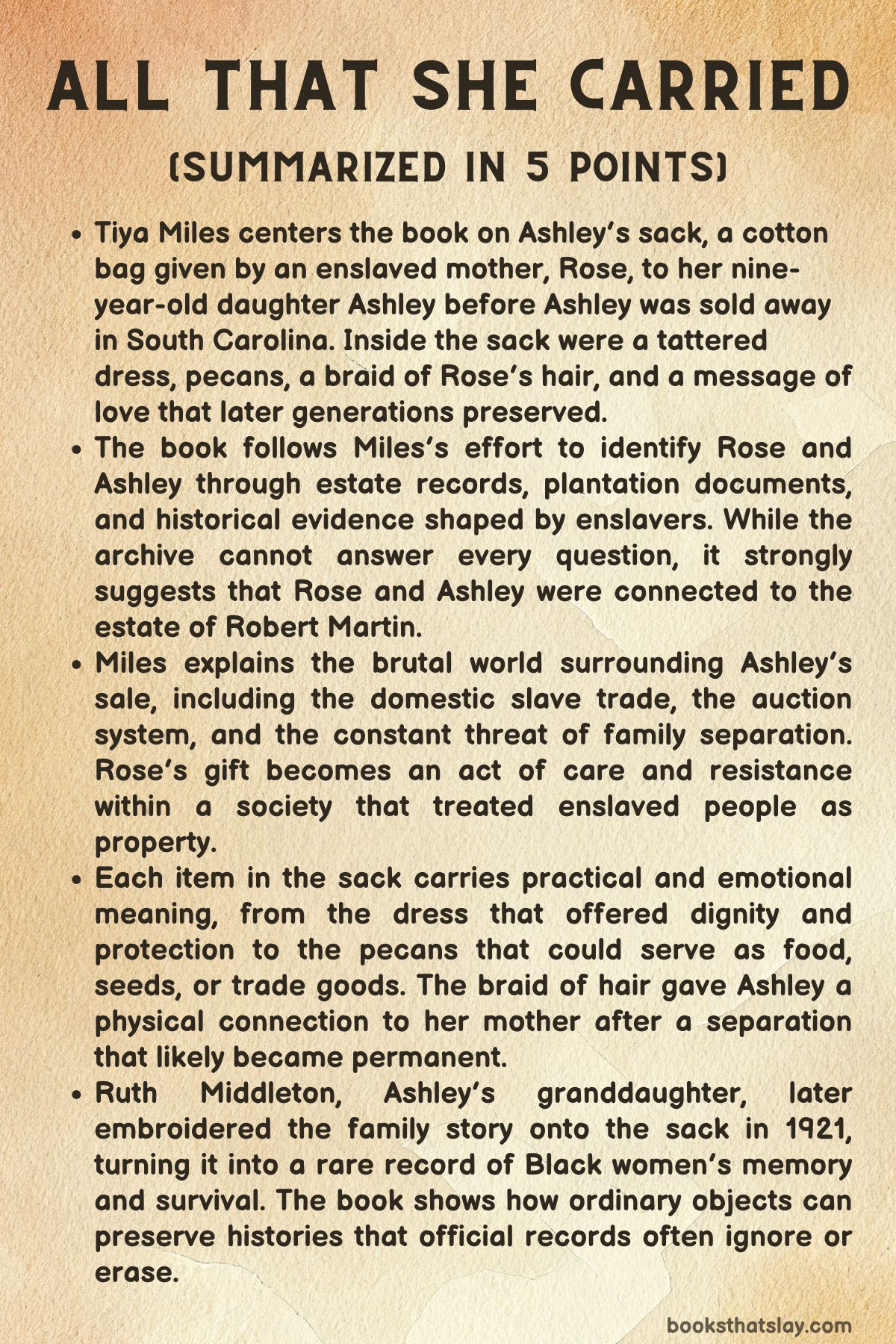
All That She Carried: The Journey of Ashley’s Sack, a Black Family Keepsake by Tiya Miles is a work of narrative history centered on a single object: a cotton sack passed from an enslaved mother, Rose, to her nine-year-old daughter, Ashley, before Ashley was sold away in South Carolina. Years later, Ashley’s granddaughter Ruth Middleton embroidered the family story onto the sack, preserving a record of loss, love, survival, and memory.
Miles uses this artifact to recover the lives of Black women whose stories were rarely protected by official archives. The book is about slavery, family separation, inheritance, and the power of ordinary objects to carry history forward.
Summary
All That She Carried begins with the death of Robert Martin, a wealthy South Carolina planter, in December 1852. His death set in motion the legal and financial process of dividing his estate, a process that treated enslaved people as property to be valued, transferred, or sold.
Among those caught in this system were Rose, an enslaved woman in her thirties, and her young daughter Ashley. Rose understood what Martin’s death could mean.
Estate settlements often broke enslaved families apart, and she knew that Ashley might soon be sold away from her forever.
Faced with that fear, Rose prepared a cotton sack for Ashley. Into it she placed a tattered dress, three handfuls of pecans, a braid of her own hair, and, as Ruth Middleton later recorded, her love.
The sack was not merely a container of supplies. It was a mother’s attempt to give her child protection, memory, and a sense of belonging in a world designed to strip both from her.
Rose had little power over the legal forces controlling her life, but through the sack she made a final act of care and choice.
Decades later, in 1921, Ruth Middleton embroidered the family story onto the sack. She identified Rose as her great-grandmother, Ashley as her grandmother, and explained that Ashley had been sold at age nine in South Carolina.
Ruth’s inscription transformed the sack into a written record, a family document, and a public testimony. Her use of embroidery matters deeply.
Through needlework, she preserved a story passed down through generations of women. The sack became a bridge between Rose, Ashley, Ruth, and the descendants and viewers who would later encounter it.
Miles examines the sack as both an object and a witness. The sack itself was made of plain cotton and likely produced for agricultural use.
It had been repaired and patched, showing that it was handled with care across time. Objects owned, made, touched, or carried by enslaved people are rare in museum collections, because slavery deprived people not only of freedom but also of secure possession.
Wealthy white families left behind houses, portraits, furniture, and written records; enslaved Black people were often denied the chance to preserve their own material histories. For this reason, Ashley’s sack is extraordinary.
The book follows Miles’s effort to identify the Rose and Ashley named in Ruth’s embroidery. The historical record is incomplete and shaped by enslavers, not by the enslaved women themselves.
Miles searches estate records, inventories, and plantation documents, knowing that these records were created to count property, not to honor human lives. She finds that Robert Martin’s estate included a woman named Rose and a child named Ashley.
Because Ashley was an uncommon name among enslaved girls in the relevant records, and because the evidence aligns closely with Ruth’s account, Miles concludes that these are very likely the Rose and Ashley of the sack.
Rose appears in the records as a domestic servant in Martin’s Charleston household. Her assigned monetary value suggests that she may have possessed a skilled ability, perhaps in cooking or sewing.
Ashley, however, was listed at a plantation property rather than in the same household as Rose. Even before the sale, mother and daughter may have been separated by labor arrangements, though they likely still saw each other at times.
Martin’s death threatened to destroy even that fragile connection.
Miles places Rose’s decision within the larger violence of the domestic slave trade. In the years before the Civil War, enslaved people were sold in huge numbers from older coastal regions into the expanding plantation territories of the South and Southwest.
Sale could mean long journeys, brutal labor, isolation from kin, and exposure to physical and sexual abuse. Rose would have known these dangers.
Her sack was shaped by practical knowledge: a child might need clothing, food, trade goods, warmth, and something that proved she had been loved.
Each item in the sack carries meaning. The tattered dress points to the harsh clothing conditions imposed on enslaved people.
Clothing issued to enslaved workers was often poor in quality, inadequate, and meant to mark them as inferior. For girls and women, insufficient clothing also increased vulnerability in a society that already treated Black female bodies as available for exploitation.
By giving Ashley a dress, Rose may have been trying to offer modesty, dignity, and protection.
The braid of Rose’s hair is equally powerful. Hair could be a site of control under slavery, especially for Black women, whose bodies were subject to punishment, surveillance, and forced humiliation.
By cutting and giving her own braid, Rose claimed control over part of herself and gave Ashley a physical piece of her mother. In the nineteenth century, keepsakes made from hair were common expressions of remembrance and mourning.
Rose’s braid served that purpose too: it was a relic of the body, a sign that Ashley’s mother remained with her even after separation.
The pecans were practical and symbolic. They could feed Ashley, especially if she had to travel or survive with little support.
They were also valuable and could potentially be traded. Because pecans were not yet common in South Carolina, Rose may have obtained them through kitchen work or access to the household’s food stores.
They were small enough for Ashley to carry, but rich in usefulness. They also carried the possibility of planting and future growth, suggesting nourishment beyond the immediate moment.
Ashley’s sale itself is reconstructed through fragments. Miles concludes that Ashley was likely sold within South Carolina, not to the far interior lands Rose may have feared most.
Later records place Ashley’s descendants in Columbia, suggesting a Midlands connection. Rose’s own fate remains uncertain.
She may have been sold, she may have remained nearby, or she may have died in captivity. The record cannot say with certainty.
This absence is part of the book’s argument: the lives of enslaved Black women were often made invisible by the very systems that controlled them.
The story then moves to Ruth Middleton, the woman who embroidered the sack. Ruth was born Ruth Jones in South Carolina and later moved to Philadelphia during the Great Migration.
Like many Black Southerners of her generation, she left a region marked by racial violence and limited opportunity for a northern city that offered new possibilities but also new hardships. In Philadelphia, Ruth built a life through church, social clubs, friendships, fashion, and community life.
She became part of a world where Black women used domestic arts, social networks, and mutual support to assert dignity and belonging.
Ruth’s embroidery gave the sack a new life. By stitching the story directly onto the object, she joined memory to material evidence.
Her words are brief but rich. She names the women in her line and leaves out fathers, husbands, and enslavers.
The result is a matrilineal record: Rose gave to Ashley, Ashley became Ruth’s grandmother, and Ruth became the keeper of their story. The phrase about the sack being filled with love stands at the center of the inscription.
For Miles, that line is not sentimental decoration; it is the core of the object’s meaning.
The sack later disappeared from family view. After Ruth’s death and the death of her daughter Dorothy, its path is uncertain until it appeared in 2007 at a flea market near Nashville.
An eBay reseller bought it among a group of old textiles and recognized its possible importance. It eventually reached Middleton Place, a former plantation site connected to South Carolina slavery, and later went on display at the Smithsonian’s National Museum of African American History and Culture.
Its ownership and display raise complicated questions about who has the right to hold, interpret, and profit from Black historical artifacts.
In the conclusion, Miles reflects on the importance of objects in remembering history. For African Americans whose ancestors were enslaved, material inheritance was often stolen, broken, sold, or lost.
Ashley’s sack survived against the odds. It holds evidence of violence, but also of care.
It shows how a mother with almost no legal power still acted with purpose. It shows how a granddaughter turned family memory into public record.
Above all, All That She Carried argues that history is not only found in official documents. It can also live in cloth, thread, food, hair, and the loving choices people make under impossible conditions.
Key People
Rose
Rose stands at the moral and emotional center of the narrative, even though the historical record preserves only fragments of her life. She is an enslaved woman, a mother, and a person forced to make choices under conditions designed to deny her choice altogether.
Her decision to prepare a sack for Ashley reveals intelligence, courage, tenderness, and practical understanding. She knows that her daughter may be sold, and she knows the dangers that may follow: hunger, exposure, isolation, sexual violence, and the terror of being a child without family protection.
The items she selects are small, but each one has a purpose. The dress offers bodily protection and dignity.
The pecans offer food, trade value, and the possibility of future planting. The braid of hair gives Ashley a physical part of her mother.
Rose’s love is not abstract; it is active, material, and urgent.
Rose also represents the many enslaved women whose interior lives were not preserved in official documents. Estate records may list her age, labor role, and assigned value, but they cannot measure her grief, fear, planning, or devotion.
Tiya Miles approaches Rose with care because the archive does not allow full certainty. Still, Rose’s act of packing the sack speaks with force.
She may not have been able to prevent Ashley’s sale, but she could shape what Ashley carried into the unknown. In All That She Carried, Rose becomes a figure of maternal resistance: not resistance through open rebellion, but through preservation, preparation, memory, and love under violent constraint.
Ashley
Ashley is the child at the center of the inherited story. At nine years old, she is sold away from her mother, becoming one of countless enslaved children torn from family by the domestic slave trade.
Her character is difficult to reconstruct because she leaves no written account of her own. Yet her presence is powerful precisely because so much of the book’s emotional and historical work gathers around her vulnerability.
She is young enough to need protection, but old enough to understand the terror of separation. The sack she carries becomes a substitute for the mother she loses, holding objects that might help her survive both physically and emotionally.
Ashley represents the stolen childhoods created by slavery. The sale of a child was not an exceptional tragedy within that system; it was part of its ordinary operation.
Her body could be inspected, priced, purchased, and moved according to the desires of adults who denied her humanity. Yet Ashley also becomes a survivor in the family story.
Ruth later identifies her as her grandmother, meaning Ashley lived long enough to have descendants and to pass down the memory of Rose’s gift. That survival matters.
Ashley is not only a victim of forced separation; she is also the link through which Rose’s act reaches future generations. Her carrying of the sack becomes an act of endurance, whether she fully understood its future meaning or not.
Ruth Middleton
Ruth Middleton is the family historian who transforms the sack from a private heirloom into a written testimony. By embroidering the story onto the cloth in 1921, she gives language, structure, and permanence to a memory that had likely been passed down orally.
Her role is crucial because without her inscription, the sack might have remained an anonymous textile. Ruth names Rose, Ashley, and herself, placing three generations of Black women into a visible line of inheritance.
Her work turns the object into a record that can speak across time.
Ruth’s use of embroidery also reveals her relationship to memory, art, and identity. She does not write the story on paper; she stitches it into the very object that carried the original gift.
This choice suggests patience, care, and reverence. Stitching requires repeated motion, attention, and physical closeness to the material.
Through that labor, Ruth honors both the story and the women who came before her. Her wording also has deep emotional force.
She presents Ashley not as a distant ancestor but as “my grandmother,” keeping the relationship immediate and personal. Ruth’s life in Philadelphia, her participation in social clubs, church life, and Black women’s community networks all frame her as a woman who understood the value of presentation, belonging, and cultural memory.
In All That She Carried, Ruth becomes the person who makes sure Rose’s love is not lost.
Tiya Miles
Tiya Miles is not a character in the conventional sense, but she is a central presence in the work as historian, interpreter, and narrator. Her role is to follow the sack’s clues while remaining honest about uncertainty.
She studies archives, estate records, museum histories, textile evidence, migration patterns, and the writings of Black women to bring Rose, Ashley, and Ruth into clearer view. At the same time, she repeatedly acknowledges the limits of what can be known.
This balance gives her work its ethical weight. She does not pretend that the archive offers everything; instead, she shows how much has been hidden, erased, or recorded only through the viewpoint of enslavers.
Miles’s voice is careful, reflective, and morally alert. She understands that writing about enslaved women requires more than gathering facts.
It also requires attention to silence, absence, and the emotional truth of lives that official records treated as property. Her method allows restrained imagination, but she does not turn speculation into certainty.
She often pauses to ask what an object, a name, or a gap in the record can responsibly suggest. Through her, the reader sees how history is made from evidence, but also how evidence can fail the people who most deserve remembrance.
Miles’s character as narrator is defined by responsibility: to the artifact, to the dead, to descendants, and to readers.
Robert Martin
Robert Martin is important less as a fully developed individual than as a representative of the slaveholding power structure that shaped Rose and Ashley’s lives. He is the wealthy planter whose death triggers the crisis that may lead to the separation of mother and daughter.
His estate treats human beings as assets to be inventoried and distributed. Through him, the book shows how slavery operated through law, property, inheritance, and family wealth.
Martin’s personal feelings are not the focus; what matters is the system he benefited from and helped maintain.
Martin’s Charleston household and plantation holdings reveal the contradiction at the heart of slaveholding society. The beauty, refinement, and wealth associated with planter life depended on violence, confinement, and forced labor.
His death exposes how little security enslaved families had. Even if Rose and Ashley had lived for years within the boundaries of his household or estate, they had no legal claim to remain together.
A change in ownership, debt, inheritance, or sale could destroy their family bonds. Martin’s role is therefore structural.
He embodies the authority that could separate a child from her mother without recognizing the act as a moral crime.
Milberry Serena Martin
Milberry Serena Martin appears as the executor of Robert Martin’s will and thus becomes part of the machinery that determines the fate of the enslaved people in his estate. Like Robert, she is not presented as a deeply personal figure, but her position is significant.
As executor, she participates in the legal handling of property, which includes enslaved people. Her role shows how white women in slaveholding families could exercise power within slavery, even while living in a society that restricted women in other ways.
Milberry’s presence complicates any simple idea that slavery was maintained only by white men. White women could inherit, manage, sell, and benefit from enslaved people.
Their domestic lives were supported by the labor of women like Rose, and their family wealth depended on the bodies of people like Ashley. Milberry’s role in the estate process reminds readers that slavery was not only a plantation field system; it was also embedded in households, wills, marriages, and family settlements.
She stands as a reminder that the separation of enslaved families often happened through ordinary legal procedures carried out by people who saw themselves as respectable.
Arthur Middleton
Arthur Middleton, Ruth’s husband, has a smaller role, but his presence helps place Ruth within the social and historical world of the early twentieth century. He is connected to the same South Carolina region as Ruth, and their marriage belongs to a period shaped by migration, war, and changing Black urban life.
His service in World War I and his later separation from Ruth suggest the instability many families experienced during this era. He is part of Ruth’s adult life, but he does not define her role in the family story.
Arthur’s relative absence from the embroidered inscription is also meaningful. Ruth’s record centers on women: Rose, Ashley, and herself.
This does not make Arthur unimportant as a person, but it shows that the sack’s meaning is organized through maternal inheritance rather than marriage or paternal lineage. In that sense, Arthur’s character helps clarify the structure of the family memory.
The story Ruth chooses to preserve is not a general genealogy; it is a record of women carrying memory through trauma, migration, and survival.
Dorothy Middleton
Dorothy Middleton, Ruth’s daughter, represents the next generation to inherit the family’s history. Although she is not described in great detail, her position matters because the sack likely passed through or near her after Ruth’s death.
Dorothy’s life extends the chain of custody beyond the women named in the inscription. She is part of the uncertain period during which the sack’s whereabouts become difficult to trace.
Dorothy’s significance lies in continuity and loss. She may have preserved the sack for years, or she may have been separated from it before her death.
The uncertainty surrounding her connection to the artifact mirrors the broader fragility of Black material inheritance. Objects can be cherished, misplaced, sold, inherited, or forgotten, especially when families face illness, death, migration, and economic pressure.
Dorothy’s place in the story shows that survival is never guaranteed, not for people and not for the objects that carry their memories.
Antoine
Antoine, the enslaved man associated with the spread of pecan cultivation, appears briefly but meaningfully. His work with grafting pecan trees reveals the expertise and agricultural knowledge of enslaved people, whose skill often enriched white enslavers while their own names remained marginal in historical memory.
Antoine’s success with pecan trees adds depth to the meaning of the pecans Rose placed in Ashley’s sack. They are not just food; they are connected to Black labor, botanical knowledge, and the transformation of Southern agriculture.
Antoine’s presence also widens the story beyond Rose’s family. He represents the many enslaved people whose intelligence and innovation shaped the material world of the South.
Like Rose, he appears through a historical record that does not fully honor him. Yet his work survives in consequences.
By including him, Miles reminds readers that enslaved people were not passive laboring bodies. They were thinkers, experimenters, makers, and cultural agents, even when the law denied them ownership of their own achievements.
Harriet Jacobs, Elizabeth Keckley, Louisa Piquet, Eliza Potter, Melnea Cass, and Mamie Garvin Fields
The Black women writers and witnesses Miles draws upon function as a supporting chorus of historical testimony. They do not belong to Rose and Ashley’s immediate family, but their words help illuminate experiences that the archive withholds from Rose herself.
Harriet Jacobs and Louisa Piquet, for example, help readers understand the sexual danger faced by enslaved women and girls. Elizabeth Keckley and others help connect clothing, labor, dignity, self-presentation, and survival.
Their accounts provide context for what Rose may have feared and what Ashley may have faced.
These women are important because they push against silence. Where Rose and Ashley did not leave written narratives, other Black women did leave accounts that reveal the emotional and physical realities of slavery and its aftermath.
Miles uses them carefully, not to replace Rose’s missing voice, but to create a historically grounded understanding of the world Rose inhabited. Their presence also emphasizes a larger tradition of Black women preserving truth through speech, writing, sewing, memory, and community work.
Themes
Maternal Love as an Act of Resistance
Rose’s gift to Ashley shows love not as a private feeling alone, but as a deliberate act carried out against a system built to deny Black motherhood. Slavery treated enslaved children as property and enslaved mothers as laboring bodies whose family bonds could be ignored whenever profit required it.
Rose cannot legally protect Ashley from sale, cannot appeal to recognized parental rights, and cannot guarantee that they will remain together. Yet she can still act.
By packing the sack, she gives Ashley food, clothing, memory, bodily connection, and a message that her mother’s love will remain with her. This act resists slavery’s attempt to reduce both mother and child to economic units.
The sack says that Ashley is not simply an item in an estate inventory; she is a loved daughter with a family history and a mother who thought carefully about her survival. Rose’s love is practical, physical, and forward-looking.
It anticipates hunger, loneliness, fear, and danger. It also offers Ashley a sense of identity that no sale can fully erase.
The power of this theme lies in the fact that Rose’s resistance is made through ordinary materials. A dress, pecans, hair, and a sack become tools of care in a world where care itself is under attack.
Objects as Carriers of Memory
The sack becomes a historical record because it survives, but also because Ruth Middleton marks it with language. Without her embroidery, the object might have remained mysterious, perhaps even meaningless to those outside the family.
With her inscription, it becomes a rare artifact that connects personal memory to national history. The book shows that objects can preserve truths that official records ignore or distort.
Enslavers’ documents may list names, prices, ages, and labor roles, but they do not preserve the emotional life of families torn apart by sale. The sack does.
Its material presence gives weight to a story that might otherwise have vanished. Its patched and repaired condition suggests long care, while the embroidered words show that Ruth understood the need to protect the memory she had inherited.
In All That She Carried, material things are not passive remains of the past. They become active witnesses.
The sack records touch, use, repair, migration, inheritance, and loss. It also reminds readers that Black families were often denied the stable transfer of property across generations.
For that reason, the survival of this object is extraordinary. It carries not only Rose’s original gift but also Ruth’s decision to make family memory visible.
The Violence of Family Separation
The sale of Ashley exposes one of slavery’s most devastating forms of violence: the destruction of family bonds. This violence was not incidental or unusual.
It was built into the economic and legal structure of slavery. Enslaved people could be sold after an owner’s death, divided among heirs, transferred to settle debts, or moved according to labor demands.
Children had no protection from this system, and mothers had no recognized authority to keep them safe. Ashley’s age makes the event especially painful.
At nine, she is old enough to understand abandonment and fear, but still a child in need of care. Rose’s preparation of the sack shows that she knows separation may be permanent.
Ruth’s later statement that Rose and Ashley never saw each other again gives the event its lasting weight. The book makes clear that family separation was not only an emotional wound; it also increased physical danger.
A sold child could face hunger, abuse, overwork, isolation, and sexual threat without the protection of kin. This theme asks readers to see slavery not only through labor and law, but through the intimate damage done to parents and children.
Rose’s sack survives as evidence of love, but it also survives as evidence of the violence that made such a gift necessary.
Black Women’s Historical Silence and Recovery
Rose, Ashley, and Ruth reveal how Black women’s lives have often been pushed to the margins of written history, even when their actions shaped generations. Rose appears in records created by enslavers, not in records of her own making.
Ashley’s sale is reconstructed through fragments. Ruth’s embroidery is one of the few direct family statements available, and even that brief text has to carry enormous historical weight.
The absence of fuller records is not accidental. It reflects a world in which enslaved women were denied education, legal standing, property rights, bodily autonomy, and the authority to document their own lives in ways institutions would preserve.
Miles’s work responds to that silence by reading creatively but carefully. She studies archives while also recognizing their limits.
She uses material culture, Black women’s writing, family memory, and historical context to approach lives that cannot be fully recovered. This theme is not only about loss; it is also about method and responsibility.
Recovering Black women’s history requires attention to small traces, respect for uncertainty, and refusal to let official silence become final silence. Ruth’s stitched words are therefore an act of historical correction.
She names the women who came before her and insists that their story deserves to be seen.