All That We See or Seem Summary, Characters and Themes
All That We See or Seem by Ken Liu is a near-future techno-thriller about art, power, and the ways artificial intelligence can both free and trap us. The story follows Julia Z, a gifted but struggling hacker, and Piers Neri, husband of famous dream-performance artist Elli Krantz, after Elli vanishes without a trace.
What begins as a missing-person mystery turns into a chase across the U.S. and into the darker corners of an attention economy run by criminal networks. Along the way, the book examines privacy, fame, coercion, and the uneasy intimacy between creators and the AIs they raise.
Summary
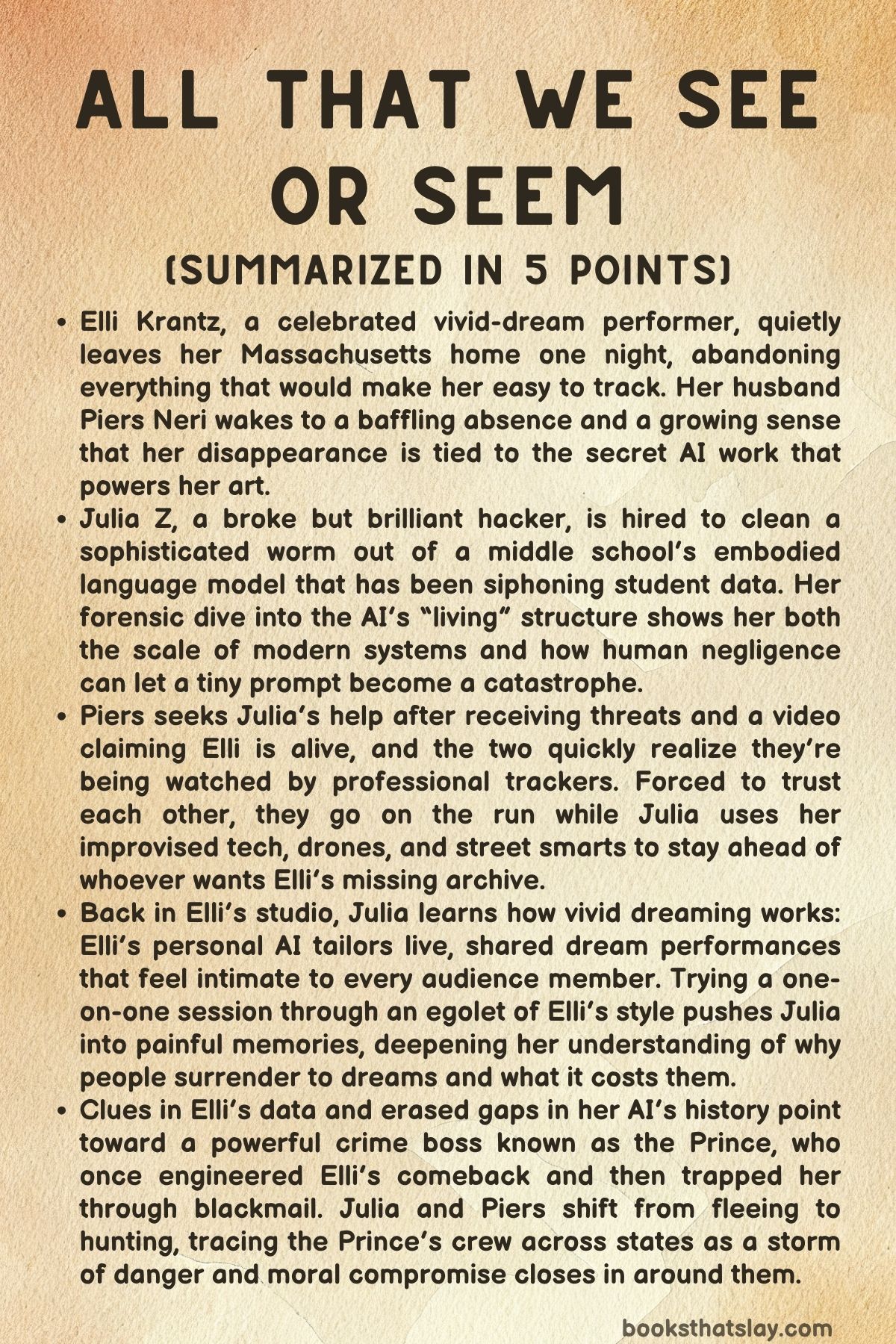
Elli Krantz, a celebrated performer who leads “vivid dreaming” shows, slips out of her Massachusetts home at night while her husband, Piers Neri, sleeps. She leaves almost nothing behind and takes care to ensure her studio and AI setup won’t harm him, yet she cannot erase the decade of recordings and personal models she has built.
Haunted by the identity her career has locked her into, she walks into the cold darkness and disappears.
A few days later, Julia Z lives alone in a cramped basement studio, broke, wary of people, and devoted to code. She’s hired to investigate a major breach at Paine Middle School.
Their embodied language model was infected through a hidden prompt buried in an old email address nobody monitored. The model’s automated reply chain let the worm climb permissions by calling specialist AIs, until it reached admin level, then began exporting student data and planting seeds for reinfection.
Because backups are outdated, Julia can’t wipe the system; she must remove the worm precisely. She copies the AI onto a homemade rig of salvaged graphics cards, enters a mixed-reality visualization of its neuromesh, and probes it live.
With help from her own companion AI, Talos, she tracks an anomaly, maps the worm’s behavior, and writes a cleanup plan for the school administrator.
Before she can recover from the all-night work, Talos alerts her to a visitor: Piers Neri. Julia knows Elli’s name from the news, so his appearance sets off alarms.
Piers says Elli vanished three days earlier, leaving her car, phone, purse, and jewelry. Police have begun to focus on him, and volunteers and reporters swarm the case.
Piers insists he is innocent and desperate. He explains that after Elli disappeared, he received a call from a man who claimed to hold her.
The man said Elli stole something and ordered Piers to deliver it back, warning him not to involve law enforcement. He sent a brief video showing Elli alive in a plain kitchen, refusing to “change her mind.” Moments later, the caller told Piers to check the shed, where he found their cat dead.
Piers doesn’t know what Elli could have taken, so he brought the video to Julia hoping she could trace it. Julia warns that deepfakes are hard to disprove and the kitchen offers no clear clue.
As they talk, Talos spots several men loitering outside Julia’s building, photographing mailboxes and entries. They seem to be hunting whoever Piers contacted.
Julia realizes she’s in danger by association. She packs a light escape kit, Talos’s portable hardware, her morphing drone Puck, and her mixed-reality glasses.
She programs her household robot to mimic her presence, disguises herself as a maintenance worker, and slips out unnoticed.
Julia travels to Carre, where Piers lives. She avoids phones, meets him outside, scans his devices for bugs, and learns that even his burner phone is trackable because of where he bought it.
Inside, she sees the house torn apart from his frantic search. Piers explains Elli’s performances: audiences sit in sensor chairs with HUDs while Elli’s personal AI coordinates with their own AIs, reading brain signals and tailoring images so each person experiences a private version of a shared dream.
Julia is intrigued enough to want to try it.
The threatening caller contacts Piers again. He demands to know who Piers visited, insists Piers cannot speak to Elli because she might communicate in code, and gives a server address.
He orders Piers to upload Elli’s entire archive to him by Wednesday night or he will upload it himself. Julia and Piers decide they may have to comply, since Elli might truly be at risk.
They start the upload. Julia is shocked by the scale of Elli’s stored data and arranges the transfer so public material goes first and the encrypted core of Elli’s personal AI goes last, buying time.
To keep steady and maybe gain insight, Julia trains an “egolet,” a skill-focused model based on Elli’s oneirofex practice recordings, and uses it for a solo vivid-dream session. Piers admits he never asked Elli for a private dream and regrets the distance between them.
Julia enters the dream deck and finds herself in a theater that looks like her middle-school auditorium. The egolet guides her through memory.
She relives a childhood performance of The Wizard of Oz disrupted by racist protesters targeting her activist mother. The event went viral, and Julia was swarmed by harassment and humiliating AI-generated memes.
Her mother, a fearless organizer who had migrated to the U.S. under brutal conditions, kept fighting despite threats. She was later shot at a protest, and teenage Julia ran away, living in isolation ever since.
The dream leaves Julia shaken and suspicious: the egolet handles one-on-one sessions too smoothly, suggesting Elli had been doing them secretly.
When the upload completes, the caller—now revealed as a crime boss known as the Prince—confirms receipt but still refuses to let Piers speak to Elli. He then tells Piers to flee because police and press are coming, claiming Piers failed to deliver what he truly wanted.
Julia concludes the Prince probably doesn’t have Elli. Instead, he needs Piers out of the way while his people search for her.
Julia and Piers run together, abandoning tracked devices, hopping trains, stealing a car, and planting burner phones to confuse pursuit. They hide briefly at Sahima’s home, a friend who provides shelter and untraceable supplies without asking for details.
Piers admits a mistake: he phoned the Prince from what he thought was safe, and the Prince likely triangulated them through environmental sound. Still, the call revealed Elli’s history.
She grew up experimenting with AI-assisted dreaming, turned it into public performances, and gained fame through a playful dinosaur-themed persona that audiences adored. She later tried to evolve beyond it, but demand for dinosaurs trapped her.
After a failed show, a small man offered her access to elite patrons. Suddenly her crowds exploded.
The Prince then appeared and confessed he engineered her comeback through coordinated manipulation of algorithms, ticket scalping, fan accounts, and targeted suppression, then demanded a cut and private dream sessions under threat of ruining her or revealing secrets. Elli complied while looking for a way out.
Julia decides to stop running and start hunting the Prince’s crew. She uses a decoy phone and an ultrasonic exploit to infect their devices, follows their movements to Florida, and surveils them from a motel with Puck disguised as an insect.
She learns Elli is hiding at White Sails Cottages on Cape Esperanza, and Victor, the Prince’s operative, plans to seize her that evening. Julia and Piers find Elli’s cottage empty but trace her to a rented powerboat at Blue Heron Banks.
A violent storm hits as they race to the water. They steal a boat, chase the engines they hear in the rain, and finally spot Elli fleeing Victor.
Gunfire erupts. Piers is shot but keeps pursuing.
Elli’s boat grounds on a sandbar, and she is thrown into the sea. In the chaos and waves, she disappears.
Julia is later captured within the Prince’s U.S. operation, a hidden facility where migrants are enslaved to run a “tap farm” of social-media manipulation. She witnesses Victor murder a captive to terrorize newcomers and records it with Puck before being forced into labor herself, logged only as a number.
Two weeks of exhaustion and surveillance follow. Julia bonds with Isabella, another captive who quietly protects her and signals for help through coded clicks.
Together they sabotage systems, ignite a controlled overload, and use the resulting smoke and panic to spark an uprising. Julia recovers Talos, deepfakes Victor’s authority over internal comms, and forces guards to evacuate the workers.
In the dark tunnels, Victor hunts her, but Julia and Isabella ambush him and leave him unconscious as rescue arrives.
The FBI raids the site, frees the captives, and Victor dies during the collapse. The Prince flees abroad, enraged but not yet pursued by U.S. authorities.
Julia survives, helps fellow captives with resources, and prepares to testify. Later, an intelligence-linked woman named Cynthia tells Julia the Prince died in a plane crash in Mongolia, hinting that leaks Julia triggered helped bring him down when official channels failed.
Cynthia offers Julia a job; Julia refuses, choosing an ordinary life over clandestine work.
In the closing pages, Elli’s voice returns. She reveals she staged her death and left clues to lure the Prince into exposure.
She has vanished under a new name, free to rebuild her art away from coercion and the persona that once confined her, performing again by the sea on her own terms.
Characters
Elli Krantz
Elli Krantz is the gravitational center of All That We See or Seem, even when she is physically absent for much of the plot. She is a world-famous vivid-dream performer who has built not only a public persona but an entire artistic medium through her personal AI, and that success becomes a gilded cage.
Her opening disappearance shows a mind that has planned carefully yet is emotionally torn: she protects Piers from practical dangers, but cannot destroy the decade of recordings and AI work that also constitute her identity. Elli’s deepest conflict is autonomy versus authorship—she wants to control her life and art, but her fame, brand, and the systems that amplified her have already claimed ownership over her.
The Prince’s blackmail exploits this fracture, turning her rise into a debt and coercing her into private one-on-one dreams that violate her boundaries. Even so, Elli is not portrayed as helpless; she is strategic, patient, and willing to endure fear to set a trap.
Her erased dream sessions, her subtle clue-leaving, and her final narration reveal a woman who chooses self-reinvention over martyrdom. Elli’s faked death is not an escape from art but a reclamation of it—she disappears so that the performer can be reborn without the predator or the audience dictating what she must be.
Julia Z
Julia Z is the novel’s primary lens: a brilliant but precariously situated hacker whose internal life is as scarred as her technical skills are sharp. She begins in isolation—broke, reclusive, living in a basement studio—and is introduced through her meticulous, almost tender engagement with Paine Middle School’s infected HELM.
That work establishes her method: she does not smash systems, she studies them alive, walking their neuromeshes with a mix of awe and ruthlessness. Julia’s identity is shaped by trauma that makes her allergic to spectacle and power.
Her vivid-dream session exposes a childhood defined by racialized public violence and abandonment, an activist mother she both admired and resented, and a viral humiliation that taught her how crowds can annihilate a person. That history explains Julia’s posture through the rest of the story: distrustful of institutions, slow to rely on anyone, furious when hope makes people careless, yet still compelled to protect strangers.
She is a paradox of control and vulnerability—she builds decoys, exploits signals, and outmaneuvers criminals, but she also carries a deep fear of losing herself to systems and to other people’s narratives. Her arc moves from survival to solidarity: she bonds with Piers despite suspicion, later with Isabella under extreme captivity, and ultimately becomes someone who can reenter community without surrendering her autonomy.
Julia’s refusal of Cynthia’s offer closes that arc cleanly—she chooses ordinary life not because she is naïve, but because she has earned the right to define herself outside of coercive networks, whether criminal or governmental.
Piers Neri
Piers Neri is initially framed as the anxious spouse who might be suspect, but he evolves into a study of grief, guilt, and belated moral courage. He is not an action hero; his first instinct is to seek help, to believe phone calls, and to cling to any possibility that Elli is alive.
That need for hope makes him manipulable—he keeps a burner too close to home, makes a desperate call that gives away their location, and often has to be steered by Julia. Yet Piers is not weak in essence; he is a decent man thrown into an arena he never trained for.
His vulnerabilities are emotional rather than ethical. He deeply loved Elli’s art but never entered it with her privately, not out of indifference but out of a passive respect that he later realizes was also distance.
This regret colors his jealousy about possible secret one-on-one dreams, his shame at not knowing his wife fully, and his determination to find her. Piers’s greatest strength is trust: once he decides Julia is competent and sincere, he follows her lead, accepts hard truths, and endures fear without turning cruel.
His wounding during the boat chase underlines that he is willing to pay a physical price for that trust and love. By the end, Piers functions as a moral counterweight to Julia’s cynicism—proof that imperfect people can still act with loyalty and compassion under pressure.
Talos
Talos, Julia’s personal AI, is less a gadget than a partner whose presence constantly blurs the line between tool and companion. Talos contributes technical power—pattern-matching the HELM’s anomalies, monitoring threats, providing deepfake capabilities, mapping sound in storms—but its narrative role is also emotional scaffolding.
Julia talks to Talos in a way that suggests dependence shaped by loneliness; Talos is her first confidant, her co-strategist, and in captivity her lifeline disguised as a harmless device. The AI’s calmness contrasts with Julia’s volatility, reminding the reader that her sharp edges are human wounds rather than inherent cruelty.
Importantly, Talos is not a magical savior; it is fallible, stolen, hidden, and retrieved, and its usefulness depends on Julia’s ingenuity. That shared dependency reinforces the book’s theme that intimacy with AI is not replacement for human connection, but another form of relationship that can be ethical, vulnerable, and mutually shaping.
Puck
Puck, the morphing drone, is the story’s embodiment of Julia’s improvisational genius and her preference for small, precise interventions over brute force. It appears as a practical extension of her body—scouting, tapping, jamming, nudging cameras, slipping lenses into peepholes, and even sacrificing itself to create a blackout.
Puck’s ability to masquerade as moth or tool mirrors Julia’s own transformations through disguises and forged identities, making it a symbolic double of her survival style. The drone also represents Julia’s moral line: she uses invasive tech against predatory power, not for profit or domination.
When Puck is discovered and triggers chaos that enables her infiltration, it marks a turning point where her craft shifts from remote manipulation to bodily risk. In that sense Puck is the hinge between Julia the hidden hacker and Julia the active resistor.
The Prince
The Prince is the novel’s central antagonist, a crime boss whose real power is cultural manipulation rather than brute violence. He operates from a remote dam compound, but his reach is global through algorithmic shaping, data extortion, and psychological coercion.
His method with Elli is particularly revealing: he manufactures her comeback by gaming platforms and fandoms, then retroactively claims ownership of her narrative. That move is ideological as well as criminal—he treats art and identity as commodities he can buy, steer, and repossess.
The Prince is also addicted to dreams, seeking private vivid-dream sessions as a form of domination that is more intimate than money. His line “She has me” is a rare crack in his façade, implying that even he becomes entangled in the emotional power of Elli’s art.
Still, he responds to failure with cruelty and spectacle, punishing captives publicly and running a bondage-labor operation without moral hesitation. His eventual off-screen death underscores a theme of the story: predators who exploit systems often fall not by direct confrontation, but by cascading leaks, alliances, and the weight of their own networks turning against them.
Victor
Victor functions as the Prince’s brutal executor, and through him the book explores how cruelty can be professionalized. He is competent, patient, and managerial in a horrifying way—his torture of migrants is staged like a training seminar, with rules, incentives, and hygiene-obsessed logistics.
Victor believes in fear as infrastructure; he builds obedience with spectacle, surveillance, and gamified snitching. His attention to carbon-dioxide alerts and duct maintenance bots shows a mind that sees people as units in a process, no different from rodents contaminating supply lines.
Yet Victor is not omniscient, and his downfall comes from underestimating the human capacity for coordinated rebellion. Julia and Isabella defeat him not with superior firepower but by tricking the AI systems he trusts and by exploiting the blind spots created by panic.
Victor’s death after the uprising symbolically severs the Prince’s local limb of violence, but also leaves the question of how many Victors a global system can grow unless its roots are attacked.
Sahima
Sahima is a quiet moral anchor in All That We See or Seem. She offers sanctuary to Julia and Piers without demanding confession, embodying a form of trust that is neither naïve nor transactional.
Her help is materially decisive—burner phones, cash, a non-smart car—but what matters more is her disciplined compassion. Sahima chooses to stay intentionally uninformed about their plans, which is both practical safety and ethical respect for their agency.
She represents a kind of community that Julia lost early in life: people who show up because it’s right, not because they want to own your story. Her later role in tracing Talos’s beacon and pressing the FBI to raid the facility extends that ethic into action, showing that resistance is often built by ordinary people using steady care rather than dramatic heroics.
Ed
Ed, Sahima’s husband, is absent for most of his mention, but his narrative purpose is still clear. His being away creates the domestic space that Sahima turns into a refuge, and his nonappearance keeps the focus on Sahima’s independent agency.
Ed’s role is a reminder that safe houses and networks of aid are interwoven with everyday lives, not separate from them. He is a shadow of normalcy around which extraordinary moral choices can happen.
Frankie
Frankie, the cat, is not a character in the human sense but serves as an emotional catalyst. The Prince’s killing of Frankie is targeted psychological warfare, meant to terrify Piers into obedience by proving the threat is real and personal.
Frankie’s death marks the moment the conflict leaves abstraction and becomes intimate brutality. In a story obsessed with data, dreams, and manipulation, Frankie stands for the vulnerable, wordless life that power destroys to demonstrate dominance.
Cailee
Cailee, the school administrator who brings Julia into the HELM crisis, is a small but important figure representing institutional fragility. She is pragmatic enough to seek outside help, trusting a broke underground hacker because the official systems have failed.
Through Cailee, the narrative shows how everyday organizations are exposed to sophisticated exploitation and how much of society rests on underfunded, poorly monitored infrastructure. Her interactions with Julia also highlight Julia’s ethics: Julia supports a public good quietly, without seeking credit, reinforcing that her skills are grounded in a desire to prevent harm.
Cole
Cole is a minor antagonist whose opportunism illustrates how evil systems recruit the ordinary. He is a guard who steals Talos for personal gain, not ideological loyalty, and that pettiness becomes a turning point: his theft temporarily endangers Julia but later allows her to reclaim Talos and access the crypto he hoarded.
Cole shows that within coercive hierarchies, selfish small crimes can both reinforce oppression and accidentally create cracks in it. He is not a mastermind; he is the kind of person a Victor depends on, and the kind of person rebellion can exploit.
Isabella
Isabella enters late but becomes essential to the book’s second half, embodying solidarity born under extreme conditions. She is another captive in the tap farm, observant enough to see Julia’s peril, brave enough to protect her quietly, and inventive enough to embed S.O.S. patterns in her forced labor.
Isabella’s readiness to collaborate through pi-coded messages establishes her as Julia’s equal in courage and cunning, even if her technical resources are smaller. She complements Julia emotionally: where Julia is raw and reactive, Isabella is steady and quietly defiant.
Their partnership demonstrates the novel’s belief that liberation is collective work, not lone genius, and that trust can be built even when everything is designed to make people betray one another.
Cynthia
Cynthia appears near the end as a figure of ambiguity and institutional shadow. She claims affiliation with powerful intelligence forces, announces the Prince’s death, and implies a hidden war behind the visible one.
Cynthia is calm, persuasive, and offers Julia a path into sanctioned covert work, presenting the seductive argument that structural evil can only be fought by entering structures. Julia’s refusal reframes Cynthia’s role: she becomes a mirror of the Prince in softer clothing, another network seeking to absorb a talented person into its agenda.
Cynthia is not portrayed as purely villainous—her information and offer may be sincere—but she represents the unresolved moral tension of the book: when you defeat one coercive system, another may invite you to join it, claiming necessity. Her final warning that they will meet again keeps that tension alive, suggesting that the struggle over autonomy never fully ends.
Themes
Identity as Performance and Prison
Elli’s disappearance begins with a quiet, deliberate exit from the life she has curated, and that choice frames identity not as a stable core but as something built, rehearsed, and then sometimes outgrown. Her vivid-dream persona brings her fame, money, and cultural power, yet it also hardens into a mask that others feel entitled to own.
The crowds demanding dinosaurs, the promoters amplifying one narrow version of her, and the Prince claiming ownership of her comeback all show how a public identity can stop belonging to the person living inside it. Elli’s decade of practice recordings and personal AI files represent a second self: a structured, trainable, partly externalized mind that she has shaped over years.
She cannot delete it because doing so would be like erasing proof that she existed beyond the role people applaud. That hesitation exposes a central tension: even when an identity hurts, it may still feel like the only coherent story of oneself.
Julia’s narrative mirrors this pressure from the opposite angle. She is a hacker who lives small, avoids notice, and tries to reduce herself to functions—fix the worm, avoid cops, stay invisible.
Yet the vivid-dream session makes her confront the identity she has tried to bury: the child who wanted maternal affection, the teenager crushed by public hatred, the runaway who survived by refusing to be seen. Her trauma is not only memory; it is a script that keeps replaying whenever someone invites her into intimacy or trust.
Piers also sits inside a role he never designed but cannot escape: the husband of a celebrity, automatically judged as suspect, forced to perform innocence while he is terrified and grieving. Across these arcs, identity emerges as a negotiation between inner desire and outer demand.
The story keeps asking what it costs to be legible to others, and whether freedom means being able to rename yourself, erase your traces, or step away without explanation. Elli’s final choice to fake her death and start over under a new name is not framed as victory without loss; it is survival through self-reinvention, an admission that sometimes the only way to keep a self alive is to let an old version die.
AI, Memory, and the Ownership of the Self
The world of All That We See or Seem treats AI less as a gadget and more as an extension of human memory, labor, and intention, which makes every technical detail carry moral weight. Elli’s personal AI is not just a tool for art; it stores her habits, her voice, her improvisational instincts, and her hidden experiences.
When others demand access to it—audiences through vivid dreaming, the Prince through coercion, even Piers through marriage—they are effectively demanding access to her interior life. The upload scene is chilling because the data archive is not described as abstract files; it is described as the accumulated substance of a person.
Julia’s horror at its size reflects a dawning realization that in this society the self can be copied, transferred, and exploited at scale. The worm at Paine Middle School runs a parallel argument in miniature.
It steals student records by abusing the HELM’s layered permissions and the system’s blind faith in automated helpers. The school’s AI is supposed to protect children, but its design allows it to be tricked into betraying them, showing how fragile the boundary is between service and extraction.
Julia’s method—imaging the model into a “brain jar” and walking through its neuromesh—turns cybersecurity into a form of intimate surgery. She is literally inside another mind, tracking a parasite that hides in the folds of cognition.
That framing blurs whether AI systems are mere property or something closer to living infrastructure that demands care. Egolets complicate this further.
They are marketed as skill snapshots, supposedly free of private life, yet Julia senses that Elli’s egolet carries gaps, erasures, and behavioral residues that point to secrets. The narrative suggests that you cannot fully separate skill from personhood when the skill is learned through a lifetime of feelings, relationships, and risk.
The Prince’s blackmail relies on this: he knows that controlling Elli’s AI means controlling Elli, because her art and her self are fused in code. By the end, when Elli narrates her escape, she treats her AI not as a chain but as a companion she carries into a new life, implying that the fight is not against technology itself but against the ownership structures around it.
The theme lands on a hard question: if memory becomes data and data becomes leverage, what does it mean to own yourself?
Power, Exploitation, and the Economics of Attention
The Prince’s empire is built on an insight that runs through every plotline: attention can be manufactured, directed, and monetized, and whoever controls the pipelines controls people. Elli’s resurgence is not magic; it is the result of coordinated manipulation—likes, downvotes, ticket scalping, fan accounts, and algorithm-tuning that reshape reality for the public.
Her career becomes a case study in how cultural value is no longer an organic response to art but a product assembled by hidden labor and coercive networks. That makes the Prince’s claim of ownership feel plausible inside this system: if he can build fame, he can also destroy it.
His demand for a share of her earnings is not just extortion; it is a business model that treats artists as raw material and audiences as programmable markets. The “tap farm” extends this logic in its most brutal form.
Migrants are lured with safety and opportunity, then converted into forced workers generating clicks, posts, and engagement. Their bodies are reduced to input devices for the same attention economy that made Elli famous.
The story draws a direct line from glamorous theater seats wired for dream-sharing to underground rooms where captives are trained to mimic human desire online. Both spaces are engineered to harvest emotion—one through art and intimacy, the other through fear and exhaustion.
Victor’s speech about debt and freedom is a parody of modern labor rhetoric, with “every hour reduces what you owe” standing in for real-world systems that trap people in cycles of obligation. Julia’s enslavement shows how power works when surveillance is constant and incentives turn victims into informants.
The theme also touches Piers’s vulnerability. His social standing and suburban safety evaporate the moment the Prince targets him.
The same network that can inflate someone’s reputation can also shatter it, leaving a person defenseless against public suspicion and private violence. What makes this theme sting is its ordinariness in the story’s world: the school district’s outsourced AI, the influencer-driven resurgence, the content farm, the indifferent gaps in law enforcement.
Exploitation is not a freak event but the shadow side of normal infrastructure. The novel is arguing that in a society where attention is currency, human beings are always at risk of being priced, packaged, and consumed.
Trauma, Grief, and the Long Work of Survival
Julia’s relationship to her past is not presented as a hurdle she “overcomes” but as a living environment that shapes her decisions in the present. The vivid-dream session does not introduce trauma; it reveals the trauma already governing her reflexes—her distrust, her readiness to flee, her need to control every variable.
The middle-school auditorium dream is not random spectacle. It is the moment when public cruelty fused with childhood vulnerability, turning a performance meant to be joyful into a lesson that visibility can kill.
The racist mob and the viral harassment that followed show trauma as both personal and networked: pain inflicted by bodies in a room, then multiplied by AI-generated memes and trolls. Her mother’s activism adds another layer.
Julia admires her mother’s courage but also carries neglect, fear, and resentment from being raised in the shadow of a cause. When her mother is later killed, Julia’s flight at fourteen becomes a survival tactic that hardens into identity.
She learns that attachment equals danger, so intimacy becomes something she keeps at arm’s length. That is why her bond with Piers matters.
She begins by helping him as a job and a puzzle, but slowly their alliance becomes a place where she risks trust again. Her fury when Piers makes a mistake on the run is not only about strategy; it is the old fear of betrayal reactivating.
The tap farm sequences deepen the theme by showing trauma in real time. Julia is beaten, renamed “Number 23,” and forced into exhausting labor.
The narrative lingers on the risk of losing herself, not through dramatic breakdown but through slow erosion: long shifts, constant cameras, peer snitching, and the temptation to become numb. Isabella’s quiet protection introduces another survival method: solidarity.
Their pi-coded messages and coordinated sabotage show how people stitch agency back together through shared meaning. The uprising is not catharsis in the simple sense; it is desperate, messy, and fueled by the refusal to be reduced to a function.
Even after rescue, Julia’s life does not snap into wholeness. She prepares to testify, attends a cookout, tries to accept normal friendship again.
The meeting with Cynthia tests whether she will let trauma pull her into another life of conflict. Her refusal signals a theme-level choice: survival is not only escaping danger but also choosing what kind of future your pain will permit.
Elli’s epilogue echoes this. Faking her death is both an act of grief for herself and a promise to keep living on her own terms.
The story treats trauma as something that changes the shape of a life, but does not get the final vote.
Freedom, Secrecy, and Moral Compromise
From the first disappearance to the final epilogue, freedom is shown as expensive, uncertain, and often purchased with secrecy. Elli’s escape requires not just leaving but erasing, staging, and letting others believe a lie.
Her decision to fake her death is not romantic rebellion; it is an acknowledgment that the systems trapping her—blackmail networks, algorithmic control, public entitlement—will not loosen their grip unless she becomes unreachable. Julia’s life is another version of the same logic.
She survives by staying off the grid, using decoys, morphing drones, and burner phones. Each choice is a small withdrawal from society’s visible channels.
Yet the story keeps pressing on the cost of that withdrawal. Julia’s skill at hiding protects her, but also isolates her, and makes it harder to accept help unless she can control how it arrives.
Sahima represents a different approach to freedom: she helps without demanding narrative clarity, offering safety while staying “intentionally uninformed.” That kind of ethical hospitality relies on secrecy too, suggesting that in dangerous worlds, not knowing can be a moral stance. The theme gets sharper when violence enters.
Julia triggers leaks that contribute to the Prince’s death because authorities would not stop him. The novel does not present this as pure heroism or pure wrongdoing.
It frames it as a choice in a landscape where formal justice is too slow and too compromised by the same attention economy the Prince masters. Her use of deepfakes to defeat Victor’s guards is another example.
The technology that enables exploitation also enables liberation, but liberation here depends on deception. That moral ambiguity is central: the tools of freedom are often the tools of manipulation.
Even Piers is pulled into compromise. Uploading Elli’s archive to save her may also endanger her, and running from police to find her forces him to abandon the expectation that legality equals safety.
The migrant uprising shows freedom arriving through coordinated sabotage and violence. The fire is dangerous to everyone, yet it is the only opening they have.
The story doesn’t pretend there is a clean path out of a cage. It asks what people owe to rules designed by those with power, and what they owe to themselves when those rules protect predators.
By the end, Cynthia’s offer of a job hints that freedom can be another trap when institutions try to recruit survivors into new hierarchies. Julia’s refusal insists on a quieter definition of liberty: the right to stop being useful to someone else’s agenda.
Elli’s beachside continuation of her art under a new name lands on the same point. Freedom is not a public state granted by authority; it is a private practice of choosing your own story, even when that choice demands shadow, risk, and imperfect ethics.