All The Bright Places Summary, Characters and Themes
All The Bright Places by Jennifer Niven is a young adult novel about two teenagers, Theodore Finch and Violet Markey, who meet at the edge of their school bell tower, both carrying pain they can barely explain. Violet is grieving her sister’s death and has shut herself away from the future she once wanted.
Finch is bright, restless, funny, and deeply troubled, fighting a private battle with his mental health. Through a school project that sends them across Indiana, they help each other see beauty, danger, love, and loss in new ways. The book is a story about survival, connection, and the limits of love.
Summary
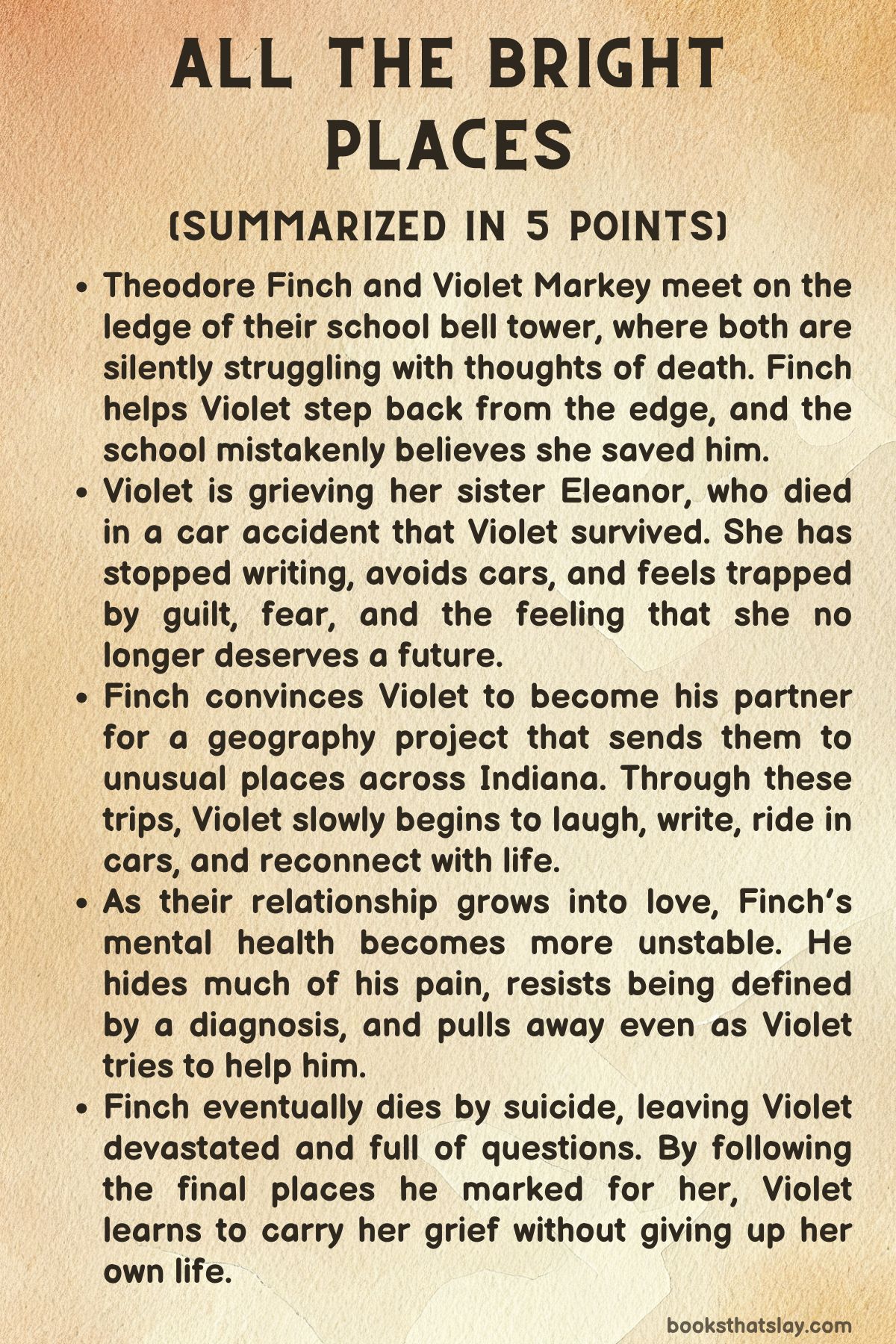
All The Bright Places begins with Theodore Finch standing on the ledge of his school’s bell tower, wondering whether this is the day he should die. Finch has often asked himself this question, and at this moment he feels numb, disconnected, and unsure of where the last few weeks of his life have gone.
While he is on the ledge, he notices Violet Markey, a popular girl from his school, standing on another part of the tower, also dangerously close to jumping. Finch talks to her, using humor and calm instructions to guide her back to safety.
He lets the students below believe that Violet saved him, protecting her from the truth that she was also in danger.
Violet is still living in the shadow of her sister Eleanor’s death. Eleanor died in a car accident while Violet survived, and Violet blames herself.
Since the crash, she has stopped writing, stopped riding in cars, and stopped imagining a future. She wears Eleanor’s glasses even though they hurt her eyes, as if taking on pieces of Eleanor might keep her close.
At school, she lets others believe she saved Finch, though the truth is far more complicated.
Finch becomes fascinated by Violet after the tower. In geography class, their teacher assigns students a project about exploring the unusual places of Indiana.
Finch persuades Violet to be his partner, though she is reluctant. He creates rules for their trips: they must use maps, avoid ordinary places, and leave something behind at each site as proof they were there.
These journeys become a way for both of them to step outside their pain.
Their first visits are small but meaningful. They go to Hoosier Hill, the highest point in Indiana, which is physically unimpressive but emotionally important because it gives Violet a rare peaceful moment.
Finch encourages her to stay present rather than record everything through a camera. He tells her that even small places can matter.
Violet begins to feel alive again around him, and Finch feels seen by her in a way he rarely does by anyone else.
As they spend more time together, Violet begins to move away from her old social circle. Her former friends, including Amanda and her ex-boyfriend Ryan, belong to the popular group that mocks Finch and calls him cruel names.
Violet starts to realize that she has little in common with them anymore. She becomes closer to Finch’s friends, Brenda and Charlie, and begins thinking seriously about creating a new online magazine called Germ.
Finch’s influence helps her return to writing, not by forcing her to be her old self, but by helping her believe she can become someone new.
Finch’s home life is painful and unstable. His mother is distracted and worn down after divorce, and his sister Kate often acts like the responsible adult in the house.
His father, a former hockey player, has remarried and built a new family. He is abusive, especially toward Finch, and Finch carries the emotional and physical effects of that abuse.
Finch often changes personas, trying on different versions of himself: stylish, rebellious, tough, witty, fearless. These identities help him cope, but they also show how unsure he is of who he truly is.
Violet and Finch continue their wanderings. They visit a park of book-filled trailers, an abandoned factory wall where people write what they want to do before they die, a homemade roller coaster, the Purina Tower, and the Blue Hole, a mysterious body of water said to be bottomless.
Finch pushes Violet to ride in a car again, and although she is frightened, she manages it with him driving slowly and carefully. She eventually tells him what happened the night Eleanor died: Eleanor had been upset after a fight with her boyfriend, Violet had suggested the route they took, and the bridge was icy.
Violet has lived with the guilt ever since.
Their relationship becomes romantic. Finch is tender, imaginative, and intense, and Violet falls in love with him.
He tells her he loves her, and she trusts him with parts of herself that had been closed off since Eleanor’s death. They share private jokes, late-night conversations, books, music, and secret places.
Violet starts sleeping better, writing again, and reconnecting with life. Her parents notice the change, though they grow worried when she stays out all night with Finch.
They forbid her from seeing him after learning more about his troubled behavior.
At the same time, Finch’s mental health worsens. He has periods of intense energy, racing thoughts, and impulsive behavior, followed by dark crashes where he feels as if he is disappearing.
He paints his room blue, rearranges it, and eventually moves into his closet because it feels safer and smaller. He struggles to concentrate, misses school, avoids counseling, and hides how serious his thoughts have become.
His counselor suggests bipolar disorder and tells Finch it can be treated, but Finch resists being reduced to a diagnosis. He wants to be known as himself, not as a list of symptoms.
After Finch attacks Roamer, the classmate who has tormented him for years, he is expelled. He grows more isolated and unpredictable.
He swallows a bottle of sleeping pills but runs to the hospital for help, then leaves before his family can be notified. He later attends a support group for suicidal teens under a false name, where he unexpectedly sees Amanda.
She admits she has bulimia and has attempted suicide. Finch realizes that many people are carrying hidden pain, but instead of feeling comforted, he pulls further away.
Violet learns about the support group from Amanda and confronts Finch. On his birthday, he creates a beautiful night in his room, decorating it with planets and stars, but when Violet brings up his need for help, he becomes angry.
He insists he does not need saving and does not want to be treated like an illness. Violet finally tells her parents the truth: Finch saved her on the tower, and now she believes he is the one in danger.
Her parents try to contact Finch’s mother and a psychiatrist, but Finch disappears.
At first, Finch sends Violet brief, cryptic messages. His family assumes he will return because he has disappeared before.
Violet continues school, works on Germ, and tries to live, but she is terrified. Eventually Finch’s mother becomes worried after receiving a farewell-like message from him.
Violet searches his room and finds clues that point toward water. She follows them to the Blue Hole, where she finds his car, his folded clothes, and the terrible truth.
Finch has died by drowning.
After Finch’s death, Violet is devastated and angry. She attends his funeral in his shirt and resents the false grief of people who once mocked him.
The preacher avoids saying suicide, calling the death an accident because there was no note, but Violet knows she may never fully understand what happened. She blames herself, just as she blamed herself for Eleanor, but Mr. Embry tells her that Finch should have had more help and that she cannot carry responsibility for everyone she loves.
In the final part of All The Bright Places, Violet follows the remaining places Finch marked for her on their map. She visits the shoe trees, the world’s largest ball of paint, an abandoned drive-in, a monastery, and finally a small chapel near a lake.
Each place contains signs of Finch’s care and memory. At the chapel, built for those who died in car accidents, Violet finds a song Finch wrote for her.
She understands that he chose this place for Eleanor, for her, and for himself.
Violet begins to speak more openly with her parents about Eleanor and Finch. She accepts that loving someone does not mean she could have saved him, and losing someone does not mean she must stop living.
At the Blue Hole, she writes an epitaph for Finch in her mind, remembering him as someone who burned brightly and left pieces of himself behind. She looks toward her own unwritten future with pain still inside her, but also with strength, possibility, and the knowledge that she is still alive.
Characters
Theodore Finch
Theodore Finch is the emotional center of the novel’s darker conflict. He is intelligent, funny, creative, unpredictable, and deeply wounded.
To others at school, he is often reduced to the cruel nickname “freak,” but that label hides the complexity of his mind and the seriousness of his suffering. Finch is constantly searching for a version of himself that can survive.
His changing personas show both his imagination and his instability. He becomes different versions of “Finch” because he does not feel safe or whole as himself.
His humor often masks despair, and his charm often covers fear. He understands pain sharply, which is why he recognizes Violet’s distress on the bell tower so quickly.
Yet he is far less able to accept help for himself. Finch wants to be loved as a person, not treated as a diagnosis or a problem.
His relationship with Violet gives him moments of real joy, but love cannot erase untreated mental illness, trauma, and isolation. In All The Bright Places, Finch is presented as brilliant and fragile, someone who sees beauty intensely but cannot always protect himself from darkness.
Violet Markey
Violet Markey begins the story frozen by grief. Before Eleanor’s death, she was a strong student, a writer, a popular girl, and someone with plans for the future.
After the accident, she becomes trapped in guilt and fear. She stops writing, avoids cars, wears Eleanor’s glasses, and feels as if continuing her own life would betray her sister.
Violet’s arc is about learning that survival is not disloyalty. Her relationship with Finch helps her re-enter the world, but her growth is not simply because of romance.
Finch gives her a push, but Violet’s courage belongs to her. She chooses to drive again, write again, speak honestly with her parents, and face the places connected to her grief.
Violet is also compassionate, though she sometimes hesitates because she fears judgment from others. Her movement away from the popular group and toward Finch’s friends shows her growing honesty about who she wants to be.
By the end, Violet carries two losses, Eleanor and Finch, but she no longer believes that pain must stop her from living.
Eleanor Markey
Eleanor Markey never appears alive in the present action, yet her presence shapes Violet’s entire emotional world. She was Violet’s sister, best friend, creative partner, and the person with whom Violet imagined her future.
Eleanor’s death leaves Violet with survivor’s guilt, especially because Violet suggested the route where the accident happened. This guilt becomes so powerful that Violet tries to become closer to Eleanor by wearing her glasses and preserving her memory in painful ways.
Eleanor represents both love and unfinished grief. She is not only a tragic absence; she is also a reminder of who Violet used to be before fear took over.
As Violet heals, her relationship with Eleanor changes. She stops using grief as punishment and begins remembering Eleanor with more openness.
The chapel Finch leads her to becomes important because it allows Violet to connect Eleanor’s death with remembrance rather than only trauma. Eleanor’s role is essential because Violet’s recovery depends on accepting that her sister can remain loved without Violet sacrificing her own future.
Theodore Finch’s Father
Finch’s father is one of the strongest sources of damage in Finch’s life. He is abusive, controlling, emotionally distant, and capable of presenting a respectable face to the outside world while hurting his family in private.
His past as an athlete and his new family create an image of masculine success, but his behavior toward Finch reveals cruelty and insecurity. He treats his new son, Josh Raymond, with patience that Finch never received, which deepens Finch’s pain and jealousy.
Finch’s father is not only physically violent; he also teaches Finch that love can be conditional, unsafe, and humiliating. His refusal to acknowledge the harm he has caused contributes to Finch’s belief that he is broken.
The father’s presence also exposes how adults can fail children by ignoring or normalizing abuse. Finch’s resistance to him, especially when he finally tells him he will never be hit again, shows a moment of power, but it cannot undo years of fear.
He represents the kind of family wound that remains active even after divorce.
Finch’s Mother
Finch’s mother is not cruel, but she is painfully absent in the ways Finch needs most. She is overwhelmed by divorce, emotional exhaustion, and the demands of daily life.
She often seems dazed, distracted, or unable to notice the depth of Finch’s crisis. Her responses to his distress are limited, sometimes reducing serious suffering to ordinary stress or physical discomfort.
This makes Finch feel invisible inside his own home. At the same time, she is not written as a villain.
She is a woman who has also been damaged by an abusive marriage and has lost her ability to fully protect or understand her children. Her failure is quiet but devastating.
She does not see the signs clearly enough, and when others try to reach her, help does not arrive in time. Her grief after Finch’s death is real, but it is complicated by the reader’s awareness that Finch needed more from her while he was alive.
She reflects the tragedy of a parent who loves her child but cannot meet the seriousness of his needs.
Kate Finch
Kate Finch is Finch’s older sister and one of the few people in his family who understands that something is wrong. She often acts more like a parent than their mother does, preparing food, managing practical needs, and covering for Finch when he disappears into depressive periods.
Kate’s care is important, but it is also limited by her own youth and her own desire to escape. Her plan to attend college in Denver suggests that she wants a life beyond the broken patterns of the Finch household, even if her reason for going is tied to a questionable romantic relationship.
Kate’s warnings to Finch about protecting his heart show that she recognizes his vulnerability. She also understands their father’s danger and reprimands Finch after he provokes him, not because she lacks sympathy, but because she knows how serious the violence can become.
Kate represents the sibling who has seen too much and learned to function too early. She loves Finch, but she is not equipped to save him.
Decca Finch
Decca Finch, Finch’s younger sister, adds innocence and sadness to the Finch family dynamic. She is still a child, yet she lives in a home where adults are emotionally unavailable and the older children carry burdens they should not have to carry.
Her habit of cutting negative words and harsh parts out of books is one of the novel’s most revealing symbolic actions. She wants to separate bad words from good ones, as if language itself can be controlled and made safe.
This mirrors Finch’s own wish to protect Violet from pain and his own struggle to separate light from darkness inside himself. Decca’s behavior shows that the family’s damage affects even the youngest child.
She may not fully understand what is happening, but she senses enough to respond in her own private way. Her presence also softens Finch, who often shows tenderness toward her.
Decca represents the quiet witnesses in troubled families, children who absorb pain even when no one directly explains it to them.
Brenda Shank-Kravitz
Brenda Shank-Kravitz is one of Finch’s most loyal friends and later becomes important to Violet as well. She is sharp, direct, protective, and unwilling to pretend that social status matters more than loyalty.
At first, Violet may see Brenda as outside the world she once belonged to, but over time Brenda becomes one of the people who offers the most honest support. Her warning to Violet not to hurt Finch shows her fierce affection for him.
Brenda understands that Finch is vulnerable even when he appears bold or strange. After Finch’s death, her anger toward those who mocked him feels justified because she saw how cruelly he was treated while alive.
Brenda’s friendship helps Violet move away from shallow popularity and toward relationships based on honesty. She also becomes part of Germ, which connects her to Violet’s creative rebirth.
Brenda’s role proves that friendship can be blunt, imperfect, and still deeply caring.
Charlie Donahue
Charlie Donahue is Finch’s best friend, though his relationship with Finch is often casual and understated. He brings humor and normalcy into Finch’s life, and his presence shows that Finch is not completely isolated from peer connection.
Charlie does not always understand the full extent of Finch’s mental illness, but he knows Finch’s patterns and accepts many of his oddities without making them into a spectacle. His friendship is not dramatic, but it matters because he treats Finch as someone worth spending time with rather than as a school legend or warning sign.
Charlie also becomes part of the group that remembers Finch after his death, and his grief feels more genuine than the public mourning of students who once mocked him. He represents the friend who is close enough to care but still too young and unequipped to understand how much danger Finch is in.
His character shows the limits of teenage friendship when serious mental illness is hidden behind humor and unpredictability.
Amanda Monk
Amanda Monk first appears as a shallow popular girl, someone invested in appearances, gossip, and social ranking. She makes insensitive remarks to Violet and participates in the kind of school culture that isolates Finch.
Yet her later appearance at the suicide support group complicates this image. Amanda is secretly struggling with bulimia and suicidal thoughts, using popularity as a mask for her own pain.
This revelation does not erase her cruelty, but it makes her more human. Amanda shows that suffering can exist behind privilege, beauty, and social power.
She also reveals how stigma keeps people silent. Like Finch, she uses a false name at the support group, suggesting shame and fear of exposure.
Her apology after Finch’s death is important but incomplete. Brenda’s rejection of it as too late captures the moral weight of Amanda’s earlier behavior.
Amanda represents both hidden pain and the harm people can cause when they protect their own image at the expense of others.
Gabe Romero
Gabe Romero, often called Roamer, is the main face of school cruelty in the novel. He bullies Finch, uses slurs, attacks him physically, and helps maintain the social environment that labels Finch as strange and disposable.
Roamer’s cruelty is not shown as harmless teenage teasing; it has real emotional consequences. He becomes part of the pressure that makes Finch feel hated and exposed.
His relationship with Amanda also places him inside the popular group that Violet gradually rejects. Roamer is important because he shows how public humiliation can deepen private suffering.
He may not be the cause of Finch’s illness, but he contributes to Finch’s isolation and rage. When Finch finally attacks him, the scene is frightening because it shows how long-term cruelty can push someone already in crisis toward a loss of control.
Roamer’s later grief after Finch’s death feels false to Violet because it comes without true accountability. He represents the people who harm others while they are alive and then perform sadness when it is too late.
Ryan Cross
Ryan Cross is Violet’s former boyfriend and part of the life she had before Eleanor’s death. He is popular, attractive, and outwardly decent, but he cannot fully understand Violet’s grief or her changed identity.
His attempts to reconnect romantically with her show that he wants a version of Violet that no longer exists. Ryan is not as cruel as Roamer, but he belongs to the same social world, and that connection makes Violet increasingly uncomfortable.
His later relationship with Suze helps Violet recognize that she does not want to return to her old romantic life. Ryan also gives her information about Roamer’s attack on Finch, which helps push her away from the popular group.
By the end, Violet can spend time with him as a friend, but she knows that romance with him would be a retreat into normalcy rather than a true choice. Ryan represents the safe, socially approved path that Violet must outgrow in order to become honest with herself.
Mr. Embry
Mr. Embry, Finch’s school counselor, is one of the few adults who notices that Finch is in serious trouble. Finch mocks him with a nickname, but Mr. Embry continues trying to reach him.
He asks direct questions, schedules meetings, notices warning signs, and eventually raises the possibility of bipolar disorder. His role is important because he represents adult concern that is real but still insufficient.
Finch is intelligent enough to hide his thoughts, and Mr. Embry cannot force him to accept help. After Finch’s death, Mr. Embry admits that Finch was a troubled young person who should have had more support.
This admission gives voice to one of the novel’s painful truths: noticing danger is not the same as successfully preventing tragedy. Mr. Embry also helps Violet understand that she cannot blame herself for Finch’s suicide.
He becomes part of her survival after Finch’s death, offering language and perspective when guilt threatens to consume her.
Mrs. Kresney
Mrs. Kresney, Violet’s counselor, provides a quieter form of support. She tracks Violet’s grief, sleep problems, college plans, and loss of interest in writing.
Her sessions show how Violet’s trauma has affected every part of her life. Unlike Finch, Violet gradually becomes more able to respond to help, and Mrs. Kresney’s presence helps mark that change.
When Violet begins riding in cars, sleeping better, and writing again, Mrs. Kresney recognizes the progress. She is not central to the plot, but she is part of the structure of adult care around Violet.
Her role also contrasts with Finch’s situation. Violet’s parents are attentive, and her counselor sees improvement, while Finch’s family system is far weaker and his treatment is inconsistent.
Mrs. Kresney represents the steady support that does not solve grief instantly but can help a young person move toward recovery when that support is matched by family attention and personal readiness.
Violet’s Parents
Violet’s parents are loving, protective, and deeply affected by Eleanor’s death. Their grief sometimes turns into overprotection, especially when they fear losing Violet too.
They want her to return to school, college plans, writing, and ordinary life, but they also struggle to discuss the full pain of Eleanor’s death. Their reaction to Finch is complicated.
At first, they appreciate how he seems to help Violet, but after she stays out all night, they view him as dangerous and unstable. Their concern is understandable, though it also creates secrecy between them and Violet.
What makes them different from Finch’s family is their willingness to act when Violet finally tells them the truth. They call Finch’s mother and seek psychiatric help.
They may not save Finch, but they try. By the end, Violet’s parents begin to communicate more openly with her about Eleanor and Finch.
Their family starts healing because they choose conversation over silence.
Mrs. Finch
Mrs. Finch is a painful example of a parent who underestimates the severity of her child’s crisis. She seems accustomed to Finch disappearing and returning, which makes her slow to respond when he vanishes for the final time.
Her belief that his behavior is part of a pattern keeps her from treating it as an emergency. She is not emotionless; her grief when Finch dies is devastating.
Still, her lack of action before his death is one of the novel’s most troubling elements. Mrs. Finch’s relationship with Violet also shows the gap between how outsiders see Finch’s danger and how his family has normalized it.
She depends on Violet in the search for Finch, asking her to bring him home, even though Violet is a teenager carrying her own trauma. Mrs. Finch represents love weakened by denial, exhaustion, and habit.
In All The Bright Places, her character shows how familiar patterns can hide life-threatening changes.
Mr. and Mrs. Markey
Mr. and Mrs. Markey are grieving parents trying to protect their surviving daughter while also coping with the loss of their first child. They are attentive in ways Finch’s parents are not, but they are not perfect.
Their hopes for Violet sometimes become pressure, especially around college and her future. They want signs that she is improving, and the story that she saved Finch briefly comforts them because it makes her seem stronger than she feels.
When Violet admits the truth about the tower and Finch’s mental state, they respond seriously. Mr. Markey contacts a psychiatrist, and both parents try to intervene.
Their protectiveness after Finch’s death can feel suffocating to Violet, but it comes from terror and love. Their eventual willingness to talk about Eleanor and hear Violet’s guilt is central to Violet’s healing.
They show that grief can close a family down, but honest conversation can begin to open it again.
Themes
Grief, Guilt, and the Work of Living After Loss
Grief in All The Bright Places is not shown as a single emotion but as a force that changes identity, behavior, memory, and the future. Violet’s grief after Eleanor’s death is tied to guilt, which makes her feel that survival itself is something she must answer for.
She stops writing, avoids cars, and wears Eleanor’s glasses because she cannot separate love from self-punishment. She does not simply miss her sister; she believes she has no right to move forward.
Finch’s death later forces her into a second grief, and this time she is tempted to repeat the same pattern of blame. She wonders whether she could have saved him, whether telling her parents betrayed him, and whether love should have been enough to keep him alive.
The novel refuses that simple answer. Violet’s healing begins when she understands that remembering the dead does not require joining them emotionally.
Talking about Eleanor, completing the wanderings, and accepting Finch’s final messages allow her to carry love without turning it into a prison. Grief remains, but it no longer controls every choice she makes.
Mental Illness, Stigma, and the Danger of Being Misunderstood
Finch’s story shows how damaging it is when mental illness is hidden, mocked, mislabeled, or ignored. His classmates call him a freak, turning his pain into entertainment and his behavior into gossip.
His family treats his disappearances and mood changes as familiar habits rather than urgent warning signs. Even Finch himself fears being reduced to a diagnosis.
When bipolar disorder is mentioned, he resists because he does not want to become a collection of symptoms in other people’s eyes. This fear is understandable, but it also keeps him from accepting care.
The novel shows that stigma works in several directions: it makes peers cruel, families passive, and sufferers ashamed. Amanda’s secret presence at the suicide support group expands this theme by showing that pain can be hidden even among those who appear socially secure.
The story also makes clear that love and attention matter, but they are not substitutes for proper treatment. Finch is creative, loving, and alive in many moments, yet he is also in serious danger.
The tragedy grows from the gap between who he is and how poorly others understand what he needs.
Love as Healing and Love as Not Enough
The relationship between Violet and Finch gives both characters real comfort, but the novel is careful not to present romance as a cure. Violet becomes braver through her bond with Finch.
She rides in a car, writes again, laughs, explores, and begins to imagine a life beyond guilt. Finch also experiences moments of happiness with Violet that feel genuine and powerful.
He feels seen by her, and he wants to be his best self around her. Their love is meaningful because it gives them both moments of safety and recognition.
Yet the story also shows the limits of love when one person is facing untreated mental illness, trauma, and suicidal thoughts. Violet’s love cannot replace therapy, family support, medical care, or Finch’s own willingness to seek sustained help.
This is one of the novel’s most important emotional truths. Violet must learn that Finch’s death is not proof that she loved him badly or failed him.
Love can help someone breathe for a while, but it cannot single-handedly hold back every darkness. The novel honors their relationship without making Violet responsible for saving him.
Seeing Beauty in Small and Overlooked Places
The wanderings across Indiana turn ordinary and forgotten locations into emotional landmarks. Finch believes that even small places can matter, and this belief becomes one of his gifts to Violet.
The highest point in the state, a book trailer park, a homemade roller coaster, a painted ball, a shoe tree, a quiet chapel, and abandoned structures all become places where the characters leave pieces of themselves. These sites are not grand in the usual sense, but they teach Violet to pay attention again.
After Eleanor’s death, her world had narrowed to fear and memory. Through the journeys, she learns to look outward.
Finch’s way of seeing is intense and unusual; he finds meaning where others might see emptiness. This theme is not only about travel.
It is about attention, presence, and the human need to mark existence. Leaving objects behind becomes a way of saying that they were there, that their lives touched a place, even briefly.
After Finch dies, Violet continues following the map, and the overlooked places become part of her mourning and recovery. They help her understand that life’s value can exist in brief moments, small gestures, and quiet signs.