All the Ugly and Wonderful Things Summary, Characters and Themes
All the Ugly and Wonderful Things by Bryn Greenwood is a dark literary novel about neglect, survival, loyalty, and the blurred lines between rescue and harm. Told through many voices, the book follows Wavy, a girl raised in violence and addiction, and Kellen, a troubled adult biker who becomes her protector and later her lover.
The story asks difficult questions about love, consent, trauma, and moral judgment, especially when the people outside a damaged relationship fail to offer real safety. It is unsettling, controversial, and emotionally demanding, built around characters who are both damaged and deeply human.
Summary
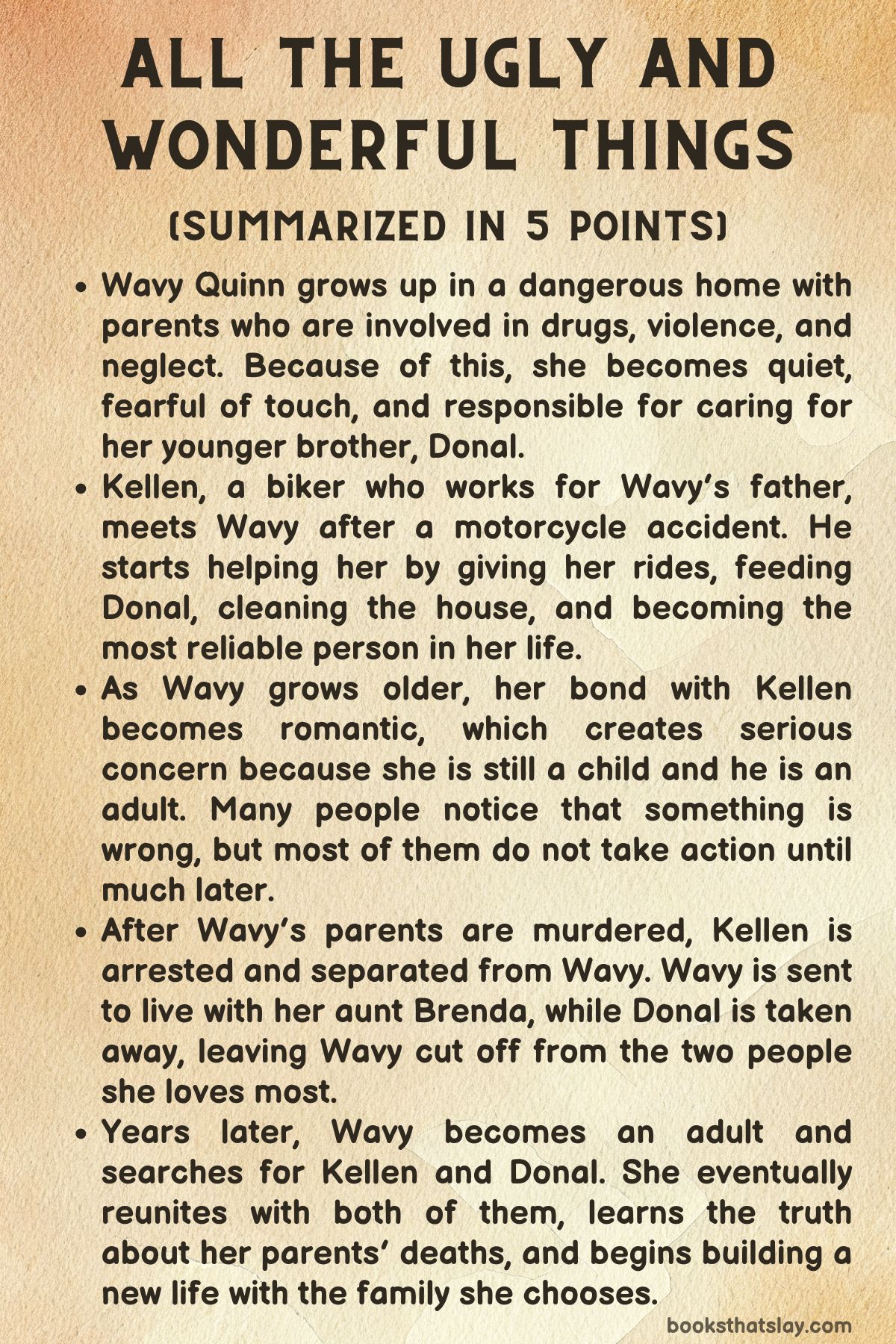
All the Ugly and Wonderful Things follows Wavy Quinn, a girl born into instability, drug crime, and emotional abuse. Her parents, Val and Liam, live outside ordinary social boundaries.
Liam is a drug dealer with a dangerous temper, while Val is mentally unstable, addicted, and often unable to care for her children. When both parents are jailed, young Wavy is sent to live with relatives, where her cousin Amy becomes one of the few people able to connect with her.
Wavy rarely speaks, hates being touched, and refuses to eat in front of others. Yet she is intelligent, observant, and fascinated by stars and constellations.
For a short time, Wavy improves under the care of her grandmother, who understands that Wavy is not incapable but deeply guarded. After her grandmother dies, Wavy returns to Val.
By then, Val has a baby son, Donal, and Wavy quickly becomes more of a parent than a child. She protects Donal from hunger, neglect, and their mother’s frightening moods.
Val teaches Wavy that bodies, mouths, touch, and desire are dirty, leaving Wavy with fear and confusion around food, speech, and affection.
Wavy’s life changes when she causes a motorcycle accident involving Kellen, one of Liam’s drug runners. Kellen is huge, scarred by his own violent childhood, and lonely.
Wavy helps him after the crash, speaking her name aloud for the first time. This moment creates a bond between them.
Kellen later returns to the Quinn farmhouse and sees the full extent of Wavy and Donal’s neglect. He starts giving Wavy rides to school, cleaning the house, feeding Donal, and showing up when no one else does.
Kellen becomes Wavy’s safest person. He buys her a helmet and boots, remembers her birthday, listens to her talk about the stars, and treats her as someone worth noticing.
Wavy, who has never had reliable care, clings to him. Kellen knows their closeness is unusual and dangerous, but he also feels needed in a way he has never felt before.
He remains tied to Liam’s criminal world partly because staying near Liam means staying near Wavy.
As Wavy grows older, her feelings for Kellen become romantic and sexual. She has learned about sex by watching adults around Liam and Val, so her understanding is distorted by violence, jealousy, and performance.
Kellen tries at times to set limits, but he also gives Wavy an engagement ring, calls her his girl, and allows their relationship to become physical. Several adults notice troubling signs: teachers, nurses, Liam’s associates, and relatives.
Some are disturbed, but most do nothing. Their silence becomes part of the tragedy.
Wavy’s aunt Brenda eventually discovers the relationship after Wavy and Donal spend time with her family. Around the same time, Val and Liam are found murdered at the farmhouse.
Brenda and her daughters first encounter the scene, then find Wavy with Kellen at his workplace. Kellen is arrested, partly for his relationship with Wavy and partly because police suspect him in the murders.
Wavy insists he did not rape her and that they love each other. Her testimony is shocking to the adults around her because she speaks openly about desire and refuses the role they want her to accept.
Even so, Kellen is sent to prison.
After the arrest, Wavy loses almost everything. Brenda takes her in but tries to control her life and separate her from Kellen.
Donal is taken away by Sean, who claims to be his biological father. Wavy writes to Kellen, but her letters are returned.
She writes to Donal too, but those letters also stop reaching him. Cut off from the two people she loves most, Wavy retreats into school, typing, woodworking, and study.
She becomes more outwardly functional, though her emotional life remains fixed on Kellen and Donal.
During high school, Wavy continues to carry Kellen’s memory. She tells Amy and others that she lied in court about having full sex with Kellen in order to provide him an alibi.
In truth, their relationship had been sexual but not in the way the court assumed. Wavy still believes their love was real, while the adults around her insist she was only a victim.
Kellen, meanwhile, begins to accept that he harmed her. At a parole hearing, he breaks down after Brenda claims Wavy now understands herself as abused.
Believing Wavy has rejected him, he apologizes and loses hope.
Wavy later goes to college, where she rooms with Renee, a privileged and dramatic young woman who first treats Wavy as strange but gradually becomes her friend. Renee learns that Wavy is still writing to Kellen, searching for Donal, and fighting Brenda over money Kellen left in trust for her.
Wavy’s letters to Kellen keep coming back unread until one is marked with notice that he has been released.
Renee helps Wavy locate Kellen. Their reunion is intense and painful.
Wavy is now an adult, but Kellen is still bound by parole conditions and listed as a sex offender. He has been living with Beth, a woman who helped him but does not truly understand him.
Wavy and Kellen have sex, and Kellen realizes she had waited for him. Yet he is terrified that being with her will send him back to prison and ruin her future.
He tells her he raped her and has no right to her life. Wavy rejects that version of events, but when she sees his despair, she gives back the ring and tells him he is free.
Wavy does not give up. She studies the law, petitions to remove the no-contact order, and confronts the judge who dismisses her as another abused woman unable to see clearly.
Wavy insists that her family and her love are real, even if they do not look respectable. The judge eventually changes the order.
Wavy asks Kellen to meet her at Brenda’s house, where she retrieves his motorcycle and confronts Brenda for lying and hiding his parole from her. Kellen comes because he trusts Wavy, not knowing the order has changed.
They leave together and later marry.
The ending brings a partial reconciliation. Wavy and Kellen find Donal, who has suffered badly under Sean and in the foster system.
They bring him to Brenda’s house for Christmas. There, Wavy reveals that Sean murdered Liam and Val, and Donal kept silent because Sean threatened Wavy.
This truth undercuts Brenda’s belief that removing Kellen protected Wavy. In reality, Kellen had often been the person who kept Wavy and Donal alive.
By the end, Wavy forgives Brenda, though the damage cannot be undone. Donal, Wavy, and Kellen form their own fragile family.
Amy notices that Wavy, who had seemed frozen for years, has begun to grow again. The novel closes not with simple approval or easy healing, but with the sense that Wavy has claimed her own story after years of others trying to define it for her.
Characters
Wavy Quinn
Wavy Quinn is the emotional center of All the Ugly and Wonderful Things, a child shaped by neglect, fear, and the strange survival habits she develops in response to her home life. Her silence is not emptiness but control.
Speaking, eating, touching, and being seen have all become dangerous to her because her mother has taught her that the body is dirty and that affection can turn threatening without warning. Wavy is unusually intelligent, especially in her knowledge of stars and patterns, but the adults around her often mistake her silence for disability or defiance.
Her bond with Kellen begins because he treats her as capable and real. He listens to her, feeds her brother, protects her, and gives her a form of steadiness she has never known.
At the same time, Wavy’s love for him is shaped by trauma, loneliness, and the absence of healthy models. She wants agency over her own story, and much of the novel shows her fighting against people who either ignore her pain or define it for her.
Kellen
Kellen is one of the most morally complicated characters in the novel. He is violent, damaged, and involved in Liam’s drug business, yet he is also the person who gives Wavy and Donal the most consistent care.
His own childhood abuse has left him ashamed, lonely, and hungry for belonging. Wavy’s trust gives him purpose, and he becomes protective of her in ways that other adults fail to be.
However, Kellen’s protection becomes compromised when he allows his emotional dependence on Wavy to turn into romance and sexual intimacy. He understands, at least partly, that she is too young and that he has power over her, but he repeatedly fails to stop the relationship from crossing boundaries.
His later guilt is genuine, but it does not erase the harm. Kellen’s tragedy lies in the fact that he can be both a rescuer and a source of damage.
The novel refuses to make him only a monster or only a savior.
Val Quinn
Val is Wavy’s mother and one of the strongest sources of Wavy’s fear. She is unstable, addicted, jealous, and deeply damaged by her relationship with Liam.
Her moods shift between seduction, rage, helplessness, and paranoia. She teaches Wavy that bodies are contaminated, that mouths are dirty, and that male attention is dangerous.
These lessons become central to Wavy’s later confusion about food, speech, touch, and sexuality. Val is not simply careless; she actively wounds her daughter, sometimes through cruelty and sometimes through the collapse of her own mind.
Yet she is also a victim of Liam’s control, abandonment, and violence. Her life shows how abuse can be passed down when pain is never treated and when dependency becomes stronger than self-preservation.
Val’s failure as a mother is devastating because Wavy and Donal need protection from the very person who should be protecting them.
Liam Quinn
Liam is the source of much of the danger surrounding Wavy’s childhood. He is charming, handsome, sexually dominant, and criminally powerful, which allows him to control nearly everyone around him.
His drug operation creates the violent world in which Wavy and Donal grow up, and his selfishness keeps his family unstable. Liam’s attitude toward his children is careless and cruel.
He shows more interest in power, money, women, and loyalty than in fatherhood. His treatment of Val keeps her emotionally trapped, and his rejection of Wavy is especially painful because it confirms her sense that she is unwanted.
Liam’s presence also distorts the behavior of the people around him. His girlfriends compete for his attention, his workers fear him, and even adults who know better often adjust themselves to his authority.
He represents a form of masculine power that is attractive to some characters but destructive to everyone who depends on him.
Donal Quinn
Donal is Wavy’s younger brother and the person she protects most fiercely. As a child, he depends on Wavy more than on either parent, and their bond becomes one of the purest forms of love in the novel.
Donal often sees things he cannot fully understand, including violence, sexual behavior, drug use, and adult betrayal. His innocence makes these observations especially painful because he tries to interpret chaos through a child’s logic.
After he is taken away by Sean, Donal’s life becomes even more unstable, and his silence about the murders shows both terror and loyalty. He keeps the secret because he believes Sean’s threats against Wavy.
Donal’s later reunion with Wavy and Kellen is difficult because he has been damaged by years of separation, abuse, and institutional life. Still, his return allows Wavy to recover part of the family she thought she had lost forever.
Amy
Amy is Wavy’s cousin and one of the novel’s most important witnesses. As a child, she is fascinated by Wavy’s strangeness and sees her as mysterious, bold, and almost magical.
Unlike many adults, Amy does not immediately try to correct Wavy. She notices her intelligence and understands that Wavy’s silence does not mean she has nothing to say.
As Amy grows older, her perspective matures. She begins to see how badly the adults around Wavy have failed her, including Amy’s own mother.
Amy’s own coming-of-age, especially her understanding of desire and her relationship with Trisha, gives her more sympathy for Wavy’s insistence on choosing her own life. Amy is not always brave, and she does not always intervene, but by the end she becomes a bridge between Wavy and the family that judged her.
Her final understanding is quiet but important: Wavy’s life cannot be reduced to scandal.
Brenda
Brenda is Wavy’s aunt and one of the most frustrating adult figures in the story. She sees enough to know that something is wrong, but for years she chooses hesitation, distance, and social comfort over decisive action.
She worries about Wavy, but she does not want the full burden of caring for her and Donal. Later, when she discovers Wavy’s relationship with Kellen, she becomes forceful and controlling, but her energy comes too late and is mixed with shame, anger, and a desire to rewrite the past.
Brenda’s opposition to Kellen is understandable in many ways, yet her refusal to listen to Wavy deepens Wavy’s isolation. She lies, withholds information, and uses authority to separate Wavy from the person Wavy loves.
Brenda’s grief and guilt are real, but her need to see herself as Wavy’s rescuer blinds her to the harm her choices cause. Her eventual breakdown comes when she realizes her protection did not protect Wavy at all.
Grandma
Wavy’s grandmother offers one of the few examples of practical, patient care in Wavy’s early life. She does not fully understand Wavy at first, but she pays attention.
She recognizes that Wavy is intelligent and that her silence is a choice rooted in fear rather than a lack of ability. Under her care, Wavy begins to stabilize.
Grandma’s importance lies in the fact that she gives Wavy structure without trying to crush her oddness. She also sees through the assumptions of teachers and counselors who underestimate Wavy.
Her death is a turning point because it sends Wavy back into Val and Liam’s world. Though she appears for a limited portion of the story, her influence lasts.
Wavy later values gifts from her grandmother differently from gifts that come with pressure or control, suggesting that Grandma remains one of the few people Wavy associates with safe love.
Renee
Renee begins as Wavy’s college roommate and first treats Wavy as a curiosity. She is dramatic, privileged, emotionally hungry, and attracted to tragedy in a shallow way.
At first, Wavy’s life seems to Renee like a fascinating story. Over time, however, Renee grows into genuine loyalty.
She sees Wavy’s discipline, grief, intelligence, and endurance. Renee becomes one of the few people who supports Wavy without trying to own her choices.
Her friendship matters because it gives Wavy adult companionship outside her family and outside Kellen. Renee also changes through knowing Wavy.
She becomes less performative about pain and more honest about love, fear, and responsibility. Her role during Wavy’s search for Kellen is crucial: she acts, calls, drives, questions, and comforts.
Even when she doubts Kellen, she remains on Wavy’s side. Renee’s growth makes her one of the healthier relationships in Wavy’s adult life.
Sean
Sean is Liam’s brother and one of the darkest secondary figures in the novel. He brings danger with him whenever he enters the Quinn household.
His need for money, his drug use, and his resentment create the conditions that lead to Val and Liam’s deaths. Sean’s later claim over Donal is especially cruel because it separates him from Wavy, the one person who consistently cared for him.
He uses fear to control Donal, threatening Wavy’s safety to ensure the boy’s silence. Sean represents the way family ties can become another form of captivity rather than protection.
His death from overdose does not undo the damage he causes, but it finally frees Donal to reveal the truth. Through Sean, the novel shows that biological connection alone does not create safety, love, or moral authority.
Sandy
Sandy is one of Liam’s girlfriends, but she is more complicated than a simple background figure. She lives inside Liam’s world of drugs, sex, jealousy, and fear, yet she sometimes shows Wavy kindness.
She helps Wavy with makeup and clothing, but her advice is shaped by the same distorted sexual environment that surrounds them all. Sandy teaches Wavy how to appear attractive without understanding how dangerous that lesson is for a young girl already attached to an adult man.
She also helps get Wavy out of police custody by pretending to be Val, showing quick thinking and a willingness to help. Sandy is damaged and dependent, but she is not heartless.
Her character shows how women in Liam’s orbit can be both victims of his power and participants in the unhealthy world that harms Wavy.
Dee
Dee is another woman caught in Liam’s orbit, and her perspective reveals the emotional cost of being one of his girlfriends. She is jealous, insecure, and aware that Liam uses women while keeping them competing for his attention.
Her feelings toward Val are mixed with pity, resentment, and memory. Dee sometimes sees the ugliness of the world around her, but she is too trapped in her own needs to protect the children within it.
Her encounter with Kellen also reveals his loneliness and awkwardness with adult women. Dee’s role is important because she shows how Liam’s sexual power structure affects everyone near him.
She is not innocent, but she is also not fully free. Like many characters in the novel, she survives by accepting conditions that should never have become normal.
Butch
Butch is a member of Liam’s criminal world, but he has a sharper moral instinct than many others around him. He sees that Val abuses Wavy, and he recognizes that Kellen’s relationship with Wavy crosses a line.
His discomfort is important because it proves that even inside this lawless community, some boundaries are visible. Butch is not a clean moral authority, however.
He still works for Liam, protects the drug operation, and acts first to keep police away from the meth lab after the murders. His reaction to Kellen is partly protective and partly self-serving.
Butch represents compromised conscience. He can identify wrong, but he does not consistently act against the system that produces it.
His character adds complexity to the novel’s moral landscape because he is neither purely loyal criminal nor true protector.
Cutcheon
Cutcheon, the motorcycle shop owner, functions as a rough father figure for Kellen. He understands Kellen’s loneliness and recognizes that Wavy has given him a reason to live.
His response to Kellen and Wavy’s relationship is shaped by his own past marriage to a much younger girl in a different historical and cultural context. This makes his judgment troubling but also revealing.
Cutcheon does not dismiss the seriousness of Kellen’s promise to Wavy. Instead, he tells Kellen to be responsible and not to make promises he will not keep.
His loyalty to Kellen is deep, and he later speaks on Kellen’s behalf. Cutcheon’s character shows how older moral codes can clash with modern legal and ethical boundaries.
He is caring, but his care is filtered through a worldview that does not fully confront the danger of Wavy’s age.
Sheriff Grant
Sheriff Grant is one of the few authority figures who tries to look carefully rather than react automatically. He knows Kellen’s violent history and does not deny that Kellen is capable of harm, but he also doubts the simple theory that Kellen murdered Liam and Val.
His investigation is shaped by patience and practical intelligence. He sees that Wavy is not fragile in the way others assume, and he understands that forcing a story onto her will not produce truth.
Grant is not perfect, especially in how he thinks about consent and legality, but he is more observant than many adults around Wavy. His frustration with Brenda and the federal agents comes from their desire for a neat conclusion.
Grant’s role is to resist easy answers, even when the truth is uncomfortable.
Lisa DeGrassi
Lisa DeGrassi is Wavy’s teacher and an example of an adult who notices a child’s distress but lacks the strength or commitment to help. She sees that Wavy is intelligent, isolated, and neglected.
She also sees the disturbing difference between Val’s moods and the confusion around Kellen’s place in Wavy’s life. Yet Lisa ultimately decides that helping Wavy is too difficult.
Her later encounter with Kellen shows her own loneliness and dissatisfaction with the town. Lisa is not cruel, but her failure matters because Wavy’s life is full of adults who look away.
Through Lisa, the novel criticizes not only obvious abuse but also professional and social fatigue, the kind that allows endangered children to remain endangered because intervention seems messy, hard, or inconvenient.
Judge Maber
Judge Maber represents institutional authority and the danger of assuming that experience equals understanding. She has seen many abused women return to harmful partners, so she interprets Wavy through that pattern before truly listening to her.
Her skepticism is not baseless, but it becomes arrogant because she treats Wavy as a type rather than a person. Wavy’s challenge to her is powerful because it exposes the judge’s emotional distance from the people whose lives she controls.
Judge Maber’s eventual reversal matters because she is one of the few authority figures who changes after being confronted. Her character shows that institutions can harm people even while intending to protect them, especially when they replace individual truth with familiar categories.
Beth
Beth appears in Kellen’s life after prison and offers him temporary shelter, but her kindness has limits. She helps him when he is vulnerable, yet she also talks down to him and never fully respects his inner life.
Her relationship with Kellen is based less on deep love than on loneliness, need, and convenience. When Wavy returns, Beth reacts with anger and disgust, partly because Kellen has hidden the emotional center of his life from her.
Beth’s judgment of Kellen is understandable, but she also serves as a reminder that Kellen’s post-prison life is narrow and humiliating. He is dependent on people who do not truly know him.
Beth is not a villain; she is an ordinary person faced with a situation that is shocking, painful, and beyond what she is willing to accept.
Leslie
Leslie, Amy’s sister, often responds to Wavy with discomfort, impatience, or social embarrassment. As a child and teenager, she is more conventional than Amy and less willing to tolerate Wavy’s oddness.
Her reactions reflect the broader family’s unease: Wavy is not easy to explain, and Leslie prefers categories that make social life simpler. By the end, Leslie is an adult with her own household, and her response to Wavy, Kellen, and Donal remains awkward.
She does not fully understand them, but she is part of the family space Wavy chooses to reenter. Leslie’s character shows the ordinary discomfort of people who are close enough to witness trauma but not brave or imaginative enough to respond with real understanding.
Bill
Bill, Brenda’s husband, is a passive figure whose inaction carries weight. He often frames Wavy and Donal as disruptions to his family’s stability rather than children in danger.
His instinct is to preserve his household, not to rescue them. While Brenda struggles with guilt and responsibility, Bill tends to resist involvement.
This makes him part of the larger pattern of adult failure in the novel. He is not violently harmful like Liam or Sean, but his emotional distance still matters.
Bill represents the comfortable adult who prefers not to see too much because seeing would require sacrifice. His presence helps explain why Wavy’s relatives repeatedly choose delay over action.
Miss Humphries
Miss Humphries, the jewelry clerk, appears briefly but leaves a strong impression. She recognizes the unusual nature of Wavy and Kellen’s engagement, yet she treats Wavy with dignity rather than open cruelty.
Her kindness at the counter gives Wavy a rare public moment of being treated like someone whose feelings matter. At the same time, Miss Humphries’s private understanding of the situation is uneasy.
She sees romance, but she also senses danger and imbalance. Her role is small, but it captures one of the book’s recurring tensions: outsiders can sense that something is wrong without knowing what response would be right.
Her politeness is both humane and insufficient.
Patty and Casey
Patty and Casey, Val’s nurses, observe Wavy and Kellen during a period when Val is recovering at home. They notice enough to suspect that Wavy’s relationship with Kellen is inappropriate, and they discuss the matter between themselves.
Yet neither takes meaningful action. Their failure is different from Brenda’s because they are temporary professionals rather than relatives, but the result is the same: Wavy remains unprotected.
Patty and Casey show how abuse can continue in plain sight when witnesses decide that reporting, confronting, or interfering is someone else’s responsibility. They are not malicious, but their passivity helps the situation continue.
Themes
Trauma and the Formation of Identity
Trauma in All the Ugly and Wonderful Things does not appear only as memory; it shapes behavior, appetite, speech, posture, desire, and self-worth. Wavy’s refusal to eat in front of others, her silence, her fear of germs, and her resistance to touch are not random eccentricities.
They are survival methods created in a home where care was unpredictable and the body was treated as shameful. Kellen’s identity is also built around injury.
His size and violence make him frightening to others, but beneath that exterior is a man who was brutalized as a child and never learned how to see himself as worthy of ordinary tenderness. Donal’s trauma appears through fear, secrecy, and later trouble with authority.
The novel shows that trauma does not always make people visibly broken in expected ways. Sometimes it makes them competent, watchful, controlling, or fiercely loyal.
Wavy’s growth depends not on forgetting what happened to her but on claiming the right to interpret her own life. The story asks whether survival habits can become a self, and whether a person can build a future from behaviors first created to endure danger.
Love, Consent, and Moral Uncertainty
The relationship between Wavy and Kellen forces a difficult examination of love and consent because the emotional truth of their bond exists beside a serious imbalance of age, power, and experience. Wavy loves Kellen because he protects her, listens to her, and gives her the care that every other adult fails to provide.
Kellen loves Wavy because she sees him without contempt and gives him a reason to live. Yet love alone cannot erase the fact that Wavy is a child when their romantic and sexual relationship develops.
The novel does not present the situation as simple, and that discomfort is central to its power. Wavy insists on her agency, while society insists on her victimhood.
Kellen recognizes too late that his need for Wavy has allowed him to cross lines he should have guarded. The theme is not asking readers to ignore harm in the name of love.
Instead, it shows how love can be real and still be ethically compromised. The hardest truth in the novel is that care and damage can come from the same person.
Adult Failure and the Cost of Looking Away
Many adults in the novel see signs of danger, but few act with courage or consistency. Teachers notice Wavy’s silence and refusal to eat.
Nurses suspect the nature of her relationship with Kellen. Relatives see bruises, neglect, and strange behavior.
Liam’s associates understand that Val is abusive and that the children are unsafe. Yet again and again, adults choose delay, discomfort, denial, or self-protection.
This failure is not limited to cruel people. Some are tired, confused, afraid, or unsure what intervention would require.
That is what makes the theme so troubling. The novel suggests that neglect is not only the result of monstrous parents; it can also be produced by ordinary people who decide that a child’s suffering is too complicated to confront.
Brenda’s later attempt to control Wavy cannot erase her earlier inaction. Lisa DeGrassi’s concern does not matter because she gives up.
Patty and Casey’s suspicion does not protect Wavy because they remain silent. The cost of looking away is enormous: Wavy grows up believing Kellen is the only person who will come for her, because in practical terms, he often is.
Chosen Family and the Search for Belonging
Family in the novel is not defined by blood but by who offers protection, recognition, and loyalty. Wavy’s biological parents fail her almost completely.
Val wounds her through fear and shame, while Liam treats her as an inconvenience. Brenda’s family offers shelter at times, but that shelter is conditional and often mixed with judgment.
By contrast, Wavy’s strongest bonds are with Kellen, Donal, Amy, Renee, and eventually the fragile family she builds as an adult. These relationships are imperfect, but they give Wavy something her original household never could: a sense of being seen.
Donal is her first true responsibility and one of her deepest loves. Kellen becomes her protector and later her contested partner.
Renee becomes a friend who learns to support without taking control. Amy becomes a witness who slowly understands Wavy’s right to her own story.
The theme of chosen family does not make the ending simple or clean. Rather, it shows that belonging sometimes has to be built from damaged materials.
Wavy’s final movement toward Donal, Kellen, and even a limited peace with Brenda suggests that family is not a fixed inheritance but an ongoing act of recognition.