All This Time Summary, Characters and Themes
All This Time by Mikki Daughtry and Rachael Lippincott is a young adult romance about grief, second chances, and the strange ways the mind protects the heart from pain. The story follows Kyle, a former football player whose life changes after a terrible car accident on graduation night.
At first, he believes he is mourning his girlfriend Kimberly and slowly rebuilding himself through a new bond with a mysterious girl named Marley. But the novel later reveals a deeper truth, turning Kyle’s recovery into a story about memory, guilt, love, and learning to live after loss.
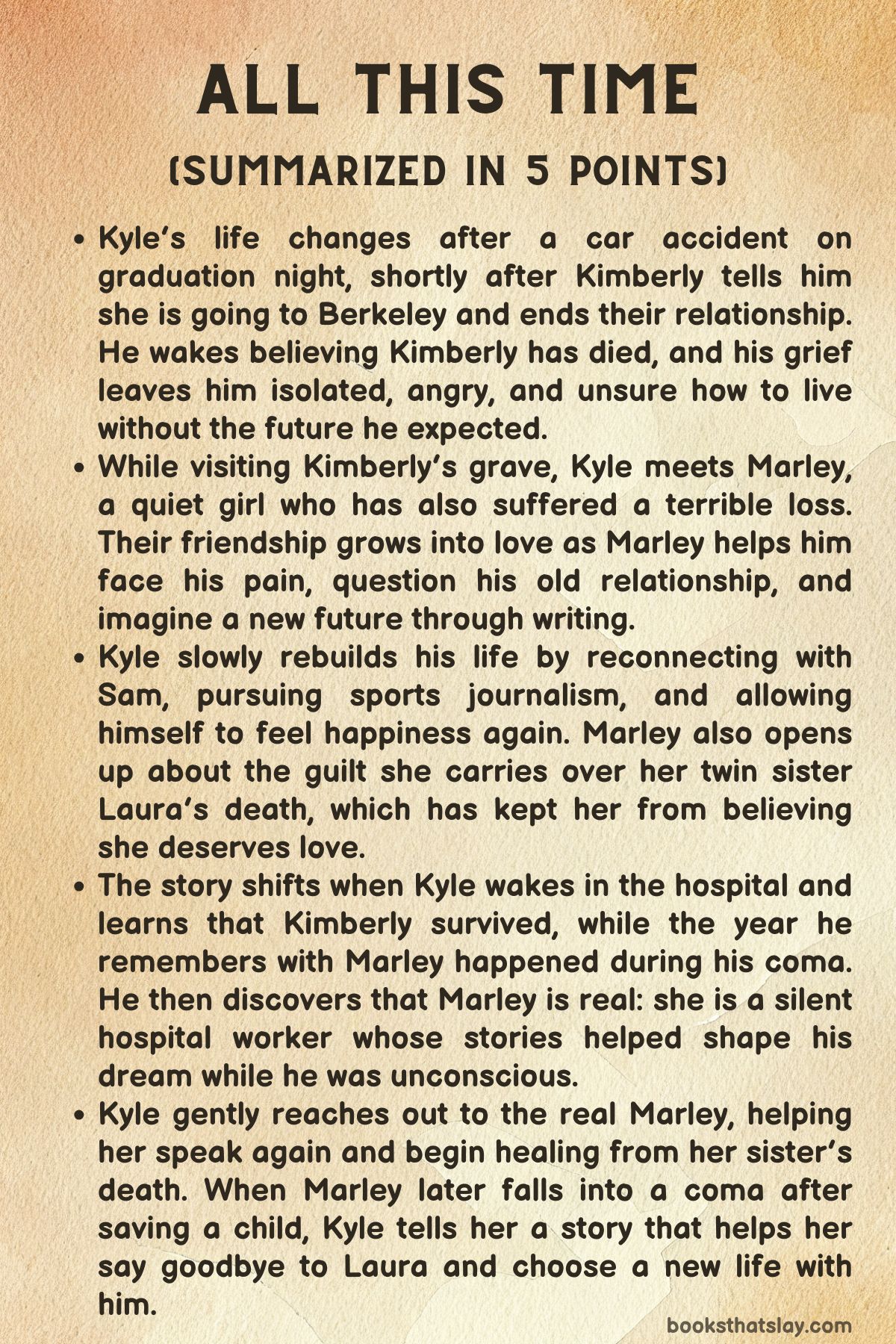
Summary
Kyle is graduating from high school and expects his future to unfold exactly as planned. He and his longtime girlfriend Kimberly are supposed to go to UCLA together, while their best friend Sam waits to hear whether he has been accepted.
Kyle has already lost one part of his identity after a football injury ended his playing career, but he still believes his relationship with Kimberly gives him a clear path forward. At the graduation party, however, he senses that Kimberly and Sam are hiding something from him.
Kimberly finally tells Kyle that she is not going to UCLA. She has been accepted to Berkeley and has known for months.
Kyle feels betrayed, especially because their plans have always been built around staying together. Angry and hurt, he drives away in the rain with Kimberly following him.
When they stop on the side of the road, Kimberly breaks up with him. She says she needs to discover who she is without being defined by their relationship.
Before Kyle can process what she has said, another vehicle crashes into them, pushing their car into the path of a truck.
Kyle wakes in the hospital with a serious head injury. He soon learns that Kimberly died in the accident.
After two weeks, he returns home, but everything feels strange and empty. Kimberly’s belongings have been removed from his room by her parents.
Kyle tries to move through normal routines, but each familiar place reminds him of her. He avoids Sam’s calls and shuts himself away.
His mother, who lost Kyle’s father years earlier, tries to help him understand grief, but Kyle cannot imagine moving forward without Kimberly.
As the summer passes, Kyle gives up on his plans for UCLA. He struggles with pain, flashbacks, and moments when he thinks he sees or hears Kimberly.
His doctor says his brain is healing, but emotionally Kyle is stuck. He finally reconnects with Sam, who reminds him that they both lost Kimberly and need each other.
Still, Kyle feels isolated from everyone who knew him before the accident.
When Kyle visits Kimberly’s grave for the first time, he meets Marley, a quiet girl who is telling a story to herself in the cemetery. She says she visits because her twin sister died when they were younger.
Marley invites Kyle to lunch, and although he resists the idea of making a new friend, he goes with her. They spend time at a pond that once held memories of Kyle, Kimberly, and Sam.
For the first time in months, Kyle feels moments of ease, but that happiness makes him feel guilty.
Kyle and Marley continue meeting. She teaches him about flowers and their meanings, gives him a daisy as a symbol of hope, and encourages him to think of friendship as a possible new beginning.
Kyle is drawn to her because she did not know the old version of him. With Marley, he can talk honestly about Kimberly, about football, about control, and about the parts of his old life that were not as perfect as they seemed.
Marley believes deeply in stories and their power to connect people. As Kyle tells her about his relationship with Kimberly, he begins to understand that he and Kimberly had been holding on to something that no longer fit either of them.
Kyle’s renewed life creates tension with Sam. When Sam learns about Marley, he accuses Kyle of moving on too quickly.
During their argument, Sam admits that he was in love with Kimberly. Kyle is shocked, but the confession helps him see how little he had noticed about the people closest to him.
He realizes that he often saw Sam and Kimberly only through his own needs. Later, Kyle and Sam make peace.
Sam also confesses that he carries guilt over Kyle’s football injury because he feels he failed to protect him during the play that ended Kyle’s career.
Kyle and Marley grow closer. She reads his sports writing, and he reads her stories.
She tells him about a girl who longs for love and finds it with the man on the moon. Kyle begins to fall in love with her.
Marley eventually reveals the source of her pain: her twin sister Laura died after running into the street to retrieve Marley’s pendant. Marley blames herself for Laura’s death.
Kyle comforts her and promises that their story does not have to end sadly.
Kyle starts rebuilding his future. He meets a sports reporter named Scott Miller and gets an internship at the Times.
He begins writing again, takes journalism classes, drives for the first time since the accident, and spends more time with Marley. He even helps her choose a rescue dog, Georgia.
As the months pass, Kyle feels happiness returning in ways he never expected.
On the anniversary of Kimberly’s death, a storm brings Kyle’s trauma back. Marley admits she is not sure she deserves happiness.
Later that night, Kyle wakes and finds Marley gone. He goes out into the storm searching for her, sees a figure at the door, and collapses.
Kyle wakes in the hospital again. He asks for Marley, but his mother does not know who she is.
Then the truth is revealed: Kimberly did not die. Kyle has been in a coma for eight weeks since the car accident, and the entire year he remembers with Marley was created in his unconscious mind.
His doctors explain that sounds, voices, smells, and things he partially sensed while in the hospital may have entered his dreams and shaped his imagined life.
Kyle is devastated. He now has Kimberly alive in front of him, but he is grieving Marley, who may never have existed as he knew her.
He speaks honestly with Kimberly and tells her she was right to end their relationship. They had loved each other, but they had also been settling into a life that neither of them truly wanted.
Kyle encourages her to find herself and to consider Sam’s feelings.
Kyle cannot let go of Marley. He searches for signs that she might be real and eventually finds information that seems to connect her to a girl whose sister died in an accident.
He leaves the hospital to find her, only to realize he has misunderstood the article. The Marley he finds is a child, not the girl from his memories.
Kyle returns to the hospital forced to accept that the Marley from his dream may not exist.
Then he sees a girl in the hospital courtyard saving snails from the sprinklers. She is the real Marley, a quiet nurse’s aide who has been near him during his coma.
Kyle realizes that she wrote stories and spoke near him, and those stories shaped the world he lived in while unconscious. Marley is real, but she is older, silent, and carrying her own trauma.
She had a twin sister who died, and since then Marley has barely spoken.
Kyle tries to reach her gently. He gives her flowers connected to her stories, leaves notes, and eventually helps her save snails in the courtyard without pressuring her to speak.
He tells her about the memories they shared in his coma world, even though those memories came from her stories and his mind. At last, Marley speaks.
She tells him she believes she does not deserve love because she failed to save her sister. Kyle assures her that he will wait until she is ready.
Marley slowly begins opening up. Kyle reads her stories aloud, and together they find comfort in the strange shared world that formed between them while he slept.
Kimberly helps adopt a dog like the Georgia from Kyle’s dream, and Sam, Kimberly, Kyle’s mother, and Marley begin to form a new circle around him. Marley’s mother thanks Kyle for helping her daughter speak again after years of silence.
Kyle is discharged, but the story takes one more painful turn. Marley video calls him from the pond with Georgia.
When Georgia’s ball rolls into the road, a little boy runs after it. Marley saves him but is hit by a car and falls into a coma.
Kyle sits beside her and tells her a story, beginning with the phrase she loves: “Once upon a time.” In that story, Marley faces the grave she created for herself and meets Laura. Kyle begs her to stay in the living world.
Marley finally says goodbye to her sister, and her body responds. Her heartbeat returns, and she wakes.
She explains that she needed to say goodbye before she could begin a new life with Kyle.
Characters
Kyle
Kyle is the emotional center of All This Time, and his journey is shaped by loss, guilt, denial, and the difficult work of rebuilding identity. At the beginning, he sees his life as something already decided: Kimberly is his girlfriend, UCLA is his future, football was his defining talent, and Sam is the friend who keeps everything steady.
When the accident destroys that structure, Kyle is forced into a version of life he never chose. His grief after believing Kimberly has died is not only about losing her; it is also about losing the future he had built around her.
This makes his mourning complicated because he is grieving a relationship that was already breaking apart before the crash.
Kyle’s early behavior shows how deeply he depends on familiar roles. He avoids Sam, hides in his room, refuses to think seriously about college, and clings to the idea that without Kimberly, nothing meaningful remains.
His hallucinations and dreams reveal how much his mind tries to protect him from pain. Marley becomes part of that protection, but she also becomes the person through whom Kyle learns how to face himself.
With her, he starts admitting that his relationship with Kimberly had problems, that he had been self-centered, and that football had controlled too much of his identity.
After waking from the coma, Kyle’s development becomes even more painful because he must mourn a life that technically did not happen. His love for Marley, his work as a writer, his reconciliation with Sam, and his emotional progress all feel real to him, even when everyone else sees them as products of unconscious thought.
This makes Kyle a character caught between emotional truth and factual reality. His final growth comes from choosing reality even when the dream offers comfort.
By the end, Kyle is more honest, more patient, and more aware of other people’s pain. He no longer tries to control love or force life into a plan.
He learns to wait, to listen, and to let healing happen without demanding that it follow his timeline.
Marley
Marley is both a real person and a figure shaped by Kyle’s coma experience, which makes her one of the most complex characters in the novel. In Kyle’s imagined year, she appears as a strange, gentle, story-loving girl who meets him in a cemetery and helps him find a way to live after Kimberly’s supposed death.
She is quiet but imaginative, shy but emotionally perceptive, and her bond with Kyle grows from their shared understanding of grief. Her stories, flower meanings, love for small creatures, and symbolic way of seeing the world make her seem almost dreamlike, but those qualities are later revealed to have roots in the real Marley.
The real Marley is a young woman marked by trauma. Her twin sister died in an accident, and Marley carries a crushing belief that she failed to save her.
Because of this guilt, she has withdrawn from ordinary life and stopped speaking to most people. Her silence is not emptiness; it is a form of punishment she has placed on herself.
She believes happiness would be a betrayal of her sister, so she avoids connection, love, and emotional risk. The Marley of Kyle’s coma is, in many ways, the voice she cannot use in waking life.
Through the stories she tells near Kyle’s hospital bed, she reveals parts of herself that she cannot openly share.
Marley’s character is built around the question of whether a person can accept love while still carrying guilt. She is drawn to Kyle because he hears her in a way others do not, even before they truly know each other.
Their connection begins in an impossible space between dream and reality, but it becomes real through patience, kindness, and recognition. When Kyle stops trying to force her to speak and simply sits beside her, Marley begins to trust him.
Her final crisis, when she saves the child and falls into a coma, forces her to confront the grief she has never released. Saying goodbye to Laura allows Marley to stop living as if her own life ended with her sister’s.
By the end, she is not magically cured, but she is ready to begin again.
Kimberly
Kimberly is first presented through Kyle’s pain, which makes her seem like the lost perfect girlfriend. As the story develops, however, she becomes much more human and complicated.
Before the accident, she is already trying to separate herself from the relationship. Her decision to attend Berkeley instead of UCLA shows that she wants a future that belongs to her, not one built entirely around Kyle.
She hides the truth because she knows how much it will hurt him, but the secrecy also shows how trapped she feels. Her breakup with Kyle is painful, but it is not cruel.
She is trying to tell the truth about a relationship that has become too limiting for both of them.
In Kyle’s coma, Kimberly becomes the symbol of what he thinks he has lost. Her imagined death allows him to confront the weight of their relationship and the damage caused by depending too much on one person for identity and direction.
Yet when Kyle wakes and finds Kimberly alive, the emotional situation becomes even more difficult. He cannot simply return to her because he has changed, and because his love for Marley feels real to him.
Kimberly’s presence forces Kyle to separate guilt from love. He cares about her deeply, but he no longer sees their relationship as something that must be restored.
Kimberly also shows growth after the accident. She apologizes, tries to reach Kyle, and struggles with the strange fact that he has lived an entire emotional year without her while she has been waiting in the real world.
Her later kindness toward Marley shows maturity. Instead of acting only out of jealousy or hurt, she helps Kyle reach the person he loves.
Kimberly’s importance lies in her honesty about needing independence. She is not a villain for leaving Kyle, and she is not simply a memory for him to mourn.
She is a young woman trying to claim her own life, and her friendship with Kyle becomes healthier once both of them stop pretending their romance is still right.
Sam
Sam is Kyle’s closest friend and one of the story’s strongest examples of hidden pain. At first, Kyle sees him as steady, reasonable, and supportive, but this view is incomplete.
Sam has his own grief, guilt, and longing, much of which Kyle fails to notice. Sam has been in love with Kimberly, but he suppresses his feelings because of his loyalty to Kyle and because he feels guilty about the football injury that ended Kyle’s career.
His silence makes him seem dependable on the surface, but underneath he is carrying emotional burdens that no one has fully acknowledged.
Sam’s conflict with Kyle over Marley reveals his vulnerability. When he accuses Kyle of moving on too quickly, his reaction is not only about Kimberly’s death in Kyle’s coma reality.
It also comes from Sam’s own inability to move forward. He has loved Kimberly from a distance and has watched Kyle take her for granted at times.
His anger forces Kyle to recognize that he has not been attentive to the inner lives of the people closest to him. Sam’s confession becomes one of the moments that breaks Kyle’s self-centered view of the world.
Even when Sam refuses to help Kyle chase after the possibly imaginary Marley, he is acting from care rather than coldness. He wants to protect Kyle from hurting himself further.
Sam’s loyalty is not blind agreement; it often means telling Kyle what he does not want to hear. His eventual move to UCLA gives him a future beyond being Kyle’s emotional support.
It also shows that Sam must learn to want things for himself. By the end of All This Time, Sam has shifted from being the quiet friend in the background to a fuller character whose love, guilt, and hope matter.
His relationship with Kimberly suggests that he may finally allow himself to pursue happiness without feeling that he is betraying Kyle.
Kyle’s Mother
Kyle’s mother is a grounding presence in the story. She understands grief because she lost Kyle’s father, and this history gives her a quiet authority when she tries to help Kyle survive Kimberly’s supposed death.
She does not dismiss his pain or demand that he recover quickly. Instead, she stays with him, watches over him, and reminds him that moving forward does not mean forgetting.
Her love is steady, but she also refuses to let him disappear entirely into grief.
Her role is important because she represents a form of survival Kyle has already witnessed but never fully understood. As a child, he lost his father, but his mother had to keep living and raising him.
When Kyle experiences devastating loss as a young adult, he begins to understand the strength that must have required. She is compassionate without being passive.
She worries when Kyle isolates himself, challenges him about his future, and welcomes signs that he is reconnecting with life.
Her reaction to Marley is also meaningful. In the imagined timeline, she is happy that Kyle has found a friend and later accepts Marley warmly.
In the real timeline, her concern is more cautious because Kyle’s attachment to Marley comes after a coma and may seem confusing from the outside. Even so, she remains open to what Kyle feels.
Her character shows parental love as a balance between protection and trust. She cannot heal Kyle for him, but she can stand beside him while he learns how to heal himself.
Laura
Laura, Marley’s twin sister, shapes Marley’s entire emotional life despite being absent from most of the present action. She represents the wound at the center of Marley’s silence.
Because Laura died in an accident connected to Marley’s pendant, Marley interprets the tragedy as her fault. The fact that they were twins deepens this pain.
Laura was not only a sister but also a mirror, a companion, and part of Marley’s identity. Losing her creates a break in Marley’s sense of self.
Laura’s importance is not based on how much she does in the plot but on what her memory does to Marley. Marley’s guilt turns Laura into an impossible standard.
If Laura cannot grow up, love, speak, or experience happiness, Marley believes she should not do those things either. This makes Laura’s memory both beloved and imprisoning.
Marley’s love for her sister becomes tangled with self-punishment.
The final vision of Laura allows Marley to change her relationship with the past. Laura is not presented as someone who wants Marley to suffer forever.
Instead, saying goodbye becomes an act of release. Marley does not stop loving Laura, but she stops using that love as a reason to deny herself a future.
Laura’s character therefore represents both the depth of sibling love and the danger of allowing guilt to speak for the dead.
Dr. Benefield
Dr. Benefield functions as the medical voice of reason in Kyle’s story. He explains Kyle’s recovery, his coma, and the way external details may have entered his subconscious mind.
His role is practical, but it is also important to the novel’s structure because he helps the reader understand the boundary between what happened physically and what Kyle experienced emotionally. He does not treat Kyle’s dream year as meaningless, but he frames it within the reality of brain injury and recovery.
His presence also emphasizes that healing is not only emotional. Kyle’s body has been badly injured, and his recovery requires physical treatment, neurological observation, and patience.
Dr. Benefield reminds Kyle that there are limits to what desire and memory can solve. Kyle cannot simply rush back into the life he imagined.
He must deal with pain, weakness, therapy, and the slow process of returning to ordinary movement.
At the same time, Dr. Benefield’s explanations do not erase the emotional truth of Kyle’s experience. This balance matters because the novel does not reduce Kyle’s coma memories to nonsense.
The doctor gives a rational framework, but Kyle still has to decide what those memories mean for his life. Dr. Benefield’s character helps keep the story anchored in reality while allowing room for the mystery of how the mind creates meaning from fragments.
Dr. Ronson
Dr. Ronson represents the psychological side of Kyle’s recovery. While Dr. Benefield focuses on the body and brain, Dr. Ronson helps Kyle examine memory, grief, and the possible sources of his coma dream.
His work is not to mock Kyle’s feelings, but to help him understand how his mind may have built Marley’s world from sensory details around him. This makes him important in the section where Kyle struggles to accept that what he remembers may not have happened as he experienced it.
Through Dr. Ronson, the story explores how the mind protects itself under extreme stress. Kyle’s dream life was not random.
It contained his grief over Kimberly, his buried awareness of Sam’s feelings, his desire for a new identity, his fear of storms, and the stories Marley told near him. Dr. Ronson’s role is to help Kyle separate emotional truth from literal truth.
That distinction is painful, but it allows Kyle to move forward without dismissing what he felt.
Dr. Ronson also challenges Kyle’s need for certainty. Kyle wants proof that Marley existed exactly as he remembers her.
Therapy pushes him toward a harder acceptance: memories can be meaningful even when they are not factual records. Dr. Ronson’s character does not dominate the story, but he helps open the space for Kyle to process trauma rather than chase only answers.
Scott Miller
Scott Miller is a minor character, but he plays an important role in Kyle’s imagined recovery. As a sports reporter who once followed Kyle’s football career, Scott becomes a bridge between Kyle’s lost identity as an athlete and his possible future as a writer.
When Scott offers Kyle an internship, he gives him a way to remain connected to sports without needing to play. This is crucial because Kyle’s football injury had left him feeling useless and directionless.
Scott’s recognition of Kyle’s writing matters because Kyle needs to see that he has value beyond his body and athletic talent. Football had once given him confidence, status, and a clear path.
Journalism offers a different kind of purpose, one based on observation, language, and understanding other people’s stories. Through Scott, Kyle begins to imagine a future that is not a weaker version of his old life but a new direction altogether.
Even though the internship occurs within Kyle’s coma experience, its emotional meaning survives after he wakes. It shows Kyle what he wants and what he might become.
Scott’s character therefore functions less as a fully developed person and more as a symbol of possibility. He helps Kyle discover that losing one dream does not mean life has no shape left.
Marley’s Mother
Marley’s mother appears later in the story, but her presence reveals the long-term impact of Laura’s death on the entire family. She has watched Marley retreat into silence and has likely lived with helplessness, worry, and grief for years.
Her gratitude toward Kyle is significant because it shows how extraordinary Marley’s change has been. Marley speaking again is not a small improvement; it is the reopening of a life that had almost closed itself off.
Her character also helps readers understand that Marley’s trauma did not exist in isolation. Families often suffer around the person who is most visibly wounded.
Marley’s mother lost one daughter and then, in another way, lost access to the other through silence and withdrawal. Her appreciation for Kyle is not simply because he becomes Marley’s romantic interest, but because he reaches Marley in a way others could not.
Marley’s mother also adds emotional weight to the ending. When Marley is injured, the fear is not only Kyle’s.
It belongs to a family that has already endured a similar tragedy. Her character reminds us that healing is fragile and that trauma can echo across years, relationships, and generations.
Themes
Grief and the Difficulty of Moving Forward
Grief in All This Time is not shown as a clean process with a clear beginning and end. Kyle’s mourning begins with the belief that Kimberly has died, but the loss he feels is larger than death alone.
He mourns his relationship, his football career, his old future, and the version of himself who believed everything was certain. His grief makes ordinary places painful because they carry memories he cannot escape.
The ice cream shop, the pond, his bedroom, and the cemetery all become reminders that life continues even when he feels frozen. This is one of the story’s sharpest observations: the world does not pause for private loss, and that can make grief feel even more isolating.
Marley’s grief has a different shape. She does not simply miss Laura; she believes she must suffer because Laura cannot live.
Her silence becomes a form of loyalty twisted into punishment. Sam also grieves quietly, not only for Kimberly in Kyle’s coma reality but for the emotional life he never allowed himself to claim.
The novel treats grief as something that changes people’s behavior, memory, and self-worth. Moving forward does not mean replacing the lost person or forgetting what happened.
It means learning to live without turning pain into a permanent identity. Kyle and Marley both must accept that love for the dead cannot require the death of the self.
Identity After Loss
Kyle’s identity is unstable long before the accident. He thinks he knows who he is because he has familiar labels: boyfriend, athlete, friend, future UCLA student.
When football is taken from him, he loses one version of himself, but he still holds tightly to Kimberly and their shared plan. After the crash, even that disappears.
His struggle is not only to recover but to answer a frightening question: who is he when the roles that defined him no longer fit? This is why Marley’s presence matters so much.
She meets him without the weight of his past and gives him space to imagine a new self.
The story suggests that identity built only around other people is fragile. Kyle and Kimberly’s relationship had become a structure both of them used to avoid uncertainty.
Kimberly’s choice to go to Berkeley is an attempt to find herself outside that structure. Kyle initially sees it as betrayal, but later understands that she was right to want independence.
His move toward sports writing also shows a healthier form of identity. He does not abandon his love of football, but he changes his relationship to it.
Instead of needing to be the player on the field, he can become someone who observes, thinks, and writes about the game.
Marley faces a similar crisis, though hers is shaped by twinship and guilt. After Laura’s death, Marley cannot separate her own life from the sister she lost.
Her growth begins when she realizes that continuing to live does not mean leaving Laura behind. Identity after loss is not about returning to the old self.
It is about forming a self that can carry the past without being trapped inside it.
Love, Control, and Letting Go
Romantic love in the novel is repeatedly tested by the desire to control outcomes. Kyle’s relationship with Kimberly begins as the kind of high school romance others admire, but beneath that image is a lack of freedom.
Kyle assumes their future is shared because that is what he wants, and he does not fully notice Kimberly’s doubts. Kimberly hides her Berkeley decision because she fears the pain of disrupting that plan.
Their love is real, but it has become too dependent on habit, expectation, and fear of change. The breakup before the accident is painful because it breaks Kyle’s illusion that love can secure the future.
Kyle’s relationship with Marley teaches him a different kind of love. At first, even there, he wants answers and contact on his own terms.
After waking from the coma, he wants Marley to speak, to confirm his memories, and to make his dream feel real. But Marley cannot be reached through pressure.
Her trauma requires patience. Kyle’s most important act of love is not a dramatic rescue but his decision to sit beside her quietly and give her space.
This contrasts strongly with his earlier relationship with Kimberly, where he often saw love as something that should follow his plan.
Letting go appears in several forms. Kyle lets go of the idea that Kimberly belongs in his future.
Sam must let go of guilt before he can pursue his own happiness. Marley must let go of the belief that loving someone means betraying Laura.
The story argues that love becomes healthier when it stops trying to possess, fix, or control another person. True care allows people to choose, heal, and grow at their own pace.
The Power of Stories and Memory
Stories are not just a decorative element in the novel; they shape survival. Marley tells stories because direct speech is difficult for her, and those stories become the material from which Kyle’s unconscious mind builds an entire year.
This makes storytelling both intimate and powerful. It reaches Kyle when he cannot respond, giving him images, emotions, and symbols that help him process pain.
The imagined Marley may not be fully factual, but she is built from real words, real grief, and real longing. That makes Kyle’s memories emotionally meaningful even when they are not literal events.
Memory in the story is unstable but not worthless. Kyle remembers a year that did not happen in ordinary time, yet that year changes him.
He becomes more honest about Kimberly, more aware of Sam, more open to writing, and more capable of loving without control. The novel asks readers to consider whether an experience must be factual to be transformative.
Kyle’s coma memories are partly dream, partly sensory input, partly emotional truth, and partly Marley’s stories. Their mixed nature makes them confusing, but also deeply important.
Marley’s stories also help her speak the truths she has buried. Through fantasy, flowers, moon imagery, pearls, snails, and fairy-tale language, she expresses guilt, loneliness, and hope.
Kyle later returns those stories to her, using them as a bridge back to life. In this way, storytelling becomes a form of communication when ordinary language fails.
It allows characters to remember, mourn, confess, and imagine futures they are not yet brave enough to claim.