Alone with You in the Ether Summary, Characters and Themes
Alone with You in the Ether by Olivie Blake is a literary romance about two difficult, brilliant people who meet by chance in a Chicago art museum and begin to change the shape of each other’s lives. Regan is a restless former art student with a troubled past, a strained family life, and an uncertain relationship with her own mind.
Aldo is a theoretical mathematician absorbed in time, patterns, bees, and the problem of existence. The novel follows their intense connection through conversation, desire, fear, art, mental illness, and the hard question of whether love can help two unstable people become more honest with themselves.
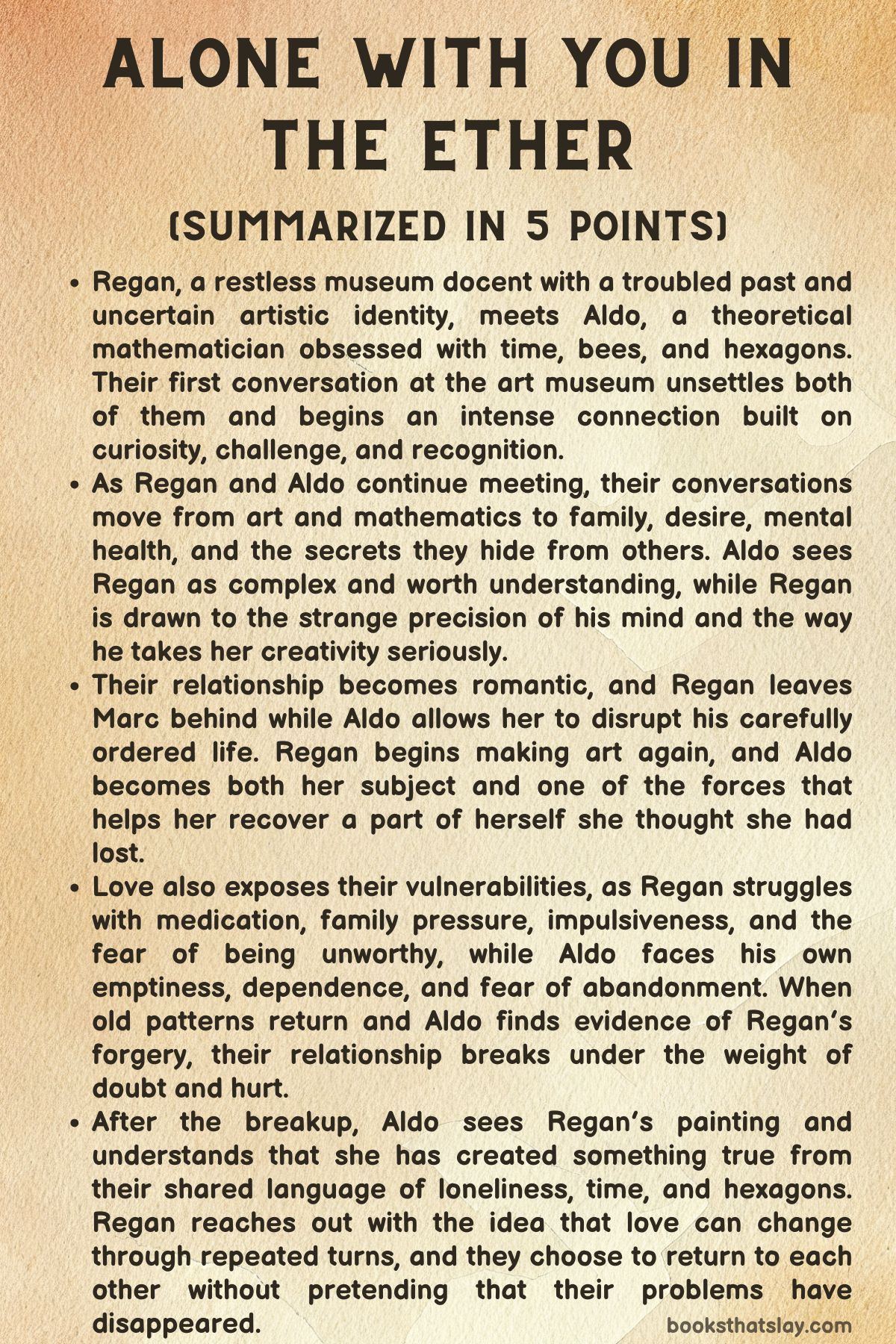
Summary
Alone with You in the Ether begins with Regan looking back on the moment she met Aldo and wondering whether love really began at that instant or long before it, through a series of choices neither of them fully understood. She often visits the art museum, studying paintings and thinking about devotion, beauty, and time.
The armory becomes the place where her life shifts, though she does not immediately understand how much.
Before they meet, Aldo lives inside his theories. He is a doctoral student and teacher in theoretical mathematics, fascinated by time travel, hexagons, bees, and the possibility that time may have a structure people cannot yet understand.
His mind moves through abstract problems with patience and focus. He is not especially warm with his students, who find him hard to follow, and his daily life is quiet, spare, and ruled by routine.
His father, Masso, calls him often, offering warmth and imagined travel plans. Aldo appreciates him, though he sometimes finds his father’s concern unnecessary.
Regan’s life is far less orderly. She wakes late beside Marc, her boyfriend, and rushes to her work as a volunteer docent at the Art Institute of Chicago.
She lives on family money, carries the weight of an art degree she has not turned into a career, and feels trapped by boredom. Marc offers a kind of easy escape through drugs, sex, and chaos, but their relationship is stagnant.
Regan also attends court-appointed therapy after a past arrest for counterfeiting and theft. Her psychiatrist diagnosed her with a mood disorder, but Regan withholds more than she shares.
She is haunted by her family’s expectations, especially the contrast between herself and her successful sister, Madeline.
Regan and Aldo meet when she finds him sitting on the museum floor, drawing hexagons and thinking about time travel. She tells him he cannot sit there, but he barely responds in the expected way.
Instead, he remarks that she does not seem like a Charlotte, which is her given name, and talks cryptically about bees, hexagons, and time. Regan is struck by his strangeness, intelligence, and physical presence.
Aldo is just as struck by her, though he processes attraction as a problem to be studied. Their brief first conversation leaves both of them changed.
They meet again at the museum, and Aldo asks her about her arrest. Regan explains that she made counterfeit foreign currency, not because she needed money, but because she could.
Aldo notices that she lies with skill and asks her to lie to him so he can learn how to detect it. Their exchange becomes the beginning of a set of planned conversations.
They eat together, talk about Aldo’s past substance use and overdose, and argue about why Regan committed her crime. She admits that she once wanted to be an artist but never became one in the way she hoped.
Aldo’s directness irritates her, but it also fascinates her.
Their conversations continue in different settings. Aldo attends one of Regan’s art tours, forcing her to remain professional while he studies her.
She shows him her favorite painting and explains that she admires art that captures a moment without demanding a clear story. Later, they meet at a cocktail bar, where Aldo talks about bees.
Regan is drawn to the way his mind works and begins to see his interest in the natural world as a key to understanding him. She tells him more about the counterfeiting, including Marc’s role in inspiring the act through his work with metal and swords.
Aldo tells her he likes her brain, which Regan recognizes as one of the highest compliments he can give.
Regan calls Aldo late at night to challenge his idea that there are no perfect circles in nature. Their conversation stretches on as they discuss ripples, hexagons, Babylonian time, friendship, family, and childhood.
Regan learns that Aldo’s best friend is his father, while she admits that her favorite person may be her young niece. She asks to join Aldo at church, and during mass she watches him draw equations and hexagons in his notebook.
When she guides his hand to her leg, he begins drawing on her skin, turning her into a surface for his thoughts. The moment is intimate but not quite sexual, and both feel the boundary between them shifting.
Regan later brings Aldo into more parts of her life. She asks him to attend her parents’ anniversary party, partly because his presence will confuse her family and reduce their questions.
Before that, she attends his class and sees how much he dislikes teaching. She cuts his hair at his apartment, and the act becomes one of creation.
Aldo realizes that Regan is an artist when she has a vision and control over form. Their bond deepens, but Marc remains present in Regan’s life, warning her that Aldo will eventually see her flaws and leave.
At the family party, Aldo quickly sees that Regan becomes Charlotte around her family. Her mother, Helen, treats her as immature and unstable, while Madeline is more open to Aldo.
Aldo tells Madeline that Regan is like an endlessly complex problem, always changing and therefore impossible to solve. Regan and Aldo nearly kiss, but he stops the moment.
Later, Regan goes to his room and asks what part of her he most wants access to. She expects him to say her body, but he says he wants to see her art.
This hurts her because she feels cut off from that part of herself. In anger and pain, she leaves.
That night, Regan goes to her father’s office and looks at a painting he once praised. As a child, she had wanted his approval, but now she sees the painting as ordinary.
She finds old supplies and makes an exact copy of it. This act revives something in her.
Soon after, she distances herself from Aldo, then calls him to model for her. In his apartment, she draws him nude while he talks about time, culture, and the way some people live without the same fixed ideas of past and future.
Regan admits she has stopped taking her medication. Aldo does not condemn her, but encourages her to release what is inside her.
The moment nearly becomes physical before she leaves.
Eventually, Regan and Aldo become lovers. Their first time happens without words in Aldo’s kitchen, and their relationship soon grows consuming.
Regan leaves Marc and gives herself fully to Aldo, while Aldo’s orderly life begins to change. He thinks of her in class, becomes more aware of his students, and invites her to Los Angeles to meet Masso.
Regan is nervous, but Masso receives her with warmth. She sees the depth of love between father and son and falls more deeply for Aldo through it.
Aldo also tells her more about his mother, who left, and about the overdose that was tied to his feelings of emptiness. He admits that obsessions, including Regan, give him reasons to keep going.
Regan and Aldo’s relationship becomes more serious, but its intensity also creates danger. Masso warns Aldo that Regan may be too unstable and too fast for him.
He fears she will hurt Aldo as Aldo’s mother did. Aldo rejects this, insisting that Regan is different and that she gives him hope.
When Regan returns to Chicago before him, she feels lost and needy without him. She runs into Marc, who repeats that Aldo will tire of her.
Aldo calms her over the phone, and they speak about ether as the vast emptiness of space, time, and existence. Later, Aldo asks Regan to move in with him.
Living together begins beautifully, but Regan’s mental state remains fragile. She continues therapy and tries to prove to her psychiatrist that she no longer needs medication.
At the same time, she is creating art again and preparing for a showcase. Her new sense of identity as an artist is powerful but unsettling.
She is changing, and neither she nor Aldo fully knows how to handle it.
Their relationship breaks after another family event, this time her father’s birthday. Helen has invited Marc, who tells Aldo that he is only part of Regan’s pattern and will eventually be replaced.
Aldo sees signs that Regan has become less stable: she is not sleeping, disappears for long stretches, and seems harder to understand. He finds the forged painting in her father’s office and realizes what she has done.
Hurt and afraid, he asks whether she has really changed at all. Regan hears this as proof that he believes she is still the person she used to be.
Aldo breaks up with her, wondering whether their love is genuine or simply a mutual need.
After the breakup, Regan reflects on what she failed to see. She knows she ignored Aldo’s needs and placed him in situations that overwhelmed him.
She also understands that her art and her growth made her feel both powerful and unsteady. Aldo, meanwhile, goes to the museum and sees Regan’s painting, titled Alone with You in the Ether.
It is made of golden hexagons and seems to him to express loneliness, humanity, love, and the universe itself. He realizes that Regan has created something true and that she is not like his mother.
She has become a source of hope, not abandonment.
Regan watches Aldo at the museum and imagines approaching him. She feels grateful that he helped her see herself as an artist.
She calls him and tells him that their love is a perfect circle, and that if time moves through turns like a hexagon, each turn gives them another chance to change. Aldo accepts this.
They agree to meet at home. The novel closes by making clear that their problems do not disappear, but they learn to build a life that can hold both love and imperfection.
Characters
Regan
Regan is one of the novel’s two central figures, and much of her character is built around restlessness, self-doubt, intelligence, and a hunger for intensity. She begins as someone who seems to have access to many forms of privilege: money, education, beauty, and cultural knowledge.
Yet none of these give her a stable sense of purpose. Her work as a museum docent keeps her close to art, but also reminds her that she has not become the artist she once hoped to be.
She understands art deeply, but she cannot yet trust herself as a creator. This gap between perception and creation becomes one of her defining conflicts.
Regan’s past with counterfeiting shows both her talent and her dangerous impulsiveness. She is capable of producing convincing work, but she uses that skill destructively, almost as if proving she can make something false is easier than risking the creation of something true.
Her relationship with Marc reflects a similar pattern. Marc offers stimulation, permission, and familiarity, but not growth.
He knows her weaknesses and uses that knowledge to keep her close. Regan stays partly because he does not demand that she become better, which makes him feel safe even when the relationship is unhealthy.
Her relationship with Aldo forces her to confront parts of herself she has avoided. Aldo does not simply desire her body or tolerate her chaos; he wants to understand her mind and see her art.
This unsettles her because it asks for honesty rather than performance. Regan is used to being watched, wanted, judged, and underestimated, but Aldo’s attention is different.
He treats her as complex rather than broken, and this helps her regain access to her creative self. At the same time, she can be self-centered, reckless, emotionally demanding, and careless with Aldo’s needs.
Her growth is not presented as simple recovery. In Alone with You in the Ether, Regan becomes most fully herself when she begins making original art, but even then she must learn that creation, love, and self-knowledge require responsibility as much as desire.
Aldo
Aldo is a mathematician whose life is shaped by routine, abstraction, and obsession. He thinks in patterns, theories, and unsolved problems, especially time travel, hexagons, bees, and the structure of reality.
At first, he appears emotionally distant, even difficult. His students dislike him because he struggles to communicate in a way others can easily understand, and he often seems uninterested in ordinary social expectations.
Yet his difficulty with people is not a lack of feeling. Rather, Aldo feels intensely, but his mind filters emotion through analysis.
His relationship with his father, Masso, reveals his softer side. Masso’s warmth has helped Aldo survive loneliness, abandonment, substance use, and a sense of emptiness.
Aldo’s mother left when he was young, and that absence shapes his fear of being left behind. His overdose also suggests a deeper pain beneath his intellectual life.
Aldo’s obsessions become a way of continuing, giving him something to focus on when existence feels unbearable. This makes his love for Regan both beautiful and dangerous.
She becomes not only a person he loves, but also a problem he wants to study, a mystery he wants to remain close to, and a reason to keep living.
Aldo’s attraction to Regan begins with curiosity, but it grows into devotion. He sees her as ever-changing, full of locked rooms, and impossible to reduce to a single explanation.
He is one of the first people to take her creative identity seriously. By asking to see her art, he reaches for the part of her that she feels she has lost.
Still, Aldo is not without flaws. His need for patterns causes him to fear that Regan is repeating old behaviors, and when he sees the forged painting, he interprets it through suspicion and hurt.
His breakup with her comes from fear as much as judgment. By the end, Aldo’s growth lies in accepting that love cannot be solved like a theorem.
In Alone with You in the Ether, he learns that uncertainty does not always mean danger; sometimes it is the condition under which hope survives.
Marc
Marc functions as a symbol of Regan’s old life: indulgent, unstable, seductive, and stagnant. He is not simply a bad boyfriend in a flat sense, because part of his power over Regan comes from the fact that he understands her patterns.
He knows when she is restless, when she wants attention, and when she is likely to return to what is familiar. Their relationship is built on mutual convenience rather than genuine intimacy.
Marc allows Regan to avoid responsibility, and Regan gives Marc access to her energy, beauty, and volatility.
His drug use, partying, and casual attitude toward Regan’s self-destructive impulses make him a poor influence, but his most damaging trait is his possessive insight. He repeatedly tells Regan that Aldo will eventually see through her and leave.
He also tells Aldo that Regan is caught in a cycle and that Aldo is only the newest part of it. Marc’s words are cruel because they contain enough truth to create fear.
He understands Regan’s capacity for repetition, but he uses that knowledge to trap her rather than help her grow.
Marc’s role is important because he tests the difference between being accepted and being enabled. He accepts Regan’s flaws only because he benefits from her staying the same.
Aldo, by contrast, wants to know her deeply and asks her to risk change. Marc represents the comfort of not being challenged.
His presence at the family event also reveals how easily Regan’s family participates in undermining her progress. Even after Regan has moved toward art, love, and self-renewal, Marc remains a reminder that old versions of the self do not disappear quietly.
Masso
Masso is Aldo’s father and one of the novel’s clearest sources of warmth. He is loving, generous, attentive, and deeply invested in Aldo’s well-being.
As a chef, he is associated with care, nourishment, and hospitality. His yearly celebration at the restaurant shows that his love extends beyond his son to the people who work for him.
He creates a world of welcome, and this makes a strong impression on Regan, who is unused to family love that feels so open and unconditional.
Masso’s relationship with Aldo is tender but also marked by worry. He knows that Aldo has survived abandonment, substance use, and emotional darkness.
His phone calls and fantasies about travel are his way of keeping Aldo connected to life. Even when Aldo insists that Masso does not need to do so much, the reader can see that Masso’s care has been essential.
He gives Aldo a model of love that is steady, patient, and present.
At the same time, Masso is not blindly approving. He likes Regan, but he fears what her intensity might do to Aldo.
His concern that Regan resembles Aldo’s mother comes from protective fear rather than cruelty. He worries that Aldo will attach himself to someone who may leave or consume him emotionally.
This makes Masso a balanced character: loving, wise in some ways, but also shaped by his own memories of loss. His warning to Aldo is not entirely wrong, but it is incomplete.
He sees the danger in Regan before he sees the hope she gives Aldo.
Helen
Helen, Regan’s mother, is a powerful force in Regan’s inner life. Even when she is not physically present, her voice seems to live inside Regan’s thoughts, criticizing, judging, and reducing her.
Helen sees Regan as impulsive, immature, and disappointing, especially in contrast with Madeline. Her treatment of Regan has helped create the shame and defensiveness that Regan carries into adulthood.
Helen’s influence is damaging because she does not merely criticize Regan’s actions; she attacks her identity. Regan has internalized the belief that she is too unstable to succeed, too difficult to love, and too likely to ruin whatever good thing she finds.
This internal voice becomes a major obstacle to Regan’s growth. When Regan begins to love Aldo and create art again, Helen’s judgment rises in her mind as a warning that she will fail.
Helen also represents a family system that values appearance, achievement, and control over understanding. She prefers Marc’s familiarity to Aldo’s strangeness, not because Marc is better for Regan, but because he fits a known pattern.
Her decision to invite Marc to a family event suggests a willingness to disrupt Regan’s new relationship. Helen’s character is not explored through deep sympathy in the book, but her importance is clear.
She is the emotional architecture Regan must resist in order to claim her own life.
Madeline
Madeline is Regan’s older sister and the family’s admired child. As a pediatric surgeon, she embodies the success, discipline, and social approval that Regan lacks.
To Regan, Madeline’s achievements intensify her own sense of failure. Even Madeline’s unexpected pregnancy once gave Regan a private sense of satisfaction because it made the perfect sister seem momentarily flawed.
This reaction reveals less about Madeline’s cruelty and more about Regan’s pain at always being compared to her.
Unlike Helen, Madeline appears more capable of seeing Regan with nuance. She speaks with Aldo and seems to understand his view of Regan as complicated, changing, and worthy of attention.
She also likes Aldo, which separates her from the more judgmental family atmosphere around Regan. Madeline’s presence shows that Regan’s family is not entirely one-dimensional, though it remains a place where Regan feels diminished.
Madeline also serves as a mirror for Regan’s insecurity. Regan’s resentment of her sister is tied to years of feeling second-best, but Madeline is not necessarily the source of that wound.
She is the person through whom the family’s values are most visibly rewarded. Her role in the story helps explain why Regan struggles to believe that her own gifts matter.
Madeline succeeds in an accepted way, while Regan must fight to see art, feeling, and self-expression as valid forms of achievement.
Regan’s Psychiatrist
Regan’s psychiatrist represents structure, diagnosis, and the demand for accountability. She is court-appointed, which means Regan’s relationship with her begins under pressure rather than trust.
Regan does not hate her, but she also refuses to give her full honesty. Their sessions reveal Regan’s tendency to perform, deflect, and control what others are allowed to know.
The psychiatrist is important because she keeps returning to questions Regan would rather avoid: medication, mood, Marc, sleep, and behavioral patterns. Regan wants to talk about art because painting feels like rebirth to her, but the psychiatrist remains focused on the risks surrounding her mental health.
This creates tension between creative freedom and clinical responsibility. Regan sees her return to art as proof that she is better, while the psychiatrist is concerned that she may be mistaking intensity for stability.
This character is not presented as a perfect healer. Regan often feels that the psychiatrist misses what matters most to her, especially the significance of painting again.
Still, the psychiatrist’s concerns are not baseless. Regan has stopped taking medication, become secretive, and begun living with heightened emotional intensity.
The psychiatrist’s role is to challenge Regan’s belief that feeling alive automatically means being well. Through her, the novel raises difficult questions about autonomy, treatment, honesty, and the difference between self-discovery and self-endangerment.
Regan’s Father
Regan’s father is less directly developed than her mother, but his presence matters because of his connection to art, approval, and Regan’s childhood ambitions. The painting in his office becomes a key object in Regan’s development.
As a child, she believed his admiration for that painting meant something profound. She wanted to create art that could earn the same kind of approval.
Later, when she sees the painting as ordinary, she recognizes that her father’s judgment may not have been as meaningful as she once believed.
This realization frees something in her. By copying the painting, Regan returns to art through imitation, fraud, and skill all at once.
The act connects her childhood longing for approval with her adult history of counterfeiting. Her father’s painting becomes a bridge between false creation and real creation.
It helps her understand that she has been measuring herself against standards that may not deserve her obedience.
Regan’s father also symbolizes the family’s passive role in her insecurity. While Helen is the sharper critical force, her father’s approval still carries emotional weight.
His birthday party becomes the setting for the crisis in Regan and Aldo’s relationship, especially when Aldo discovers the forged painting. In this way, the father’s world is tied to performance, judgment, and the old self Regan is trying to escape.
Aldo’s Mother
Aldo’s mother is absent, but that absence has shaped Aldo profoundly. She left shortly after he was born and never tried to find him.
Aldo claims not to be interested in finding her, but her abandonment remains part of the emotional background of his life. It helps explain Masso’s protectiveness and Aldo’s fear of being left by someone he loves.
Her importance increases through Masso’s fear that Regan may resemble her. To Masso, Aldo’s mother represents instability, departure, and damage.
When he warns Aldo about Regan, he is partly responding to the old wound of being left and having to raise Aldo alone. Aldo resists the comparison because he sees Regan not as abandonment, but as possibility.
Aldo’s mother is therefore less a character of action than a character of consequence. Her absence creates a pattern that others fear may repeat.
Aldo’s final rejection of the comparison between Regan and his mother is significant because it shows his decision to trust his own understanding of love rather than inherit Masso’s fear. He does not deny that Regan is difficult or unstable, but he refuses to define her by another woman’s disappearance.
Themes
Love as Recognition and Risk
Love in Alone with You in the Ether is not presented as simple rescue or comfort. Regan and Aldo fall in love because each sees something in the other that most people miss.
Aldo sees Regan not merely as chaotic or beautiful, but as intelligent, creative, and endlessly complex. Regan sees Aldo not merely as strange or difficult, but as alive with thought, precision, and hidden tenderness.
Their love begins through conversation because language becomes the first space where they test each other. They ask questions, challenge assumptions, and reveal parts of themselves gradually.
This makes their bond feel like recognition before it becomes romance.
Yet recognition also creates danger. Aldo’s fascination with Regan can become obsession, and Regan’s desire for Aldo can become need.
Both are vulnerable to using love as proof that they matter. Aldo fears emptiness and looks for purpose in problems that cannot be exhausted.
Regan fears failure and rejection, so Aldo’s attention feels like validation. Their relationship becomes healthiest only when they stop treating love as possession, cure, or escape.
The ending does not pretend that love erases their difficulties. Instead, it suggests that love can become a place where two people keep choosing honesty, change, and return, even when certainty is impossible.
Art, Creation, and the Search for Self
Regan’s relationship with art is central to her identity. She begins close to art but separated from her own creative power.
As a museum docent, she can explain paintings, understand artistic movements, and speak with insight about beauty, intention, and form. However, she cannot produce work that feels meaningful to her.
This failure is not only professional; it is personal. Regan’s inability to create reflects her deeper fear that she has no stable self worth expressing.
She can perform, seduce, lie, copy, and provoke, but original creation requires exposure.
The counterfeiting episode is important because it shows that Regan has artistic ability, but she has directed it toward falsehood. Making fake money allows her to create without emotional risk.
Copying her father’s painting later repeats that pattern, yet it also becomes a turning point. By confronting the painting she once associated with approval, she begins to free herself from inherited standards.
Aldo’s request to see her art wounds her because it reaches the part of her that feels most empty, but it also pushes her back toward creation. Her final painting, built from hexagons and emotional truth, marks the moment when she turns observation, love, loneliness, and thought into original expression.
Art becomes the proof that Regan is not merely reacting to life. She can shape it, translate it, and claim it as her own.
Time, Patterns, and the Possibility of Change
Aldo’s fixation on time gives the novel one of its main intellectual frameworks. He thinks about time travel, hexagons, bees, light cones, and ancient systems of measurement because he wants to understand whether existence has a shape.
For Aldo, patterns are comforting. They allow him to sit with problems that may never be solved.
His routines work the same way: they give his life structure and protect him from emotional disorder. Regan, however, disrupts this structure.
She makes his days different, and through that difference, time becomes more noticeable and more alive.
Patterns also carry emotional meaning. Marc tells Aldo that Regan is repeating a cycle, and Aldo begins to fear that he is only another temporary obsession in her life.
Regan’s forged painting seems to confirm this fear because it connects her present to the old act of counterfeiting. The central question becomes whether patterns determine people or whether people can turn at a new angle.
The image of the hexagon is important because it suggests direction without simple linearity. Regan’s idea that every turn creates a chance for change gives the story its final hope.
The characters do not become entirely new people, and the past is not erased. Still, the novel argues that repetition is not destiny if people can recognize the pattern and choose differently.
Mental Health, Instability, and the Limits of Romantic Cure
The novel treats mental health as a serious and ongoing part of both Regan’s and Aldo’s lives. Regan has a diagnosed mood disorder, a court-appointed psychiatrist, medication she resists, and patterns of impulsive behavior.
Aldo has a history of substance use, an overdose, abandonment wounds, and recurring feelings of emptiness. Their love does not exist apart from these realities.
It is shaped by them from the beginning. Their intensity is partly romantic, but it is also connected to compulsion, fear, need, and the desire to be saved from oneself.
Regan’s decision to stop taking her medication complicates her return to art. She experiences creativity as proof of life and freedom, but the psychiatrist worries about sleep, honesty, and stability.
This tension is handled without an easy answer. The novel respects Regan’s longing to feel fully alive, yet it also shows the danger of confusing intensity with wellness.
Aldo faces a similar danger when he makes Regan his reason to continue. That kind of devotion may sound beautiful, but it places a heavy burden on both people.
The ending is careful because it does not claim that romance cures mental illness. Instead, it suggests that a healthier love requires truth, treatment of the self with care, and the recognition that another person can offer hope without becoming the sole condition for survival.