Amari And The Great Game Summary, Characters and Themes
Amari And The Great Game by B. B. Alston is a middle-grade fantasy adventure about courage, prejudice, power, and choosing what kind of person you want to become under pressure. The story follows Amari Peters, a young magician already feared by much of the supernatural world, as she tries to prove that magicians are not monsters.
When a mysterious time freeze shakes the Bureau of Supernatural Affairs, Amari is blamed, excluded, and watched closely by powerful enemies. At the same time, she is pulled into a dangerous contest for control of the League of Magicians, forcing her to face fear, anger, and the cost of power. It’s the 2nd book of the Supernatural Investigations series.
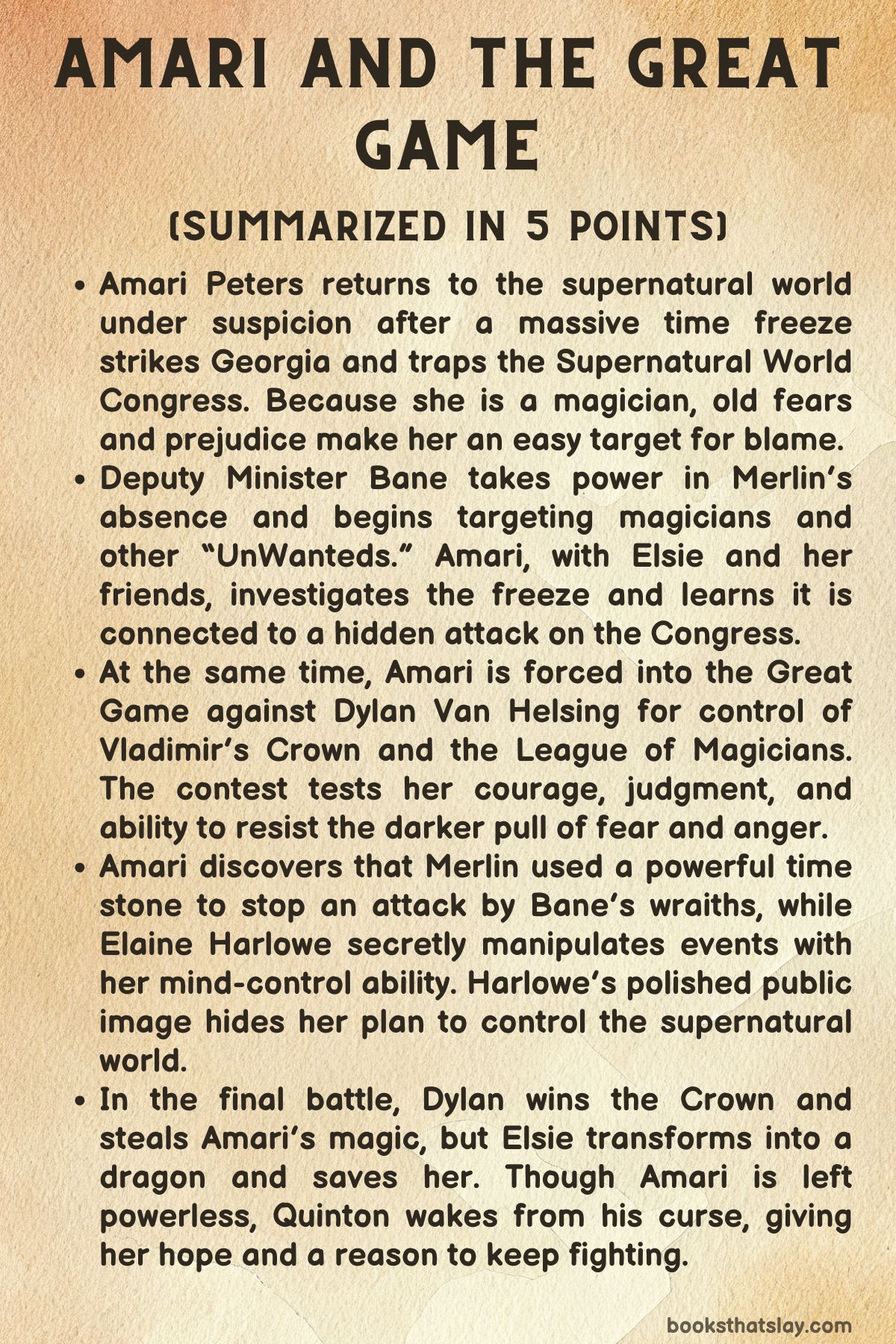
Summary
Amari Peters is trying to enjoy the end of the school year with her best friend Elsie Rodriguez, but trouble finds her quickly. Amari has already made a name for herself in the supernatural world by defeating a dangerous magician, yet that victory has not made her life easier.
Many supernatural beings still fear magicians because of the terrible crimes committed long ago by the Night Brothers, Vladimir and Moreau. Amari, who was born with magic, carries the weight of that history even though she has done nothing to deserve people’s suspicion.
Before summer begins, Elsie gives Amari and their friends enchanted fortune cookies. Amari’s cookie warns her about unseen dangers.
Soon after, a strange storm strikes Atlanta, freezing nearly everyone in time for a few moments. Amari is not frozen, which makes the incident even more alarming.
The Bureau of Supernatural Affairs declares the event a major magical attack. Instead of being welcomed back to summer camp, Amari receives a message saying she has been uninvited.
Amari is upset because summer camp is her way back into the Bureau, where her brother Quinton lies under a sleeping curse. She wants to be near him and continue searching for a way to save him.
The political situation soon grows worse. Merlin, the Prime Minister of the supernatural world, is trapped in a larger time freeze along with the Supernatural World Congress.
Deputy Minister Bane, a wraith with a deep hatred of magicians and other outcasts, takes power in Merlin’s absence. He begins targeting “UnWanteds,” a cruel label used for magicians and those connected to them.
Amari refuses to accept the blame. She and Elsie reason that the time freeze is too powerful for one magician to have caused alone.
Amari contacts the League of Magicians, a secret organization connected to Vladimir’s old magic. Its steward, Cozmo, insists that the League did not cause the freeze, but he pressures Amari to accept Vladimir’s Crown.
If she accepts, she will gain authority over the League and inherit great magical power. Amari hesitates because accepting the crown could make the supernatural world fear magicians even more.
Elsie helps get Amari reinstated at camp, but her return is tense. People stare at her, fear her, and treat her like a threat.
At the Bureau, Amari sees Quinton still asleep and joins the Department of Supernatural Investigations as a Junior Agent. She also meets Elaine Harlowe, a faun appointed by Bane.
Harlowe acts friendly in public, but Amari senses danger beneath her polished manner. Harlowe controls the message around Amari, using press conferences to make the Bureau seem fair while keeping Amari under watch.
At camp, Amari learns that Bane has taken over the time freeze investigation and that the Bureau itself is not allowed to pursue it. She joins the exclusive Elite club, hoping it will give her access to officials and information.
While listening in on Harlowe and Director Van Helsing, she hears that Bane has plans for her. Harlowe warns her not to investigate.
Amari also starts training as a Junior Agent. She rejects the arrogant Tristan Davies as her partner and chooses Lara Van Helsing instead.
Lara is prickly and resentful, but she and Amari slowly form a practical alliance. Lara wants to prove she belongs as a Junior Agent, while Amari needs help navigating Bureau life.
In class, Amari speaks against the unfair treatment of UnWanteds. She later learns that, just before the time freeze, the Congress had been voting on whether UnWanteds should receive equal rights.
Merlin supported them, while Bane and Harlowe opposed them.
Meanwhile, Maria Van Helsing secretly tutors Amari in magic. Maria teaches her about fair magic and foul magic, explaining that magic can be shaped by selfless or selfish motives.
Amari fears losing control, especially when she discovers that her secondary ability is storm magic. She can summon weather, but controlling it requires control over her own emotions.
The danger increases when Dylan Van Helsing escapes from the Sightless Depths, the prison where he was sent after Amari defeated him. Dylan is the magician who cursed Quinton, and once he is free, Quinton’s condition worsens.
Amari is then summoned to the League, where Cozmo reveals that he helped Dylan escape. Since both Amari and Dylan have a claim to Vladimir’s Crown, Cozmo invokes the Great Game.
The contestants must compete in magical challenges. Whoever wins will receive the crown and the loser’s magic.
The first challenge tests trust. Amari must cross an invisible bridge over a canyon while voices try to make her doubt herself.
She gives in to fear and fails. Afterward, Maria prepares her to defend herself, but Harlowe has Maria arrested.
Harlowe threatens Maria with the Sightless Depths unless Amari cooperates. Then she publicly frames Amari as the person who turned Maria in, forcing Amari to play along to protect her teacher.
Amari, Elsie, Lara, and Jayden begin working together to solve the time freeze mystery. On a field mission, Amari meets Newton, a young NightWalker hiding from both the Bureau and magicians.
He tells her that someone is gathering UnWanteds to fight Bane and that the current events resemble the Ancient Wars. Amari helps him escape and saves his pet shade, which Jayden later names Shadow.
The second challenge takes Amari to the living Library of Alexandria. Dylan attacks her there, setting parts of the library on fire.
Amari finds the Victor’s Ring in a dangerous bowl of liquid and understands that the test values courage. She reaches in with her bare hand and retrieves the ring, but Dylan steals it from her.
Although she loses the challenge, a silver book she saved helps her escape and returns with her.
The silver book shows Amari strange mirror-like scenes from her life, including warnings she does not fully understand. She and Lara later sneak into the frozen Congress Room.
Amari sees that all the frozen leaders seem to be looking toward the same unseen danger. She begins to suspect Dylan, though the timing does not make sense because he was imprisoned when the freeze happened.
Amari speaks out publicly against Bane and Harlowe’s treatment of UnWanteds. She continues researching the first time freeze from the Ancient Wars with Elsie and Arthur, a Junior Agent from Time Management.
They learn that a werewolf named Thomas Fletcher witnessed the first incident. With Julia’s help, Amari contacts Fletcher’s ghost, but he cannot remember what happened because Dylan had stolen that memory with a spell called Dreamcatcher.
In the third challenge, Amari is trapped in an illusion where Quinton is awake and her family is happy. She nearly wants to stay, but she realizes it is false and breaks free.
She wins the ring, then saves Dylan from being killed by a creature inside his own illusion. Dylan denies causing the time freeze and tells Amari where Fletcher’s stolen memory is hidden.
Amari, Elsie, and Lara recover it from the Department of Dreams and Nightmares. The memory shows that the Night Brothers once used an enchanted time stone to freeze their attackers.
Amari and her friends realize the stone must need centuries to recharge, meaning the recent freeze may be connected to the same object. In the fourth challenge, Amari and Dylan are trapped on an underwater train heading toward the Kraken.
Dylan gives in to fear and leaves. Amari stays long enough to win the ring and escape.
Amari, Elsie, and Lara return to the Congress Room, believing the stone is hidden there. Amari discovers it in Merlin’s hand.
When she takes it, the room briefly unfreezes. Merlin grabs the stone back and shouts a warning before freezing everyone again.
That moment reveals the truth: armed wraiths had attacked the Congress while they were voting for UnWanted rights. Because wraiths can become invisible, Merlin’s freeze had hidden them from sight.
Bane is exposed, but Harlowe arrives and orders everyone to release him. Her secret ability is mind control.
She has been manipulating Bane and others, using the crisis to seize control of the supernatural world. Her power does not work on Amari or Elsie because they possess strong magic.
Harlowe has also forced Maria to reveal the League’s existence and has sent agents after its members.
Before Amari can act, the final stage of the Great Game begins. Cozmo cancels the last formal challenge and declares that Amari and Dylan must fight directly.
Amari tries to stop the conflict, but Dylan wants the Crown. Their battle pushes Amari toward fear and anger.
She nearly uses a forbidden storm spell, but Elsie stops her from killing Dylan. Instead, Amari uses Dreamcatcher to remove Dylan’s darkest memories.
For a brief moment, his better self returns, and he breaks Quinton’s curse.
Cozmo restores Dylan’s memories, and Dylan wins the Game. He claims Vladimir’s Crown and steals Amari’s magic, leaving her powerless.
When Dylan attacks, Elsie protects Amari and transforms into her dragon form for the first time. She drives Dylan away and flies off.
Amari is sent home, shaken by the loss of her magic and terrified for her friends.
Back in Atlanta, Amari learns that the Vanderbilt Hotel, where the Bureau is located, has burned. Jayden later brings Elsie to Amari’s apartment after finding her unconscious on a roof.
Amari feels defeated, worried about Lara, the Bureau, and the supernatural world now under Harlowe and Dylan’s threats. Then Quinton wakes up.
His return gives Amari hope. Even without her magic, she decides the fight is not over.
With her brother awake and her friends beside her, Amari prepares to stand against the forces trying to control and divide the supernatural world.
Characters
Amari Peters
Amari Peters is the emotional and moral center of Amari And The Great Game. She is a thirteen-year-old girl who has already survived extraordinary danger, but the story makes clear that courage does not erase fear.
Amari wants to be seen as a person rather than as a symbol of everything the supernatural world hates about magicians. Her greatest struggle is not simply defeating Dylan or exposing Bane and Harlowe; it is resisting the pressure to become what others expect her to be.
She is angry about injustice, frightened for Quinton, hurt by public rejection, and tempted by the power that could protect her. Yet she keeps choosing compassion even when it costs her.
Her decision to save Dylan during the mirror challenge shows that she is not ruled by revenge. Her near-use of forbidden storm magic shows how close she comes to being consumed by fear and rage.
By the end, losing her magic does not destroy her identity. Amari’s strength has never come only from power; it comes from loyalty, conscience, and her refusal to accept a world built on prejudice.
Elsie Rodriguez
Elsie Rodriguez is Amari’s closest friend and one of the story’s most important sources of warmth, intelligence, and loyalty. She is brilliant, curious, and deeply committed to helping Amari even when doing so puts her own future and safety at risk.
Elsie’s acceptance into a prestigious academic program shows her talent and ambition, but the story never presents her intelligence as cold or distant. She uses her knowledge to protect people she loves.
She researches, hacks, investigates, questions official stories, and repeatedly stands beside Amari when others pull away. Elsie also represents a different kind of courage from Amari’s.
She is not always on the front line of magical combat, but she shows bravery through trust, persistence, and self-sacrifice. Her transformation into a dragon is a powerful expression of who she has always been: protective, fierce, and stronger than even she fully realized.
Her bond with Amari is one of the story’s strongest relationships because it is built on honesty, belief, and action.
Dylan Van Helsing
Dylan Van Helsing is both an antagonist and a tragic figure. He is dangerous, ambitious, and willing to use fear as a weapon, but the story also suggests that his cruelty is not simple.
Dylan has been shaped by pain, dark memories, family pressure, and his connection to foul magic. His rivalry with Amari is about more than winning Vladimir’s Crown.
He represents one possible path Amari could take if she allowed resentment, fear, and isolation to control her choices. Dylan wants power because power promises safety, dominance, and revenge.
Yet the brief moment when Amari removes his darkest memories reveals that goodness still exists beneath the damage. His decision to break Quinton’s curse during that moment complicates him.
It does not excuse his actions, but it shows that he is not purely evil. When his memories return and he takes Amari’s magic, he becomes a symbol of corrupted potential.
He is what happens when talent is guided by bitterness instead of responsibility.
Quinton Peters
Quinton Peters is physically absent for much of the story because of the sleeping curse, but his presence shapes Amari’s every decision. He is her brother, her motivation, and one of the clearest reminders of what she is fighting for.
Quinton represents family, safety, and the life Amari is desperate to recover. His condition gives the conflict personal stakes beyond politics or magical power.
Amari does not investigate the time freeze only to clear her name; she also wants access to the Bureau because Quinton is there, trapped and vulnerable. His worsening condition after Dylan escapes deepens Amari’s fear and pushes her closer to desperate choices.
When Quinton finally wakes, the moment restores hope after a series of losses. His return does not solve the larger crisis, but it reminds Amari that the fight is still worth continuing.
Quinton’s role shows how love can be both a source of fear and a source of courage.
Maria Van Helsing
Maria Van Helsing serves as Amari’s mentor and moral guide in magic. Unlike many people in the supernatural world, Maria understands the burden of being judged because of magical identity.
She treats Amari not as a threat but as a young person who needs instruction, honesty, and trust. Her lessons about fair and foul magic are central to Amari’s growth because they teach her that power is shaped by motive.
Maria does not pretend that magic is harmless, but she refuses to treat Amari as doomed because she was born with it. Her arrest shows how authoritarian systems attack teachers, protectors, and truth-tellers first.
Harlowe uses Maria as leverage because she knows Amari cares about her. Maria’s courage lies in her willingness to help Amari even when secrecy is necessary and punishment is likely.
She represents responsible power: knowledge guided by restraint, compassion, and ethical choice.
Lara Van Helsing
Lara Van Helsing begins as guarded, resentful, and difficult to approach, but she becomes one of the story’s most interesting examples of growth. She carries the pressure of the Van Helsing name while also feeling that others doubt whether she deserves her place as a Junior Agent.
At first, she interprets Amari’s choice of her as a partner as pity, which reveals how insecure and defensive she is. Her bargain with Amari creates a relationship based on usefulness before it becomes based on trust.
Lara’s development matters because she must choose between family reputation, Bureau expectations, and her own conscience. She helps Amari investigate, keeps secrets, and refuses to betray her friends even when Bane tries to force a confession.
Lara is not instantly warm or easy, but that makes her loyalty more meaningful. Her arc shows that people raised inside flawed institutions can still question them and act with courage.
Jayden
Jayden brings kindness, humor, and emotional steadiness into the story. His excitement about the supernatural world gives the narrative moments of lightness, but he is not just comic relief.
His ability to speak with animals fits his personality because he is gentle, patient, and naturally caring. He calms Shadow when others cannot, helps the group find a hidden meeting place, and later rescues Elsie after her dragon transformation.
Jayden’s importance lies in the way he supports others without needing to dominate the action. He reminds Amari that friendship is not only about dramatic sacrifice; it is also about showing up, listening, helping, and staying when things become frightening.
His loyalty is simple in the best sense. He believes in Amari and Elsie, and that belief helps hold the group together during moments when the Bureau and the supernatural world become hostile.
Elaine Harlowe
Elaine Harlowe is one of the story’s most dangerous villains because she hides cruelty behind charm, public relations, and controlled language. She presents herself as friendly, polished, and reasonable, but her kindness is a performance designed to manage appearances.
Harlowe understands that power does not always need to look violent. Sometimes it works through speeches, press conferences, labels, punishments, and manipulation.
Her secret ability to control people reveals the truth behind her public image: she does not want cooperation; she wants obedience. Harlowe’s treatment of Amari is especially disturbing because she tries to turn Amari into a symbol she can use.
She wants Amari visible, controlled, and useful to her political agenda. Her villainy is rooted in control rather than chaos.
She is dangerous because she knows how to make oppression look official, polite, and necessary.
Prime Minister Bane
Bane is a political antagonist whose hatred of UnWanteds drives much of the conflict. As a wraith, he carries old grudges and uses the crisis at the Congress to seize authority.
He frames his actions as protection of the supernatural world, but his policies are built on fear, exclusion, and punishment. Bane’s use of the term UnWanteds shows how language can dehumanize people before institutions mistreat them.
He does not need proof that magicians or other targeted groups are guilty; prejudice is enough for him. Yet the story later reveals that Bane is also being manipulated by Harlowe, which complicates his position without making him innocent.
He still represents the danger of leaders who exploit public fear. His rise shows how quickly rights can be threatened when a society accepts suspicion as justice.
Cozmo
Cozmo is a complicated figure because he appears helpful and refined, but his loyalty is ultimately to the League of Magicians and the legacy of Vladimir’s Crown. He pressures Amari to accept power before she is ready, then helps Dylan escape in order to force the question of leadership.
Cozmo believes the League needs a ruler, and his commitment to that belief makes him willing to gamble with Amari’s safety and the supernatural world’s stability. He is not a villain in the same way as Harlowe or Bane, but he is morally dangerous because he treats young people as pieces in an ancient system.
His actions show how tradition can become harmful when people obey it without questioning its cost. Cozmo’s calm manner hides the severity of what he does.
He claims to serve order, but he helps create chaos.
Tristan Davies
Tristan Davies represents arrogance, privilege, and the cruelty that can grow in competitive institutions. He is talented and ambitious, but he uses his status to belittle others, especially Lara and Amari.
His resentment when Amari receives recognition from the Elite club reveals his insecurity. Tristan wants superiority to be publicly confirmed, and when it is not, he tries to regain control through humiliation.
His duel with Amari is not only a contest of skill; it is an attempt to embarrass her in front of others. Tristan’s role shows how prejudice and ego reinforce each other.
He dislikes Amari not just because she is a magician, but because her success threatens the hierarchy he expects to benefit from. He is not the central villain, but he helps create the hostile environment that makes Amari’s life at the Bureau so difficult.
Merlin
Merlin is an important figure even though he spends much of the story trapped in the time freeze. He represents a more just vision of supernatural leadership because he supports equal rights for UnWanteds.
The truth about the Congress freeze changes how readers understand him. What first appears to be a magical attack becomes an act of protection.
Merlin used the time stone to stop the wraith assault and preserve the Congress, even though that action also created confusion and political opportunity for his enemies. His role highlights the difference between power used to protect and power used to dominate.
Merlin’s absence also shows how fragile justice can be when it depends too heavily on one leader. Once he is frozen, people like Bane and Harlowe move quickly to reverse progress.
Director Van Helsing
Director Van Helsing is a figure caught inside the Bureau’s politics and limitations. As the head of Supernatural Investigations, he should be central to solving the time freeze, yet Bane’s control prevents a proper investigation.
His position shows how institutions can be weakened from within when authority is redirected by politics. He is not portrayed as actively cruel like Harlowe, but he is also not able to protect Amari from the systems closing around her.
His family connection to Maria, Lara, and Dylan adds another layer to the story’s treatment of legacy. The Van Helsing name carries power, expectation, and damage.
Through him, the story suggests that official titles do not always equal real control, especially when manipulation and fear shape the rules.
Julia
Julia plays a smaller but meaningful role as someone who uses her abilities and public presence to help vulnerable people. Her livestream for deported UnWanteds shows that she is willing to act against injustice rather than remain neutral.
As a medium, she also helps Amari contact Thomas Fletcher, which becomes essential to the investigation. Julia’s function in the story connects activism, friendship, and supernatural skill.
She does not occupy the center of the conflict, but she helps move the truth forward. Her willingness to assist Amari and Elsie shows that resistance to prejudice requires many kinds of contributions.
Some people fight, some research, some speak publicly, and some open doors to hidden knowledge.
Arthur
Arthur is a useful ally because of his connection to the Department of Time Management. His role may be limited, but it is important to the mystery.
By helping Amari and Elsie access information about the first time freeze, he gives them a path toward understanding the present crisis. Arthur also shows that not everyone inside the Bureau accepts the official version of events without question.
His cooperation suggests that institutions are not made only of villains and bystanders; they also contain people willing to quietly help when the truth matters. Through Arthur, the story reinforces the value of specialized knowledge.
Solving the mystery requires more than bravery. It requires archives, memory, history, and people who know where to look.
Newton
Newton, the young NightWalker, gives the story a personal view of what it means to be labeled UnWanted. He is frightened, hunted, and caught between powerful groups who see him as useful, dangerous, or disposable.
His brief encounter with Amari strengthens her understanding of the larger crisis. The issue is not only that Amari is being treated unfairly; many others are being pushed into hiding, exile, or forced allegiance.
Newton’s fear shows the human cost of political language and supernatural prejudice. Amari’s choice to let him escape proves that she values justice over orders.
By saving him and his pet shade, she rejects the Bureau’s mission and follows her conscience instead.
Shadow
Shadow, Newton’s pet shade, adds tenderness and humor while also becoming a reminder of Amari’s compassion. The creature causes chaos in Lara’s room, but its presence helps bring Amari, Lara, Elsie, and Jayden closer together.
Shadow’s need for care gives Jayden a chance to use his gift and shows Lara participating in the group’s secret world. Though Shadow is not a major character in terms of plot decisions, it helps soften tense scenes and reveals character through reaction.
Amari saves Shadow when she could have ignored it, and that choice reflects her instinct to protect the vulnerable, even during danger.
Themes
Prejudice, Fear, and the Politics of Blame
Fear of magicians shapes nearly every part of Amari And The Great Game, and the story shows how prejudice becomes most dangerous when institutions accept it as common sense. Amari is not judged mainly by her actions; she is judged by what people believe magicians have always been.
The crimes of the Night Brothers become a permanent stain placed on anyone connected to magic, even a child who has already risked herself to stop evil. Bane uses this fear to target UnWanteds, turning old hatred into official policy.
The term itself is a weapon because it reduces living beings to a category that can be excluded, deported, or punished. Harlowe makes this even more unsettling by dressing oppression in polite language and public relations.
The story shows that prejudice does not need to be loud to be harmful. It can appear in press conferences, school conversations, club politics, government decisions, and the silence of people who know better but do not act.
Amari’s fight is therefore not only against villains. It is against a society that finds it easier to blame feared groups than question those in power.
Power, Control, and Moral Choice
Magic in the story is never treated as only a tool for spectacle. It is closely tied to motive, emotion, and responsibility.
Maria’s lessons about fair and foul magic give Amari a framework for understanding that power does not become good simply because a good person holds it. Fear, anger, and desperation can turn even justified pain into something destructive.
Amari’s storm magic makes this conflict visible. When she is calm, her power is difficult to control; when she draws from rage or fear, it becomes stronger but more dangerous.
Dylan shows the darker path. He wants power because he believes it will restore his strength and place him above others.
Harlowe represents another form of power: the ability to control minds, public image, and political systems. Cozmo represents inherited power and the pressure of old traditions.
Against all of these, Amari must decide what kind of power she will accept and what kind she will refuse. Her near-use of forbidden magic is one of her most important moments because it shows that moral choice is hardest when violence seems effective.
The story argues that true strength includes restraint.
Friendship, Loyalty, and Chosen Support
Amari survives the story not because she stands alone, but because she has people who believe in her when the world turns hostile. Elsie’s loyalty is constant, but it is not passive.
She researches, challenges unfair decisions, breaks rules when necessary, and risks herself to protect Amari. Jayden brings steadiness and care, while Lara’s friendship develops slowly through suspicion, honesty, and shared danger.
This range of relationships gives the story emotional depth because friendship is shown in different forms. Elsie offers fierce devotion, Jayden offers gentle reliability, Lara offers hard-earned trust, Julia offers practical help, and Maria offers mentorship.
These bonds matter because the villains use isolation as a weapon. Harlowe tries to control who can speak to Amari.
Bane’s policies divide people into acceptable and unacceptable groups. Dylan tries to convince Amari that power matters more than connection.
The story rejects that idea again and again. Elsie’s dragon transformation is the clearest example: her love for Amari awakens a hidden strength.
Friendship is not treated as sentimental decoration. It is a force that protects identity, restores courage, and helps characters resist systems built on fear.
Identity, Legacy, and Refusing a Predetermined Role
Many characters struggle with names, histories, and expectations they did not choose. Amari is treated as dangerous because she is a magician.
Dylan is tied to the Van Helsing family and the legacy of foul magic. Lara feels trapped beneath the expectations of her family name.
Merlin carries the burden of leadership, while Cozmo clings to the old authority of Vladimir’s Crown. The story repeatedly asks whether a person must become what history, family, or society expects.
Amari’s answer is no, but that answer is not easy. She cannot simply reject the magician label, because magic is part of her.
Instead, she must redefine what being a magician can mean. This is why her refusal of the Crown matters.
She does not want power that forces her into an ancient conflict or turns her into a ruler over people she barely understands. Lara’s growth follows a similar pattern.
She wants to prove herself, but she must also decide whether proving herself means obeying the Bureau or doing what is right. The story treats identity as something shaped by choices under pressure.
Legacy may influence a person, but it does not have to own them.