Ambiguous Adventure Summary, Characters and Themes
Ambiguous Adventure by Cheikh Hamidou Kane is a philosophical novel about faith, colonial education, cultural loss, and spiritual conflict. Set among the Diallobé people of West Africa and later in France, it follows Samba Diallo, a gifted boy raised in strict Islamic learning who is sent to a French school so his community can understand the power that has conquered them.
As Samba moves between religious devotion and Western thought, he becomes divided within himself. The book asks whether a people can learn from a dominant culture without losing the beliefs, memories, and inner life that define them.
Summary
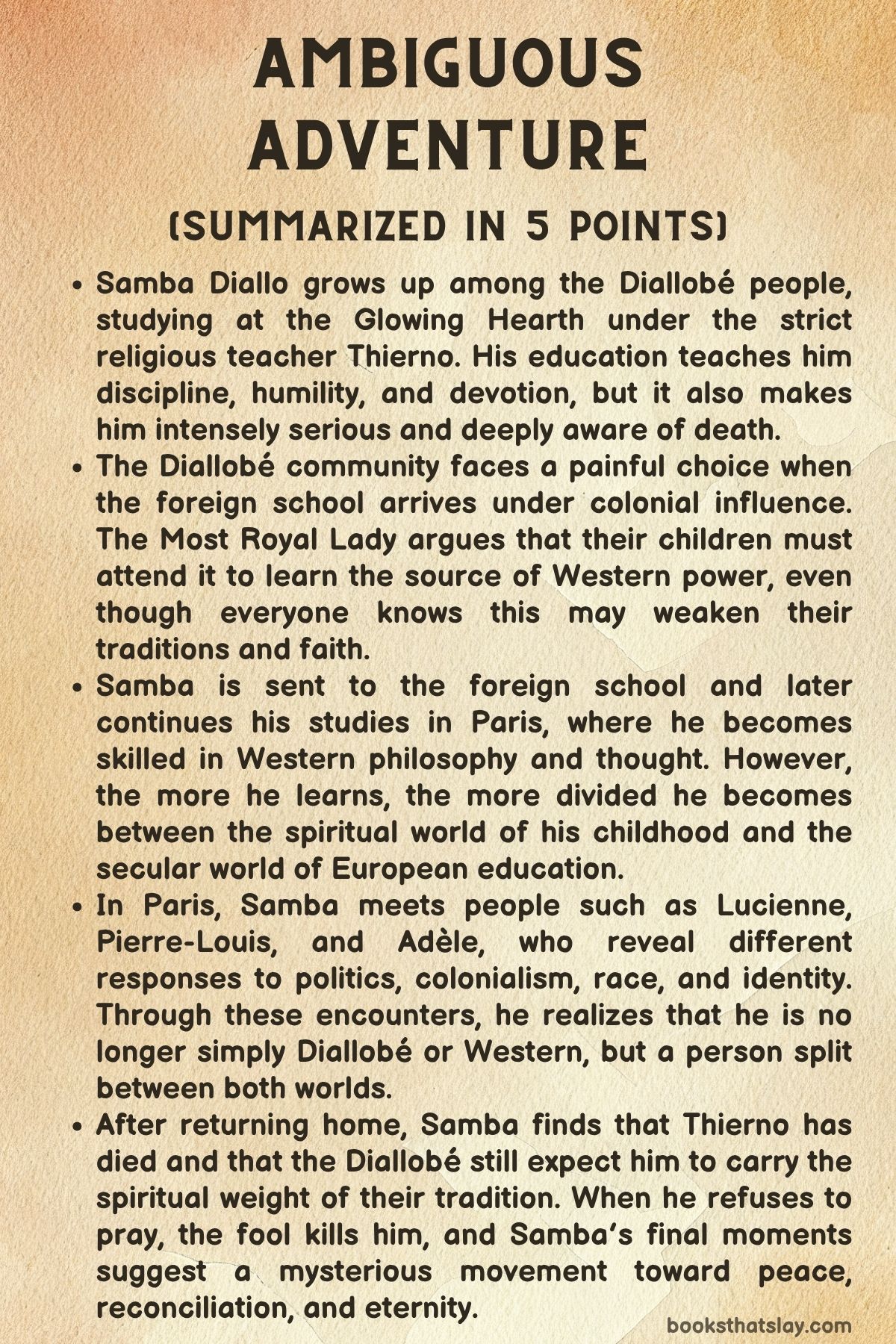
Ambiguous Adventure begins in the Diallobé region of West Africa, where Samba Diallo studies at the Glowing Hearth, a traditional religious school led by the stern teacher Thierno. Samba is still a child, but his education is harsh and demanding.
Thierno beats him when he recites sacred verses incorrectly, not because he hates the boy, but because he believes spiritual discipline must be exact. Samba often does not fully understand the meaning of what he recites, yet he tries to pronounce every word perfectly.
His suffering becomes part of his religious training, teaching him self-control, humility, and endurance.
Thierno is deeply respected among the Diallobé because he has given his life to prayer, teaching, and labor. He sees something rare in Samba: a seriousness of spirit that makes the boy different from other pupils.
Samba is also from a noble family, since his cousin is the chief of the Diallobé, but he does not use this status to place himself above others. Instead, he tries to humble himself, though this only increases the resentment of some boys around him.
One of them, Demba, mocks him and provokes him until Samba suddenly loses control and attacks him. The Most Royal Lady, the powerful elder sister of the chief, stops the fight and criticizes Samba’s father for sending the boy to the Glowing Hearth, saying the school is draining the life out of him.
The Diallobé are facing a grave decision. A foreign school has arrived, brought by the colonial power.
The community fears it because it offers knowledge that can help them survive in the new order, but it also threatens their religion, customs, and memory. Thierno worries that children who enter the foreign school may lose their path to God.
The chief is concerned with preserving the traditions of the Diallobé, while the Most Royal Lady argues that refusal will lead only to weakness and death. She reminds the elders that their ancestors fought the colonizers and lost.
Since the victors know the reason for their victory, she says the Diallobé must send their children to learn that reason. Samba, as one of the finest children of the community, must go first.
The decision is painful. Samba is taken from Thierno and sent to the foreign school in the city of L. Before leaving, he receives fine gifts from the chief and the Most Royal Lady, but he gives them away to Thierno and the other students.
Thierno, in turn, gives away the horse meant for him. This exchange shows the sorrow beneath the decision: Samba is being prepared for another world, but everyone knows that something sacred may be lost.
Samba himself is torn. He is happy to live near his father in the city, yet deeply saddened to leave Thierno and the religious life that shaped him.
In the city, Samba meets Jean Lacroix, the son of a French colonial official, Paul Lacroix. Jean is fascinated by Samba’s quiet dignity and sadness.
Samba’s father, whom Jean imagines as a knightly figure, also makes a strong impression on him. Samba and Jean walk together, and Samba speaks of beauty, death, and the fleeting nature of life.
When Samba stops to pray, Jean watches him with wonder, sensing that Samba’s prayer carries him beyond the ordinary world.
Samba’s father is a deeply religious man who accepts the decision to send his son to the foreign school, though not without sorrow. He believes that the Diallobé must learn to understand the external forces that are destroying their way of life.
In conversation with Paul Lacroix, he contrasts Western faith in science with the Diallobé belief in spiritual truth. Lacroix sees science as a force that frees humanity from fear, while Samba’s father argues that a life limited to the material world is spiritually empty.
He believes humanity is moving toward a shared future, but fears that if the West’s mechanical and godless vision triumphs completely, humanity itself will be diminished.
Meanwhile, Thierno grows older and more troubled. The people continue to ask him whether they should send their children to the foreign school, but he no longer claims certainty.
A strange man known as the fool visits him and speaks of the white man’s country, where he has seen machines, dehumanized spaces, and people swallowed by objects. His words confirm Thierno’s fear that the foreign world is powerful but spiritually damaged.
Still, change cannot be stopped. The Diallobé begin to adjust their religious school so children may also attend the foreign one.
Years later, Samba is in Paris studying philosophy. He has become intellectually sharp, admired by those who meet him, but inwardly divided.
At a dinner hosted by Lucienne’s family, he refuses alcohol and openly identifies himself as Muslim. He discusses Western philosophy, explaining that its central questions remain important, but that its path has shifted away from its original spiritual concern.
He sees in Western thought both greatness and danger. He has learned from it, but he cannot fully accept it.
Samba’s relationships in Paris reveal the depth of his inner conflict. Lucienne, a politically committed young woman, believes in social liberation and revolutionary action.
Samba admires her passion, but he sees that they are fighting for different things: she fights for liberty, while he fights for God. Yet he is no longer sure he can return to the certainty of his childhood faith.
He remembers a simple dream of rural happiness, but he senses that behind that dream there was once a greater truth that he can no longer reach.
Samba also meets Pierre-Louis, an older Black man who has worked in law across several African regions. Pierre-Louis believes Africans must study the laws and languages of colonizing powers in order to understand and challenge them.
At Pierre-Louis’s home, Samba meets his family, including the young Adèle. Samba feels drawn to her, especially because she carries an African inheritance but has been shaped by the West.
He sees in her another form of division, though less conscious than his own. In conversation, Samba admits that he is no longer simply a man of the Diallobé facing the West from outside.
He has become both. This is the central wound of his life: he understands the West too well to reject it simply, but he has lost the spiritual wholeness that once rooted him.
Back home, Thierno dies. Demba is chosen to succeed him, but others quietly wonder whether Samba would have guided the Diallobé better.
The chief writes to Samba about the community’s sorrow and confusion. Samba reads the letter with frustration and exhaustion.
He feels that the community has placed impossible hopes on him. He wants to withdraw from their demands, yet he cannot escape the burden of what he represents.
Samba’s father eventually writes to him and asks him to return home. He admits that sending Samba to the West may have been a mistake, but he also insists that God has not abandoned him.
If Samba feels lost, his father says, it is because he has failed to align his mind and body with God’s law. This letter brings the conflict to its final stage.
Samba returns, but he does not return as the faithful child who once studied under Thierno.
The fool, still grieving Thierno’s death, mistakes Samba for the old teacher. He urges Samba to come to the mosque and pray.
Samba refuses, saying he is not Thierno. Later, at the cemetery, the fool again reminds him that it is time to pray.
Samba replies that people are not obliged to pray. In his thoughts, he speaks to Thierno and admits that he no longer believes as he once did.
He is not proud of this loss; he wishes Thierno were alive to help him recover faith. But he cannot force belief back into himself.
The fool, unable to bear Samba’s refusal and perhaps seeing it as a final sign of the community’s spiritual collapse, kills him. In the closing moments, Samba’s consciousness enters a strange space beyond ordinary life.
A voice speaks to him of peace, reconciliation, love, hate, light, and darkness. Samba feels divided even in death, as if two voices exist within him, one fading and one growing stronger.
At the end, he senses a vast return to the kingdom he had lost, suggesting that his death may bring a form of spiritual resolution that life denied him. Ambiguous Adventure ends with Samba as both victim and symbol: a man broken by the struggle between inherited faith and colonial modernity, yet still reaching toward eternity.
Characters
Samba Diallo
Samba Diallo is the central figure of Ambiguous Adventure, and his life becomes the place where the major conflicts of the story are tested. As a child, he is spiritually intense, obedient, gifted, and unusually serious.
At the Glowing Hearth, he accepts Thierno’s harsh discipline because he has been taught that suffering can become a path toward mastery of the self. Even when he does not fully understand the sacred words he recites, he gives himself completely to their sound, rhythm, and correctness.
This shows that his early faith is not merely intellectual; it is bodily, emotional, and disciplined. Samba is also noble by birth, but he resists pride and privilege.
His attempt to humble himself, however, separates him from other children and makes him seem strange, withdrawn, and difficult to understand.
As he grows older, Samba becomes more divided. His move to the foreign school gives him access to Western learning, philosophy, and new ways of thinking, but it also weakens the certainty that once shaped him.
In Paris, he can speak intelligently about philosophy, colonialism, faith, work, and modernity, yet this intelligence does not bring him peace. He understands both the Diallobé world and the Western world, but he can no longer belong fully to either.
This is the tragedy of his character. Samba is not simply corrupted by the West, nor is he merely a victim of tradition.
He becomes a man who sees too much, thinks too deeply, and loses the innocence that made faith possible for him. His final refusal to pray is not casual rebellion; it is the honest confession of someone who cannot pretend to believe in the same way he once did.
His death turns him into a symbol of the spiritual cost paid by colonized people who are asked to survive by becoming something other than themselves.
Thierno
Thierno is the religious teacher of the Diallobé and one of the strongest embodiments of spiritual discipline in the novel. He is severe, demanding, and sometimes physically cruel, especially toward Samba, but his harshness comes from a belief that the soul must be trained with absolute seriousness.
To Thierno, religious education is not a gentle ornament added to life; it is the center of existence. He believes that the child must learn to submit the body, control pain, and place God above all worldly concerns.
His treatment of Samba reveals both his greatness and his limitation. He recognizes Samba’s rare spiritual quality and loves him deeply, but this love often appears as severity because Thierno fears that softness may weaken the boy’s soul.
Thierno also represents a tradition under pressure. He sees the foreign school as a danger because it may teach children to value the material world more than God.
Yet he is not a shallow conservative who simply rejects everything new without thought. As change advances, he becomes uncertain and admits that he does not know the correct answer.
This uncertainty makes him more human and more tragic. He is wise enough to see the danger of the foreign school, but also honest enough to know that the Diallobé cannot easily remain untouched by the new order.
His aging body, his struggle to continue praying, and his eventual death suggest the weakening of an older spiritual world. After his death, no one fully replaces him.
Demba inherits his position, but not his depth. Thierno’s absence leaves Samba spiritually exposed and leaves the Diallobé without their most powerful guardian of sacred memory.
The Most Royal Lady
The Most Royal Lady is one of the most powerful and complex figures in the story. She is politically intelligent, emotionally strong, and capable of making painful decisions without hiding from their consequences.
As the sister of the chief, she holds a position of authority among the Diallobé, but her power comes not only from rank. It also comes from her clarity of judgment.
She understands that the foreign school is dangerous, and she openly says she hates it. Yet she also sees that refusing it may condemn the Diallobé to further weakness, dependence, and death.
Her argument is practical and historical: the colonizers defeated the Diallobé, and the defeated must learn the source of the victors’ strength.
Her decision to support sending children to the foreign school does not mean she has surrendered to colonial values. Instead, she chooses a painful strategy of survival.
She knows that the foreign school will estrange future generations from their past, but she believes ignorance would be even more destructive. Her treatment of Samba reflects this tension.
She pities him when she sees how religious discipline has made him solemn and death-centered, yet she also helps send him into the very system that will deepen his inner conflict. She is therefore both protector and sacrificer.
Her greatness lies in her willingness to face reality, but her tragedy lies in the fact that every available choice carries loss. Through her, the novel shows leadership as a burden rather than a privilege.
Samba’s Father
Samba’s father, often described with knightly dignity, is a man of deep faith, reflective intelligence, and quiet sorrow. He accepts the decision to send Samba to the foreign school, but he does so with spiritual anxiety.
He does not celebrate Western education as a simple path to progress. Instead, he sees it as a dangerous necessity.
His hope is that Samba will learn how to understand the external forces destroying the Diallobé world without losing the inner truth of his faith. This hope places an enormous burden on Samba, because his father wants him to enter the West, master its knowledge, and still remain spiritually whole.
His conversations with Paul Lacroix reveal the depth of his worldview. He rejects the idea that science alone can explain human existence.
To him, a world without transcendence is not liberated but emptied. He believes that work, civilization, and knowledge must remain connected to God; otherwise, they become forms of greed, pride, and dehumanization.
Yet he is not ignorant or anti-intellectual. He understands that the world is changing and that isolated traditions may not survive.
His tragedy is that he sends Samba away hoping faith will remain strong enough to guide him, only to realize later that this decision may have helped break the boy’s spiritual unity. His letter asking Samba to return home is both a father’s appeal and a religious warning.
He insists that God has not abandoned Samba, but he cannot fully repair the wound that has already opened.
The Chief of the Diallobé
The chief is a figure of communal authority, memory, and hesitation. He does not possess the fierce decisiveness of the Most Royal Lady or the spiritual certainty of Thierno, but he carries the responsibility of protecting the Diallobé people.
His concern is not merely political; it is historical. He worries about how memory can survive when the children of the community are sent into a school that may teach them to forget.
For him, the crisis of education is also a crisis of continuity. If the young lose their connection to the old ways, the community may continue physically but die spiritually.
His relationship with Samba is marked by affection and expectation. He sees Samba as a child of promise, someone who might one day guide the Diallobé through their crisis.
This makes the decision to send Samba away especially difficult. The chief participates in honoring Samba before his departure, but those gifts also carry the sadness of sacrifice.
Later, when he writes to Samba about the changes in the community, his words reveal both grief and dependence. He still imagines Samba as someone who might understand what others cannot.
Yet this expectation is unfair in its own way. Samba is treated not only as a person but as the possible answer to a historical crisis.
The chief’s character shows the pain of leadership when every path threatens the people one is meant to protect.
Demba
Demba begins as one of Samba’s companions at the Glowing Hearth, but he is also one of Samba’s early opposites. He resents Samba’s nobility, seriousness, and distance from ordinary childish behavior.
His taunting of Samba exposes the social tension surrounding Samba’s identity. Samba tries to humble himself, but Demba does not read this as virtue; instead, he sees Samba as strange, proud, or gloomy.
Their fight shows that Samba’s spiritual discipline is not complete. Beneath his calm exterior, there is anger, violence, and wounded pride.
Later, Demba is chosen to succeed Thierno, but the choice carries a sense of decline. He can inherit the office, but he does not seem to inherit Thierno’s spiritual force.
His decision to adjust the timetable of the religious school so that children may also attend the foreign school suggests practical adaptation, but it also shows the weakening of the older order. Demba is not portrayed as evil or foolish; rather, he represents a more ordinary generation trying to manage change without the depth of those who came before.
His presence also sharpens Samba’s symbolic role. Others wonder whether Samba would have guided the people differently, but Samba is absent, changed, and unable to become the leader they imagine.
Demba’s character therefore reflects both social resentment and historical compromise.
The Fool
The fool is one of the strangest and most important figures in the novel. Though he is called mad, his madness often carries a disturbing kind of truth.
He has seen the white man’s country and returns with images of machinery, lifeless spaces, and people consumed by objects. His descriptions are fragmented and intense, but they reveal the spiritual horror that the novel associates with a world ruled by material systems.
He understands modernity not through philosophy but through shock. What he has seen has damaged him, yet it has also given him insight into the danger facing the Diallobé.
His devotion to Thierno is intense. After Thierno’s death, he cannot fully accept the loss and begins to mistake Samba for the teacher.
This confusion is symbolically important. To the fool, Samba should be the continuation of Thierno’s spiritual authority.
But Samba has returned changed, unable to pray with conviction. The fool’s demand that Samba pray is therefore not only a religious request; it is a desperate attempt to restore a broken world.
When Samba refuses, the fool kills him. This act is horrifying, but it emerges from grief, madness, and spiritual panic.
The fool cannot endure the fact that the child once formed by Thierno has become a man who says prayer is not obligatory. His violence marks the final collapse of the hope that Samba might reconcile the old world and the new.
Paul Lacroix
Paul Lacroix represents the educated European colonial mind, but he is not presented as a simple villain. He is thoughtful, curious, and capable of admiring Samba’s intelligence and dignity.
He believes deeply in science, progress, and rational inquiry. To him, Western knowledge has freed humanity from old fears and superstitions.
His confidence in science reflects the broader colonial belief that Europe stands closer to light, reason, and advancement than the societies it dominates.
Yet Paul’s limitation is clear. He can appreciate Samba and Samba’s father, but he struggles to understand the spiritual foundation of their worldview.
When Samba’s father argues that the material world cannot be the whole of reality, Paul hears something backward or impoverished rather than a serious philosophical challenge. His idea of progress is incomplete because it does not fully account for what may be lost when spiritual traditions are pushed aside.
Still, he is not cruel in a direct sense. He is part of a system whose violence is often hidden beneath education, administration, and confidence in reason.
Through Paul, Ambiguous Adventure shows that colonial power does not always appear as brutality; it can also appear as politeness, curiosity, and certainty that one’s own civilization represents the future.
Jean Lacroix
Jean Lacroix is Paul’s son and Samba’s classmate at the foreign school. His role is smaller than his father’s, but he is important because he sees Samba with youthful fascination rather than political judgment.
Jean notices Samba’s sadness, dignity, and difference. When he watches Samba pray, he senses that there is something powerful and beautiful in Samba’s spiritual life, even if he cannot fully understand it.
This makes Jean a witness to Samba’s inner world at a stage when Samba is still closely connected to his faith.
Jean’s perception is shaped by imagination. He sees Samba’s father as a knightly figure, which suggests admiration but also a tendency to translate African dignity into European images.
His friendship with Samba is genuine, yet it exists within an unequal colonial world. Jean can be fascinated by Samba without carrying Samba’s burden.
He observes the mystery of Samba’s prayer, but he does not have to choose between civilizations in the same way Samba does. Jean therefore represents a more innocent form of European encounter: curious, moved, and attracted to difference, but still protected by the privileges of the colonizing side.
Lucienne
Lucienne is a young French woman connected to Samba during his years in Paris. She is intelligent, politically committed, and direct.
Her involvement with communism shows that she is not complacent about injustice; she believes in action, liberation, and social transformation. Samba admires her seriousness because, like him, she is committed to something larger than personal comfort.
Yet their commitments differ deeply. Lucienne fights for political freedom, while Samba’s struggle is centered on God, faith, and spiritual survival.
Her relationship with Samba exposes his alienation. He is drawn to her, but he withdraws because her gaze makes him feel examined.
She wants to understand him, but her questions also reveal the limits of her understanding. When she wonders whether Samba’s people can be cured of the part of themselves that weighs them down, she shows sympathy mixed with a Western assumption that tradition is a burden to be removed.
Samba cannot fully accept this view, but he also cannot confidently defend the spiritual world he is losing. Lucienne’s character brings out the contrast between political certainty and religious uncertainty.
She knows what she is fighting for, while Samba knows what he has lost but no longer knows how to recover it.
Pierre-Louis
Pierre-Louis is an older Black intellectual whom Samba meets in Paris. He has lived and worked across different African regions and has practical experience with colonial law.
His belief that Black people should study the laws and languages of colonizing nations comes from a clear understanding of power. For him, knowledge of the colonizer’s systems is necessary because law, language, and administration are tools of domination.
Unlike Thierno, he does not focus primarily on spiritual danger; unlike Paul Lacroix, he does not romanticize Western institutions. He sees them as instruments that must be understood if Africans are to defend themselves.
Pierre-Louis offers Samba a different model of adaptation. He is not spiritually innocent, but he is not as lost as Samba.
He has found a way to live within the colonial world while maintaining a critical awareness of it. His home also becomes a space where African identity, exile, memory, and Western influence meet.
Through him, Samba encounters another possible future: one based on legal knowledge, social intelligence, and political realism. However, this future does not solve Samba’s deeper spiritual crisis.
Pierre-Louis can help explain power, but he cannot restore Samba’s lost faith.
Adèle
Adèle, Pierre-Louis’s granddaughter, represents a younger generation shaped by mixed inheritance. She has African origins, but she has been raised within the West and does not fully understand the source of some of her own feelings and instincts.
Samba is drawn to her partly because he recognizes in her another form of division. She is not torn in the same conscious, painful way that he is, but she carries an unresolved relationship to Africa and the West within herself.
Her desire to visit Africa suggests a longing for origin, though it is still uncertain and romantic. Samba’s response to her is complex.
He feels attraction, but he also interprets her identity in symbolic terms. He believes he gives a human face to the part of her that she herself finds unclear.
This reveals both Samba’s sensitivity and his tendency to turn people into signs of his own inner struggle. Adèle matters because she shows that colonial history does not only divide those who leave Africa for Europe; it also shapes those born closer to Europe who still carry African memory in incomplete form.
Her character reflects identity as inheritance, confusion, and desire for return.
Themes
Faith, Doubt, and Spiritual Discipline
Faith in the novel is not presented as a simple belief that comforts people without effort. It is a discipline that shapes the body, the mind, and the soul.
Samba’s childhood at the Glowing Hearth shows religion as a demanding education in obedience, endurance, and humility. Thierno believes that the sacred word must be served with exactness, and that the child must be trained to place God above pain, pride, and worldly distraction.
This form of faith gives Samba depth and seriousness, but it also makes him vulnerable when he enters a world that does not share the same spiritual assumptions. In Paris, Samba does not become thoughtless or immoral; instead, he becomes uncertain.
His doubt is painful because he understands the value of what he is losing. He remembers the certainty of prayer, but he can no longer recover it by will alone.
The novel treats this loss as a tragedy rather than a triumph of reason over religion. Samba’s final refusal to pray is therefore devastating because it marks not freedom, but separation from the spiritual center that once gave his life meaning.
Colonial Education and Cultural Loss
The foreign school stands at the center of the Diallobé crisis because it promises survival while threatening erasure. The community knows that the colonizers possess forms of knowledge that have made them powerful.
To refuse that knowledge may mean remaining weak in a world now governed by foreign systems. Yet accepting it means sending children into an education designed by the conqueror, an education that may teach them to think, desire, and judge according to values alien to their own people.
This is why the decision to send Samba away is so painful. He is chosen because he is gifted and noble, but that also makes him a sacrifice.
The Diallobé hope he can learn the secret of Western power without losing his spiritual inheritance. The tragedy is that education changes not only what Samba knows but who he becomes.
In Ambiguous Adventure, colonial education is not merely a classroom experience; it is a force that reorganizes memory, belief, language, and identity. The foreign school may create capable students, but it also risks producing people who can no longer return whole to the world that formed them.
The Conflict Between Material Progress and Spiritual Meaning
Western modernity is repeatedly associated with science, machinery, work, law, and administration. These forces are powerful and cannot simply be dismissed.
They build systems, conquer distances, organize societies, and produce material strength. Paul Lacroix sees this as liberation from fear, while Samba’s father sees danger in any civilization that mistakes the material world for the whole of reality.
The novel does not deny the usefulness of science or practical knowledge, but it questions what happens when they become detached from spiritual purpose. The fool’s memories of the white man’s country are especially important here.
He describes a world filled with mechanisms and objects, a place where human beings seem to have been reduced or swallowed by the things they have made. Samba’s father makes a similar argument when he reflects on work.
Labor can be sacred when connected to the preservation of life and the worship of God, but it becomes destructive when driven by greed and endless production. The novel suggests that progress without spiritual meaning may increase power while diminishing humanity.
Divided Identity and the Burden of Return
Samba’s deepest suffering comes from becoming two selves at once. He is formed by the Diallobé, by Thierno’s teaching, by prayer, and by the memory of a community rooted in God.
He is also formed by Western education, philosophy, Parisian society, and the intellectual habits of Europe. The problem is not that one side simply replaces the other.
The problem is that both remain inside him, and neither can fully silence the other. This divided identity makes return almost impossible.
When Samba comes back home, the people want him to represent continuity, leadership, and spiritual renewal. The fool even mistakes him for Thierno, as if Samba could restore the lost teacher’s authority.
But Samba knows he cannot become what they need him to be. He has changed too much to return as the child who left, yet he has not found peace in the world that changed him.
His final encounter with the fool shows the violence of failed return. The community seeks a restored believer; Samba can only offer uncertainty.
His death reveals the unbearable pressure placed on those expected to bridge worlds that history has forced apart.