American Sniper Summary and Analysis
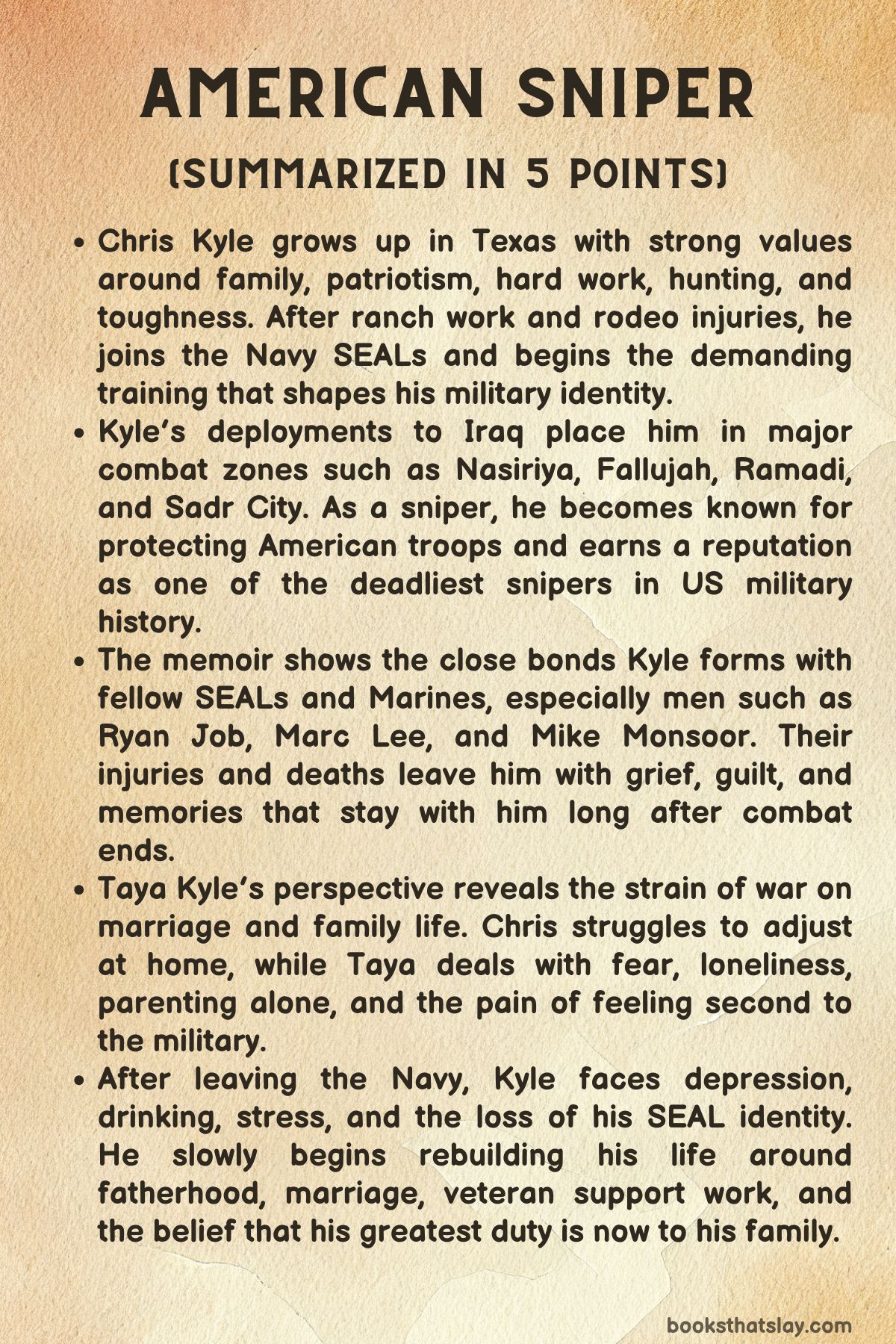
American Sniper: The Autobiography of the Most Lethal Sniper in U.S. Military History is a war memoir by Chris Kyle, written with Jim DeFelice and Scott McEwen. It presents Kyle’s life as a Texas-born Navy SEAL sniper, his four deployments in Iraq, and the strain that combat places on his mind, marriage, and family.
The book is direct, blunt, and often harsh in its view of war, reflecting Kyle’s own voice and beliefs. It follows his journey from ranch work and rodeo life to SEAL training, frontline combat, national fame, and the difficult return to civilian life. It is both a combat account and a portrait of a man shaped by duty, violence, loyalty, and loss.
Summary
American Sniper begins with Chris Kyle in Iraq in 2003, covering Marines near Nasiriya during the US invasion. As a new SEAL, he is not yet formally trained as a sniper, but he is given a .300 WinMag rifle and placed in an overwatch position.
Through his scope, he sees a woman with a child preparing to throw a grenade at approaching Marines. Ordered to fire, he shoots her, stopping the attack.
This becomes his first confirmed sniper kill. Kyle says he has no regret because he believes he saved American lives.
From the start, the book presents his central view of war: his job is to protect his fellow Americans, and he judges his actions by that duty.
Kyle then looks back at his childhood in Texas. He grows up in a family that values patriotism, hard work, faith, loyalty, and self-reliance.
Hunting teaches him to handle guns, and ranch life teaches him patience and toughness. He becomes drawn to rodeo and the cowboy way of life, competing in bull riding and saddle bronc riding until an injury ends that path.
After college and ranch work, he explores military service. A Navy recruiter introduces him to the SEALs.
At first, his injury disqualifies him, but the Navy later calls him back, opening the door to the career that defines his life.
Kyle enters Navy training in 1999 and faces the brutal process of becoming a SEAL. He endures intense physical punishment, cold, exhaustion, injury, and the mental pressure of Basic Underwater Demolition/SEAL training.
During Hell Week, he hides a fractured foot so he can continue. Later, an ear infection and damaged eardrum force him to repeat part of training, but he finishes and joins SEAL Team 3.
During this period, he meets Taya, who becomes his wife. Their relationship begins with humor, suspicion, attraction, and uncertainty.
The September 11 attacks change everything. Kyle rushes back to base, and his unit prepares for war.
He and Taya marry quickly before his first deployment.
His early deployment includes operations enforcing sanctions against Iraq, boarding ships suspected of smuggling oil or weapons, and working alongside foreign special forces. As the invasion of Iraq begins, Kyle’s team is sent into the country to secure important sites, including the al-Faw oil refinery.
Their mission is marked by bad intelligence, difficult terrain, and heavy enemy fire. Kyle experiences intense fighting and sees how quickly plans break down in combat.
He also begins to form strong opinions about the different US military branches, praising Marines for aggression while criticizing commanders he sees as cautious or ineffective.
After returning home, Kyle struggles to adjust. Taya notices his anger, his restless sleep, and his inability to relax.
He remains mentally tied to the war even while physically back in the United States. Instead of leaving the Navy, he attends sniper school.
The training teaches him not only how to shoot but how to observe, hide, judge distance, and gather intelligence. He learns several rifles but favors the .300 WinMag.
His identity as a sniper strengthens, though he admits success depends on opportunity and luck as well as skill.
Kyle’s second deployment takes him first to Baghdad, where he works with Polish special operations forces, then to Fallujah during Operation Phantom Fury. Fallujah becomes one of the defining battles of his life.
He begins by providing overwatch for Marines from apartment buildings, killing insurgents at long range. As the battle moves through the city, he shifts between sniper work and room-clearing.
Frustrated by Marines being wounded in house-to-house combat, he trades his sniper role for an assault role and teaches Marines techniques from SEAL training. He loses weight, suffers injuries, and spends days in constant danger.
During Fallujah, Kyle gains a reputation among Marines for courage and effectiveness. He rescues wounded men, provides covering fire, and repeatedly moves toward danger.
He is recommended for a higher award but receives a Bronze Star with valor. The battle also adds to the emotional weight he carries.
He remembers a young Marine dying in his arms and later says he is haunted more by the Americans he could not save than by the enemies he killed.
At home, Taya describes the strain of loving a man who belongs as much to war as to his family. Kyle is distant, volatile, and immature at times.
He has trouble parenting, reconnecting, and leaving combat behind. Their marriage is tested by deployments, emotional distance, and his need to return to battle.
Still, he remains devoted to the SEALs and believes his country needs him. The birth of his children creates moments of tenderness, but even fatherhood cannot fully compete with the pull of combat.
Kyle’s third deployment takes him to Ramadi, where his reputation grows. His platoon becomes known as “The Punishers,” using the skull symbol as a sign of intimidation and identity.
Kyle is nicknamed “the Legend” by his teammates and later “the Devil of Ramadi” by insurgents, who place a bounty on him. He is proud of the enemy nickname because he sees it as proof that he is effective.
In Ramadi, he reaches major kill-count milestones and becomes known as the most lethal American sniper by official count.
The Ramadi deployment is also marked by deep loss. Ryan Job, a teammate, is shot in the face and blinded.
Kyle blames himself because he had placed Ryan in that position. Soon after, Marc Lee is killed during a mission connected to the attempt to strike back after Ryan’s shooting.
These events devastate the platoon. Kyle grieves, but he also turns his pain into renewed aggression.
The book shows how loss, guilt, revenge, and loyalty become closely connected in his wartime experience.
Kyle is pulled home when his infant daughter is suspected of having leukemia. Doctors later rule it out, but the crisis exposes how far his family life has been stretched by his deployments.
Taya is relieved he is home but also angry about his absences. Their marriage reaches a breaking point when Kyle reconnects with an old girlfriend.
Taya confronts him, and they begin to rebuild trust. She makes clear that their children need a present father.
Kyle eventually decides he will not reenlist after his service ends, though the Navy still sends him on a fourth deployment.
His final deployment takes him to Sadr City, Baghdad. There, he faces some of the heaviest combat of his career while providing overwatch for Army engineers building a wall to stop attacks on the Green Zone.
During an ambush, a bullet strikes his helmet and another hits his body armor. For the first time, his sense of invincibility breaks.
He continues fighting and records more confirmed kills, including his longest shot in Iraq, but the psychological damage becomes harder to ignore. He suffers anxiety, insomnia, high blood pressure, and a growing sense that his body and mind are failing under the pressure.
Kyle leaves Iraq early, ashamed that he is leaving his teammates. Back in the United States, he struggles with sleep, stress, and the transition out of the Navy.
A virtual combat-stress study shows his body reacting calmly to simulated firefights but strongly to peaceful scenes, suggesting how deeply war has altered him. He wants to remain part of the SEAL world, but Taya insists their family needs him.
After a promised recruiter role in Texas fails to materialize, he leaves the Navy.
Civilian life is difficult. Kyle misses combat, drinks heavily, feels depressed, and wrestles with his identity.
He co-founds a tactical training company and begins working with veterans, especially wounded warriors. Ryan Job’s later death from surgical complications affects him deeply.
Kyle also honors fallen SEALs such as Marc Lee and Mike Monsoor, whose deaths remain central to his memory of service.
By the end of American Sniper, Kyle no longer defines himself only as a warrior. He still believes firmly in what he did and says his only regrets are for the American lives he could not save.
Yet he also comes to see husband and father as his most important roles. Taya reflects that their love has changed through pain, anger, endurance, and forgiveness.
The book closes with Kyle shaped permanently by war, still proud of his service, but trying to live with its cost.
Key People
Chris Kyle
Chris Kyle is the central figure of American Sniper, and the narrative presents him as a man built from competing identities: Texan, cowboy, Christian, husband, father, SEAL, sniper, and survivor. His childhood teaches him discipline, physical toughness, loyalty, and comfort with weapons, all of which prepare him for military life.
He carries a strong sense of patriotism and sees military service as a natural extension of his values. In combat, Kyle becomes intensely focused on protecting American troops.
He measures his worth less by public recognition and more by whether he saves fellow soldiers and Marines. His sniper record matters to the outside world, but he repeatedly frames his work as duty rather than fame.
Kyle’s strength is also the source of many of his weaknesses. He is brave, decisive, and loyal to his teammates, yet he can be emotionally closed, harsh in judgment, and unable to separate war from ordinary life.
His language about the enemy is often extreme, showing how combat has narrowed his moral world into protectors and threats. At home, the same traits that help him survive in Iraq become harmful.
His alertness becomes anxiety, his aggression becomes temper, and his loyalty to the mission creates distance from his family. The book does not present him as a simple hero without conflict.
It shows a man who believes deeply in what he has done, while also carrying grief, stress, guilt, and emotional damage from the lives he could not save.
Taya Kyle
Taya Kyle serves as the emotional counterweight to Chris’s combat-centered perspective. Her sections reveal what war costs the family members who wait at home.
She loves Chris, but she is also hurt by his absences, emotional distance, and inability to fully return to domestic life after deployment. Through her, the reader sees the private strain behind military service: fear during news reports, anger over missed family moments, exhaustion from parenting alone, and the uncertainty of whether her husband will come back alive or come back emotionally available.
Taya is not passive. She challenges Chris when his priorities damage the family, especially when he chooses deployment after deployment and when their marriage reaches a crisis.
Her strength lies in her honesty. She does not deny her love for him, but she refuses to pretend that love alone can sustain a family without trust, presence, and responsibility.
She forces Chris to confront the fact that being a warrior cannot excuse failing as a husband or father. Her role broadens the memoir beyond battlefield action by showing that war continues in the home through silence, resentment, fear, and the difficult work of rebuilding intimacy.
Ryan Job
Ryan Job is one of the most significant members of Kyle’s SEAL circle because he represents courage, humor, and resilience under terrible circumstances. At first, Kyle and others underestimate him because he does not fit their image of the typical SEAL.
Over time, Ryan earns their respect through determination, work ethic, and his ability to belong in a harsh team culture. His transformation in Kyle’s eyes is important because it shows how the SEAL world values proven character over appearance.
Once accepted, Ryan becomes part of the tight brotherhood that Kyle depends on in combat.
Ryan’s wounding in Ramadi becomes one of the memoir’s most painful moments. Kyle feels responsible because he placed Ryan in the position where he was shot.
Ryan’s insistence on walking after being gravely injured shows his concern for the team even while suffering. His later blindness does not stop him from pursuing difficult goals, including athletic and outdoor challenges.
His death after surgery, after surviving combat and rebuilding his life, gives the story a cruel sense of unfinished recovery. For Kyle, Ryan becomes a symbol of both battlefield sacrifice and the long shadow of war after the shooting stops.
Marc Lee
Marc Lee is portrayed as athletic, religious, good-natured, and quickly accepted by the platoon. His faith stands out in a world often dominated by aggression, dark humor, and violence.
He fits into the SEAL team not because he imitates everyone else perfectly, but because he proves himself through ability, attitude, and loyalty. Kyle’s memories of Marc include rough team bonding and affection, showing how friendship in this environment is often expressed through teasing, physical tests, and shared danger.
Marc’s death marks a major emotional break in the narrative. He is killed during a mission after Ryan Job has already been badly wounded, turning a moment of revenge and renewed action into deeper loss.
His death reinforces one of Kyle’s most painful beliefs: that the men beside him are more important than anything else, and losing them creates wounds that never fully close. Kyle’s later act of placing his Trident on Marc’s tombstone shows delayed grief and respect.
Marc becomes one of the figures through whom the memoir measures the cost of loyalty, not in abstract patriotism, but in the permanent absence of a friend.
Mike Monsoor
Mike Monsoor appears as a figure of extraordinary sacrifice. His death, caused by deliberately covering a grenade to save other men, places him among the most honored examples of SEAL courage in the memoir.
Although he is not as personally developed as Ryan Job or Marc Lee, his presence carries great symbolic weight. He represents the highest standard of selflessness within the military culture Kyle admires.
His posthumous Medal of Honor confirms what Kyle and other SEALs already understand: that Monsoor gave his life so others could live.
Monsoor’s funeral also reveals how SEALs express grief and respect. The act of pressing Trident insignia into his coffin becomes a ritual of brotherhood, a way for the living to mark the dead as permanently part of the team.
Kyle’s participation in the funeral connects Monsoor’s sacrifice with Kyle’s own unresolved grief for other fallen teammates. Monsoor’s role is brief but powerful because he embodies the ideal Kyle values most: absolute loyalty to the men beside you, even at the cost of your own life.
Marcus Luttrell
Marcus Luttrell appears as a fellow Texan, SEAL, and friend whose survival after a disastrous mission in Afghanistan deeply affects Kyle. When Kyle hears that Luttrell is missing, his sense of SEAL invincibility is shaken.
Until then, Kyle often thinks of himself and his fellow operators as nearly untouchable, men who can fight through anything. Luttrell’s ordeal forces him to recognize that even the best-trained men can be overwhelmed, injured, or killed.
Luttrell’s survival brings relief, but it does not erase the fear that Kyle experiences while waiting for news. His role in the memoir helps widen Kyle’s awareness of mortality before Kyle faces his own breaking point later.
Luttrell also becomes connected to Kyle’s postwar life through veteran charity work. In that later context, he represents not just survival in combat but the effort to support wounded and struggling service members after war.
Chris Kyle’s Father
Kyle’s father is important because he shapes the moral and cultural foundation of Kyle’s life. He teaches his son to value hard work, toughness, family loyalty, and meaningful work.
He also encourages Kyle to seek a life that feels purposeful rather than empty. This guidance helps explain why Kyle is drawn to both ranching and military service.
For Kyle, work is not only a way to earn money; it is a test of identity and character.
His father’s influence also appears in Kyle’s confidence with firearms and his connection to hunting. These early experiences make weapons familiar rather than frightening, and they help prepare Kyle for sniper training.
More broadly, his father represents the Texas world that Kyle carries with him into the Navy: direct speech, independence, patriotism, and a belief that a man proves himself through action. Even when Kyle changes through war, the values learned from his father remain central to how he sees himself.
Chris Kyle’s Mother
Kyle’s mother is less prominent than his father, but she remains part of the family structure that grounds his early life. She belongs to the world of small-town Texas values that shapes Kyle before he becomes a SEAL.
Her presence helps establish the importance of family background in the memoir. Kyle does not present himself as someone who emerges from nowhere; he is formed by a home culture that prizes loyalty, faith, and responsibility.
Although she does not drive the action in the same way Taya does, Kyle’s mother contributes to the sense that family is always present behind the military story. When Kyle becomes a husband and father himself, the contrast between the stable family values of his upbringing and the instability of his own wartime household becomes sharper.
His mother’s role is quiet, but it helps frame the domestic ideal that Kyle struggles to protect and live up to.
Chris Kyle’s Brother
Kyle’s brother represents family vulnerability within the war zone. When Kyle sees evidence of dead American service members and briefly fears his brother may be among them, the war becomes personal in a different way.
Kyle is used to risking his own life, but the possibility of losing his brother exposes another kind of fear. It reminds him that military service is not only an individual choice; it can place multiple members of a family under the same national burden.
His brother also helps show that Kyle’s patriotism is not isolated. Service and loyalty run through the family, reinforcing Kyle’s sense that fighting for the United States is honorable and expected.
The fear for his brother’s safety adds emotional depth to Kyle’s battlefield experience, even though the brother is not a major active character in the memoir.
David Landrum
David Landrum, the rancher Kyle works for before fully entering military life, represents the path Kyle might have followed if the Navy had not called him back. Ranch work gives Kyle discipline, physical endurance, and a sense of satisfaction rooted in practical labor.
Landrum’s world is demanding but familiar, offering Kyle a version of masculine purpose tied to land, animals, and long workdays.
This part of Kyle’s life matters because it shows that he is not searching for ease or comfort. Before becoming a SEAL, he is already drawn to hard work and risk through rodeo and ranching.
Landrum’s role, though limited, helps establish the continuity between cowboy life and military life. Kyle does not abandon one identity for another as much as he transfers the same toughness and appetite for challenge into a more violent profession.
Chief Tony
Chief Tony is one of the leaders Kyle respects most. He is experienced, calm, and practical under pressure.
His leadership style suits the dangerous world of Ramadi because he does not waste words or hide from risk. When Kyle crosses a suspected booby-trapped bridge alone and Tony explains that only one man needed to risk being blown up, the moment captures his blunt battlefield logic.
He is not careless; he is economical with danger.
Tony also understands the emotional needs of his men. After Ryan Job is wounded and Kyle breaks down, Tony does not respond with soft comfort.
Instead, he asks whether Kyle wants payback, knowing that action is the language Kyle can understand in that moment. This does not mean Tony is emotionally empty.
Rather, he knows the culture and psychology of his team. He channels grief into mission focus.
His character shows the kind of leadership Kyle values: aggressive, protective, realistic, and deeply bonded to the men under him.
Marc Lee’s Mother, Debbie Lee
Debbie Lee appears later as a figure of grief transformed into service. After Marc’s death, she founds an organization to support veterans, turning personal loss into public commitment.
Her role expands the story beyond soldiers and spouses to include parents whose children do not return. She represents a form of sacrifice different from combat but no less enduring.
Through Debbie, the memoir acknowledges that the dead leave behind families who must build lives around absence. Her work with veterans also connects the fallen to the living, making Marc’s memory active rather than frozen in mourning.
She becomes part of the larger network of people trying to care for those damaged by war, and her presence reinforces the idea that service continues after a funeral.
Kyle’s Son
Kyle’s son represents the life Chris repeatedly leaves behind and eventually must choose to prioritize. When Kyle returns from deployments, his son has changed, grown, and developed new habits without him.
This creates distance and conflict. Kyle wants to assert authority as a father, but Taya has been the steady parent during his absence.
The child’s presence exposes the gap between biological fatherhood and daily fatherhood.
As Kyle moves toward leaving the Navy, his son becomes one of the strongest arguments for change. Taya tells Chris that the boy needs a present father, not just a heroic one.
This forces Kyle to reconsider what duty means. Protecting American troops has defined him, but his son requires a different kind of protection: attention, patience, consistency, and emotional availability.
By the end, fatherhood becomes central to Kyle’s attempt to rebuild himself.
Kyle’s Daughter
Kyle’s daughter carries emotional significance because her birth and illness challenge Kyle’s combat-first identity. Unlike with his son, Kyle feels an immediate bond with her at birth.
Her medical crisis later pulls him out of Ramadi and forces him to face the needs of his family in a direct and urgent way. His guilt over leaving his teammates clashes with fear for his child, creating one of the clearest conflicts between soldier and father.
Her illness also changes the emotional atmosphere of the homecoming. Kyle returns not to peace, but to a frightened family and a hospitalized infant.
When she cries in his arms, he feels the pain of being a stranger to his own child. She represents the cost of absence in its most intimate form.
Her role shows that war can make a man famous among comrades while leaving him unsure how to comfort his own baby.
Runaway
Runaway functions as a contrast to the courage and dependability Kyle expects from teammates. He abandons Kyle under fire more than once, making him one of the few military figures in the memoir whom Kyle openly disrespects.
In a combat environment where trust is essential, Runaway’s actions are presented as a serious failure. Kyle’s anger toward him is not merely personal irritation; it comes from the belief that fear or unreliability can get others killed.
His character helps define the code of the SEAL team by showing what violates it. Kyle can tolerate rough personalities, arrogance, and mistakes, but he cannot accept leaving another man exposed during a fight.
Runaway’s presence sharpens the memoir’s larger emphasis on loyalty. The men Kyle honors most are those who move toward danger for others; Runaway is judged harshly because he moves away from it.
Moose
Moose, the trusted interpreter, represents the local allies who assist American forces at great personal risk. Kyle’s unit trusts him enough to allow him to carry a weapon, which distinguishes him from many other Iraqi or regional figures whom Kyle views with suspicion.
His presence complicates the memoir’s often severe view of Iraqis and other local forces. He shows that Kyle’s trust, while difficult to earn, can extend beyond Americans when someone proves reliable.
Moose also highlights the importance of interpreters in combat. They are not simply translators; they help soldiers understand the environment, communicate with civilians and local forces, and survive in unfamiliar territory.
By including Moose as a respected figure, the memoir acknowledges that American operations depend on people whose names and risks are often less publicly remembered.
Matthew
Matthew, the Polish sniper from GROM, represents professional respect across national lines. Kyle bonds with him through shared skills, shared danger, and a similar military mindset.
Their relationship shows Kyle’s ability to connect with foreign special operators when he recognizes competence and courage. He teaches the Polish unit some SEAL tactics, but he also learns from their culture and camaraderie.
Matthew’s role is important because it places Kyle within an international military community rather than only an American one. The friendship is based less on long personal history and more on battlefield trust.
For Kyle, that trust can form quickly when men prove themselves under pressure. Matthew helps show that Kyle’s respect is not automatic, but it is strong when earned.
Chief Primo
Chief Primo is an aggressive, protective senior enlisted leader whom Kyle admires. As a fellow Texan, he shares part of Kyle’s cultural identity, but his importance goes beyond regional connection.
Primo protects Kyle and other operators when they get into trouble and later helps with Kyle’s promotion. He represents the kind of senior leadership Kyle respects: someone who understands operators, values combat effectiveness, and supports his men within the bureaucracy.
Primo’s role also reveals Kyle’s frustration with military systems. Kyle often sees rules, tests, paperwork, and command decisions as disconnected from battlefield reality.
Primo helps him navigate those systems. In this way, Primo serves as a bridge between the aggressive world of combat and the formal structure of the Navy.
He shows that leadership is not only about battlefield command but also about protecting capable men from being wasted or blocked by institutional limits.
Dauber
Dauber is one of the SEALs who responds when Ryan Job is shot, serving as a corpsman who rushes to treat him under dangerous conditions. His role emphasizes the lifesaving side of combat units.
In a memoir dominated by shooting and killing, Dauber’s work reminds the reader that survival often depends on medical courage performed in the middle of chaos.
He also represents the quiet competence Kyle values in teammates. Dauber is not defined by speeches or dramatic self-presentation, but by action when a friend is bleeding and time is short.
His presence reinforces the team’s dependence on specialized roles. A sniper may protect from a distance, but a corpsman’s skill can decide whether a wounded man lives long enough to leave the battlefield.
Tommy
Tommy appears as another trusted member of Kyle’s SEAL world, involved both in combat and in moments of danger outside direct firefights. Like Dauber, he helps treat Ryan Job after the shooting, showing his courage and loyalty under pressure.
Later, he leads a team through a hidden sewage pool and becomes seriously ill, a moment that shows the ugly physical reality of war beyond gunfire and explosions.
Tommy’s character contributes to the memoir’s sense of daily hardship. Combat is not only heroic action; it is filth, exhaustion, illness, confusion, and bad luck.
Through figures like Tommy, the reader sees how much discomfort and risk soldiers accept as ordinary. He is part of the dependable group that allows Kyle to function in combat, and his presence adds texture to the team beyond Kyle’s individual achievements.
Ray
Ray is Kyle’s fellow sniper in Fallujah, working beside him from a constructed shooting position during the battle. His role shows the practical teamwork behind sniper operations.
Although the public often imagines snipers as solitary figures, Ray’s presence demonstrates that observation, rotation, communication, and shared endurance are central to the job. He and Kyle take turns watching, resting, and firing from exposed positions.
Ray also helps establish Kyle’s early success as a sniper during major urban combat. Their shared kills and cooperation build the rhythm of Kyle’s Fallujah experience.
Ray is not explored as deeply as some later teammates, but he represents the professional partnership that allows Kyle to become effective in the field.
Eagle
Eagle appears in Fallujah as a teammate who accompanies Kyle during dangerous efforts to support trapped Marines. His role is connected to Kyle’s reputation for moving toward danger when others hesitate.
Eagle’s presence reinforces the idea that Kyle’s courage is not isolated. Even when Kyle acts boldly, he often does so within a network of other men who share the risk.
Eagle helps show the cross-unit loyalty between SEALs and Marines. Kyle’s respect for Marines grows through these shared fights, and Eagle is part of the SEAL support that strengthens that bond.
His character is less individually developed, but he contributes to the memoir’s larger portrait of combat brotherhood.
The Marine Units
The Marines function almost as a collective character in the memoir. Kyle repeatedly expresses admiration for their aggression, toughness, and willingness to fight.
In Fallujah and Ramadi, Marines become the troops he is most determined to protect. His sniper work is often framed around keeping Marines alive as they move through streets, buildings, and exposed positions.
At the same time, Kyle criticizes certain Marine commanders when he sees them as too cautious. This distinction matters because Kyle respects battlefield courage more than rank.
Individual Marines, especially wounded or endangered ones, bring out his strongest protective instincts. Their gratitude after Fallujah confirms his sense of purpose.
In Kyle’s moral world, saving Marines is one of the clearest measures of success.
The Army Units
The Army is presented in a more mixed way than the Marines. Kyle respects many Army soldiers and works closely with Army units in Ramadi and Sadr City, especially when armored vehicles and heavy firepower rescue SEAL teams or support operations.
An Army captain in Ramadi earns Kyle’s respect after seeing the SEALs’ effectiveness and providing strong support.
However, Kyle also criticizes Army units he sees as inexperienced, cautious, or too bound by procedure. His frustration with investigations, Rules of Engagement, and uncertain support often attaches itself to Army leadership or bureaucracy.
The Army’s role in the memoir therefore shows both the necessity of inter-branch cooperation and the tensions between different military cultures. Kyle values action, speed, and aggression, while larger military structures often demand caution, evidence, and restraint.
The Iraqi Insurgents
The Iraqi insurgents are presented largely through Kyle’s combat perspective, meaning they are usually seen as threats rather than fully individualized people. Kyle describes them as dangerous, fanatical, and cruel, and he believes his mission is to kill them before they kill Americans.
This view reflects the mental framework he uses to survive and act decisively in war. The enemy becomes a category defined by hostile action: carrying weapons, planting bombs, firing rockets, attacking convoys, or threatening Marines.
At times, the memoir shows glimpses of the human cost on the other side, such as a mother grieving over her dead son. Kyle’s response remains hard and unsympathetic, which reveals how completely combat has shaped his judgment.
The insurgents’ role is therefore twofold: they are the direct military enemy, and they also reveal the moral narrowing that occurs when a soldier spends years seeing people mainly through a rifle scope.
Themes
Duty, Patriotism, and Personal Identity
Chris Kyle’s sense of self is built around service. He grows up with values that make patriotism feel natural rather than abstract: loyalty to family, respect for work, pride in Texas, and belief in the United States.
Once he becomes a SEAL, duty becomes the organizing force of his life. He does not describe his combat role as a search for glory, even though fame later attaches itself to his kill count.
He sees himself as a protector of American troops, especially Marines and fellow SEALs. This creates a powerful identity, but also a limiting one.
The more successful he becomes in war, the harder it is for him to imagine who he is outside it. Civilian life feels small, slow, and frustrating because it lacks the clear purpose of combat.
American Sniper shows that duty can give a person meaning, discipline, and courage, but it can also consume other parts of life. Kyle’s final movement toward husband and father as central identities does not erase his military self.
Instead, it shows how difficult it is to rebuild identity after years of defining personal worth through war.
The Cost of War on Family
War damages Kyle’s family not through a single collapse but through repeated separations, emotional distance, fear, and mistrust. Taya lives through deployment after deployment while raising children, watching news reports, fearing phone calls, and trying to keep a household together.
Kyle returns physically, but his mind often remains in combat. He is restless, angry, hyper-alert, and unable to adjust quickly to ordinary family life.
This creates tension over parenting, intimacy, and priorities. Taya wants a present husband, not only a brave soldier.
Their children also reveal the cost of absence. Kyle’s son grows and changes while he is away, and his daughter’s illness forces him to confront how painful it is to be needed at home while feeling obligated to remain with his team.
The marriage crisis shows that love cannot survive on admiration alone; it requires trust, attention, and daily commitment. The memoir presents military families as participants in war’s burden, even when they never enter the battlefield.
Taya’s voice is essential because it shows that heroism in public can coexist with failure at home unless the soldier learns to return emotionally, not just physically.
Brotherhood, Loyalty, and Survivor’s Guilt
The strongest emotional bonds in the memoir are often between men who fight together. Kyle’s loyalty to his teammates is intense because combat creates dependence at the highest possible level.
A reliable teammate can mean survival; an unreliable one can mean death. This explains why Kyle honors men such as Ryan Job, Marc Lee, and Mike Monsoor so deeply, while judging someone like Runaway so harshly.
Brotherhood is not sentimental in Kyle’s world. It is proven by action: holding a position, treating the wounded, entering danger, returning fire, or sacrificing oneself for others.
Yet this loyalty also produces survivor’s guilt. When Ryan is shot, Kyle blames himself for placing him there.
When Marc dies, the grief becomes tied to revenge, anger, and helplessness. Kyle’s deepest regrets are not about enemy deaths but about Americans he could not save.
This distinction reveals how his moral universe works. He can justify killing enemies because he sees it as protection, but he struggles to accept the deaths of comrades.
The theme becomes especially painful after the war, when fallen friends remain central to his memory and surviving friends continue to suffer.
Combat, Morality, and Emotional Hardening
The memoir presents combat as a world where moral decisions are immediate, violent, and often irreversible. Kyle repeatedly insists that he follows Rules of Engagement and shoots only identified threats, yet his language about the enemy shows how emotionally hardened he becomes.
He often divides the battlefield into Americans who must be protected and enemies who must be destroyed. This mindset helps him act without hesitation, which is necessary in situations where delay can kill fellow troops.
At the same time, it narrows his sympathy and makes civilian grief on the other side almost impossible for him to acknowledge. The shooting of young fighters, the killing of insurgents at long range, and the investigations after disputed kills all show the moral pressure around sniper work.
Kyle’s confidence in his own righteousness remains strong, but the memoir also shows signs of psychological cost: insomnia, anxiety, high blood pressure, emotional numbness, and memories of the wounded. Combat hardens him enough to survive, yet that hardness becomes difficult to carry into civilian life.
The theme is not only about whether killing in war is justified; it is about what repeated killing and constant danger do to a person’s mind, relationships, and ability to feel ordinary peace.