Americanah Summary, Characters and Themes
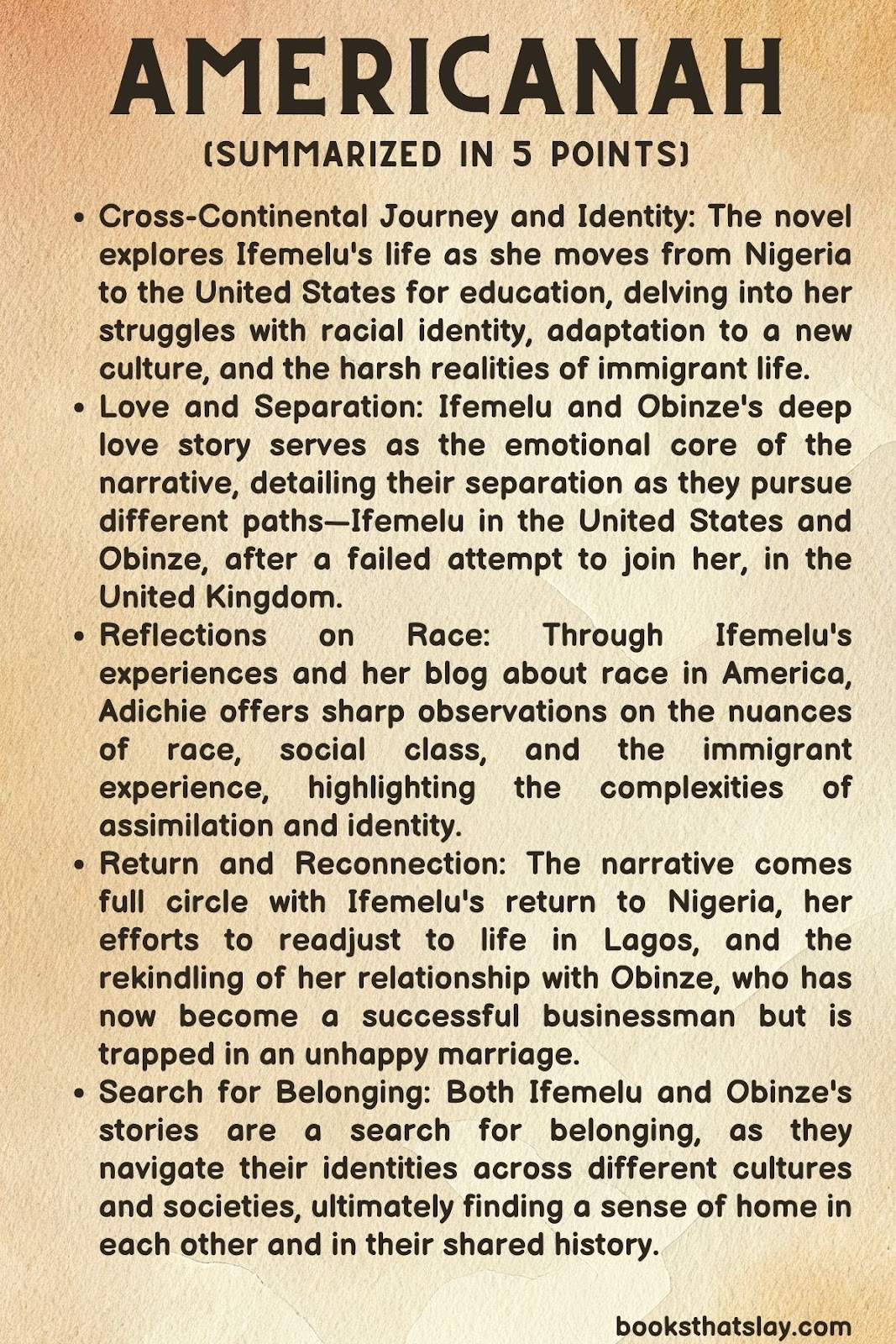
Americanah by Chimamanda Ngozi Adichie is a novel about love, migration, race, identity, and the uneasy act of returning home. It follows Ifemelu and Obinze, two young Nigerians whose teenage romance is interrupted when Ifemelu leaves for the United States and Obinze later tries to build a life in England.
Through Ifemelu’s sharp observations as a Nigerian woman in America, the book examines how race is learned, performed, ignored, and discussed. It is also a story about class, ambition, hair, loneliness, family, and the question of whether two people can find their way back to each other after years apart.
Summary
Ifemelu is a Nigerian woman living in Princeton, New Jersey, preparing to return to Nigeria after many years in America. Before leaving, she travels to Trenton to have her hair braided, since Princeton has no place where she can easily do so.
The salon becomes a frame for her memories. As Aisha, an African hairdresser, braids her hair and talks about her own troubles with love and immigration, Ifemelu thinks about the life she is leaving behind: her successful race blog, her breakup with Blaine, and the man she has never truly forgotten, Obinze.
Obinze is now in Nigeria, wealthy, married to Kosi, and father to a young daughter. When he receives Ifemelu’s email announcing her return, he is unsettled.
His marriage is comfortable but emotionally thin, and his wealth has come through networks of influence that leave him uneasy. Ifemelu’s message brings back their youth, when they met as teenagers in Lagos.
Obinze was thoughtful, bookish, and confident; Ifemelu was clever, direct, and unafraid of saying what others avoided. They fell in love quickly, building a bond around desire, conversation, and shared dreams of a future abroad.
Their early years are shaped by the unstable world around them. Ifemelu’s mother becomes intensely religious, her father loses his job, and her Aunty Uju becomes the mistress of a powerful military man known as The General.
Uju enjoys comfort and status through him, but after he dies in a plane crash, his relatives seize control of everything, leaving her with nothing. She flees to America with her young son, Dike.
Meanwhile, university strikes disrupt Ifemelu and Obinze’s education in Nigeria, and the dream of leaving becomes more urgent. With help from Uju and her old friend Ginika, Ifemelu gets a visa to study in America.
She and Obinze promise that he will join her when he can.
America is not what Ifemelu expected. She first stays with Uju, who has become tired and diminished by immigrant life.
Uju changes the way she says her own name, discourages Dike from speaking Igbo, and struggles to become licensed as a doctor while raising him alone. Ifemelu moves to Philadelphia for college and is shocked by the small rules of American life: tipping, indirect speech, racial language, and the assumption that her accent means she cannot speak English.
She begins practicing an American accent and tries to understand the country by reading, listening, and watching.
Her financial situation becomes desperate. Unable to work legally, she searches for jobs under another woman’s identity and is repeatedly rejected.
Depression closes in on her. At her lowest point, she answers an ad from a tennis coach who expects sexual favors in exchange for money.
The encounter leaves her ashamed and numb. Soon after, she gets a babysitting job with Kimberly, a wealthy white woman, but Ifemelu cannot bring herself to tell Obinze what happened.
She cuts off all contact with him, deleting his emails and throwing away his letters. This silence becomes one of the deepest wounds in both their lives.
Working for Kimberly exposes Ifemelu to liberal white America: kindness mixed with blindness, politeness mixed with condescension. She later dates Curt, Kimberly’s wealthy white cousin.
Curt is generous, energetic, and deeply devoted to her. Through him, she gets a professional job after chemically straightening her hair for an interview.
The straightener burns her scalp, and later her hair begins to fall out. Cutting it and wearing it natural becomes part of her self-recognition.
Yet her relationship with Curt cannot erase the distance between them. He wants to protect her, but often fails to understand the daily racial slights she experiences.
After she cheats on him, the relationship ends.
The breakup helps lead Ifemelu to start a blog about race in America from the view of a “Non-American Black.” The blog becomes popular because she writes with honesty about things many people avoid saying aloud: interracial dating, black hair, Obama, white guilt, and the difference between African immigrants and African Americans. She becomes a speaker on diversity, but she also learns that institutions often want softened truths that make audiences feel comfortable.
Years later, she reconnects with Blaine, a black American professor she once met on a train. They begin a serious relationship.
Blaine is disciplined, moral, politically committed, and demanding. Ifemelu admires him, but she often feels judged by his certainty.
His world of academics and activists makes her aware of her own distance from African American history, even as she writes about race. Their relationship is strained when Ifemelu fails to attend a protest after a black security guard is wrongly suspected of drug dealing.
Blaine sees her absence as a moral failure, while Ifemelu resents the way he turns everything into a test of conviction. They reconcile, and the election of Barack Obama briefly brings them close again.
Still, the relationship never fully recovers.
Obinze’s path abroad is harsher in different ways. Denied an American visa, he goes to England on a temporary visa arranged through his mother.
Once there, he becomes undocumented, works under another man’s name, cleans toilets, does warehouse labor, and lives with the fear of being discovered. He feels invisible and humiliated.
His friend Emenike has succeeded in England and moves among upper-class British circles, but Obinze sees the strain beneath his polished life. Desperate for legal status, Obinze arranges a sham marriage, but he is arrested before the wedding and deported to Nigeria.
Back home, he eventually becomes rich through business and political connections, but the experience leaves him wary of empty success.
A crisis brings Ifemelu closer to leaving America. Dike, now a teenager, attempts suicide.
He survives, but the event frightens Ifemelu and forces her to think about belonging, identity, and the pain Dike has carried as a black child raised in America without a clear connection to Nigeria. After helping him recover, she returns to Lagos, ending her relationship with Blaine.
Back in Nigeria, Ifemelu is both home and not home. Lagos overwhelms her with heat, noise, traffic, generators, gossip, and social performance.
Her friend Ranyinudo teases her as an “Americanah,” someone changed by America. Ifemelu takes a job at a women’s magazine but finds it shallow and corrupt, built around flattering wealthy women rather than telling meaningful stories.
She resigns and starts a new blog about life as a returnee in Lagos, writing about the habits of Nigerians who come back from abroad and expect the country to behave like America or England.
Eventually, Ifemelu tells Obinze she is back. They meet, and the old intimacy returns almost immediately.
They talk about their lives, their changes, their losses, and the silence that separated them. Ifemelu finally tells him about the tennis coach and breaks down.
Obinze responds with tenderness rather than judgment, and the moment releases years of shame. Their relationship resumes, but Obinze is still married.
Their happiness is shadowed by Kosi and his daughter, and by the life he built without Ifemelu.
Obinze tries to keep both duty and love intact, but he cannot. Kosi knows about the affair and wants to preserve the family regardless.
Friends advise him to keep Ifemelu as a lover rather than disrupt his marriage, but Obinze realizes that such a life would be false. He leaves Kosi, determined to remain a father to his daughter while choosing the woman he loves.
After months of separation, he comes to Ifemelu’s door and tells her he is ready to pursue her properly. Ifemelu lets him in, ending the novel with the possibility of a new beginning for them both.
Characters
Ifemelu
Ifemelu is the central consciousness of the novel and the character through whom many of its sharpest ideas about race, migration, class, love, and selfhood are expressed. In Americanah, she begins as a bold, intelligent Nigerian girl who is not afraid to question adults, religious hypocrisy, social rules, or male authority.
Her honesty is one of her strengths, but it can also make her harsh, especially when she judges others before fully understanding the compromises they have made. In America, Ifemelu is forced to rebuild herself under pressure.
She learns that race, which had not defined her in Nigeria, becomes unavoidable in the United States. Her accent, hair, skin, job struggles, and immigrant status all become part of her education.
Her silence after the traumatic encounter with the tennis coach shows how shame can cut a person off from love and from herself. Her blog gives her back a voice, turning observation into power, but even success does not make her feel fully at home.
When she returns to Lagos, she is changed, restless, and often critical, yet still searching for belonging. Her growth lies in learning to accept that identity is not fixed; she is Nigerian, American-shaped, proud, wounded, funny, difficult, and deeply alive.
Obinze
Obinze is thoughtful, inward, and emotionally steady, but he is also trapped by the expectations of class, masculinity, and success. As a teenager, he is drawn to Ifemelu because she challenges him and speaks with a force that matches his own seriousness.
His love for America begins as an idea formed through books and imagination, but his actual migration experience takes him to England instead, where he becomes undocumented and powerless. This humiliation changes him.
Cleaning toilets, working under another man’s name, and facing deportation strip away the privilege he once took for granted. When he returns to Nigeria and becomes wealthy, he gains social respect but not inner peace.
His marriage to Kosi gives him status, comfort, and a family, yet he knows it lacks the curiosity and emotional truth he had with Ifemelu. Obinze is not a reckless romantic hero; he hesitates, feels guilt, and understands the damage his choices may cause.
His final decision to leave Kosi is difficult because it forces him to reject the easy Nigerian social solution of keeping a wife and a lover. His character is defined by longing, moral discomfort, and the struggle to live honestly after years of compromise.
Aunty Uju
Aunty Uju is one of the most complex portraits of immigrant survival in the novel. In Nigeria, she is ambitious and talented, a doctor with the potential to build an independent life, but her relationship with The General places her in a position of dependence.
She receives comfort, money, and protection, yet owns none of it. After The General’s death, her sudden loss of security exposes the fragility of a life built on another person’s power.
In America, Uju becomes more practical, more anxious, and more diminished. She changes her name pronunciation, suppresses parts of her Nigerian identity, and tries to adapt in ways that Ifemelu often finds disappointing.
Yet her choices are not simply weakness. She is a single mother trying to survive in a country that does not welcome her easily.
Her relationship with Bartholomew shows her fear of loneliness and her willingness to accept less than she deserves. Her treatment of Dike is loving but limited; she wants to protect him, but she often fails to give him a strong language for who he is.
Uju represents the cost of migration when dignity must constantly be negotiated.
Dike
Dike is the child most deeply marked by displacement. Born Nigerian but raised in America, he grows up without a secure sense of belonging.
He is loved by his mother and adored by Ifemelu, yet he is often left to interpret racism alone. His school experiences reveal how black children are easily misunderstood, labeled aggressive, or treated as suspicious.
His desire to be “regular” captures the pain of a child who wants to exist without being singled out. Dike’s lack of connection to Igbo, to Nigeria, and to his father’s story leaves him with gaps in his identity.
His suicide attempt is one of the novel’s most painful moments because it shows that charm, intelligence, and popularity can hide deep isolation. When he visits Lagos, his amazement at seeing so many black people in one place suggests that Nigeria offers him something America could not: a vision of blackness as ordinary, varied, and socially central.
Dike’s character shows how children inherit the unresolved struggles of adults, especially when race, migration, and silence shape family life.
Blaine
Blaine is principled, disciplined, and intellectually serious. As a black American professor, he has a strong sense of political duty and expects those close to him to share that level of commitment.
His relationship with Ifemelu is built on attraction, respect, and shared interest in race, but it is also marked by judgment. Blaine wants Ifemelu’s blog to instruct and to take a clearer moral position, while Ifemelu wants to observe with freedom and irony.
His goodness can become rigid because he often turns personal differences into ethical failures. The protest over the wrongly suspected security guard exposes the divide between him and Ifemelu.
For Blaine, showing up is a moral necessity; for Ifemelu, the situation is more emotionally complicated, and she resents being measured by standards she did not fully choose. Blaine is not portrayed as false or cruel.
He is sincere and often admirable, but his certainty leaves little room for Ifemelu’s ambiguity. Through him, the novel explores the difference between African and African American relationships to race, anger, activism, and historical memory.
Curt
Curt represents charm, privilege, generosity, and the limits of good intentions. He loves Ifemelu with open enthusiasm and brings ease into her life at a time when she has known hardship and shame.
His family connections help her secure a job, and his affection makes her feel chosen. Yet Curt’s whiteness and wealth protect him from understanding many of the things that shape Ifemelu’s daily reality.
He dislikes the racism she faces, but he often imagines it as something he can solve through outrage, influence, or rescue. His inability to fully grasp her loneliness within his world becomes more obvious as their relationship continues.
Ifemelu’s affair is destructive and unfair to him, but it also reveals her discomfort inside a relationship where she is loved yet not fully understood. Curt is not simply a symbol of white privilege; he is warm, loyal, and wounded.
Still, his life has taught him that problems can be fixed quickly, while Ifemelu’s life has taught her that some wounds remain present even when people mean well.
Kosi
Kosi is Obinze’s wife and the embodiment of a socially approved Nigerian marriage. She is beautiful, polished, dutiful, and deeply invested in family stability.
She knows how to perform the role expected of her: gracious wife, careful mother, socially appropriate partner to a wealthy man. Her refusal to discuss Obinze’s affair in emotional terms is revealing.
For Kosi, the marriage is not only about love; it is about structure, family, respectability, and the future of their daughter. She understands the social world she lives in and knows that many women are expected to tolerate infidelity as long as the household remains intact.
Her position is painful because she is not foolish. She knows enough, but she chooses preservation over confrontation.
Kosi’s character raises difficult questions about marriage as an institution, especially in a society where women may be praised for endurance more than honesty. She is not the villain of Obinze and Ifemelu’s love story.
She is a woman trying to hold on to the life she believes must not break.
Ranyinudo
Ranyinudo is Ifemelu’s friend in Lagos and one of the clearest voices of practical Nigerian social reality. She is lively, frank, funny, and deeply aware of how power works in relationships between men and women.
Her dating life reflects a world in which romance, money, marriage prospects, and social advancement are closely connected. To Ifemelu, especially after returning from America, Ranyinudo can seem too accepting of these compromises.
Yet Ranyinudo often sees through Ifemelu’s superiority and calls it out directly. She understands that returning from abroad can make a person judgmental, especially toward people who never left and had to survive under local rules.
Her friendship with Ifemelu is valuable because it is not built on admiration alone. She teases, challenges, and grounds Ifemelu.
Through Ranyinudo, the novel shows Lagos as a place of humor, pressure, appetite, and negotiation. She also helps mark Ifemelu’s uneasy return, reminding her that home is not waiting unchanged for those who leave.
Ginika
Ginika is important because she represents an easier, younger adaptation to America. When she leaves Nigeria as a teenager, her friends joke that she will return as an “Americanah,” but her transformation is more than comic.
By the time Ifemelu meets her in Philadelphia, Ginika has learned American codes of speech, body image, race language, social habits, and friendship. She becomes Ifemelu’s guide, explaining terms like “biracial,” teaching her what Americans mean by certain phrases, and helping her adjust.
Yet Ginika’s adaptation is not presented as betrayal. She retains warmth toward Ifemelu and helps her find work through Kimberly.
Her character highlights how age, timing, and personality affect migration. Because Ginika arrives younger, she bends more easily into American life.
Ifemelu, older and more formed, experiences adaptation as a more painful process. Ginika is also a reminder that friendship can survive change, though not always without distance.
Obinze’s Mother
Obinze’s mother is one of the novel’s strongest moral figures. A professor, a widow, and a woman of firm principles, she raises Obinze with intellectual seriousness and emotional openness.
Her relationship with Ifemelu is unusually honest. Instead of shaming young love or sexuality, she speaks plainly and calmly, asking Ifemelu to be responsible rather than fearful.
This makes a lasting impression on Ifemelu, who sees in her a form of adulthood based on respect rather than control. Her decision to lie so Obinze can travel to England is significant because it shows that even a principled person can bend under the pressure of a failing country and a blocked future.
She understands that truth becomes harder to afford when systems deny young people opportunity. Her death deeply affects Obinze because she was not only his mother but also his moral center.
Her absence leaves him more vulnerable to the compromises of wealth and social expectation.
Ifemelu’s Mother
Ifemelu’s mother is shaped by religious longing and emotional instability. Her dramatic conversion and movement from church to church suggest a search for certainty in a life marked by economic and personal insecurity.
She becomes absorbed in religious performance, and Ifemelu watches her mother’s sense of self fade into devotion. This does not mean she lacks love for her family, but her faith often makes her less available as a fully present parent.
Her anger when Ifemelu challenges church hypocrisy shows how much she depends on religious belonging for order and meaning. Later, when Ifemelu is in America, her mother’s concerns become more conventional: marriage, respectability, and whether her daughter will settle down.
She represents a generation for whom obedience, faith, and social approval carry great weight, even when those values fail to answer the realities their children face.
Ifemelu’s Father
Ifemelu’s father is gentle, educated, proud, and wounded by the indignities of Nigerian bureaucracy. Losing his job because he refuses to flatter a superior shows both his integrity and his vulnerability.
His unemployment changes the family’s emotional atmosphere, leaving him depressed and ashamed. He is a man who values language and dignity, yet finds himself powerless in a country where survival often requires submission to absurd authority.
His relationship with Ifemelu is quieter than her bond with Aunty Uju, but his influence is visible in her intelligence and sensitivity to words. When he later regains employment and visits America, Ifemelu feels both love and embarrassment toward her parents, revealing how migration can make familiar family behaviors seem strange or diminished.
Her father’s character shows the private damage caused by public corruption and economic instability.
Aisha
Aisha, the hair braider in Trenton, is a minor character with major thematic importance. She represents another version of African immigrant life, one less polished than Ifemelu’s world of Princeton, blogs, fellowships, and public speaking.
Aisha is direct, needy, and persistent, asking Ifemelu to speak to her Nigerian boyfriend about marriage. Her presence irritates Ifemelu at first, partly because Aisha’s desperation forces her to confront the less elegant realities of migration.
Aisha’s salon is also a space where African women negotiate beauty, work, language, class, and survival. Through Aisha, the novel reminds readers that immigrant lives are not all shaped by education and professional success.
Some are shaped by long hours, uncertain papers, romantic dependence, and the hope that another person might provide security. Her tears near the end of the salon visit reveal the emotional weight beneath her pushiness.
Kimberly
Kimberly is Ifemelu’s employer and one of the more sympathetic white American characters. She is kind, generous, and eager to respect Ifemelu, but her kindness is often mixed with awkwardness.
She overpraises Ifemelu’s name, makes incorrect assumptions about Nigerian culture, and wants to be seen as good. Yet unlike Laura, Kimberly has a basic openness that Ifemelu recognizes.
She provides Ifemelu with work, stability, and a safer place after a period of despair. Kimberly’s character shows that good intentions matter but do not erase ignorance.
Her relationship with Ifemelu is unequal because she is employer, benefactor, and wealthy white woman, while Ifemelu is an immigrant worker in need. Still, she is not presented cynically.
She is a person trying to be decent inside a society that has trained her to see race through politeness rather than full understanding.
Laura
Laura, Kimberly’s sister, is sharper, more openly unpleasant, and more casually racist. She makes comments about Africa and black people with the confidence of someone who believes her opinions are informed when they are actually shallow.
If Kimberly’s flaw is anxious goodness, Laura’s flaw is smug certainty. She uses language that reveals racial assumptions while likely imagining herself reasonable.
For Ifemelu, Laura becomes an example of the kind of white liberal or semi-liberal American who speaks about other people’s lives without humility. Laura’s role is important because she helps sharpen Ifemelu’s awareness of how racism can appear not only as open hostility but also as casual commentary, false expertise, and social ease.
Shan
Shan, Blaine’s sister, is charismatic, brilliant, insecure, and often cruel. She has a commanding presence and knows how to dominate a room.
As a writer, she is deeply aware of how race shapes publishing, especially the demand that black writers make their anger acceptable or “transcend” race for white audiences. Her insights are often accurate, but her delivery can be cutting and self-protective.
She both attracts and unsettles Ifemelu. Shan recognizes that Ifemelu’s African identity gives her a certain freedom to write about race in America in a way that might be less acceptable from a black American woman.
This observation is sharp, but Shan uses it partly to diminish Ifemelu. Her character exposes the competitive wounds within literary and intellectual spaces, where people who speak about justice may still seek power over one another.
Emenike
Emenike is a figure of ambition, class anxiety, and reinvention. As a student in Nigeria, he is conscious of status and eager to rise beyond his background.
In England, he achieves the kind of success that allows him to marry into British respectability and move among elite circles. Yet his performance of refinement reveals insecurity.
He changes his speech, edits his anger, and presents stories of racial humiliation in ways that are acceptable to his white friends. Obinze notices the difference between Emenike’s private rage and his public polish.
Emenike is not simply false; he is someone who has learned that acceptance requires performance. His success comes at the cost of constant self-management.
Through him, the novel examines class mobility as both achievement and erasure.
The General
The General is powerful, older, and morally compromised. His relationship with Aunty Uju gives her wealth and status, but it also traps her in dependence.
He represents a Nigerian political class that controls resources through personal loyalty rather than justice. His charm and authority cannot hide the imbalance between him and Uju.
Everything she enjoys through him can be taken away because none of it truly belongs to her. After his death, the speed with which his relatives seize his property shows how little protection Uju ever had.
The General’s character is less psychologically developed than symbolic, but his role is crucial. He stands for the dangerous closeness between desire, money, military power, and female vulnerability.
Bartholomew
Bartholomew is Aunty Uju’s partner in America and a picture of small, insecure masculinity. He performs Americanness through slang and attitude, but his behavior toward Uju is traditional in the most limiting way.
He expects service, food, respect, and control while offering little emotional generosity. Uju’s willingness to accommodate him shows how fear and exhaustion can lower a person’s standards.
Bartholomew is not powerful like The General, but he still benefits from gender expectations that ask women to shrink themselves for male comfort. His presence in Uju’s life makes Ifemelu angry because she sees her aunt accepting a lesser version of partnership.
He helps reveal the loneliness of immigrant adulthood, where companionship may be chosen not out of joy but out of fatigue.
Kelsey
Kelsey is the young white woman who comes into the braiding salon wanting Bo Derek braids. She is friendly in an aggressive, self-satisfied way and treats Ifemelu’s reading and opinions as opportunities to display her own open-mindedness.
Her conversation about African literature reveals a familiar kind of cultural consumption: she wants access to African style and stories, but she also wants to remain the neutral interpreter of them. Ifemelu’s irritation with Kelsey comes from recognizing that Kelsey sees herself as generous and curious while still centering her own perspective.
Kelsey’s role is brief but effective. She shows how cultural interest can become another form of entitlement when it lacks humility.
Doris
Doris is a returnee like Ifemelu, but she has adapted to Lagos in a different way. At Zoe, she understands the magazine’s compromises and accepts them as part of how things work.
Her conflict with Ifemelu reveals the tension between idealism and professional survival. Doris sees Ifemelu as judgmental because Ifemelu returns with strong opinions about what Nigerian journalism should be, while Doris knows the limits of their workplace.
Their argument exposes Ifemelu’s difficulty in accepting that Lagos has its own systems of compromise, just as America did. Doris is not simply cynical; she is practical, tired, and defensive.
Her role helps challenge Ifemelu’s assumption that seeing clearly always gives her the right to condemn.
Aunty Onenu
Aunty Onenu is the editor of Zoe and a symbol of elite Nigerian media culture shaped by patronage, appearance, and social access. She runs a magazine that depends less on honest storytelling than on flattering wealthy women who pay for visibility.
She is polished and authoritative, but her publication lacks the seriousness Ifemelu wants. Aunty Onenu’s world is one where journalism becomes social decoration.
Her character helps Ifemelu realize that returning home does not mean escaping artificiality or compromise. The pressures are different from America’s, but they are just as real.
Aunty Onenu also shows how older wealthy women can hold power while still reinforcing shallow systems of prestige.
Zemaye
Zemaye is a smaller character, but her conversation with Ifemelu about black Americans is important. Her assumption that black Americans are criminal shocks Ifemelu because it reveals how American racial stereotypes travel globally, even among black people outside America.
Zemaye has absorbed images and ideas without understanding the history behind them. Her role shows that anti-blackness is not limited to white societies; it can also be repeated by people who do not see themselves as part of the same racial category.
Through Zemaye, the novel exposes how media, distance, and ignorance shape perceptions of African Americans in Nigeria.
Nigel
Nigel is Obinze’s former coworker in England who later comes to work for him in Nigeria. In London, Nigel treats Obinze with friendliness and shows him the city, offering a form of ordinary companionship during Obinze’s undocumented years.
Later, in Lagos, Nigel adapts surprisingly well and becomes part of Obinze’s business world. His character reverses the usual migration lens.
Instead of only showing Africans adjusting to the West, the novel also shows a white Englishman adjusting to Nigeria. Nigel’s presence allows Obinze to reflect on cultural fit, especially when he explains that certain Western design ideas, such as open kitchens, do not suit Nigerian cooking.
Nigel is not central emotionally, but he helps mark the changing power dynamics between Obinze’s life in England and his life in Nigeria.
The Nigerpolitan Club
The Nigerpolitan Club functions almost like a collective character. Its members are Nigerians who have lived abroad and returned with new tastes, complaints, and expectations.
They miss fast internet, customer service, certain foods, and Western cultural habits, while also wanting to claim Nigeria as home. Ifemelu both belongs to them and resists them.
Their conversations expose the comedy and arrogance of returnee identity: the desire to improve Nigeria mixed with irritation that Nigeria is not America or England. The club helps Ifemelu see her own contradictions.
She mocks their superiority, but she shares some of it. By the end of Americanah, return is shown not as a simple homecoming but as another form of adjustment.
Themes
Race as a Learned Reality
Race becomes visible to Ifemelu only after she arrives in America, and that shift is central to the novel’s understanding of identity. In Nigeria, Ifemelu is black, but blackness does not organize her daily life in the same way.
In the United States, she learns that race shapes how people hear her accent, judge her intelligence, respond to her hair, read her relationships, and interpret her opinions. Her blog develops from this discovery.
Because she is a “Non-American Black,” she can observe American racial customs with both closeness and distance. She notices the polite evasions, the fear of direct language, the coded compliments, and the way white comfort often controls public conversations about racism.
The novel also distinguishes between African immigrants and African Americans. Ifemelu learns that sharing skin color does not mean sharing history.
Blaine’s seriousness about protest, Shan’s anger about publishing, and Dike’s pain as a black child in America all show dimensions of race that Ifemelu cannot treat as theory. Race in Americanah is not presented as an abstract issue but as something built into speech, work, love, beauty, education, and memory.
Migration, Belonging, and the Cost of Reinvention
Migration in the novel is not a clean movement from hardship to opportunity. It is a process of loss, adjustment, shame, and self-editing.
Ifemelu arrives in America with curiosity and hope, but she soon faces poverty, joblessness, loneliness, and the pressure to sound and behave differently. She practices an American accent, learns new social rules, and slowly becomes someone who can function in that world.
Obinze’s migration experience in England is even more humiliating. He becomes undocumented, works under another man’s name, fears exposure, and is finally deported.
Aunty Uju’s life shows another cost: a respected doctor in Nigeria becomes an exhausted immigrant trying to rebuild her career while raising a child alone. The novel refuses the simple idea that leaving Africa means success.
It also refuses the idea that return solves everything. When Ifemelu goes back to Lagos, she must adjust again.
She is home, but she is also changed by America, irritated by Nigeria, and uneasy with other returnees who share her complaints. Belonging becomes less about place than about the difficult task of living honestly with all the selves one has become.
Love, Silence, and Emotional Truth
The love between Ifemelu and Obinze is powerful because it begins in youth as friendship, desire, and intellectual recognition. They see each other clearly before migration, status, and shame complicate their lives.
Yet the novel does not treat love as enough by itself. Ifemelu’s silence after the encounter with the tennis coach damages both of them.
She cannot speak because she feels ashamed, and Obinze experiences her disappearance as abandonment. Years later, their reunion is moving not simply because they still love each other, but because they finally confront the silence that separated them.
Other relationships test different versions of love. Curt offers devotion without full understanding.
Blaine offers moral seriousness but often with judgment. Kosi offers family stability without emotional depth.
Uju’s relationships show how fear and dependence can be mistaken for partnership. The novel suggests that love requires more than attraction or loyalty; it requires a space where truth can be spoken without humiliation.
Ifemelu only truly breaks open when Obinze responds to her painful confession with tenderness. Their final possibility depends not on nostalgia, but on whether they can build a life without hiding.
Hair, Beauty, and the Politics of Self-Presentation
Hair carries social, racial, and emotional meaning throughout the novel. Ifemelu’s trip to the braiding salon frames much of the story, making hair a physical reminder of identity, migration, and return.
In America, black women’s hair is treated as something to be managed, judged, touched, corrected, or made acceptable. When Ifemelu straightens her hair for a job interview, she is not simply changing her appearance; she is responding to a professional world that treats natural black hair as improper.
The chemical burn on her scalp makes that pressure painfully literal. Later, when her hair begins to fall out and she chooses to wear it natural, the decision becomes part of her movement toward self-recognition.
Still, the novel avoids making natural hair a simple symbol of freedom. Aunty Uju criticizes it, white strangers exoticize it, and even Blaine reacts strongly when someone touches it.
Hair becomes a public surface on which other people project race, class, gender, professionalism, and desirability. The salon scenes also show African immigrant women building community through beauty work, gossip, labor, and survival.
Through hair, the novel turns the body into a record of social pressure and personal choice.