An Enemy of the People Summary, Characters and Themes
An Enemy of the People is a play by Henrik Ibsen about truth, power, public opinion, and the cost of moral courage. Set in a small Norwegian town, it follows Dr. Thomas Stockmann, a physician who discovers that the town’s famous medicinal Baths are polluted and dangerous.
At first, he believes the community will thank him for protecting public health. Instead, political leaders, newspapers, and ordinary citizens turn against him because the truth threatens the town’s economy. The play examines how easily people abandon principle when money, reputation, and comfort are at risk.
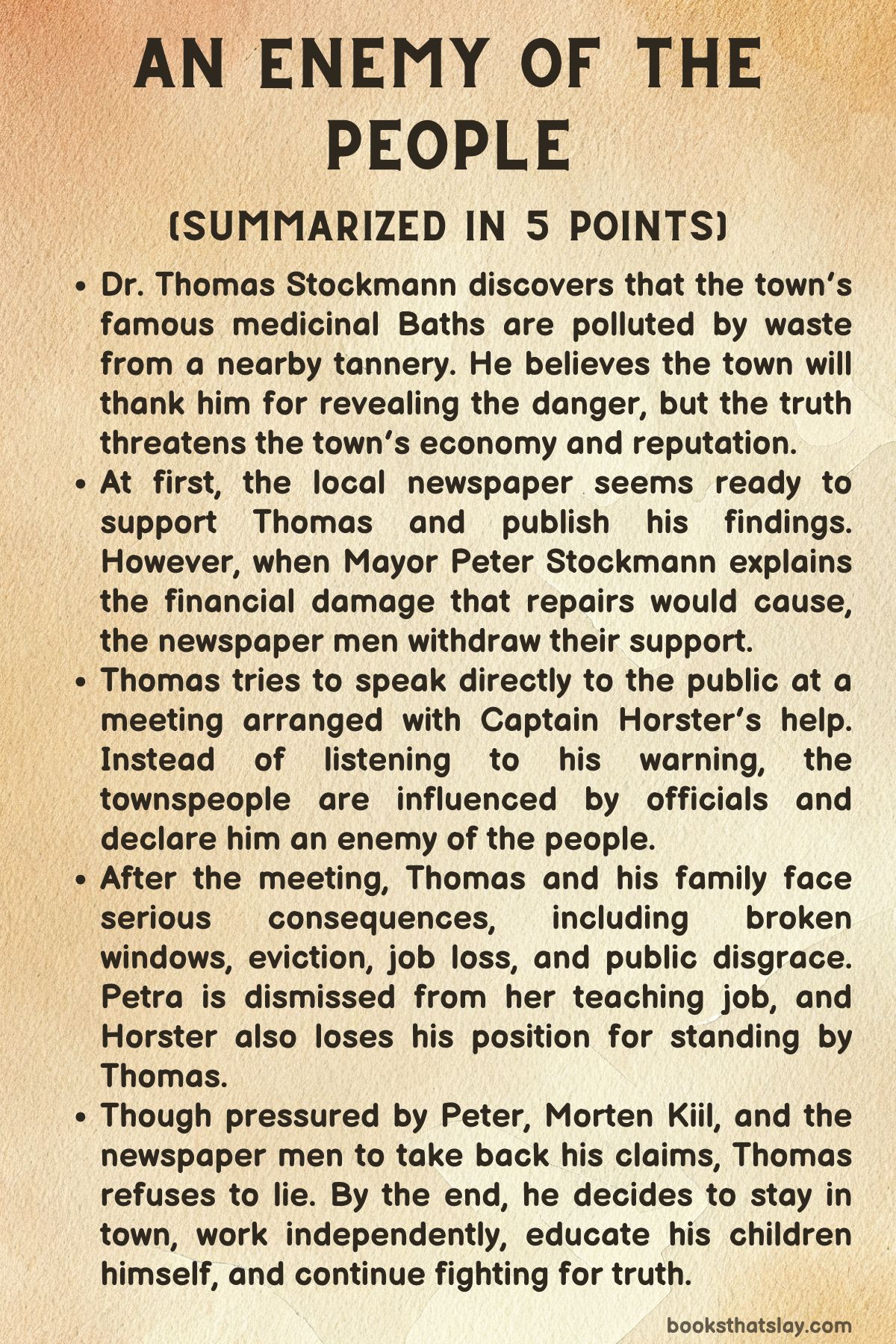
Summary
An Enemy of the People begins in the home of Dr. Thomas Stockmann and his wife, Katherine, shortly after supper. The household is warm, lively, and sociable.
Billing, a sub-editor at the local newspaper, the People’s Messenger, is eating roast beef with Katherine because he arrived too late to dine with Thomas. Soon, two more men arrive: Peter Stockmann, Thomas’s brother and the town’s mayor, and Hovstad, the editor of the People’s Messenger.
Their conversation quickly turns to the town’s Baths, a new medicinal spa that many people believe will bring wealth, visitors, and status to the community.
Thomas and Peter are both connected to the Baths, but in different ways. Thomas is the medical director and was one of the first people to support the idea.
Peter is the chairman and sees himself as the practical leader who made the project possible. This creates tension between the brothers.
Peter dislikes the attention Thomas receives for the Baths and feels that his own authority is not properly respected. Thomas, meanwhile, is cheerful, impulsive, and proud of the comfortable life he has built after years of financial struggle.
Thomas is waiting for an important letter, but he does not want to explain its contents while Peter is present. After Peter leaves, Thomas’s daughter Petra arrives with the letter.
It contains results from a scientific laboratory. The tests confirm Thomas’s suspicion that the Baths’ water is contaminated.
Waste from a local tannery has polluted the water supply, making it dangerous for anyone who bathes in it or drinks it. Thomas is disturbed by the danger but relieved that his fears are now supported by evidence.
He believes the town will be grateful to him for discovering the problem before visitors are harmed.
Katherine, Petra, Hovstad, and Billing initially support Thomas. The newspaper men are eager to publish the discovery.
Thomas has already prepared a report for the Baths Committee and believes the proper repairs will be ordered. Yet there is uneasiness beneath the excitement.
The needed changes will be costly, and the Baths are central to the town’s economic hopes. Thomas assumes that public health will matter more than money, but others are not so sure.
The next morning, Morten Kiil, Katherine’s adoptive father and the owner of the tannery, visits the Stockmann home. He has heard about Thomas’s claims and treats them as a joke.
Because he cannot see the microbes in the water, he refuses to take the danger seriously. He thinks Thomas may be inventing the story to embarrass the local authorities.
His reaction shows how difficult it will be for Thomas to convince people of a threat that is invisible but real.
Hovstad then visits Thomas and reveals that he sees the water scandal as more than a public health issue. He wants to use it to attack the town’s ruling class and expose the failures of local leadership.
Thomas does not fully share this political aim. He criticizes mistakes, but he still believes the leaders are decent men who want the best for the town.
Aslaksen, an influential printer and community figure, also offers Thomas support. He represents the so-called moderate majority and suggests that Thomas should rely on public backing.
Thomas is glad to have allies, though he still believes the truth itself will be enough.
This confidence is shaken when Peter comes to see him. Peter is angry that Thomas ordered water tests without consulting him.
He explains that repairing the Baths would cost a great deal and take a long time. Closing the Baths would damage the town’s reputation and finances.
Peter insists that Thomas must keep the matter quiet or publicly take back his claims. Thomas is horrified.
To him, concealing the danger would be a betrayal of his duty as a doctor. Peter reminds him that his job depends on the town authorities and threatens to remove him from his post.
Katherine worries about the family’s future and urges caution, but Petra encourages her father to stand firm. Thomas chooses the truth, even though he knows it may cost him everything.
Thomas then goes to the People’s Messenger office, where he believes his report will be printed. Hovstad and Billing seem ready to support him, and Thomas now accepts their idea that the scandal can expose the corruption of the town government.
But after he leaves, their motives become clearer. They are less interested in public safety than in using Thomas for political gain.
Aslaksen also begins to worry that Thomas is too forceful and may upset the town’s social balance.
Petra arrives at the newspaper office and confronts Hovstad about a translation assignment she had accepted. She refuses to continue because she objects to the story’s moral message.
Hovstad dismisses her concerns and admits that his support for Thomas is tied partly to his attraction to Petra. She is disgusted and leaves, having lost faith in him.
Peter then arrives at the newspaper office and persuades Hovstad and Aslaksen that printing Thomas’s report would be disastrous. He explains the financial consequences of closing the Baths and presents Thomas as reckless.
When Thomas returns, he still believes the newspaper is on his side. Instead, Hovstad refuses to print the report and accepts Peter’s statement denying the pollution rumors.
Thomas realizes that the newspaper has abandoned him. He decides to hold a public meeting and speak directly to the townspeople.
Finding a venue is difficult because public opinion has already turned against him. Captain Horster, one of Thomas’s few loyal friends, offers his house.
At the meeting, the crowd is restless and suspicious. Peter, Hovstad, Billing, and Aslaksen work together to control the event.
Aslaksen is elected chairman, giving him the power to limit Thomas’s speech. The townspeople have read Peter’s version in the newspaper and believe Thomas is endangering the town’s prosperity.
Thomas is eventually allowed to speak, but he does not limit himself to the Baths. Hurt and angered by the betrayal around him, he attacks the majority itself.
He argues that the greatest danger is not only polluted water but a polluted public life, where people accept whatever leaders and newspapers tell them. He accuses the crowd of lacking independence and courage.
His words offend nearly everyone present. Instead of winning support, he makes the crowd angrier.
Hovstad, Billing, and Aslaksen move to declare him an enemy of the people. The motion passes, and the crowd leaves in a wave of hostility.
The next morning, Thomas’s home has been attacked. Stones have been thrown through his windows.
Katherine brings an eviction notice, showing that even their landlord has yielded to public pressure. Thomas considers leaving the country with Horster, who is preparing to sail to the New World.
But one by one, the consequences of his stand become clearer. Petra has been dismissed from her teaching job because people consider her radical.
Horster has also lost his job for helping the Stockmann family.
Peter visits and formally removes Thomas from his position as medical director of the Baths. He offers a path back: if Thomas will take back his claims and say the Baths are safe, he may be restored later.
Thomas refuses. Peter then reveals that Morten Kiil had planned to leave money to Katherine and the children.
Soon after, Kiil arrives and says he has used that inheritance to buy shares in the Baths. If Thomas does not deny the pollution, the shares will become worthless, and his own family will suffer.
Kiil tries to force Thomas to choose between truth and his children’s financial security.
Hovstad and Aslaksen arrive with another scheme. Having heard about Kiil’s purchase, they accuse Thomas of manipulating the value of the Baths for personal gain.
They offer to help repair his public image through the newspaper in exchange for money. Thomas is furious and drives them away.
He sends Kiil a firm refusal and decides not to leave town after all.
Instead, Thomas resolves to stay and fight. Horster offers his house to the family.
Thomas plans to work as an independent doctor for the poor and to build support among those ignored by respectable society. When his sons return from school after getting into trouble for fighting, he decides they will not go back.
With Petra’s help, he will start a new school for his children and other neglected children in the town. The play ends with Thomas isolated but unbroken.
He has lost his job, reputation, security, and public standing, yet he believes that a person who stands alone for the truth can still be strong.
Characters
Dr. Thomas Stockmann
Dr. Thomas Stockmann is the central figure of An Enemy of the People, and he stands for scientific truth, personal conviction, and the difficult pride that can come with moral certainty. As the medical director of the Baths, he first appears as a cheerful, sociable, generous man who enjoys his home, his food, his friends, and the modest comforts he has earned after years of hardship.
His discovery that the Baths are polluted reveals his finest qualities: he is honest, brave, and committed to protecting public health even when the truth threatens the town’s prosperity. At first, Thomas is almost innocent in his confidence.
He believes that facts will be enough, that officials will act responsibly, and that the public will thank him for saving them from danger. His shock comes from realizing that truth is not always welcomed when it is expensive.
Thomas’s strength is also his weakness. As opposition grows, his righteous anger turns into contempt for the majority.
Instead of speaking only about the polluted water, he attacks the townspeople’s intelligence, obedience, and moral weakness. This makes him more isolated and gives his enemies a chance to portray him as dangerous.
Yet the play does not reduce him to a flawless hero or a foolish rebel. He is both admirable and difficult.
He refuses to lie, refuses to sell his conscience, and refuses to let his family’s future be secured through dishonesty. By the end, he has lost his job, reputation, home, and public respect, but he has gained a harsher understanding of society.
His final decision to stay and fight shows that his courage is not temporary. He may be impractical and proud, but he remains one of the play’s clearest voices for truth.
Katherine Stockmann
Katherine Stockmann is Thomas’s wife, and her role in the play is deeply practical, protective, and emotionally grounded. She is not opposed to truth, but she understands the cost of public conflict more quickly than her husband does.
While Thomas thinks first of principles, Katherine thinks of rent, employment, food, children, and safety. This does not make her weak or selfish.
Instead, it makes her one of the most realistic characters in the story. She knows that moral courage can be noble, but she also knows that a family must live with the consequences of that courage.
Katherine’s conflict is painful because she loves and respects Thomas, yet fears the damage his defiance will bring upon their household. When Peter threatens Thomas’s position, Katherine urges caution because she sees how dependent the family is on Thomas’s job.
When public anger rises, her worries prove justified: the family is attacked, evicted, and socially punished. Even so, Katherine does not abandon her husband.
Her loyalty is not loud or ideological, but it is steady. She may question Thomas’s choices, but she remains beside him when those choices become costly.
Katherine represents the domestic side of public morality. Through her, the play shows that standing for truth is not an abstract act; it affects spouses, children, homes, and livelihoods.
Her presence keeps Thomas’s idealism connected to ordinary human responsibility.
Petra Stockmann
Petra Stockmann is Thomas and Katherine’s daughter, and she is one of the strongest supporters of her father’s principles. She is educated, independent-minded, and morally alert.
As a teacher, she believes in intellectual honesty, and this is clear when she refuses to translate a story for the newspaper because she objects to its moral message. Petra does not believe that people should knowingly spread ideas they consider false or corrupt simply because those ideas are popular or profitable.
In this way, she mirrors Thomas’s commitment to truth, but she often expresses it with more calm clarity.
Petra’s character also exposes the hypocrisy of Hovstad and the newspaper. At first, she trusts Hovstad because he supports her father, but she is disgusted when she learns that his support is mixed with personal attraction and political calculation.
Her disappointment shows her high standards: she expects public words to match private character. Petra’s dismissal from her teaching job shows how public punishment spreads beyond the person who speaks out.
She loses her position not because she has done anything wrong, but because she is connected to Thomas and is seen as dangerous by association. Yet Petra does not collapse under this pressure.
By the end, she is ready to help Thomas build a new school outside the town’s official institutions. She represents the possibility of a future shaped by honest education rather than social conformity.
Peter Stockmann
Peter Stockmann, the mayor and Thomas’s brother, is the main representative of authority in An Enemy of the People. He is controlled, formal, image-conscious, and deeply invested in public order.
Unlike Thomas, who speaks impulsively and emotionally, Peter uses official language, procedure, and social pressure to maintain power. His concern is not simply personal pride, although that is certainly part of him.
He also believes that the town’s economic stability and reputation matter more than exposing a truth that could cause immediate financial damage. To Peter, Thomas is reckless because he treats scientific fact as if it exists apart from politics, money, and public confidence.
Peter’s conflict with Thomas is intensified by family rivalry. He resents the praise Thomas receives for the Baths and reminds him that official leadership, not merely ideas, made the project possible.
He also uses Thomas’s dependence on his position as a weapon, threatening to dismiss him if he does not recant. Peter is not a cartoon villain; he is frightening because he is plausible.
He tells himself that suppressing the truth is practical, responsible, and necessary for the town. Yet his practicality becomes moral cowardice.
He would rather let people be exposed to danger than admit that the town’s great source of pride is built on a serious mistake. Peter represents institutional self-protection, where authority defends its own image even at the expense of public welfare.
Hovstad
Hovstad is the editor of the People’s Messenger, and he represents the instability of public opinion when journalism is driven by ambition rather than principle. At first, he appears to be Thomas’s ally.
He wants to publish the findings about the polluted Baths and frames the issue as a chance to challenge the town’s powerful officials. His language suggests reform, freedom, and public interest.
However, as the story develops, it becomes clear that Hovstad’s support depends less on truth than on usefulness. He supports Thomas when the doctor’s report can damage the authorities, but he withdraws support when Peter convinces him that the financial and political risks are too great.
Hovstad’s treatment of Petra further reveals his character. He presents himself as a man of ideals, yet he is willing to publish material he does not respect because it appeals to the average reader.
He also admits that his interest in Thomas’s cause is connected to his attraction to Petra, making his political support feel opportunistic and self-serving. Hovstad’s betrayal is one of the play’s sharpest criticisms of the press.
The newspaper claims to serve the people, but it quickly bends before pressure, profit, and influence. Hovstad is dangerous because he knows how to speak the language of reform while lacking the courage to defend truth when it becomes inconvenient.
Billing
Billing, the sub-editor of the People’s Messenger, is a lively but shallow figure whose political attitudes shift according to convenience. He is friendly in Thomas’s home and initially appears supportive of exposing the pollution.
Like Hovstad, he enjoys the idea of using the scandal to attack the local authorities. However, his commitment is not deep.
He is more interested in agitation, talk, and the excitement of opposition than in the hard moral responsibility that comes with taking a stand.
Billing’s character shows how people can attach themselves to causes for reasons that have little to do with truth. He talks like a radical but does not act like one when real consequences appear.
Once Peter makes clear that the town’s finances and the newspaper’s position are at risk, Billing joins the retreat from Thomas’s side. His betrayal is less dramatic than Hovstad’s because he never seems as intellectually serious, but it is still important.
Billing represents the kind of public figure who enjoys the performance of conviction without accepting its cost. Through him, the play criticizes empty political language and the ease with which supposed allies can vanish when pressure rises.
Aslaksen
Aslaksen is the printer of the People’s Messenger and an influential member of local civic groups. He is one of the most important secondary characters because he embodies moderation, caution, and the power of the respectable majority.
At first, he offers Thomas support and speaks of the “compact majority” as if public pressure can be used for justice. Yet his support is always conditional.
He wants change only if it remains orderly, polite, and safe. His repeated emphasis on moderation reveals a character who fears disruption more than wrongdoing.
Aslaksen’s moderation becomes a tool of suppression. At the public meeting, he takes control as chairman and helps prevent Thomas from presenting the issue on his own terms.
He insists on proper procedure while helping turn the crowd against the man trying to reveal a public danger. This makes him a subtle but damaging figure.
He does not seem cruel, and he probably thinks of himself as reasonable. Yet his reasonableness serves the side of concealment.
Aslaksen shows how social cowardice can hide behind calm language. He is not as openly authoritarian as Peter or as opportunistic as Hovstad, but his fear of conflict makes him equally responsible for Thomas’s isolation.
Captain Horster
Captain Horster is one of the few characters in the play who remains loyal to Thomas without trying to use him. He is quiet, steady, and independent.
Unlike the newspaper men, he does not support Thomas because of political advantage. Unlike the townspeople, he does not turn against him because the majority has done so.
His offer to host Thomas’s public meeting is an act of simple moral courage, especially because he knows it may create trouble for him. When he later loses his job for helping the Stockmann family, he accepts the consequence with calm dignity.
Horster’s importance lies in his independence from public approval. He is not a great speaker or theorist, but he acts with integrity.
His profession as a ship captain also gives him symbolic value. He is connected to movement, distance, and wider horizons beyond the narrow thinking of the town.
When Thomas considers leaving for the New World, Horster becomes associated with escape. Yet by the end, his home becomes a place of refuge rather than departure.
He offers the Stockmann family shelter, allowing Thomas to stay and resist. Horster proves that courage does not always require speeches; sometimes it appears as quiet loyalty when everyone else withdraws.
Morten Kiil
Morten Kiil, Katherine’s adoptive father and the owner of the tannery, is a sharp, stubborn, and morally ambiguous figure. His tannery is the source of the contamination, but he initially treats Thomas’s findings as absurd.
Because the pollution consists of invisible microbes, Kiil mocks the idea and assumes Thomas is trying to embarrass the authorities. His reaction reflects an older, practical mindset that distrusts scientific evidence when it cannot be seen directly.
He is not merely ignorant, though; he is also proud and vindictive.
Kiil becomes more threatening when he uses Katherine and the children’s inheritance to buy shares in the Baths. This act turns Thomas’s moral stand into a direct threat to his own family’s financial future.
Kiil tries to trap Thomas by making honesty costly not only to the doctor but to his wife and children. His promise to repair the Baths later, if Thomas first declares them safe, exposes his corrupted sense of compromise.
He wants to protect money and reputation before protecting people. Kiil’s character adds another layer to the play’s moral conflict: even family ties and inheritance can become weapons when truth threatens property.
Morten Stockmann
Morten Stockmann, one of Thomas and Katherine’s sons, is a minor character, but he helps show the family consequences of Thomas’s public stand. As a child, Morten does not fully understand the political and moral conflict surrounding the Baths, but he is affected by it all the same.
When he gets into trouble at school, it becomes clear that the hostility toward Thomas has reached even his children. The town’s anger is not limited to public debate; it enters classrooms, friendships, and daily life.
Morten’s role becomes more important near the end, when Thomas decides to remove him and his brother from school and educate them himself. Through Morten, the story raises questions about what children should be taught and who should teach them.
Official schooling, in the play, appears tied to social obedience and public respectability. Thomas wants his children to learn independence instead.
Morten therefore represents the next generation, which may either inherit the town’s habits of conformity or be taught to think differently.
Ejlif Stockmann
Ejlif Stockmann, Thomas’s other son, serves a similar purpose to Morten, but together the boys make the family’s vulnerability more visible. They are not responsible for their father’s choices, yet they are pulled into the punishment that follows those choices.
Their trouble at school shows how quickly public hatred spreads and how children can become targets when adults turn against a family.
Ejlif’s presence also softens Thomas’s story by reminding the reader that his decisions are not made in isolation. When Thomas refuses to lie, he is not only risking himself; he is risking the comfort and security of his children.
This makes his courage more complicated. The ending, in which Thomas plans to educate Ejlif, Morten, and other neglected children, gives Ejlif a symbolic place in the story’s hope for renewal.
He is part of the generation Thomas wants to save from blind obedience.
Mrs. Bunk
Mrs. Bunk is Petra’s employer at the school, and although she appears only indirectly, she is important because she shows how private sympathy can fail under public pressure. She does not seem to hate Petra or strongly oppose her views.
In fact, Petra suggests that when they are alone, Mrs. Bunk is more open-minded than her public actions suggest. Yet Mrs. Bunk dismisses Petra because anonymous letters and social pressure make it difficult to keep her.
Mrs. Bunk represents the many people who may privately know better but publicly choose safety. Her weakness is not dramatic, but it is damaging.
She helps show that injustice often depends not only on aggressive enemies but also on cautious people who surrender to pressure. Through her, the play shows how institutions protect themselves by sacrificing individuals who become inconvenient.
The Drunk Man
The drunk man at the public meeting is a small but memorable figure. He interrupts the proceedings and attempts to participate in the vote, but he is quickly removed.
His presence adds disorder and dark humor to the meeting, but it also exposes the absurdity of the crowd’s claim to rational public judgment. The gathering presents itself as a serious democratic event, yet it is driven by anger, rumor, manipulation, and exclusion.
The drunk man’s failed attempt to vote also reflects the limits of the town’s idea of “the people.” The majority claims moral authority, but not everyone is treated as equally worthy of participation. He becomes a comic reminder that public opinion is often less dignified and reasonable than it imagines itself to be.
His brief role strengthens the play’s criticism of crowd behavior and performative democracy.
Themes
Truth and Public Convenience
Truth in An Enemy of the People is not rejected because it is unclear; it is rejected because it is costly. Thomas has scientific evidence that the Baths are polluted, and the danger is serious enough to threaten public health.
Yet the town’s leaders and citizens respond by asking what the truth will do to business, reputation, employment, and civic pride. This creates the central moral pressure of the story.
The facts are not enough because people measure them against their own interests. Peter wants delay and silence because repairs will be expensive.
The newspaper changes sides because public anger and political risk make honesty inconvenient. The townspeople accept the version that protects their hopes for prosperity.
The play shows that societies often praise truth in theory but punish it when it demands sacrifice. Thomas’s isolation reveals how fragile public morality can be when comfort is threatened.
His discovery should make him a protector of the town, but instead it makes him dangerous in the eyes of those who prefer a profitable lie. The theme remains powerful because it asks whether people truly value truth, or only the truths that do not disturb their lives.
The Tyranny of the Majority
The crowd in the story is not shown as naturally wise simply because it is large. Public opinion becomes dangerous when people stop thinking independently and allow leaders, newspapers, and fear to decide for them.
Thomas begins with faith in the community, believing that ordinary people will support him once they know the Baths are unsafe. Instead, the majority turns against him after hearing arguments that appeal to money, pride, and suspicion.
The public meeting becomes a staged display of democracy, but it is shaped by manipulation before Thomas even speaks. Aslaksen controls the procedure, Peter frames Thomas as a threat, and Hovstad and Billing help guide the crowd’s anger.
The vote declaring Thomas an enemy of the people gives social approval to injustice. This theme does not simply attack common people; it attacks mental laziness, group fear, and the habit of borrowing opinions from louder voices.
The majority becomes tyrannical when it treats disagreement as betrayal. Thomas’s harsh speech against the crowd is flawed and insulting, but it emerges from a real discovery: numbers alone do not guarantee wisdom, justice, or courage.
Moral Courage and Personal Cost
The story presents courage not as a glorious public victory, but as a lonely and expensive choice. Thomas’s decision to expose the polluted Baths costs him almost everything that gives ordinary life stability.
He loses his official position, his reputation, his home, and the support of people who once called themselves friends. His family also suffers.
Katherine faces insecurity, Petra loses her job, the children are affected at school, and even Horster is punished for offering help. This makes Thomas’s stand more serious than a simple declaration of principle.
The play asks whether a person can remain honest when truth harms not only the self but also loved ones. Thomas’s refusal to sign a false statement is especially important because he is given several chances to make life easier through compromise.
Peter offers professional restoration, Kiil uses inheritance as pressure, and Hovstad and Aslaksen offer a corrupt route back into public favor. Thomas rejects each path.
His courage is imperfect because it is mixed with pride and anger, but it is still real. The story shows that integrity is proven when retreat would be safer, profitable, and socially acceptable.
The Corruption of Institutions
The town’s institutions are supposed to protect public welfare, inform citizens, educate children, and represent the common good. Instead, they protect themselves.
The local government hides behind financial caution and official authority. The Baths Committee is more concerned with reputation and cost than with the health of visitors.
The newspaper claims to serve public truth, but it changes its position when truth becomes risky. Civic organizations speak of moderation and the majority, yet they help silence the person with evidence.
Even the school system becomes part of the punishment when Petra is dismissed because of her association with Thomas. This theme shows corruption as something broader than bribery or obvious crime.
It appears in cowardice, reputation management, selective silence, and the language of responsibility used to excuse wrongdoing. Peter, Hovstad, Billing, Aslaksen, and Mrs. Bunk all participate in this pattern in different ways.
Some act out of ambition, some out of fear, and some out of practicality, but the result is the same: institutions fail the truth they are meant to uphold. The story suggests that public systems are only as moral as the people willing to defend principle within them.