An Inconvenient Truth Summary and Analysis
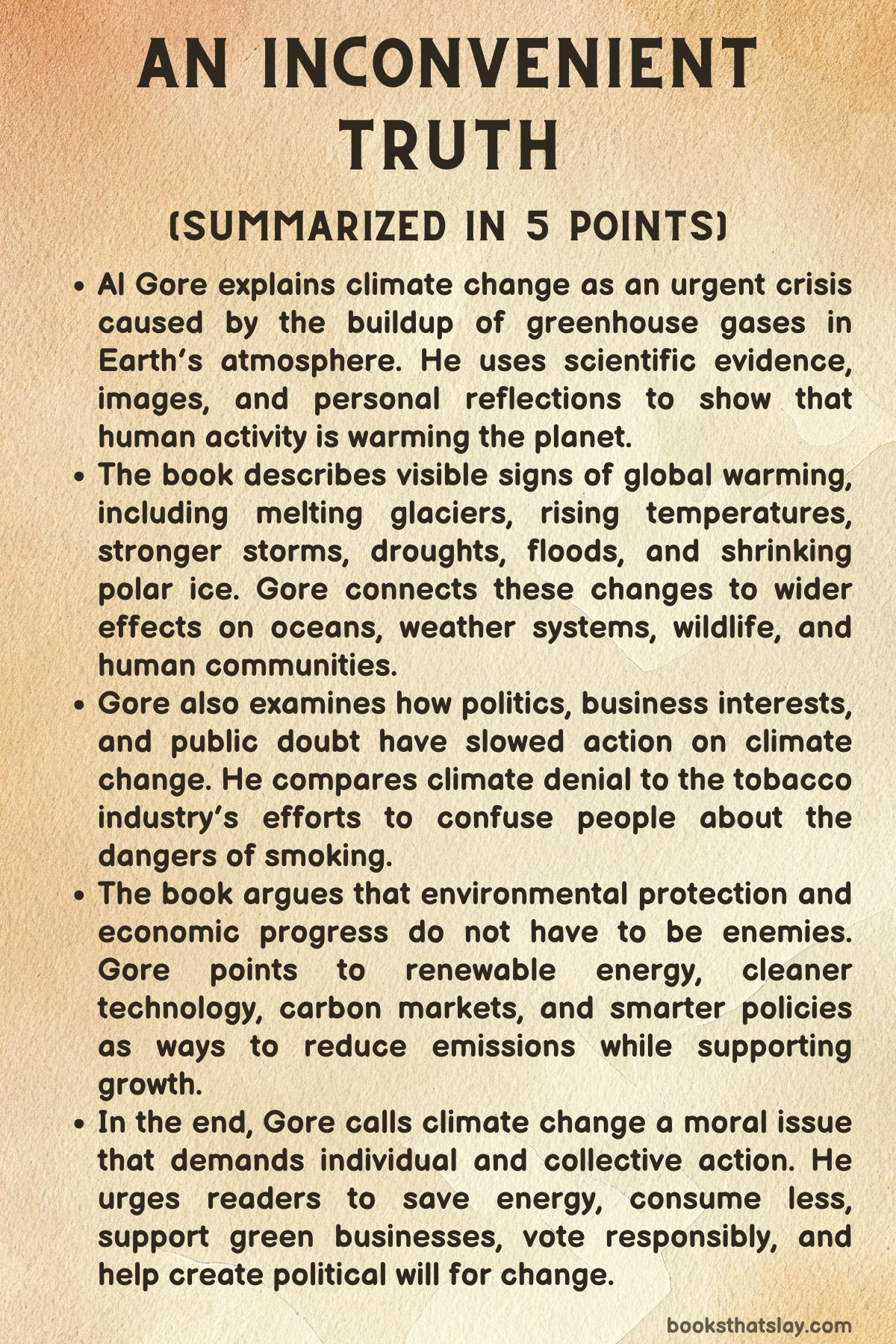
An Inconvenient Truth: The Planetary Emergency of Global Warming and What We Can Do About It by Al Gore is a nonfiction book about the climate crisis, written as both an explanation and a call to action. Gore uses scientific evidence, photographs, charts, personal memories, and political argument to show how human activity is changing the planet’s climate.
The book explains greenhouse gases, rising temperatures, melting ice, stronger storms, species loss, sea-level rise, and the role of public policy. It also challenges the idea that environmental protection and economic growth must be enemies. Above all, the book argues that climate change is a moral issue, and that ordinary people, governments, and businesses still have the power to act.
Summary
An Inconvenient Truth opens with Al Gore presenting climate change as an urgent problem that demands attention, honesty, and action. He explains that his concern did not appear suddenly, but grew out of years of study, travel, political work, and personal reflection.
He sees global warming not only as a scientific subject but as a test of human responsibility. The book begins by asking readers to think beyond their own lives and consider what future generations will say about the choices being made now.
Gore starts with a basic explanation of Earth’s atmosphere and the greenhouse effect. Sunlight reaches Earth, warms the surface, and some of that heat is sent back toward space as infrared radiation.
The atmosphere naturally traps part of that heat, keeping Earth warm enough for life. The problem, Gore explains, is that human activity has added too many greenhouse gases to the atmosphere.
Carbon dioxide, methane, nitrous oxide, and other gases make the atmosphere hold more heat than it should. This extra trapped heat raises the planet’s average temperature and changes climate systems that have supported human civilization for thousands of years.
To show how scientists came to understand this problem, Gore discusses the work of Roger Revelle, a scientist who measured carbon dioxide in the atmosphere. Revelle’s research showed that carbon dioxide levels were rising steadily.
Gore studied under him at Harvard, and the experience changed the way he saw the planet. What had seemed like a distant scientific concern became, for Gore, a clear warning about Earth’s future.
He presents Revelle’s work as one of the foundations for modern climate science and as proof that the warning signs have been visible for decades.
The book then turns to visible evidence of warming. Gore describes glaciers shrinking across the world, from Africa and Alaska to South America, Europe, and Asia.
Places once known for permanent ice are losing it at a speed that can be seen in photographs taken over time. Scientists also study ice cores to understand past carbon dioxide levels and ancient temperatures.
These samples reveal that today’s rise in carbon dioxide and temperature is not ordinary. Gore uses this evidence to argue that the planet is moving outside the stable climate range in which human societies developed.
Alongside the science, Gore includes personal memories that explain why the issue matters to him. One major turning point was a serious accident involving his young son.
The experience forced him to reconsider what mattered most and deepened his sense of obligation to protect life, family, and the future. This personal element gives the book a wider purpose: climate change is not only about numbers and charts, but about the people and places that may be harmed if society fails to respond.
As Gore moves into rising temperatures, he points to record-breaking heat and warming oceans. He argues that warmer oceans help fuel stronger storms because higher water temperatures increase wind speed and moisture.
The book discusses hurricanes, typhoons, cyclones, tornadoes, floods, droughts, and fires as part of a broader pattern of climate disruption. Hurricane Katrina becomes a major example of how extreme weather can damage communities, economies, and public systems.
Gore also notes that insurance companies and risk experts have had to take climate-related disasters seriously because the financial losses are so large.
Climate change, Gore explains, does not simply make every place hotter in the same way. It shifts weather patterns.
Some regions receive too much rain, while others suffer from drought. The disappearance of Lake Chad becomes an example of how climate pressure can damage food supplies, create conflict, and worsen human suffering.
Gore also explains desertification, showing how warming can dry soil, reduce crop production, and increase the risk of wildfires. These changes are not isolated events; they are signs of a planet under stress.
The polar regions receive special attention because they react strongly to warming. Gore describes cracking ice shelves, melting tundra, thawing permafrost, and damage to infrastructure in cold regions.
The Arctic ice cap is shrinking, which threatens animals such as polar bears and alters global climate patterns. He explains that ice reflects sunlight, while darker ocean water absorbs more heat.
As ice disappears, warming accelerates. This feedback effect makes the Arctic one of the most important warning signs in the climate crisis.
Gore also discusses the role of ocean circulation. He describes a vast movement of ocean water that helps distribute heat around the planet.
If too much fresh water from melting ice enters the ocean, it could disrupt this system and change weather patterns in severe ways. The book connects these physical changes to the living world.
As seasons shift and habitats change, plants and animals struggle to survive. Some species move into new areas, while others decline because they cannot adapt quickly enough.
The book then focuses on threats to biodiversity. Gore explains that coral reefs are damaged by warmer ocean temperatures, causing coral bleaching.
He also describes ocean changes that contribute to dead zones, algae blooms, disease spread, and the return of illnesses once thought to be under control. In Antarctica, animals such as emperor penguins depend on sea ice for breeding and feeding.
As ice disappears, their survival becomes more uncertain. Gore uses these examples to show that climate change affects entire ecosystems, not just human communities.
Sea-level rise is one of the book’s strongest warnings. Gore explains that if major ice sheets in Greenland or Antarctica melt significantly, sea levels could rise enough to reshape coastlines around the world.
Low-lying islands, coastal cities, river deltas, and major population centers would be at risk. He names places such as Florida, San Francisco, the Netherlands, Beijing, Calcutta, Bangladesh, and Manhattan to make the danger concrete.
The message is clear: melting ice is not a remote polar issue; it can alter maps, economies, and lives across the globe.
Gore also examines why human civilization has become such a powerful force on Earth. Population growth is one factor.
More people means more pressure on land, forests, water, food, and energy. He discusses deforestation, including the contrast between Haiti and the Dominican Republic, and the destruction of the Amazon through burning and clearing.
Forests matter because they absorb carbon dioxide, support biodiversity, and regulate climate. Destroying them adds to the crisis.
Technology is another factor. Gore acknowledges that scientific and technological progress has improved life in many ways, from medicine to communication.
But he warns that technology also gives humanity the power to damage Earth on a vast scale. Nuclear weapons changed warfare, and modern industry has changed the planet’s surface, atmosphere, and water systems.
The shrinking of the Aral Sea becomes an example of how human decisions can transform entire landscapes.
Policy and economics are central to Gore’s argument. He compares carbon emissions from different countries and shows that wealthy industrial nations, especially the United States, have played a major role in creating the problem.
He also discusses market-based solutions such as carbon trading, where companies that reduce emissions can benefit financially while those that pollute more must pay. Gore wants readers to understand that climate policy is not only about sacrifice; it can also encourage innovation, efficiency, and cleaner industries.
A major part of the book deals with the way people think about climate change. Gore uses the image of a frog sitting in slowly heating water to describe society’s failure to react to gradual danger.
Because climate change unfolds over time, many people ignore it until the damage becomes obvious. He also compares climate denial to the tobacco industry’s long campaign to create doubt about the dangers of smoking.
His sister’s death from cancer gives this comparison personal force. For Gore, both cases show how powerful interests can delay action by confusing the public.
Gore argues that science and politics operate differently. Science accepts uncertainty as part of research, while politics often uses uncertainty as an excuse for inaction.
He says there is broad scientific agreement that global warming is real and caused by human activity, yet opponents have worked to make the public believe scientists are deeply divided. He criticizes political figures and lobbyists who cast doubt on climate science to protect economic interests.
Another false belief, Gore says, is that people must choose between the environment and the economy. He rejects this as a mistaken choice.
Cleaner energy, better efficiency, improved fuel standards, and responsible business practices can strengthen the economy while reducing harm to the planet. He praises wind power and other renewable technologies, arguing that the tools already exist.
What is missing is political will.
Near the end, Gore shifts from warning to encouragement. He reminds readers that societies have solved major problems before, including slavery, women’s voting rights, civil rights, fascism, the moon landing, and ozone depletion.
These achievements required courage, organization, and moral clarity. He presents climate change in the same way: as a moral challenge that can be met if people choose action over denial.
The final part offers practical steps. Gore urges readers to save energy at home, use efficient lighting, improve insulation, conserve hot water, drive less, buy cleaner vehicles, use public transportation, reduce air travel, recycle, consume less, buy durable goods, avoid unnecessary packaging, compost, carry reusable bottles and bags, eat less meat, buy local food, and offset carbon emissions.
He also asks readers to learn more, talk to others, support environmental organizations, influence schools and businesses, invest responsibly, and vote for leaders who take the climate crisis seriously.
The book ends with the belief that individual action and collective action are connected. Gore does not claim that one person can solve the crisis alone, but he insists that every person can help create social and political change.
The book is therefore both a warning and an appeal. It shows the damage caused by human choices, but it also argues that better choices are still possible.
Key Figures
Al Gore
Al Gore is the central voice and guiding presence of An Inconvenient Truth. As the author, narrator, public servant, and climate advocate, he functions like the main figure through whom the book’s argument is shaped.
Gore presents himself as someone who has been changed by science, personal loss, public responsibility, and direct observation of environmental damage. His character is built around urgency, but also around faith in human action.
He does not describe climate change as a problem that only scientists or politicians can solve; he treats it as a moral responsibility shared by citizens, businesses, and governments. His personal memories, including his childhood experiences in Tennessee, his son’s accident, his sister’s death, and his political career, make him more than a lecturer presenting facts.
He appears as someone trying to connect public evidence with private conviction. His strongest quality in the book is persistence.
Even when he discusses denial, political delay, and corporate resistance, he continues to believe that people can change course. This makes Gore both the messenger and the emotional anchor of the book.
Roger Revelle
Roger Revelle is one of the most important scientific figures in the book because he represents the foundation of Gore’s understanding of climate change. As Gore’s professor at Harvard, Revelle becomes a mentor whose work opens Gore’s eyes to the seriousness of rising carbon dioxide levels.
He is presented as intellectually brilliant, careful, and ahead of his time. Revelle’s measurements of carbon dioxide in the atmosphere give the book one of its central scientific bases, because they show a clear rise over time rather than a vague or temporary fluctuation.
His role is also symbolic. He stands for the value of science when it is patient, disciplined, and willing to warn society before disaster becomes unavoidable.
Gore treats Revelle with deep respect, suggesting that his teacher’s importance lies not only in gathering data but in helping others understand what that data means. In that sense, Revelle becomes a figure of wisdom.
He shows that knowledge can carry moral weight when it reveals danger and gives people time to respond.
Gore’s Son
Gore’s son has a brief but powerful role in the book. His accident becomes one of the personal moments that reshapes Gore’s priorities and deepens his sense of responsibility.
The child is not developed through dialogue or independent action, but his presence affects the emotional structure of the work. Through him, Gore confronts how fragile life can be and how quickly a person’s sense of purpose can change.
The accident forces Gore to look beyond ambition, routine, and public duty in a narrow sense. It makes him think more seriously about what is worth protecting.
His son therefore becomes connected to the book’s larger concern with future generations. Climate change is not presented only as a scientific crisis affecting landscapes and weather systems; it is also shown as a threat to children who will inherit the consequences of present choices.
Gore’s son represents vulnerability, love, and the future. His recovery brings gratitude, but the experience also leaves Gore with a stronger obligation to defend what is precious.
Gore’s Sister
Gore’s sister is one of the most personal and tragic figures in the book. Her story is connected to smoking, illness, and the danger of industries that hide or distort the truth for profit.
Gore remembers her with affection, describing her as a strong supporter in his life and political career. Her death from cancer gives the book a personal example of how denial can become deadly when powerful institutions encourage confusion.
Through her, Gore draws a comparison between the tobacco industry and climate change denial. In both cases, he argues, evidence was available, but public understanding was delayed by people with financial interests.
His sister’s role is therefore emotional and argumentative at the same time. She is not included only to gain sympathy; her story strengthens the book’s warning about the cost of ignoring science.
Her life and death help Gore show that misinformation is not abstract. It affects families, bodies, decisions, and futures.
She represents the human cost of delayed truth.
Lonnie Thompson
Lonnie Thompson appears as a scientist whose work helps reveal Earth’s climate history. His study of glacier samples gives the book evidence about past levels of carbon dioxide and temperature.
Thompson’s role is important because he connects the present crisis to the deep past. By studying ice, he helps show that current warming is not simply part of a normal cycle.
He represents field science: physical, demanding, and grounded in direct contact with the natural world. His work also gives the book a sense of scale.
Climate change becomes something that can be measured not only through recent weather events, but through records preserved inside glaciers over long periods of time. Thompson’s character is defined by discipline and seriousness.
He is not presented as a political figure but as someone whose research carries political importance because it challenges comfortable assumptions. In the book, he stands for the kind of evidence that cannot easily be dismissed: evidence taken from the planet itself.
Phillip Cooney
Phillip Cooney is presented as a figure connected to political obstruction and the manipulation of public understanding. Gore discusses him in relation to efforts during the Bush-Cheney administration to cast doubt on climate change.
Cooney’s role in the book is not sympathetic. He represents the way political and corporate interests can interfere with scientific communication.
Unlike the scientists in the book, whose authority comes from research and evidence, Cooney’s importance comes from his influence over messaging. He becomes an example of how language can be used to slow action, blur certainty, and protect existing systems.
His character is significant because Gore’s argument is not only that climate change exists; it is also that people in power have worked to prevent the public from grasping its seriousness. Cooney therefore functions as a symbol of institutional resistance.
In An Inconvenient Truth, he helps Gore show that the climate crisis is also a crisis of truth, trust, and political courage.
Sir David King
Sir David King appears as a scientific authority whose warning about sea-level rise gives the book a strong sense of consequence. Gore uses King’s statement about the need to redraw world maps if major ice sheets melt to emphasize the scale of possible change.
King’s role is brief but significant because he gives outside authority to one of Gore’s most alarming claims: that the climate crisis can physically reshape the human world. He represents the global scientific community and the seriousness with which climate change is viewed beyond American politics.
His presence also helps move the book away from being only Gore’s personal argument. By including figures like King, Gore shows that concern about warming, melting ice, and rising seas is shared by respected experts across nations.
King stands for sober warning. He is not presented as dramatic for its own sake; rather, his words matter because they translate scientific risk into a clear image of human vulnerability.
The Readers
The readers become active figures in the book because Gore repeatedly addresses them as people capable of making choices. They are not treated as passive receivers of information.
Instead, they are asked to examine their habits, question political messages, reduce energy use, influence businesses and schools, vote carefully, and speak to others. This gives the audience a role inside the book’s moral structure.
Gore’s argument depends on the idea that ordinary people are not powerless. Readers are shown as consumers, citizens, family members, and future ancestors whose decisions matter.
Their character, in a sense, is unfinished. Gore presents them at a crossroads: they can ignore the evidence, accept excuses, and continue harmful habits, or they can become catalysts for change.
This makes the reader one of the most important presences in An Inconvenient Truth, because the book’s purpose is not complete unless its audience acts.
Themes
Climate Change as a Moral Responsibility
Climate change is treated not only as a scientific or environmental issue, but as a test of human conscience. Gore repeatedly asks readers to think about what present choices will mean for future generations.
The damage caused by rising temperatures, melting glaciers, stronger storms, droughts, floods, species loss, and sea-level rise is not presented as an unfortunate accident. It is shown as the result of human behavior, political delay, and avoidable waste.
That framing makes responsibility central to the book. People cannot claim innocence once the evidence is clear.
Gore’s personal stories strengthen this theme because they connect public action to private love, grief, family, and duty. His son’s accident makes him reflect on what must be protected, while his sister’s death shows how denial can destroy lives.
The climate crisis becomes a moral issue because it asks whether people will defend life when the warning signs are visible. An Inconvenient Truth argues that knowledge creates obligation: once society understands the danger, inaction becomes a choice with consequences.
The Conflict Between Science and Political Denial
Scientific evidence in the book is steady, cumulative, and clear, yet political systems often respond with hesitation or distortion. Gore shows this conflict by explaining how researchers measured carbon dioxide, studied glaciers, tracked warming oceans, and observed changes in ice, storms, and ecosystems.
Against that evidence, he places political resistance, special interests, and public confusion. The problem is not that scientists have failed to warn society; it is that their warnings have been softened, challenged, or buried by people who benefit from delay.
Gore’s comparison with the tobacco industry is especially important here. Just as cigarette companies created doubt despite evidence of harm, opponents of climate action use uncertainty as a weapon.
The book shows that uncertainty in science does not mean ignorance. It means careful measurement, testing, and revision.
Politics, however, can misuse uncertainty to avoid hard decisions. This theme reveals one of Gore’s strongest concerns: environmental damage is made worse when truth itself becomes a political battleground.
The Fragility of the Natural World
The natural world in the book is vast and powerful, but also vulnerable to human pressure. Glaciers, oceans, forests, coral reefs, polar ice, animals, rivers, and farmland all appear as parts of a connected planetary system.
Gore shows that when one part changes, others are affected. Melting Arctic ice changes the reflection of sunlight and speeds warming.
Warmer oceans strengthen storms and damage coral reefs. Deforestation reduces Earth’s ability to absorb carbon dioxide.
Thawing permafrost damages land and infrastructure. Drying soil harms agriculture and increases fires.
This theme matters because it challenges the idea that nature is too large for humans to affect. Gore argues the opposite: modern civilization has become powerful enough to alter the atmosphere, reshape landscapes, drain seas, and threaten entire species.
At the same time, the book suggests that humans depend completely on the systems they are damaging. The natural world is not separate from human life.
Its decline returns as hunger, disease, displacement, economic loss, and insecurity.
Hope Through Action and Innovation
Even though the book describes severe dangers, it does not end in despair. Gore insists that solutions already exist and that people have the ability to reduce harm.
Energy efficiency, cleaner vehicles, renewable power, better insulation, recycling, reduced consumption, local food, political participation, and responsible business decisions are all presented as practical steps. The theme of hope is grounded in action rather than wishful thinking.
Gore does not suggest that optimism alone will solve the crisis. Instead, he argues that political will, public pressure, and technological innovation can change the direction of society.
His examples from history reinforce this belief. Movements against slavery, struggles for voting rights and civil rights, the fight against fascism, the moon landing, and the repair of the ozone layer all show that people can meet huge challenges when they accept responsibility.
Hope in the book is therefore active, not passive. It asks people to change habits, challenge misinformation, support better policy, and believe that collective effort can still protect the future.